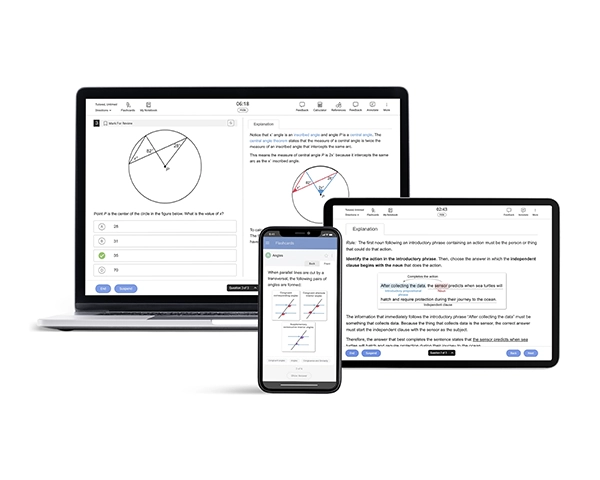
Superscoring refers to selecting your best section scores from multiple test dates to get a new final score. The final SAT® score ranges from 400-1600 and is the sum of the Reading and Writing (RW) and Math section scores. Each section of the SAT is scored on a scale of 200-800.
Let’s understand superscoring with an example. You take the SAT twice. In your first attempt, you score a 500 on RW and a 600 on Math, for a final score of 1100. In your second attempt, you score a 600 on RW and a 500 on Math, which again totals 1100. However, when a college uses a superscore approach, it may consider your best section results across test dates, in this case, 600 on RW and 600 on Math, giving you a new final score of 1200.
List of Colleges That Superscore the SAT
You will find that many US universities and colleges use SAT superscore policies. Here, we have put together a list of top colleges that superscore the SAT for the 2026–2027 cycle to help you with college admissions.
| College/University | State | College/University | State |
|---|---|---|---|
| Amherst College | MA | Auburn University at Montgomery | AL |
| Babson College | MA | Bellarmine University | KY |
| Baylor University | TX | Beloit College | WI |
| Boston College | MA | Bentley University | MA |
| Bowdoin College | ME | Boston University | MA |
| Bucknell University | PA | Claremont McKenna College | CA |
| Coastal Carolina University | SC | Connecticut College | CT |
| College of Wooster | OH | Creighton University | NE |
| Columbia University | NY | Denison University | OH |
| Cornell College | IA | Drexel University | PA |
| Fordham University | NY | Georgia Institute of Technology | GA |
| Franklin & Marshall College | PA | Gonzaga University | WA |
| Goucher College | MD | Hamilton College | NY |
| Grinnell College | IA | Hofstra University | NY |
| Hobart and William Smith Colleges | NY | Illinois Institute of Technology | IL |
| Kean University | NJ | Kenyon College | OH |
| Lebanon Valley College | PA | Lehigh University | PA |
| Loyola University of Chicago | IL | Marquette University | WI |
| Massachusetts Institute of Technology | MA | Mercer University | GA |
| Miami University | OH | New York University | NY |
| Niagara University | NY | Ohio Dominican University | OH |
| North Carolina State University | NC | Randolph-Macon College | VA |
| Northwestern University | IL | Rice University | TX |
| Occidental College | CA | Roger Williams University | RI |
| Scripps College | CA | Santa Clara University | CA |
| St. Olaf College | MN | Spelman College | GA |
| Stockton University | NJ | Stanford University | CA |
| Swarthmore College | PA | Texas Christian University | TX |
| Tufts University | MA | The University of the South | TN |
| Union College (NY) | NY | Union College (KY) | KY |
| University of Arkansas--Fayetteville | AR | United States Military Academy | NY |
| University of Dayton | OH | University of Central Arkansas | AR |
| University of Florida | FL | University of La Verne | CA |
| University of Georgia | GA | University of Maryland, Baltimore County | MD |
| University of Portland | OR | University of Massachusetts-Amherst | MA |
| University of Rhode Island | RI | University of Michigan--Ann Arbor | MI |
| University of Rochester | NY | University of North Florida | FL |
| University of San Francisco | CA | University of Oklahoma | OK |
| University of Tennessee at Martin | TN | University of Pennsylvania | PA |
| University of Tulsa | OK | University of Tennessee- Knoxville | TN |
| Ursuline College | OH | Valparaiso University | IN |
| Vanderbilt University | TN | Wabash College | IN |
| Vassar College | NY | West Virginia University | WV |
| Wesleyan University | CT | Western Michigan University | MI |
| Whitworth University | WA | Whitman College | WA |
| Winthrop University | SC |
Why Do Colleges Superscore?
While submitting your admission application to colleges, you might be wondering why some colleges accept SAT superscores. Here are a few reasons:
- It helps colleges maintain their reputation
Colleges that superscore the SAT are able to report higher test score averages across all admitted students. This helps in maintaining their reputation.
- The majority of students take the SAT at least twice
Colleges are aware that many students take the SAT twice or more in order to prepare for college admissions. Research shows that students improve in at least one section when they retake the test.
- A single test result is not a reliable measure of your academic potential.
There are a lot of factors that influence your test performance: your level of preparation, your sleeping and eating schedule before the test, and any personal issues that may affect your concentration on the test.
For guided section-focused prep, you can explore the SAT Course.
Colleges that Superscore SAT: (FAQs)
Which colleges don't superscore SAT and why?
Not all colleges superscore. Some schools want to see how you performed in one complete test sitting, so they use your best total score from a single test date instead of mixing sections from different dates. For example, the University of Illinois Urbana-Champaign says it does not use the highest subscores from different sittings to create a superscore. Some colleges also tell students not to recompute scores on their own. Mount Holyoke College, for instance, says not to superscore or recalculate scores and to send scores exactly as received.
Do public/state universities superscore the SAT?
Some do, and some do not. Public universities often set testing rules at the campus or system level, so 2 schools in the same state can have different SAT score policies. One campus may accept an SAT superscore, while another may review only your best single sitting. This matters when you are comparing target majors or deciding whether to retake the test based on your current SAT scores. Before you send any score reports, confirm the policy for the exact campus listed on your application. If the admissions website is unclear, email the school and ask how they evaluate multiple SAT test dates.
How to confirm a college’s superscore policy?
Start on the college’s official admissions testing page and look for wording like “superscore,” “highest section scores,” or “highest scores across test dates.” If the policy mentions combining your best Math and Reading, and Writing scores, that usually means the school superscores. If the language is unclear, check the freshman admissions FAQ and the testing section in the applicant portal, since many schools explain score reporting in those places. You can also search the page for terms like “Score Choice,” “testing policy,” or “standardized testing,” because superscoring details are sometimes listed under those headings. It helps to understand how the SAT exam is structured, since colleges often describe policies using section names and test dates. If you still cannot confirm the rule, email the admissions office with a simple question asking whether they combine section scores from different dates or only consider the best single sitting.
If a college superscores, should I send all SAT attempts?
Follow the school’s instructions. If you have one date with your highest Math score and another date with your highest Reading and Writing score, those are typically the sittings that matter most for superscoring schools. Some colleges want you to report all test dates, and they calculate the SAT superscore themselves, so do not try to combine sections on your own unless the policy tells you to. Before retesting, students often use a timed SAT Practice Test to confirm whether they are realistically tracking toward a higher section score, then sharpen weak areas with targeted sets from an SAT QBank and concept review supported by SAT Prep Books. If your practice trend shows only minor improvement, it may be smarter to stop retesting and focus on other parts of the application.
Does superscoring affect scholarships or honors programs?
Sometimes. A college may use your superscore for admission review, but scholarships or honors programs may follow different rules. For example, a scholarship committee might look at your best single test date, require official score reports, or use a separate score cutoff that is not based on superscoring. Some programs also have earlier deadlines, so waiting for another test date could affect eligibility. To avoid surprises, check both the scholarship page and the honors program requirements, not just the main admissions testing policy. If anything is unclear, email the college and ask whether they use a superscore or a single sitting when making scholarship or honors decisions.
References
- Freshman Application Review. (n.d.). admissions.illinois.edu. Retrieved from https://www.admissions.illinois.edu/apply/freshman/review
- Standardized Testing Policies. (n.d.). mtholyoke.edu. Retrieved from https://www.mtholyoke.edu/admission/apply-undergraduate-first-year/standardized-testing-policie
- What’s an SAT Superscore?. (2024). collegeboard.org. Retrieved from https://blog.collegeboard.org/what-is-an-sat-superscore
- First-Year Applicants. (n.d.). amherst.edu. Retrieved from https://www.amherst.edu/admission/apply/firstyear
- How to Apply. (n.d.). aum.edu. Retrieved from https://www.aum.edu/apply/
- Evaluation Criteria. (n.d.). babson.edu. Retrieved from https://www.babson.edu/undergraduate/admission/how-to-apply/evaluation-criteria/
- Admissions Requirements. (n.d.). bellarmine.edu. Retrieved from https://www.bellarmine.edu/admissions/requirements/
- Test-Optional Process. (n.d.). baylor.edu. Retrieved from https://admissions.web.baylor.edu/admission/incoming-freshman/test-optional-process
- International Applicants Requirements. (n.d.). beloit.edu. Retrieved from https://www.beloit.edu/admission/apply/international-applicants/requirements/
- Apply. (n.d.). bc.edu. Retrieved from https://www.bc.edu/content/bc-web/admission/apply.html
- First-Year Applicant. (n.d.). bentley.edu. Retrieved from https://www.bentley.edu/undergraduate/apply/first-year-applicant
- Test-Optional Policy. (n.d.). bowdoin.edu. Retrieved from https://www.bowdoin.edu/admissions/our-process/test-optional-policy/index.html
- Apply as a First-Year Student. (n.d.). bu.edu. Retrieved from https://www.bu.edu/admissions/apply/first-year/
- Undergraduate Admission Requirements. (n.d.). bucknell.edu. Retrieved from https://www.bucknell.edu/admissions-aid/apply-bucknell/undergraduate-admission-requirements
- First-Year Application Instructions. (n.d.). cmc.edu. Retrieved from https://www.cmc.edu/admission/first-year-application-instructions
- Freshman Admissions. (n.d.). coastal.edu. Retrieved from https://www.coastal.edu/admissions/freshman/
- Standardized Test Policy. (n.d.). conncoll.edu. Retrieved from https://www.conncoll.edu/admission/apply/standardized-test-policy/
- Test-Optional Policy. (n.d.). wooster.edu. Retrieved from https://wooster.edu/admissions/apply/test-optional-policy/
- Admissions Requirements (Undergrad Transfer). (n.d.). creighton.edu. Retrieved from https://www.creighton.edu/admissions/admissions-requirements/undergrad-transfer
- Testing. (n.d.). columbia.edu. Retrieved from https://undergrad.admissions.columbia.edu/apply/process/testing
- Test-Optional Policy. (n.d.). denison.edu. Retrieved from https://denison.edu/forms/test-optional-policy
- Standardized Testing Policy. (n.d.). cornell.edu. Retrieved from https://admissions.cornell.edu/policies/standardized-testing-policy
- Standardized Tests. (n.d.). drexel.edu. Retrieved from https://drexel.edu/admissions/apply/undergrad-instructions/first-year-instructions/standardized-tests
- Testing Policy. (n.d.). fordham.edu. Retrieved from https://www.fordham.edu/undergraduate-admission/apply/what-were-looking-for/testing-policy/
- Standardized Tests. (n.d.). gatech.edu. Retrieved from https://admission.gatech.edu/first-year/standardized-tests
- Apply. (n.d.). fandm.edu. Retrieved from https://www.fandm.edu/apply/index.html
- Test-Optional FAQs. (n.d.). gonzaga.edu. Retrieved from https://www.gonzaga.edu/undergraduate-admission/apply/admission-requirements/test-optional-faqs
- Test-Optional Policy. (n.d.). goucher.edu. Retrieved from https://www.goucher.edu/become/apply/admissions-requirements/our-test-optional-policy
- Testing. (n.d.). hamilton.edu. Retrieved from https://www.hamilton.edu/admission/apply/testing
- Requirements. (n.d.). grinnell.edu. Retrieved from https://www.grinnell.edu/admission/apply/first-year/requirements
- Standardized Testing Policy. (n.d.). hofstra.edu. Retrieved from https://www.hofstra.edu/admission/standardized-testing-policy.html
- Testing Policy. (n.d.). hws.edu. Retrieved from https://www.hws.edu/admissions/apply/testing-policy.aspx
- First-Year Students. (n.d.). iit.edu. Retrieved from https://www.iit.edu/admissions-aid/undergraduate-admission/first-year-students
- Freshman Application Instructions. (n.d.). kean.edu. Retrieved from https://www.kean.edu/offices/admissions-0/freshman-application-instructions
- Standardized Testing Policy. (n.d.). kenyon.edu. Retrieved from https://www.kenyon.edu/admissions-aid/apply-to-kenyon/standardized-testing-policy/
- Test-Optional. (n.d.). lvc.edu. Retrieved from https://www.lvc.edu/admission-aid/undergraduate/test-optional/
- Admissions Requirements. (n.d.). lehigh.edu. Retrieved from https://www1.lehigh.edu/admissions/admissions-requirements
- Freshman Apply. (n.d.). luc.edu. Retrieved from https://www.luc.edu/undergrad/apply/freshman/
- Application Scores. (n.d.). marquette.edu. Retrieved from https://www.marquette.edu/explore/application-scores.php
- Tests and Scores. (n.d.). mitadmissions.org. Retrieved from https://mitadmissions.org/apply/firstyear/tests-scores/
- First-Year Admissions. (n.d.). mercer.edu. Retrieved from https://undergrad.mercer.edu/first-year-admissions/
- Test-Optional FAQs. (n.d.). miamioh.edu. Retrieved from https://miamioh.edu/admission-aid/apply/first-year-students/test-optional-faqs.html
- Standardized Tests. (n.d.). nyu.edu. Retrieved from https://www.nyu.edu/admissions/undergraduate-admissions/how-to-apply/standardized-tests.html
- Admissions Policies. (n.d.). niagara.edu. Retrieved from https://www.niagara.edu/admissions-policies/
- Admission Requirements. (n.d.). ohiodominican.edu. Retrieved from https://www.ohiodominican.edu/admissions/undergraduate/how-to-apply/admission-requirements.html
- Test Score Consideration in Admission Decisions. (n.d.). ncsu.edu. Retrieved from https://admissions.ncsu.edu/apply/first-year/test-score-consideration-in-admission-decisions/
- How to Apply. (n.d.). rmc.edu. Retrieved from https://www.rmc.edu/admissions-and-aid/how-to-apply/
- Standardized Testing Policy FAQs. (n.d.). northwestern.edu. Retrieved from https://admissions.northwestern.edu/faqs/standardized-testing-policy/
- Apply: First-Year Domestic Applicants. (n.d.). rice.edu. Retrieved from https://admission.rice.edu/apply/first-year-domestic-applicants
- Test-Optional Admission Policy. (n.d.). oxy.edu. Retrieved from https://www.oxy.edu/admission-aid/apply/test-optional-admission-policy
- Standardized Test Optional Policy. (n.d.). rwu.edu. Retrieved from https://www.rwu.edu/undergraduate/admission-aid/first-year-applicants/standardized-test-optional-policy
- Test Optional. (n.d.). scu.edu. Retrieved from https://www.scu.edu/admission/undergraduate/first-year-students/test-optional/
- First-Year Applicants. (n.d.). scrippscollege.edu. Retrieved from https://www.scrippscollege.edu/admission/apply/first-year-applicants
- Test-Optional Admissions Policy. (n.d.). spelman.edu. Retrieved from https://www.spelman.edu/admissions/applying-to-spelman/test-optional-admissions-policy.html
- Test-Optional. (n.d.). stolaf.edu. Retrieved from https://wp.stolaf.edu/admissions/test-optional/
- Testing. (n.d.). stanford.edu. Retrieved from https://admission.stanford.edu/apply/first-year/testing.html
- Standardized Test Scores. (n.d.). stockton.edu. Retrieved from https://stockton.edu/admissions/standardtestscores.html
- Testing Policy: SAT and ACT. (n.d.). tcu.edu. Retrieved from https://admissions.tcu.edu/apply/first-year/testing-policy-sat-act.php
- Standardized Testing Policy. (n.d.). swarthmore.edu. Retrieved from https://www.swarthmore.edu/admissions-aid/standardized-testing-policy
- Application Review. (n.d.). sewanee.edu. Retrieved from https://new.sewanee.edu/admission-aid/application-process/application-review/
- SAT and ACT Tests. (n.d.). tufts.edu. Retrieved from https://admissions.tufts.edu/apply/first-year-students/sat-and-act-tests/
- Test Policy. (n.d.). union.edu. Retrieved from https://www.union.edu/admissions/apply/test-policy
- Steps to Admission. (n.d.). westpoint.edu. Retrieved from https://www.westpoint.edu/admissions/steps-to-admission
- Test Scores and Applying. (n.d.). uark.edu. Retrieved from https://admissions.uark.edu/apply/test-scores-and-applying.php
- Freshman Apply. (n.d.). uca.edu. Retrieved from https://uca.edu/admissions/apply/freshman/
- Test-Optional. (n.d.). udayton.edu. Retrieved from https://udayton.edu/apply/undergraduate/test-optional.php
- Test-Optional Policy. (n.d.). laverne.edu. Retrieved from https://laverne.edu/admission/traditional-undergraduate/test-optional-policy/
- Freshman Requirements. (n.d.). admissions.ufl.edu. Retrieved from https://admissions.ufl.edu/apply/freshman/requirements
- Freshman Application FAQs. (n.d.). umd.edu. Retrieved from https://admissions.umd.edu/apply/freshman-application-faqs
- Test-Optional Policy. (n.d.). umass.edu. Retrieved from https://www.umass.edu/admissions/undergraduate-admissions/connect/information-policies/test-optional-policy
- First-Year Admission Criteria. (n.d.). admissions.uga.edu. Retrieved from https://www.admissions.uga.edu/admissions/first-year/first-year-admission-criteria/
- Application Changes. (n.d.). umich.edu. Retrieved from https://admissions.umich.edu/apply/first-year-applicants/requirements-deadlines/application-changes
- SAT or ACT. (n.d.). up.edu. Retrieved from https://www.up.edu/admissions/faqs/application-questions/sat-or-act.html
- First-Year Admission. (n.d.). uri.edu. Retrieved from https://web.uri.edu/admission/first-year/
- First-Time-in-College. (n.d.). unf.edu. Retrieved from https://www.unf.edu/catalog/admissions/undergrad/First-Time-in-College.html
- Testing Policies. (n.d.). rochester.edu. Retrieved from https://admissions.rochester.edu/applying/testing-policies/
- OU Is Test Optional. (n.d.). ou.edu. Retrieved from https://www.ou.edu/admissions/apply/freshman/requirements-factors/ou-is-test-optional
- First-Year. (n.d.). usfca.edu. Retrieved from https://www.usfca.edu/admission/undergraduate/first-year
- Testing. (n.d.). upenn.edu. Retrieved from https://admissions.upenn.edu/how-to-apply/what-penn-looks-for/testing
- Catalog. (n.d.). utm.edu. Retrieved from https://catalog.utm.edu/content.php
- Test Score Policy. (n.d.). utk.edu. Retrieved from https://admissions.utk.edu/undergraduate-application/test-score-policy/
- Test-Optional FAQ. (n.d.). utulsa.edu. Retrieved from https://utulsa.edu/admissions/apply/first-year-domestic-students/faq-test-optional/
- SAT and ACT Testing Policy. (n.d.). valpo.edu. Retrieved from https://www.valpo.edu/admission/undergraduate/process/
- How to Apply. (n.d.). ursuline.edu. Retrieved from https://www.ursuline.edu/admission/undergraduate-admission/how-to-apply
- Admissions Requirements. (n.d.). wabash.edu. Retrieved from https://bulletin.wabash.edu/admissions/requirements/
- Testing Policies. (n.d.). vanderbilt.edu. Retrieved from https://admissions.vanderbilt.edu/apply/testing-policies/
- Admission Requirements. (n.d.). wvu.edu. Retrieved from https://admissions.wvu.edu/how-to-apply/first-time-freshmen/admission-requirements
- Requirements. (n.d.). vassar.edu. Retrieved from https://www.vassar.edu/admission/apply/requirements/
- Apply Process. (n.d.). wmich.edu. Retrieved from https://wmich.edu/apply/process
- Standardize Test. (n.d.). wesleyan.edu. Retrieved from https://www.wesleyan.edu/admission/apply/standardize-test.html
- Testing Policy. (n.d.). whitman.edu. Retrieved from https://www.whitman.edu/admission-and-aid/applying-to-whitman/testing-policy
- Admissions. (n.d.). whitworth.edu. Retrieved from http://catalog.whitworth.edu/admissions/
- Freshman Application Process. (n.d.). winthrop.edu. Retrieved from https://www.winthrop.edu/admissions/freshman-application-process.aspx