As a high school student, the pressure to excel and build your future can be overwhelming. The quest for the perfect 800 on your digital SAT® Math can feel like an uphill battle. But here’s the secret: with the right strategies, a touch of dedication, and a dash of smart work, you can achieve this remarkable feat.
So, are you ready to embark on a journey to unlock your full potential and achieve an astonishing 800 on the Digital SAT Math section? In this article, we’ll delve into the intricacies of the Digital SAT Math section, providing you with a comprehensive roadmap to success and equipping you with expert digital SAT math tips and proven strategies to make that 800 your reality.
Why Aim for an 800 on Digital SAT Math?
Scoring high on the digital SAT Math section is more than just a numerical achievement–it opens doors to a world of opportunities. When it comes to college admissions, an 800 on the math section can be a game-changer, showcasing your excellence in a core subject and readiness for the academic rigors of higher education. It sends a strong signal to admissions officers that you’re not just academically capable but also committed to excelling in your studies. A perfect math score can also make you a prime candidate for getting merit-based scholarships offered by many institutions.
Achieving a perfect score on the digital SAT Math section also demonstrates your dedication, discipline, and ability to perform under pressure. This accomplishment can boost your confidence in math as well as other areas of the digital SAT. With a solid foundation in math, you may find it easier to tackle the reading and writing sections, even if they are not your strongest suits. Moreover, the problem-solving abilities and management skills you develop while preparing for an 800 can lead to increased success in other standardized tests, coursework, and even real-world challenges.
What Does It Take to Get an 800 in Digital SAT Math?
Achieving an 800 on the digital SAT Math section demands determination, dedication, and consistent practice. The road to an 800 begins with self-belief. You must have confidence in your own capabilities and trust that your hard work will pay off. No doubt you’ll come across complex problems, encounter moments of doubt, and face various obstacles, but there is nothing that is unconquerable.
Consistency is key. Dedicate time each day to practice, review, and refine your skills. Seek guidance when needed. Don’t be afraid to ask questions or seek help from teachers, tutors, or online resources. Also, remember that mistakes are opportunities to learn and grow. Embrace them, analyze them, and use them to become better. With the right mindset and the willingness to put in the work, the perfect score is within your grasp.
Strategies on How to Get 800 on Digital SAT Math
Now that we’ve discussed the determination and mindset required to chase the 800 in Digital SAT Math, it’s time to look into the specific strategies and techniques that will lead you to success. Remember, this journey is not just about mastering math; it’s about mastering the art of tackling the math section effectively. Let’s explore how to get 800 on digital SAT Math:
Master every Digital SAT Math topic and skill
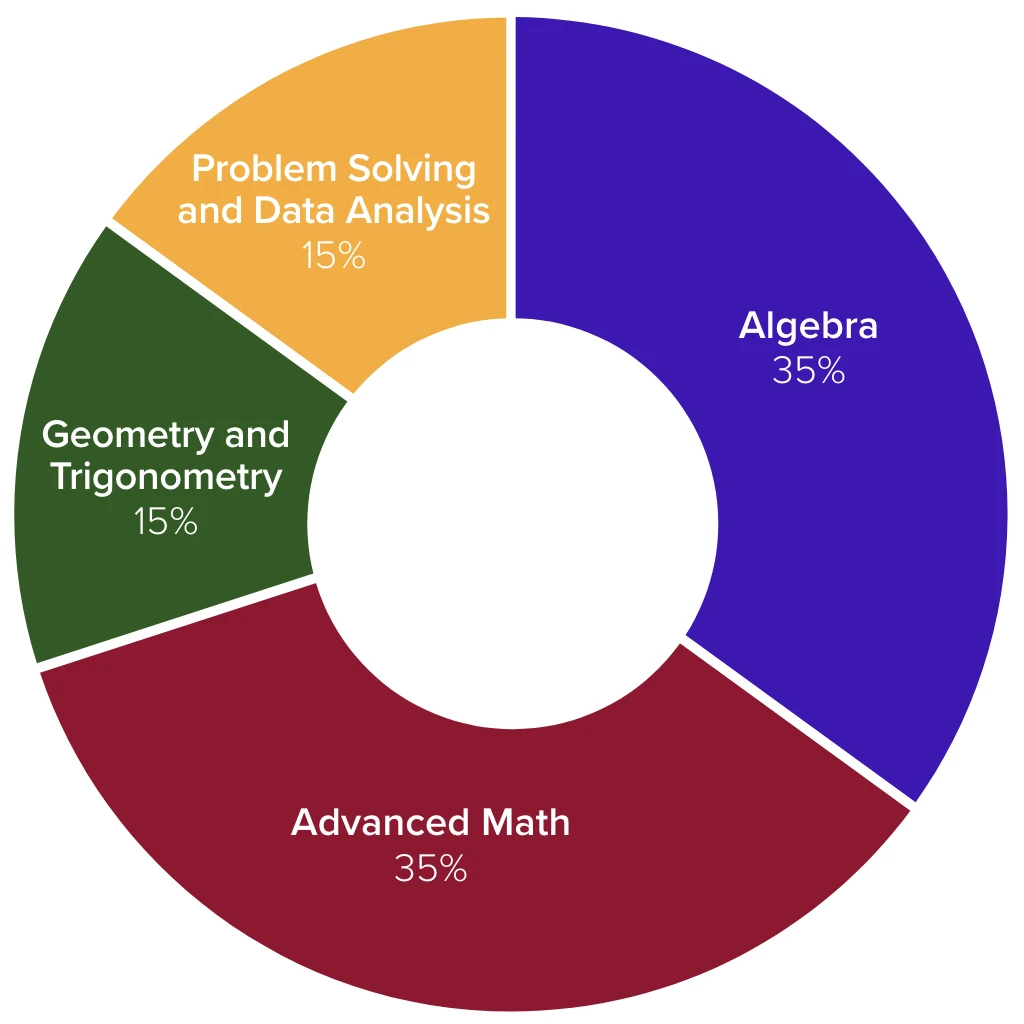
Mastering every math concept covered in the Digital SAT Math section requires a systematic and focused approach. Familiarize yourself with the structure of the math section, which outlines the percentage of topics covered in this section. This will help you prioritize your study efforts.
To kick start your preparation, take diagnostic tests to identify your strengths and weaknesses. Create a structured study plan that covers all the topics and allocate more time to areas where you need improvement. Break your plan into manageable daily or weekly goals. Also, make sure that you use reputable SAT prep materials like UWorld’s SAT Math practice test or textbooks to study theory and concepts thoroughly.
Save time: the calculator is your “frenemy”
The Digital SAT Math section is split into two equal parts, each lasting 35 minutes and containing 22 questions. Thus, time management is crucial on the Digital SAT. By using the calculator judiciously, you can complete the math section with time to spare.
- Do not rely on the calculator for every question. Many problems on the math section can be solved more quickly and efficiently without it. Practice doing simple calculations in your head or on paper.
- Familiarize yourself with the Desmos calculator embedded in the test to save valuable time during the test. The more proficient you become with Desmos, the less time you’ll waste navigating its features during the test.
In addition to calculator usage, practice overall time management skills. As you work through the test, prioritize questions. If you are stuck at a particularly challenging problem, move on and return to it later. Try not to spend more than 1 minute per question. This will help you complete the math section with time to spare for reviewing and double-checking your answers at the end.
Memorize Digital SAT Math formulas
Memorizing essential Digital SAT Math formulas can significantly boost your score and test-taking efficiency. First and foremost, it can save you precious time during the test. Instead of searching for formulas provided in the reference material, you can quickly recall and apply the necessary formulas shaving off time on more straightforward questions. Additionally, when you know the formulas by heart, you’re less likely to make calculation errors that can cost you valuable points.
It’s essential to practice applying the formulas to ensure you recognize the scenarios when to use them. This includes understanding which solution is best to address a problem and the step-by-step process to apply these formulas strategically.
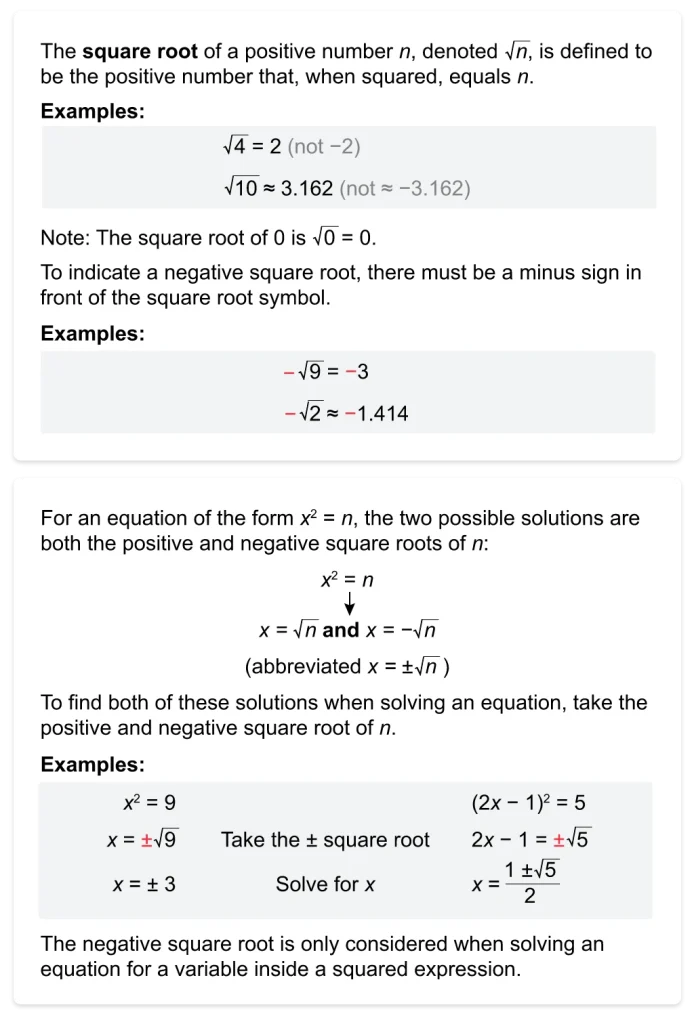
Example: Understanding Square Roots and Variable Solving
The square root of a number always refers to its positive square root. This rule applies whenever you take the square root of a number. (E.g., square root of 9 is 3, even though -3*-3 = 9).
However, many students get confused because there’s a separate, more commonly used, rule for variables: if x2 is equal to some number, then x is equal to the positive and negative square root of that number. (E.g., if x2 = 9, x could be either 3 or -3).
In this case, students often get confused because, in their minds, they’re taking the square root in that second case, so they don’t get why the square root of 9 is 3 sometimes but +/-3 other times. Here, understanding the concept clarifies that the square root function is its own rule, and solving for a variable is a related, but still separate, process.
Identify growth opportunities
Success on the Digital SAT Math section is not just about getting questions right; it’s about a deeper understanding of mathematical concepts. So, it is very important to embrace a growth mindset while you are preparing for the test. It is natural to feel discouraged if you get stuck or encounter frequent failures, but you should view these errors as stepping stones to success. In Digital SAT Math, mistakes are an integral part of the learning process. When you analyze and learn from your errors, you’re actively engaging in skill development.
Here’s how you can make the most of your mistakes:
- Identify patterns and keep an error log: Look for recurring errors or patterns in your mistakes. Check if there is a specific type of problem that consistently trips you up. Maintain a record of your mistakes, including the question type, the specific error, and the correct solution. This log can serve as a valuable resource for targeted practice. If you’re using the UWorld Digital SAT QBank, you can do this easily by referring to the performance dashboard which tracks this information as you progress through questions.
- Practice retention: Using tools like flashcards, highlighting, and note-taking help you quickly review concepts between practice sessions. Revisit your mistakes periodically to ensure you retain the lessons learned. Regularly reviewing and reinforcing your understanding is key to long-term improvement.
- Ask for help: Don’t hesitate to seek help from teachers or peers if you’re struggling with a particular concept. Sometimes, an external perspective can clarify misconceptions.
Practice, practice, practice!
When it comes to mastering the Digital SAT Math section, the age-old saying stands true: practice makes perfect. By consistently and strategically practicing with the right materials, you’ll build the skills and confidence needed to conquer the math section.
Here are a few Digital SAT math tips to help you with your practice:
- If you miss a question, read the explanation then try it again: This can be an excellent way to reinforce your understanding and test your ability to learn from mistakes. If you miss it again, make a flashcard so you can review this concept before trying similar practice questions. This approach encourages active problem-solving and retention.
- Using the calculator effectively: Ensure you have a good understanding of graphing calculator functions, particularly if you intend to utilize the integrated Desmos calculator during the Digital SAT. Practice its effective use to avoid encountering challenges with unfamiliar calculator functions during the exam. For more tips on calculator usage, read our blog on Practicing Digitally Using the Built-In Calculator.
- Use relevant practice resources: Download the College Board’s BluebookTM app and take the free practice Digital SAT exam they offer to get a baseline understanding of how well you understand the math topics covered. In addition to this, consider using reputable Digital SAT Math study resources like UWorld’s Digital SAT practice test that offers hundreds of exam-like practice questions and detailed answer explanations. Using a combination of these resources provide you with a comprehensive and well-rounded preparation experience.
Stay Calm, Confident, and Manage Test Stress
Maintaining a sense of calm and confidence while preparing for the Digital SAT Math section is essential for optimal performance. By staying composed and focused, you’ll be better equipped to tackle the test with confidence and achieve your desired score.
Try these techniques to remain calm and focused:
- Deep breathing: Take slow, deep breaths which fill your diaphragm (“belly breaths”) to calm your vagus nerve and clear your mind. This will help you stay centered and focused on the task at hand.
- Positive self-talk: Self-assurance can boost both your confidence and your score. Quiet any negative thoughts by repeating positive affirmations in your mind or out loud, such as “I am prepared.” Remind yourself that you crushed Digital SAT math in your practice sessions and you know this material.
- Stay hydrated and energized: Dehydration and blood sugar crashes caused by hunger can affect your concentration. Make sure to drink water and eat a small, energy-boosting snack rich in protein during breaks.
For more in-depth strategies on overcoming test anxiety and managing stress, we recommend reading our comprehensive article on How to Deal with Test Anxiety.
Conclusion
In the journey to achieve a perfect score of 800 on the Digital SAT Math section, the overarching theme is clear: work smart and work hard, and you can achieve amazing things. If you’re reading this, you’re already taking the first step toward achieving your Digital SAT Math goals. Now is the time to begin your preparation journey. Remember that every practice question, every review session, and every moment spent honing your skills bring you one step closer to your target score.
As you embark on this path, keep in mind that getting a perfect score is not just about being perfect; it’s about staying focused, motivated, and confident. Believe in your abilities and embrace mistakes as opportunities for growth. So, Start your preparation today, armed with the knowledge and strategies you’ve gained from this blog and trust that achieving that 800 is well within your reach.

References
- How To Get 800 On SAT Math. (n.d.). Learnfromblogs.com. Retrieved October 5, 2023, from https://learnfromblogs.com/how-to-get-800-on-sat-math
- How To Get 800 On SAT Math. (December 28, 2021). Prepexpert.com. Retrieved October 5, 2023, from https://prepexpert.com/how-to-get-800-on-sat-math/
- How To Get A Perfect Score Of 800 On SAT Math?. (n.d.). Effortlessmath.com. Retrieved October 5, 2023, from https://www.effortlessmath.com/blog/how-to-get-a-perfect-score-of-800-on-sat-math/
- How to Get 800 on SAT Math. (September 6, 2022). Targettestprep.com. Retrieved October 6, 2023, from https://sat.blog.targettestprep.com/how-to-get-800-on-sat-math/
- Here’s What You Need to Know About the Digital SAT Math Section. (n.d.). Testinnovators.com. Retrieved October 6, 2023, from https://testinnovators.com/blog/digital-sat-math-section/
- What to Know About the Digital SAT. (January 26, 2023). Road2college.com. Retrieved October 9, 2023, from https://www.road2college.com/what-to-know-about-the-digital-sat/
- Tips to CRUSH the Digital SAT Math Section. (June 29, 2023). Tychr.com. Retrieved October 9, 2023, from https://tychr.com/tips-to-crush-the-digital-sat-math-section/