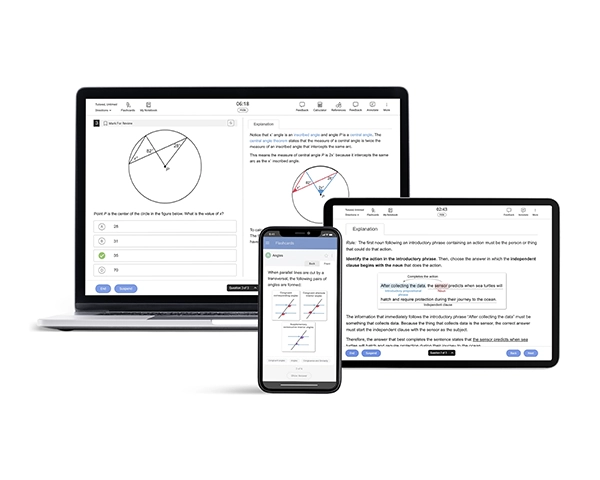
A robust vocabulary is indispensable for excelling in the Digital SAT® Reading and Writing section. This section tests your ability to comprehend and analyze short passages that are under 150 words covering a variety of subjects, including literature, history, and social sciences. The passages contain vocabulary words students are likely to encounter in college and career reading, which could be challenging if you are unfamiliar with them. Building a strong vocabulary facilitates quicker and more accurate reading comprehension of the passages, which is crucial for achieving success in this section.
If you are stressed about Digital SAT vocab prep, then we’re here to help! We’ve curated a list of the top 100 vocabulary words specifically chosen for their frequency in SAT® reading passages, ensuring you invest your time where it matters most. This Digital SAT vocabulary list also aligns with the updated Reading and Writing section of the Digital SAT, so keep it handy when you’re prepping for the digital test format. We’ve also explained how context clues, prefixes, and suffixes can help students infer the meaning of unfamiliar terms.
Understanding Vocabulary in the Digital SAT Reading and Writing Section
The Digital SAT Reading and Writing short passages are chosen to evaluate student comprehension and analytical skills. We’ve classified general SAT vocabulary tips into a few categories based on the types and frequency of words you may see on the test. Understanding these groups can help you understand what kinds of words may appear on the test and how to decipher the meaning of any words that are unfamiliar.
Common SAT vocabulary
Most Digital SAT reading and writing passages include a typical selection of vocabulary words you’ll frequently encounter regardless of their subject areas. These words are flexible, as they can function in various contexts, conveying distinct meanings in each. Words like “delegate,” “foil,” “spike,” “stream,” and “bank” are a few examples of common SAT vocabulary that you should expect to see throughout the Digital SAT’s reading and writing passages.Subject-specific vocabulary
The Digital SAT Reading and Writing section includes passages from various subject areas and materials, such as academic journals, historical documents, or literary works. These passages incorporate technical and advanced vocabulary specific to their respective disciplines. Let’s look at a couple of examples below:
Example
Passage:
Although leprosy typically develops after a 5-year incubation period, it can take as long as 20 years to show symptoms. The disease’s impact is also progressive, meaning the symptoms get worse over time. Although curable, if left untreated, its later stages can be marked by large skin ulcerations, paralysis of the hands and feet, and facial disfigurement.
The passage above was selected from a medical case study on Leprosy. As you can see, words like “incubation” and “ulcerations” belong to the subject area from which the passage was chosen. To get familiar with advanced and specialized vocabulary, you should read texts from various subject areas and sources where these words are commonly used.
Context clues
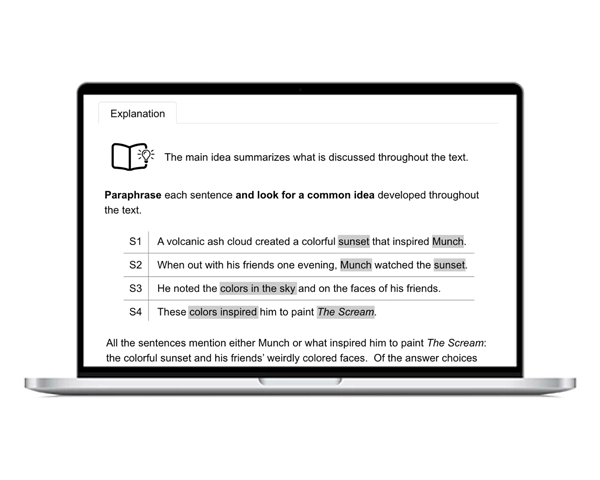
The Digital SAT emphasizes understanding words in context, discerning meaning from the passage, and being able to use context clues. Context clues are an efficient way to decipher the meanings of unfamiliar words. As you read each of the passages on the Digital SAT, you must analyze their tone, structure, discipline, and writing style to determine the meaning of any tricky words. You may also see passages with footnotes or annotations that provide further context. Use these context clues to understand the overall purpose of the passage and the sentences within it. Once you’ve done that, the only thing left is to note any words you’re struggling with and guess their meaning. Let’s try with one example below:
Example
Passage:
Brain research suggests that new memories go through a period where the memory is likely to change (a labile state) before becoming a lasting (consolidated) memory. Scientists previously believed that—once consolidated—a memory became resistant to change, but recent findings have strongly established that a consolidated memory can re-enter a labile state through a process called memory reactivation, a deliberate recalling of a long-term memory.
Many students can find the word “labile” difficult to understand. But, as you can analyze from the passage above, “a labile state” has been used as an antonym for “consolidated” memory. If you already know the meaning of “consolidate” (something solid and whole), you can guess that it is the opposite of something that is not “solid.” In the context of brain and memory, this word can refer to something dynamic and unstable. Therefore, even if you do not know the exact dictionary meaning of “labile,” you can still guess it.
Prefixes, Suffixes, and Roots
Using word parts like prefixes and suffixes can provide clues about the meaning of a word, even if you have never encountered it before. Here’s how:- Prefixes:
Prefixes always occur before the root of a word. For example, in the word “uncommon,” “un” is a prefix. Some common prefixes are: - “un-” (not)
- “re-” (again)
- “pre-” (before)
- “dis-” (not, opposite of)
- “Con-” (with)”post-” (after)
- Suffixes:
As opposed to prefixes, suffixes come after the root word. For example, “recital” uses the suffix “-al” after the root word “recite.” There are a few common suffixes used in standard English grammar, among others: - “-acy” (state or quality)
- “-al” (act or process)
- “-dom” (place or state of being)
- “-ism” (belief system)
- “-ity” (quality of something)
- “-ment” (condition of something)
- Roots:
Roots are the core building blocks that make up words and often carry each word’s primary meaning. Some common roots include: - “Ambi” (both)
- “Aqua” (water)
- “Bio-” (life)
- “Multi” (many)
- “Port-” (carry)
- “Form” (shape)
A thorough knowledge of standard English prefixes can help you understand unfamiliar words easily! For example, if you come across the term “conjoin” and are unsure of its meaning, remove the root word “join.” Now, if you use your knowledge of the prefix “con-,” which means “with,” you will understand that the word “conjoin” means “to join with,” which further points to describing a thing or things that are joined together.
So, next time you encounter words like delicacy (delicate + acy), judgment (judge + ment), or endorsement (endorse + ment), be sure to memorize the list of suffixes and their meanings. Doing so will help you decipher the meaning of many tricky words.
You may encounter words like “conform,” “aquatic,” “multifarious,” and “portable,” which consist of root words. Use what you know to navigate the core meaning of any unfamiliar word, along with context clues to crack open the meaning of any tricky word you may encounter on your Digital SAT test.
Top 100 Common Digital SAT Vocabulary Words You Need to Know
Simple ways to build up your vocabulary before your Digital SAT test date
This “Digital SAT vocabulary list” includes words students will likely encounter on other college preparatory exams and later as they pursue their academic and career journey. Students can also benefit from building a robust vocabulary by reading widely and critically, encountering diverse texts, and practicing with Digital SAT-style questions to understand how words function in context. When you encounter words that are unfamiliar to you, look up the definition and make a note of this information. Creating flashcards can help you test your ability to recall the meaning of unfamiliar words.
Conclusion
Remember that a strong vocabulary could not only accelerate your comprehension of passages but also enhance your accuracy in answering questions. Our Top 100 Vocabulary Words list has been curated to align with the specific requirements of the Digital SAT in 2024. By investing your time in learning these frequently encountered words, you are strategically positioning yourself for improved performance.
As you delve into your Digital SAT vocabulary preparation, don’t forget to leverage essential strategies such as utilizing context clues, prefixes, and suffixes to decipher the meaning of unfamiliar terms.
References
(2022, Summer). The Digital SAT® Suite of Assessments Specifications Overview. College Board. https://satsuite.collegeboard.org/media/pdf/digital-sat-test-spec-overview.pdf