AP® Physics 1 Unit 5 Review and Practice Test
AP® Physics 1 Unit 5 introduces torque, rotational dynamics, and the relationships that govern how objects rotate. These ideas can feel abstract, but the right tools make them easier to understand and apply. UWorld helps you master AP Physics 1 Unit 5 topics, such as torque and rotational motion, so you walk into the exam with clarity and confidence.
Pass the Exam Confidently with Our AP Physics 1 Unit 5 Review
Unit 5 becomes much easier when your learning tools actively build your intuition. Short videos simplify complex concepts, interactive study guides strengthen understanding, and practice reinforces the logic behind torque and rotational motion AP Physics 1 questions. Everything works together to support your review from start to finish.
Simplify Torque and Rotation with Easy, Guided Videos
Torque clicks fast when you can watch it happen. These short lessons, built into UWorld, show how a force creates a turn and how that turn changes with the lever arm and the angle of the push. Each video wraps with a quick AP style check that trains you to set up torque equations cleanly, track clockwise and counterclockwise signs, and explain why an object rotates the way it does.
Deepen Your Understanding with Smart, Interactive Study Guide
This study guide breaks down AP Physics 1 Unit 5: Torque and Rotational Dynamics into clear, visual, and step-by-step explanations. Interactive checkpoints help you understand why torque increases with lever arm distance, how rotational inertia affects motion, and how angular momentum fits into the bigger picture. These guides help you prepare for AP Physics 1 Torque MCQs and FRQs with clear logic. Everything supports a deeper understanding instead of surface-level memorization.
Score Higher with Our AP Physics 1 Unit 5 Practice Test Questions
Question
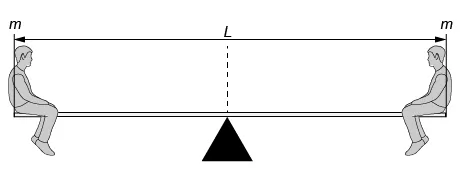
Two students each of mass sit on opposite ends of a balanced seesaw of negligible mass and length with the fulcrum located at the center, as shown in the figure above. One additional student of mass joins the student on the right end of the seesaw. How far and in what direction should the fulcrum be moved from center to balance the set of three students?
| A. to the left | |
| B. to the right | |
| C. to the right | |
| D. The fulcrum should remain at the center |
Explanation
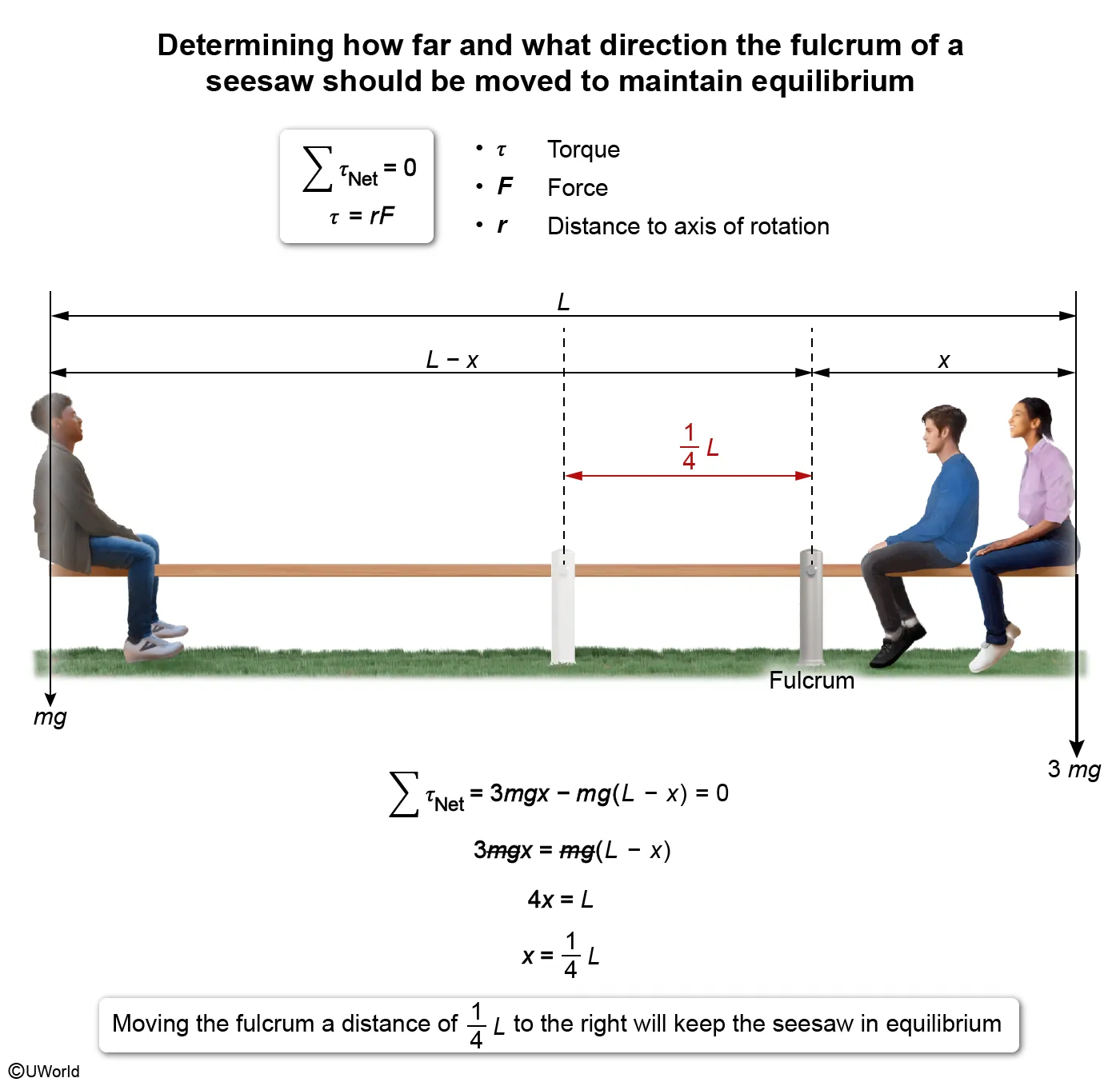
An object is in rotational equilibrium when the net external torque about any axis is zero:
In this question, two students each of mass sit on opposite ends of a balanced seesaw of negligible mass and length with the fulcrum located at the center. An additional student of mass then sits on the right side of the seesaw. The weight of each student causes a torque on the seesaw equal to the product of their respective weight and the distance to the fulcrum, :
The distance to the fulcrum for the two students sitting on the right end of the seesaw can be defined as , giving the distance to the fulcrum for the student sitting on the left end as . Thus, the net torque equation for the seesaw can be expressed as:
Solving for the distance x yields:
Therefore, to maintain equilibrium the fulcrum should be moved from the center of the seesaw to the right by a distance of .
(Choice A) to the left follows from incorrectly applying the direction of each torque supplied on the seesaw.
(Choice C) to the right follows from incorrectly solving for the distance to the fulcrum.
(Choice D) Keeping the fulcrum at the center incorrectly assumes that increasing torque in one direction will not cause the seesaw to rotate.
Things to remember:
When an object is in rotational equilibrium, the sum of all torques acting on the object is equal to zero.
Question
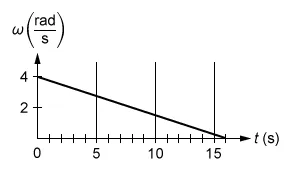
The figure above shows the angular speed of one wheel on a toy car as a function of time. The toy car is wound up and released at time t= 0 s . At t= 16.0 s , the toy car comes to a stop after traveling 2.00 m . What is the radius of the wheel of the toy car?
| A. 0.0313 m | |
| B. 0.0625 m | |
| C. 0.125 m | |
| D. 0.250 m |
Explanation
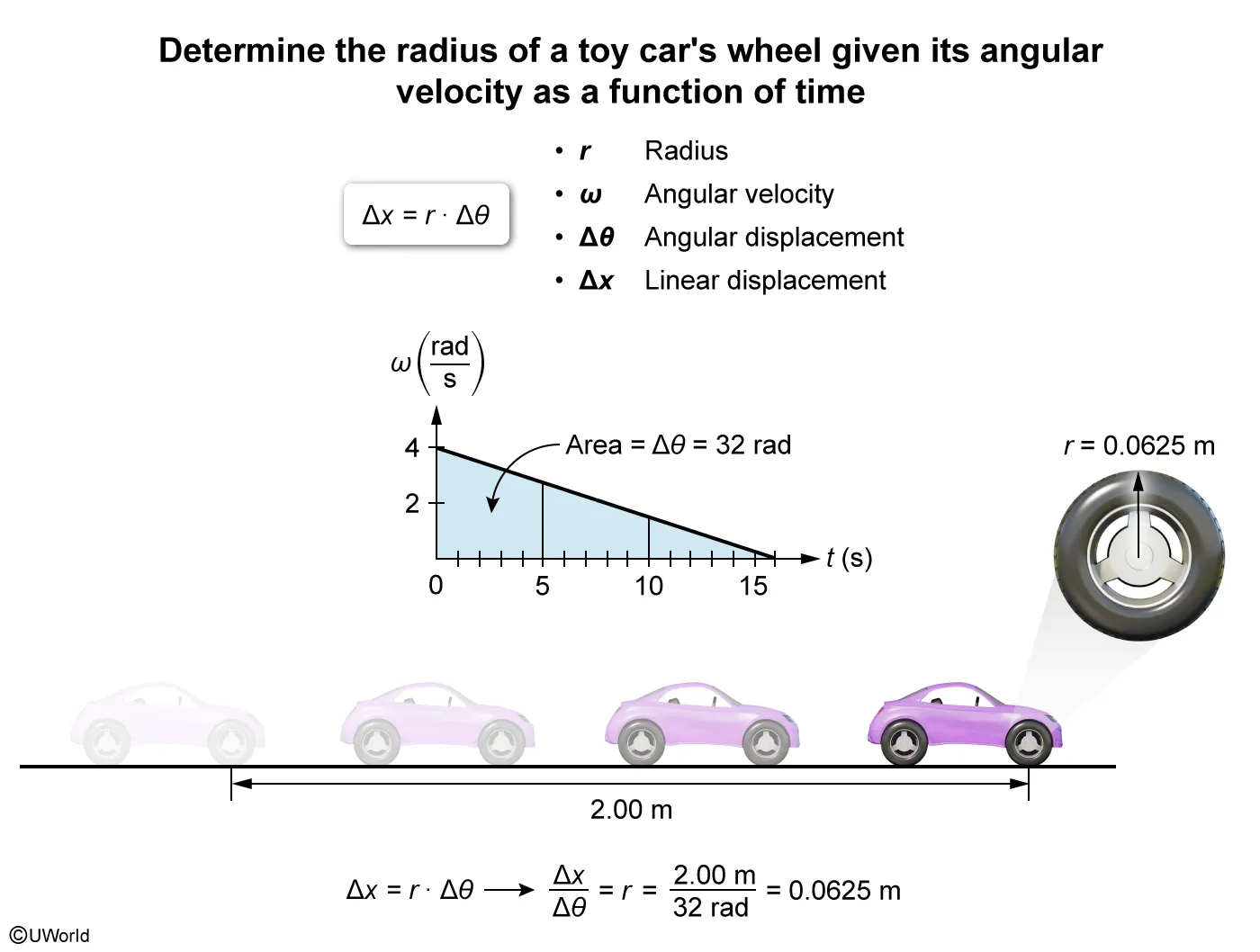
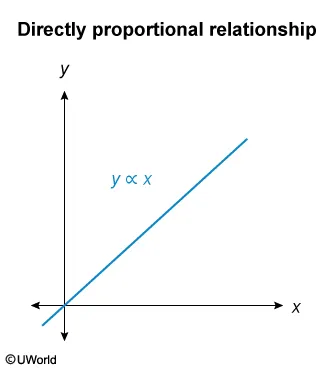
The linear displacement Δx of a point on a rotating object is directly proportional to both the point's distance r from the rotational axis of the object and the angular displacement Δθ of the object:
Furthermore, the angular speed ω is the rate of change of Δθ over an interval Δt:
In this question, the angular speed of a wheel on a toy car is plotted as a function of time. The toy car is released with an initial angular speed of and travels a total distance of 2.00 m in 16.0 s before slowing to a stop.
The total angular displacement of the wheel of the car can be calculated by finding the area under the graph of ω vs. time. For the triangular region, the area is half the product of the base and the height:
Hence, the wheel has 32.0 rad of total angular displacement. The radius of a wheel is equal to the ratio of the linear displacement of the car and the angular displacement of the wheel:
(Choice A) 0.0313 m follows from incorrectly calculating the area under the graph (ie, the angular displacement).
(Choice C) 0.125 m follows from incorrectly solving for the radius by using the initial angular speed instead of the linear distance traveled.
(Choice D) 0.250 m follows from calculating the slope of the graph (ie, the angular acceleration).
Things to remember:
The angular displacement of an object is proportional to the distance to the axis of rotation (ie, the radius).
Question
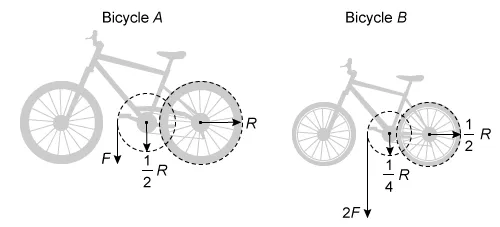
Starting from rest, two students push the pedals on bicycles A and B with the downward forces and at the instant shown in the diagram above. The bicycles are designed in such a way that when the pedals make 1 full revolution, the back wheel makes 5 complete rotations. Which of the following compares the torque each student exerts on the pedals and the linear distance traveled for each bicycle?
| A. | |
| B. | |
| C. | |
| D. |
Explanation
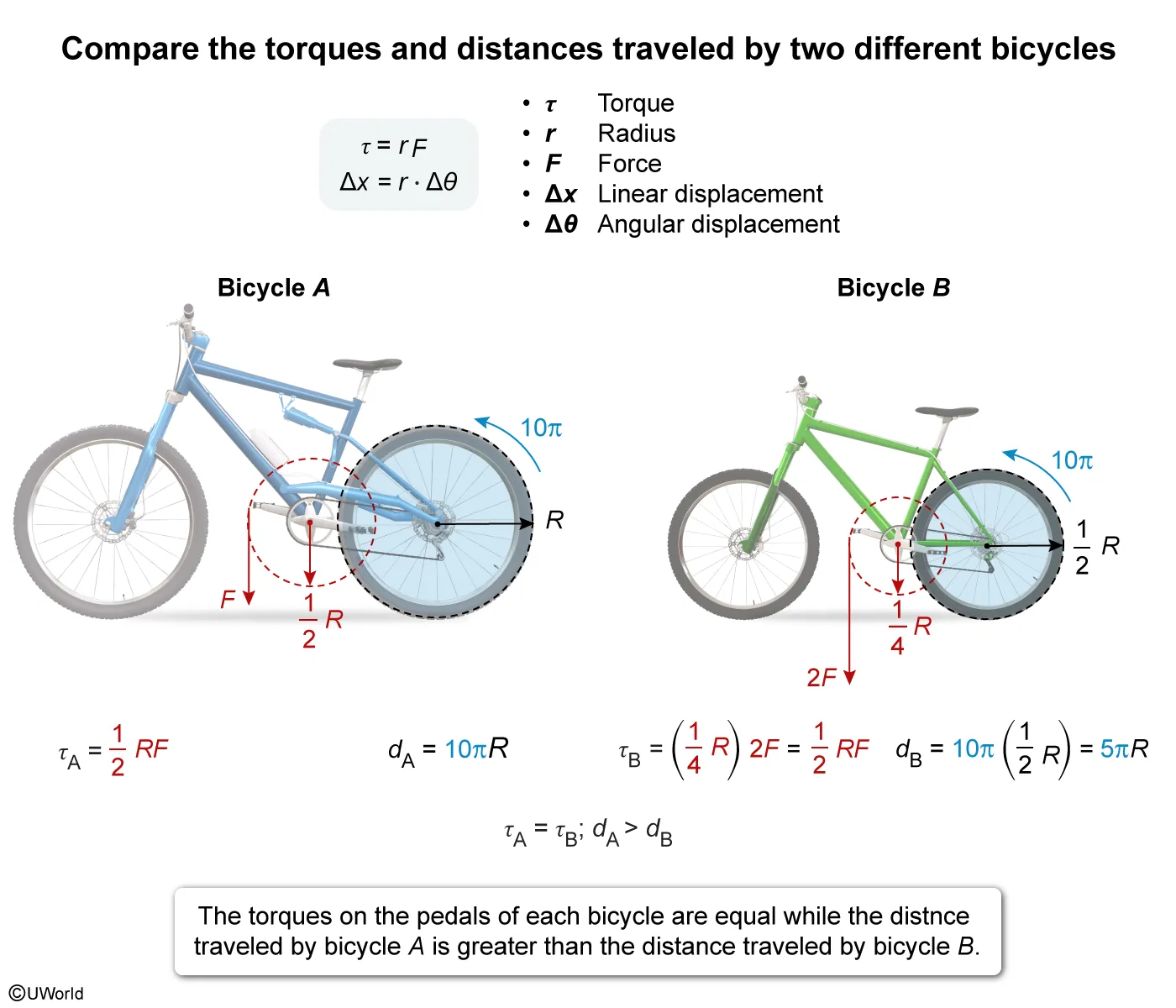
The linear displacement d of the point on a rotating object is directly proportional to both the point's distance r from the rotational axis of the object (or the rotational axis of the system) and the angular displacement of the object Δθ:
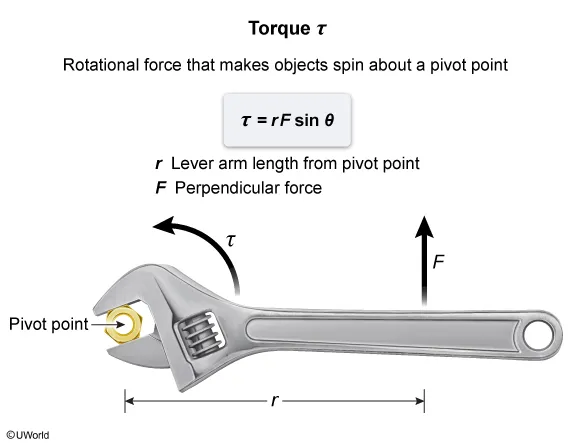
In addition, torque is the ability of a force to rotate an object and can be expressed as the product of the perpendicular lever arm and the applied force:
In this question, two students push the pedals on two different bicycles starting from rest. Bicycle A receives a force on its pedals with radius and back wheel radius . Bicycle B receives a force on its pedals with radius and back wheel radius . The torques and exerted on bicycles A and B are the product of the forces and the radial values:
Hence, the two applied torques are equal:
The angular displacement of the bicycle wheels is found by converting the number of rotations (or revolutions) into radians. After 5 revolutions, the back wheel experiences an angular displacement of 10π radians:
Substituting this value into the above formula for linear displacement yields:
Therefore, the linear distance bicycle A travels is greater than the linear distance bicycle B travels:
(Choice A) This option incorrectly compares the torques exerted on the pedals using equal downward forces F.
(Choice B) This option incorrectly assumes that since the torque exerted on the pedals is the same, the linear distances d will be equal.
(Choice D) This option incorrectly compares the torques exerted on the pedals using equal downward forces F and assumes that the linear distance will be greater for the back wheel with the smaller radius.
Things to remember:
Torque is equal to the product of the distance to the axis of rotation and the perpendicular component of the force applied. Linear displacement is equal to the product of the radius and the angular displacement.

Study Torque and Rotation On the Go
Use short moments anywhere to practice AP Physics 1 Unit 5 torque problems, rewatch videos, or review explanations. The UWorld app lets you study between classes, during commutes, or whenever you have a few free minutes. Each tool works together, so every quick session builds toward a stronger understanding of rotational motion and exam readiness.
Stand Out
with a Top Score in AP Physics 1
Finish your AP Physics 1 Unit 5 review and continue mastering all units with UWorld. Boost your performance and make yourself a standout candidate for competitive colleges, majors, and scholarships by mastering your AP Physics 1 course and scoring a 5 on the exam.
Get our all-in-one course today!
- Focused AP Physics 1 Review Videos
- Print & Online AP Physics 1 Study Guide
- 450+ Physics 1 Exam-style Practice Questions
- Customizable Quiz Generator
- Adjustable Study Planner
- Realistic AP Physics 1 Exam Review
- Timed Test Simulation
- Progress Dashboard
- Smart Flashcards
- Digital Notebook
Hear From Our AP Students
UWorld’s service is pretty good and helps provide a lot of explanations on subjects I haven’t been confident on before.
The questions here are the most realistic to the AP tests I've seen so far! I appreciate the ability to customize tests as well.
The best part is that all options are well-explained, telling clearly why they are not the right option.

Frequently Asked Questions (FAQs)
What are the main topics covered in AP Physics 1 Unit 5:Torque and Rotational Dynamics?
AP Physics 1 Unit 5 focuses on torque, rotational dynamics, and the laws that govern how objects rotate around an axis. This unit can feel challenging because it shifts from linear motion to rotational analogs, which requires you to think in a new way about forces, acceleration, and equilibrium. Clear explanations and guided practice make these concepts easier to understand and apply. Using a review resource like UWorld helps because each question breaks down the reasoning behind torque and rotational motion relationships in AP Physics 1, providing a deeper understanding.
Core topics in Unit 5 include:
- Rotational kinematics
- Connecting linear and rotational motion
- Torque
- Rotational inertia
- Rotational equilibrium and Newton’s First Law in rotational form
- Newton’s Second Law in rotational form
When you understand how these pieces fit together, solving AP Physics 1 torque problems becomes much more predictable. You move from plugging numbers into formulas to understanding the logic behind rotational behavior. This makes it easier to approach the MCQs and FRQs with confidence. Good preparation combines clear concepts, structured examples, and practice that demonstrates why each step works.
How should I prepare for an AP Physics 1 Unit 5 exam?
Preparing for Unit 5 means building both conceptual understanding and problem-solving skills. Torque and rotation behave differently from linear forces, so your goal is to create a strong intuition rather than memorize formulas. Start by reviewing how torque depends on the direction of force and the distance of the lever arm, then connect these ideas to rotational inertia and angular acceleration. Using guided explanations from a tool like UWorld helps you understand why each step in a solution works, which strengthens your reasoning for AP Physics 1 torque and rotational motion MCQ questions.
A strong preparation strategy includes:
- Reviewing definitions of torque, rotational inertia, and angular acceleration
- Working examples that show how torque changes with angle and distance
- Drawing free-body diagrams for rotating systems
- Practicing rotational kinematics and energy problems
- Solving a mix of conceptual and numerical AP Physics 1 torque practice problems
- Reviewing explanations to understand common misconceptions
Once you combine conceptual clarity with steady practice, Unit 5 becomes far more manageable. You start to see patterns, such as how a heavier mass farther from the axis increases rotational inertia, or why equal forces produce different torques. These insights help you approach the exam with confidence and accuracy.
Are any free resources available for AP Physics 1 Unit 5?
Yes, several free resources can help you begin your AP Physics 1 Unit 5 review, and the most complete starting point is UWorld’s free 7-day trial. The trial provides you with access to videos, interactive study guides, and realistic AP Physics 1 torque and rotational motion practice problems, enabling you to study with structured explanations that break down each step. This support is invaluable for torque, which many students find difficult because it involves angles, lever arms, and the idea of rotational effectiveness.
Beyond UWorld, you can find supplementary videos, diagrams, and formula sheets online that explain the basics of rotational kinematics and the torque formula AP Physics 1 relationships. Textbook publishers sometimes provide free sample problems and summaries that align with classroom instruction. However, most free resources focus on giving you information rather than helping you understand the reasoning behind each step. That is why many students pair these free materials with UWorld’s explanations, which walk you through correct and incorrect answer choices and help you build the deeper intuition needed for success. This combination of classroom content, free reference material, and structured practice gives you a strong foundation for performing well on Unit 5 assessments.
What types of questions are on the AP Physics 1 Unit 5 test?
The AP Physics 1 Unit 5 test includes multiple-choice questions, free-response questions, and conceptual reasoning problems focused on torque, rotational inertia, angular acceleration, and energy in rotation. These questions require you to understand how rotational motion parallels linear motion. Instead of only applying formulas, you need to reason through lever arms, net torque, and the distribution of mass. Practicing with explanations, such as those offered in UWorld, helps you understand the logic behind each step and prepares you for AP Physics 1 torque and rotational motion MCQ items.
You will typically see:
- Multiple choice questions involving torque diagrams, rotational kinematics, or comparing rotational inertia
- Conceptual questions asking how mass distribution affects angular acceleration
- Numerical problems combining net torque and rotational kinematics formulas
- FRQs requiring diagrams, explanations, and step-by-step reasoning
- AP Classroom style progress check questions that emphasize conceptual understanding
Seeing these formats ahead of time helps you build confidence. You learn how the exam blends conceptual and computational tasks, and you understand which ideas are tested most frequently. As you work through guided practice, you begin to recognize patterns such as how torque depends on perpendicular force components or why a smaller moment of inertia leads to faster rotation. This preparation builds stronger instincts for both classroom tests and the AP exam.
How can I improve my score on the Free-Response Questions (FRQs) for Unit 5?
Improving your FRQ performance in Unit 5 comes down to expressing your reasoning clearly and selecting evidence that supports your explanation. FRQs often require diagrams, step-by-step logic, and careful interpretation of rotational relationships. Many students lose points because they skip conceptual reasoning and rely solely on equations. Begin by reviewing fundamental concepts, including net torque, rotational inertia, and angular acceleration. Using explanation-based practice from UWorld helps you see how to write clear reasoning for AP Physics 1 torque FRQs.
A strong FRQ strategy includes:
- Drawing clean diagrams showing forces, lever arms, and rotation direction
- Stating relationships such as τ = rF perpendicular before substituting numbers
- Explaining how mass distribution affects rotational inertia and acceleration
- Using words to connect your equations to the physics concept
- Practicing timed responses to improve clarity and pacing
Once you build these habits, FRQs feel more manageable. You begin describing not just what you are calculating but why it makes sense. This approach strengthens your ability to analyze new scenarios, which is essential because FRQs often present unfamiliar systems. With steady practice, you learn how to structure your responses clearly and support each step with strong reasoning.
What is the "Torque and Rotational Dynamics" unit's weight on the AP Physics 1 exam?
Unit 5 carries meaningful weight (10-15%) on the AP Physics 1 exam because torque, rotational dynamics, and rotational kinematics form a major skill set tested throughout multiple-choice questions and free-response items. Rotational motion is a core topic emphasized in both the course framework and the exam design. You can expect several multiple-choice questions involving torque, angular acceleration, or rotational inertia, along with at least one FRQ part requiring diagrams, reasoning, or conceptual analysis of rotating systems. These questions are designed to test your ability to connect forces, motion, and energy in a rotational context.
Rotational motion parallels earlier units on linear dynamics; a strong understanding of Unit 5 also enhances your performance in later units that involve angular momentum and energy. Many students find it helpful to practice with guided explanations, such as those from UWorld, to understand how the test evaluates reasoning rather than memorization. Recognizing which concepts matter most helps you focus your study time effectively and approach Unit 5 questions with more confidence. By developing both conceptual understanding and strong problem-solving skills, you improve your chances of earning points across multiple sections of the exam.
Where can I find a good study guide for AP Physics 1 Unit 5?
A strong AP Physics 1 Unit 5 study guide should help you understand torque, rotational inertia, angular acceleration, and how these ideas connect to earlier linear motion concepts. The best guides make these topics easier to grasp by breaking them into clear steps and using visuals to show how forces create rotation. You want a resource that teaches reasoning, not just formulas, because solving torque AP Physics 1 problems requires understanding how direction, distance, and force interact. UWorld offers this kind of structure through interactive explanations that help you learn why each step works.
A high-quality Unit 5 study guide should include:
- Visual breakdowns of torque, lever arm, and perpendicular force components
- Clear explanations of rotational inertia and mass distribution
- Examples connecting linear equations to their rotational counterparts
- Rotational kinematics summaries with diagrams and motion cues
- Conceptual checks that reinforce understanding before moving to problems
- Practice is integrated directly with explanations
When your study guide emphasizes reasoning, the unit becomes easier to manage. You begin recognizing why the same force can create different torques, why objects with the same mass rotate differently, and how to connect angular acceleration to net torque. This prepares you for AP Physics 1 Unit 5 with effective practice and understanding for exam precision.
Can I find practice tests specifically for AP Physics 1 Unit 5?
Yes, you can find targeted practice for AP Physics 1 Unit 5, and using these tests makes a major difference when studying torque and rotational motion. Practice tests help you understand how the exam blends conceptual reasoning with numerical calculations. They also show you how Unit 5 topics, such as net torque, rotational inertia, and angular acceleration, appear in real exam items. Working through explanation-based questions from a resource like UWorld helps you see why answers are correct and how to avoid common mistakes on AP Physics 1 torque and rotational motion practice problems.
A good Unit 5 practice test should include
- Multiple choice questions involving torque diagrams and moment arm analysis
- Problems that compare rotational inertia in different mass distributions
- Angular acceleration calculations using net torque
- Rotational kinematics tasks involving angular displacement and velocity
- Conceptual questions linking linear and rotational motion
- FRQ-style prompts requiring diagrams and written reasoning
Once you practice these different formats, you become more comfortable recognizing the patterns the AP exam uses. You will notice that many problems test the same core ideas from different angles. This builds the kind of flexibility you need for solving unfamiliar scenarios during the AP Physics 1 Unit 5 exam.
How can I prepare for the AP Physics 1 Unit 5 progress check in AP Classroom?
Preparing for the AP Physics 1 Unit 5 progress check in AP Classroom requires a clear understanding of torque, rotational dynamics, and the relationships that connect force to rotational motion. These progress checks focus heavily on conceptual questions, so your first step should be reviewing the main ideas, such as net torque, the effect of lever arm distance, and how rotational inertia changes when mass is redistributed.
After building this foundation, practice with AP-style multiple-choice questions to strengthen your reasoning. UWorld helps by offering a check for understanding experience that mirrors the structure and difficulty of the AP Classroom items. Each explanation shows not only why the correct answer works but also why the other options fail, which improves your ability to identify common misconceptions. When preparing for the progress check, it helps to redraw diagrams, mark force directions, and think about how each concept applies to motion. After practicing, review your mistakes to understand which topics need more reinforcement. Progress checks are designed to measure how well you can apply the concepts, not just recall them, so building strong intuition is essential. With consistent review and guided practice, you develop the confidence and accuracy needed to perform well on the Unit 5 progress check and the AP exam.
How can I study effectively for MCQs in AP Physics 1 Unit 5?
Preparing for MCQs in Unit 5 requires you to combine conceptual clarity with strong problem-solving skills. MCQs often test your ability to interpret torque diagrams, compare rotational inertia, or reason about angular acceleration. To prepare well, begin by reviewing the core ideas of torque, lever arms, net torque, and rotational inertia. Guided practice from a resource like UWorld helps you develop the habits needed because explanations show why each answer is correct or incorrect.
A strong approach includes
- Practicing MCQs that mix conceptual and mathematical reasoning
- Drawing diagrams before solving torque and rotation scenarios
- Reviewing angular kinematics and net torque relationships regularly
- Revisiting problems that felt confusing until the logic becomes clear
As you use this method, you begin to understand torque and rotational dynamics more deeply. MCQs become easier because you recognize patterns and learn to support each statement with a clear explanation. With consistent practice, you build confidence and perform better on the AP Physics 1 Unit 5 MCQs.
Can I study AP Physics 1 Unit 5 offline if I need to?
Yes, you can study AP Physics 1 Unit 5 offline, which makes it easier to stay consistent even when you do not have internet access. Many students prefer to review torque diagrams or work through rotational motion practice during commutes, in waiting areas, or in places where WiFi is unreliable. UWorld supports offline study by allowing you to download question sets through the app. Once downloaded, you can solve AP Physics 1 torque practice problems, review step-by-step explanations, and revisit earlier topics without needing a connection.
This flexibility helps you reinforce concepts such as lever arm effects, changes in moment of inertia, and relationships between angular acceleration whenever you have a few minutes to spare. When you reconnect, your progress syncs automatically, keeping everything up to date. You can also combine offline UWorld sets with printed notes or formula sheets for a balanced approach. This makes it easier to keep information current and develop a comprehensive understanding of torque and rotational dynamics. With offline access, you stay on track even during busy days, and you enter the exam confidently with better preparation.
How do I stay organized while studying AP Physics 1 Unit 5 torque and rotational motion?
Staying organized is essential for mastering torque and rotation because Unit 5 introduces a new way of thinking about forces and motion. Instead of just tracking linear acceleration, you now consider lever arms, angles, rotational inertia, and net torque. When these ideas mix, studying without a structure can become overwhelming. The easiest way to stay on track is to break the unit into smaller concepts and use consistent practice to reinforce what you learn. Tools like UWorld help with this because each explanation reinforces the logic behind the AP Physics 1 ideas.
A strong organization strategy includes:
- Creating topic clusters such as torque basics, rotational inertia, and angular acceleration
- Using diagrams to track force directions and moment arms
- Setting a weekly plan with small, manageable study goals
- Keeping formula sheets separated by concept instead of all at once
- Ending each session with a few practice problems to reinforce learning
When your study sessions stay organized, you spend less time feeling confused and more time understanding how rotational systems behave. You start recognizing patterns, such as how torque changes with angle or why objects with greater rotational inertia accelerate more slowly. Staying organized also helps you see your progress clearly, which makes the exam feel more manageable.