AP® Physics 1 Unit 2 Review and Practice Test
Master the concepts of Force and Translational Dynamics with this complete AP® Physics 1 Unit 2 review. Learn how to analyze motion under various forces, apply Newton’s laws, and understand the connection between net force and acceleration. Use this guide to prepare for your Unit 2 AP Physics 1 test with exam-style questions, progress checks, and detailed study resources, all designed to mirror the AP exam format.
Boost Your Confidence and Score High with Our AP Physics 1 Unit 2 Review
Strengthen your understanding of AP Physics 1 Unit 2: Force and Translational Dynamics, through step-by-step lessons, visual explanations, and AP Physics 1 Unit 2 practice problems. Review essential equations, solve forces and dynamics FRQs, and test your grasp with realistic Unit 2 progress check MCQs that reinforce every key topic from the College Board framework.
Engaging Video Lessons
Watch complex ideas like free-body diagrams, net force, friction, and Newton’s laws of motion come to life through short, focused videos. Each concept is broken down using visual cues and real-world examples so you can learn faster and retain more.
Interactive Study Guides
Get complete AP Physics 1 Unit 2 notes and study materials that explain every formula and principle in clear, simple terms. Each section includes built-in checkpoints and progress checks to help you assess your understanding of dynamics, forces, and equilibrium. Whether you’re reviewing Unit 2 FRQs or MCQs, these guides ensure you stay on track for success.
Try These AP Physics 1 Unit 2 Practice Test Questions
Question
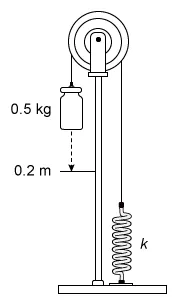
An ideal spring with spring constant k has one end fixed to the floor and the other end attached to the end of a vertical string of negligible mass that wraps around a pulley, as shown in the diagram above. A mass of 0.5 kg is suspended from the other end of the string and allowed to come to equilibrium 0.2 m below its initial height. The value of the spring constant k is most nearly
| A. | |
| B. | |
| C. | |
| D. |
Explanation
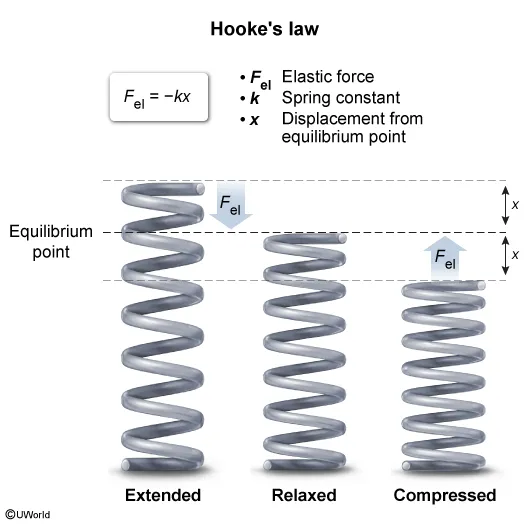
According to Hooke's law, the restoring force of a spring is a function of the spring displacement and the spring constant k for an ideal spring. This relationship is expressed mathematically as:
In this question, a spring with constant k is fixed to the floor and attached to the end of a vertical string of negligible mass that wraps around a pulley. On the other end of the string is a mass of 0.5 kg. When the hanging mass is released and the system comes to equilibrium, the mass is 0.2 m below its initial height.
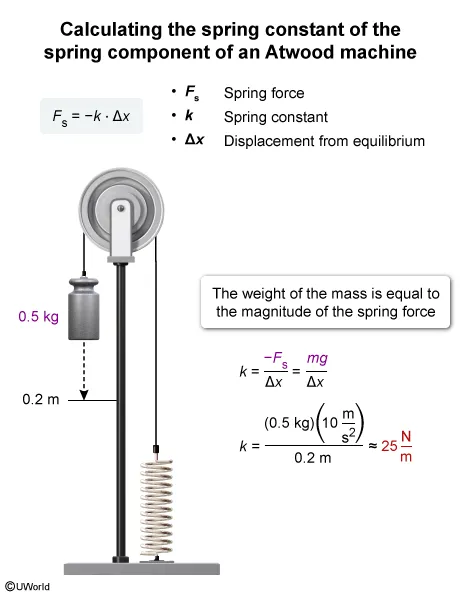
The weight of the mass mg is balanced by the tension T in the string:
On the other side of the pulley, the upward tension is balanced by the downward restoring force of the spring:
Combining these equations implies that the restoring force of the spring is equal to mg:
Rearranging the variables to solve for the spring constant gives:
Substituting in the respective values for each quantity yields:
Therefore, the spring constant is most nearly .
(Choice A) follows from incorrectly calculating the spring constant by finding the quotient of the displacement and the spring force.
(Choice B) follows from incorrectly calculating the spring constant by finding the product of the mass of the block and the displacement.
(Choice C) follows from incorrectly calculating the spring constant using only the mass of the block instead of its weight.
Things to remember:
The spring constant of an ideal spring is equal to the restoring force over its displacement from equilibrium.
Question
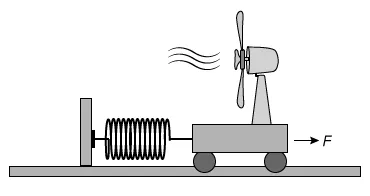
A fan cart of mass M is connected to an ideal spring with a constant k that is tethered to a wall behind the cart. After the fan cart is turned to its low setting, the fan exerts a force F on the cart and moves to the right, stretching the spring a distance d1. The fan is then turned to its high setting and exerts a force 2F on the cart, stretching the spring a new distance d2. Which of the following expressions correctly relates the distances d2 and d1?
| A. | |
| B. | |
| C. | |
| D. |
Explanation
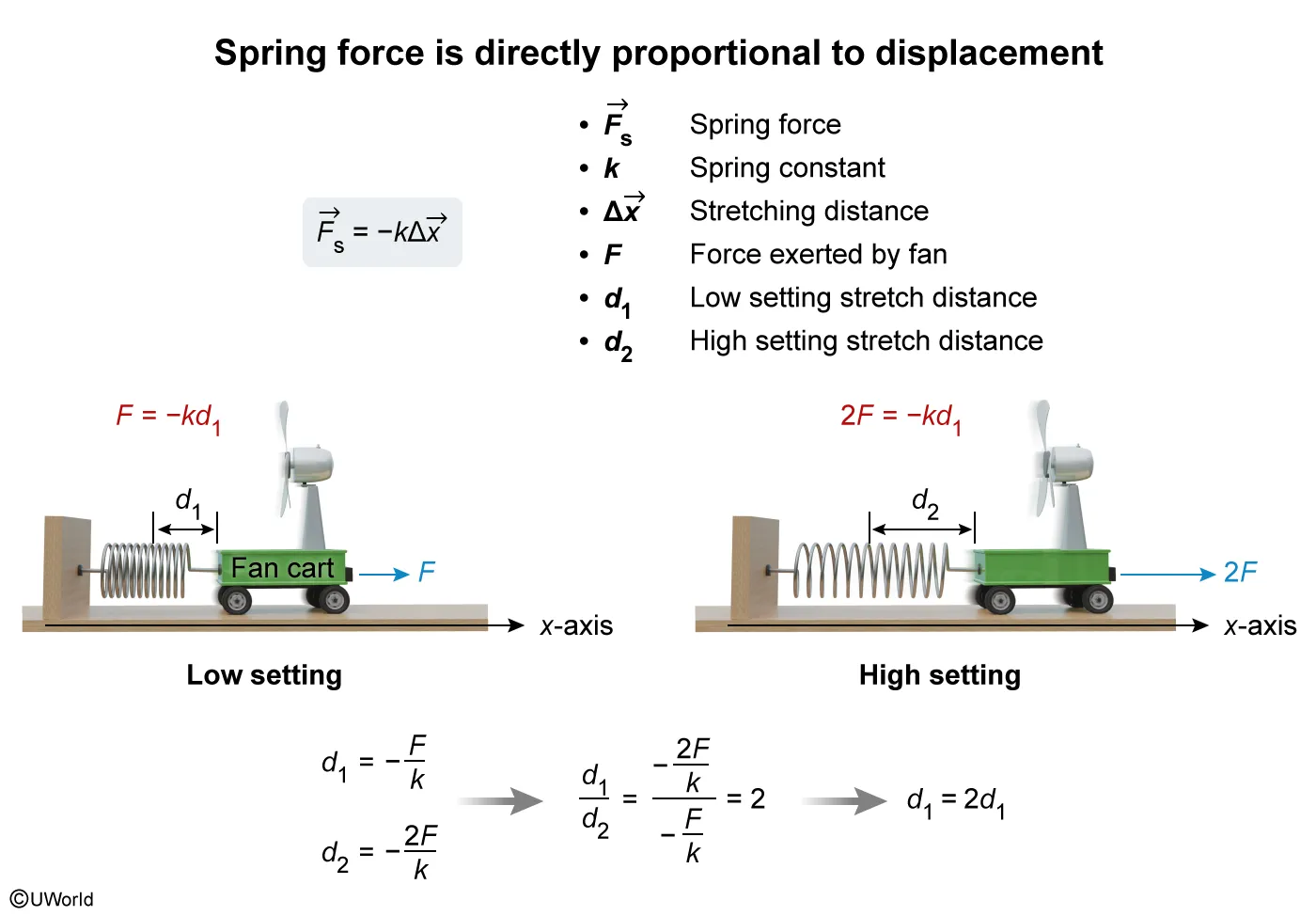
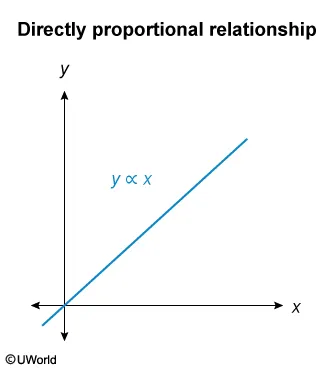
According to Hooke's law, the force exerted by an ideal spring on an object is directly proportional to the product of the spring constant k and the displacement from equilibrium and is directed toward the equilibrium of the spring:
In this question, a fan on a cart exerts a force on the cart to the right, causing it to stretch the connected ideal spring with a constant k over a distance . Hence, the spring exerts an equal force on the cart to the left. Furthermore, the distance can be solved for by rearranging Hooke's law:
When turning the fan to its high setting, the force doubles to 2F. In this case, Hooke's law implies that the stretched distance d2 equals:
The relation of d2 to d1 can be found by taking the ratio of one to the other. The ratio of d2 to d1 yields:
Therefore, the distance the spring is stretched when the fan is turned to its high setting is 2 times the distance the spring is stretched when the fan is turned to its low setting:
(Choices A and C) These expressions incorrectly apply Hooke's law in relating the two different distances. The force exerted by the spring is proportional to its displacement from equilibrium. Doubling the force exerted by the spring doubles its displacement from equilibrium.
(Choice B) This expression incorrectly relates distance to by using the reciprocal of the correct ratio, .
Things to remember:
Hooke's law implies that an ideal spring's displacement from equilibrium is directly proportional to the force exerted by the spring.
Question
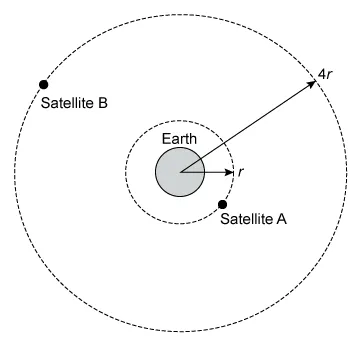
A student investigates two different satellites in different circular orbits around Earth, as shown in the figure above. Satellite A orbits Earth at a radius of r , and satellite B orbits Earth at a radius of 4r . Which of the following expressions correctly relates periods and ?
| A. | |
| B. | |
| C. | |
| D. |
Explanation
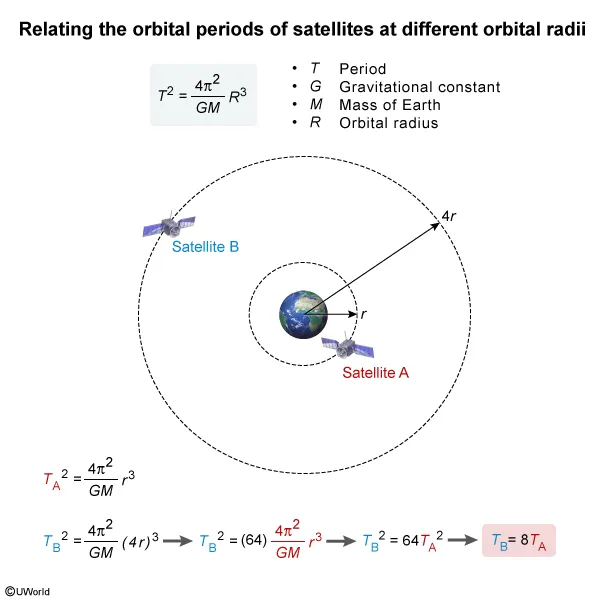
According to Kepler's third law, the square of an object's orbital period T2 around a central body is directly proportional to the cube of its orbital radius R3:
where G = 6.67 × 10⁻¹¹ N·m2/kg2 is the universal gravitational constant and M is the mass of the central body.
In this question, a student investigates two satellites orbiting Earth with different orbital radii. Satellite A orbits Earth at a radius r, and satellite B orbits Earth at a radius 4r. The periods and of satellites A and B, respectively, can be related using Kepler's equation.
Substituting their respective orbital radii into Kepler's equation yields:
Hence, the square of the orbital period of satellite A can be substituted into Kepler's equation for satellite B:
Finally, take the square root of both sides of the above equation, which yields the following relationship between the periods of satellite A and B:
Therefore, the period of satellite B must be equal to 8 times the period of satellite A.
(Choice A) incorrectly implies that the period of satellite B is less than that of satellite A, which is counter to Kepler's third law.
(Choices B and C) and incorrectly use Kepler's third law to relate both orbital periods.
Things to remember:
Kepler's third law can be used to relate the periods of satellites orbiting the same planet at different orbital radii.

Stand Out
with a Top Score in AP Physics 1
Complete your AP Physics 1 Unit 2 review and continue building mastery across all units with UWorld. Gain the confidence to perform your best on the AP Physics 1 exam and strengthen your profile for competitive college admissions, majors, and scholarships.
Get our all-in-one course today!
- Focused AP Physics 1 Review Videos
- Print & Online AP Physics 1 Study Guide
- 450+ Physics 1 Exam-style Practice Questions
- Customizable Quiz Generator
- Adjustable Study Planner
- Realistic AP Physics 1 Exam Review
- Timed Test Simulation
- Progress Dashboard
- Smart Flashcards
- Digital Notebook
Hear From Our AP Students
UWorld’s service is pretty good and helps provide a lot of explanations on subjects I haven’t been confident on before.
The questions here are the most realistic to the AP tests I've seen so far! I appreciate the ability to customize tests as well.
The best part is that all options are well-explained, telling clearly why they are not the right option.

Frequently Asked Questions (FAQs)
What are the main topics covered in AP Physics 1 Unit 2: Force and Translational Dynamics?
AP Physics 1 Unit 2, titled Force and Translational Dynamics, focuses on Newton’s Laws of Motion and how forces cause acceleration. This unit builds the foundation for all mechanics concepts tested on the AP exam. It frequently appears in AP Physics 1 Unit 2 FRQs and MCQs, assessing your ability to apply F = ma and interpret motion under various force conditions.
To prepare effectively:
- Review Newton’s First, Second, and Third Laws in depth.
- Practice interpreting free-body diagrams for objects in motion and at rest.
- Study how friction, tension, and normal forces affect net acceleration.
- Work through AP Physics 1 forces practice problems and FRQs to test understanding.
Mastering this unit is essential for connecting theory to problem-solving in real-world motion scenarios.
What topics are covered in Unit 2 AP Physics 1?
AP Physics 1 Unit 2 includes several key concepts under Force and Translational Dynamics:
- Newton’s Three Laws of Motion – inertia, net force, and action-reaction pairs
- Equilibrium – understanding balanced forces and static conditions
- Frictional Forces – static and kinetic friction, and their role in motion
- Tension and Normal Forces – analyzing contact and pull forces
- Net Force and Acceleration – applying Newton’s Second Law (F = ma)
- Free-Body Diagrams – visualizing and interpreting all forces on an object
- Mathematical Relationships – applying AP Physics 1 Unit 2 equations and friction formulas
These topics reinforce conceptual reasoning and problem-solving strategies needed for AP Physics 1 Unit 2 tests and FRQs.
How should I study for AP Physics 1 Unit 2 review?
Studying for AP Physics 1 Unit 2 dynamics requires both conceptual understanding and consistent application. Begin by revisiting motion and acceleration concepts from Unit 1, then focus on forces that cause these motions.
Follow these steps:
- Read through definitions of force, mass, and acceleration.
- Draw free-body diagrams for simple and compound systems.
- Practice AP Physics 1 Unit 2 practice problems daily to apply equations.
- Review mistakes after each attempt to understand reasoning errors.
UWorld’s AP Physics 1 Unit 2 review videos and diagrams break down complex forces visually, helping you connect mathematical equations to physical understanding.
What’s the best study sequence for AP Physics 1 Unit 2?
A structured sequence improves comprehension and helps link concepts smoothly.
- Newton’s First Law: Study inertia and equilibrium.
- Newton’s Second Law: Learn how net force relates to acceleration.
- Newton’s Third Law: Understand action-reaction force pairs.
- Friction and Tension: Examine real-world applications.
- AP Physics 1 Unit 2 MCQs and FRQs: Reinforce concepts through timed practice.
This order ensures each idea builds logically on the next, making it easier to solve AP Physics 1 Unit 2 practice problems and analyze forces effectively.
What is the most effective AP Physics 1 Unit 2 review plan before the exam?
A well-structured study plan for AP Physics 1 Unit 2: Force and Translational Dynamics helps you move from concept mastery to exam readiness. Because Unit 2 underpins most of the mechanics section, spacing your review across several stages ensures both retention and speed. For a full subject-wide approach, explore How to Study for AP Physics 1.
3 Months Before the Exam:
- Begin reading through Newton’s Three Laws and their applications to real-world motion.
- Build your foundation with basic free-body diagrams and equilibrium problems.
- Review your AP Physics 1 Unit 2 equations (F = ma, friction, tension) and understand their derivations.
- Practice simple AP Physics 1 Unit 2 practice problems involving mass, acceleration, and net force.
1 Month Before the Exam:
- Shift focus to problem application—combine conceptual reasoning with calculations.
- Solve friction and tension problems, paying attention to direction and force balance.
- Mix MCQs and FRQs from Units 1 and 2 to connect kinematics and dynamics.
- Summarize key equations and formulas into a personal AP Physics 1 Unit 2 cheat sheet for daily review.
2 Weeks Before the Exam:
- Take full-length AP Physics 1 Unit 2 practice tests under timed conditions.
- Concentrate on high-yield topics: net force, acceleration, motion graphs, and equilibrium analysis.
- Revisit errors from previous attempts and re-solve those problems for reinforcement.
- Review your AP Physics 1 Unit 2 notes daily and focus on high-impact formulas.
UWorld’s AP Physics 1 Unit 2 review offers adaptive question sets, visual diagrams, and realistic timed tests that mirror College Board standards. Pairing UWorld with your classroom resources and official practice materials ensures confident, exam-ready performance.
What are the main FRQ question types for AP Physics 1 Unit 2?
The AP Physics 1 Unit 2 FRQs test both conceptual reasoning and problem-solving ability. Common types include:
- Drawing and interpreting free-body diagrams.
- Calculating net force, acceleration, and tension in connected systems.
- Explaining the direction and magnitude of frictional forces.
- Justifying relationships between mass, force, and motion in written form.
Practicing these helps you develop structured answers that earn full credit in unit 2 AP Physics 1 FRQs.
How can I improve my accuracy on AP Physics 1 Unit 2 multiple-choice questions?
Accuracy comes from consistent review and awareness of common traps.
- Read questions carefully, many hinge on direction or sign conventions.
- Always label forces before solving numerically.
- Revisit AP Physics 1 Unit 2 practice problems involving tension and inclined motion.
- Analyze mistakes to identify weak conceptual areas.
Solving small, focused question sets daily helps improve reasoning speed and reduces careless errors.
How are forces, motion, and equilibrium connected in Unit 2?
In AP Physics 1 Unit 2: Force and Translational Dynamics, forces, motion, and equilibrium are deeply interrelated. Forces are the cause of motion—when all forces on an object are balanced, the object remains in equilibrium; when they are unbalanced, the object accelerates according to Newton’s Second Law (F = ma). Recognizing this connection helps explain how every change in motion results from a net external force.
Consider these key links:
- Balanced forces create static or dynamic equilibrium with zero acceleration.
- Unbalanced forces produce acceleration proportional to the net force and inversely proportional to mass.
- Free-body diagrams visually connect forces and resulting motion, clarifying relationships among tension, friction, and normal forces.
Understanding how these elements interact is essential for both AP Physics 1 Unit 2 FRQs and multiple-choice questions. It strengthens your ability to interpret physical systems, predict motion, and analyze equilibrium conditions accurately during problem solving.
How can I retain complex formulas or topics in AP Physics 1 Unit 2?
Retention in AP Physics 1 Unit 2 improves when you connect formulas to real-world meaning instead of memorizing them in isolation. Understanding how each variable interacts; force, mass, and acceleration, makes it easier to recall and apply during problem-solving.
Retention strategies:
- Create a formula chart for AP Physics 1 Unit 2 equations, listing what each symbol represents.
- Solve one or two forces practice problems daily to reinforce how F = ma applies.
- Sketch free-body diagrams alongside equations to visualize force directions.
- Use flashcards for friction, tension, and net force to test recall regularly.
Understanding why formulas work makes them easier to remember and apply accurately during both AP Physics 1 Unit 2 MCQs and FRQs.
How do I study forces and motion effectively for the Unit 2 test?
Studying forces and motion in AP Physics 1 Unit 2: Force and Translational Dynamics requires connecting Newton’s Laws to physical outcomes. Focus on cause-and-effect relationships, how forces produce acceleration and how equilibrium maintains rest or constant velocity.
Key study areas:
- Forces: Review friction, tension, and normal forces in various setups.
- Motion: Link F = ma to velocity changes and motion graphs.
- Diagrams: Practice labeling forces in every problem to reduce confusion.
- Application: Solve AP Physics 1 Unit 2 practice problems involving pulleys, inclines, and multi-body systems.
Integrating conceptual understanding with problem-solving develops the reasoning skills needed to master unit 2 AP Physics 1 FRQs and multiple-choice questions alike.
What is the best AP Physics 1 Unit 2 practice test format?
The most effective AP Physics 1 Unit 2 practice test format mirrors the structure of the official AP exam, combining depth and breadth to assess both conceptual and computational mastery.
Recommended structure:
- 35–40 MCQs: Test conceptual clarity, formula application, and reasoning.
- 2 FRQs: Include one data-analysis problem and one multi-step calculation.
- Total Duration: Around 70 minutes with a short review period for reflection.
Practicing under timed conditions familiarizes you with the rhythm of the AP Physics 1 Unit 2 test, helping you pace your problem solving while maintaining accuracy.
When should I begin preparing for the AP Physics 1 Unit 2 test?
It’s best to start preparing for AP Physics 1 Unit 2 dynamics as soon as your class finishes Unit 1: Kinematics. Early review allows you to connect motion equations with the forces that cause motion, building a stronger conceptual link.
Suggested approach:
- 3–4 weeks before the test: Review Newton’s Laws and study AP Physics 1 Unit 2 formulas.
- 2 weeks before: Begin solving forces practice problems and timed mini-tests.
- Final week: Revisit your AP Physics 1 Unit 2 notes and summary sheets daily to reinforce weak areas.
Short, frequent sessions are more effective than cramming and help you retain principles like F = ma and equilibrium conditions for long-term mastery.
What are common mistakes students make in AP Physics 1 Unit 2?
Many students lose points in AP Physics 1 Unit 2 because of minor conceptual errors or skipped steps in reasoning. Recognizing these mistakes early helps build exam precision.
Common pitfalls include:
- Confusing mass with weight in calculations.
- Forgetting to include friction or normal forces in diagrams.
- Mislabeling force directions or neglecting vector components.
- Applying AP Physics 1 Unit 2 equations incorrectly due to sign errors.
Avoiding these issues comes down to careful diagramming, consistent unit checks, and deliberate practice with AP Physics 1 Unit 2 practice problems that emphasize reasoning as much as math.
Where can I find AP Physics 1 Unit 2 notes, cheat sheets, or study guides?
High-quality AP Physics 1 Unit 2 study guides and notes provide concise explanations of Newton’s Laws, frictional forces, and tension. Look for resources that align with the College Board framework and include:
- Simplified derivations of key AP Physics 1 Unit 2 equations.
- Free-body diagram examples for different systems.
- Short concept summaries on equilibrium and motion.
- Quick quizzes for revision before your unit 2 AP Physics 1 test.
UWorld’s interactive study guide supplements these with visual explanations and structured examples designed to reinforce both understanding and problem-solving ability.
Are there downloadable AP Physics 1 Unit 2 study guide PDFs and practice materials?
Yes. You can find AP Physics 1 Unit 2 review PDFs and practice materials that summarize the key topics of Force and Translational Dynamics. These resources often include:
- Formula sheets and quick-reference summaries.
- Forces practice problems PDFs with step-by-step solutions.
- Printable diagrams for friction, tension, and acceleration scenarios.
When selecting materials, prioritize those modeled after official AP Physics 1 question styles. Combining printable worksheets with digital tools ensures both conceptual understanding and practical test readiness.