AP® Calculus BC Unit 8 Review and Practice Test
AP® Calculus BC Unit 8 focuses on using integrals to solve real-world problems involving area, volume, and motion. Review key concepts and practice exam-style questions with detailed answer explanations to boost your AP Calc BC exam score.
Excel in AP Calculus BC Unit 8 with Smart Review Tools
Tackle tough integration problems with ease. Our AP Calc BC Unit 8 review simplifies advanced concepts, connects them to real-world applications, and helps you prepare confidently for test day.
Engaging Video Lessons
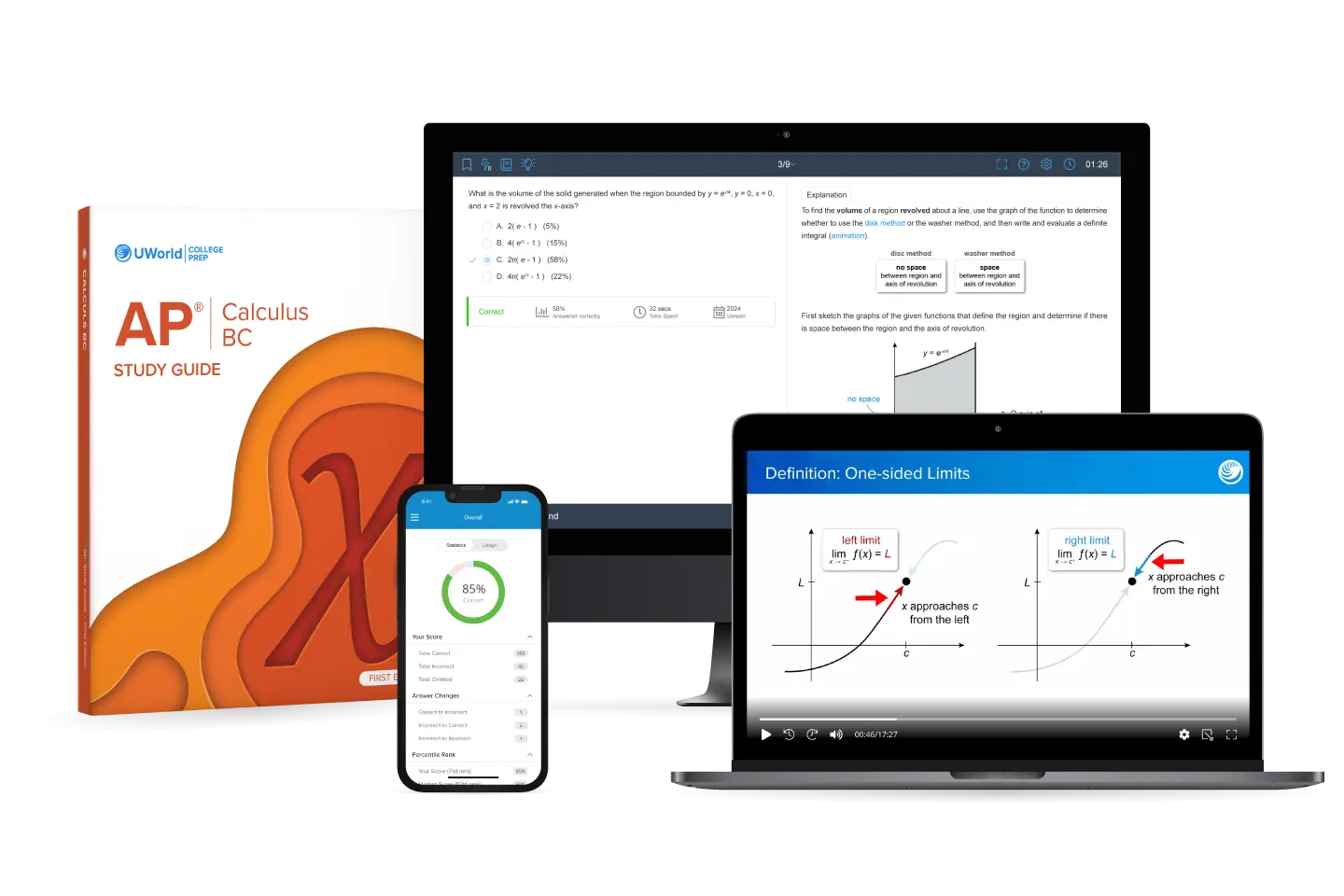
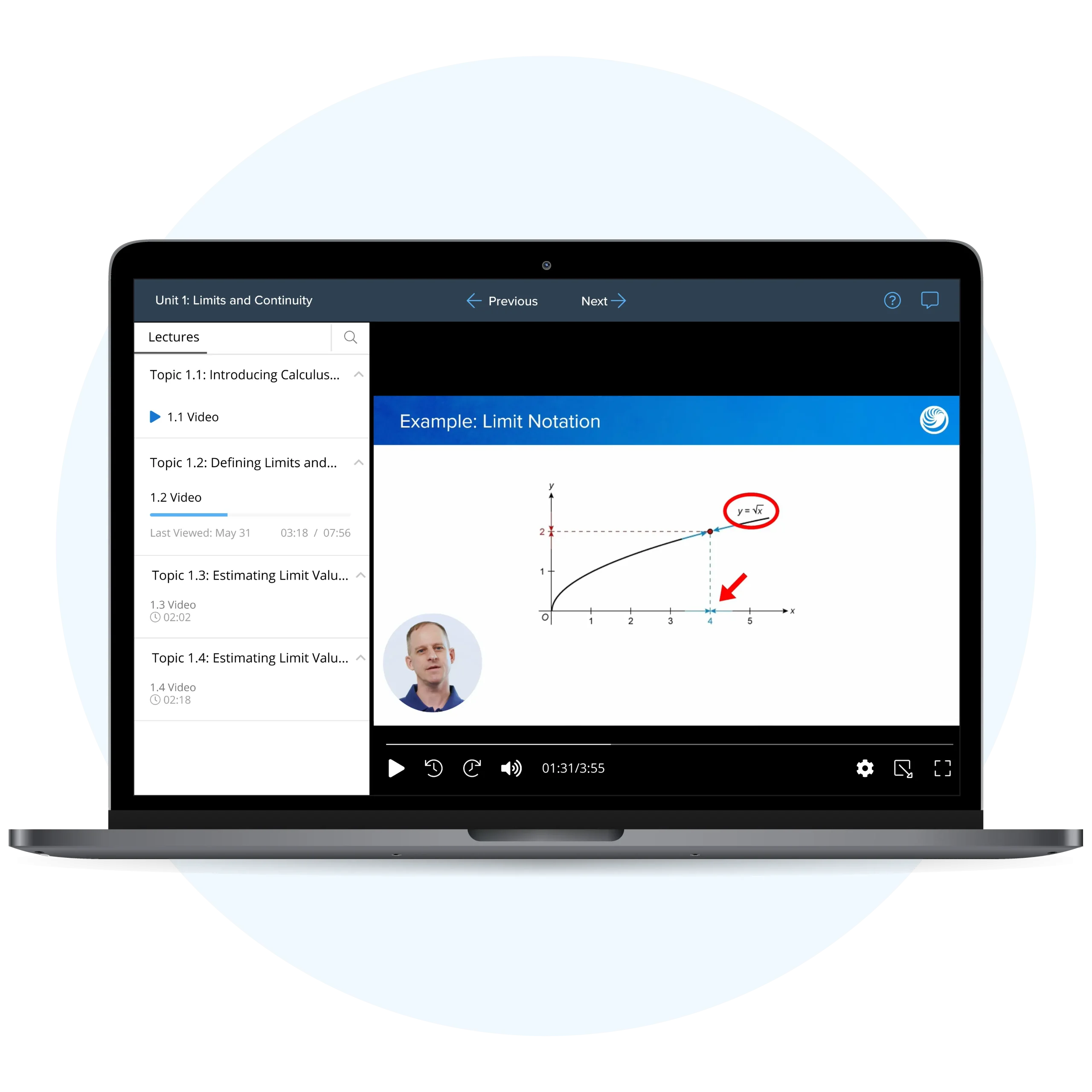
Learn AP Calculus BC Unit 8 concepts through engaging video lessons that break down applications of integrals into simple, visual explanations. Understand how to calculate areas, volumes, and accumulated change step-by-step. Each video connects theory to real AP Calc BC exam questions, helping you grasp every topic with confidence.
Interactive Study Guides
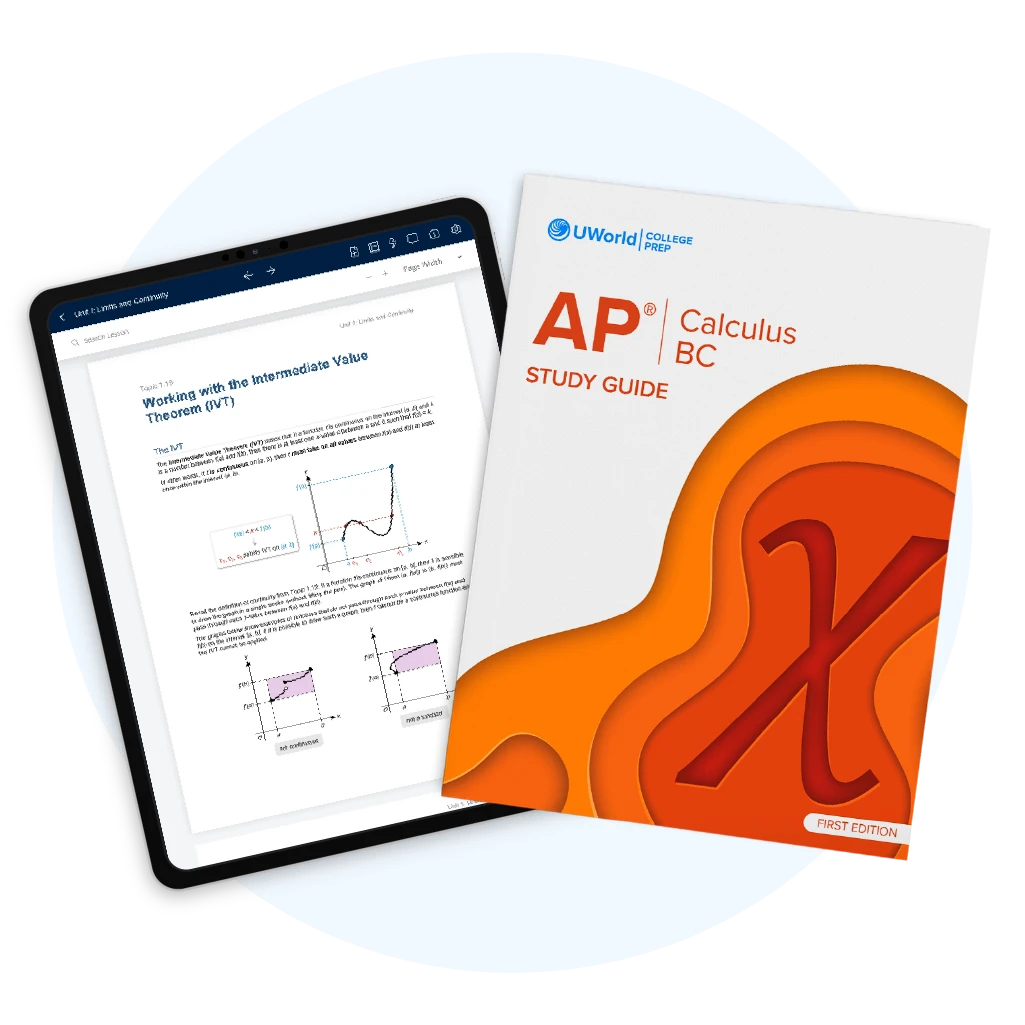
Explore AP Calculus BC Unit 8 with interactive study guides that make complex integration concepts easier to understand. Each guide covers topics like areas between curves, volumes, and motion problems in clear detail. Review formulas, examples, and visuals designed to help you retain key ideas and perform better on your AP Calc BC exam.
Try These AP Calculus BC Unit 8 Practice Test Questions
Question
Which of the following is the volume of the solid generated by revolving the region bounded by the lines y = 2x + 1, y = x + 1, and x = 3 about the x-axis?
| A. | |
| B. | |
| C. | |
| D. |
Explanation
To determine whether to use the disc or washer method, graph the given lines to see if there is space between the region and the x-axis.
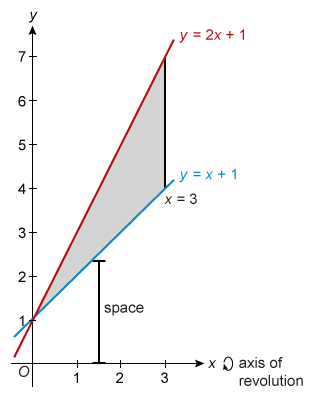
There is space between the region and the axis of revolution, so it is necessary to use the washer method to find the volume.
The top function is y = 2x + 1 and the bottom function is y = x + 1, so R(x) = 2x + 1 and r(x) = x + 1. The region spans the interval of x-values [0, 3], so the limits of integration are 0 and 3. Substitute the function and limits into the integral for the washer method and evaluate.
| Washer method integral | |
| Substitute functions and limits | |
| Expand binomials | |
| Combine like terms | |
| Integrate | |
| Apply FTC | |
| Simplify |
Therefore, the volume of the solid is
Question
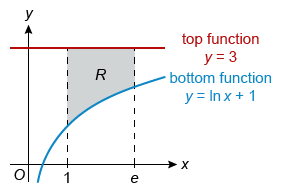
Which of the following gives the area of the region R bounded by the graph of y = ln x + 1 and the lines y = 3, x = 1, and x = e ?
| A. | |
| B. | |
| C. | |
| D. |
Explanation
It is given that the region R is bounded by the vertical lines x = 1 and x = e, so the area integral spans the interval [1, e]. Eliminate Choices A and B.
Region R is the area between the functions y = ln x + 1 and y = 3 on the interval [1, e]. To determine which is the top function and which is the bottom function, plug the endpoints of the interval into y = ln x + 1 and compare the resulting values to y = 3.
| y = ln x + 1 | Given function | y = ln x + 1 |
| y = ln 1 + 1 | Plug in given x-values | y = ln e + 1 |
| y = 0 + 1 | Evaluate logarithms | y = 1 + 1 |
| y = 1 | Add | y = 2 |
The function y = ln x + 1 is an increasing function that is less than 3 for x = 1 and x = e. Therefore, y = 3 must be the top function and y = ln x + 1 must be the bottom function.
Substitute the functions f(x) = 3 and g(x) = ln x + 1 and the endpoints a = 1 and b = e into the formula for the area between two curves to find the integral that gives the area of region R.
| Area of region R | |
| Substitute functions and values | |
| Distribute −1 and combine constants |
The integral that gives the area of region R is (graph).
Question
A program defines the dimensions of a certain coupling for a three-dimensional printer. The coupling is defined as the rectangular area bound between x = 1, y = 3, and the x- and y-axes revolved around the vertical line x = −1. What is the volume of the coupling?
| A. 3𝜋 | |
| B. 9π | |
| C. 12π | |
| D. 15π |
Explanation
It is given that the area revolves around a vertical line, so the volume integral is in terms of y.
Graph the given area and the axis of revolution to determine whether to use the disc or washer method.
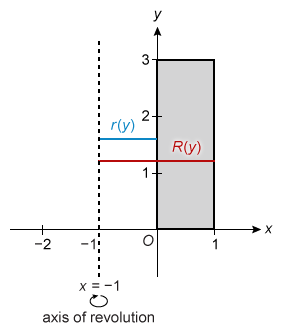
There is space between the given area and the axis of revolution, so it is necessary to use the washer method.
The radii of each washer are R(y) = 1 − (−1) = 2 and r(y) = 0 − (−1) = 1, and the area spans the interval of y-values [0, 3]. Plug these values into the washer method volume integral and evaluate.
| Washer method integral | |
| Plug in R(y) = 2, r(y) = 1, y1 = 0, and y2 = 3 | |
| Simplify integrand | |
| Integrate | |
| Apply FTC | |
| Simplify |
Therefore, the volume of the coupling is

Stand Out
with a Top Score on the AP Calculus BC Exam
Wrap up your AP Calculus BC Unit 8 review and keep advancing through later units with UWorld. Boost your performance and stand out as a top candidate for competitive colleges, majors, and scholarships by earning a top score.
Get our all-in-one course today!
- Focused AP Calc BC Videos
- Print & Digital Study Guide
- 1800+ Exam-style Practice Questions
- Customizable Quiz Generator
- Adjustable Study Planner
- Realistic Timed Test Simulation
- Colorful Visual Explanations
- Progress Dashboard
- Smart Flashcards & Digital Notebook
Hear From Our AP Students
UWorld’s service is pretty good and helps provide a lot of explanations on subjects I haven’t been confident on before.
The questions here are the most realistic to the AP tests I've seen so far! I appreciate the ability to customize tests as well.
The best part is that all options are well-explained, telling clearly why they are not the right option.

Frequently Asked Questions (FAQs)
Which major topics fall under “Applications of Integration”?
AP Calculus BC Unit 8: Applications of Integration explores how definite integrals describe real-world change and accumulation. This unit applies mathematical concepts to motion, area, and volume, forming a key bridge between theory and application.
Here’s what you’ll study in this unit:
- Average Value of a Function: Use definite integrals to find the mean output over an interval.
- Modeling Particle Motion: Connect velocity and position using integrals.
- Solving Accumulation Problems: Quantify change over time through integration.
- Area Between Curves: Calculate the space enclosed by multiple functions.
- Volume with Cross-Sections, Disc, and Washer Methods: Build 3D shapes from 2D regions.
- Length of a Planar Curve: Use integrals to find the arc length of smooth curves.
With UWorld’s AP Calculus BC Unit 8 review and practice tests, you’ll see each of these applications in exam-style problems, helping you build strong problem-solving and conceptual understanding for test day.
How should I prepare for an AP Calculus BC Unit 8 exam?
Preparing for AP Calculus BC Unit 8 starts with a clear study structure. Begin by reading your notes or textbook to review the fundamentals of integration and its applications. Focus on topics like finding areas, volumes, and average values to refresh the key formulas and theorems.
Next, watch instructional videos to visualize concepts such as the disc and washer methods or motion modeling. Seeing problems worked out step-by-step helps you understand how integrals translate into geometric or physical meaning, making complex ideas easier to grasp.
Finally, practice with UWorld’s AP Calculus BC Unit 8 review. Solve realistic MCQs and FRQs that mirror the actual exam format, and use detailed explanations to learn from your mistakes. UWorld’s structured approach ensures you strengthen both accuracy and speed so you walk into test day confident and well-prepared.
How much time should I spend reviewing Unit 8 before the exam?
For AP Calculus BC Unit 8, aim to spend one to two weeks focused solely on review before the exam. This unit, Applications of Integration, includes multiple essential concepts like areas, volumes, and motion, which often appear in both multiple-choice and free-response sections.
Divide your time strategically:
- Days 1–3: Revisit lessons on definite integrals, disc and washer methods, and accumulation problems.
- Days 4–6: Solve mixed practice questions and past FRQs related to integration applications.
- Final days: Review key formulas, common errors, and speed drills to boost confidence.
If you’re unsure where to start, UWorld’s AP Calculus BC Unit 8 review provides a ready-made structure with topic-based questions and detailed feedback. It helps you use your time effectively, focusing on weak areas and reinforcing problem-solving accuracy before test day.
Are any free resources available for AP Calculus BC Unit 8?
Yes, there are several excellent free options to help you prepare for AP Calculus BC Unit 8: Applications of Integration. You can start with Khan Academy, which offers comprehensive video lessons and practice problems covering areas, volumes, and motion using integrals.
The College Board website provides official practice materials, including free-response questions, multiple-choice examples, and detailed scoring guidelines that reflect real exam expectations. These resources help you understand the format and difficulty level of actual test questions.
For a more exam-focused experience, try the UWorld free trial for AP Calculus BC. It includes realistic Unit 8 practice questions, detailed explanations, and study tools that strengthen conceptual understanding and test-taking speed, all designed to help you feel confident on exam day.
What types of questions are on the AP Calculus BC Unit 8 test?
The AP Calculus BC Unit 8 test includes a mix of multiple-choice questions (MCQs) and free-response questions (FRQs) that test your understanding of integration applications. You’ll encounter both calculator and non-calculator sections, assessing your ability to solve real-world problems using definite integrals.
Expect problems that involve:
- Finding areas between curves and volumes using disc or washer methods.
- Applying accumulation functions and the Fundamental Theorem of Calculus.
- Solving motion problems involving velocity, position, and total distance traveled.
- Determining average values or curve lengths using integrals.
For focused practice, use UWorld’s AP Calculus BC Unit 8 review and practice tests. Each question mirrors the exam’s style and rigor, providing detailed solutions that strengthen your reasoning and improve your performance under timed conditions.
How can I improve my score on the Free-Response Questions (FRQs) for Unit 8?
Improving your FRQ performance for AP Calculus BC Unit 8 comes down to clarity, accuracy, and strategy. Start by reviewing past FRQs from College Board to understand common question types, such as volume calculations, average value problems, and motion-based integrals. Focus on showing every step, since partial credit is awarded for correct reasoning even if the final answer isn’t perfect.
Use a structured approach:
- Clearly define variables and label units.
- Write out integral expressions before solving.
- Check if a graphing calculator is allowed and use it efficiently.
- Always justify your answers with calculus-based reasoning, not guesses.
To strengthen your FRQ skills, practice with UWorld’s AP Calculus BC Unit 8 FRQs. Each problem includes step-by-step solutions and scoring insights that show how to earn every possible point, helping you turn your understanding into top-tier exam performance.
What is the "Applications of Integration" unit's weight on the AP Calculus BC exam?
The “Applications of Integration” unit carries a significant portion of the AP Calculus BC exam, generally making up about 6–9% of the total score. Questions from this unit assess your ability to apply integrals to real-world contexts, including areas, volumes, and motion problems.
Expect both multiple-choice and free-response questions that require you to compute definite integrals, apply the disc or washer methods, and solve accumulation or particle motion problems. These questions test both conceptual understanding and problem-solving accuracy.
Using UWorld’s AP Calculus BC Unit 8 review and practice tests, you can tackle a variety of exam-style problems with detailed explanations. UWorld helps you identify weak areas, reinforce key concepts, and gain confidence in applying integration techniques effectively under timed conditions.
What’s the best way to organize my formula sheet for integrals?
A well-organized formula sheet can save valuable time during the AP Calculus BC Unit 8 test. Group formulas by type, such as definite and indefinite integrals, disc and washer methods, accumulation functions, and motion equations. This makes it easier to quickly locate the right formula for each problem.
Include key integration techniques like substitution, integration by parts, and formulas for volumes and arc length. Highlight frequently used formulas or tricky integrals with color or symbols for quick reference. Keeping it concise helps prevent clutter and ensures you can quickly scan for the information you need.
UWorld’s AP Calculus BC Unit 8 review provides structured examples and practice problems that help you decide which formulas are essential. Using UWorld while building your formula sheet ensures that you focus on the concepts most likely to appear on the AP Calc BC exam and strengthens your problem-solving confidence.
Where can I find a good study guide for AP Calculus BC Unit 8?
UWorld’s AP Calculus BC Unit 8 review is one of the best ways to prepare for the Applications of Integration unit. It offers a structured approach with realistic practice questions, step-by-step solutions, and topic-specific explanations that strengthen your understanding of key concepts. UWorld also tracks your performance to highlight strengths and weaknesses, helping you focus on areas that need improvement. With its interactive tools, detailed feedback, and curated problem sets, UWorld makes it easier to grasp complex integration applications and build confidence for test day.
A great way to review AP Calculus BC Unit 8: Applications of Integration is to use a comprehensive study guide that covers all major topics, including areas between curves, volumes with disc and washer methods, accumulation functions, motion problems, and arc length. Focus on guides that break concepts into manageable sections with clear explanations and practice problems. For the most effective preparation, combine your coursework with UWorld’s AP Calculus BC Unit 8 review for realistic exam practice and targeted learning.
What are the most common mistakes students make on Unit 8 questions?
Students often lose points on AP Calculus BC Unit 8 questions due to misapplying integration techniques. Common errors include confusing disc and washer methods, forgetting to include constants when calculating indefinite integrals, or incorrectly setting up limits of integration for areas and volumes.
Other frequent mistakes involve misreading graphs in motion problems, neglecting the Fundamental Theorem of Calculus when computing accumulation functions, or making algebraic errors when simplifying integrals. Time management can also be an issue, causing rushed or incomplete solutions on longer free-response questions.
Practicing with UWorld’s AP Calculus BC Unit 8 review and practice tests can help you avoid these pitfalls. Its detailed step-by-step solutions, realistic exam-style questions, and performance tracking allow you to identify weak areas, correct common errors, and approach the AP Calc BC exam with confidence and accuracy.
Learn More About Specific Unit
Limits and Continuity
Differentiation: Definition and Fundamental Properties
Differentiation: Composite, Implicit, and Inverse Functions
Contextual Applications of Differentiation
Analytical Applications of Differentiation
Integration and Accumulation of Change
Differential Equations
Parametric Equations, Polar Coordinates, and Vector-Valued Functions
Infinite Sequences and Series