
AP® Calculus BC Unit 6 Review and Practice Test
If you’re preparing for AP® Calculus BC Unit 6, this guide helps you build a solid grasp of integration and accumulation concepts—core ideas that connect everything you’ve learned about change, motion, and area. Through guided practice, step-by-step examples, and exam-style questions, you’ll strengthen your problem-solving skills and get exam-ready with confidence.
Strengthen Your Skills with Our AP Calculus BC Unit 6 Review
Learn how integration connects rates of change and accumulated quantities in real-world contexts. This AP Calc BC Unit 6 review breaks down key techniques, builds problem-solving confidence, and prepares you for success on the AP exam.
Engaging Video Lessons
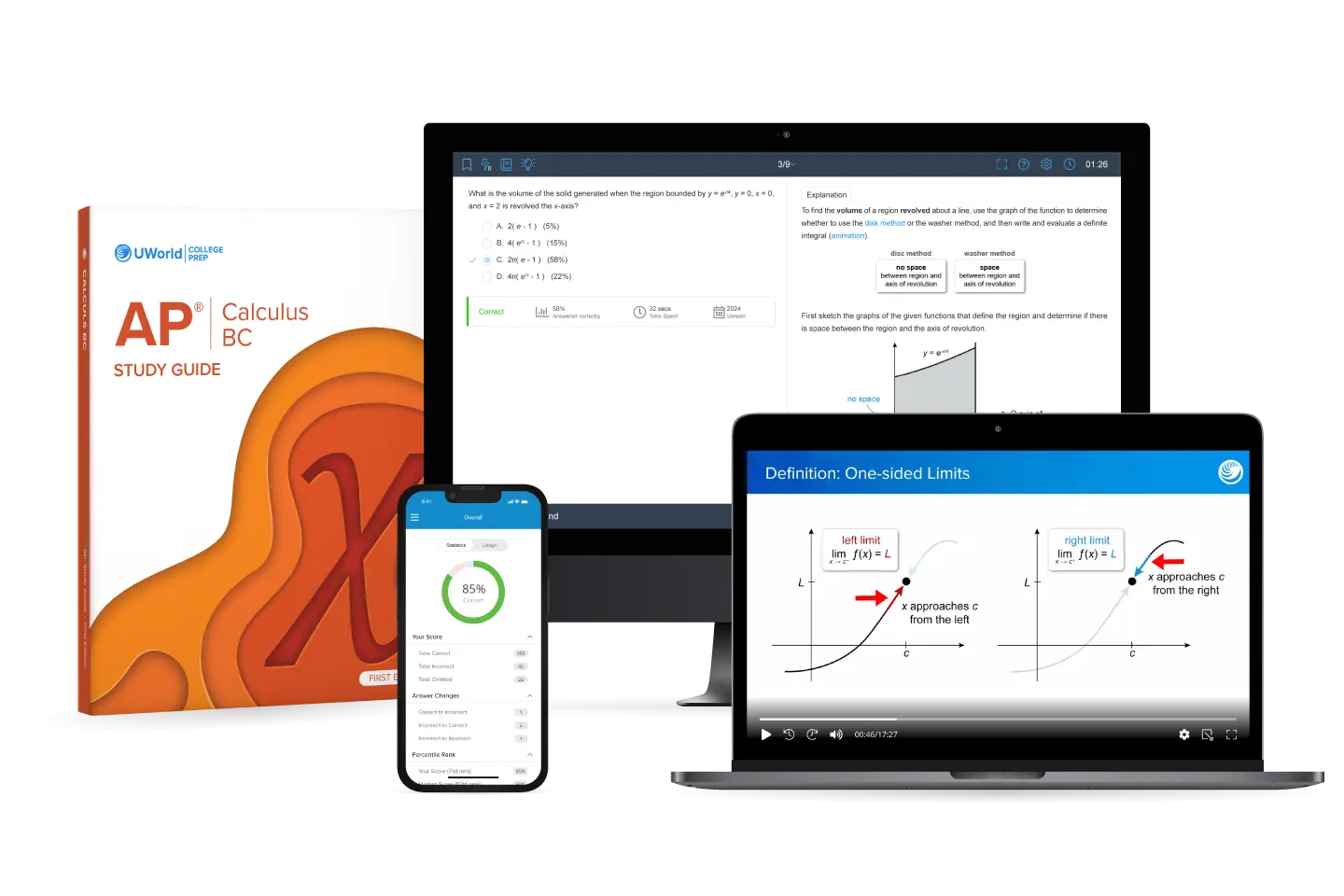
Watch step-by-step explanations of integration techniques, including substitution, partial fractions, and integration by parts. These AP Calculus BC Unit 6 videos simplify complex topics and show how each method applies to real problems. Perfect for reviewing before practicing your AP Calc BC Unit 6 progress check MCQ Part A.
Interactive Study Guides
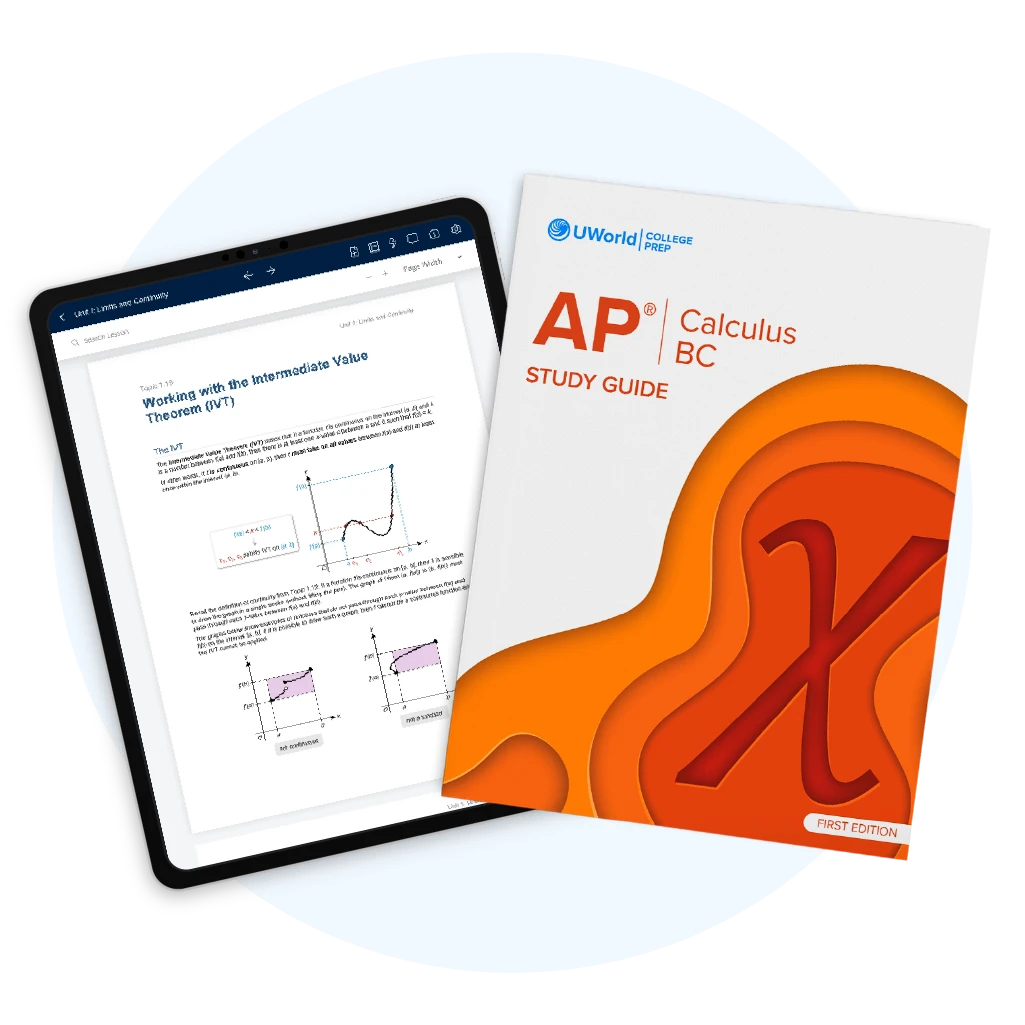
Explore AP Calculus BC Unit 6 study guides that break down integration and accumulation of change into easy-to-follow steps. These interactive guides cover essential formulas, substitution rules, and integration by parts methods. Perfect for your unit 6 AP Calc BC review, they include visuals, examples, and practice tips to help you retain concepts and perform better on your exam.
Challenge Yourself with AP Calculus BC Unit 6 Practice Questions
Question
| A. | |
| B. | |
| C. | |
| D. |
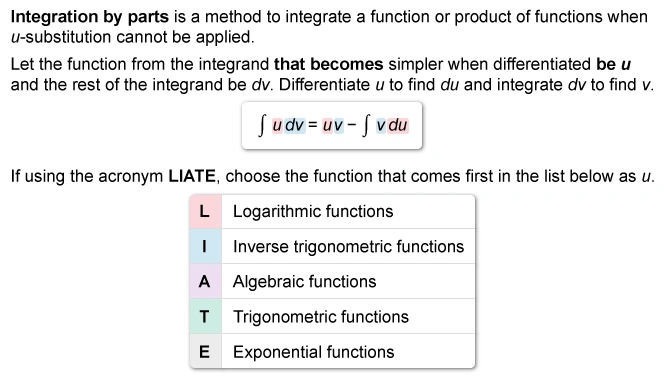
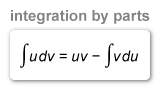
The functions cannot be rewritten algebraically or with u-substitution, so use integration by parts.
Explanation
The given integrand is the product of the functions x 3 and cos x. The functions cannot be rewritten algebraically or with u-substitution, so use integration by parts.
Follow the LIATE acronym to select u. Algebraic expressions (x3) are above trigonometric expressions (cos x),so let u = x3 and let dv = cos x dx (the remaining parts of the integrand).
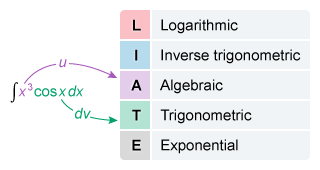
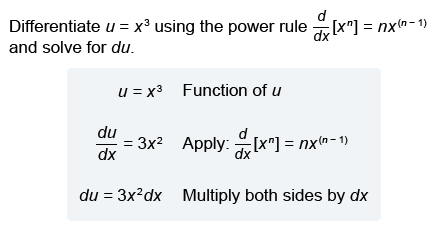
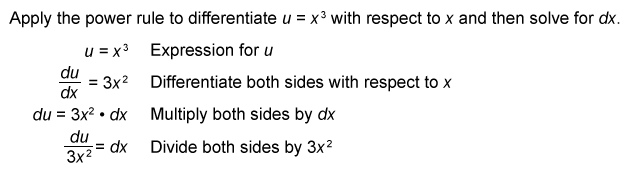
Differentiate u = x3 and solve for du (see how), and integrate dv = cos x dx to find v. Substitute u = x3, v = sin x, and du = 3x2 dx into the formula for integration by parts and simplify.
| Integration by parts formula | |
| Plug in u = x3, v = sin x, and du = 3x2 dx | |
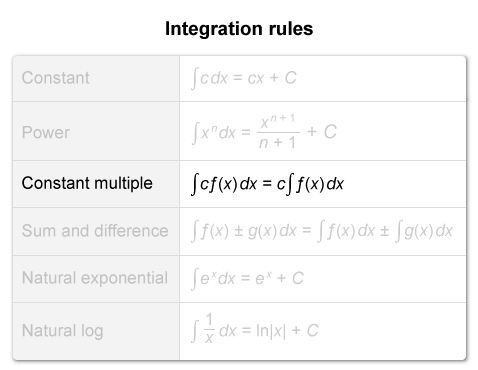
| Simplify and apply constant multiple rule |
Notice that the resulting expression matches one of the choices, so it is not necessary to integrate . From integration by parts, the given integral is equal to .
(Choice A) may result from mistakenly switching the expressions for u and du when substituting into the formula for integration by parts.
(Choice C) may result from mistakenly integrating each function in the given product individually.
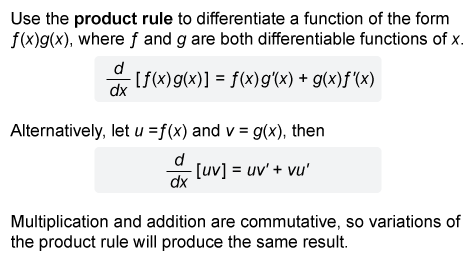
(Choice D) may result from mistakenly applying the product rule for differentiation.
Things to remember:
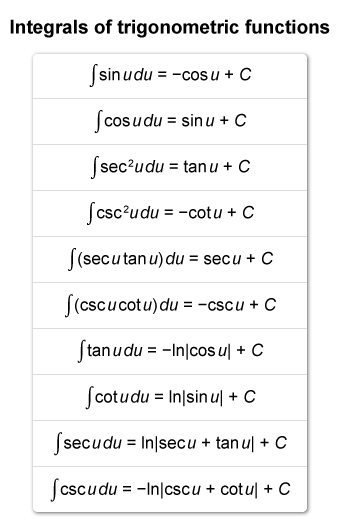
If the integral of the product of two functions cannot be evaluated by u-substitution, use integration by parts:
Question
| A. | |
| B. e8 | |
| C. 3e8 | |
| D. divergent |
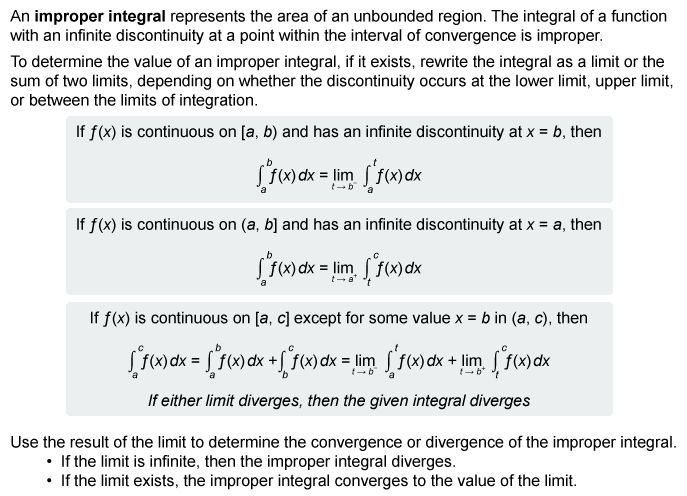
An improper integral of the form converges if exists.
Explanation
An integral in which one or both limits of integration is infinite is an improper integral.
To evaluate an improper integral of this form, replace the infinite limit of integration with the variable t and then calculate the limit as t approaches −∞ .
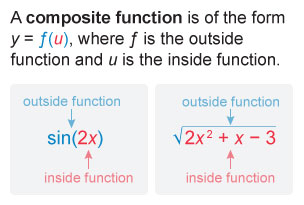
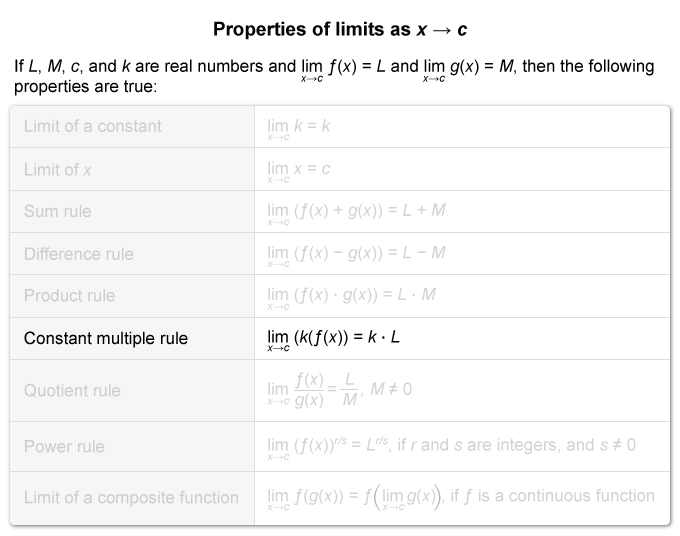
The integrand contains a composite function of the form eu, where u = x3. To use u-substitution, first differentiate u = x3 with respect to x and solve for dx to get (calculation).
The limits of integration must be changed to values of u, so plug the limits of integration into u = x3 to rewrite them as values of u. Substitute x3 = u, , and the new limits of integration into the given integral.
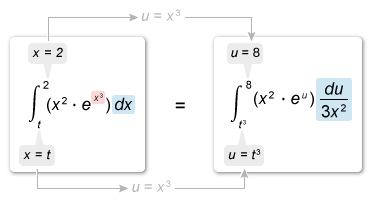
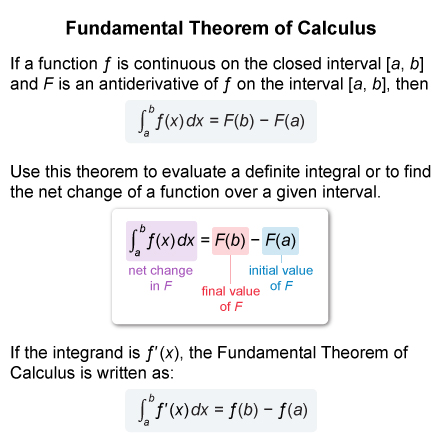
Now simplify the resulting integral to eliminate the remaining x-terms, integrate, and apply the Fundamental Theorem of Calculus (FTC).
| Resulting integral in terms of u | |
| Cancel and apply constant multiple rule | |
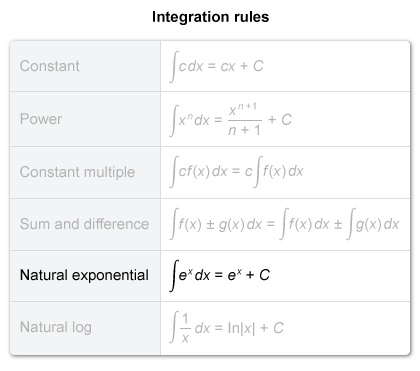
| Integrate natural exponential function | |
| Apply FTC |
Substitute the result above into the limit expression for the desired improper integral.
| Improper integral rewritten as a limit | |
| Substitute | |
| Apply constant multiple rule for limits | |
| Evaluate: | |
| Simplify |
Therefore, the value of the given integral is .
(Choice B) e8 may result from mistakenly substituting (instead of ) when rewriting the integral in terms of u.
(Choice C) 3e8 may result from mistakenly bringing out a constant multiple of 3 (instead of ) when applying u-substitution.
(Choice D) "Divergent" may result from assuming that an infinite limit of integration does not converge.
Things to remember:
To evaluate an improper integral, rewrite it as the limit of a definite integral:
Question
Which of the following expressions is equal to ) ) ?
| A. | |
| B. | |
| C. | |
| D. |
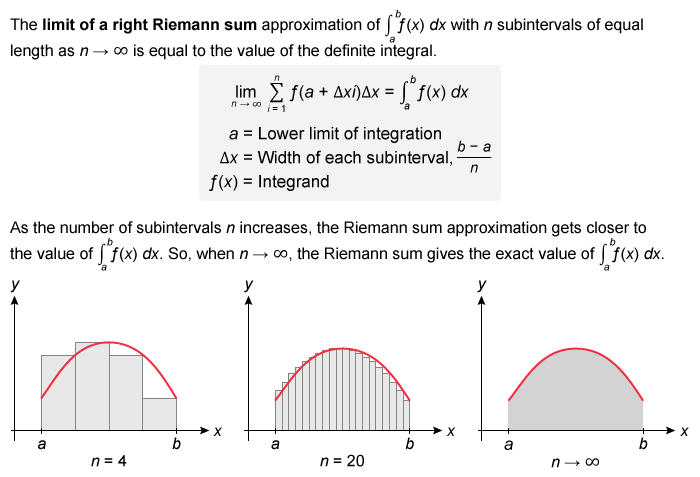
The value of a definite integral can be expressed in the form , which gives the limit at infinity of a right Riemann sum approximation with n subintervals of equal width .
Explanation
The value of a definite integral can be expressed in the form , which gives the limit at infinity of a right Riemann sum approximation with n subintervals of equal width :
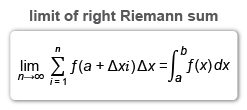
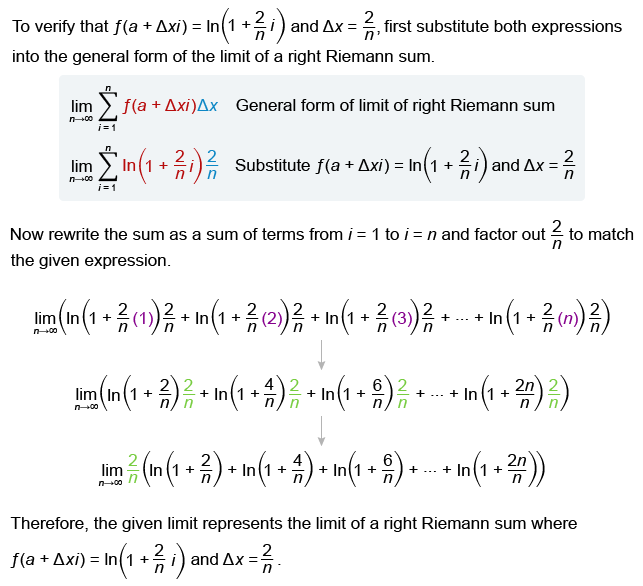
The given limit appears to be in the form of the limit of a right Riemann sum where and . First, verify that the general function is and the subinterval width is (see how).
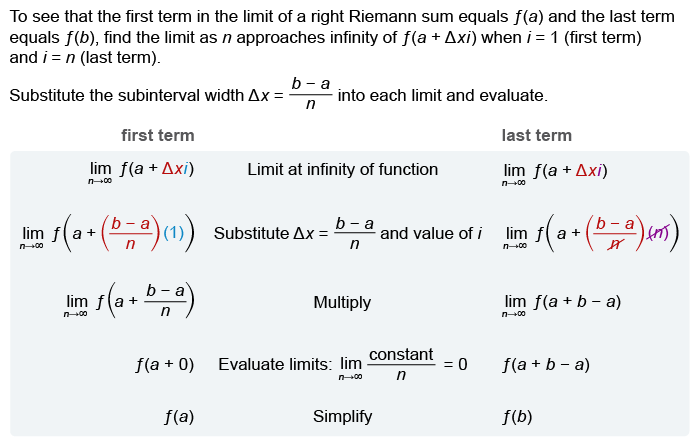
As n approaches infinity, the first term in a right Riemann sum approaches f(a), the value of f at the left endpoint of the interval [a, b]. The last term equals f(b), the value of f at the right endpoint of [a, b] (read more).
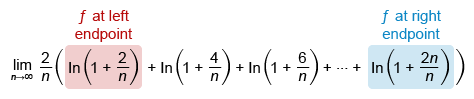
The left endpoint of the interval a is the lower limit of integration, and the right endpoint b is the upper limit of integration.
To determine which choice has the correct integrand f(x) and limits of integration [a, b], evaluate the limit as n approaches infinity of the first and last terms to find f(a) and f(b).
| Limits of first and last terms | ||
| Cancel n in right limit | ||
| Evaluate limits | ||
| Add |
The choices include two possible integrands ln x and ln(1 + x). The values of f(a) and f(b) could correspond to either integrand, so find the values of a and b that yield ln 1 and ln 3, respectively, for each integrand.
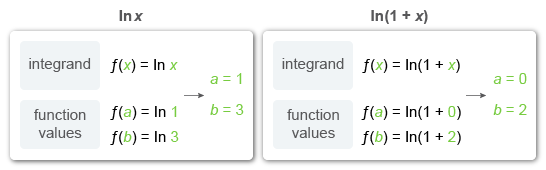
The given limit must equal or . Of these two integrals, only is an answer choice.
(Choice A) may result from incorrectly calculating limits of integration for the integrand ln x.
(Choice C) may result from incorrectly calculating the upper limit of integration for the integrand ln(1 + x).
(Choice D) may result from incorrectly calculating limits of integration for the integrand ln(1 + x).
Things to remember:
The value of a definite integral
can be expressed in the form
, which gives the limit at infinity of a right Riemann sum approximation with n subintervals of equal width
.

Learn Anytime, Anywhere
Whether you’re on your way to class, taking a study break, or relaxing at a café, keep your prep going with the UWorld app. Access AP Calculus BC Unit 6 review materials, video lessons, and practice tests anytime to stay consistent and confident with your integration and accumulation concepts.
Stand Out
with a Top Score on the AP Calculus BC Exam
Wrap up your AP Calculus BC Unit 6 review and keep advancing through later units with UWorld. Boost your performance and stand out as a top candidate for competitive colleges, majors, and scholarships by earning a top score.
Get our all-in-one course today!
- Focused AP Calc BC Videos
- Print & Digital Study Guide
- 1800+ Exam-style Practice Questions
- Customizable Quiz Generator
- Adjustable Study Planner
- Realistic Timed Test Simulation
- Colorful Visual Explanations
- Progress Dashboard
- Smart Flashcards & Digital Notebook
Hear From Our AP Students
UWorld’s service is pretty good and helps provide a lot of explanations on subjects I haven’t been confident on before.
The questions here are the most realistic to the AP tests I've seen so far! I appreciate the ability to customize tests as well.
The best part is that all options are well-explained, telling clearly why they are not the right option.

Frequently Asked Questions (FAQs)
Which major topics fall under “Integration and Accumulation of Change”?
AP Calculus BC Unit 6 focuses on understanding how integration models change and accumulation in mathematical and real-world contexts. It builds essential skills for solving complex integral problems efficiently.
Key topics include:
- Using definite integrals to calculate accumulated change over a specific interval.
- Approximating integrals with Riemann Sums to estimate areas and totals when exact values are hard to find.
- Exploring accumulation functions, the Fundamental Theorem of Calculus, and how they connect derivatives and integrals.
- Finding antiderivatives and indefinite integrals to reverse differentiation and represent families of functions.
- Applying properties of integrals and extended integration techniques to simplify complex problems.
- Determining improper integrals to evaluate infinite intervals or unbounded functions.
With UWorld’s AP Calculus BC Unit 6 review and practice questions, you can strengthen each of these skills through clear explanations and step-by-step examples that mirror real AP Calc BC Unit 6 test problems.
How should I prepare for an AP Calculus BC Unit 6 exam?
Preparing for the AP Calculus BC Unit 6 exam is most effective when you follow a simple cycle: read, watch, and practice. Start by reading through your notes and AP Calc BC Unit 6 review materials to revisit integration rules, the Fundamental Theorem of Calculus, and accumulation concepts.
Next, watch AP Calculus BC Unit 6 video lessons that break down substitution, integration by parts, and other key techniques. Visual learning helps you see how formulas are applied and improves your problem-solving approach.
Finally, practice using AP Calc BC Unit 6 progress check MCQ Part A and FRQ questions to test your understanding under exam-like conditions. With UWorld’s AP Calculus BC Unit 6 practice tests and interactive explanations, you can identify weak areas, learn from mistakes, and build confidence for the real exam.
How much time should I spend reviewing Unit 6 before the exam?
For AP Calculus BC Unit 6, plan at least one week of focused review to master integration and accumulation of change. Dedicate separate sessions for definite integrals, Riemann Sums, and integration techniques like substitution or parts. Reviewing smaller topics daily helps retain concepts and reduces stress closer to exam day.
Balance your time between reading theory and solving problems. Try working through a few AP Calc BC Unit 6 progress check MCQ Part A and FRQ questions each day to track improvement and identify gaps in understanding.
If you’re unsure how to organize your prep, UWorld’s AP Calculus BC Unit 6 review materials make it simple. With structured lessons, practice tests, and step-by-step solutions, UWorld helps you use your study time efficiently and feel fully prepared for the AP Calc BC Unit 6 test.
Are any free resources available for AP Calculus BC Unit 6?
Yes! There are several great free resources to help you prepare for AP Calculus BC Unit 6. Start with Khan Academy, which offers clear video tutorials and interactive exercises on integration, Riemann Sums, and accumulation functions. It’s a great way to refresh concepts before diving into practice.
The College Board website also provides official AP Calculus BC materials, including Unit 6 progress check MCQs and FRQs, sample questions, and scoring guidelines. Reviewing these helps you understand the format and difficulty of actual exam questions.
For more in-depth practice, try UWorld’s free trial for AP Calculus BC Unit 6 review. You’ll get access to realistic questions, detailed solutions, and integration-focused study tools that make complex topics easier to understand—helping you build confidence and accuracy before test day.
What types of questions are on the AP Calculus BC Unit 6 test?
The AP Calculus BC Unit 6 test includes a mix of multiple-choice and free-response questions (FRQs) that test your understanding of integration and accumulation of change. You’ll encounter problems on definite and indefinite integrals, accumulation functions, and the Fundamental Theorem of Calculus.
Expect to solve questions involving Riemann Sums, substitution, integration by parts, and improper integrals. Some questions require interpreting graphs, while others involve applying formulas to real-world rate and area problems. Knowing when to use a calculator is also important—some parts of the exam allow one, while others don’t.
To prepare effectively, use UWorld’s AP Calculus BC Unit 6 practice tests and review materials. Each question includes step-by-step explanations that mirror real exam problems, helping you strengthen problem-solving skills and gain confidence for your AP Calc BC Unit 6 progress check MCQ Part A and FRQ.
How can I improve my score on the Free-Response Questions (FRQs) for Unit 6?
To score higher on the AP Calculus BC Unit 6 FRQs, focus on clarity, setup, and correct reasoning. Always show your work; even partial solutions can earn points. Review how to apply the Fundamental Theorem of Calculus and integration techniques like substitution and integration by parts, as these often appear in FRQs.
Practice writing complete responses under timed conditions. Many FRQs combine concepts such as accumulation functions, area under curves, and rate of change problems, so make sure you understand how to interpret each scenario mathematically.
Use UWorld’s AP Calculus BC Unit 6 review and practice questions to get familiar with the question format and scoring style. With detailed solutions and exam-style prompts, UWorld helps you identify common errors, refine explanations, and build the confidence needed to excel on test day.
What is the "Integration and Accumulation of Change" unit's weight on the AP Calculus BC exam?
The “Integration and Accumulation of Change” unit makes up about 17–20% of the AP Calculus BC exam, making it one of the most heavily tested sections. It covers key concepts like definite integrals, accumulation functions, and integration techniques, which are vital for solving real-world rate, area, and motion problems.
Expect multiple-choice and free-response questions that test your understanding of the Fundamental Theorem of Calculus, antiderivatives, and improper integrals. These skills also serve as a foundation for advanced units such as Differential Equations and Infinite Series.
Strengthen your grasp of these topics with UWorld’s AP Calculus BC Unit 6 review, featuring realistic progress check MCQs and FRQs that simulate the exam format and help you gain the precision and confidence needed for a top score.
What’s the best way to organize my formula sheet for integrals?
A well-organized formula sheet helps you recall key integration concepts quickly during your AP Calculus BC Unit 6 review. Start by grouping formulas by type: basic integration rules, substitution, integration by parts, partial fractions, and trigonometric integrals. This structure helps you identify which technique applies to a given problem.
Next, include common antiderivatives and key relationships from the Fundamental Theorem of Calculus. Keep your notes clean and minimal; focus on formulas you tend to forget or confuse. Use color-coding or symbols to highlight patterns between related functions.
As you practice with UWorld’s AP Calculus BC Unit 6 progress check MCQ and FRQ-style questions, refine your formula sheet to focus on areas where you make mistakes. Over time, it becomes not just a study tool but a quick-reference guide that sharpens accuracy and speed.
Where can I find a good study guide for AP Calculus BC Unit 6?
UWorld’s AP Calculus BC Unit 6 review and practice questions are a great starting point for anyone looking for a reliable study guide. With its structured learning path, UWorld helps you build a deeper understanding of differentiation topics like the chain rule, implicit differentiation, and derivatives of inverse functions. The detailed explanations, visual solutions, and question-level feedback make complex ideas easier to grasp. Whether you’re studying for the AP Calculus BC Unit 6 test or brushing up before your final exam, UWorld’s comprehensive study guide and free trial provide the support you need to master this unit.
In addition to UWorld, you can strengthen your preparation with trusted academic resources and classroom materials that summarize formulas, show worked examples, and highlight common student mistakes. Websites like Khan Academy offer concise AP Calc BC Unit 6 review notes with topic explanations and short quizzes for quick practice. The College Board’s AP Classroom also features Unit 3 progress check MCQs and FRQs that mirror the format of real exam questions, making them ideal for self-assessment.
What are the most common mistakes students make on Unit 6 questions?
Many students lose points on AP Calculus BC Unit 6 questions by confusing definite and indefinite integrals or forgetting to apply the Fundamental Theorem of Calculus correctly. Others make algebraic or sign errors when using integration techniques like substitution or integration by parts.
Another common mistake is misinterpreting accumulation function graphs or neglecting to include the constant of integration when finding antiderivatives. Students also struggle with setting up Riemann sums and improper integrals, which can affect both accuracy and time management.
To avoid these pitfalls, review worked examples, check your setup before solving, and practice under timed conditions. UWorld’s AP Calculus BC Unit 6 review offers detailed explanations and instant feedback, helping you recognize and fix these errors before exam day.
Learn More About Specific Unit
Limits and Continuity
Differentiation: Definition and Fundamental Properties
Differentiation: Composite, Implicit, and Inverse Functions
Contextual Applications of Differentiation
Analytical Applications of Differentiation
Differential Equations
Applications of Integration
Parametric Equations, Polar Coordinates, and Vector-Valued Functions
Infinite Sequences and Series