Bundle 3+ College Prep products for 20% off

AP® Calculus BC Unit 4 Review and Practice Test

Contextual Applications of Differentiation

Excel in AP® Calculus BC Unit 4 by mastering how derivatives model motion, optimization, and real-world rates of change. UWorld’s AP Calc BC Unit 4 review combines expert instruction, visual study tools, and authentic exam-style questions to strengthen understanding and improve your AP score. From related rates to acceleration, every concept is taught for depth, accuracy, and speed under exam conditions.

Ace the Derivative Applications on the Exam with UWorld’s AP Calculus BC Unit 4 Review

Learn to interpret and apply derivatives to solve real-world problems through UWorld’s complete AP Calc BC Unit 4 prep course. Each explanation ties theory to practical application so you can tackle the AP Exam confidently. Whether calculating velocity, finding extrema, or analyzing concavity, you’ll approach every problem methodically with precision that earns points.

Watch

Learn with Engaging Video Lessons

Bring Calculus to life with concise, visual videos that simplify even the most abstract Unit 4 concepts. Each video demonstrates exactly how to structure solutions the AP Exam expects, helping you bridge understanding and execution in AP Calculus BC Unit 4 topics.

Read

Interactive Study Guides for Faster Learning

UWorld’s AP Calculus BC Unit 4 review materials turn complex derivative applications into structured, easy-to-follow lessons See how each topic links to real AP Exam problems and practice writing clear, concise reasoning, which is an essential skill for both FRQs and MCQs.

Practice

Sharpen Your Skills with Realistic AP Calculus BC Unit 4 Questions

Test your calculus knowledge with AP Calculus BC Unit 4 practice test questions designed to match the official AP Exam structure and difficulty. Each question covers essential concepts like velocity, acceleration, optimization, and growth rates, complete with detailed solutions and explanations that clarify every step. Build endurance, accuracy, and confidence for exam day.
Try these sample practice questions with detailed answer explanations:
Contextual Applications of Differentiation Practice Tests

Question

A particle is moving along the x -axis with position given by x (t) = 2 t At what time t in the interval 0 t 9 is the particle's instantaneous velocity equal to its average velocity over the interval 0 t 9 ?

A. 0
B. 1 9
C. 9 4
D. 9

Hint :

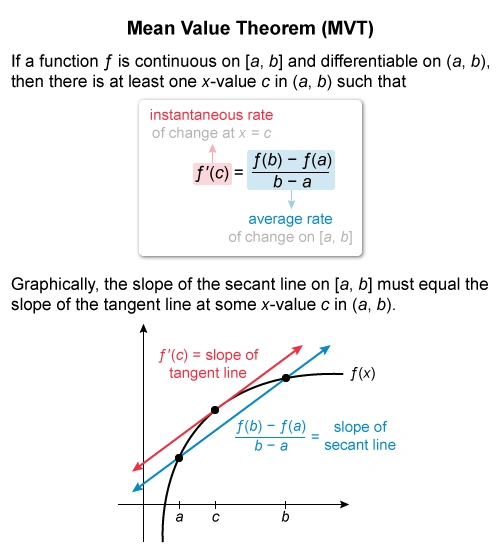
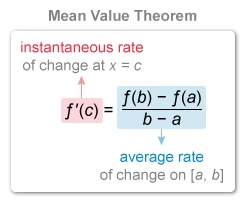
The Mean Value Theorem guarantees the existence of at least one value of x=c in the closed interval [a,b] for which the instantaneous rate of change of a continuous and differentiable function f(x) equals the average rate of change of f on [a,b] .

Explanation

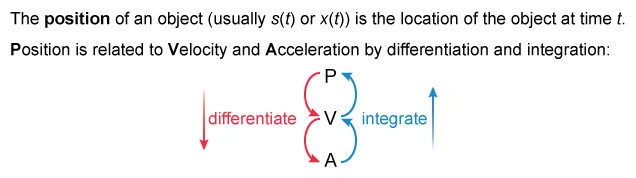
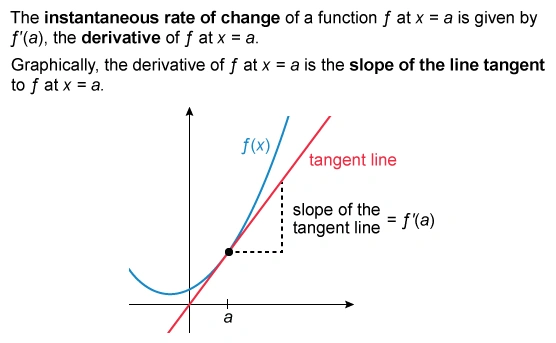
The velocity v(t) of a moving particle is given by the derivative of the particle's position function x(t) .

v (t) = x (t)

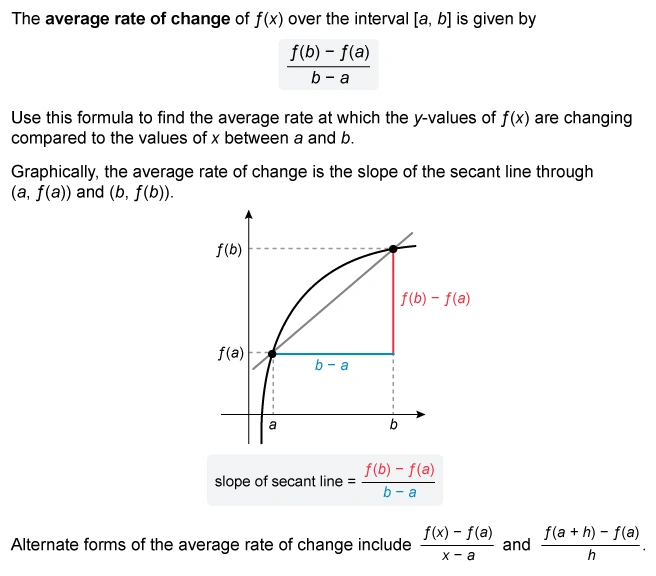
Since velocity is the derivative of position, the instantaneous velocity is the instantaneous rate of change of the position x . Similarly, the average velocity is the average rate of change (AROC) of the position x .

The Mean Value Theorem (MVT) guarantees that there exists at least one value of x in the closed interval [a,b] for which the instantaneous rate of change (IROC) of a continuous and differentiable function f(x) equals the average rate of change (AROC) of f on [a,b] .
To determine the value of t = c for which the instantaneous velocity equals the average velocity of the particle on the given interval, first differentiate the position function x (t) = 2 t to find an equation for the instantaneous velocity to find an equation for the instantaneous velocity x (t) .

x (t) = 2 t Given position function
x (t) = 2 t 1 / 2 Rewrite x n m = x n / m
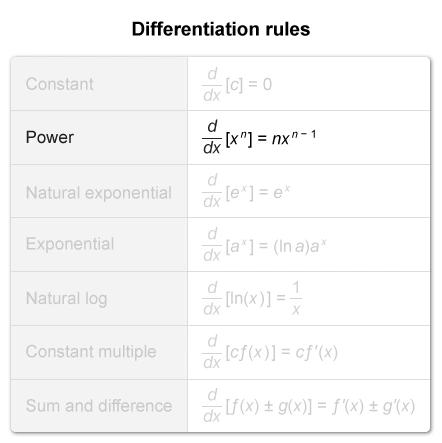
x (t) = 2 ( 1 2 t - 1 / 2 ) Differentiate: d d x [ x n ] = n x n - 1
x (t) = 1 t Simplify and rewrite x - n = 1 x n and x n / m = x n m

To calculate the average velocity of x t = 2 t on 0 t 9 , use the formula for average rate of change with the given function x: x (b) - x (a) b - a

x (b) - x (a) b - a AROC formula
x (9) - x (0) 9 - 0 Plug in a = 0 and b = 9
2 9 - 2 0 9 - 0 Evaluate x (t) = 2 t for t = 0 and t = 9
2 (3) - 2 (0) 9 - 0 Take the square root of 9 and 0
2 3 Simplify

Now set the expression for the instantaneous velocity ( x (t) = 1 t ) equal to the average velocity ( 2 3 ) and solve for t.

x (t) = x (9) - x (0) 9 - 0 Set the instantaneous velocity = average velocity
1 t = 2 3 Substitute x (t) = 1 t and x (9) - x (0) 9 - 0 = 2 3
3 = 2 t Cross multiply
3 2 = t Divide both sides by 2
9 4 = t Square both sides

Therefore, the value of t in the interval 0 ≤ t ≤ 9 for which the particle's instantaneous velocity equals its average velocity is 9 4

(Choices A and D) 0 and 9 may result from the assumption that the particle's instantaneous velocity and average velocity are equal at one of the endpoints.

(Choice B) 1 9 may result from setting the given position function x(t) , instead of the instantaneous velocity function x′(t) , equal to the average velocity.

Things to remember:

  • The velocity of a moving particle is given by the derivative of the particle's position function. .
  • The conclusion of the Mean Value Theorem guarantees the existence of at least one value x=c in the open interval (a,b) at which the instantaneous rate of change of a continuous function f(x) is equal to the average rate of change of f on the interval [a,b]

f ' (c) = f ( b ) f ( a ) b a

Question

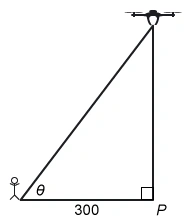
A person stands 300 feet from point P and watches a drone rise vertically from the point, as shown in the figure above.  The drone is rising at a constant rate of 50 feet per second.  What is the rate of change, in radians per second, of angle θ at the instant when the drone is 400 feet above point P ?

A. 3 50
B. 3 40
C.

5 24

D.

25 54

Hint :

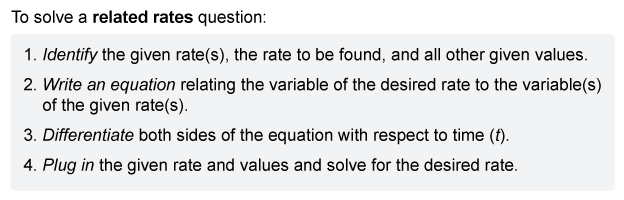
To find a quantity when given the rates at which multiple variables are changing, first identify the quantity to be found, when it is to be found, and any other given values or rates.

Explanation

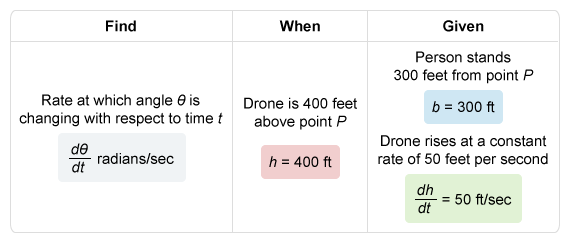
To find a quantity when given the rates at which multiple variables are changing (related rates), first identify the quantity to be found, when it is to be found, and any other given values or rates.

The question asks for the rate of change d θ dt in the angleθ when the drone's height h is 400 feet above point P. It is given that the person is 300 feet from point P, and the drone rises at a constant rate of dh dt = 50  feet per second.

A trigonometric equation for a right triangle that relates an acute angle θ of a right triangle to the lengths of the adjacent side b and opposite side h is tan  θ = h b

The angle θ and the length of the opposite side h are changing, but the adjacent side b remains constant. Plug the constant value b = 300 into the equation, differentiate with respect to time t,and solve for d θ dt

tan  θ = h b Equation for tangent of θ
tan  θ = h 300 Plug in b = 300
sec 2 θ d θ dt = 1 300 dh dt Differentiate with respect to t
1 cos 2 θ d θ dt = 1 300 dh dt Apply definition of secant
d θ dt = 1 300 dh dt cos 2 θ Multiply both sides by cos 2θ

The values of b and dh dt are given, and the trigonometric ratio for cos θ is adjacent hypotenuse However, the hypotenuse of the right triangle (the distance between the person and the drone) is unknown.

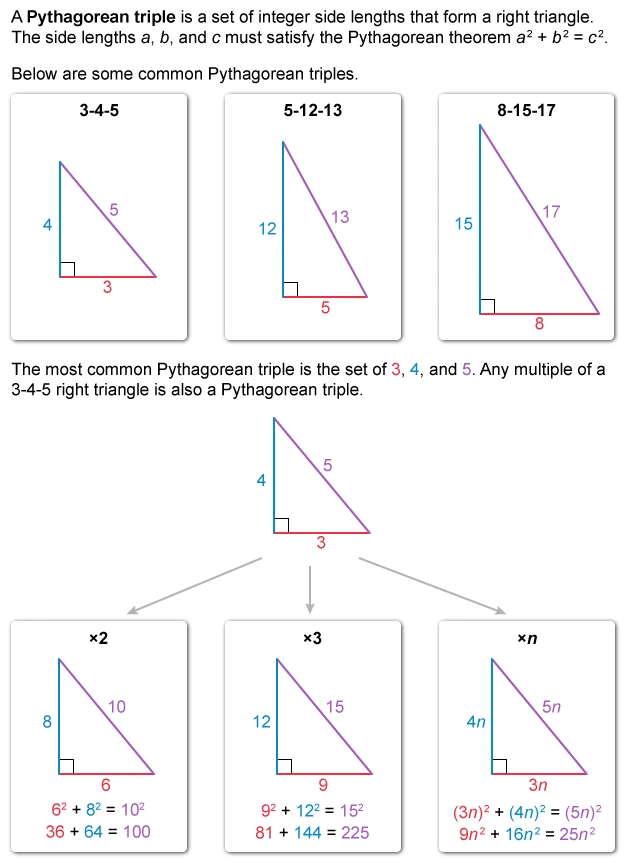
The height of the drone (400 feet) and the person's distance from point P (300 feet) correspond to a 3-4-5 Pythagorean triple, so the hypotenuse of the right triangle is 500 feet.
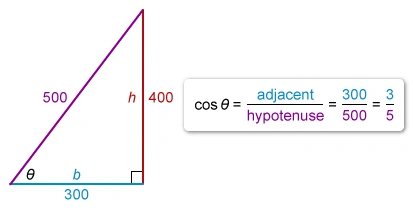
To find d θ dt , substitute the values of b, d h dt , and cos θ into the equation for d θ dt .

d θ d t = 1 300 d h d t (cos  θ) 2 Equation for d θ dt with cos2 θ rewritten as (cos θ)2
d θ d t = 1 300 50 ( 3 5 ) 2 Substitute values
d θ dt = 1 6 9 25 Simplify
d θ dt = 3 50 Multiply

The rate of change of angle θ with respect to time t is 3 50 radians per second.

(Choice B) 3 40 may result from incorrectly differentiating tan θ as sec θ tan θ, instead of sec² θ.

(Choice C) 5 24 may result from incorrectly differentiating tan θ as sin θ, instead of sec2 θ.

(Choice D) 25 54 may result from incorrectly differentiating tan θ as cos² θ, instead of sec2 θ.

Things to remember:
To find a quantity when given the rates at which multiple variables are changing, first identify the quantity to be found, when it is to be found, and any other given values or rates.

Question
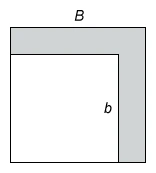
A region is bounded by two squares that have a common vertex at the bottom-left corner, as shown in the shaded region in the figure above. The side length of the outer square, B, is increasing at a constant rate of 3 meters per second, and the side length of the inner square, b, is decreasing at a constant rate of 1 meter per second. What is the rate of change, in square meters per second, of the area of the region at the instant when B is 5 meters and b is 4 meters?

A. 4
B. 8
C. 22
D. 38

Hint :

To find a quantity when given the rates at which multiple variables are changing, first identify the quantity to be found, when it is to be found, and any other given values or rates.

Explanation

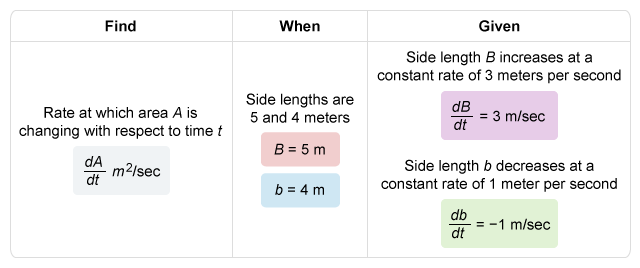
To find a quantity when given the rates at which multiple variables are changing (related rates), first identify the quantity to be foundwhen it is to be found, and any other given values or rates.

The question asks for the rate of change dA dt in the shaded area when the side lengths B and b are 5 and 4 meters, respectively. Side length B is increasing and b is decreasing, so dB dt = and db dt = - 1 meters per second.

The area of the shaded region is given by the difference between the areas of the two squares. A square with side length s has area A = s2, so the shaded region has area A = B2 − b2.
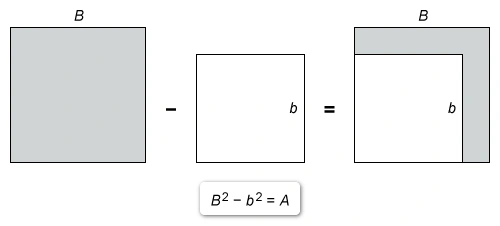
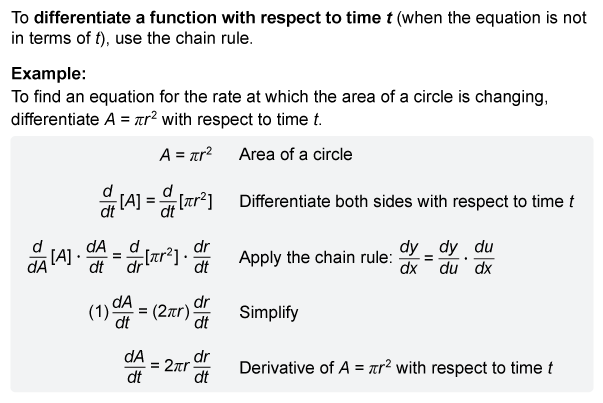
Now differentiate both sides of the equation with respect to t, plug in the given side lengths and rates of change, and evaluate dA dt

A = B 2 - b 2 Area of shaded region
dA dt = 2 B dB dt - 2 b db dt Differentiate with respect to t
dA dt = 2 (5) (3) - 2 (4) (- 1) Plug in given values
dA dt = 38 Simplify

Therefore, the rate of change in the area of the shaded region at the given instant is 38 square meters per second.

(Choice A) 4 may result from the error described in Choice B and not including the constant multiple 2 when applying the power rule to differentiate (B − b)².

(Choice B) 8 may result from incorrectly using A = (B − b)² as the formula for the area of the shaded region, instead of A = B² − b².

(Choice C) 22 may result from incorrectly using db dt = 1 as the rate of change for the smaller side length. The side length is decreasing, so the rate of change is negative.

Things to remember:

To find a quantity when given the rates at which multiple variables are changing, first identify the quantity to be found, when it is to be found, and any other given values or rates.


UWorld Dark Blue logo

Study On The Go

Stay exam-ready no matter where you are. Watch quick differentiation tutorials between classes, attempt Unit 4 AP Calc BC practice tests during commutes, or review optimization notes before bed. Every lesson, question, and guide syncs across devices, so your AP Calculus BC Unit 4 review is always organized and within reach.

Stand Out
with a Top Score on the AP Calculus BC Exam

Wrap up your AP Calc BC Unit 4 review and keep advancing through later units with UWorld. Boost your performance and stand out as a top candidate for competitive colleges, majors, and scholarships by earning a top score.

Choose Your Subscription
Dream Score Plan
360-Day
$169
Deep Learning Plan
180-Day
$149
Score Booster Plan
90-Day (No print book, only digital)
$129
Introductory Plan
30-Day (No print book, only digital)
$99

Get our all-in-one course today!

  • Focused AP Calc BC Videos
  • Print & Digital Study Guide
  • 1800+ Exam-style Practice Questions
  • Customizable Quiz Generator
  • Adjustable Study Planner
  • Realistic Timed Test Simulation
  • Colorful Visual Explanations
  • Progress Dashboard
  • Smart Flashcards & Digital Notebook
Explore our free trial and frequently asked questions.

Hear From Our AP Students

UWorld’s service is pretty good and helps provide a lot of explanations on subjects I haven’t been confident on before.

— Bence P.

The questions here are the most realistic to the AP tests I've seen so far! I appreciate the ability to customize tests as well.

— Kaila H.

The best part is that all options are well-explained, telling clearly why they are not the right option.

— Syeda Huma Z.

Frequently Asked Questions (FAQs)

AP Calculus BC Unit 4: Contextual Applications of Differentiation explores how derivatives describe change in physical and abstract systems. It’s where calculus meets real-world meaning. In this unit, you’ll learn how to connect derivative formulas with interpretation, using calculus to model, analyze, and predict change across motion, optimization, and growth problems.

The major topics include:

  • Identifying relevant mathematical information in verbal representations of real-world problems involving rates of change
  • Applying understandings of differentiation to problems involving motion
  • Generalizing understandings of motion problems to other situations involving rates of change
  • Solving related rates problems
  • Local linearity and approximation
  • L’Hospital’s rule

Each topic requires you to justify reasoning and communicate results clearly, the two skills that carry heavy weight in FRQs and MCQs on the AP Exam. UWorld’s AP Calculus Unit 4 review connects these abstract concepts to test-day logic with visuals, guided steps, and structured examples. By practicing with questions that mirror the AP style, you’ll develop fluency not only in problem-solving but also in writing mathematically sound explanations. This unit lays the groundwork for integration and motion in later units, making it a turning point in your AP Calculus BC preparation.

UWorld prepares you for AP Calculus BC Unit 4 by strengthening conceptual control, analytical precision, and exam-oriented reasoning. The approach moves you from clear intuition to efficient execution without relying on mechanical memorization. The priority is your ability to interpret, justify, and communicate solutions in the format AP graders expect.

  • Guided videos build intuition for motion, growth, related rates, and optimization, so each idea is understood before any procedure begins
  • Interactive study guides connect equations, derivatives, graphs, and contextual meaning, tightening your recall and conceptual mapping
  • AP-style practice sets expose you to real exam structure with full explanations that unpack each step, explain why it works, and clarify the final interpretation
  • FRQ training forces disciplined communication by defining variables, justifying transitions, and framing answers within the problem’s context
  • Timed quizzes replicate AP pacing and pressure to build fluency under constraints

Check for Understanding questions function as immediate progress audits after each subtopic. These items measure reasoning accuracy in real time and include explanations that model the precise calculus language used on the AP Exam. This structure sharpens memory, improves subtopic retention, and boosts performance on classroom progress checks. The same reasoning patterns extend directly to the official exam. The result is a preparation system that builds mastery through explanation, interpretation, and applied problem solving. UWorld positions you to handle Unit 4 MCQ and FRQ demands with clarity and to carry that mastery forward into the full AP Calculus BC exam.

Yes. Several high-quality resources can supplement your AP Calculus BC Unit 4 review, but UWorld’s free trial remains one of the most practical for focused, exam-style learning. It provides access to videos, practice questions, and rationales that mirror the format and difficulty of actual AP Exam problems. These materials help you preview the structure of UWorld’s full prep course and experience how its explanations guide your reasoning process. Beyond that, the College Board’s AP Classroom platform offers free topic outlines and sample Unit 4 AP Calc BC questions, which align with the core curriculum. However, these resources emphasize assessment rather than teaching. UWorld bridges that gap by combining instruction with active practice. Each question is accompanied by a detailed solution explaining both the calculus and the test-taking strategy behind it, something static resources can’t provide.

To maximize value, pair UWorld’s free materials with your class notes and official course framework. Watch one video per day, solve a few questions, and record mistakes in a short reflection log. That small, consistent routine helps strengthen weak areas while preparing you for deeper paid practice later. Even brief exposure to UWorld’s guided explanations can significantly improve conceptual clarity and test-day confidence.

The AP Calculus BC Unit 4 test evaluates how well you can apply differentiation to solve real-world and abstract problems. It doesn’t focus on formula memorization but measures reasoning, justification, and interpretation. You’ll encounter both multiple-choice (MCQ) and free-response (FRQ) questions that require translating contextual information into calculus models.

The question types you’ll see include:

  • Motion analysis: Finding velocity, acceleration, and distance using first and second derivatives.
  • Related rates: Setting up and solving problems where multiple variables change together.
  • Optimization: Determining maxima or minima for functions in real scenarios.
  • Concavity and inflection: Using the second derivative to describe function behavior.
  • Model interpretation: Explaining what a derivative means in context.

Each problem tests your ability to link symbolic manipulation to reasoning, which is exactly what UWorld’s AP Calculus BC Unit 4 review is built for. Every question in the platform mirrors AP Exam style, guiding you through setup, solution, and interpretation with clarity. The answer explanations also highlight typical AP scoring logic, helping you avoid subtle mistakes that cost points. By practicing these patterns repeatedly, you’ll move into the AP Exam able to identify question intent quickly and communicate complete, mathematically sound answers with confidence.

AP Calculus BC Unit 4 demands spaced repetition because the exam tests interpretation of rates, motion, and optimization rather than formula recall. While 7 to 10 hours across 2 weeks is a reliable target for most students, you should focus on breaking the work into short sessions that cycle through relearning, applying, and analyzing. Revisit core differentiation ideas through concept videos until the meaning of a derivative in context is automatic. Move into targeted Unit 4 question sets and force yourself to read the full explanations even when your answer is correct. This exposes hidden reasoning gaps.

In the final stretch, switch to mixed timed quizzes that blend Unit 4 with adjacent areas. That shift builds the ability to interpret velocity, acceleration, and rate changes without stopping to rethink fundamentals. Stabilizing this unit strengthens performance across the entire course because AP Calc BC Unit 4 acts as the conceptual bridge from basic differentiation to the modeling ideas used later.

Raising your performance on AP Calc BC Unit 4 problems requires building a stable interpretation process for every derivative driven scenario. The exam measures your ability to read a situation, convert it into a mathematical structure, justify each step, and explain meaning in context. Strength in this unit comes from consistent reasoning, not shortcuts.

  • Strengthen your first step. When you read an AP Calc BC Unit 4 prompt involving motion, identify position, velocity, and acceleration immediately. When you see quantities changing, identify the variables and the relationships that connect their rates. This front loaded clarity reduces hesitation and prevents setups that collapse later.
  • Build a fixed structure for AP Calc BC FRQs. Define all variables at the start. Justify each algebraic move so the logic is visible. State what your final value represents in plain mathematical language. This structure aligns with the scoring rubric and removes ambiguity.
  • Increase fluency by practicing AP Calc BC Unit 4 questions under time pressure. Use problems involving related rates, optimization, and motion interpretation until the setup becomes automatic. You want a process that remains stable even when the clock is tight.

After each practice session, isolate the source of every error. Most failures come from misreading the scenario, confusing variable relationships, or giving conclusions with no interpretation. Correct derivatives do not earn credit if the reasoning is unclear. Rebuild any concept that produces repeated mistakes. This method produces stronger interpretation, cleaner setups, sharper pacing, and more coherent explanations. Those improvements directly raise scores on AP Calc BC Unit 4 MCQs and AP Calc BC FRQs that test contextual applications of differentiation.

AP Calculus BC Unit 4: Contextual Applications of Differentiation typically accounts for around 6-9% of the total exam score, depending on the year’s distribution. Although it appears early in the course, its influence extends across the entire exam because it connects directly to major concepts like motion, optimization, and growth modeling.

The unit’s weight lies not just in its percentage, but in its reach:

  • Derivative interpretation underpins many questions from later units, including integration and motion analysis.
  • Optimization and related rates form part of complex FRQs where multiple concepts overlap.
  • Analytical reasoning developed here appears again in slope fields, parametric motion, and differential equations.

Mastering AP Calculus BC Unit 4 is essential for scoring high on the test. UWorld’s targeted review and practice simulate this integration by training you to approach problems with the same layered logic the exam demands. Even if only a fraction of questions belong explicitly to this unit, the reasoning patterns recur throughout the course. A strong grasp of Unit 4 can turn a borderline performance into a top-tier score.

Yes. UWorld’s platform makes AP Calculus BC Unit 4 review seamless across all devices, allowing you to learn anywhere and even access materials offline. You can start a session on your laptop, review explanations on your phone, and continue quizzes later on your tablet, and your data stays synced automatically. The UWorld app is built for students balancing busy schedules, enabling small, high-impact study bursts that still contribute to meaningful exam progress.

When you download the UWorld app, you can pre-load lessons and practice questions for offline use. This means that even without internet access, whether commuting, traveling, or studying in a low-connectivity area, you can continue practicing Unit 4 AP Calc BC questions uninterrupted. Once you reconnect, your progress, accuracy reports, and notes sync instantly across devices.

This flexibility is critical during exam season. Instead of waiting for long study windows, you can make steady progress in five- or ten-minute sessions, turning idle moments into productive learning time. Every question you review offline still provides the same detailed explanations, visuals, and reasoning found online. UWorld’s cross-platform design ensures that no matter where or how you study, you’re always building toward the same goal: mastering contextual differentiation for the AP Calculus BC Exam efficiently and consistently.

UWorld provides a fully interactive AP Calculus BC Unit 4 study guide crafted to match the College Board framework and the rigor of real exam questions. It goes beyond static notes, turning complex derivative applications into visual, step-by-step learning experiences that reinforce reasoning, not memorization.

Inside the guide you’ll find:

  • Explanations linking motion graphs, slope analysis, and optimization models.
  • Formula summaries organized by concepts, such as velocity, acceleration, related rates, and critical points.
  • Worked examples with annotated solutions that show AP-style justification.
  • Integrated “Check-for-Understanding” items that confirm mastery before advancing.

Unlike generic review sheets, UWorld’s guide mirrors the tone and format of exam reasoning, so you learn how to articulate calculus ideas precisely. Used alongside videos and practice test questions, it functions as both a teaching resource and a self-assessment tool. Every explanation connects derivative theory to exam-ready communication, thereby, training you to write concise, mathematically sound responses on test day.

Yes. UWorld offers AP Calculus BC Unit 4 practice tests created to match the complexity, structure, and pacing of the official AP Exam. Each set targets differentiation in context, such as motion, optimization, and related-rate scenarios with questions that reflect both multiple-choice logic and free-response rigor.

Every problem includes:

  • Exam-style setup: Contextual wording identical to unit 4 ap calc bc prompts.
  • Step-by-step solutions: Full rationales that explain not only how but why an answer is correct.
  • Common-error analysis: Notes showing where students typically lose points and how to avoid them.
  • Adaptive practice: Personalized question mixes that strengthen weak sub-topics before the exam.

Working through these sets builds automatic recognition of calculus patterns and helps you manage timing effectively. UWorld’s analytics track accuracy and improvement, turning practice data into actionable insight. By the time you reach the AP Exam, derivative applications, be it from velocity and acceleration to optimization, will feel familiar, logical, and completely within your control.

Many students lose points in AP Calculus BC Unit 4 not because they lack knowledge, but because they misinterpret what derivatives represent in context. The most frequent mistake is treating differentiation mechanically rather than conceptually. Students often compute correct derivatives but fail to connect results to meaning, like explaining what a positive slope or zero acceleration indicates in a physical scenario.

Another recurring error is poor setup in related rate or optimization problems. A single missing variable relationship or incorrect assumption can derail the entire solution. Likewise, some skip labeling units, which costs clarity and sometimes points. Others over-rely on memorized formulas, ignoring whether conditions actually fit those models. To avoid these pitfalls, focus on interpretation first, calculation second. UWorld’s AP Calculus BC Unit 4 review materials emphasize understanding through visuals, step-by-step logic, and model reasoning. Each question includes complete justifications that illustrate how to translate numerical results into language that AP graders reward.

By training with these realistic exam-style questions, you’ll learn to identify traps instantly, organize work methodically, and express calculus ideas precisely. That shift from performing operations to explaining relationships is what separates a 3 from a 5.

UWorld’s strength lies in how its tools transform AP Calculus BC Unit 4 from theory into an intuitive skill. The platform integrates several advanced learning features that guide you beyond rote calculation toward conceptual fluency, an essential shift for high-scoring AP students.

The most impactful features include Smart Flashcards, Performance Analytics, and Check-for-Understanding items. Flashcards allow you to instantly convert difficult practice questions into review notes, complete with solution explanations and visuals. You can tag these by topic, such as motion, optimization, or related rates, and revisit them in spaced intervals for retention. UWorld’s analytics, meanwhile, break your performance down by accuracy, topic strength, and time management, helping you pinpoint where comprehension gaps persist.

Another key feature is the interactive question explanation design: every problem contains diagrams, color cues, and reasoning chains that teach you how to think, not just how to compute. These make conceptual leaps like connecting slope, concavity, and change feel logical rather than abstract. By combining these tools in a steady study rhythm, you gain a 360-degree command of Unit 4 concepts and build the reasoning habits essential for both MCQs and FRQs.

Scroll to Top

Beat AP Calc BC

No Credit Card Required
See the UWorld Difference For Yourself

Frequently Asked Questions

New Purchase: All new subscriptions go into effect from the time they are activated and not at the time of setup/purchase. A subscription can be activated immediately or any time thereafter. If your initial purchase consists of multiple courses (Qbank, Self-Assessment exam, CCS, etc.), each can be activated individually and independently via your account on our website. This process of activating a subscription after purchase allows you the flexibility to start a subscription when you are truly ready to use it.

We recommend that all subscriptions be activated within 180 days of setup/purchase. Once a subscription is activated, it cannot be paused or suspended for any reason and will run continuously for the duration of the course material.

Renewal: A renewal is an extension of time to continue access to a current activated subscription. Because a renewal is an extension to an already active subscription, it is effective from the existing expiration date, not from the day of purchase and cannot be deferred to start at a later date/time.

Note: All of our subscriptions are based on the Eastern Time Zone (GMT/UTC -5 hours or New York Time), which may be different than your local time zone.

Any of our product offerings can be purchased from our website with payment due in full at time of purchase via a credit or debit card with American Express/Discover/MasterCard or Visa logo.

You will need to register for an account in order to purchase any of our products. Once you have registered for an account or if you already have an account:

  • Log in to your UWorld account
  • Click on the Cart icon at the top of the page and then select your desired product to see a list of available packages and their prices
  • Select the package you wish to purchase
  • Verify your profile information, address, and educational status, then click the Update button
  • Enter your Billing address and credit/debit card information, then click Review Order
  • Verify that the correct product is in your cart and click Place Order
  • A purchase receipt will automatically be sent to your registered email address

If you complete your purchase but do not receive a receipt, please contact the Customer Care Team at [email protected]

You can subscribe to any of our online courses/services using a credit or debit card with a Visa, MasterCard, Discover or American Express logo. After a successful payment, your subscription will immediately be available for activation via your account on our website or available complementary mobile applications.

You can also subscribe via personal check, money order, or demand drafts taken in U.S. dollars. These types of payments should be mailed to us and should include the name of the subscription and the duration, along with the details asked for in the registration form. We will set up your account as soon as we receive your payment and notify you via email of your access credentials. All direct-mail payments must be in U.S. dollars and made payable to:

UWorld, LLC
9111 Cypress Waters Blvd
Suite 300
Dallas, TX 75019

We do not accept cash via mail, currencies other than U.S. dollars or payments via fax.

Individuals purchasing our CPA Review product may finance their purchase using Affirm during checkout process. Your eligibility depends on your credit score and other criteria, as per Affirm’s policies (outlined here). A soft credit check, a credit check that does not affect your credit score, will be performed by Affirm to determine your loan eligibility. You will need a US based bank account to qualify.

All refunds are evaluated on a case-by-case basis for products purchased directly from UWorld. One case has no bearing on another. Refund amounts determined by UWorld are final.

In-App Purchases: We are unable to process any refunds for purchases made via mobile application (in-app). Please contact Apple for all refund/credit requests for Apple in-app purchases.

USMLE Step 2 CS, Step 3 CCS, Subject Reviews & Self-Assessment Exams: These subscriptions are non-refundable, non-transferable, and cannot be converted into another subscription.

CPA Review: Students may request to cancel their CPA review product only within 10-days of activation of any of the materials. To qualify for a refund, no more than 10% of the course (lectures, Qbank, or a combination there-of) may have been used per exam section. All CPA Review refunds are subject to a cancellation fee of $75 (for single section purchases) or $250 (for package
purchases), plus any applicable shipping charges. No return of merchandise is necessary.

All other Qbanks: Refunds are considered for subscriptions of more than 30 days. Refund amounts are based on the number of days elapsed since the subscription start date or the number of questions used, whichever amounts to a higher deductible.

Example scenarion: An individual purchases a 180-day Qbank subscription and generates a few test blocks equal to 20% of the questions in the Qbank. After 45 days, he/she requests a refund. Because the elapsed duration is greater than the percentage of questions used, the refund amount will be based on a subscription converted to the closest duration (60 days) by deducting the applicable 60-day subscription fee from the refund. In the same scenario, if the individual had used 85% of the questions, the refund would be 15% of the subscription fee paid.

Note 1: A processing fee of 10% (minimum of $10 and maximum of $25) will be applied to all refund amounts.

Note 2: All refunds, pro-rated or otherwise, must be requested within 360 days of original purchase. Refunds for purchases made more than 360 days ago will be issued as non-refundable, non-transferable store credit.

Note 3: Subscribers must notify UWorld of their intent to obtain a refund before activating their subscription (or) during the active duration. If the reset option is used or all of the questions are used, no refund will be allowed (see “I want to reset/delete my Qbank test history (or) start all over again, is this possible?” below for further details). No refunds will be offered for expired subscriptions.

Note 4: For combination package purchases, individual subscription fees will be applied when calculating the refund. If any self-assessment Exam(s) is utilized from a package, the entire purchase is rendered non-refundable.

Note 5: Although access to Qbanks via certain mobile devices is provided as an additional feature, it is not intended to be a replacement for computer access, and no refunds or cancellations will be honored due to user inability to install and/or use the provided software on any mobile device (regardless of whether the device meets the minimum system requirements).

Please use the following steps to purchase a renewal for your subscription:

  • Log in to your account on our website
  • Click on the User Icon in the top right corner of the screen
  • Click on the Renew button corresponding to your subscription
  • Select the Renewal duration you wish to purchase
  • Verify your profile information, address, and educational status, then click the Update button
  • Enter your Billing address and credit/debit card information, then click Review Order
  • Verify that the correct package is in your cart and click Place Order

Upon a successful transaction, you will be sent a confirmation email receipt.

A renewal is an extension of time to continue accessing an active subscription, and it will not start the subscription over, provide a reset, or grant access to additional questions that were not previously accessible. Because a renewal is an extension to an already active subscription, it is effective from the existing expiration date, not from the date of purchase, and cannot be deferred in any way to start at a later date/time.

Please note that to qualify for renewal pricing, you will need to renew the course before it expires. Renewals are not offered to expired subscriptions. If you fail to secure a renewal before the expiration date, you will need to purchase a new subscription at the regular price directly from our website to regain access to the material.

Note: All times and dates displayed for subscription expiration correspond with the Eastern Time Zone (GMT/UTC -5 hours or New York Time), which may be different than your local time zone.

Note: If your initial purchase was a combination package, you will need to renew each active subscription individually. You do not need to renew a course that has not been activated.

You may request to upgrade or downgrade your subscription purchase as long as it has not been activated. If you purchase a combination package, all included subscriptions must be unused. Please be advised that current subscription pricing will apply.

If your subscription has been activated, unfortunately, we cannot upgrade it retroactively. If seeking to downgrade, please refer to our refund policy for available options.

We do not offer custom duration(s) or combination packages other than those outlined on the website. Please refer to our purchase page for currently available subscriptions (including discounted combination packages for some products).

Self-Assessment exam subscriptions are for 14 days each. Subscribers whose active subscription(s) have not expired can purchase renewals from 7 days or more at any time before their active subscription expires. Please refer to the respective course description page for renewal options.

We offer a demo on each of our product pages that contains a sample of the product interface and a few sample questions. We do not offer guest/trial accounts to test our software and view materials.

It is possible to purchase a subscription as a gift for someone else. However, the intended recipient will need to register an account on our website (or have an account registered for them, with their profile information entered accurately). If the user is present at the time of purchase, the purchase can be made from their account on our website using any credit or debit card with a Visa, MasterCard, American Express, or Discover logo.

If the user is not present, or you wish for the gift to be a surprise, please contact Support directly using the contact form to arrange payment for the gift subscription. You will need to provide the user’s registered email address so the account can be located.