AP Calculus BC Unit 1 Review and Practice Test
Prepare for your AP® Calculus BC Unit 1 test with our complete Limits and Continuity review. Unit 1 introduces the concept of limits, continuity, and how they form the foundation of differential and integral calculus. Use our AP Calculus BC Unit 1 review to study with exam-style MCQs, practice tests, and guided lessons that reflect the structure of the real AP exam. Whether you prefer concise notes, visual explanations, or detailed AP Calc BC Unit 1 practice problems, this resource strengthens your understanding and builds the confidence to aim for a top score.
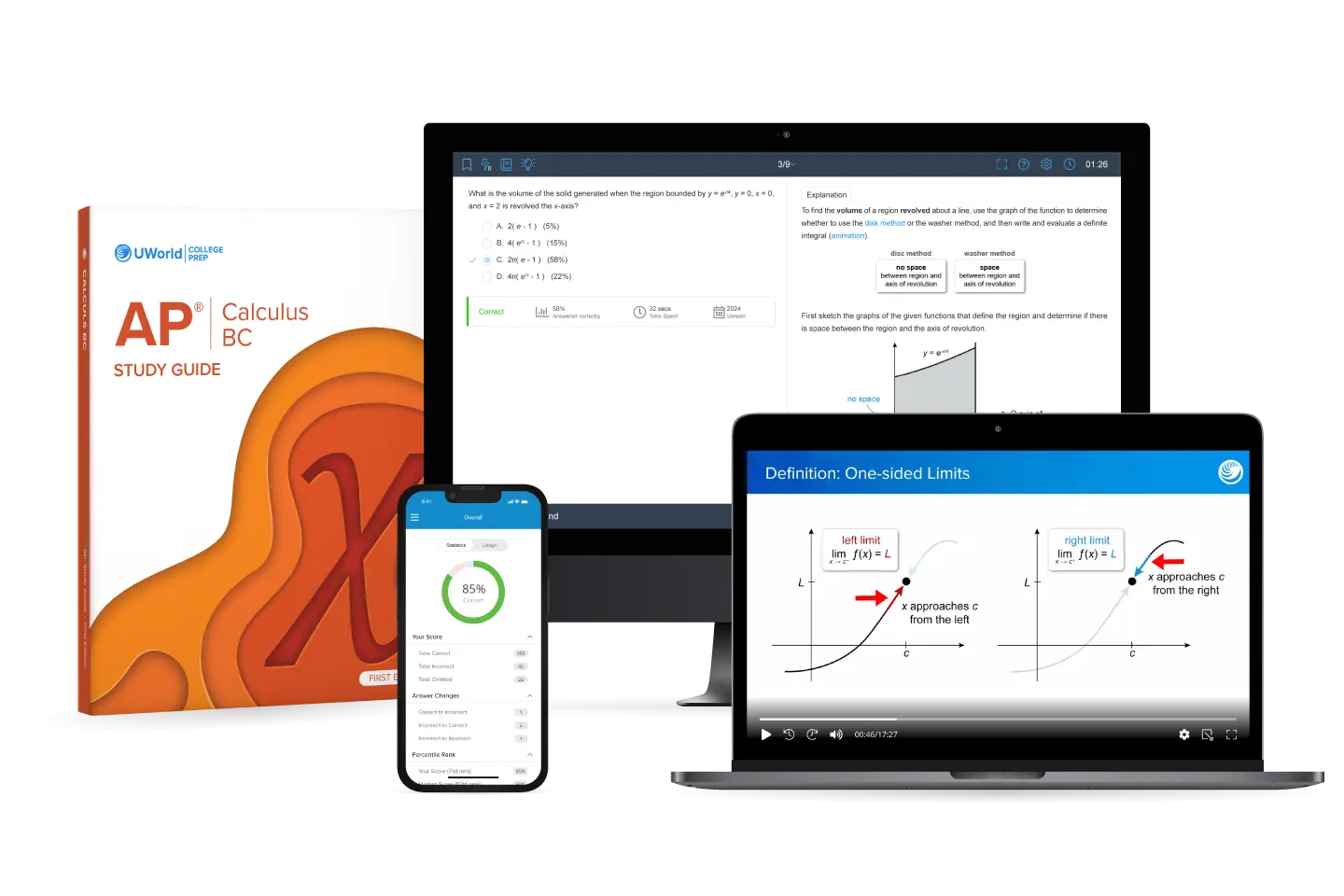
Boost Your Confidence and Score High with Our AP Calculus BC Unit 1 Review
Dive into AP Calculus BC Unit 1: Limits and Continuity with everything you need to master the foundation of calculus. This unit focuses on understanding how limits define continuity and approach derivatives, preparing you for advanced concepts later in the course. Practice with AP Calc BC Unit 1 review lessons, videos, and exam-style questions that build conceptual clarity and strengthen your problem-solving skills for the official AP exam.
Engaging Video Lessons
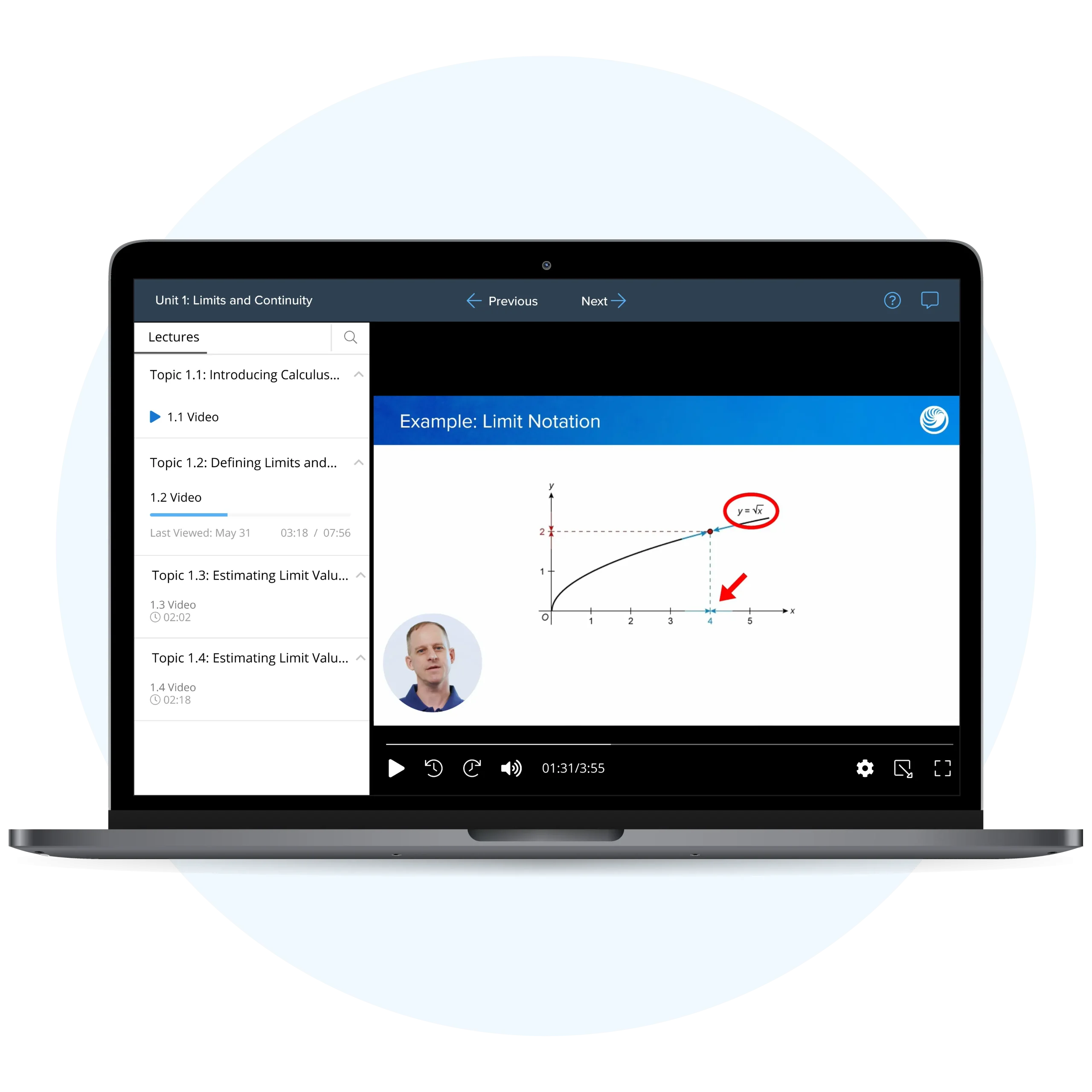
Challenging concepts like evaluating limits, identifying discontinuities, and understanding continuity are broken down into simple, visual explanations. Learn faster with short, high-yield videos tailored for AP Calculus BC Unit 1 review, supported by UWorld’s exclusive progress check questions that reinforce each topic.
Interactive Study Guides
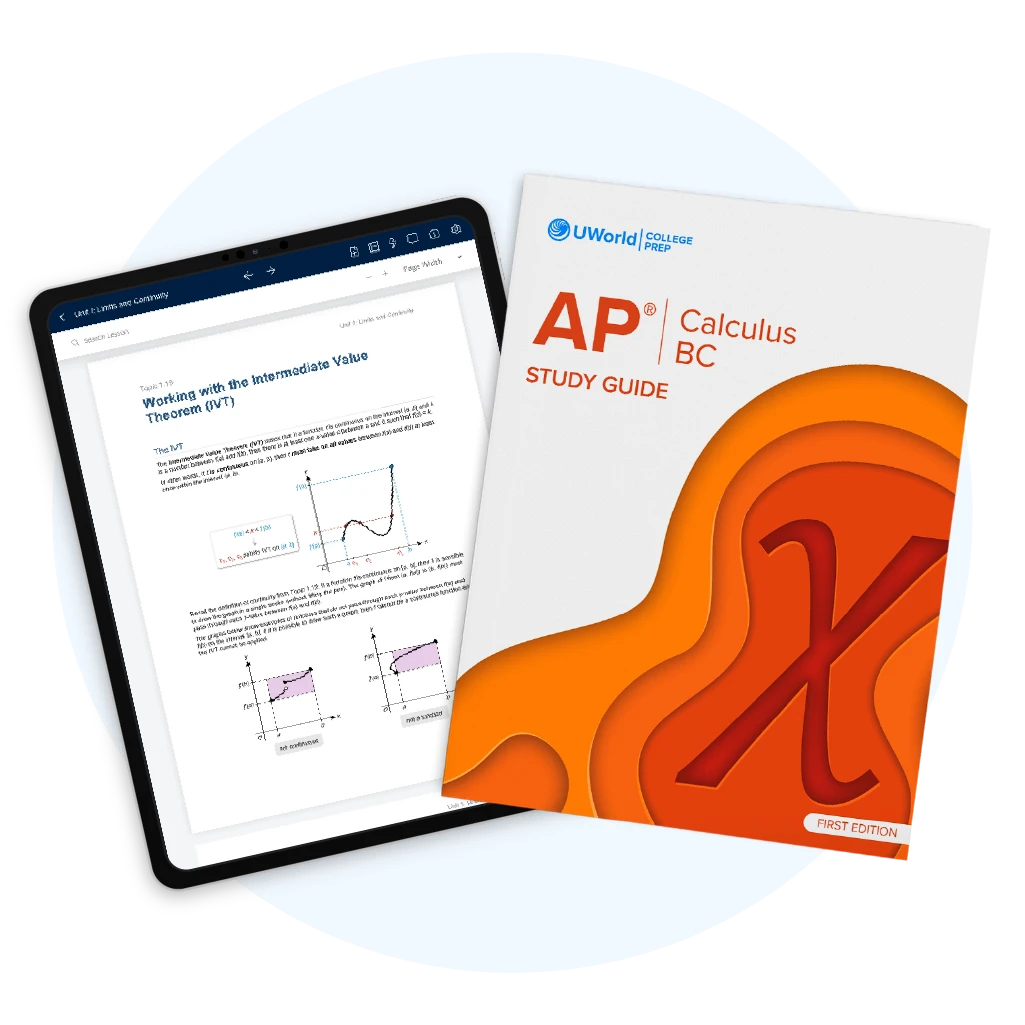
Our AP Calculus BC Unit 1 study guide makes complex ideas like limits and continuity easy to grasp through clear visuals and step-by-step examples. Review how to evaluate limits algebraically, determine continuity at a point, and identify infinite and removable discontinuities. Each topic includes UWorld’s AP Calc BC Unit 1 progress check MCQs and FRQs, giving you instant feedback and targeted practice to strengthen understanding before your next AP Calculus BC Unit 1 test.
Try These AP Calculus BC Unit 1 Practice Test Questions
Question

The table above gives values of a function f at selected values of x. Which of the following limits appear to exist?
| A. | |
| B. | |
| C. | |
| D. All the Above |
Explanation
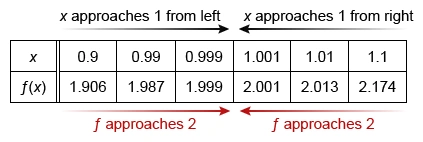
As values of x get very close to 1 from the left, values of f get very close to 2. Therefore, .
As values of x get very close to 1 from the right, values of f get very close to 2. Therefore, .
Both one-sided limits of f equal 2 as x approaches 1. Therefore, it is reasonable to assume the two-sided limit exists and approximately equals 2.
Question
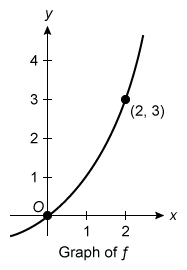
The graph of a function f is shown above. What is the average rate of change in f over the interval [0, 2] ?
| A. | |
| B. | |
| C. 2 | |
| D. 3 |
Explanation
The average rate of change (AROC) of f over [0, 2] corresponds to the slope of the secant line that runs through (0, f(0)) and (2, f(2)). Use the given graph to find the slope of the secant line.
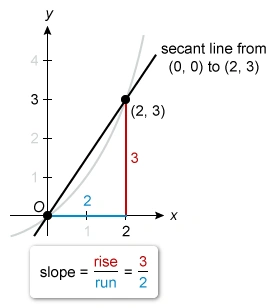
Therefore, the AROC in f over [0, 2] is .
Question
| A. -1 | |
| B. 0 | |
| C. 1 | |
| D. The limit does not exist. |
Explanation
First note that direct substitution yields an indeterminate form, Use the definition of tan x to rewrite the expression with as a factor and evaluate.
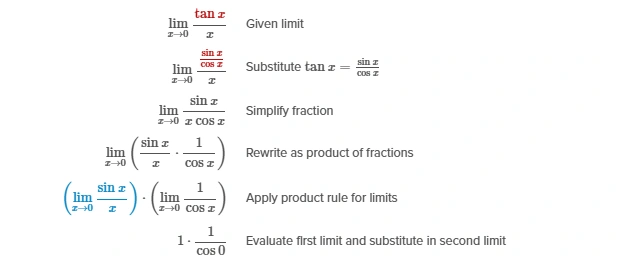
Therefore, the given limit equals 1.

Study Anywhere, Anytime
Review AP Calculus BC Unit 1 concepts wherever you are with the UWorld app. Solve limits and continuity problems on the go, watch short video lessons between classes, or revisit key formulas from your AP Calc BC Unit 1 review anytime. With UWorld’s mobile-friendly platform, every progress check MCQ and FRQ is easily accessible, so consistent practice and improvement fit seamlessly into your routine.


Stand Out
with a Top Score on the AP Calculus BC Exam
Wrap up your AP Calculus BC Unit 1 review and keep advancing through later units with UWorld. Mastering limits and continuity sets the stage for success in derivatives, integrals, and series that follow. Strengthen accuracy, deepen conceptual understanding, and approach the AP exam with confidence to achieve the high score that reflects your full potential.
Get our all-in-one course today!
- Focused AP Calc BC Videos
- Print & Digital Study Guide
- 1800+ Exam-style Practice Questions
- Customizable Quiz Generator
- Adjustable Study Planner
- Realistic Timed Test Simulation
- Colorful Visual Explanations
- Progress Dashboard
- Smart Flashcards & Digital Notebook
Hear From Our AP Students

UWorld’s service is pretty good and helps provide a lot of explanations on subjects I haven’t been confident on before.
The questions here are the most realistic to the AP tests I've seen so far! I appreciate the ability to customize tests as well.
The best part is that all options are well-explained, telling clearly why they are not the right option.
Frequently Asked Questions (FAQs)
What is AP Calculus BC Unit 1, and why is it important for the exam?
AP Calculus BC Unit 1, titled Limits and Continuity, introduces one of the most fundamental ideas in calculus, understanding how functions behave as they approach specific points or infinity. Mastery of this concept is essential for later units involving derivatives, integrals, and series. Because of its foundational nature, it appears frequently in AP Calc BC Unit 1 FRQs and MCQs, making this unit vital for success on the AP exam.
To study effectively:
- Review limit laws and practice evaluating limits using algebraic manipulation, substitution, and rationalization.
- Understand continuity and learn how to determine if a function is continuous at a point or over an interval.
- Study one-sided and infinite limits, as these concepts prepare you for derivative definitions.
- Use AP Calculus BC Unit 1 review materials and guided practice tests to strengthen your understanding.
UWorld’s AP Calculus BC Unit 1 lessons make complex limit concepts visual and approachable. Through video explanations, step-by-step examples, and progress check MCQs, you can identify weak areas and build the confidence needed for top performance on both the AP Calc BC Unit 1 practice test and the full AP exam.
What topics are covered in Unit 1 AP Calculus BC?
Unit 1 of AP Calculus BC, titled Limits and Continuity, establishes the foundation for understanding how functions behave as inputs approach specific values. These ideas lead directly into derivatives and integrals, making this unit essential for higher-level calculus concepts tested on the AP exam. You’ll encounter these fundamentals often in AP Calc BC Unit 1 MCQs, FRQs, and classroom assessments.
Key topics in AP Calculus BC Unit 1 review include:
- Evaluating Limits: Using algebraic manipulation, substitution, and rationalization.
- Limit Laws and Theorems: Applying the squeeze theorem and limit properties.
- Continuity: Identifying removable, jump, and infinite discontinuities in functions.
- One-Sided and Infinite Limits: Understanding how functions behave from both directions.
- Piecewise and Composite Functions: Determining points of continuity across intervals.
- Graphical Analysis: Recognizing limits and continuity from function graphs.
After studying each topic, you can use UWorld’s AP Calculus BC Unit 1 progress check MCQs and FRQs to evaluate understanding and strengthen weak areas. These exclusive checkpoints provide immediate feedback, reinforcing each concept before you move on to the next topic, an effective way to master Unit 1 AP Calc BC before tackling the exam.
How should I study for the AP Calculus BC Unit 1 review?
Studying for AP Calculus BC Unit 1: Limits and Continuity requires combining conceptual understanding with consistent practice. Since this unit introduces the foundation of all calculus, mastering it early ensures success in derivatives, integrals, and series later on. Concepts like approaching values, infinite limits, and continuity at a point appear frequently in AP Calc BC Unit 1 MCQs and FRQs, so it’s important to study with both depth and precision.
Here’s an effective approach for your AP Calc BC Unit 1 review:
- Start with theory: Review definitions of limits, continuity, and one-sided limits.
- Use visuals: Study graphs to interpret limit behavior and discontinuities.
- Apply limit laws: Practice evaluating limits algebraically and with substitution.
- Solve practice problems daily: Reinforce each concept through short quizzes or AP Calculus BC Unit 1 practice test sets.
- Reflect after each topic: Use UWorld’s progress check MCQs and FRQs to gauge how well you understand each concept before moving on.
UWorld’s AP Calculus BC Unit 1 lessons guide you through each topic with annotated visuals, interactive examples, and immediate feedback. Combined with your classroom notes and official College Board materials, this approach ensures steady progress and readiness for the full AP exam.
What’s the best study sequence for AP Calculus BC Unit 1?
A structured study order helps you build a clear understanding of how limits and continuity connect across topics in AP Calculus BC Unit 1. Since each concept builds on the previous one, studying them in sequence ensures you don’t miss the logical flow that supports future units on derivatives and integrals. This sequence is especially useful when reviewing for AP Calc BC Unit 1 practice tests or classroom quizzes.
Follow this recommended study path:
- Introduction to Limits: Understand what limits represent and how they describe a function’s behavior as x approaches a value.
- Evaluating Limits Algebraically: Apply factoring, rationalization, and substitution to solve limit problems.
- One-Sided and Infinite Limits: Learn how functions behave differently from the left and right sides of a point.
- Continuity and Discontinuity: Identify points of discontinuity; removable, jump, or infinite, and test for continuity at a point.
- Piecewise and Composite Functions: Analyze how limits behave across different function intervals.
- Formal Definition of a Limit: Study epsilon-delta reasoning if covered in your course for deeper understanding.
As you move through each topic, reinforce your learning with UWorld’s AP Calculus BC Unit 1 progress check MCQs, which help confirm your grasp of each section before moving forward. Consistent review using this flow will make your Unit 1 AP Calc BC review more efficient and help solidify key concepts.
What is the most effective AP Calculus BC Unit 1 review plan before the exam?
A structured study plan for AP Calculus BC Unit 1: Limits and Continuity ensures you build understanding, retention, and speed in problem solving. Since this unit is the basis for differentiation and integration, an early and consistent approach gives you a strong advantage in later topics.
Follow this 3-phase study approach:
3 Months Before the Exam:
- Begin reviewing the fundamentals: limit definitions, continuity, and one-sided limits.
- Watch short, focused lessons to visualize how functions behave near certain points.
- Reinforce each topic with UWorld’s AP Calculus BC Unit 1 progress check MCQs, designed to help identify weak areas and strengthen reasoning.
- Review class notes alongside visuals and strategies from the How to Study for AP Calculus BC guide for structured pacing.
1 Month Before the Exam:
- Shift from theory to application. Work through AP Calc BC Unit 1 practice test questions that mix conceptual and computational limits.
- Create a condensed summary sheet of limit laws, continuity tests, and common problem types.
- Practice continuity and piecewise function problems that often appear in AP Calc BC Unit 1 FRQs.
2 Weeks Before the Exam:
- Take at least two full-length AP Calculus BC Unit 1 practice tests under timed conditions.
- Revisit missed questions from UWorld progress checks and focus on error correction.
- Allocate daily review blocks for mixed MCQs and FRQs on limits and continuity.
This approach balances theory, practice, and timed review; helping you master Unit 1 AP Calc BC and build the confidence to perform strongly across the full AP Calculus BC exam.
What are the main FRQ question types for AP Calculus BC Unit 1?
The AP Calculus BC Unit 1 FRQs primarily assess your ability to reason through problems involving limits and continuity, often in connection with graphical or real-world representations. These questions test both conceptual understanding and written mathematical communication, making it crucial to explain each step logically. Since Unit 1 forms the base of differentiation and integration, FRQs often integrate limit analysis with early derivative concepts.
Expect the following common AP Calc BC Unit 1 FRQ types:
- Graph Interpretation Questions: Describe where a function is continuous or discontinuous and justify your reasoning using limits.
- Piecewise Function Analysis: Determine continuity at boundary points and use limit laws to support conclusions.
- Formal Limit Proofs: Apply definitions to verify limits exist or do not exist.
- Applied Scenarios: Use limit reasoning in physics- or motion-based problems (e.g., instantaneous velocity).
To prepare effectively:
- Practice FRQs from past exams that include continuity and limit applications.
- Write complete explanations instead of short answers, this helps you earn method and reasoning points.
- Use UWorld’s AP Calculus BC Unit 1 progress check FRQs for structured feedback and detailed explanations.
By regularly working through these question types, you’ll gain the clarity and precision needed to approach any AP Calculus BC Unit 1 review problem confidently and improve your performance on the full exam.
How can I improve my accuracy on AP Calculus BC Unit 1 MCQs and practice questions?
Improving accuracy in AP Calculus BC Unit 1 MCQs comes from developing both conceptual clarity and procedural fluency in limits and continuity. Most errors occur when students rely on memorization instead of understanding why limit rules or continuity tests work. Building stronger reasoning will improve your results on both AP Calc BC Unit 1 review quizzes and full-length practice tests.
To boost precision:
- Master foundational rules. Revisit the definitions of limits, one-sided limits, and continuity at a point.
- Identify error patterns. After each problem set, note if your mistakes stem from algebraic manipulation, substitution errors, or misinterpreting graphs.
- Blend problem formats. Practice numerical, algebraic, and graphical questions to recognize how similar ideas appear across contexts.
- Apply the limit laws regularly. Repetition builds confidence in using theorems like the squeeze theorem or direct substitution effectively.
- Simulate test conditions. Work through timed AP Calculus BC Unit 1 practice test sets to build endurance and accuracy under pressure.
The more consistently you review and reflect on each mistake, the faster your problem-solving accuracy improves, especially on limit and continuity questions that often anchor early sections of the AP Calculus BC exam.
How are limits and continuity connected in AP Calculus BC Unit 1?
In AP Calculus BC Unit 1, limits and continuity are deeply interconnected concepts that form the foundation for understanding change and motion in calculus. A limit describes the behavior of a function as it approaches a specific value, while continuity ensures that the function behaves predictably without breaks or jumps. Understanding this relationship is critical because it determines whether derivatives and integrals, core topics in later units, can exist.
Here’s how they connect conceptually:
- A function is continuous at a point if the limit exists, the function is defined there, and both values are equal.
- When a limit fails to exist, discontinuities occur (removable, jump, or infinite).
- Piecewise functions often illustrate this connection by showing how left-hand and right-hand limits affect continuity.
- Continuity is also used to apply important theorems later, such as the Intermediate Value Theorem and Mean Value Theorem.
Recognizing how limits determine continuity helps students visualize smooth versus abrupt changes in functions. This understanding supports problem-solving across multiple question types in the AP Calc BC Unit 1 review, including graph interpretation, one-sided limits, and continuity verification, skills that carry forward throughout the entire AP Calculus BC course.
How can I retain complex processes or problem types in AP Calculus BC Unit 1?
Retention in AP Calculus BC Unit 1 relies on developing strong visual and conceptual memory for how limits and continuity work together. Because many problems involve multiple steps, algebraic simplification, substitution, and limit evaluation; students often lose accuracy due to skipped reasoning. Building a structured approach to review these steps helps turn short-term understanding into lasting mastery.
Here are a few ways to improve retention:
- Create visual summaries. Sketch graphs of discontinuities and limit behaviors to link formulas with patterns.
- Use structured repetition. Review a few AP Calc BC Unit 1 practice test questions daily to reinforce methods like factoring and rationalization.
- Teach it aloud. Explaining concepts such as “continuity at a point” or “the limit exists if both sides agree” helps strengthen recall.
- Keep a formula tracker. Write down important AP Calculus BC Unit 1 equations and revisit them regularly.
- Mix problem types. Alternate between conceptual and numerical questions to improve adaptability.
Spacing your review and focusing on concept mapping instead of memorization ensures you remember how and why each rule applies. Over time, this approach turns even the most abstract limits and continuity problems into familiar, repeatable processes during the exam.
How do I study limits and continuity for the AP Calculus BC Unit 1 test?
Studying limits and continuity effectively means balancing conceptual understanding, algebraic methods, and visual interpretation. These topics form the base for differentiation and integration, so mastering them early improves performance across all AP Calc BC Unit 1 review sections.
Focus on:
- Understanding what a limit represents and how continuity depends on it.
- Applying limit laws; direct substitution, factoring, and rationalization.
- Identifying removable, jump, and infinite discontinuities.
- Interpreting graphs to compare left-hand and right-hand limits.
- Solving mixed AP Calculus BC Unit 1 practice test questions to improve speed and accuracy.
Alternate between short concept reviews and timed problem sets to strengthen reasoning under pressure. Regular practice helps you recognize function behavior patterns and confidently handle both MCQs and FRQs on the AP Calculus BC Unit 1 test.
What is the best AP Calculus BC Unit 1 practice test format?
The most effective AP Calculus BC Unit 1 practice test format closely mirrors the structure and pacing of the actual AP exam. Since Unit 1: Limits and Continuity focuses on conceptual understanding and procedural fluency, your practice should include both multiple-choice and free-response questions that test reasoning, calculation, and application.
A balanced test format should include:
- 30–35 MCQs: Mix conceptual problems on limits and graphical interpretation with algebra-based continuity questions.
- 2 FRQs: Include one procedural (evaluating or proving a limit) and one analytical (explaining continuity or interpreting a graph).
- Time Limit: Around 60–70 minutes to simulate real exam pacing.
- Review Section: Dedicate 10 minutes after completion to analyze missed questions and note recurring patterns.
This structure ensures that your AP Calc BC Unit 1 review covers both speed and depth of understanding. Completing timed tests regularly helps you manage pacing, recognize problem types quickly, and build the endurance required for the full AP Calculus BC exam.
When should I begin preparing for the AP Calculus BC Unit 1 test?
The best time to start preparing for the AP Calculus BC Unit 1 test is as soon as your class begins covering limits and continuity. These early concepts are foundational, so steady, consistent review is far more effective than last-minute cramming. Starting early allows you to strengthen both conceptual understanding and procedural accuracy before progressing to derivatives and integrals.
Here’s a suggested preparation timeline:
- During Class Instruction: Review daily lessons and solve a few AP Calc BC Unit 1 practice problems after each topic to reinforce learning.
- 2 to 3 Weeks Before the Test: Focus on mixed problem sets covering one-sided limits, continuity tests, and piecewise functions.
- One Week Before the Test: Take short, timed AP Calculus BC Unit 1 practice test sessions to build pacing and identify weak areas.
- Final Days: Review formulas, key AP Calculus BC Unit 1 equations, and common graph patterns.
This gradual approach keeps the material fresh, builds problem-solving confidence, and ensures mastery of limits and continuity, core topics that influence nearly every question type on the AP Calculus BC exam.
What are the common mistakes students make in AP Calculus BC Unit 1?
Many students lose points on AP Calculus BC Unit 1 because they focus on memorizing formulas instead of understanding the logic behind limits and continuity. Since these topics form the foundation for all later calculus concepts, even small misconceptions can carry over into derivatives and integrals. Recognizing and correcting these common errors early will improve both accuracy and confidence.
Frequent mistakes in AP Calc BC Unit 1 review include:
- Confusing when a limit exists versus when a function is defined.
- Forgetting to check both one-sided limits when testing for continuity.
- Misclassifying discontinuities, especially removable vs. jump.
- Overlooking algebraic simplifications before substituting values.
- Ignoring domain restrictions that affect function behavior.
- Misinterpreting graph behavior near asymptotes or holes.
To avoid these issues, always start by analyzing the function visually before solving algebraically. Revisit problem explanations after every AP Calculus BC Unit 1 practice test to see how reasoning connects across examples. Consistent error analysis ensures that conceptual gaps are filled long before exam day, setting you up for success on the full AP Calculus BC exam.
Where can I find AP Calculus BC Unit 1 notes, cheat sheets, or study guides?
Reliable AP Calculus BC Unit 1 notes and study guides simplify the most important concepts of limits and continuity into clear, quick-reference materials. The best resources summarize definitions, formulas, and problem-solving techniques that help you review efficiently before a test or quiz. Quality guides also include visuals and examples that explain how limits behave near specific points and why continuity matters for real-world functions.
Look for study materials that include:
- Key AP Calculus BC Unit 1 equations for evaluating limits and testing continuity.
- Step-by-step examples showing how to handle one-sided and infinite limits.
- Graph-based explanations that illustrate removable, jump, and infinite discontinuities.
- Summaries of limit laws, theorems, and continuity conditions in checklist form.
- Short quizzes or AP Calc BC Unit 1 practice test sets for quick revision.
Using a mix of your class notes and structured AP Calculus BC Unit 1 review sheets helps reinforce accuracy and recall. Concise, well-organized guides are especially useful during the final days before the exam, allowing you to refresh essential topics quickly and confidently.
Are there downloadable AP Calculus BC Unit 1 study guide PDFs and practice materials?
Yes. Downloadable AP Calculus BC Unit 1 review PDFs and worksheets provide concise summaries of equations, definitions, and example problems on limits and continuity. Choose resources that follow the College Board’s Course and Exam Description for accurate alignment with the official curriculum.
You can also access printable and digital AP Calc BC Unit 1 study guides, flashcards, and practice test materials designed to reinforce understanding of limit laws, continuity conditions, and one-sided limits. Combining structured review sheets with official College Board resources ensures conceptual mastery and exam-style readiness for AP Calculus BC Unit 1: Limits and Continuity.
Learn More About Specific Unit
Differentiation: Definition and Fundamental Properties
Differentiation: Composite, Implicit, and Inverse Functions
Contextual Applications of Differentiation
Analytical Applications of Differentiation
Integration and Accumulation of Change
Differential Equations
Applications of Integration
Parametric Equations, Polar Coordinates, and Vector-Valued Functions
Infinite Sequences and Series