
AP® Calculus AB Unit 5 Review and Practice Test
Prepare for your AP® Calculus AB Unit 5 test with our complete Analytical Applications of Differentiation review. This unit deepens your understanding of how derivatives describe function behavior, including extrema, concavity, and motion. You’ll learn to apply derivatives to real-world contexts, analyze graphs, and solve optimization problems with precision. Our AP Calc AB Unit 5 review combines high-yield video lessons, an interactive study guide, and Unit 5 practice tests that reflect the actual AP exam format.
Boost Your Confidence and Score High with Our AP Calculus AB Unit 5 Review
Master AP Calculus AB Unit 5: Analytical Applications of Differentiation with all the tools you need to succeed. This AP Calc AB Unit 5 review explains how derivatives describe function behavior, from identifying extrema and points of inflection to analyzing concavity and motion. Strengthen your problem-solving skills with unit 5 AP Calc AB practice tests and MCQs that mirror the style and difficulty of the actual exam, and reinforce every concept through UWorld’s detailed Unit 5 study guide and step-by-step lessons.
Engaging Video Lessons
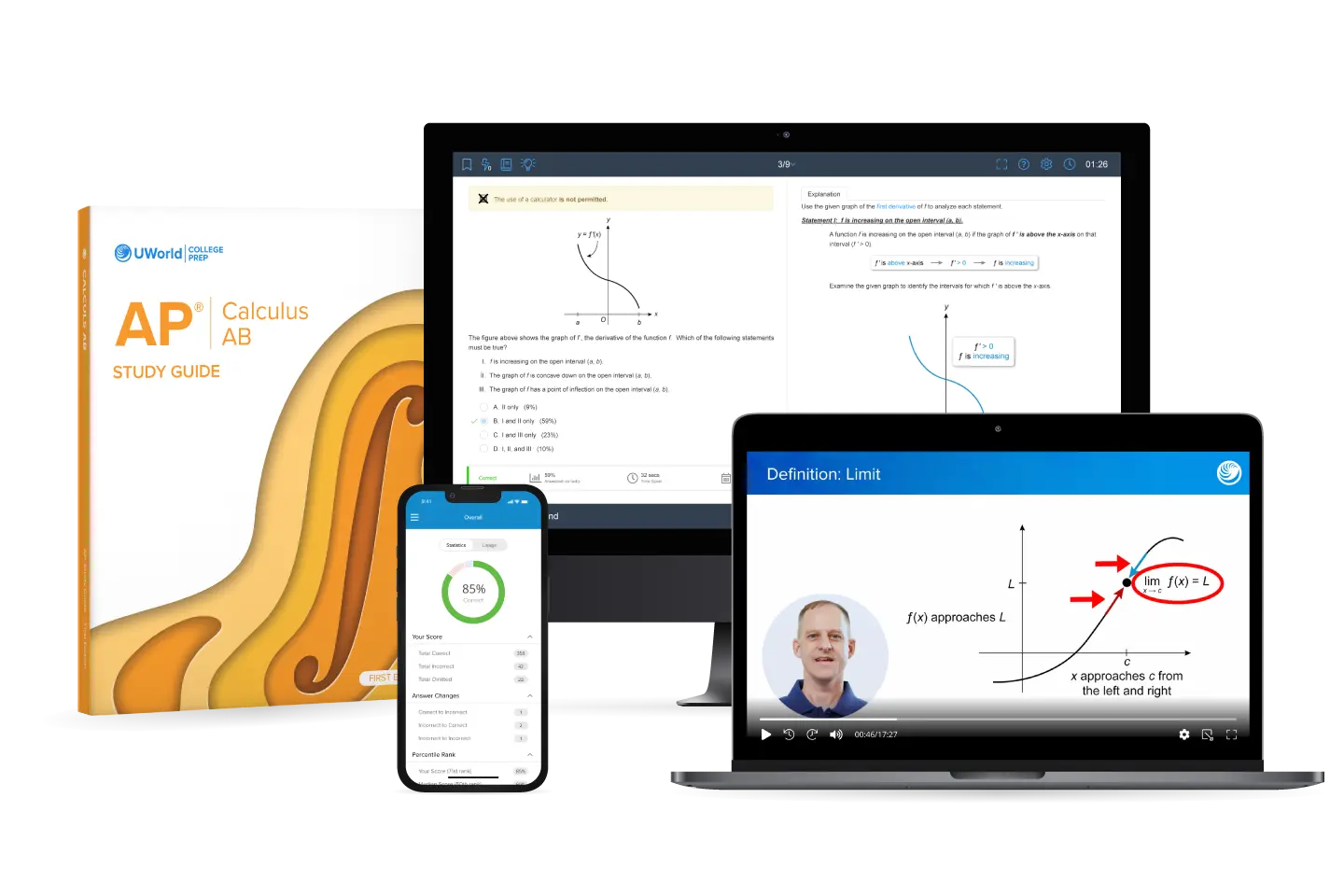
Understand how derivatives reveal the behavior of functions with short, visual lessons designed for clarity. UWorld’s AP Calculus AB Unit 5 videos simplify complex ideas like concavity, extrema, and optimization, showing how each connects to real-world motion and rates of change. These AP Calc AB Unit 5 video lessons use step-by-step visualizations to make problem-solving intuitive, helping you review efficiently before your next quiz or exam.
Interactive Study Guides
Our AP Calculus AB Unit 5 study guide covers every topic in the College Board’s CED. Built-in knowledge checks reinforce your understanding of extrema, concavity, and optimization, so you know exactly what to review for your AP Calc AB Unit 5 review.
Try These AP Calculus AB Unit 5 Practice Test Questions
Question
The derivative of a continuous function f is given by for x > 0. If f(1) = 16 and f(4) = 19, what value of x in the open interval (1, 4) satisfies the conclusion of the Mean Value Theorem for f on the closed interval [1, 4] ?
| A. 1 | |
| B. | |
| C. | |
| D. 2 |
Hint :
The Mean Value Theorem guarantees that the instantaneous rate of change of a continuous and differentiable function f equals the average rate of change of f on [a, b] for at least one x-value in the interval (a, b).
Explanation
The Mean Value Theorem (MVT) guarantees that the instantaneous rate of change of a continuous and differentiable function f equals the average rate of change (AROC) of f on [a, b] for at least one x-value c in the interval (a, b).
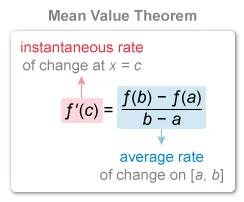
To determine the value of x = c that satisfies the MVT for f on the closed interval [1, 4], first use the given function values to calculate the (AROC) of f(x) on [1, 4].
| AROC formula for a = 1 and b = 4 | |
| Plug in f(4) = 19 and f(1) = 16 | |
| Simplify |
The average rate of change of f(x) on [1, 4] is equal to 1, so set the given instantaneous rate of change equal to the average rate of change 1 and solve for x.
| Set instantaneous rate of change equal to AROC | |
| Multiply both sides by x2 | |
| Add 12 and subtract x2 on both sides | |
| Divide both sides by 3 | |
| Take the square root of both sides |
The solution x = −2 is not in the interval (1, 4), so the only value that satisfies the MVT for f on the closed interval [1, 4] is x = 2.
(Choice A) 1 is the value of the average rate of change of f on [1, 4], but the question asks for the value of x that satisfies the MVT on [1, 4].
(Choice B) may result from mistakenly setting f ′ equal to zero instead of setting f ′ equal to the average rate of change.
(Choice C) may result from incorrectly calculating the average rate of change as 3.
Things to remember:
The Mean Value Theorem guarantees that the instantaneous rate of change of a continuous and differentiable function f equals the average rate of change of f on [a, b] for at least one x-value in the interval (a, b).
Question
The function g is defined by . If the function f is an antiderivative of g, which of the following is the x-coordinate of the location of a local minimum for the graph of y = f(x) ?
| A. −5.058 | |
| B. −3.391 | |
| C. 1.216 | |
| D. 3.821 |
Hint :
An antiderivative f of a function g is any function whose derivative is g.
Explanation
An antiderivative f of a function g is any function whose derivative is g. It is given that f is an antiderivative of g, so the derivative of f is g.
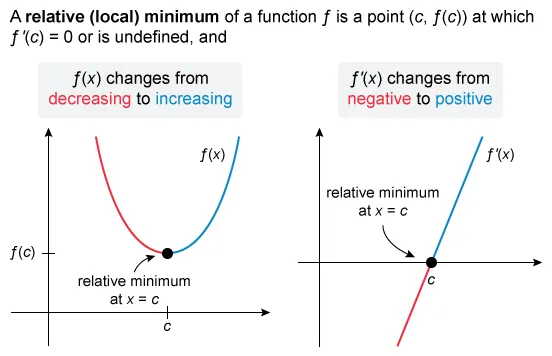
A local (relative) minimum on the graph of f(x) occurs at any value of x where f′(x) = g(x) is zero or undefined (a critical point on the graph of f) and changes from negative to positive.
| To find the x-value of the relative minimum of f, graph its derivative and locate any zeros where the graph changes from negative to positive. |
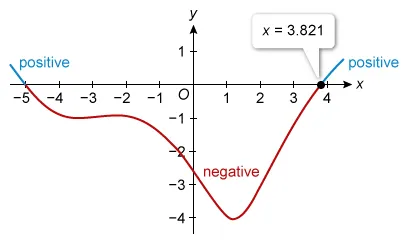
The graph of f ′ = g changes from negative to positive at only one point, so the graph of y = f(x) has a relative minimum at x = 3.821.
(Choice A) −5.058 is the x-coordinate of a local maximum on the graph of f, but the question asks for the x-value of a local minimum.
(Choices B and C) −3.391 and 1.216 are x-coordinates of relative minimums on the graph of g(x), but the question asks for a relative minimum on the graph of f(x) = g ′(x).
Things to remember:
-
An antiderivative of a function f is any function F whose derivative is f.
-
A local minimum of a continuous function f(x) occurs at any value of x at which f ′(x) is zero or undefined and f ′ changes from negative to positive.
Question
The function f is continuous on the closed interval [−1, 5]. If f(−1) = −3 and f(5) = 3, which of the following conditions would guarantee that there is a number c in the open interval (−1, 5) where f ′(c) = 1 ?
| A. f is differentiable on the open interval (−1, 5). |
|
| B. f is not differentiable on the open interval (−1, 5). | |
| C. for all k on the open interval (−1, 5). | |
| D. f ′(k) = 0 for at least one value of k in the open interval (−1, 5). |
Hint :
The Mean Value Theorem guarantees that the instantaneous rate of change of a continuous and differentiable function f equals the average rate of change of f on [a, b] for at least one x-value c in the interval (a, b).
Explanation
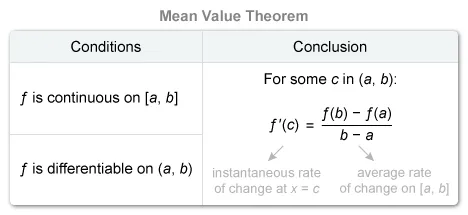
The Mean Value Theorem (MVT) guarantees that the instantaneous rate of change of a continuous and differentiable function f equals the average rate of change of f on [a, b] for at least one x-value c in the interval (a, b).
To guarantee there is a number c in the open interval (−1, 5) where f ′(c) = 1, first verify the average rate of change is 1 between the given points f(−1) = −3 and f(5) = 3 (calculation).
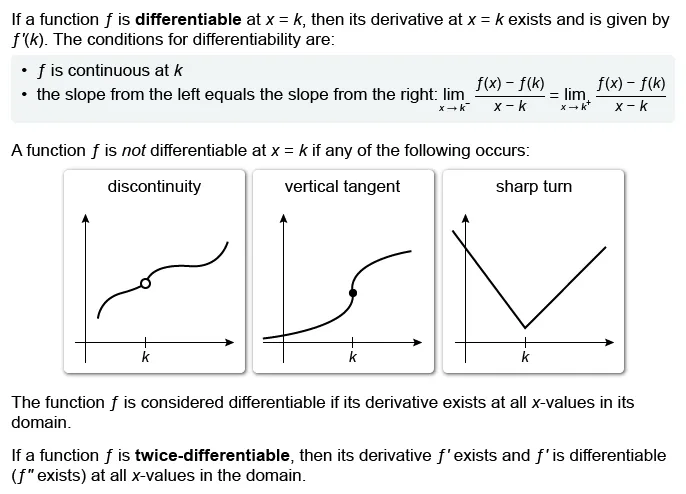
The MVT guarantees that f ′(c) = 1 if the MVT conditions are met for f on the interval [−1, 5]. It is given that f is continuous on [−1, 5], but no information is given about the differentiability of f on (1, 5).
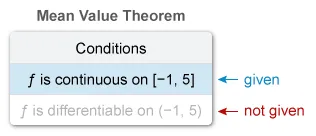
The MVT applies to the continuous function f on [−1, 5] and guarantees that f ′(c) = 1 for at least one value of c in (−1, 5) only if f is differentiable on the open interval (−1, 5).
(Choice B) "f is not differentiable on the open interval (−1, 5)" indicates that the MVT does not apply to the function on the interval, but the question implies that the MVT does apply.
(Choice C) " for all k on the open interval (−1, 5)" indicates that the function is continuous on the open interval, but the MVT also requires differentiability.
(Choice D) "f ′(k) = 0 for at least one value of k in the open interval (−1, 5)" is the conclusion of Rolle's Theorem, but the question requires justifying the conditions of the MVT.
Things to remember:
The Mean Value Theorem guarantees that the instantaneous rate of change of a continuous and differentiable function f equals the average rate of change of f on [a, b] for at least one x-value c in the interval (a, b).

Stand Out
with a Top Score in AP Calculus AB
Complete your AP Calculus AB Unit 5 review and keep building your mastery across all units with UWorld. Achieving a top score can enhance your academic profile and open doors to competitive college programs and scholarship opportunities.
Get our all-in-one course today!
- Focused AP Calc AB Videos
- Print & Digital Study Guide
- 1400+ Exam-style Practice Questions
- Customizable Quiz Generator
- Adjustable Study Planner
- Realistic Timed Test Simulation
- Colorful Visual Explanations
- Progress Dashboard
- Smart Flashcards & Digital Notebook
Hear From Our AP Students
UWorld’s service is pretty good and helps provide a lot of explanations on subjects I haven’t been confident on before.
The questions here are the most realistic to the AP tests I've seen so far! I appreciate the ability to customize tests as well.
The best part is that all options are well-explained, telling clearly why they are not the right option.

Frequently Asked Questions (FAQs)
What is AP Calculus AB Unit 5 about?
AP Calculus AB Unit 5, titled Analytical Applications of Differentiation, focuses on using derivatives to analyze how functions behave. This unit explains how to determine where a function is increasing or decreasing, identify extrema, analyze concavity, and locate inflection points. Students also explore optimization and motion problems, applying derivatives to real-world and graphical contexts. Mastering these ideas is key to understanding relationships between variables and preparing for integration topics in later units.
UWorld’s AP Calculus AB Unit 5 review and study guide provide visual examples, detailed explanations, and real exam-style problems. This structured approach helps you connect theory with application and gain the confidence to succeed on your AP Calc AB Unit 5 test or practice test.
Which topics are covered in AP Calculus AB Unit 5?
Unit 5 AP Calc AB, also known as Analytical Applications of Differentiation, builds on derivative concepts to help students interpret and predict function behavior. This unit focuses on applying derivatives to real-world and theoretical problems through graphical, numerical, and analytical reasoning.
Key topics covered include:
- Extrema and Critical Points: Using derivatives to locate local and absolute maxima and minima.
- Concavity and Inflection Points: Determining where a function curves upward or downward and identifying changes in curvature.
- The First and Second Derivative Tests: Analyzing function behavior to justify increasing/decreasing intervals and concavity.
- Optimization Problems: Solving real-world scenarios involving maximum or minimum values.
- Motion and Rate-of-Change Applications: Applying derivatives to describe velocity, acceleration, and movement along a curve.
UWorld’s AP Calculus AB Unit 5 study guide and QBank are aligned with the College Board’s Course and Exam Description (CED). Each topic includes AP Calc AB Unit 5 practice test questions and visual explanations to make your AP Calculus AB Unit 5 review efficient, targeted, and exam-ready.
Where can I find the best AP Calculus AB Unit 5 study guide and notes?
A well-designed AP Calculus AB Unit 5 study guide should teach both the “why” and the “how” behind each derivative application. UWorld’s print and digital materials for AP Calc AB Unit 5 follow the College Board’s CED and walk you through analytical applications of differentiation; covering extrema, concavity, inflection points, and optimization. Every section includes short self-check activities and quick practice examples that confirm your grasp of each concept before you move ahead.
The AP Calculus AB Unit 5 notes PDF, available in the UWorld app, features visual graphs, concise explanations, and built-in flashcards with a personalized planner for flexible study sessions. You can also try a free trial to explore how UWorld’s integrated read-watch-practice method streamlines your learning compared with typical class notes or online worksheets. While additional College Board or classroom resources can complement your preparation, UWorld’s platform should be your main source for a complete, efficient AP Calculus AB Unit 5 review.
What types of questions usually appear on the AP Calculus AB Unit 5 test?
The AP Calculus AB Unit 5 test focuses on applying derivatives to analyze and interpret the behavior of functions. Students encounter both multiple-choice and free-response questions that assess their understanding of extrema, concavity, and optimization concepts introduced in this unit.
Common question types include:
- Graphical analysis of increasing/decreasing intervals and points of inflection.
- Derivative-based justifications using the First and Second Derivative Tests.
- Optimization problems involving real-world maximum and minimum values.
- Motion and related rates questions connecting velocity, acceleration, and position.
- Interpretation of graphical data and reasoning from slope and tangent behavior.
UWorld’s AP Calc AB Unit 5 review and practice tests mirror these formats, featuring problems that reflect the rigor and style of the actual exam. Each AP Calculus AB Unit 5 practice test includes detailed visual explanations, helping you master every topic in Analytical Applications of Differentiation.
What concepts should I master before taking the AP Calculus AB Unit 5 test?
Before taking your AP Calculus AB Unit 5 test, make sure you have a strong understanding of the fundamental derivative concepts introduced in earlier units. You should be able to calculate derivatives accurately, interpret their meaning, and apply them to real-world and graphical scenarios.
Key concepts to review include:
- Identifying and classifying critical points, extrema, and inflection points.
- Applying First and Second Derivative Tests to determine function behavior.
- Solving optimization problems involving maximum and minimum values.
- Understanding how concavity and slope describe motion, acceleration, and rates of change.
- Analyzing graphical representations to predict behavior using the derivative relationship
UWorld’s AP Calculus AB Unit 5 study guide, video lessons, and practice tests give you all the tools you need to strengthen these skills. By reading concise explanations, watching step-by-step demonstrations, and practicing with AP Calc AB Unit 5 review questions, you’ll gain the confidence and accuracy needed to excel on both unit tests and the full AP Exam.
Are there any free resources available for AP Calculus AB Unit 5?
Yes. UWorld offers a free trial that gives you access to selected AP Calculus AB Unit 5 practice tests, multiple-choice questions, and visual explanations from expert instructors. This allows you to experience how derivative applications are taught and tested before subscribing to the full program.
The free version highlights how UWorld’s AP Calc AB Unit 5 review platform connects theory with practice, helping you learn how extrema, concavity, and optimization appear in real exam questions. You can explore how each problem is broken down step by step, with graphs and reasoning that reinforce understanding.
Combining the UWorld free trial with official College Board materials or classroom notes creates a balanced study plan. However, UWorld remains the most efficient primary resource for mastering the analytical applications of differentiation and preparing for your AP Calculus AB Unit 5 test.
How can I find an AP Calculus AB Unit 5 cheat sheet?
While a full study plan is always best, UWorld provides concise reference tools that can serve as an effective AP Calculus AB Unit 5 cheat sheet for quick review. These summaries highlight essential derivative concepts and applications from Analytical Applications of Differentiation, making them perfect for last-minute study sessions or on-the-go practice.
Key topics covered in these short reference materials include:
- Rules for finding extrema, concavity, and inflection points.
- Optimization strategies using derivatives.
- First and Second Derivative Tests for analyzing graphs.
- Real-world motion and rate-of-change applications.
- Critical terms and formulas essential for the AP Calc AB Unit 5 test.
These quick references are available through the UWorld app, along with flashcards and AP Calculus AB Unit 5 notes PDF materials for structured learning. They’re designed to complement, not replace, full-length AP Calculus AB Unit 5 review and practice tests that provide deeper understanding and exam readiness.
What are the best flashcards for AP Calculus AB Unit 5 review?
The most effective AP Calculus AB Unit 5 flashcards focus on key derivative applications and help reinforce understanding through active recall and repetition. UWorld’s flashcard system is designed to complement your AP Calc AB Unit 5 review, offering structured practice on critical Unit 5 concepts and definitions from Analytical Applications of Differentiation.
Each deck includes:
- Core terminology such as extrema, concavity, inflection point, and optimization
- Step-by-step derivative strategies and problem-solving reminders
- Concept links connecting derivatives to motion, velocity, and acceleration
- Graph-based examples that visualize how derivatives describe function behavior
UWorld’s digital flashcard system works seamlessly across devices and adapts to your performance using spaced repetition to improve long-term retention. You can tag tricky topics for extra review, track progress, and instantly connect each flashcard to related AP Calculus AB Unit 5 practice questions for complete reinforcement.
How can I maximize my AP Calculus AB Unit 5 review?
A strong AP Calculus AB Unit 5 review integrates reading, watching, and active practice. UWorld combines all these methods in one structured platform to help you master Analytical Applications of Differentiation.
- Read: Begin with UWorld’s AP Calculus AB Unit 5 study guide, featuring clear explanations and visual graphs that simplify concepts like extrema, concavity, inflection points, and optimization.
- Watch: Learn through UWorld’s high-yield video lessons that break down derivative applications into real-world examples, showing how slope, motion, and rate of change connect to function behavior.
- Practice: Strengthen comprehension with AP Calc AB Unit 5 practice tests and problem sets designed to mirror the real exam. Each question includes step-by-step solutions and visual reasoning to reinforce accuracy.
- Active Recall & Spaced Repetition: Use UWorld’s adaptive flashcard system to revisit challenging calculus concepts and formulas at spaced intervals, improving retention and long-term understanding.
- Timed Practice: Simulate real exam conditions with the AP Calculus AB Unit 5 test to build pacing, focus, and problem-solving efficiency under pressure.
- Targeted Review & Tracking: Use UWorld’s progress dashboard to analyze results, identify weak areas, and track growth through analytics that show improvement over time during your AP Calculus AB Unit 5 review.
UWorld’s integrated approach ensures comprehensive preparation, guiding you from concept mastery to confident performance on your AP Calculus AB Unit 5 test and the full AP Exam.
Learn More About Specific Unit
Limits and Continuity
Differentiation: Definition and Fundamental Properties
Differentiation: Composite, Implicit, and Inverse Functions
Contextual Applications of Differentiation
Integration and Accumulation of Change
Differential Equations
Applications of Integration