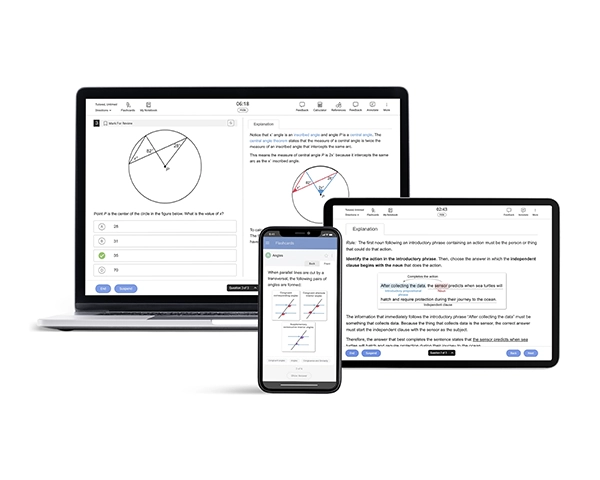
This guide explains how the SAT Reading and Writing section works, how to start studying, and which strategies will help you increase your score efficiently for the 2026 academic year. You will also find realistic practice suggestions and expert SAT Reading and Writing tips to guide your study plan.
Understanding the SAT Reading and Writing Section
The SAT Reading and Writing section is a combined portion of the digital SAT that measures your ability to read, interpret, and revise short texts. To do well, you need strong reading comprehension, grammar knowledge, vocabulary skills, and data interpretation abilities. These skills help you understand what a question is actually asking and eliminate wrong answer choices confidently.
What the RW Section Actually Measures
The exam is designed to measure the following high-value skills:
- Identifying central ideas, themes, and evidence.
- Understanding vocabulary in context.
- Analyzing tone, purpose, and structure.
- Applying grammar rules and recognizing errors.
- Improving clarity, accuracy, and conciseness in writing.
- Interpreting charts, tables, and informational graphics.
- Evaluating logical relationships and strengthening arguments.
Each question is short, so accuracy matters more than speed. Mastering these skills early makes it easier to apply effective SAT reading strategies during practice.
How the Digital SAT RW Format Impacts Your Study Strategy
Since the digital SAT uses short passages and adaptive modules, your study plan should focus on:
- Practicing short, targeted questions.
- Strengthening your ability to skim for purpose.
- Building comfort with screen-based reading.
- Improving accuracy on inference and evidence questions.
- Learning to revise sentences for clarity and logic.
- Interpreting graphics quickly and accurately.
If you find visual information challenging, review how to analyze data presented in charts or tables. These question types reward students who can read precisely under timed conditions.
How to Start Studying for SAT Reading and Writing
Before you begin learning new SAT Reading and Writing strategies, start with a structured approach. Take a diagnostic test to understand your baseline performance, identify the question types that slow you down, and determine where you tend to lose accuracy. This helps you set clear goals and begin your prep with a focused plan instead of guessing what to study next.
A diagnostic test also reveals whether you struggle more with reading skills like inference and evidence selection or with writing skills such as grammar rules and sentence clarity. You can check your progress over time by completing a UWorld SAT Practice Test, which mirrors the digital testing experience and tracks your improvement.
Identify Your Reading Weaknesses
Students often understand basic passages but lose points on higher -level reading skills such as inference, evidence selection, and interpretation. Identifying your weak areas early helps you choose the SAT reading strategies that will lead to the biggest improvement.
Start by noticing where you struggle the most. For example, if you find it difficult to draw conclusions from short passages, you may benefit from reviewing how inference questions work. If locating supporting evidence takes too long, practice focusing on keywords and scanning for matching ideas. Students who struggle with charts or visuals can also build confidence by practicing with data-based questions that appear on the digital SAT.
Pay special attention to patterns that cause repeated mistakes. Over time, you will see whether your challenges come from speed, accuracy, or question interpretation. Understanding these trends helps you target your practice and improve your SAT reading score more efficiently.
Identify Your Writing Weaknesses
The Writing portion of the SAT evaluates grammar knowledge, clarity, sentence structure, and your ability to revise text effectively. Many students lose points on advanced editing skills like verb tense consistency, modifier placement, punctuation, and logical flow. Identifying these weaknesses early helps you apply stronger SAT writing strategies during your prep.
Focus first on the high-yield skills that appear across many questions. These include verbs, pronouns, modifiers, transitions, and clarity-based revisions. Notice which rules you tend to confuse, and track them each time you review your answers. If you often choose between two similar options, you may need to strengthen your grammar fundamentals or practice recognizing concise writing.
Pay close attention to consistent patterns in your mistakes. For example, unclear pronouns, misplaced modifiers, or unnecessary wordiness often appear repeatedly.
Set a Realistic RW Score Goal
Set a score goal based on your diagnostic results, timeline, and the colleges you plan to apply to. A clear target keeps your prep focused and helps you measure steady progress. Break your goal into smaller steps, such as improving accuracy on specific question types, reducing careless errors, or completing a set number of SAT Reading and Writing practice questions each week. This structured approach supports consistent growth in both reading and writing skills.
How to Study for SAT Reading (Step-by-Step Strategies)
Improving your SAT Reading score requires more than reading a passage from start to finish. Since the digital SAT uses short, focused texts, you need a strategic approach that helps you understand the purpose of each passage, locate evidence quickly, and avoid distractor choices. The following SAT reading tips and techniques will help you read more efficiently and improve your accuracy on test day.
Use Purpose-Driven Reading for Short Passages
Short SAT passages are designed to test how well you identify the author’s purpose, tone, and central idea. Before reading the text, look at the question to understand what the passage will ask you to find. This purpose-driven approach helps you stay focused on key information instead of scanning every word.
Ask yourself:
- What is the author trying to explain or prove?
- What problem or idea is the passage addressing?
- What overall message should I take away from this text?
Using this mindset will help you understand the passage faster and support more accurate answer choices.
Improve Accuracy on Inference and Evidence Questions
Inference and evidence-based questions appear frequently on the SAT Reading section. These questions require you to read between the lines, identify ideas not stated directly, and support conclusions with textual evidence. Many students lose points here by overthinking the passage or assuming information that is not present.
To improve:
- Base your answer on what the passage directly supports.
- Look for the strongest line or phrase that backs up your conclusion.
- Avoid answers that exaggerate, assume, or introduce new ideas.
Effective Skimming and Scanning Techniques
Since passages are short, you do not need to read every sentence slowly. Instead, skim for the main idea and scan for the details relevant to the question. Skimming helps you understand the general message, while scanning allows you to quickly locate keywords, tone shifts, transitions, or specific data.
Helpful techniques include:
- Focus on the first and last sentences of each paragraph.
- Look for contrast words like however, but, although.
- Circle important names, dates, or claims.
- Scan the passage again only after reading the question
This technique saves valuable time while supporting strong comprehension.
Eliminate Wrong Choices Using Logical Filters
Elimination is one of the most powerful SAT reading strategies. Wrong answers often include absolute language, extreme claims, unsupported assumptions, or details that do not match the passage. Learning how to filter out these distractors will help you raise your SAT Reading score even when a question seems difficult.
You can apply these logical filters:
- Remove answers with absolute words like always or never.
- Eliminate options that introduce unrelated ideas.
- Cross out answers that distort the author’s view.
- Reject choices that sound correct but lack evidence.
How to Improve Reading Speed (Without Losing Accuracy)
Reading speed often affects performance on the SAT, especially for students who read every sentence too carefully. Improving your speed does not mean rushing. Instead, it means training your eyes to move smoothly across the passage and focusing only on information that matters.
To increase reading speed while maintaining accuracy:
- Start with skimming to get the main idea.
- Avoid rereading unless necessary.
- Practice timed reading drills.
- Annotate only essential ideas.
- Train yourself to move on when stuck.
How to Study for SAT Writing (Grammar + Editing Strategies)
The SAT Writing portion tests how well you understand grammar rules, improve sentence clarity, and revise text for accuracy. Since the digital exam includes short, targeted questions, you need to know the rules that appear most often and apply editing skills quickly. The following SAT writing tips and techniques will help you build strong fundamentals and avoid common mistakes.
Master High-Yield Grammar Rules First
Most of the SAT Writing questions focus on essential grammar topics, so strengthening these rules gives you the biggest score boost. Focus your study on the concepts that appear across many questions, including:
- Verb tense consistency
- Subject-verb agreement
- Pronoun clarity
- Modifier placement
- Parallel structure
- Punctuation such as commas, colons, and apostrophes
How to Approach Expression of Ideas Questions
Many questions ask you to revise sentences for clarity, transitions, tone, and logical flow. These are known as Expression of Ideas questions, and they require you to improve the writer’s message rather than simply correct grammar.
To master these questions:
- Choose the most concise and direct version.
- Make sure sentences follow a logical order.
- Use transitions that match the relationship between ideas.
- Maintain consistent tone and style throughout the passage.
Learn to Recognize Common Wrong-Answer Patterns
Wrong answers in SAT Writing often follow predictable patterns. They may include grammar errors, unnecessary wordiness, extreme claims, misplaced transitions, or ideas that do not support the passage. Learning to identify these patterns helps you eliminate incorrect choices quickly and confidently.
Look for answers that:
- Change the meaning of the original sentence.
- Add unnecessary or repetitive information.
- Introduce an error where none existed.
- Use punctuation incorrectly.
- Misplace modifiers or pronouns.
Fix RW Mistakes Using a Consistency Checklist
A consistency checklist helps you catch errors that appear repeatedly across reading and writing questions. Many students improve their SAT Writing score by reviewing their answers and looking for patterns in the mistakes they often make, such as:
- Shifts in verb tense
- Pronouns without clear antecedents
- Incorrect modifier placement
- Redundant or wordy sentence structure
- Inconsistent transitions
SAT Reading and Writing Study Plan
The most effective study sessions begin with a plan. Start early and structure your regimen based on your testing time frame and unique student profile. A custom plan means optimal practice. If you’re prepping during the school year, a dynamic study planner accounts for classes and activities, doing all the hard work for you.
Study Plans by Timeline
Choose the plan that matches how much time you have before your SAT. Longer study plans usually lead to stronger score improvement.
|
6-Month Plan Start with a diagnostic test and keep a steady pace of 1 hour per week (2 sessions of 30 minutes or 3 sessions of 20 minutes). Prioritize your weakest areas and thoroughly review answer explanations. Take 1 full-length practice test monthly. |
3-Month Plan Begin with topics and questions you find most challenging. Dedicate about 1 hour per week, broken into 2-3 short sessions with a day or more between them, to support long-term retention. Concentrate on revisiting flashcards and notes in your final week. |
|
1-Month Plan Take 1 practice test at the beginning of the month and another 2 weeks before the SAT to measure your progress. Aim for 20 minutes to 1 hour per weekday (150-250 questions per week). |
2-Week Plan Practice 150-250 questions weekly, accompanied by a full-length mock exam. After taking the SAT, consider planning additional review time if you want to retake the exam and improve your score further. |
Study Plans by Student Profile
Different students need different approaches. Use the plan that best matches your habits and learning style.
|
Busy Aim for shorter sessions during a longer prep period (6 - 12 months) to fit into your hectic life. The goal is progress without sacrificing your other commitments. |
At a Plateau Drill hard questions to get “unstuck” and target your weakest areas with our adaptive learning technology. |
|
Just Getting Started Ease into your studies with our structured resources and guidance. Build your knowledge and confidence from day 1. |
Not a “Good Test Taker” Focus on gaining confidence and comfort with exam content. Learn to navigate trick questions more easily with our strategic practice questions. |
|
Retaking the Exam (good score, but wants better) Alter your strategy based on tailored feedback on practice tests and focused practice to help pinpoint and correct past mistakes. |
Stressed by the Clock Get more comfortable with time pressure and avoiding common trick answers with our timed practice tests. |
Study Plans by Time Off
The goal should be a consistent, bite-sized study designed for light review. Remember to enjoy your break!
|
Spring Break (May or June SAT) Practice 300-500 questions* on a 1-week plan. For your best performance, follow up with a longer study plan. |
Summer Break (August or October SAT) For a 3-month plan, increase your weekly study |
|
Thanksgiving Break (December or March SAT) Aim for 300-500 questions on a 1-week plan. Follow up with a longer study plan for your best performance. |
Winter Break (December or March SAT) Stick to a 1-month plan and complete 300-500 |
*If you have the full SAT prep course, don’t forget to review your study guide alongside practice questions for more thorough study sessions.
Before and During the SAT
The night before
Make sure your testing device is fully charged, BluebookTM app is installed, and your exam setup is complete. Keep your admission ticket ready, pack two water bottles and a low-sugar snack, and aim for at least seven to nine hours of uninterrupted sleep so you feel alert and focused the next morning.
On test day
Eat a balanced, protein-rich breakfast and arrive early to avoid rushing. Use your breaks to stretch, drink water, and have your snack so you can stay energized throughout the exam.
Manage stress
Take a few minutes to practice deep breathing or a short mindfulness exercise before your test begins. Staying calm helps you think clearly, maintain your pace, and reduce test-day anxiety.
SAT Reading and Writing Tips for High-Yield Topics
High-yield strategies can help you improve accuracy, manage time effectively, and make smarter decisions during the test. These SAT reading tips and SAT writing tips are designed to give you quick wins, especially if you want to strengthen your performance in the final weeks of your prep.
RW Tips That Boost Accuracy Fast
Improving accuracy on the digital SAT starts with recognizing patterns in the questions. Many wrong choices follow predictable patterns, so knowing what to avoid helps you eliminate incorrect options quickly.
Use these accuracy boosters during practice:
- Eliminate extreme choices. Words like always, never, or completely usually signal an incorrect answer because SAT passages rarely use absolute language.
- Match the tone and purpose. The correct answer will align with the author’s attitude and the passage’s main idea.
- Look for precise and concise phrasing. Both reading and writing questions reward clarity and accuracy.
- Use the passage as your guide. If the passage does not support an idea, eliminate the answer immediately.
- Focus on evidence, not opinions. Correct choices are grounded in textual support, not personal interpretation.
Last-Minute SAT Reading and Writing Tips
If your test is around the corner, you can make targeted improvements with a last-minute review approach. Here are some helpful SAT reading tips and SAT writing tips to use in the days leading up to the exam:
- Review your most common mistakes. Identify patterns such as misplaced modifiers, inference errors, tone confusion, or misreading visual data.
- Focus on high-yield grammar rules. Verb tenses, punctuation, parallel structure, and clarity-based edits appear frequently and are easy to reinforce quickly.
- Practice short, timed drills. Rapid-fire question sets help improve your pacing and decision-making.
- Read one short article per day. Choose editorials, science summaries, or historical excerpts to boost comprehension.
- Do a light walkthrough of your notes or flashcards. Quick memory refreshes help reinforce confidence without adding stress.
RW Techniques That Save Time on Test Day
Time management is one of the biggest challenges on the SAT. With short passages and targeted questions, knowing when to engage deeply and when to move on is essential.
Use these time-saving techniques:
- Predict answers before looking at the choices. A quick prediction helps you avoid persuasive but incorrect distractors.
- Use the skip and return method. If a question seems confusing or time-consuming, skip it and return after finishing easier questions.
- Scan for keywords. Names, dates, and repeated ideas help you locate information quickly in short passages.
- Limit rereading. Focus on only the lines or phrases needed to answer the question.
- Trust evidence, not instinct. Avoid spending extra time debating answers; rely on what the passage supports.
Tools and Resources for SAT Reading and Writing Prep
Using the right tools makes your SAT Reading and Writing prep more efficient and helps you build skills that directly improve your score. Strong practice resources can strengthen your comprehension, reinforce grammar rules, and help you master question types that appear often on the digital SAT. The tools below support both accuracy and confidence as you prepare for test day.
Flashcards for Vocabulary and Grammar Patterns
Vocabulary and grammar flashcards are powerful study tools because they reinforce essential concepts through repetition. Use flashcards to review:
- Word roots, prefixes, and suffixes
- Common academic vocabulary
- Frequently tested grammar rules
- Transition words and their functions
Incorporating flashcards into your study routine helps you build stronger retention and better recognition of patterns you will see on the digital SAT.
Best Online RW Practice Resources
Online practice tools play an important role in strengthening your SAT Reading and Writing skills. The best platforms offer realistic digital SAT practice questions, detailed explanations, and opportunities to practice reading comprehension, grammar, and data interpretation in short, targeted sets.
Start with the official College Board® resources, which provide sample questions and full-length digital SAT practice tests through the Bluebook app. These materials help you understand the exact structure and format of the exam. Khan Academy is another useful free option for skill review, especially if you want extra support with foundational reading or grammar concepts.
For deeper practice, many students benefit from resources that mirror the adaptive style of the digital SAT and offer more detailed feedback. UWorld’s SAT Reading and Writing tools help you work through a wide range of question types, build confidence with grammar and editing skills, and strengthen your reasoning through step-by-step explanations. Using a mix of official materials and high-quality practice questions gives you a well-rounded preparation experience.
When to Use Full-Length Practice Tests for RW Prep
Full-length practice tests are most helpful when you use them at the right points in your study plan. They show how well you manage the timing of both Reading and Writing modules and give you a realistic sense of your overall progress.
You will get the most value from full-length tests when you use them to:
- Build endurance for completing two RW modules in one sitting.
- Practice pacing so you do not spend too long on challenging questions.
- Track improvement in accuracy across different RW question types.
- Identify remaining weak areas that need targeted review.
- Get comfortable with the digital test format and interface.
A good approach is to take one full-length test at the start of your prep to establish your baseline, another midway through your timeline to measure growth, and one more shortly before your actual exam. This helps you monitor progress while strengthening the reading and writing skills you need for a higher score.
UWorld Tools for SAT Reading and Writing Success
UWorld’s SAT resources are designed to mirror the digital testing experience and help you strengthen the exact skills needed for the Reading and Writing section. With realistic questions, detailed explanations, and performance analytics, you can study more effectively and track meaningful progress as you prepare for the exam.
Realistic RW Questions Matching Digital SAT
UWorld’s SAT Question Bank offers short passages, targeted reading questions, and grammar-based items that closely match the digital SAT format. Every question is crafted to reflect the style, tone, and difficulty level you will see on test day, which makes your practice feel more authentic and helps improve your confidence with real exam-style tasks. Working through these RW questions also builds familiarity with question patterns so you can make faster, more accurate decisions.
Explanations That Teach Reading and Grammar Skills
Each practice question includes a step-by-step explanation that breaks down the reasoning process behind the correct answer. These explanations teach you how to analyze short passages, understand tone and purpose, recognize grammar errors, and revise sentences effectively. By reviewing why an answer is correct and why others are not, you can build stronger reading comprehension and grammar foundations, which directly improve your SAT Reading and Writing performance.
Analytics to Identify Weak Reading or Writing Areas
UWorld’s performance analytics help you understand where you need the most improvement. You can see your accuracy by skill type, track how much time you spend on each question, and monitor your progress over time. This makes it easier to focus your study sessions on weaker reading or writing areas, adjust your pacing, and build a more targeted SAT Reading and Writing study plan.
How to Study for SAT Reading and Writing: FAQs
What is the best way to study for SAT Reading and Writing?
The best way to study is to combine targeted drills with full-length practice. Focus on the skills tested most often, such as reading for purpose, identifying evidence, revising sentences for clarity, and applying grammar rules. Use short, consistent practice sessions to build accuracy, then take periodic full-length tests to check pacing and progress.
How long should I study for SAT Reading?
Study time varies from student to student. Many learners need about two to three months of consistent practice to see significant improvement. If you want a higher score boost or are starting from a lower baseline, 6 to 3 months may be more effective. Shorter timelines are still manageable with focused daily practice.
What’s tested on the SAT Reading and Writing section?
The SAT Reading and Writing section evaluates your ability to understand and edit texts across various subjects. You’ll answer 54 multiple-choice questions over two modules in 64 minutes. Expect questions on grammar, vocabulary, reading comprehension, rhetorical skills, and interpreting data from text and visuals, all essential concepts to master when preparing for SAT Reading and Writing.
How do I improve my reading speed without sacrificing comprehension?
You can improve your SAT reading speed by skimming for the main idea, focusing on transitions and repeated concepts, and scanning for details only when a question requires them. Start slowly to build accuracy, then increase your pace through short timed drills. Avoid rereading entire passages and train your eyes to move smoothly across the text. With consistent practice using these SAT reading strategies, your speed improves naturally without lowering comprehension.
What grammar rules should I focus on the most?
Focus on the grammar rules that appear most often on SAT Writing, such as subject-verb agreement, verb tense consistency, pronoun clarity, modifier placement, parallel structure, and correct punctuation use. These high-yield concepts guide many SAT writing questions and help you make clearer, more precise revisions. As you practice, pay attention to patterns in your mistakes and review the rules you mix up most often. Strengthening these core grammar skills will help you improve your SAT Writing score more efficiently.
Why do I keep choosing the wrong answer even when I understand the passage?
Simply understanding the passage often isn’t enough to answer the question. Since every question type has a corresponding ideal strategy, it’s more important to grasp the relationship between the question and the passage. Our detailed answer rationales can help strengthen your understanding of these relationships so you know what makes right answers right.
Should I guess if I’m unsure about an answer?
Yes. There is no penalty for guessing on the SAT, so it is always better to select an answer than leave a question blank. Use the process of elimination to remove options that are extreme, unsupported, or off-topic, then choose the most reasonable remaining choice. Even an educated guess can raise your overall score, especially on SAT Reading and Writing questions where two or three options are often easy to rule out. Trust the passage, stay calm, and avoid spending too much time on a single problem.