
Get Premium SAT® and ACT® Prep — All in One Platform
Top-Rated Prep for a Top Score
We’ve combined the most effective features of our SAT® and ACT® question banks and full-length practice tests into one powerful package. Updated to match current testing standards, this dual resource will help you master both exams — and prepare to test for success.
(1 SAT & 1 ACT)
(1 SAT & 1 ACT)
(1 SAT & 1 ACT)
Smart Features for Smarter Study
- Digital SAT® and ACT® question bank with 4,000+ exam-style practice questions
- Smart flashcards with spaced-repetition technology
- Dynamic study planner
- Customizable digital notebook
- Bite-sized, expert-led video lessons
- SAT diagnostic practice test to identify strengths and weaknesses
- ACT full-length practice test for a data-backed score prediction
- Detailed answer explanations
- Expertly designed illustrations
- Intuitive progress dashboard
Purposeful SAT and ACT Practice
Preparing for both exams? Combine our SAT and ACT practice question banks with easy-to-use learning tools to strengthen your understanding of key English, reading, and math concepts. With customized, focused study, you can boost your score by 4 or more on the ACT and 200 points or more on the SAT.* What does this mean for you? Better admission chances at top schools and access to more scholarship opportunities!
*Score increases reflect real success stories from user testimonials; results may vary.
Passage:
Data collected using the Juno spacecraft reveals that Jupiter itself may actually ______ the volcanoes that cover its moon Io. According to astrophysicist Scott Bolton, the gravitational pull from Jupiter and two of its other moons continuously stretches and squeezes Io, a process which may cause the production of the lava that erupts through the moon's surface to form volcanoes.
Question
Which choice completes the text with the most logical and precise word or phrase?
| A. create | |
| B. restrain | |
| C. shield | |
| D. install |
Explanation
Look for information in the text that can help determine which word has a meaning that best completes the sentence.
Sentence 2 reveals that Io is stretched and squeezed by the gravitational pull from Jupiter and two other moons, potentially causing lava to be produced. This wording indicates that Jupiter may be responsible for the existing volcanoes on Io.
Create = to bring something into existence. Because the information supports the idea that competing gravitational pulls bring Io's volcanoes into existence, the best answer to complete the text is create.
(Choice B) Restrain = to prevent someone or something from doing something. (Ex. Sally had to restrain herself from shouting at her younger brother.) No details are provided that suggest Jupiter prevents Io's volcanoes from doing anything.
(Choice C) Shield = to protect someone or something. (Ex. Julio used his notebook to shield his head from the rain.) The text does not indicate that Jupiter protects Io and its volcanoes; instead, its gravitational pull stretches and squeezes Io.
(Choice D) Install = to set up for use or service. (Ex. Edna was unable to install the new software on her computer.) The text does not include any information to suggest that Jupiter sets up the volcanoes already formed or that they exist for a particular use.
Things to remember:
Information in the text will hint at the missing word with a meaning that best completes the text.
Question
If a − b = 3 and a + b = 4, what is the value of (a − b)(a2 − b2) ?
Hint :
Factor the expression (a2 − b2) as a difference of two squares.
Explanation
Notice that the given expression contains a difference of two squares (a2 − b2) and a factor with a given value (a − b).
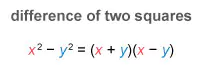
A difference of two squares of the form x2 − y2 can be factored as (x + y)(x − y).
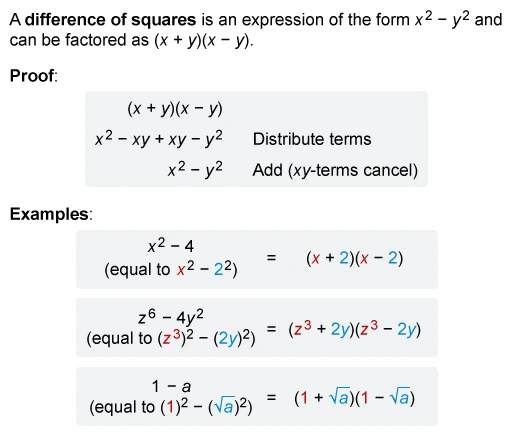
The difference of two squares a2 − b2 in the given expression can be factored as (a + b)(a − b), and both factors have given values. To evaluate (a − b)(a2 − b2), first factor a2 − b2 as a difference of two squares.
| (a − b)(a2 − b2) | Given expression |
| (a − b)(a + b)(a − b) | Factor a2 − b2 |
Now plug in the given values for each of the factors (a − b) = 3 and (a + b) = 4.
| (a − b)(a + b)(a − b) | |
| (3)(4)(3) | Substitute (a − b) = 3 and (a + b) = 4 |
| 36 | Multiply |
The value of (a − b)(a2 − b2) is 36.
Things to remember:
- An expression of the form x2 − y2 is a difference of two squares that can be factored as (x + y)(x − y).
- If the value for an expression is given, it may be possible to rewrite a desired expression in terms of the given expression and plug in known values.
Passage
Before the 1963 March on Washington, many women worked to ensure that their contributions to the civil rights movement were recognized at this event. Organizing committee member Anna Arnold Hedgeman advocated for a female speaker. ______ Dorothy Height persuaded the male organizers to let a woman deliver an address entitled "Tribute to Negro Women."
Question
Which choice completes the text with the most logical transition?
| A. In summary, | |
| B. Nevertheless, | |
| C. Likewise, | |
| D. For instance, |
Explanation
Rule: Transitions show the specific relationship between sentences.
Determine the relationship between the sentences before and after the blank. Then, choose the transition with a meaning that indicates this relationship.
The sentences before and after the proposed transition relate similar ideas: each mentions a woman who wanted a female speaker at the March on Washington. "Likewise" means similarly. Because it has a meaning that shows the specific relationship between the two sentences, likewise, is the most logical transition.
(Choice A) "In summary" is used to indicate that what follows is a brief overview of the previous point(s). However, Height convincing men to let a woman give a speech is not a summary of Hedgeman's idea to have a female speaker.
(Choice B) "Nevertheless" indicates that a different idea follows. Because both sentences focus on a similar idea of wanting a female speaker, a transition that highlights a difference would not correctly indicate this relationship.
(Choice D) "For instance" indicates that a specific example follows to illustrate a previous general statement. This transition isn't appropriate because it would need to be followed by a specific example of what Hedgeman did to advocate for a female speaker, not a sentence about what Height did.
Things to remember:
Choose the transition that indicates the relationship between two sentences.
Question
What is the solution set of the equation above?
| A. {−4} | |
| B. {0} | |
| C. {3} | |
| D. {3, 4} |
Hint :
To solve a rational equation, first multiply both sides by the least common denominator (LCD) to clear the fractions.
Explanation
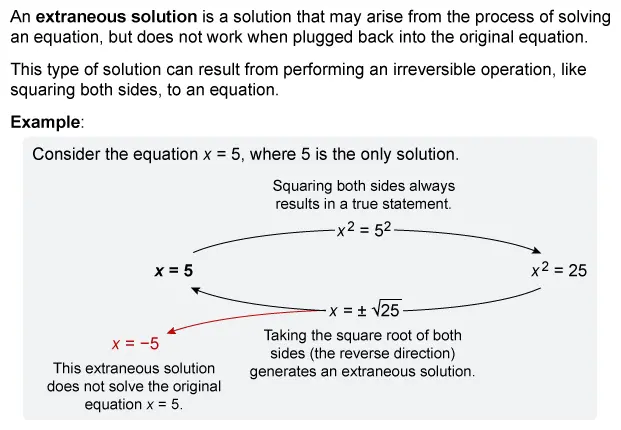
The given equation is a rational equation because it contains a variable in a denominator. Solutions to a rational equation may be valid or extraneous, so solve for x and then check for extraneous solutions.
The only denominator in is x − 3, so multiply both sides of the equation by x − 3 to clear the fraction.
| Given equation | |
| Multiply both sides by (x − 3) | |
|
(x2 - 9) (x - 3)
(x - 3)
=
(x - 3)
|
Cancel factors to clear fraction |
| x2 - 9 = -1 (x - 3) | Simplify |
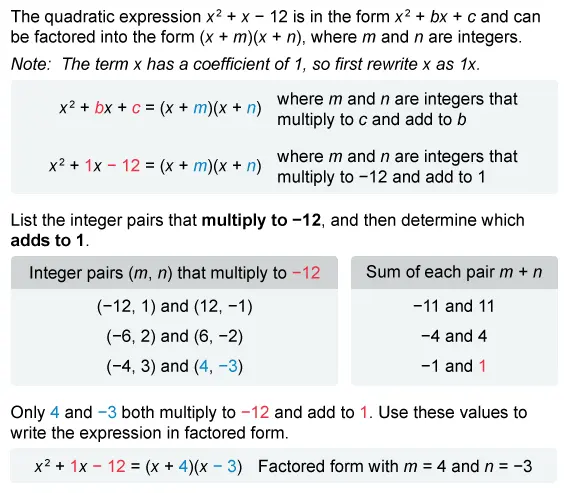
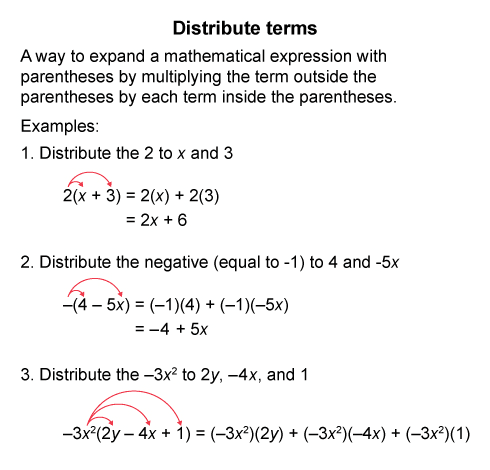
To solve the resulting quadratic equation, rewrite it in standard form ax² + bx + c = 0 and then factor.
| Distribute −1 to (x − 3) | |
| Add x and subtract 3 on both sides | |
| Factor |
The expression (x + 4)(x − 3) is equal to 0 when either of its factors equals 0. Set each factor equal to 0 to solve for x.
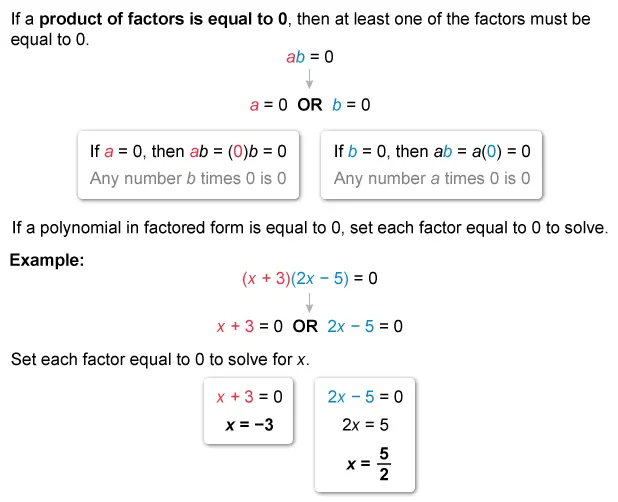
| x + 4 = 0 | Set each factor equal to 0 | x − 3 = 0 |
| x = −4 | Solve for x | x = 3 |
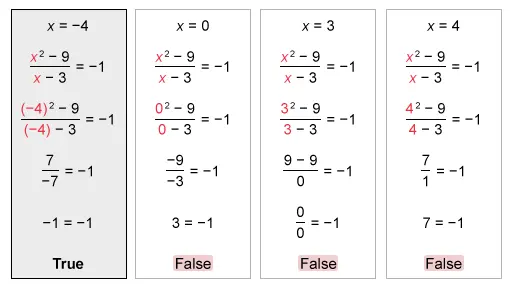
Plug x = −4 and x = 3 into the given equation and simplify to check if they are valid or extraneous.
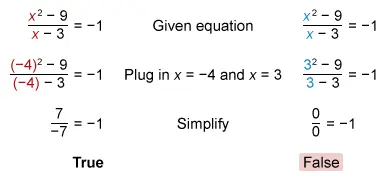
The solution x = −4 results in a true statement, so
−4 is a valid solution.
The solution x = 3 results in a false statement, so
3 is an extraneous solution.
Therefore, the solution set of the given equation is {−4}.
Elimination strategy: It is possible to identify values of x where the given equation is undefined to eliminate Choices C and D.
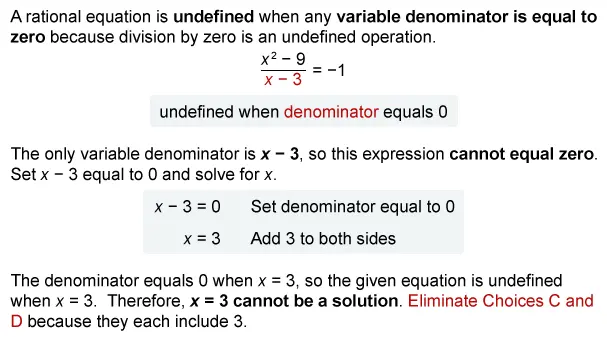
(Choice B) 0 is not in the solution set, because 0 does not satisfy the given equation (see alternate method).
(Choice C) 3 is an extraneous solution, because the left side of the given equation simplifies to the undefined fraction when x = 3. Therefore, 3 is not in the solution set.
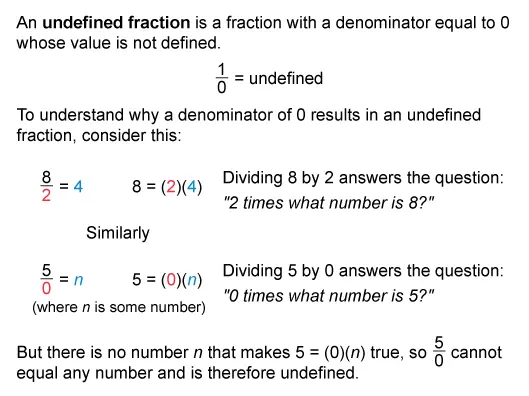
(Choice D) 3 and 4 may result from a combination of a sign error and the error described in Choice C.
Things to remember:
- An equation that contains a variable in a denominator is a rational equation. To solve a rational equation, multiply both sides by the least common denominator (LCD) to clear the fractions.
- Solutions to a radical equation may be valid or extraneous, so solve the equation and then plug the results into the given equation to check for extraneous solutions.
- A rational equation is undefined when any variable denominator is equal to zero.
Alternate Method :
It is also possible to plug each possible solution from the choices into the given equation to determine the solution set. The choices include −4, 0, 3, and 4 as possible solutions.
Plug x = −4, x = 0, x = 3, and x = 4 into to see which simplifies to a true statement.
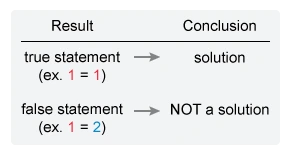
Of the values from the choices, only −4 simplifies the equation to a true statement. Therefore, the solution set of the given equation is {−4}.
Note: When x = 3, the left side of the given equation simplifies to the undefined fraction .
Things to remember:
Any value that simplifies an equation to a true statement is a solution to the equation.
Passage:
While researching a topic, a student has taken the following notes:
- At the age of seven or eight, native West African Phillis Wheatley was sold into slavery to a wealthy merchant family in Boston.
- She quickly learned to read and write, composing her first poem at age 14.
- When she was 20, she had a book of poetry published in England.
- This book is considered the first published poetry collection by an African American author.
- These poems are still available for readers to view online or in print.
Question
The student wants to emphasize what Wheatley achieved that made her a pioneer in American literature. Which choice most effectively uses relevant information from the notes to accomplish this goal?
| A. After becoming the slave of a Boston merchant family, Wheatley learned to read and write. | |
| B. A native of West Africa, Wheatley composed her first poem when she was fourteen years old. | |
| C. The poems from the book Wheatley had published in England can still be found online and in print. | |
| D. Wheatley was the first African American to publish a book of poetry. |
Explanation
Determine the key information from the question that must be located in the notes. The correct answer choice will have details from the notes that support what the student wants to emphasize about the topic.
Based on the question, the key information that's needed from the notes is which of Wheatley's achievements speaks to her role as a pioneer (one of the first to do something) in American literature. Although the notes mention several of Wheatley's accomplishments, only the fact that she was the first African American to publish a book of poetry emphasizes her role as a pioneer in American literature.
The answer choice that emphasizes her accomplishments as a pioneer of American literature states that Wheatley was the first African American to publish a book of poetry.
(Choice A) Although learning to read and write as a slave can be listed among her accomplishments, the notes don't indicate that Wheatley was the first to do this nor how this would have had an effect on American literature.
(Choice B) Because the notes don't state that it was unusual for West African teenagers to write poetry, this answer doesn't indicate that this was a pioneering achievement for Wheatley.
(Choice C) The current availability of her work does not speak to her pioneering achievement as the first African American author to publish a book of poetry.
Things to remember:
Choose the answer with specific information related to what is referenced in the question.
Question

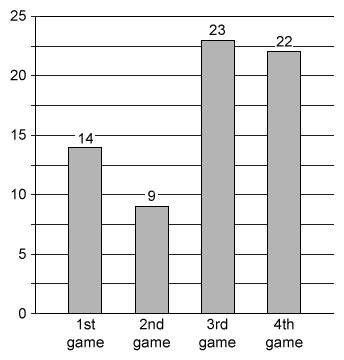
The bar graph shows the number of points scored by a football team in each of four games. For these four games, how much greater is the median number of points scored than the mean number of points scored?
Hint :
The mean of a data set is the sum of the values divided by the number of values.
The median is the middle of a data set when all values are ordered numerically.
Explanation
To find how much greater the median number of points is than the mean number of points, calculate each measure separately and then subtract the mean from the median.
First identify from the given bar graph that the numbers of points scored in the 4 games were 14, 9, 23, and 22.
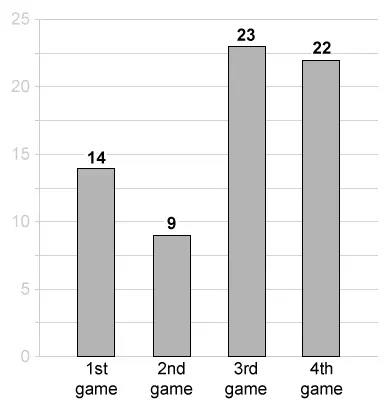
Mean score
The mean of a data set is the sum of the values divided by the number of values.
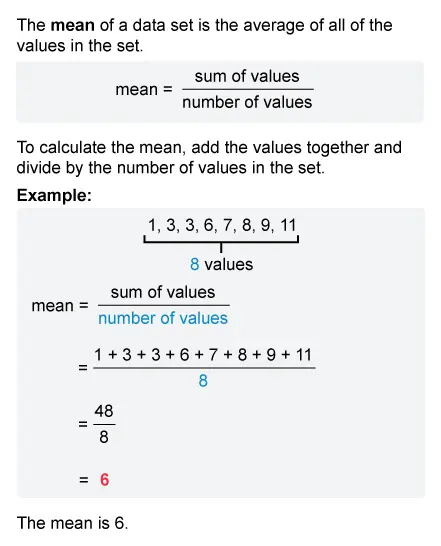
The sum of the values is the sum of the numbers of points scored and the number of values is the number of games.
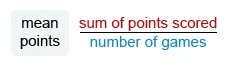
Plug the numbers of points (14, 9, 23, and 22) and the number of games (4) into the expression for the mean and simplify to calculate the mean score.
| Mean number of points | |
| Plug in values | |
| Add in numerator | |
| Divide |
The mean number of points is 17.
Median score
The median is the middle of a data set when all values are ordered numerically. For a data set with an even number of values, the median is the average of the middle two.
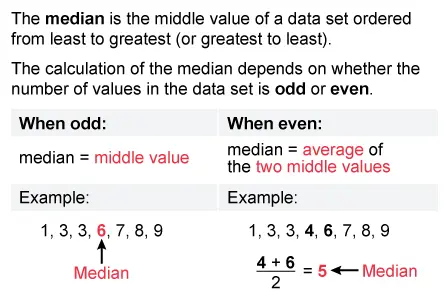
The numbers of points scored are 14, 9, 23, and 22. Order these values numerically and then calculate the average of the middle two to find the median number of points scored.
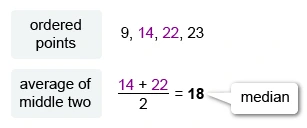
The median number of points is 18.
The mean is 17 points and the median is 18 points. Subtract 18 − 17 = 1 to see that the median is 1 point greater than the mean.
Things to remember:
- The mean of a data set is the sum of the values divided by the number of values.
- The median is the middle of a data set when all values are ordered numerically. For a data set with an even number of values, the median is the average of the middle two.
Passage:
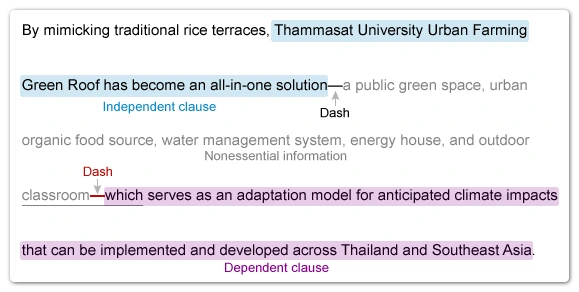
By mimicking traditional rice terraces Thammasat University Urban Farming Green Roof has become an all-in-one solution—a public green space, urban organic food source, water management system, energy house, and outdoor ______ serves as an adaptation model for anticipated climate impacts that can be implemented and developed across Thailand and Southeast Asia.

Question
Which choice completes the text so that it conforms to the conventions of Standard English?
| A. classroom—which | |
| B. classroom; which | |
| C. classroom: which | |
| D. classroom which |
Explanation
Rule: Nonessential information that begins with a dash must end with a dash.
When nonessential information occurs in the middle of the sentence, use the same punctuation—like dashes—at both the beginning and the end to indicate when this information starts and finishes.
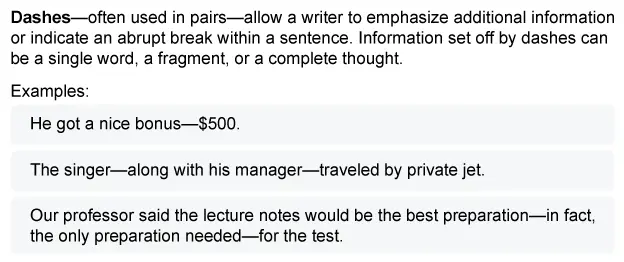
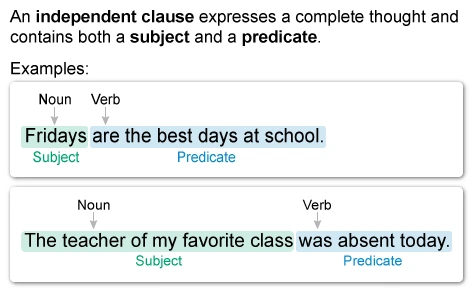
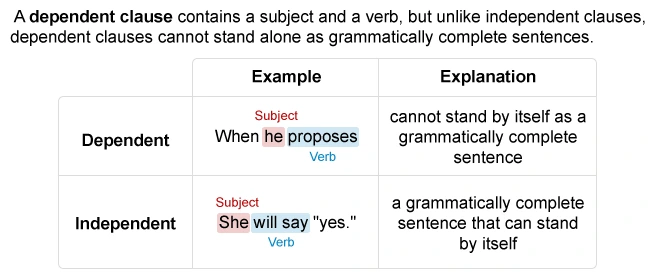
When nonessential information is inserted between an independent clause and dependent clause, the beginning and ending punctuation separating it from the rest of the sentence must match. This sentence already contains a dash after the independent clause "By…solution." Following the dash is a fragment "a public…outdoor classroom" that could be removed from the sentence without changing the meaning, so this information is nonessential.
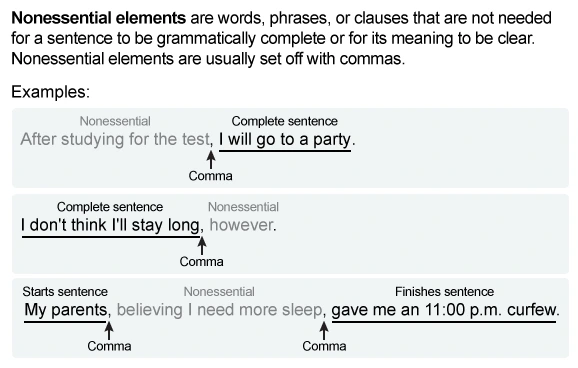
Therefore, the most fitting option is classroom—which because it matches the earlier punctuation of the nonessential information with a dash.
(Choices B, C, and D) These choices are not correct based on the punctuation and context of the sentence.
- Choice B: A semicolon is used to join two independent clauses that are related. Because the clause that follows "classroom" cannot stand on its own as a complete sentence, it is not an independent clause.
- Choice C: A colon could be used in place of the first dash, as it precedes a list, but not in the space in question which is at the end of the list.
- Choice D: The word "which" in this context is describing the "solution" at the end of the independent clause. Because it begins a dependent clause, providing additional, nonessential information, it would require either a comma or dash to separate it from the independent clause.
Things to remember:
A sentence or fragment that interrupts the middle of a sentence requires matching punctuation before and after it.
Question
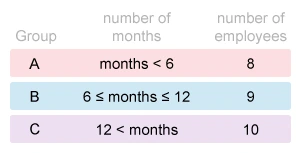
A small company classifies its employees according to how long they have been employed. Eight employees have worked at the company for less than 6 months and are classified in Group A. Nine employees have worked at the company for at least 6 months but no more than 12 months and are classified in Group B. Ten employees have worked at the company for more than 12 months and are classified in Group C. Which of the following could be the median amount of time, in months, that these 27 employees have worked at the company?
| A. 5.5 | |
| B. 7 | |
| C. 12.5 | |
| D. 16 |
Hint :
The median of a data set is the middle of the set when all values are ordered numerically.
Explanation
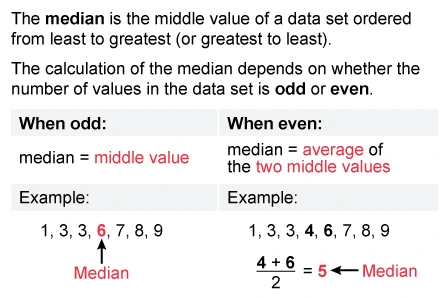
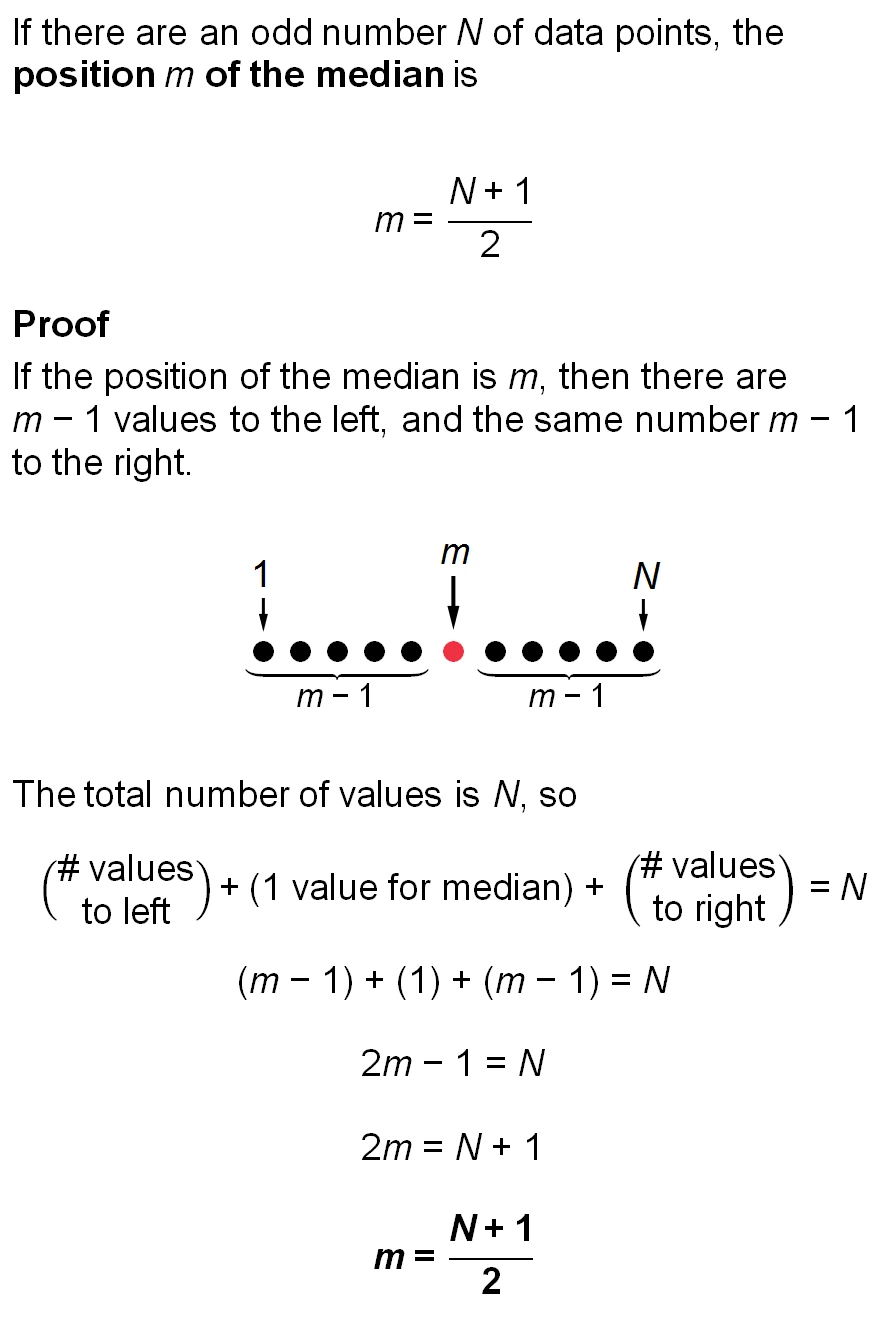
The median of a data set is the middle of the set when all values are ordered numerically. When the number of values is odd, the median is the middle value.
The number of months each employee has worked at the company is unknown, but the range of months for each group is given. First consider the groups from least to greatest according to the ranges of months worked.
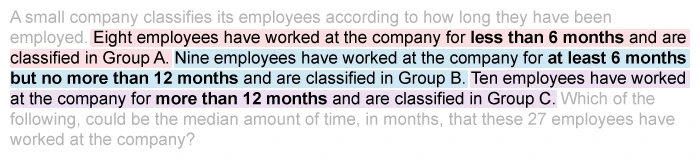
It is given that there are 27 employees, so the median number of months must be the number worked by the 14th employee (proof).
Starting with the first range, add the number of employees in each successive group to find the group that contains the 14th employee and identify the range of months that employee has worked.
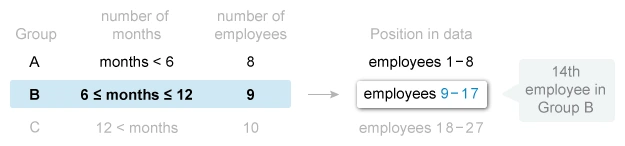
The 14th employee was in Group B, so the 14th employee worked at least 6 months and no more than 12 months.
Of the choices, only Choice B falls within this range. Therefore, the median number of months could be 7.
(Choices A, C, and D) These choices are not possible numbers of months because they do not fall within the range worked by the 14th employee (at least 6 months and no more than 12 months).
Things to remember:
The median of a data set is the middle of the set when it is ordered numerically. When the total number of values is odd, the median is the middle value. When it is even, the median is the average of the middle two values.
Passage:
In 1912, during the First Balkan War, Milunka Savić chopped off her hair and dressed in men's clothing to join the Serbian army disguised as her brother, who was sick with tuberculosis. _______ Savić proved to be a skilled soldier and eventually became—after her true identity was discovered in 1913—the most decorated female in world military history.
Question
Which choice completes the text with the most logical transition?
| A. Subsequently, | |
| B. Likewise, | |
| C.Nevertheless, | |
| D. Furthermore, |
Explanation
| Transitions help show the specific relationship between sentences. |
Examine the information before and after the blank to determine the relationship between the sentences. Then, choose the conjunctive adverb that expresses that relationship.
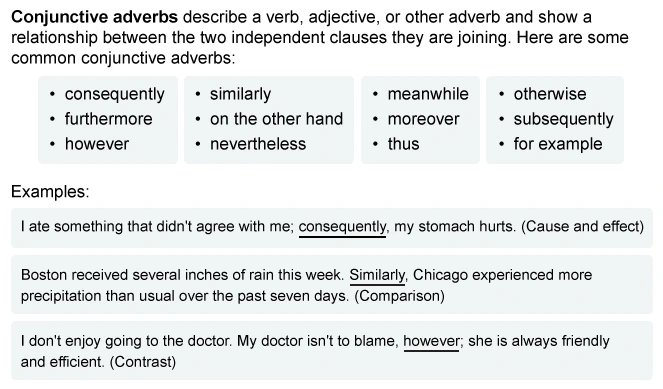
The first sentence provides details about how Savić joined the army as a woman. The second sentence reveals that she was awarded many medals after joining the army. The correct answer will indicate this sequence of events.
"Subsequently" refers to events that came after another. Because it refers to the events in the second sentence occurring after the events in the first sentence, subsequently, is correct.
(Choice B) "Likewise" indicates a similarity between two ideas. This answer doesn't work because the second sentence states that Savić was highly decorated as a soldier, which isn't similar to the first sentence's description of her joining the army.
(Choice C) "Nevertheless" signals that something is happening despite another thing. The second sentence reveals that Savić earned her medals because she joined the army, not in spite of joining.
(Choice D) "Furthermore" shows an idea that is related and an addition to the idea that precedes it. The idea presented in the second sentence indicates what happened after Savić joined the army; it is not an additional detail describing how she became a soldier.
Things to remember:
The correct answer will reflect the relationship between the ideas in the two sentences.
Question
In a tall office building, an express elevator descends from a height of 300 feet to 20 feet at a constant rate of 8 feet per second. What type of function best models the relationship between the height of the descending elevator and time?
| A. Increasing linear | |
| B. Decreasing linear | |
| C. Increasing exponential | |
| D. Decreasing exponential |
Hint :
A function is linear if the same number is added to each value to get the next. A function is exponential if the same number is multiplied by each value to get the next.
Explanation
A function is linear if the same number is added to each value to get the next (the difference is constant).
A function is exponential if the same number is multiplied by each value to get the next (the ratio is constant).
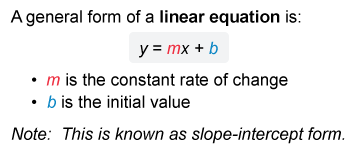
It is given that the elevator descends 8 feet per second, so the same number (−8) is added every second. Therefore, the function is linear.
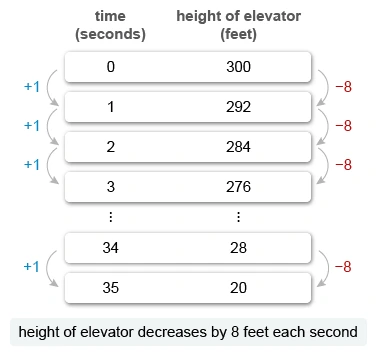
As the number of seconds increases, the height of the elevator decreases. Therefore, the function is decreasing.
The function that best models the relationship between the height of the elevator and time is decreasing linear.
(Choice A) "Increasing linear" is incorrect because as time increases, the height of the elevator decreases.
(Choice C) "Increasing exponential" may result from the combination of errors described in Choices A and D.
(Choice D) "Decreasing exponential" is incorrect because the same number is added (−8) for each constant change in time. A relationship is exponential if the same number is multiplied for each constant change in time.
Things to remember:
A relationship between two variables is:
- linear if the same number is added to each value to get the next value (the difference between consecutive values is constant).
- exponential if the same number is multiplied by each value to get the next value (the ratio of consecutive values is constant).
Passage:
Literary Narrative: This passage is adapted from the novel Mrs. Dalloway by Virginia Woolf (©1925 by Virginia Woolf).
The crush was terrific for the time of day. Lords, Ascot, Hurlingham, what was it? She wondered, for the street was blocked. It is probably the Queen, thought Mrs. Clarissa Dalloway, coming out of Mulberry's with her flowers; the Queen. And for a second she wore a look of extreme dignity standing by the flower shop in the sunlight while the car passed at a foot's pace, with its blinds drawn. The Queen going to some hospital; the Queen opening some bazaar, thought Clarissa.
The British middle classes sitting sideways on the tops of omnibuses with parcels and umbrellas, yes, even furs on a day like this, were, she thought, more ridiculous, more unlike anything one could conceive; and the Queen herself held up; the Queen herself unable to pass. Clarissa was suspended on one side of Brook Street; Sir John Buckhurst, the old Judge on the other, with the car between them when the chauffeur, leaning ever so slightly, said or showed something to the policeman, who saluted and raised his arm and jerked his head and moved the omnibus to the side and the car passed through. Slowly and very silently it took its way.
As she observed the events taking place, Clarissa knew, of course, she had seen something white, magical, circular, in the footman's hand, a disc inscribed with a name—the name of the Queen's, the Prince of Wales's, or the Prime Minister's?—which, by force of its own lustre, burnt its way through to blaze among the candelabras, glittering stars, and the gentlemen of England present that night in Buckingham Palace. Clarissa saw the car diminishing, disappearing. She stiffened a little; so she would stand at the top of the stairs.
The car had gone, but it had left a slight ripple that flowed through glove shops and hat shops and tailors' shops on both sides of Bond Street. For thirty seconds all heads were inclined the same way—to the window. Choosing a pair of gloves—asking should they be to the elbow or above it, lemon or pale grey?—ladies suddenly stopped; something had happened. Something so trifling in single instances that no mathematical instrument, though capable of transmitting shocks in China, could register the vibration; yet in its fullness rather formidable and in its common appeal emotional; for in all the hat shops and tailors' shops strangers looked at each other and thought of the dead; of the flag; of Empire. For the surface agitation of the passing car as it disappeared grazed something very profound.
Gliding across Piccadilly, the car turned down St. James's Street. Tall men, men of robust physique, well-dressed men with their tail-coats and their hair raked back who, for reasons difficult to discriminate, were standing in the bow window of Brooks's with their hands behind the tails of their coats, looking out, perceived instinctively that greatness was passing, and the pale light of the immortal presence fell upon them as it had fallen upon Clarissa Dalloway. At once they stood even straighter, and removed their hands, and seemed ready to attend their Sovereign, if need be, in front of the cannon's mouth, as their ancestors had done before them. The white busts and the little tables in the background covered with copies of the Tatler and syphons of soda water seemed to approve; seemed to indicate the flowing corn and the manor houses of England; and to return the frail hum of the motor wheels. Shawled Moll Pratt with her flowers on the pavement wished the dear boy well (it was the Prince of Wales, for certain) and would have tossed the price of a pot of beer—a bunch of roses—into St. James's Street out of sheer light-heartedness and contempt of poverty had she not seen the constable's eye upon her, discouraging an old Irishwoman's loyalty. The sentries at St. James's saluted; Queen Alexandra's policeman approved.
A small crowd, meanwhile, had gathered at the gates of Buckingham Palace. Listlessly, yet confidently, poor people all of them, they waited; looked at the Palace itself with the flag flying; at Victoria, billowing on her mound, admired her shelves of running water, her geraniums; singled out from the motor cars in the Mall first this one, then that; bestowed emotion, vainly, upon commoners out for a drive; recalled their tribute to keep it unspent while this car passed and that; and all the time let rumour accumulate in their veins and thrill the nerves in their thighs at the thought of Royalty looking at them; the Queen bowing; the Prince saluting; at the thought of the heavenly life divinely bestowed upon Kings.
Question
In lines 7-13, the narrator uses which of the following literary devices to describe the British people?
| A. Irony | |
| B. Simile | |
| C. Imagery | |
| D. Personification |
Explanation
The British middle classes sitting sideways on the tops of omnibuses with parcels and umbrellas, yes, even furs on a day like this, were, she thought, more ridiculous, more unlike anything one could conceive; and the Queen herself held up; the Queen herself unable to pass. Clarissa was suspended on one side of Brook Street; Sir John Buckhurst, the old Judge on the other, with the car between them when the chauffeur, leaning ever so slightly, said or showed something to the policeman, who saluted and raised his arm and jerked his head and moved the omnibus to the side and the car passed through. Slowly and very silently it took its way.
To determine which literary device (technique) an author is using, examine the specified lines, look at the possible choices, and decide which literary device best applies to those lines.
Lines 7-13 describe a series of events:
- The middle-class people were "sitting sideways on the tops of omnibuses with parcels and umbrellas;" some are wearing fur coats.
- Clarissa "was suspended on one side of Brook Street" and a judge was "on the other."
- The chauffeur in the car "leaning ever so slightly…showed something" to the policeman.
- The policeman "saluted and raised his arm and jerked his head and moved the omnibus" out of the way to let the car pass.
Because the description helps the reader to envision (picture) what is happening through images, the author is using imagery (visually descriptive language).
(Choice A) Irony = an event or narration that proceeds (or ends) differently than expected to highlight the difference between how things appear and their reality. These lines are direct and provide only a description of the scene; they don't indicate anything ironic in the description.
(Choice B) Simile = compares two things using "like" or "as." These lines don't use "like" or "as" and they don't provide a comparison.
(Choice D) Personification = when something is given the qualities of a person to better describe it or represent some bigger meaning. This technique is not present in the specified lines.
Things to remember:
Study the functions of key literary devices to better recognize them in the passage.
Question
For all real values of x, which of the following is the solution set of −3x + 6 ≤ −9 ?
| A. x ≤ 1 | |
| B. x ≥ 1 | |
| C. x ≤ 5 | |
| D. x ≥ 5 |
Hint:
To solve for x in an inequality, isolate x so that it is by itself on one side of the inequality.
Explanation
The solution set of an inequality with one variable is the set of all values of the variable that make the inequality true. To find the solution set, solve for the variable in the inequality.
To solve for x in the given inequality −3x + 6 ≥ −9, subtract 6 from both sides and divide by −3 to isolate x so that it is by itself on one side of the inequality.
| −3x + 6 ≤ −9 | Given inequality |
| −3x ≤ −15 | Subtract 6 from both sides |
| x ≥ 5 | Divide both sides by −3 |
| Note: The inequality sign changes direction because −3 is negative. |
The solution set of the given inequality is x ≥ 5.
Note: When both sides of an inequality are multiplied or divided by a negative value, the inequality sign changes directions. For the given inequality, it is also possible to first add 3x to both sides to see that the solution is x ≥ 5.
(Choice A) x ≤ 1 may result from incorrectly subtracting −9 − 6 to get −3 (instead of −15) and not reversing the direction of the inequality as a result of dividing both sides by a negative number.
(Choice B) x ≥ 1 may result from incorrectly subtracting −9 − 6 to get −3 instead of −15.
(Choice C) x ≤ 5 may result from not reversing the direction of the inequality.
Things to remember:
- To find the solution set of an inequality in one variable, isolate the variable by itself on one side of the inequality.
- The solution set of an inequality is the set of all values that make the inequality true.
- The inequality sign reverses as a result of multiplying or dividing both sides by a negative number.
Passage
[1]
Since the Revolutionary War, the US government has played a role in the health and safety of the nation's food supply. The government's efforts to feed Americans good and frequent meals have had significant impacts on the food chain from farm to factory. Much legislation came about in 1906 as the result of an experiment that took place at the Bureau of Chemistry after Harvey Washington Wiley became the US Department of Agriculture's chief chemist.
[2]
Wiley had focused his career on the subject of food adulterants. He objected to certain food additives on moral grounds and approached his work with the zeal of a crusader. Food adulteration was a surprise perpetrated on the American people, when he was determined to expose it to justice's harsh light.
[3]
Industrial Age foodstuffs were commonly doctored: with arsenic formaldehyde, sodium benzoate, boric acid, and other substances. These chemicals were added to foods as dyes or preservatives or to mask substandard ingredients and spoilage. Chemical preservatives, Wiley believed, posed the most danger to the consumer, but he would need proof.
[4]
Wiley devised an experiment designed to provide evidence that these substances were indeed harmful. He rounded up 12 "young, robust fellows" to volunteer for what he called "the Hygienic Table." [A] Perhaps motivated by the promise of free meals, his collection of medical students and Agriculture Department underlings signed on to eat food laced with increasing amounts of chemical preservatives found extensively in American diets. [B] Their motto was "None but the brave dare eat the fare." [C] The experiment surprised Wiley on two counts; the fascination it held for the press—who gleefully dubbed it "The Poison Squad"—and the severity of the illness caused by the adulterants. [D] News of the Poison Squad contributed to the mounting public outcry for protection. In 1906, Wiley and other supporters prevailed, and ultimately the Pure Food and Drug Act was passed. [9]
Question
Which choice best emphasizes that the government took significant action based on one man's research?
| A. NO CHANGE | |
| B. Influential | |
| C. Routine | |
| D. Reasonable |
Explanation
Influential legislation came about in 1906 as the result of an unusual experiment that took place in the basement of the Bureau of Chemistry when Harvey Washington Wiley became the US Department of Agriculture's chief chemist.
Individual words emphasize an idea by precisely expressing it. Choose the answer with a definition matching the task identified in the question.
This question asks for a word emphasizing "significant (important) action." The word that does this is "influential," which means "having the power to affect others." The government's action—legislation based on Wiley's research—affected all Americans, making it significant and influential.
(Choice A) "Much" merely means "a large amount," and it does not precisely express that something is important.
(Choice C) "Routine" means that an action is "common" or "regularly done," but it does not emphasize its importance.
(Choice D) "Reasonable" can mean "logical" or "not excessive" (ex. I ate a reasonable amount of dessert, so I wouldn't get sick). Neither of these definitions emphasizes the importance of the legislation (laws).
Things to remember:
Choose the answer with a definition that precisely expresses the idea identified in the question.
Passage:
Literary Narrative: This passage is adapted from the novel Mrs. Dalloway by Virginia Woolf (©1925 by Virginia Woolf).
The crush was terrific for the time of day. Lords, Ascot, Hurlingham, what was it? She wondered, for the street was blocked. It is probably the Queen, thought Mrs. Clarissa Dalloway, coming out of Mulberry's with her flowers; the Queen. And for a second she wore a look of extreme dignity standing by the flower shop in the sunlight while the car passed at a foot's pace, with its blinds drawn. The Queen going to some hospital; the Queen opening some bazaar, thought Clarissa.
The British middle classes sitting sideways on the tops of omnibuses with parcels and umbrellas, yes, even furs on a day like this, were, she thought, more ridiculous, more unlike anything one could conceive; and the Queen herself held up; the Queen herself unable to pass. Clarissa was suspended on one side of Brook Street; Sir John Buckhurst, the old Judge on the other, with the car between them when the chauffeur, leaning ever so slightly, said or showed something to the policeman, who saluted and raised his arm and jerked his head and moved the omnibus to the side and the car passed through. Slowly and very silently it took its way.
As she observed the events taking place, Clarissa knew, of course, she had seen something white, magical, circular, in the footman's hand, a disc inscribed with a name—the name of the Queen's, the Prince of Wales's, or the Prime Minister's?—which, by force of its own lustre, burnt its way through to blaze among the candelabras, glittering stars, and the gentlemen of England present that night in Buckingham Palace. Clarissa saw the car diminishing, disappearing. She stiffened a little; so she would stand at the top of the stairs.
The car had gone, but it had left a slight ripple that flowed through glove shops and hat shops and tailors' shops on both sides of Bond Street. For thirty seconds all heads were inclined the same way—to the window. Choosing a pair of gloves—asking should they be to the elbow or above it, lemon or pale grey?—ladies suddenly stopped; something had happened. Something so trifling in single instances that no mathematical instrument, though capable of transmitting shocks in China, could register the vibration; yet in its fullness rather formidable and in its common appeal emotional; for in all the hat shops and tailors' shops strangers looked at each other and thought of the dead; of the flag; of Empire. For the surface agitation of the passing car as it disappeared grazed something very profound.
Gliding across Piccadilly, the car turned down St. James's Street. Tall men, men of robust physique, well-dressed men with their tail-coats and their hair raked back who, for reasons difficult to discriminate, were standing in the bow window of Brooks's with their hands behind the tails of their coats, looking out, perceived instinctively that greatness was passing, and the pale light of the immortal presence fell upon them as it had fallen upon Clarissa Dalloway. At once they stood even straighter, and removed their hands, and seemed ready to attend their Sovereign, if need be, in front of the cannon's mouth, as their ancestors had done before them. The white busts and the little tables in the background covered with copies of the Tatler and syphons of soda water seemed to approve; seemed to indicate the flowing corn and the manor houses of England; and to return the frail hum of the motor wheels. Shawled Moll Pratt with her flowers on the pavement wished the dear boy well (it was the Prince of Wales, for certain) and would have tossed the price of a pot of beer—a bunch of roses—into St. James's Street out of sheer light-heartedness and contempt of poverty had she not seen the constable's eye upon her, discouraging an old Irishwoman's loyalty. The sentries at St. James's saluted; Queen Alexandra's policeman approved.
A small crowd, meanwhile, had gathered at the gates of Buckingham Palace. Listlessly, yet confidently, poor people all of them, they waited; looked at the Palace itself with the flag flying; at Victoria, billowing on her mound, admired her shelves of running water, her geraniums; singled out from the motor cars in the Mall first this one, then that; bestowed emotion, vainly, upon commoners out for a drive; recalled their tribute to keep it unspent while this car passed and that; and all the time let rumour accumulate in their veins and thrill the nerves in their thighs at the thought of Royalty looking at them; the Queen bowing; the Prince saluting; at the thought of the heavenly life divinely bestowed upon Kings.
Question
The point of view from which the passage is told is best described as that of:
| A. a first person narrator reflecting on the lifestyle of the royal family. | |
| B. a first person narrator standing outside a flower shop, imagining the life she desires. | |
| C. a limited third person narrator who relates the thoughts of a character preparing to become part of the royal family. | |
| D. an ominscient third narrator observing a British crowd's reaction to the appearance of royalty. |
Explanation
To determine point of view, consider what the passage's details (subjects and actions) indicate about the narrator and how much the narrator knows. Choose the answer supported by the details in the passage.
| (Choice A) a first person narrator reflecting on the lifestyle of the royal family. | A first person narrator is a character in the story who tells the story. Here, someone outside of the story describes how Mrs. Dalloway watches the Queen's car pass by. |
| (Choice B) a first person narrator standing outside a flower shop, imagining the life she desires. | Mrs. Dalloway is standing outside a flower shop; however, she doesn't imagine her life nor is does she tell the story. |
| (Choice C) a limited third person narrator who relates the thoughts of a character preparing to become part of the royal family. | A limited third person narrator only describes the thoughts and emotions of a single character. This narrator describes the internal life of several characters, but none are becoming part of the royal family. |
|
(Choice D) an ominscient third person narrator who describes the reactions of several characters to the appearance of royalty. |
The narrator describes the reactions of several characters:
Mrs. Dalloway—thought "It is probably the Queen" Moll Pratt—"would have tossed the price of a pot of beer—a bunch of roses—into St. James's Street" Poor people--thrilled "at the thought of Royalty looking at them; the Queen bowing; the Prince saluting" |
Things to remember:
To determine point of view, note who tells the story and what details they give about characters.
Question
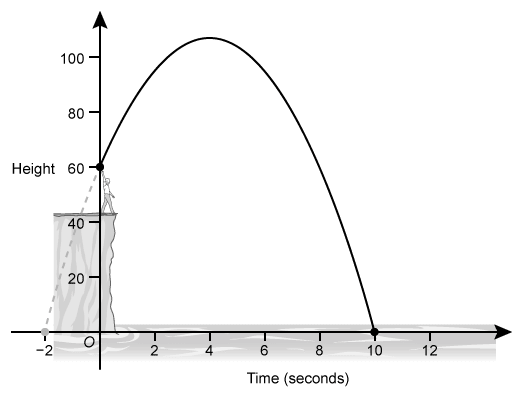
A rock is thrown from the top of a cliff into the air above a lake. The height above the lake, h units, of the rock t seconds after being thrown is given by the equation h = −3t2 + 24t + 60. When this equation is converted to an equivalent factored form, the rock is shown to:
| A. reach the surface of the lake at 2 seconds. | |
| B. reach the surface of the lake at 10 seconds. | |
| C. reach a maximum height of 2 units. | |
| D. reach a maximum height of 10 units. |
Hint :
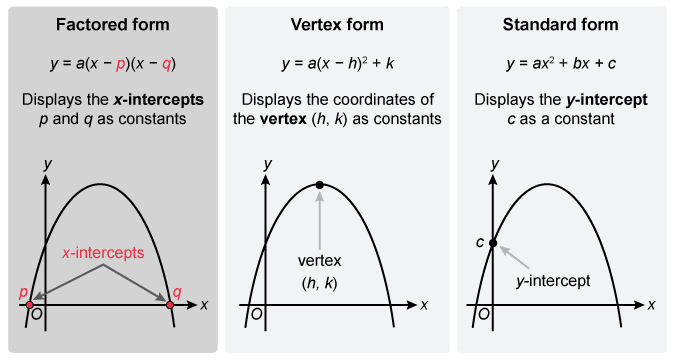
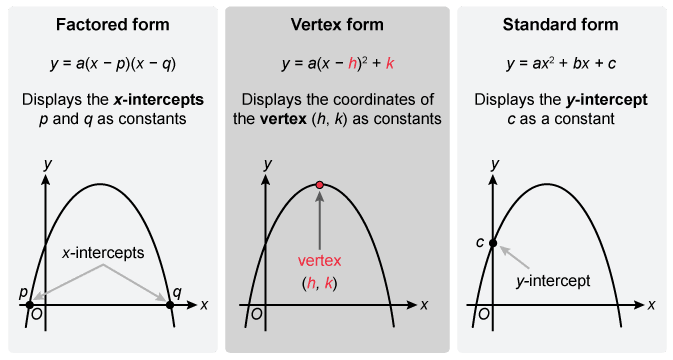
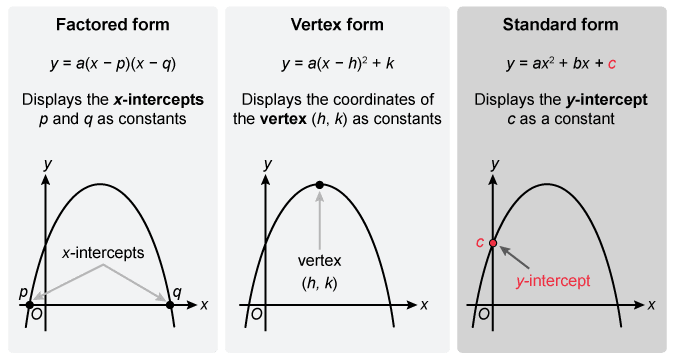
The factored form of a quadratic equation is y = a(x − p)(x − q), where p and q are x-intercepts of the graph. The x-intercepts of a graph are values of x that make the function equal to 0.
Note: The given equation uses h instead of y, and t instead of x.
Explanation
The given height function h = −3t2 + 24t + 60 is a quadratic function in standard form at2 + bt + c. The question asks about an equivalent factored form, so factor the equation.
Note: Standard form h = at2 + bt + c is the same as ax2 + bx + c, where the variable is t instead of x.
| h = −3t2 + 24t + 60 | Given equation |
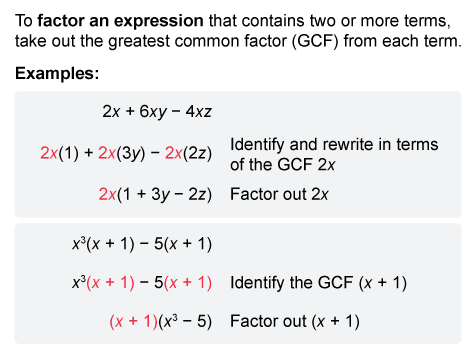
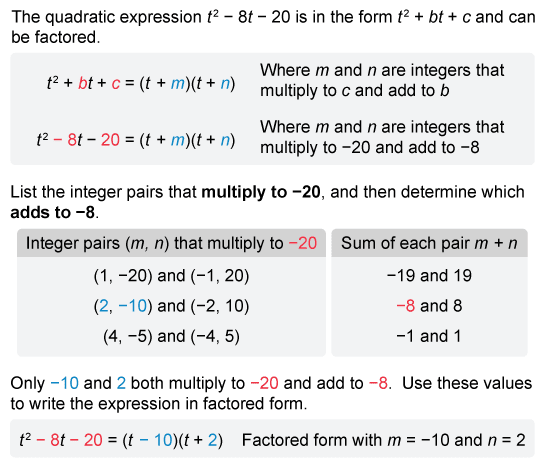
| h = −3(t2 − 8t − 20) | Factor −3 out of each term |
| h = −3(t − 10)(t + 2) | Factor t2 − 8t − 20 |
The factored form of this quadratic equation displays the t-intercepts as constants. The t-intercepts are the values of t that give the height h a value of 0, so they represent the times when the rock reaches the surface of the lake.
Eliminate C and D because they describe values of height h, but the factored form of this equation describes values of time t. Now set each factor equal to 0 and solve for the t-intercepts.
| (t − 10) = 0 | Set each factor equal to 0 | (t + 2) = 0 |
| t = 10 | Solve for t-intercepts | t = −2 |
The negative value t = −2 corresponds to a time before the rock is thrown (at time t = 0), so it cannot be the solution.
Therefore, the rock must reach the surface of the lake at 10 seconds after it is thrown.
(Choice A) This answer may be a result of incorrectly factoring the given quadratic as −3(t + 10)(t − 2) instead of −3(t − 10)(t + 2). It may also result from misinterpreting (t + 2) to mean that h = 0 when t = 2.
(Choices C and D) The maximum height is given by the constant term in the vertex form of a quadratic equation, but the question asks about the factored form.
Things to remember:
- The factored form of a quadratic equation is y = a(x − p)(x − q), where p and q are the x-intercepts of the parabola.
- An x-intercept is the value of x at a point where a graph intersects the x-axis.
- Real-world questions on the ACT involving time cannot have negative solutions.
Passage:
[1]
Since the Revolutionary War, the US government has played a role in the health and safety of the nation's food supply. The government's efforts to feed Americans good and frequent meals have had significant impacts on the food chain from farm to factory. Much legislation came about in 1906 as the result of an experiment that took place at the Bureau of Chemistry after Harvey Washington Wiley became the US Department of Agriculture's chief chemist.
[2]
Wiley had focused his career on the subject of food adulterants. He objected to certain food additives on moral grounds and approached his work with the zeal of a crusader. Food adulteration was a surprise perpetrated on the American people, when he was determined to expose it to justice's harsh light.
[3]
Industrial Age foodstuffs were commonly doctored: with arsenic formaldehyde, sodium benzoate, boric acid, and other substances. These chemicals were added to foods as dyes or preservatives or to mask substandard ingredients and spoilage. Chemical preservatives, Wiley believed, posed the most danger to the consumer, but he would need proof.
[4]
Wiley devised an experiment designed to provide evidence that these substances were indeed harmful. He rounded up 12 "young, robust fellows" to volunteer for what he called "the Hygienic Table." [A] Perhaps motivated by the promise of free meals, his collection of medical students and Agriculture Department underlings signed on to eat food laced with increasing amounts of chemical preservatives found extensively in American diets. [B] Their motto was "None but the brave dare eat the fare." [C] The experiment surprised Wiley on two counts; the fascination it held for the press—who gleefully dubbed it "The Poison Squad"—and the severity of the illness caused by the adulterants. [D] News of the Poison Squad contributed to the mounting public outcry for protection. In 1906, Wiley and other supporters prevailed, and ultimately the Pure Food and Drug Act was passed. [9]
Question
Which choice makes the sentence most grammatically acceptable?
| A. NO CHANGE | |
| B. counts, by | |
| C. counts: | |
| D. counts |
Explanation
The experiment surprised Wiley on two counts: the fascination it held for the press—who gleefully dubbed it "The Poison Squad"—and the severity of the illness caused by the adulterants.
Look at whether the parts of the sentence before and after the punctuation are complete sentences or fragments. Also, look to see how their ideas are related.
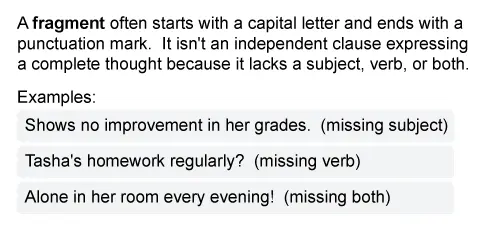
A colon is the correct punctuation to use when there is a complete sentence followed by information that explains an idea from the sentence. In this case, the correct punctuation is counts:
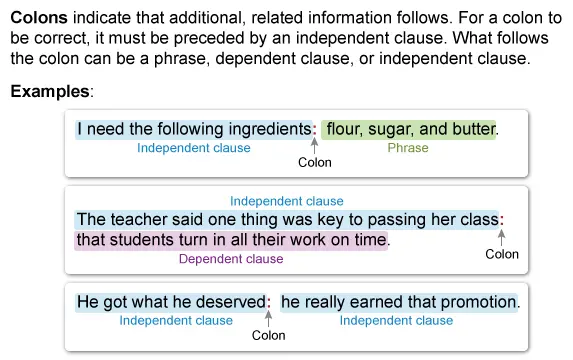
(Choice A) A semicolon cannot join a fragment to a complete sentence. This punctuation mark can be used only to join two complete sentences.
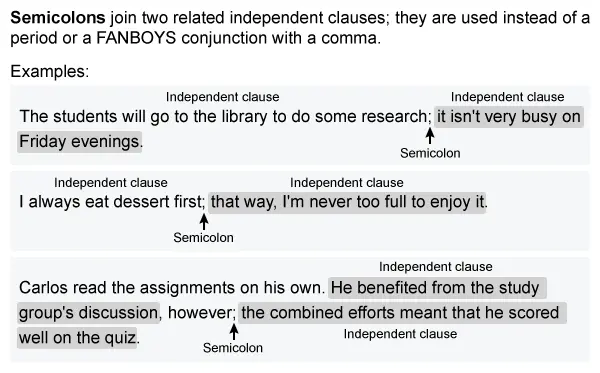
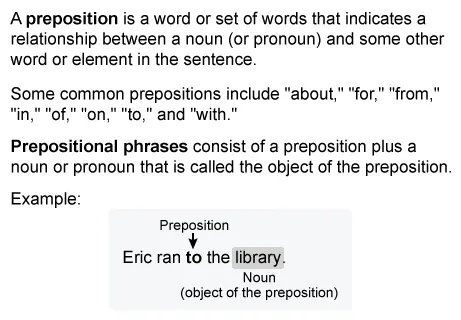
(Choice B) "By" is a preposition, and a prepositional phrase at the end of a sentence is not set apart by a comma. Only prepositional phrases at the beginning of sentences are separated by commas (ex. By the rooster's crowing, I could tell it was dawn).
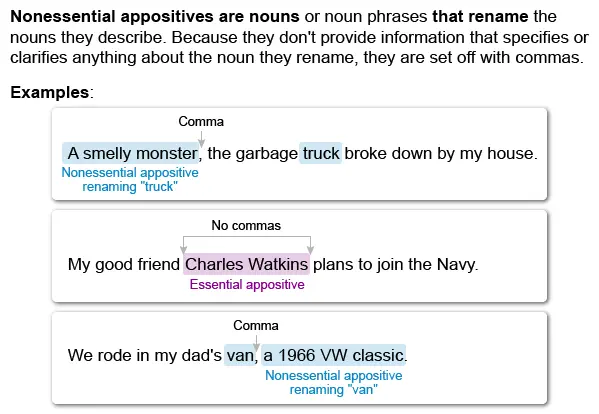
(Choice D) The information that appears after "counts" explains it by describing it in a different way. This kind of information is called a nonessential appositive, and it is connected to the noun it explains with punctuation, such as a colon, comma, or dash (ex. My favorite place is Disneyworld, the happiest place on Earth). This answer is missing the necessary punctuation for an appositive.
Things to remember:
In a question about punctuation, determine whether the punctuation separates complete sentences or fragments and how the parts of the sentence relate to each other.
Passage:
INFORMATIONAL: This passage is adapted from the article "Octopuses are Smart Suckers!?" by Jennifer Mather (© 2000 by Jennifer Mather).
While watching an octopus in Bermuda, animal behaviorist Jennifer Mather observed it sitting in its sheltering den after a foraging expedition, where it caught several crabs, took them home, and ate them. Suddenly it jetted out directly to a small rock about six feet away, tucked it under its spread arms and jetted back. Going out three times more in different directions, it took up three more rocks and piled the resulting barrier in front of the entrance to its den and went to sleep. To Dr. Mather, this didn't look like random action.
An octopus is very different from a mammal. It lives only about two years. It has much less opportunity to gain and use knowledge than an elephant, which has a 50-year lifespan and three generations of a family to learn from. The young octopus learns on its own with minimal contact with other octopuses and no influences of parental care or sibling rivalry. This may be because the octopus has a large brain with vertical and sub-frontal lobes dedicated to storing learned information: it has the anatomy for a robust, built-in intelligence.
But it is not enough to know that anatomy predicts an animal to be intelligent without some idea of how it uses this ability. Investigations at Naples in the 1950s and 1960s found that octopuses can learn a wide array of visual patterns, encoding information mostly by comparing edges, orientations, and shapes. They also learn by touch, and that tactile information is stored in a different area of the brain. Intent on just demonstrating learning abilities at first, researchers did not follow up to find what octopuses were doing with this learning in their ocean home. As concerns about direct experimentation in laboratories on intelligent animals began to emphasize observation of natural behavior in the field, the Naples studies ended, and no link was made between abstract information storage and the use of learning in daily life. In 1996, the works of Roger Hanlon and John Messenger provided an overview of cephalopod behavior in their natural habitat, studying areas such as prey manipulation, personality, and even play in the octopus.
What were octopuses doing with the information that learning studies said they could acquire? One study Mather and Roland C. Anderson undertook in 1999 centered on the "Packaging Problem." The problem posed was how an octopus could get at the soft, delectable clam enclosed in its hard shell. Many predators have evolved means of penetrating the clam's hard shell—sea stars pull the valves apart, seabirds pry them apart, snails drill a hole into the shell, and gulls drop the clam from a carefully calculated height onto rocks or road pavement.
But the octopus does even better than these predators in that it can use an arsenal of different solutions for use in feeding. It has the holding ability of hundreds of suckers and the pulling power of eight muscular arms, flexible because they are boneless. Underneath, inside the mouth at the junction of the arms, it has a parrot-like twin beak for biting. Inside are also two more useful structures, the radula with teeth for rasping and the extendible salivary papilla that delivers cephalotoxin, a neuromuscular function-blocker that can kill a crab in several minutes. Fortunately for Mather and Anderson, only the venom of blue-ringed octopuses has proven fatal to humans.
Since octopuses are well set up to recover and use information for solving the problem of the clam's protection, Mather and Anderson set out to determine what the giant Pacific octopus would do to get at three types of bivalves. Prey species were each opened differently. The fragile mussel shells were simply broken, and the stronger Venus clams were pulled apart. Thick-shelled Protothaca clams were drilled with the octopuses' radula and salivary papilla, or chipped with the beak, then injected with venom, which weakened the muscle holding the valves together. When they were offered the clams opened on the half shell, the octopuses changed preference and consumed both clam species, but hardly any mussels. When they didn't have to work hard for the clam meat, they liked Protothaca. Octopuses could also shift their penetration strategies. When live Venus clams were wired shut with stainless steel wire, the octopuses couldn't pull the valves apart, so they then tried drilling and chipping. Given empty-weighted shells glued shut, the octopuses ignored them; they were on to that trick right away.
Perhaps this individual sensitivity to change, honed by intelligence and variability, has been the key to solving the puzzle of the success of both the cephalopods and the higher vertebrates. Similarities that could lead us to understand the evolution of intelligence in octopuses and humans are few but thought-provoking. Neither group has the protection of a hard exoskeleton. Both have evolved in complex environments; the octopuses in the tropical coral reef and the hominid in the savanna edge. Both have considerable variability among individuals and the ability to change their behavior to help them survive. So, perhaps looking at octopuses through their intelligence, as witnessed by their feeding flexibility, helps us also look at aspects of ourselves as we continue to unpack the evolution of intelligence.
Question
The passage indicates that compared to those of mussels and Venus clams, the shells of Protothaca clams are:
| A. more easily broken and light. | |
| B. thicker and more protective. | |
| C. less attractive and nutritious. | |
| D. less robust and intricate. |
Explanation
P6: The fragile mussel shells were simply broken, and the stronger Venus clams were pulled apart. Thick-shelled Protothaca clams were drilled with the octopuses' radula and salivary papilla, or chipped with the beak, then injected with venom, which weakened the muscle holding the valves together.
Compare the shells of Protothaca clams to the shells of mussels and Venus clams by summarizing their descriptions and choosing the answer that matches both descriptions.
Protothaca clams are compared to mussels and Venus clams in P6:
| Mussel shells | Venus clam shells | Protothaca clam shells |
| "fragile" and "simply broken" | "stronger" than mussel shells but can be "pulled apart" | "thick-shelled"; must be either "chipped" or "drilled" and then "injected with venom" (poison) before they can be opened |
These details indicate that octopuses can open mussels and Venus clams in one step, whereas Protothaca clams require multiple steps because the shells of Protothaca clams cannot be easily broken open or pulled apart. Therefore, compared to the shells of mussels and Venus clams, the shells of Protothaca clams are thicker and more protective.
(Choice A) P6 states that Protothaca clams are "thick-shelled," indicating they are not easily broken and are likely heavy rather than light.
(Choice C) P6 doesn't discuss the attractiveness of the shells, nor does it suggest any shells are nutritious. Octopuses eat the meat inside the shells, not the shells themselves.
(Choice D) P6 indicates that Protothaca shells are more difficult to open than the others, so they are more, not less, robust (strong). The passage describes feeding on Protothaca as an intricate (complex) process but doesn't describe the shells as intricate.
Things to remember:
To compare items in the passage, summarize key details about each item and select the answer that accurately describes the relationship between them.
Question
Anthony is deciding whether to buy a membership to his local art museum. The price of an annual membership is $162 and paid members may attend any of the 16 museum events held throughout the year at no additional cost. For non-members, the museum charges $12 for an individual ticket to each event. What is the minimum number of museum events that Anthony must attend in a year so that the cost of the annual membership is less than the cost of buying an individual ticket to each event he attends?
| A. 10 | |
| B. 11 | |
| C. 13 | |
| D. 14 |
Hint :
The total membership cost must be less than or equal to the total cost of individual tickets. Write an inequality that relates the membership and individual ticket costs.
Explanation
To find the minimum number of events Anthony must attend so that the membership cost is less than (<) the total cost of individual tickets, first write an inequality that relates the membership and individual ticket costs.
The total cost of individual tickets is equal to the cost per ticket multiplied by the number of events Anthony must attend. Plug in the given costs ($162 and $12), and let the number of events he must attend be x.
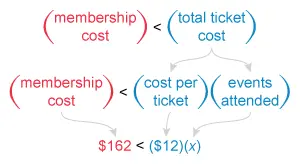
Now solve the inequality for x, the minimum number of events Anthony must attend.
| 162 < 12x | |
| 13.5 < x | Divide both sides by 12 |
For the cost of the membership to be less than the total cost of individual tickets, the minimum number of events Anthony must attend is the smallest whole number greater than 13.5.
Therefore, Anthony must attend a minimum of 14 events.
Note: It is also possible to answer the question by process of elimination. Calculate the ticket cost for each answer choice, and identify which results in the lowest amount that is greater than the membership cost (calculation).
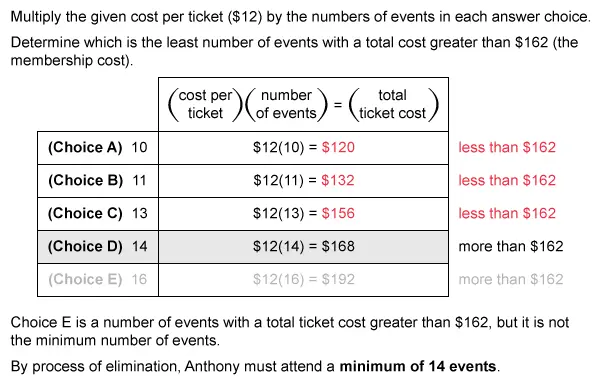
(Choice A) 10 may result from a combination of the errors described in Choices B and C.
(Choice B) 11 may result from mistaking the total number of events (16) for the cost of each individual ticket ($12).
(Choice C) 13 may result from rounding down to the nearest answer choice (instead of rounding up), but the number of tickets must be greater than 13.5 for the membership cost to be less than the total cost of individual tickets.
Things to remember:
If the solution to an equation or inequality represents a real-world object with no fractional meaning (ex. a number of people or a number of completed tasks), it may be necessary to round that value to a whole number.
Passage:
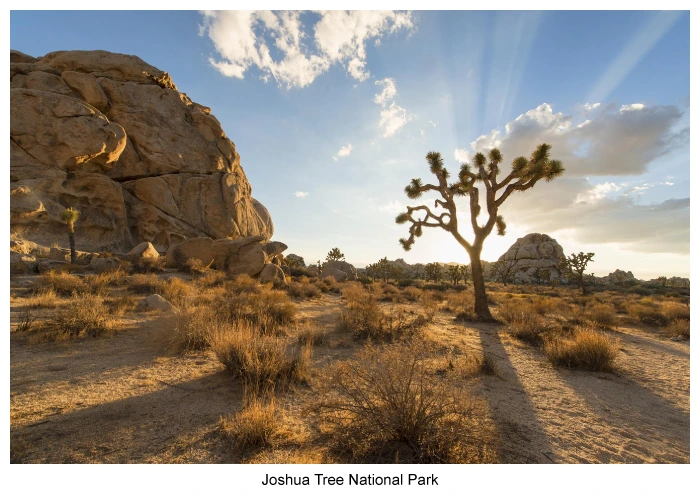
Joshua Tree National Park is extensive, slightly larger than Rhode Island, and named after a tree-like desert plant species. But this area might never have become a monument in 1936 and a bona fide national park in 1994 without the involvement of a woman who tirelessly worked, promoted, and eventually succeeded in convincing the government to protect it.
Civic activist, Minerva Hamilton Hoyt, became interested in cactuses and Joshua trees because of her love for gardening. She even traveled across the country to educate people about these desert plants. In reality, to expand her audience, Hoyt exhibited to other gardeners, some as far away as London. Two years after her first 1928 Garden Club of America show in New York, which was when Hoyt founded the International Desert Conservation League.
Hoyt might have never started her efforts on behalf of Southern California's desert plants had it not been for her growing concern that increased automobile traffic was threatening those plants in that region of that state. In an effort to protect these desert plants, Hoyt crusaded for the creation of Joshua Tree National Park by the state of California throughout the 1930s.
She also persuaded the Mexican government to set aside 10,000 acres for cactus preservation. In fact, in 1931, a species of Mexican cactus was named after Hoyt. Then in 2013, a mountaintop within Joshua Tree was also named after her. Even today the Joshua Tree National Park Association annually honors "notable achievement on behalf of the deserts of California" with it's Minerva Hoyt Award, a fitting tribute to the woman who I think deserves to be honored.
Question
Given that all the statements are true, which one provides the most effective transition from the preceding paragraph to this paragraph?
| A. NO CHANGE | |
| B. Eventually Hoyt was recognized for her conservation efforts. | |
| C. Hoyt's Joshua Tree promotion left a permanent stamp on American culture. | |
| D. Hoyt had the money to promote this cause because she was a wealthy socialite. |
Explanation
Paragraph 3: In an effort to protect these desert plants, Hoyt crusaded for the creation of Joshua Tree National Park by the state of California throughout the 1930s.
P4: Eventually Hoyt was recognized for her conservation efforts. In fact, in 1931, a species of Mexican cactus was named after Hoyt. Then in 2013, a mountaintop within Joshua Tree was named after her.
An effective transition at the beginning of a paragraph will connect ideas from the previous paragraph to ideas in the one with the transition.
P3 discusses Hoyt's concerns about conserving the desert plants in Southern California and her efforts to get these areas declared a national park. P4 explains how Hoyt was recognized later for her conservation efforts by having a cactus and an award named after her. Therefore, the most effective transition is Eventually Hoyt was recognized for her conservation efforts.
(Choice A) Although this sentence would connect to the information about "a species of Mexican cactus" being named after Hoyt, it does not connect as closely to the previous paragraph in which Hoyt worked to protect desert plants.
(Choice C) Although Hoyt promoted the Joshua tree, the idea that her efforts had a lasting impact on American culture doesn't connect to the honors she received. Although a cactus and mountaintop are still referred to by her name, that doesn't mean people know who Hoyt was or what she did.
(Choice D) Hoyt's money doesn't necessarily have anything to do with her efforts to preserve desert plants or the honors she received, as discussed in the paragraphs before and after the transition sentence.
Things to remember:
To determine which sentence is the best transition, choose the one that contains ideas connecting the previous paragraph and the current one.
Passage:
Literary Narrative: This passage is adapted from the novel Mrs. Dalloway by Virginia Woolf (©1925 by Virginia Woolf).
The crush was terrific for the time of day. Lords, Ascot, Hurlingham, what was it? She wondered, for the street was blocked. It is probably the Queen, thought Mrs. Clarissa Dalloway, coming out of Mulberry's with her flowers; the Queen. And for a second she wore a look of extreme dignity standing by the flower shop in the sunlight while the car passed at a foot's pace, with its blinds drawn. The Queen going to some hospital; the Queen opening some bazaar, thought Clarissa.
The British middle classes sitting sideways on the tops of omnibuses with parcels and umbrellas, yes, even furs on a day like this, were, she thought, more ridiculous, more unlike anything one could conceive; and the Queen herself held up; the Queen herself unable to pass. Clarissa was suspended on one side of Brook Street; Sir John Buckhurst, the old Judge on the other, with the car between them when the chauffeur, leaning ever so slightly, said or showed something to the policeman, who saluted and raised his arm and jerked his head and moved the omnibus to the side and the car passed through. Slowly and very silently it took its way.
As she observed the events taking place, Clarissa knew, of course, she had seen something white, magical, circular, in the footman's hand, a disc inscribed with a name—the name of the Queen's, the Prince of Wales's, or the Prime Minister's?—which, by force of its own lustre, burnt its way through to blaze among the candelabras, glittering stars, and the gentlemen of England present that night in Buckingham Palace. Clarissa saw the car diminishing, disappearing. She stiffened a little; so she would stand at the top of the stairs.
The car had gone, but it had left a slight ripple that flowed through glove shops and hat shops and tailors' shops on both sides of Bond Street. For thirty seconds all heads were inclined the same way—to the window. Choosing a pair of gloves—asking should they be to the elbow or above it, lemon or pale grey?—ladies suddenly stopped; something had happened. Something so trifling in single instances that no mathematical instrument, though capable of transmitting shocks in China, could register the vibration; yet in its fullness rather formidable and in its common appeal emotional; for in all the hat shops and tailors' shops strangers looked at each other and thought of the dead; of the flag; of Empire. For the surface agitation of the passing car as it disappeared grazed something very profound.
Gliding across Piccadilly, the car turned down St. James's Street. Tall men, men of robust physique, well-dressed men with their tail-coats and their hair raked back who, for reasons difficult to discriminate, were standing in the bow window of Brooks's with their hands behind the tails of their coats, looking out, perceived instinctively that greatness was passing, and the pale light of the immortal presence fell upon them as it had fallen upon Clarissa Dalloway. At once they stood even straighter, and removed their hands, and seemed ready to attend their Sovereign, if need be, in front of the cannon's mouth, as their ancestors had done before them. The white busts and the little tables in the background covered with copies of the Tatler and syphons of soda water seemed to approve; seemed to indicate the flowing corn and the manor houses of England; and to return the frail hum of the motor wheels. Shawled Moll Pratt with her flowers on the pavement wished the dear boy well (it was the Prince of Wales, for certain) and would have tossed the price of a pot of beer—a bunch of roses—into St. James's Street out of sheer light-heartedness and contempt of poverty had she not seen the constable's eye upon her, discouraging an old Irishwoman's loyalty. The sentries at St. James's saluted; Queen Alexandra's policeman approved.
A small crowd, meanwhile, had gathered at the gates of Buckingham Palace. Listlessly, yet confidently, poor people all of them, they waited; looked at the Palace itself with the flag flying; at Victoria, billowing on her mound, admired her shelves of running water, her geraniums; singled out from the motor cars in the Mall first this one, then that; bestowed emotion, vainly, upon commoners out for a drive; recalled their tribute to keep it unspent while this car passed and that; and all the time let rumour accumulate in their veins and thrill the nerves in their thighs at the thought of Royalty looking at them; the Queen bowing; the Prince saluting; at the thought of the heavenly life divinely bestowed upon Kings.
Question
Which of the following statements about the men standing in the window of Brooks's on St. James's Street is supported by the passage?
| A. In their eyes, something magical had passed between the footman and the policeman. | |
| B. They realized instantly that greatness was passing. | |
| C. They were proud of their royal ancestry in such a moment. | |
| D. In their eyes, the events unfolding were trifling and unworthy of their time. |
Explanation
P5: …the car turned down St. James's Street. Tall men, men of robust physique, well-dressed men with their tail-coats and their hair raked back who, for reasons difficult to discriminate, were standing in the bow window of Brooks's with their hands behind the tails of their coats, looking out, perceived instinctively that greatness was passing….
When a question asks which statement is "supported by the passage," the answer will be directly stated (though often using different words) in the text. Find the subject asked about (the men on St. James's Street) in the passage to identify the answer that is supported by the text.
In this case, the correct answer is stated in the same language used in the passage. P5 examines the men as they watched the events and states that they realized instantly that greatness was passing.
(Choice A) P2 and P3 indicate that on Bond Street, Mrs. Dalloway observed the interaction between the footman and the policeman; the gentlemen on St James's Street did not.
(Choice C) There is no evidence in the passage that the men looking out the window had royal ancestry.
(Choice D) The act described as "trifling" is the Queen's movement through the streets in P4, not the men in P5. In P5, the men are "standing in the bow window of Brooks's…looking out," which leads the reader to believe that watching royalty is worthy of their time.
Things to remember:
To find the answer "supported by the passage," locate the question's subject matter in the text, where the answer will be directly stated.
Why Students Love Our SAT and ACT Prep
UWorld’s question bank is extremely satisfactory to my needs as a digital SAT test-taker! It helped me in both the mathematics and writing sections. I also went from getting almost 47/58 in math to an all-time flawless math score. I’m vastly grateful for this product.
I bumped my SAT score from 1200 to 1370 in under a month. Before that, I used Khan Academy, which was good, but not nearly as thorough as UWorld.
Studying for the ACT was extremely frustrating. The countless strategy books in my closet were too overwhelming to begin studying. When I found UWorld, preparing for the exam became quick and easy. I received a better ACT score than I could have imagined!
Ready to Get College-Ready?
Thousands of expert-written practice questions — our SAT and ACT prep combo will get you closer to an admission letter from your dream school.