Verb Tenses and Forms on the Digital SAT® Reading & Writing | Complete Guide With Examples

Verb Tenses and Forms on SAT Reading & Writing section
Strong control of verb usage is one of the fastest ways to improve your SAT® Reading & Writing score. When you understand how timelines work and how verbs fit the structure of a sentence, many tricky questions become easy. This guide walks you through all the essential verb tenses, forms, and error-spotting techniques you’ll need for the exam.
Verb Tenses and Forms on SAT Reading & Writing section

What Are Verb Tenses and Forms on the SAT?

Verb tense refers to when an action happens in a sentence. The SAT® tests whether you can choose the correct tense to show past, present, or future events. Questions may include shifts in time or sentences where multiple actions need consistent tense. These items often relate to SAT verb tense or SAT past tense concepts.

Verb form refers to the correct structure of a verb, including participles, gerunds, and infinitives. The test checks whether you can match the verb form to the sentence’s meaning and grammar pattern. You will see SAT verbs tested throughout the Reading and Writing section, especially in questions that ask you to maintain logical time order, correct SAT verb tense consistency, or identify errors in past tense SAT usage.

Why Verb Tenses and Forms Matter for SAT Reading & Writing

Verb tense and verb form questions show whether you can read closely and maintain a clear, precise meaning. The SAT often tests your ability to keep actions in logical time order, recognize shifts in context, and choose the most effective SAT verbs for a sentence. A strong understanding of SAT verb tenses improves both accuracy and efficiency on the test.

Here are the key reasons they matter:

  • They help maintain consistency when a passage describes events in different time periods.
  • They ensure the sentence reflects the correct relationship between ongoing, completed, or future actions.
  • They prevent errors in SAT past tense usage when writers describe historical information or sequences of events.
  • They improve clarity, which is essential for understanding arguments and explanations on the exam.

If you want guided practice with real SAT-style examples, our SAT Prep Course offers interactive lessons and explanations that help you master verb tenses and other core Reading and Writing skills.

Learn Verb Tenses the Way the SAT Tests Them
Get step-by-step lessons that show how verb tense choices affect meaning on real SAT questions.

Verb Tenses You Need for the Digital SAT

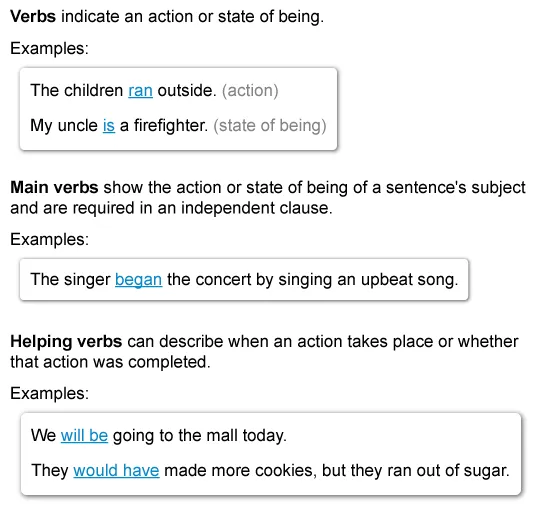
The SAT focuses on a core set of verb tenses that show clear time relationships in a sentence. You will need to recognize how actions relate to one another and identify when a tense shift affects meaning. Many SAT verb tense questions require you to compare what happened in the past, what is happening now, and what will happen next.

A solid understanding of the past tense and other essential tenses helps you choose the most precise option quickly and confidently.

Present Tense

  1. Simple Present: Used for habits, routines, and general truths.

    Example: Scientists study climate change.

    Explanation: This shows a regular or ongoing fact.

  2. Present Continuous: Used for actions happening right now or temporary ongoing actions.

    Example: Scientists are studying climate change.

    Explanation: The form changes to “are studying” to show the action is happening at this moment.

  3. Present Perfect: Used for an action that started in the past and continues or has relevance now.

    Example: Scientists have studied climate change.

    Explanation: The form “have studied” connects past work to the present moment.

  4. Present Perfect Continuous: Used to show an action that began in the past and is still continuing, with focus on duration.

    Example: Scientists have been studying climate change.

    Explanation: The form “have been studying” shows a long, ongoing activity that continues today.

Past Tense

  1. Simple Past: Used for actions completed in the past.

    Example: Scientists studied climate change.

    Explanation: The form “studied” shows the action is finished.

  2. Past Continuous: Used for an ongoing past action often interrupted by another event.

    Example: Scientists were studying climate change when the results arrived.

    Explanation: The form changes to “were studying” to show the action was in progress at a specific past time.

  3. Past Perfect: Used for an action completed before another past action.

    Example: Scientists had studied climate change before the new tools were introduced.

    Explanation: The form “had studied” shows this action happened earlier than another event in the past.

  4. Past Perfect Continuous: Used for a longer action in progress before another past event.

    Example: Scientists had been studying climate change before funding increased.

    Explanation: The form “had been studying” highlights the ongoing nature of the action before another event occurred.

Future Tense

  1. Simple Future: Used for actions that will happen later.

    Example: Scientists will study climate change.

    Explanation: The form “will study” shows a planned future action.

  2. Future Continuous: Used for an ongoing action expected to occur at a specific future time.

    Example: Scientists will be studying climate change next summer.

    Explanation: The form changes to “will be studying” to show the action will be in progress.

  3. Future Perfect: Used for an action that will be completed before a specific future moment.

    Example: Scientists will have studied climate change before the report is published.

    Explanation: The form “will have studied” shows the action will be finished by a certain time.

  4. Future Perfect Continuous: Used for actions that will continue up to a point in the future.

    Example: Scientists will have been studying climate change for decades by 2050.

    Explanation: The form “will have been studying” shows the action continuing over a long period until that future year.

Tense Type Present Past Future
Simple Subject + base verb Subject + past tense verb Subject + will + base verb
Continuous Subject + am/is/are + verb + ing Subject + was/were + verb + ing Subject + will + be + verb + ing
Perfect Subject + has/have + past participle Subject + had + past participle Subject + will + have + past participle
Perfect Continuous Subject + has/have + been + verb + ing Subject + had + been + verb + ing Subject + will + have + been + verb + ing
Turn Rules Into Confidence With Guided Review
Reinforce every SAT verb tense with clear explanations and examples you can revisit anytime.

Verb Forms You Need for the Digital SAT

The SAT checks whether you can recognize and use the correct verb forms to match a sentence’s meaning and structure. These questions often check if you can choose between infinitives, participles, or gerunds while keeping the sentence clear and grammatically correct. Many verb form items appear alongside SAT verbs and SAT verb tense questions, so understanding how each form functions is important.

Conditional (Would / Could / Might)

Conditional forms express hypothetical or possible situations, often depending on another action or circumstance. On the SAT, these forms test whether you can convey correct meaning in hypothetical statements.

Examples:

  • Scientists would study climate change if funding were available. → Shows a hypothetical situation.
  • The team could discover new species with better equipment. → Indicates possibility.
  • Researchers might analyze additional data next week. → Suggests uncertainty.

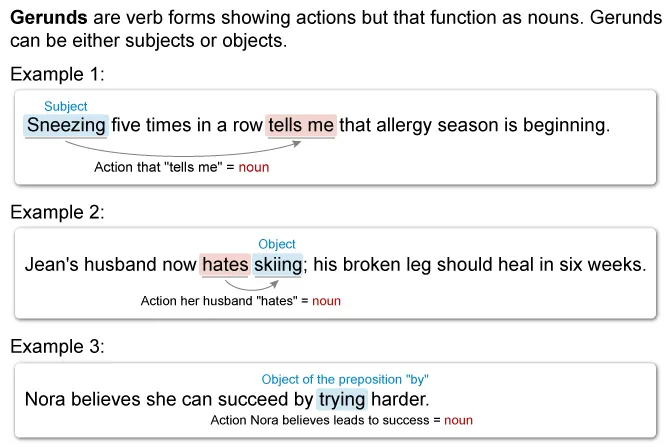
Gerunds (verb + ing used as a noun)

Gerunds are verbs ending in -ing that function as nouns. The SAT may test gerunds as subjects, objects, or after prepositions.

Examples:

  • Studying climate change requires patience. → “Studying” is the subject.
  • The scientists focused on analyzing the results. → Gerund after a preposition.
  • She enjoys reading reports on climate trends. → Gerund as an object.

Infinitives (to + base verb)

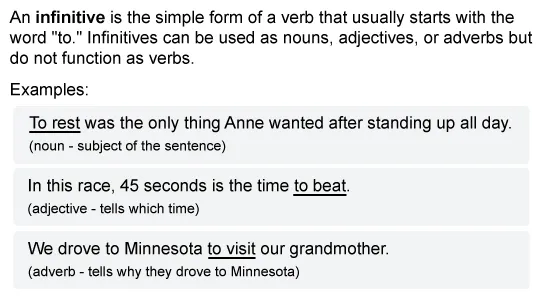
Infinitives use “to” plus a base verb and can act as nouns, adjectives, or adverbs. The SAT often tests infinitives to maintain clarity and proper parallel structure.

Examples:

  • The team wants to study climate change thoroughly. → Infinitive as object.
  • A method to analyze the data efficiently is necessary. → Infinitive as an adjective modifying “method.”
  • Scientists pause to record their observations. → Infinitive as purpose/adverb.

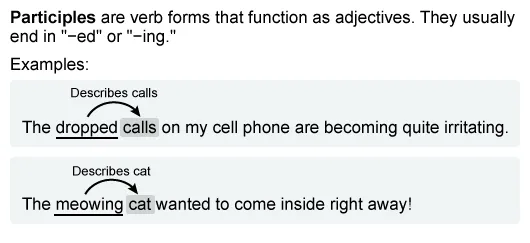
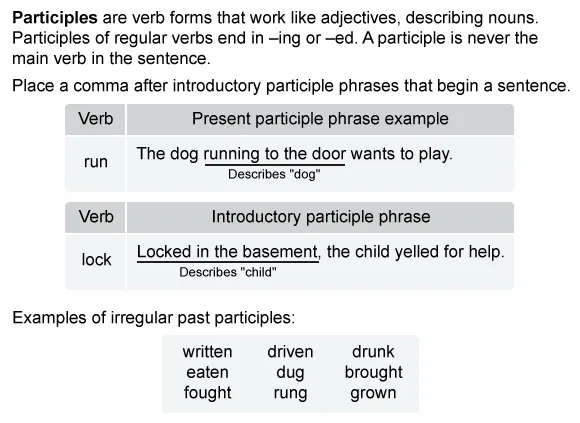
Participles (used as adjectives)

Participles are verbs used as adjectives, usually ending in -ing (present participle) or -ed (past participle). They describe nouns or pronouns.

Examples:

  • The studying scientists took careful notes. → Present participle modifying “scientists.”
  • The recorded data showed unexpected results. → Past participle modifying “data.”
  • Using analysis software, the team improved their results. → Participial phrase showing how the action is done.

Irregular Verb Forms

Irregular verbs do not follow standard -ed patterns in the past tense or past participle. SAT questions often test correct usage and consistency in tense.

Examples:

  • The team began the study early last year. → Past tense of “begin.”
  • They have gone through multiple drafts of the report. → Past participle of “go.”
  • Scientists write, wrote, and have written findings carefully. → Shows base, past, and past participle forms.

For students who prefer structured review, our SAT Prep Book provides clear explanations, rule summaries, and practice pages that reinforce every tense and form you’ll see on the test.

Practice Verb Forms Until They Feel Automatic
Work through SAT-style examples that train you to spot tense and form errors fast.

How to Spot Verb Tense and Form Errors on the SAT

Verb tense and verb form mistakes usually appear when a sentence shifts time without reason, presents events in the wrong order, or uses the wrong version of a verb. The SAT includes subtle clues that help you detect these common errors quickly. Using the steps below helps you approach SAT verb tense and form questions with confidence.

Step 1: Identify the Time Frame

Determine when the action happens by looking for time clues such as “now,” “in 2019,” “later,” or “today.” These markers tell you which tense the sentence should use.

Example:

Error: The report discusses results that scientists found last year and explores what they might discover next.

Explanation: The sentence mixes present and past even though the events are all in the past.

Fix: Use present or past consistently depending on the surrounding text.

Step 2: Check for Consistent Events

Some sentences describe two or more actions that happen in a specific order. If one event happened before another, the sentence may need perfect tense forms.

Example:

Error: The team published their findings after they complete the experiment.

Explanation: “Complete” is in present tense even though the action happened before the publishing, which is in the past.

Fix: The team published their findings after they had completed the experiment.

Step 3: Confirm the Correct Verb Form

Decide whether the sentence needs a gerund, infinitive, or participle. Each form serves a specific purpose, and the wrong choice can change the meaning or break the grammar.

Example:

Error: The excited results surprised the team.
Explanation: “Results” cannot feel emotions. The participle must describe the noun logically.

Fix: The exciting results surprised the team

Step 4: Test Irregular Verb Forms

Some verbs change completely in the past tense or past participle, so using the wrong form creates errors even if the timeline is correct.

Example:

Error: The scientist had wrote the conclusion earlier.

Explanation: “Wrote” is the simple past form, but the sentence needs the past participle because it follows “had.”

Fix: The scientist had written the conclusion.

Step 5: Check Conditional or Modal Consistency

Sentences that describe possibilities, hypotheticals, or uncertain outcomes require consistent use of “would,” “could,” or “might.” Using a normal verb tense instead of a conditional form changes the meaning or makes the sentence grammatically incorrect.

Example:

Error: The team studies the data more carefully if they had more time.

Explanation: The clause “if they had more time” signals a hypothetical situation, so “studies” must become a conditional verb.

Fix: The team would study the data more carefully if they had more time.

To sharpen your accuracy with realistic practice, our SAT Question Bank includes hundreds of verb tense and form questions that mirror SAT difficulty and provide instant feedback.

Key Rules and Tips (Fast SAT Reminders)

Use these quick reminders to avoid common SAT verb tense and verb form errors. They’ll help you move faster and choose the most accurate answer.

  • Keep the timeline consistent. If a sentence stays in the past, the verbs should stay in the past unless there is a clear reason to shift.
  • Use perfect tenses to show one action happening before another. Past perfect and future perfect often appear in sequencing questions.
  • Match verb forms to their functions. Use gerunds as nouns, infinitives to show purpose, and participles to describe nouns.
  • Check for irregular verb patterns. After “has,” “have,” or “had,” you must use the past participle.
  • Pay attention to time signals like “now,” “in 2010,” “later,” or “already.” They often reveal the correct tense immediately.
  • Be careful with conditional verbs. If a sentence describes a hypothetical situation, use “would,” “could,” or “might.”
  • Read the whole sentence. Many errors appear at the end of the sentence or in a surrounding clause.
  • Avoid unnecessary tense shifts when comparing facts, general truths, or ongoing research situations.

SAT Verb Tenses Practice Questions

Use the following practice questions to check your understanding of the verb tenses and forms most commonly tested on the Digital SAT. Each question challenges you to maintain a logical time order and grammatical accuracy, just like the real exam.

Passage:

To help end the stigma around HIV/AIDS and empower people who are living with the virus, an ongoing exhibition highlights images of HIV-positive individuals and their perspectives. Through Positive Eyes, the name of the exhibition, which is an art project created in collaboration with people living with HIV/AIDS. Launched in 2007, Through Positive Eyes features personal photo essays that hopefully will produce enough positive public reactions to create a change in how people most deeply affected by HIV are viewed.

When it opened, the exhibition featured photography, video, sculpture, and live storytelling components that reflected the lives of 130 people in 10 different cities. Participants in each city generate a cohesive body of work—intended by dissolving distrust and fear of people living with HIV/AIDS. The primarily autobiographical works on view conjuring a broad picture of the epidemic—ranging from everyday imagery of relationships, bodies, and hobbies to more abstract meditations on joy, grief, solitude, and resilience—and explore physical and emotional aspects of daily life after diagnosis with this chronic illness.

The exhibition opens with a mural-size collage of 130 faces, a composite of portraits taken by Gideon Mendel, being born in Johannesburg, South Africa. Now living in London, the photographers' commented, "After many years documenting the HIV/AIDS epidemic myself, I felt that the time had come to hand over the camera to people living with the syndrome." Mendel's composite photograph is surrounded by 10 self-portraits, one from each city where past workshops are being held. The walls had been covered in 10 floor-to-ceiling banners, and HIV-positive artist-activists, known as artivists, take turns performing in front of this backdrop, using a scripted monologue aimed at connecting with audiences about their experiences with HIV. The hope is that the experience will foster greater awareness and empathy, two essential steps toward banishing the stigma associated with the epidemic.

Question

Mendel's composite photograph is surrounded by 10 self-portraits, one from each city where past workshops are being held.
A. NO CHANGE
B. will be held
C. have been held
D. are held

Explanation

Mendel's composite photograph is surrounded by 10 self-portraits, one from each city where past workshops have been held.

Look for words in the sentence that might indicate which answer contains the correct verb tense.

Because "past" indicates when the workshops took place, this word shows that the correct answer will be the one that indicates a past action. Therefore, the best way to end the sentence is to indicate that each of the self-portraits come from a city where past workshops have been held.

(Choices A and D) "Are" indicates things currently happening or that happen regularly (ex. The track events are being held at the stadium, and they are held every year), but the workshops being described were held in the past.

(Choice B) "Will" indicates something that could happen in the future. (Ex. I will be happy after I graduate.) However, the workshops being described in this sentence happened in the past.

Things to remember:
Look for context clues in the sentence that indicate whether a verb should be past, present, or future tense.

Passage:

To help end the stigma around HIV/AIDS and empower people who are living with the virus, an ongoing exhibition highlights images of HIV-positive individuals and their perspectives. Through Positive Eyes, the name of the exhibition, which is an art project created in collaboration with people living with HIV/AIDS. Launched in 2007, Through Positive Eyes features personal photo essays that hopefully will produce enough positive public reactions to create a change in how people most deeply affected by HIV are viewed.

When it opened, the exhibition featured photography, video, sculpture, and live storytelling components that reflected the lives of 130 people in 10 different cities. Participants in each city generate a cohesive body of work—intended by dissolving distrust and fear of people living with HIV/AIDS. The primarily autobiographical works on view conjuring a broad picture of the epidemic—ranging from everyday imagery of relationships, bodies, and hobbies to more abstract meditations on joy, grief, solitude, and resilience—and explore physical and emotional aspects of daily life after diagnosis with this chronic illness.

The exhibition opens with a mural-size collage of 130 faces, a composite of portraits taken by Gideon Mendel, being born in Johannesburg, South Africa. Now living in London, the photographers' commented, "After many years documenting the HIV/AIDS epidemic myself, I felt that the time had come to hand over the camera to people living with the syndrome." Mendel's composite photograph is surrounded by 10 self-portraits, one from each city where past workshops are being held. The walls had been covered in 10 floor-to-ceiling banners, and HIV-positive artist-activists, known as artivists, take turns performing in front of this backdrop, using a scripted monologue aimed at connecting with audiences about their experiences with HIV. The hope is that the experience will foster greater awareness and empathy, two essential steps toward banishing the stigma associated with the epidemic.

Question

Launched in 2007, Through Positive Eyes features personal photo essays that hopefully will produce enough positive public reactions to create a change in how people most deeply affected by HIV are viewed.
A. NO CHANGE
B. so that it creates
C. for creating of
D. creating

Explanation

Use context clues to help determine the correct verb or verb phrase.
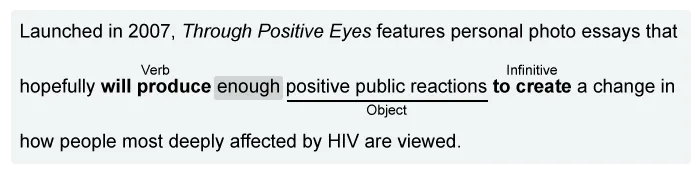
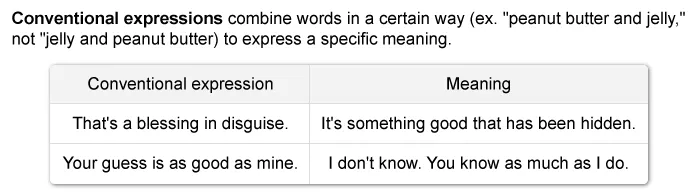
An infinitive ("to" + verb) is conventionally used after a phrase using the construction of "will" + [verb] + "enough." This same pattern can be seen in expressions like "we will buy enough food to last the week" and "I will run fast enough to win."

Therefore, the best wording after "will produce enough positive public reaction" is the infinitive "to create" or NO CHANGE.

(Choice B) The pronoun "it" in this answer choice doesn't have a clear antecedent as either "reaction" or Through Positive Eyes could be the noun being referred to.

(Choice C) This answer is unclear because while "enough positive public creation for [the] creating of a change" would be clear, without the "the," the word "creating" could be either a noun/gerund or verb/participle.

(Choice D) "Creating" could begin a participle phrase, but participles must either be set off with a comma or be placed beside what they describe. Here, the "photo essays"—not the "reaction"—are "creating a change," so this choice is neither punctuated correctly nor places the participle next to the word it describes.

Things to remember:
Often, an infinitive is the correct part of speech after the pattern "[verb] enough [optional object]. (Ex. The grove will produce enough fruit to support the family.)


Passage:

The death rate among cancer patients is increasing due to a lack of understanding about how this disease is likely to exploit the body's own cells as a form of attack. As a result of this lack of understanding, further research on the subject is likely focusing on the connection between the host and the environment in which the cancer grows.

There were a number of challenges that cancer can present to the immune system, which usually keeps the body healthy by recognizing and eliminating infections. One is related to the discovery that cancer cells occurring within the immune system fail to be recognized as harmful. In fact, cancer cells are created from the cells within the body and is viewed as native, instead of foreign, to the immune system. Even when identified properly, cancer cells can hinder immune systems, causing these important human defense mechanisms to malfunction.

Unfortunately, normal, healthy cells do not reproduce nearly as fast as cancer cells did, and this is especially true when cancer cells are left undisturbed. When the immune system fails to destroy these cells, the cancer growth became uncontrollable. Tumors form due to the unnecessary buildup of excess tissue that [Q#9] was the result of this rapid cell growth.

Question

As a result of this lack of understanding, further research on the subject is likely focusing on the connection between the host and the environment in which the cancer grows.
A. NO CHANGE
B. in focusing
C. focuses
D. to focus

Explanation

As a result of this lack of understanding, further research on the subject is likely to focus on the connection between the host and the environment in which the cancer grows.

Use context clues to select the correct answer. Choose an infinitive when it follows the phrase "is likely" and indicates something will happen in the future. (Ex. She is likely to succeed.).

Because the focus of the research is likely to be on a future connection "between the host and the environment in which the cancer grows," the correct answer is the infinitive to focus.

(Choice A) "Focusing" would pair with "is" to indicate that the action is currently happening or ongoing. (Ex. The student is focusing on her test.) However, "further" indicates more research will be done in the future.

(Choice B) "In focusing" makes it unclear whether "likely" means further research is likely or if the research will likely focus on "connections between the host and the environment. " Also, "is likely in focusing" is awkwardly worded.

(Choice C) "Is focuses" is awkward and incorrect English because verbs ending in "s" can't follow the verb "is," so "focuses" doesn't work after "is likely." (Incorrect: Walter is likely focuses on his studies.)

Things to remember:
Choose the infinitive verb form when a sentence includes a linking verb like "is" that is followed by the word "likely" and indicates a future occurrence.

Get More SAT Verb Practice With Instant Feedback
Drill verb tense and form questions with detailed explanations that show why each choice works.

SAT Verb Tenses and Forms: FAQS

The SAT Reading & Writing section tends to use present and past simple forms most frequently, especially when describing research, historical events, or general facts. Perfect tenses appear when the test checks the order of events or long-running actions. Continuous forms come up less often but still appear in context questions. Knowing how these tenses shift within a passage helps you avoid mistakes.
Gerunds end in -ing and function as nouns, while infinitives use “to” plus a base verb and can act as nouns, adjectives, or adverbs. The SAT often tests whether you can choose the form that fits the sentence structure. Gerunds commonly follow prepositions, but infinitives are often used to express purpose. Recognizing each form’s role helps you eliminate wrong choices quickly.
Many students miss errors involving mixed timelines, especially when a sentence shifts between past and present without a clear reason. Perfect tense mistakes are also common because they require you to know which action happened first. Irregular verbs can cause additional problems when the wrong past participle is used. Students often overlook subtle time clues that point to the correct tense.
Practice identifying time markers and event order in short sentences to build speed. Review common irregular verb forms and perfect tense structures since these appear often on SAT verb tense questions. Working through targeted SAT Practice tests helps reinforce patterns, and reading explanations strengthens your ability to spot mistakes. Consistent practice with short passages boosts accuracy and confidence.
The SAT includes 20 Standard English Conventions questions in total. These questions cover grammar, usage, and punctuation, including SAT verbs, tense SAT items, and verb form issues. They are mixed into both modules of the Reading and Writing section. Understanding key rules helps you move through them efficiently.
Follow Us For Daily Video Tips
View More...
UWorld College Prep Logo Inverse
See the Difference for Yourself.
Try UWorld SAT Course FREE for 7 Days
No credit card required
Scroll to Top

Try Our SAT Course
FREE for 7 Days

See the UWorld Difference For Yourself
No Credit Card Required