Passage: Insufficient Sleep Among Teenagers
Insufficient sleep is common among high school students and has been associated with an increased risk for motor vehicle crashes, sports injuries, and [Q#1] also an increased risk of occupational hazards. US high school students who get fewer than 7 hours of sleep are also more prone to risky behavior, be it texting while driving, [Q#2] when they infrequently use a seat belt, or drinking and driving.
Insufficient sleep directly contributes to injury risk, slowing reaction time, [Q#3] impair the ability to pay attention, or causing a driver to fall asleep. Thus, not getting enough sleep might cause adolescent drivers to take more risks and [Q#4] have disregarded the possibility of negative consequences.
Teens may have unavoidable reasons for insufficient sleep; some lose rest by working at night, [Q#5] to study late, or participating in extracurricular activities like theater or band. Historically, however, students have viewed the evening as the only time to pursue their own interests, playing video games late into the night or [Q#6] socializing with friends on their phones or computers.
Even more problematic for sleep, students' circadian rhythms, or internal biological clocks, often cause wakefulness at night, [Q#7] they increase sleepiness during the day, and contribute to tiredness during school. In addition, depression has been identified as another problem among teens, often accompanied by "at risk" behaviors or sleepiness that could cause them to crash their car, not to mention [Q#8] injured themselves or others.
To ensure adequate sleep, adolescents can practice good sleep hygiene. These habits include a consistent schedule with the same bedtime and wake-up time each day, a technology-free bedroom with no computers or cell phones, and [Q#9] a dark room with minimal exposure to light. To help their teens get enough sleep, parents should establish reasonable bedtimes, [Q#10] limit when (only before a set time or "media curfew") and where (not in their bedrooms) their teenagers can use electronic devices, and ensure the house is quiet and conducive to rest.
Unfortunately, early school start times can also contribute to a lack of sleep among adolescents. Delaying school start times has been proposed as a means of ensuring that adolescents are livelier, can think better, [Q#11] and they are more awake, are ready to learn. Unfortunately, some students wake up feeling tired in spite of adequate sleep, which might be an indication of poor sleep quality or an underlying health condition. Poor sleep quality might result from bad sleeping habits, an inconducive sleep environment (too warm, too noisy, cell phones in the bedroom), or a sleep disorder. Teens should be aware of these potential problems because the recommendation, according to the National Sleep Foundation, is for adolescents aged 14–17 years to sleep 8–10 hours per night and [Q#12] getting good quality rest.
Question
Insufficient sleep is common among high school students and has been associated with an increased risk for motor vehicle crashes, sports injuries, and also an increased risk of occupational hazards.
| A. NO CHANGE | |
| B. for occupational hazards. | |
| C. occupational hazards. | |
| D. it also increases the risk of occupational hazards. |
Explanation
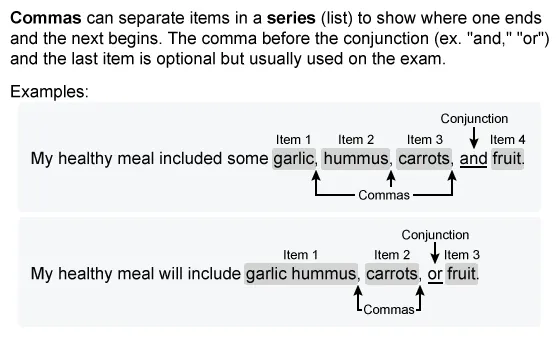
Rule: Items in a series should maintain parallel structure by using the same parts of speech for each item.
If the underlined portion is a list, see which each answer choice matches the grammatical structure of the other listed items.
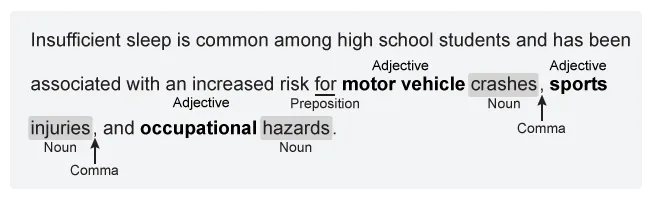
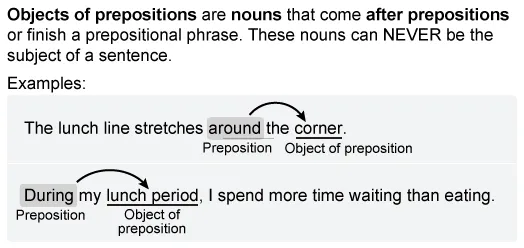
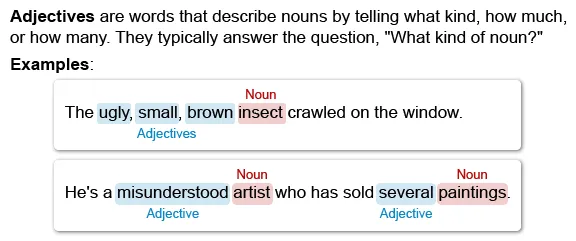
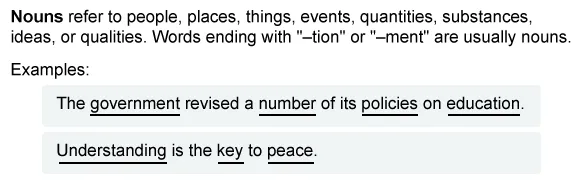
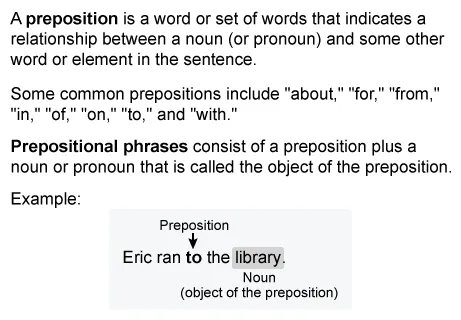
The first two items for which "insufficient sleep" presents "an increased risk" are given as objects of the preposition "for." Both contain an adjective followed by a noun. The only answer that also uses an adjective followed by a noun is occupational hazards.
(Choice A) "An increased risk" is already used before the preposition "for," so repeating these words would be unnecessary as well as not parallel to the other items after "for."
(Choice B) This answer repeats the preposition "for," which is used before the first item but not before the second. All the items would have to include "for" in order to maintain parallel structure.
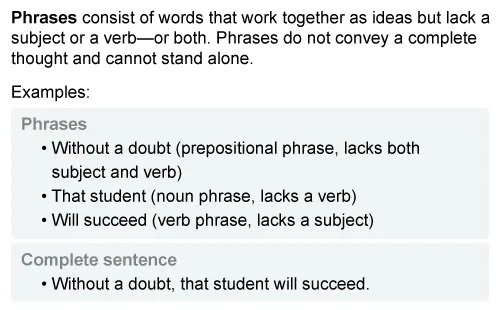
(Choice D) "It also increases the risk of occupational hazards" is an independent clause. Because none of the other items are independent clauses, this answer doesn't maintain parallel structure.
Things to remember:
Items in a series should maintain parallel structure by using the same parts of speech.
Passage: Insufficient Sleep Among Teenagers
Insufficient sleep is common among high school students and has been associated with an increased risk for motor vehicle crashes, sports injuries, and [Q#1] also an increased risk of occupational hazards. US high school students who get fewer than 7 hours of sleep are also more prone to risky behavior, be it texting while driving, [Q#2] when they infrequently use a seat belt, or drinking and driving.
Insufficient sleep directly contributes to injury risk, slowing reaction time, [Q#3] impair the ability to pay attention, or causing a driver to fall asleep. Thus, not getting enough sleep might cause adolescent drivers to take more risks and [Q#4] have disregarded the possibility of negative consequences.
Teens may have unavoidable reasons for insufficient sleep; some lose rest by working at night, [Q#5] to study late, or participating in extracurricular activities like theater or band. Historically, however, students have viewed the evening as the only time to pursue their own interests, playing video games late into the night or [Q#6] socializing with friends on their phones or computers.
Even more problematic for sleep, students' circadian rhythms, or internal biological clocks, often cause wakefulness at night, [Q#7] they increase sleepiness during the day, and contribute to tiredness during school. In addition, depression has been identified as another problem among teens, often accompanied by "at risk" behaviors or sleepiness that could cause them to crash their car, not to mention [Q#8] injured themselves or others.
To ensure adequate sleep, adolescents can practice good sleep hygiene. These habits include a consistent schedule with the same bedtime and wake-up time each day, a technology-free bedroom with no computers or cell phones, and [Q#9] a dark room with minimal exposure to light. To help their teens get enough sleep, parents should establish reasonable bedtimes, [Q#10] limit when (only before a set time or "media curfew") and where (not in their bedrooms) their teenagers can use electronic devices, and ensure the house is quiet and conducive to rest.
Unfortunately, early school start times can also contribute to a lack of sleep among adolescents. Delaying school start times has been proposed as a means of ensuring that adolescents are livelier, can think better, [Q#11] and they are more awake, are ready to learn. Unfortunately, some students wake up feeling tired in spite of adequate sleep, which might be an indication of poor sleep quality or an underlying health condition. Poor sleep quality might result from bad sleeping habits, an inconducive sleep environment (too warm, too noisy, cell phones in the bedroom), or a sleep disorder. Teens should be aware of these potential problems because the recommendation, according to the National Sleep Foundation, is for adolescents aged 14–17 years to sleep 8–10 hours per night and [Q#12] getting good quality rest.
Question
Insufficient sleep directly contributes to injury risk, slowing reaction time, impair the ability to pay attention, or causing a driver to fall asleep.
| A. NO CHANGE | |
| B. sleep deficit impairing | |
| C. to impair | |
| D. impairing |
Explanation
Rule: Items in a series should maintain parallel structure by using the same parts of speech for each item.
Determine if the underlined word is part of a list, and if so, make a note of the grammatical pattern so that you can choose the answer that matches that pattern.
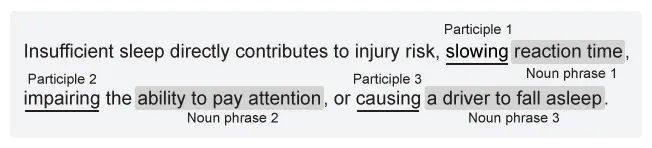
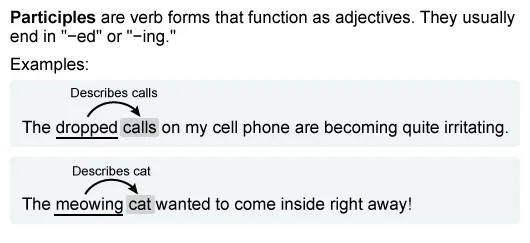
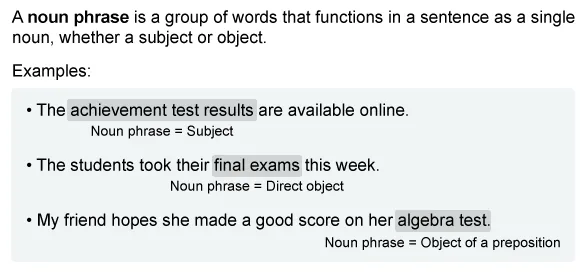
Each participle begins a noun phrase that describes "insufficient sleep." Because the first participle "slowing" and the third participle "causing" are both present participles that end in "–ing," the second one should also end in "–ing." Therefore, the correct answer is impairing.
(Choices A, B, and C) None of these answers match the grammatical pattern of the other items in the list, so they don't maintain parallel structure.
- Choice A: "Impair" is a present tense verb instead of a present participle "–ing" verb.
- Choice B: The two other items in the series place a participle before a noun phrase, but this answer puts the noun phrase "sleep deficit" first, so this order isn't the same as the other listed items.
- Choice C: "To impair" is an infinitive, not a participle.
Things to remember:
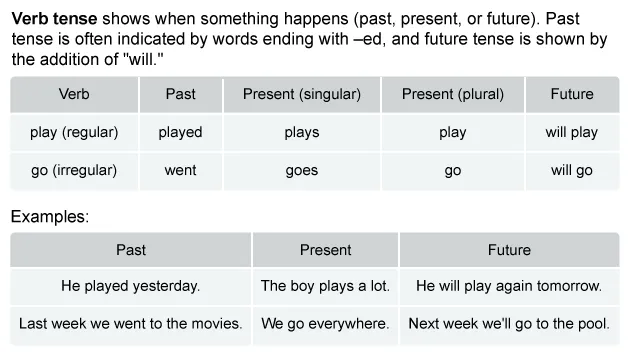
To maintain parallel structure, series items often use the same parts of speech (ex. present participles) in the same order. (Ex. He plans on going home, taking a shower, and watching TV.)
Passage: Insufficient Sleep Among Teenagers
Insufficient sleep is common among high school students and has been associated with an increased risk for motor vehicle crashes, sports injuries, and [Q#1] also an increased risk of occupational hazards. US high school students who get fewer than 7 hours of sleep are also more prone to risky behavior, be it texting while driving, [Q#2] when they infrequently use a seat belt, or drinking and driving.
Insufficient sleep directly contributes to injury risk, slowing reaction time, [Q#3] impair the ability to pay attention, or causing a driver to fall asleep. Thus, not getting enough sleep might cause adolescent drivers to take more risks and [Q#4] have disregarded the possibility of negative consequences.
Teens may have unavoidable reasons for insufficient sleep; some lose rest by working at night, [Q#5] to study late, or participating in extracurricular activities like theater or band. Historically, however, students have viewed the evening as the only time to pursue their own interests, playing video games late into the night or [Q#6] socializing with friends on their phones or computers.
Even more problematic for sleep, students' circadian rhythms, or internal biological clocks, often cause wakefulness at night, [Q#7] they increase sleepiness during the day, and contribute to tiredness during school. In addition, depression has been identified as another problem among teens, often accompanied by "at risk" behaviors or sleepiness that could cause them to crash their car, not to mention [Q#8] injured themselves or others.
To ensure adequate sleep, adolescents can practice good sleep hygiene. These habits include a consistent schedule with the same bedtime and wake-up time each day, a technology-free bedroom with no computers or cell phones, and [Q#9] a dark room with minimal exposure to light. To help their teens get enough sleep, parents should establish reasonable bedtimes, [Q#10] limit when (only before a set time or "media curfew") and where (not in their bedrooms) their teenagers can use electronic devices, and ensure the house is quiet and conducive to rest.
Unfortunately, early school start times can also contribute to a lack of sleep among adolescents. Delaying school start times has been proposed as a means of ensuring that adolescents are livelier, can think better, [Q#11] and they are more awake, are ready to learn. Unfortunately, some students wake up feeling tired in spite of adequate sleep, which might be an indication of poor sleep quality or an underlying health condition. Poor sleep quality might result from bad sleeping habits, an inconducive sleep environment (too warm, too noisy, cell phones in the bedroom), or a sleep disorder. Teens should be aware of these potential problems because the recommendation, according to the National Sleep Foundation, is for adolescents aged 14–17 years to sleep 8–10 hours per night and [Q#12] getting good quality rest.
Question
In addition, depression has been identified as another problem among teens, often accompanied by "at risk" behaviors or sleepiness that could cause them to crash their car, not to mention injured themselves or others.
| A. NO CHANGE | |
| B. injuring | |
| C. injure | |
| D. have injured |
Explanation
Rule: When a conjunction connects two infinitives, they should both be present tense verbs.
Determine if the underlined verb is connected to another verb in the sentence. If so, make sure those two verbs match.
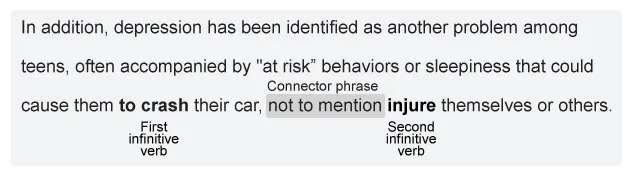
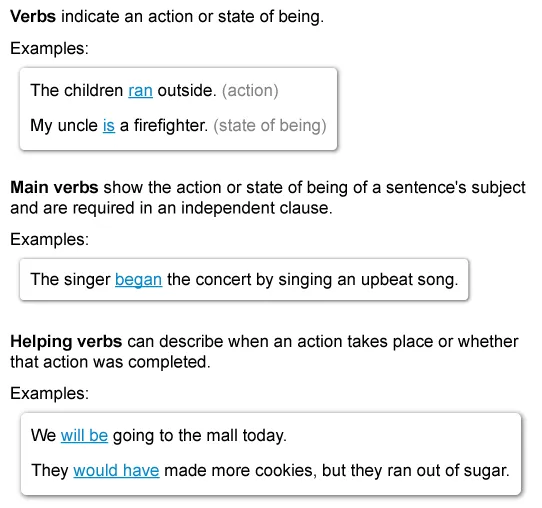
"Not to mention" connects the infinitive "to crash" with a second verb, which should be in the present tense because it functions as a second infinitive. (Ex. The goal of every student driver should be to maneuver carefully, not to mention [to] keep everyone in the car safe.) Of the choices, the only option that creates parallel structure is injure.
(Choice A) "Injured" is a past tense verb that can't be part of an infinitive and, therefore, doesn't match the first verb. (Incorrect: The coach shouldn't allow the students to play recklessly or [to] injured others.)
(Choice B) "Injuring" can't be preceded by "to," so it can't create a second infinitive that is parallel to the first verb. (Incorrect: The dart thrower wanted to hit the target, not [to] injuring others.)
(Choice D) Although "have injured" could be preceded by "to," it wouldn't be parallel with the infinitive form "crash" from earlier in the sentence. (Not parallel: I need to sleep and have gotten more rest.)
Things to remember:
Two infinitive verbs can be parallel when only the first is preceded by "to" as long as the second is also in the present tense form.
Passage: Insufficient Sleep Among Teenagers
Insufficient sleep is common among high school students and has been associated with an increased risk for motor vehicle crashes, sports injuries, and [Q#1] also an increased risk of occupational hazards. US high school students who get fewer than 7 hours of sleep are also more prone to risky behavior, be it texting while driving, [Q#2] when they infrequently use a seat belt, or drinking and driving.
Insufficient sleep directly contributes to injury risk, slowing reaction time, [Q#3] impair the ability to pay attention, or causing a driver to fall asleep. Thus, not getting enough sleep might cause adolescent drivers to take more risks and [Q#4] have disregarded the possibility of negative consequences.
Teens may have unavoidable reasons for insufficient sleep; some lose rest by working at night, [Q#5] to study late, or participating in extracurricular activities like theater or band. Historically, however, students have viewed the evening as the only time to pursue their own interests, playing video games late into the night or [Q#6] socializing with friends on their phones or computers.
Even more problematic for sleep, students' circadian rhythms, or internal biological clocks, often cause wakefulness at night, [Q#7] they increase sleepiness during the day, and contribute to tiredness during school. In addition, depression has been identified as another problem among teens, often accompanied by "at risk" behaviors or sleepiness that could cause them to crash their car, not to mention [Q#8] injured themselves or others.
To ensure adequate sleep, adolescents can practice good sleep hygiene. These habits include a consistent schedule with the same bedtime and wake-up time each day, a technology-free bedroom with no computers or cell phones, and [Q#9] a dark room with minimal exposure to light. To help their teens get enough sleep, parents should establish reasonable bedtimes, [Q#10] limit when (only before a set time or "media curfew") and where (not in their bedrooms) their teenagers can use electronic devices, and ensure the house is quiet and conducive to rest.
Unfortunately, early school start times can also contribute to a lack of sleep among adolescents. Delaying school start times has been proposed as a means of ensuring that adolescents are livelier, can think better, [Q#11] and they are more awake, are ready to learn. Unfortunately, some students wake up feeling tired in spite of adequate sleep, which might be an indication of poor sleep quality or an underlying health condition. Poor sleep quality might result from bad sleeping habits, an inconducive sleep environment (too warm, too noisy, cell phones in the bedroom), or a sleep disorder. Teens should be aware of these potential problems because the recommendation, according to the National Sleep Foundation, is for adolescents aged 14–17 years to sleep 8–10 hours per night and [Q#12] getting good quality rest.
Question
Delaying school start times has been proposed as a means of ensuring that adolescents are livelier, can think better, and they are more awake, are ready to learn.
| A. NO CHANGE | |
| B. and | |
| C. and therefore | |
| D. and, because they |
Explanation
Rule: When connecting items in a list, "and" is used between the last two items.
Read the entire sentence, noting the punctuation and wording already there to make sure the selected answer is grammatically correct.
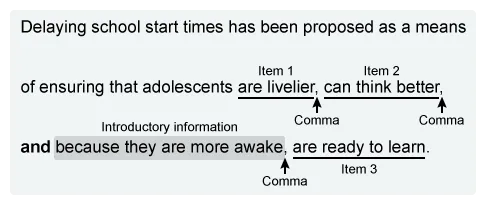
The commas after "livelier" and "better" indicate the first two verb phrases that are items in the list of what delayed start times ensure for adolescents. "And" indicates that there is only one more item in the list. That item is "ready to learn." What comes before this last item introduces a reason that adolescents are ready to learn: "because they are more awake."
In this case, a comma would be placed after "awake" to mark a separation between the introductory information and the last item in the list. Therefore, the grammatically correct option is and, because they.
(Choice A) "They are more awake" is another independent clause, but the other items in the list are verb phrases, keeping this choice from being parallel.
(Choices B and C) These answers treat the introductory information as another item in the list. They incorrectly place the "and" between the two middle items in the list rather than the last two items in the list.
Things to remember:
When items in a list are joined by "and," make sure this conjunction occurs between the last two listed items.