Why Some SAT English Questions Are Harder Than Others
Some SAT English questions feel harder because they ask you to do more than one thing at once. Instead of testing a single skill, the toughest Reading and Writing questions often combine comprehension, logic, and precision under strict time pressure. Even if you understand the passage or the grammar rule, choosing the best answer can still feel uncertain when multiple options seem reasonable.
What makes these questions especially challenging is how realistic the wrong answers feel. The SAT uses high-quality distractors that are grammatically correct and partially supported by the text, which makes guessing based on intuition risky. On the Digital SAT, this difficulty is amplified by adaptive sections and no backtracking, meaning hesitation costs you. The challenge is not knowing more, but deciding better, faster, and with confidence.
Hardest SAT Reading Question Types
On the SAT Reading section, difficulty is not evenly spread across all questions. Some question types consistently take more time, create more doubt, and lead to more second-guessing, especially for students aiming for higher scores on the Digital SAT. Hence, several students opt for SAT prep courses that help them identify these questions, and hone their skills.Below are the Reading question types that tend to cause the most trouble, along with why they are harder than the rest.
(Information and Ideas)
Inference questions ask you to identify what the passage suggests, not what it directly states.
(Information and Ideas)
Several answer choices may seem to support the claim, but only one provides the strongest and most direct evidence.
(Information and Ideas)
These questions are hard because wrong answers often include ideas that are true but not central to the passage.
(Craft and Structure)
Multiple answer choices can fit the sentence grammatically, but only one matches the passage’s exact meaning and tone.
(Information and Ideas)
Inference questions ask you to identify what the passage suggests, not what it directly states.
Inference questions require you to draw conclusions that are supported by the passage without going beyond what the text actually says. The hardest versions include answer choices that sound logical but rely on assumptions the passage does not fully support.
As Digital SAT passages are short and information-dense, missing or misreading even one line can lead to an incorrect inference.
(Information and Ideas)
Several answer choices may seem to support the claim, but only one provides the strongest and most direct evidence.
Command of Evidence questions test how precisely you can match ideas to proof. Some questions rely only on text, while others require you to interpret data from charts or graphs, but the difficulty comes from the same core skill: selecting evidence that directly proves the claim, not just relates to it.
The hardest versions punish broad or imprecise reading, especially when tempting answer choices quote relevant but incomplete support.
(Information and Ideas)
These questions are hard because wrong answers often include ideas that are true but not central to the passage.
The SAT designs difficult Central Ideas questions to push students toward overthinking. Many incorrect options focus on interesting details or secondary points instead of the passage’s main focus.
The challenge is choosing the answer that best represents the passage as a whole without narrowing it too much or adding meaning that is not there.
(Craft and Structure)
Multiple answer choices can fit the sentence grammatically, but only one matches the passage’s exact meaning and tone.
Words in Context questions go beyond vocabulary knowledge. The SAT often uses common words with multiple meanings, forcing you to rely on context rather than memorization.
On harder questions, incorrect choices are subtle shifts in meaning that feel close but change the author’s intent, making this question type especially tricky under time pressure.
Hardest SAT Writing Question Types
SAT Writing questions can feel deceptively easier than Reading questions, especially because the passages are shorter and the rules feel familiar. But on harder modules, Writing questions are designed to test judgment, clarity, and logical flow, not just grammar. The toughest Writing questions are the ones where more than one answer looks correct. Choosing the best option often comes down to understanding purpose, structure, and meaning rather than spotting an obvious error.
(Information and Ideas)
All answer choices are grammatically correct, but only one best supports the author’s goal.
(Expression of Ideas)
Multiple options can seem to fit smoothly, even when they express different logical relationships.
(Craft and Structure)
These questions are hard because they test whether a sentence or idea fits logically within the passage, not whether it is written well.
(Standard English Conventions)
Sentence Boundary questions are hard because longer, more complex sentences make errors harder to spot.
(Information and Ideas)
All answer choices are grammatically correct, but only one best supports the author’s goal.
These questions ask you to decide how information should be used, not whether it is correct. The SAT often includes answer choices that sound polished but include irrelevant details, repeat information, or weaken the point being made.
The hardest versions require you to understand the writer’s purpose and select the option that fits both the context and the intended message, which makes relying on grammar rules alone ineffective.
(Expression of Ideas)
Multiple options can seem to fit smoothly, even when they express different logical relationships.
The challenge with transitions is identifying the exact relationship between ideas, such as contrast, cause and effect, or continuation. The SAT frequently uses answer choices that create a logical shift that feels subtle but changes the meaning of the sentence.
On harder questions, choosing a transition that “sounds right” instead of one that precisely matches the logic of the passage leads to mistakes.
(Craft and Structure)
These questions are hard because they test whether a sentence or idea fits logically within the passage, not whether it is written well.
Form, Structure, and Sense questions often ask you to evaluate sentence placement, paragraph flow, or the overall organization of ideas. Wrong answers usually contain sentences that are relevant but disrupt the logical progression of the passage.
The difficulty comes from thinking beyond individual sentences and considering how each part contributes to the passage as a whole.
(Standard English Conventions)
Sentence Boundary questions are hard because longer, more complex sentences make errors harder to spot.
These questions test your ability to correctly use periods, commas, and conjunctions to separate or join independent clauses. On harder questions, the sentences are long enough that punctuation mistakes blend in easily.
Students often miss these questions by trusting how the sentence sounds rather than checking whether each clause is properly connected.
How Top Scorers Approach the Hardest SAT English Questions
Top scorers don’t rely on confidence or intuition when SAT English questions get difficult. They use specific decision habits that reduce errors on the hardest Reading and Writing questions, while having laid the foundation with study guides.
- They recognize “two-answer” questions and change pace immediately: When two choices both seem defensible after a first read, top scorers flag the question as high-risk. Instead of rereading the entire passage, they slow down just enough to compare wording carefully, knowing these questions are designed to create doubt.
- They eliminate answers for specific reasons, not general discomfort: Strong students do not eliminate choices because they “feel off.” They remove answers for concrete reasons, such as going beyond the passage, weakening the claim, or changing the logical relationship between ideas. This keeps decision-making precise even under pressure.
- They avoid adding meaning that isn’t explicitly supported: On the hardest questions, top scorers are careful not to bring outside assumptions into their reading. If an answer requires information that is not clearly supported by the text, they treat it as wrong, even if it sounds sophisticated or reasonable.
- They accept the least flawed option instead of searching for a perfect one: High scorers understand that on difficult SAT questions, the correct answer is often not ideal, just better than the rest. They choose the option that stays closest to the passage or sentence logic and move on without second-guessing.
Practicing Hard SAT English (Reading & Writing) Questions
Understanding which SAT English questions are hardest is only useful if you practice them the right way. Hard questions require a different mindset than easier ones, especially on the Digital SAT where time pressure and adaptive difficulty make mistakes harder to recover from.
Here, you’ll find practice questions from UWorld’s SAT Question Bank that reflect the most challenging Reading and Writing question types. These are designed to help you focus on decision-making and precision, not just concept knowledge, so you can build confidence where it matters most on test day.
Passage: Cellular Respiration
Cellular respiration—a fundamental metabolic process enabling energy extraction from glucose across all living cells—follows two discrete pathways: aerobic respiration, a process that relies on the consumption of oxygen and releases carbon dioxide as a byproduct, and anaerobic respiration, a process that occurs independently of oxygen through electron acceptors such as elemental sulfur, which yields sulfide as a metabolic byproduct. Although many cells are known to be capable of both respiration pathways, prevailing models assume that these cells transition between the two, depending on oxygen availability. When cultivating Hydrogenobacter strains (bacteria found in low-oxygen Yellowstone hot springs) in a laboratory by exposing them to various combinations of hydrogen, elemental sulfur, and oxygen, Lisa Keller et al. recorded concurrent sulfide accumulation and oxygen depletion, suggesting that ______
Question
Which choice most logically completes the text?
| A. given the accumulation of sulfide within the Hydrogenobacter cells, anaerobic respiration that extracted glucose from elemental sulfur initiated the primary metabolic process that caused oxygen depletion and activated aerobic respiration. | |
| B. in contrast to the long-standing assumption that there are only two distinct respiration pathways, some Hydrogenobacter strains have developed a third type of respiration that relies on hydrogen instead of oxygen. | |
| C. because the bacteria strains were cultivated with high levels of oxygen in a laboratory setting, the observed concurrent metabolic responses are likely not a phenomenon that would occur naturally in the low-oxygen Yellowstone hot springs. | |
| D. instead of alternating between aerobic and anaerobic pathways in response to oxygen availability, these bacteria utilized both simultaneously, revealing that respiration may occur through two seemingly exclusive modes at once. |
Explanation
Summarize the paragraph and find connections among the details to draw a logical conclusion. Choose the answer that matches that conclusion.
| S1 | There are two types of cellular respiration. Aerobic respiration uses oxygen and releases carbon dioxide. Anaerobic respiration uses elements such as sulfur, which releases sulfide. |
| S2 | Cells can perform both types of respiration, but it is thought that they use only one type at a time. |
| S3 | Bacteria exposed to hydrogen, sulfur, and oxygen were found to produce sulfide and use up oxygen simultaneously. |
| Connections | S1 states that anaerobic respiration produces sulfide, and aerobic respiration uses oxygen. S3 describes sulfide being produced and oxygen being used at the same time. |
| Conclusion | Based on these details, both anaerobic and aerobic respiration were happening simultaneously. |
The answer that matches this conclusion says instead of alternating between aerobic and anaerobic pathways in response to oxygen availability, these bacteria utilized both simultaneously, revealing that respiration may occur through two seemingly exclusive modes at once.
(Choice A) The text never suggests that anaerobic respiration can cause oxygen depletion or activate aerobic respiration. Furthermore, glucose isn't extracted from sulfur; rather, S1 indicates that energy is extracted from glucose.
(Choice B) Although hydrogen was included in the experiment, there is no information suggesting a third type of respiration that relies on hydrogen.
(Choice C) Oxygen is necessary for aerobic respiration, but there is no evidence that the specific level of oxygen in the laboratory is what allowed two metabolic responses to happen simultaneously.
Things to remember:
To form a logical conclusion, look for connections among details in the text.
Passage: Webb Telescope
The James Webb Space Telescope was used to discover the CEERS 1019 galaxy in 2023. NASA scientist Rebecca Larson notes that, despite the challenges of exploring deep space objects formed early in the universe's history, the telescope ______ highly detailed infrared images and data, providing proof of the existence of the most distant black hole.
Question
Which choice completes the text with the most logical and precise word or phrase?
| A. adopted | |
| B. supplied | |
| C. inspired | |
| D. absorbed |
Explanation
Look for clues in the text that hint at the meaning of the missing word. Then, consider the definition of each answer choice to determine which one best completes the sentence.
Note that the text describes what the telescope did as "providing proof." Therefore, the correct answer would be a synonym of "providing."
| (Choice A) adopted | This answer cannot be correct because "adopted" means to use something belonging to another, instead of providing something. |
| (Choice B) supplied | "Supplied" means provided. Because the telescope provided the images, the most logical answer is supplied. |
| (Choice C) inspired | This answer is incorrect because "inspired" implies that the telescope motivated or caused the images to be taken. The telescope, however, was the device that provided the images instead of motivating their creation. |
| (Choice D) absorbed | This answer cannot be correct because "absorbing" means to take in, rather than to give out, or provide. |
Things to remember:
Look for clues in the text that hint at the meaning of the missing word.
Passage: The Function of Sleep
If the sole function of sleep were the conservation of energy, neural activity would diminish uniformly across all stages of slumber. Electroencephalogram (EEG) investigations demonstrate that certain cerebral regions—particularly within the limbic system and cortical networks—remain highly active during rapid eye movement (REM) sleep, though. ______ researchers posit that indispensable cognitive operations of consolidating memories and regulating emotions occur during these dynamic phases of unconsciousness, meaning that energy conservation alone does not explain the full purpose of sleep.
Question
Which choice completes the text with the most logical transition?
| A. Despite this, | |
| B. Hence, | |
| C. For instance, | |
| D. Meanwhile, |
Explanation
Paraphrase the text's sentences to determine how their ideas are related. Then choose the transition that logically connects those ideas.
| S1 | If sleep is only to conserve energy, then brain activity would decrease by the same amount throughout all stages of sleep. |
| S2 | EEGs show significant brain activity during a particular sleep stage. |
| S3 | Researchers suggest that important brain operations happen during this stage, so sleep isn't just for saving energy. |
Because the EEG studies show that some areas of the brain are not resting during parts of sleep, researchers theorize that important activities are happening during this time. Thus, the statement in S3 is a result of the studies mentioned in S2.
"Hence" means "as a result." Because it shows that the statement in S3 results from the ideas in S2, the correct transition is hence.
(Choice A) "Despite this" introduces a contrasting statement. However, what the brain might be doing while we sleep is related to, not in contrast with, the fact that EEGs show brain activity during sleep.
(Choice C) "For instance" leads into a specific example of what was stated before. But the processes researchers think occur during sleep aren't examples of the EEG measurements of brain activity; rather, they are interpretations of that activity.
(Choice D) "Meanwhile" means "at the same time." The interpretation of brain activity during sleep had to come after—not at the same time as—the EEG measurements.
Things to remember:
The best transition accurately shows how the sentences before and after it are related.
Passage: Melville's reputation
Nineteenth-century American author Herman Melville's _____ initially favorable after the success of his first novel and for the years immediately following, had, at the time of his renewed recognition by scholars in the mid-twentieth century, suffered for decades because of the commercial failures of his later works.
Question
Which choice completes the text so that it conforms to the conventions of Standard English?
| A. reputation was | |
| B. reputation, was | |
| C. reputation, | |
| D. reputation had been |
Explanation
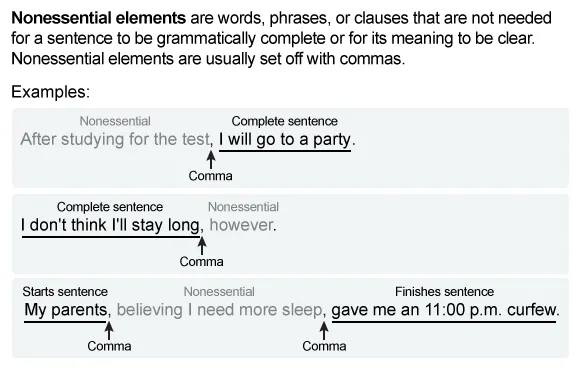
Rule: Nonessential information that separates a subject and main verb should begin and end with the same punctuation mark.
Identify any subjects and verbs in the sentence to determine whether a verb is needed in the answer. Eliminate answers with unnecessary verbs and select the answer with correct punctuation.
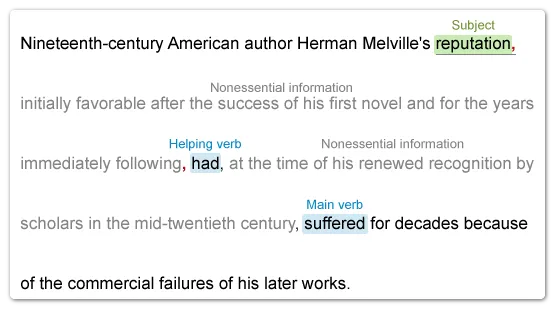
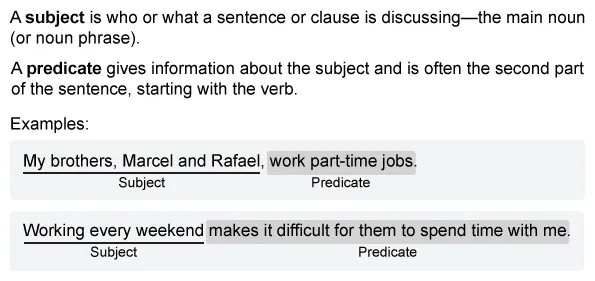
The comma before "had" is a clue that the sentence contains nonessential information between the subject and verb. The verb "had suffered" belongs with the subject "reputation," making the core of the sentence "Herman Melville's reputation had suffered for decades." Therefore, a comma is required after the subject "reputation" to begin the nonessential information.
Three of the answers include an additional verb ("was" or "had been") that would go with the subject "reputation," but these would make the later verb "had" seem out of place in the sentence.
Because it doesn't add a verb and it includes the required comma, reputation, is correct.
(Choices A and D) These choices add a verb that would go with the same subject as the verb already in the sentence. However, if two verbs go with the same subject, they cannot be separated by a single comma. (Incorrect: He ran and, jumped.) Here, the verbs would be incorrectly separated by the comma before "had."
(Choice B) A single comma cannot appear between a subject and its verb, so the verb "was" in this choice would be left without a subject.
Things to remember:
A comma immediately before a verb indicates that nonessential information interrupts the subject and verb.