FREE Ground Shipping on Courses $149+ | Code: SANTASENDSFREE

AP® World History: Modern Unit 8 Review and Practice Test

Cold War and Decolonization

AP® World History Unit 8 examines the ideological conflict between the United States and the Soviet Union, the proliferation of proxy wars, and the global wave of decolonization that reshaped political boundaries following World War II. These developments can feel overwhelming without clear explanations, but UWorld helps you understand how these ideas connect, so your AP World History Unit 8 review becomes more efficient and outcome-oriented.

AP World History: Modern prep course suite by UWorld

Make AP World History Unit 8 Easier With A Review That Ties Events Together

Unit 8 explores the intersection of ideological rivalry, political realignment, independence movements, and global shifts in power. UWorld helps you understand how each development fits into a larger narrative, enabling you to approach AP® World History Unit 8 MCQ, SAQ, and FRQ tasks with greater confidence and clarity.

Watch

Engaging Video Lessons That Explain Concepts

These videos break down Cold War ideologies, global alliances, proxy wars, and independence movements in a clear and visually appealing manner. You see how competing political visions shaped foreign policy, why tensions rose across regions, and how decolonization transformed global politics. Each explanation prepares you for the AP World History Unit 8 review work by turning complex events into understandable stories.

Read

Interactive Study Guides That Help Understand

These study guides help you walk through major Cold War conflicts, ideological competition, nationalist movements, and the collapse of empires. You learn how the Non-Aligned Movement emerged, why colonies pursued independence, and how shifting alliances shaped political outcomes. Each guide uses visuals and structured explanations to prepare you for the AP World History Unit 8 study guide tasks and review sessions.

Practice

Prepare Smarter With AP World History Unit 8 Practice That Mirrors the Real Exam

Practice questions strengthen your ability to interpret maps, evaluate political documents, and analyze global shifts. UWorld’s AP World History Unit 8 practice test questions match the style and reasoning used on the AP exam, helping you build accuracy with stimulus-based prompts.
Try these sample practice questions with detailed answer explanations:
Cold War and Decolonization Practice Tests

Passage

Source 1

"Seizing Kankan in 1879, [Samory Touré*] imposed his authority on the whole of the Ouassoulou and the greater part of the Mandingo countries. He first came into contact with the French early in 1882 when he attacked Keniera, south-east of Siguiri….

[By] 1898 Samory's forces were driven out of Kong…. Samory had kept the whole of West Africa, from the Gold Coast to Sierra Leone and from the Niger to the forest of the Ivory Coast, in a ferment for twenty-four years, during sixteen of which he was in direct conflict with the French. With him the last major obstacle to the peace of French West Africa disappeared."

Kenneth Mason, British professor of Geography, 1943

Source 2
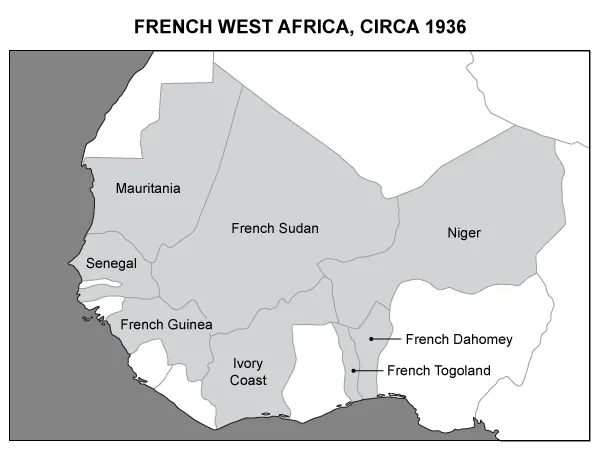
Question

Which of the following factors would contribute most to future revisions of Source 2?

A. The reduction of French colonial authorities
B. European discovery of petroleum in Nigeria
C. Soviet sponsorship of institutions for global cooperation
D. Britain's resumption of military expeditions to expand its colonial empire

Explanation

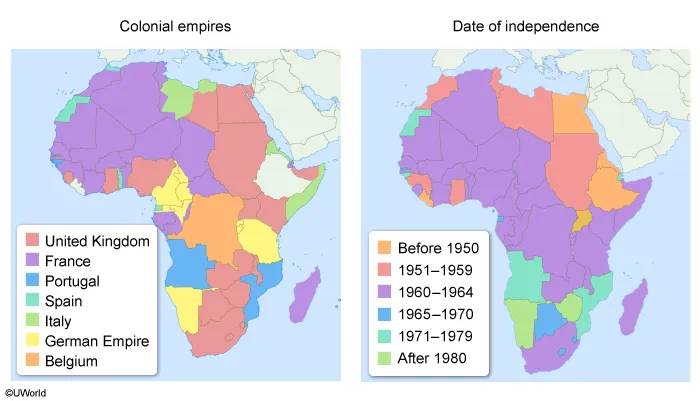
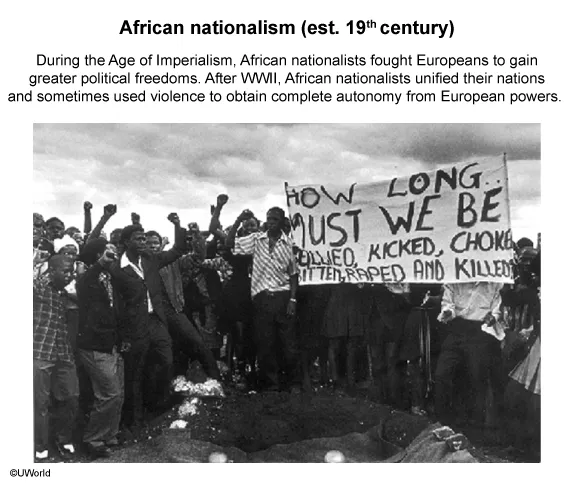
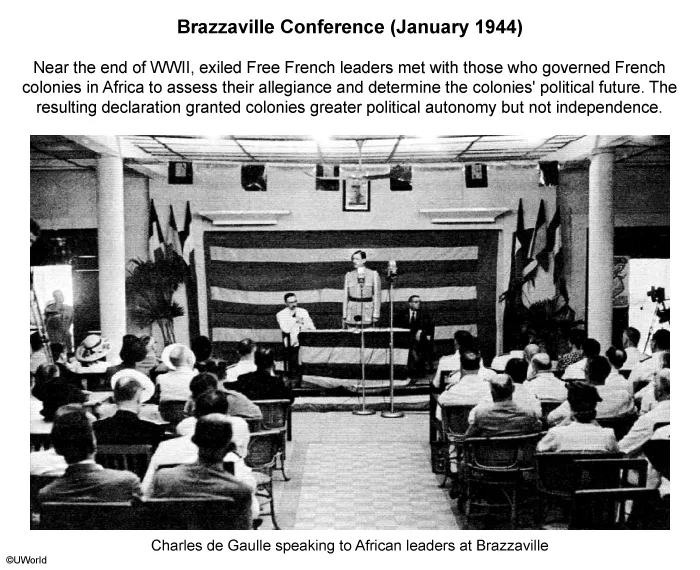
Toward the end of WWII, increased African nationalism and a weakened France resulted in the Brazzaville Conference, a meeting between exiled Free French politicians and African colonial officials. During the conference, African officials negotiated for increased political autonomy and the reduction of colonial authority. However, complete independence was denied, which resulted in rebellions in some of France's African colonies.

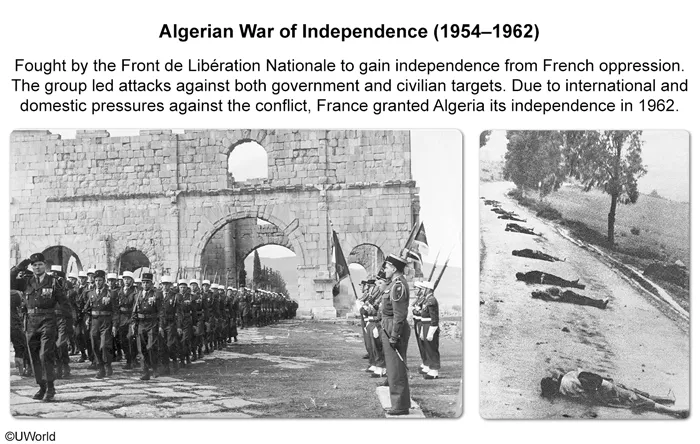
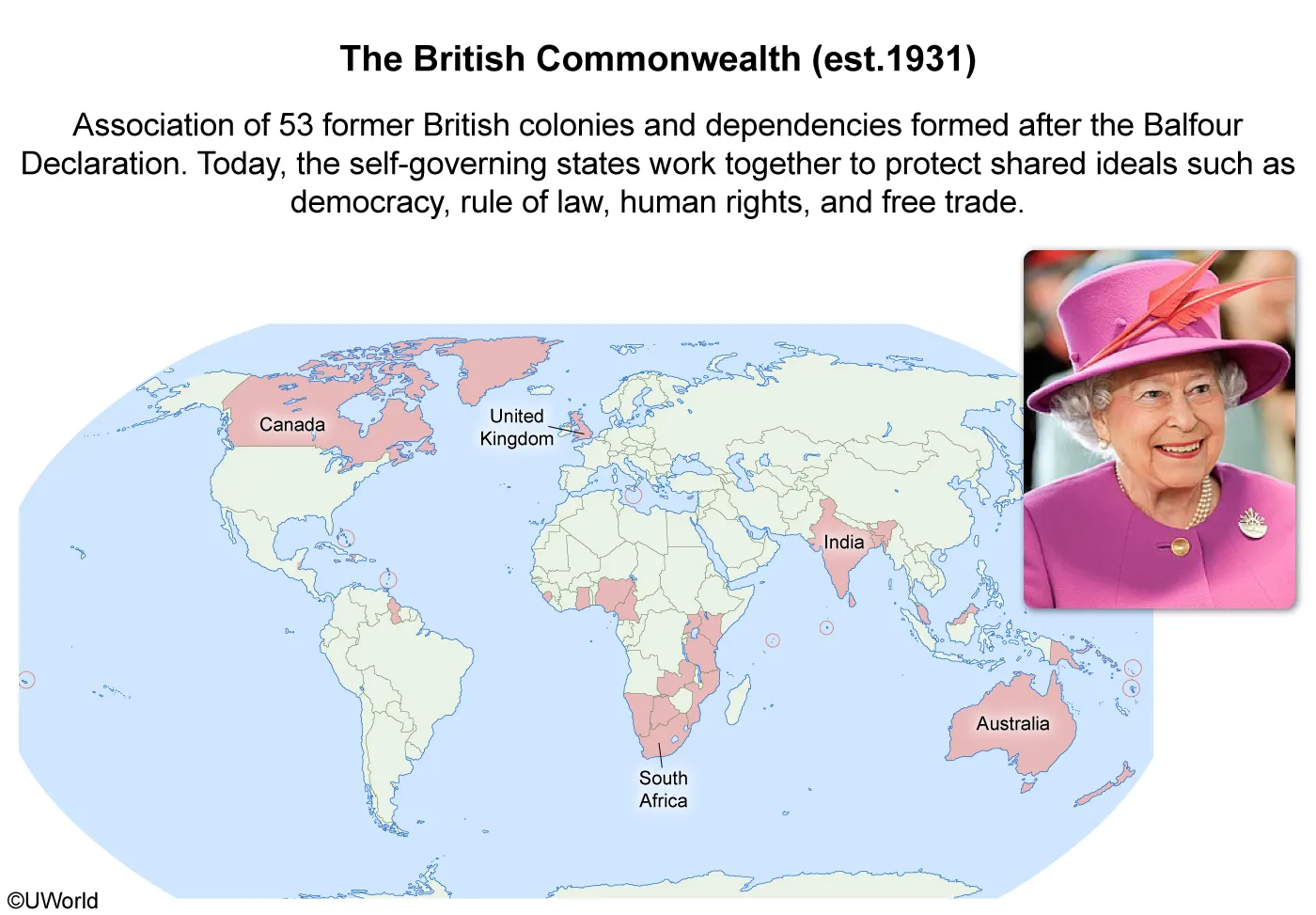
By 1955, several of these rebellions had escalated into full-blown war, including the Algerian War. As the conflicts persisted, the French Fourth Republic collapsed, leading to a new French constitution. This new constitution allowed France's overseas territories to vote on the status of their autonomy in 1958. All French territories except New Guinea, which became fully independent, elected to become an autonomous state within the French Community, an association similar to the British Commonwealth.

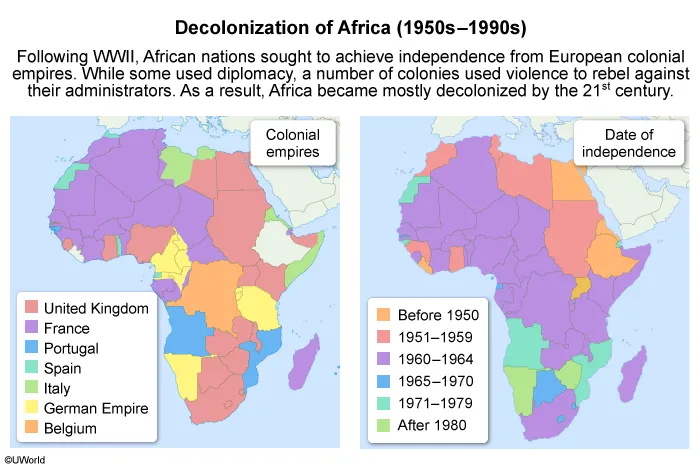
During this time, the internal boundaries of French West African colonies were redrawn, creating distinct states within the French Community. Despite the autonomous status of these states, calls for complete decolonization continued, resulting in the granting of independence to all French West African states in 1960.

(Choices B and D) European discovery of natural resources and British expeditions shaped the creation of the boundaries in Africa depicted in Source 2. However, after 1936, revisions to the map were not influenced by these factors.

(Choice C) Although the Soviet Union was involved in African politics during the Cold War, Soviet influences did not cause revisions to the map in Source 2.

Things to remember:
During the post-WWII decolonization of Africa and the withdrawal of colonial authorities, some political boundaries were redrawn, which led to the creation of African states.

Passage

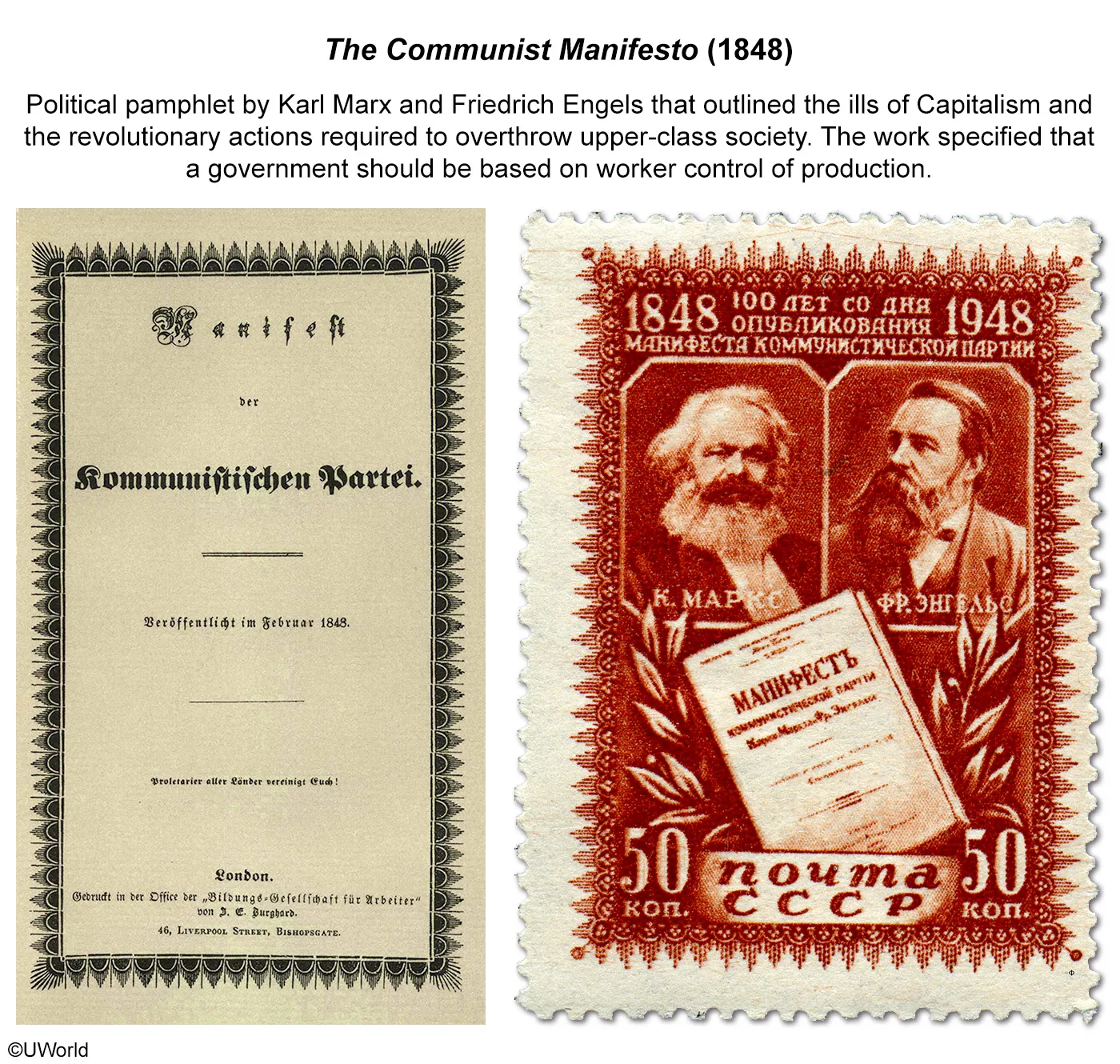
"The Soviet Government will propose an immediate democratic peace to all the nations and an immediate armistice on all fronts. It will secure the transfer of the land of the landed proprietors, the crown and the monasteries to the peasant committees without compensation; it will protect the rights of the soldiers by introducing complete democracy in the army; it will establish workers' control over production; it will ensure the convocation* of the Constituent Assembly at the time appointed; it will see to it that bread is supplied to the cities and prime necessities to the villages; it will guarantee all the nations inhabiting Russia the genuine right to self-determination."

Vladimir Lenin, Russian revolutionary, Speech at Second All-Russia Congress of Soviets of Workers' and Soldiers' Deputies, 1917

Question

Which of the following would most directly challenge the labor system portrayed in the passage?

A. Socialism
B. Capitalism
C. Nationalism
D. The increased use of labor camps in the Soviet Union

Explanation

"…it will establish workers' control over production...."

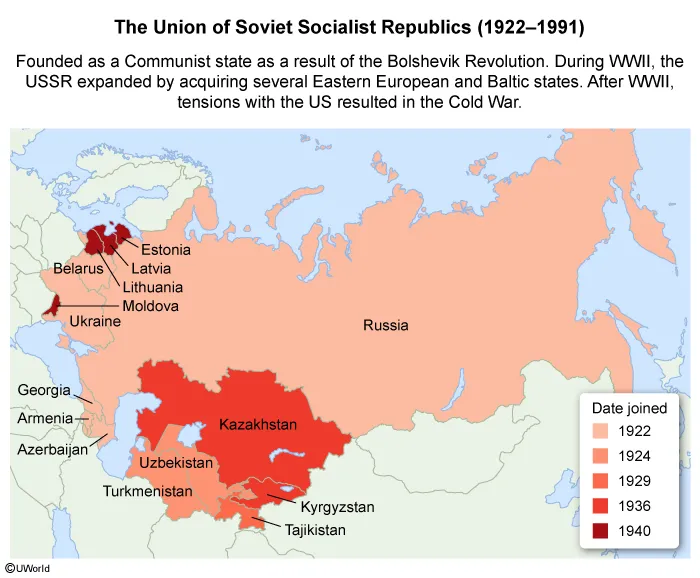
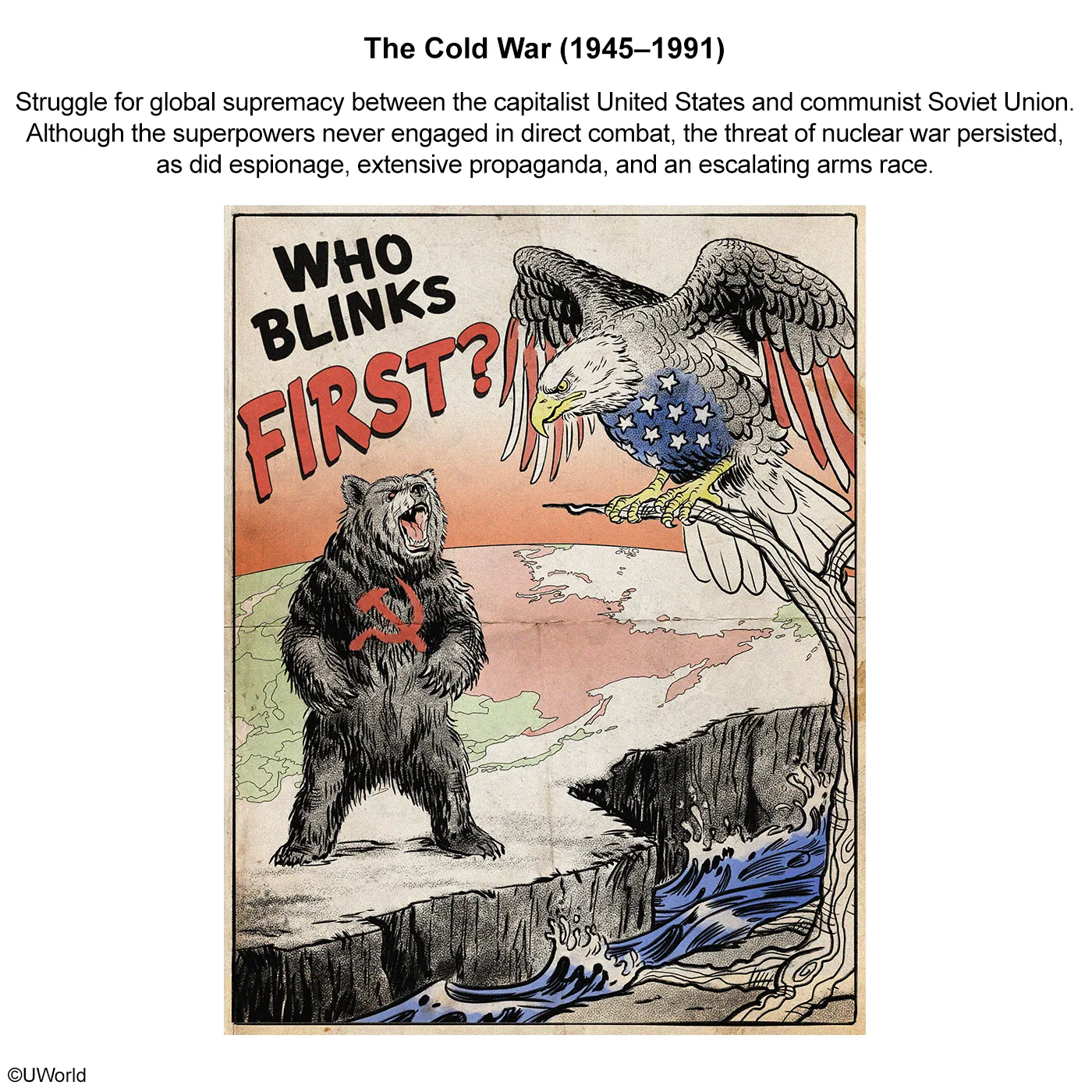
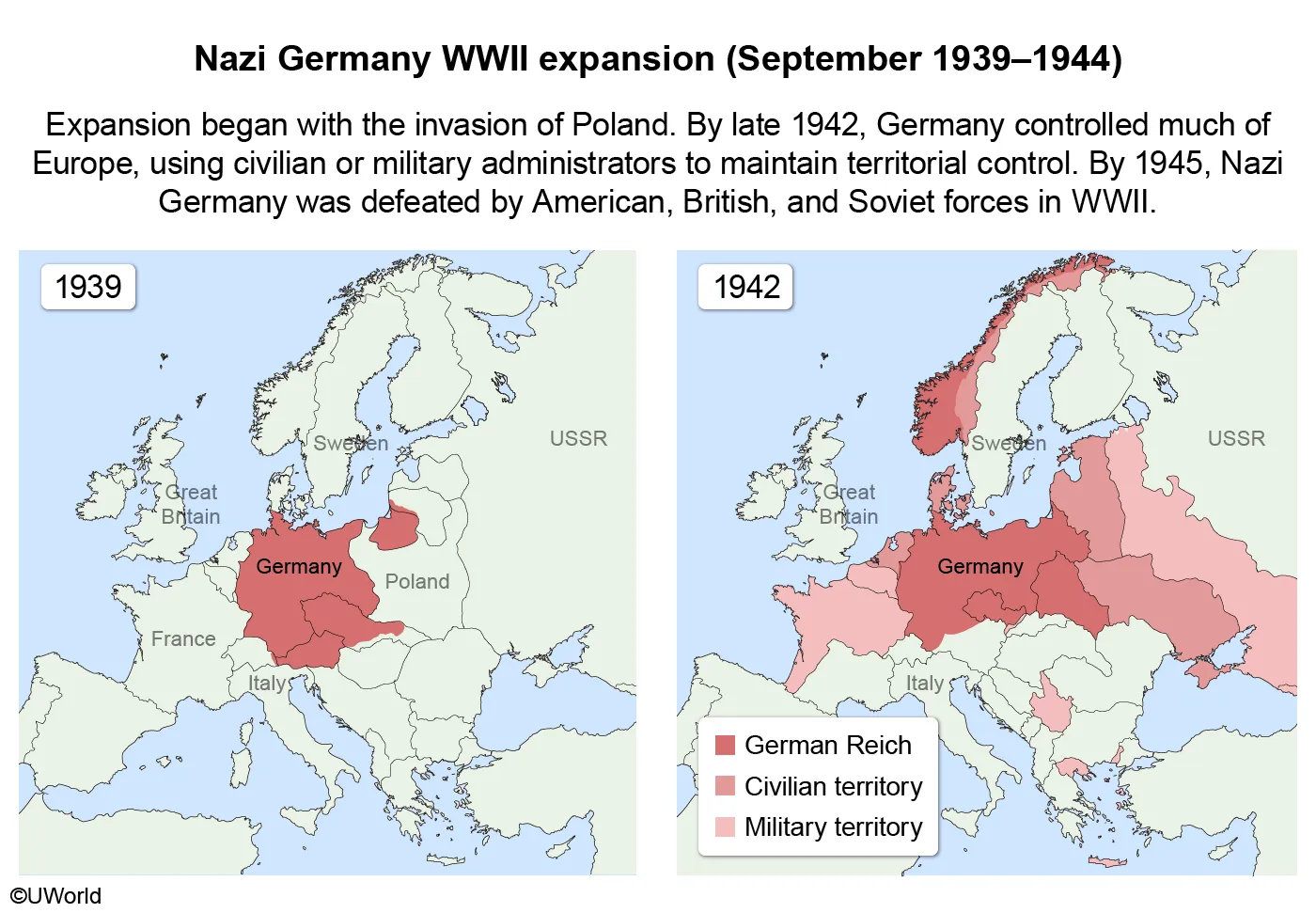
Despite working as allies during WWII, the US and Soviet Union distrusted each other because of America's delayed entry into the war and Stalin's tyrannical rule. Toward the end of the war, disagreements over the division of Nazi territory and postwar security further escalated tension between the two nations.

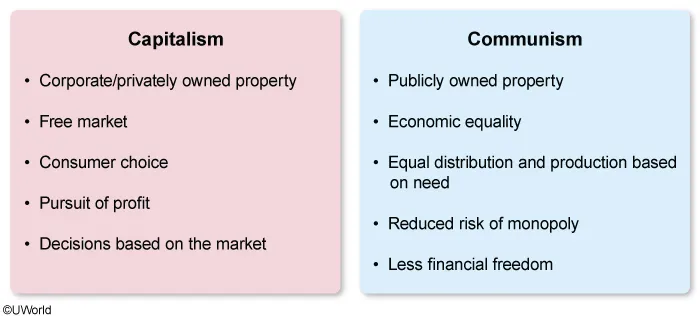
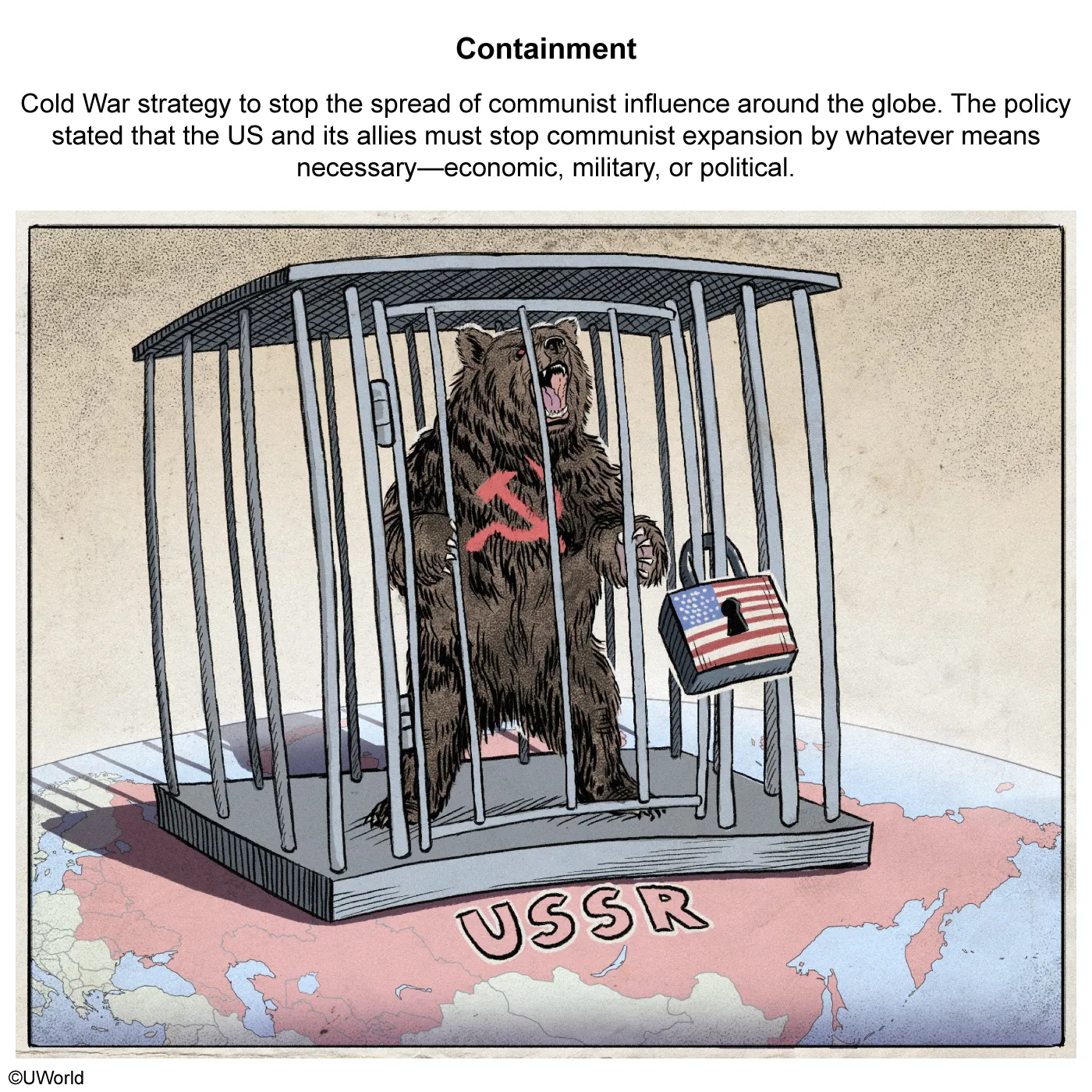
Beginning in 1946, the Soviet Union actively spread Communism abroad by converting territory occupied during the war into Soviet satellite states. Viewing the spread of Soviet-style regimes and ideology as a threat to capitalism, the US implemented the Cold War policy of containment, which promoted US values and the spread of capitalism.

The policy was intended to limit the expansion of Communism by militarily and financially aiding groups who resisted Soviet influence. Between 1947 and 1991, the expansion of Soviet influence and the US policy of containment resulted in major military conflicts across the globe, including in Korea, Vietnam, Cuba, and Afghanistan.

(Choice A) Socialism is an economic structure that promotes the elimination of social classes and is characterized by state ownership of production, which is similar to Communism, the labor system portrayed in the passage.

(Choice C) Collective bargaining (the process of a group of employees negotiating with an employer) ended as a result of early Bolshevik policies. Therefore, it couldn't have challenged the labor system portrayed in the passage.

(Choice D) Nationalism tends to work with, rather than challenge, the communist labor system described in the passage.

Things to remember:
The emergence of tensions between the US and Soviet Union after WWII resulted in the global conflict known as the Cold War. During this conflict, the Soviet Union's attempt to spread Communism was resisted by the US, which advocated for capitalism.

Passage

"At the beginning of this year, I submitted to the Congress a defense budget which reflects my best judgment, and the best understanding of the experts and specialists who advise me, about what we and our allies must do to protect our people in the years ahead.

That budget is much more than a long list of numbers, for behind all the numbers lies America's ability to prevent the greatest of human tragedies and preserve our free way of life in a sometimes dangerous world. It is part of a careful, long-term plan to make America strong again after too many years of neglect and mistakes. Our efforts to rebuild America's defenses and strengthen the peace began two years ago when we requested a major increase in the defense program.

The defense policy of the United States is based on a simple premise: The United States does not start fights. We will never be an aggressor. We maintain our strength in order to deter and defend against aggression—to preserve freedom and peace.

Our nation needs a superior navy to support our military forces and vital interests overseas. We're now on the road to achieving a 600-ship navy and increasing the amphibious capabilities of our marines, who are now serving the cause of peace in Lebanon. And we're building a real capability to assist our friends in the vitally important Indian Ocean and Persian Gulf region."

Ronald Reagan, United States president, address to the nation on
defense and national security, 1983

Question

The United States' overseas capabilities, like the ones described in the passage, would eventually contribute most to which of the following problems facing Western societies in the period 1990 to the present?

A. Alienation of NATO allies
B. Increasing human rights abuses
C. Proliferation of violence against civilians
D. Reduced access to oil and natural gas deposits

Explanation

"And we're building a real capability to assist our friends in the vitally important Indian Ocean and Persian Gulf region."

In 1978, internal conflict resulted in the creation of the Democratic Republic of Afghanistan and a transfer of power to the People's Democratic Party of Afghanistan (PDPA), a Soviet-backed, Marxist political organization.

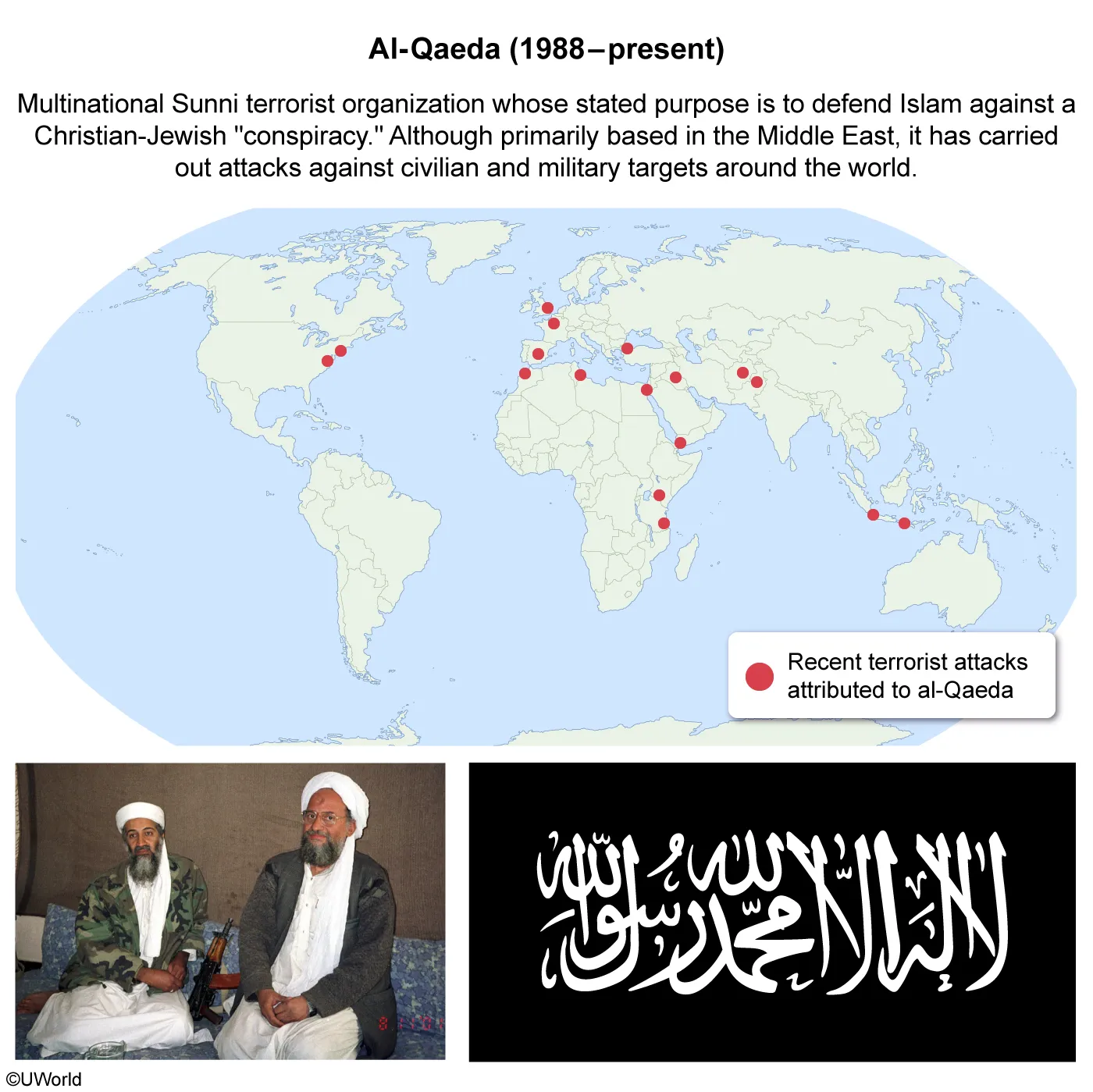
Although the PDPA initially received financial and military support from the Soviet Union, fear of losing power to Islamic radicals and increasing US influence in the country resulted in the Soviet invasion of Afghanistan in 1979. To hinder Soviet expansion, the US launched Operation Cyclone, a covert CIA program that funded and armed groups of militant mujahideen (Islamic warriors who fight non-Muslim forces), including Maktab al-Khidamat, the precursor to al-Qaeda.

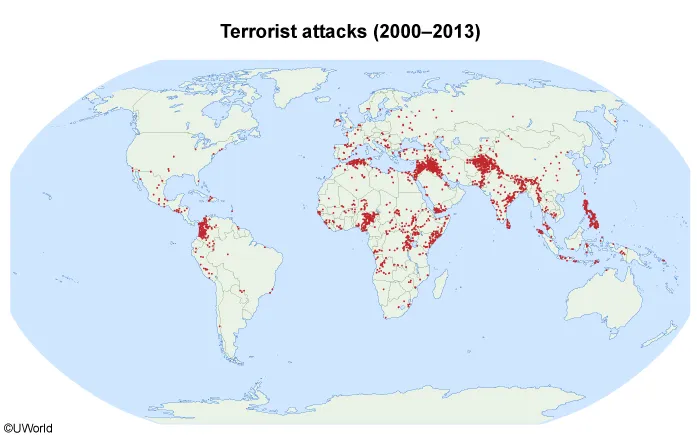
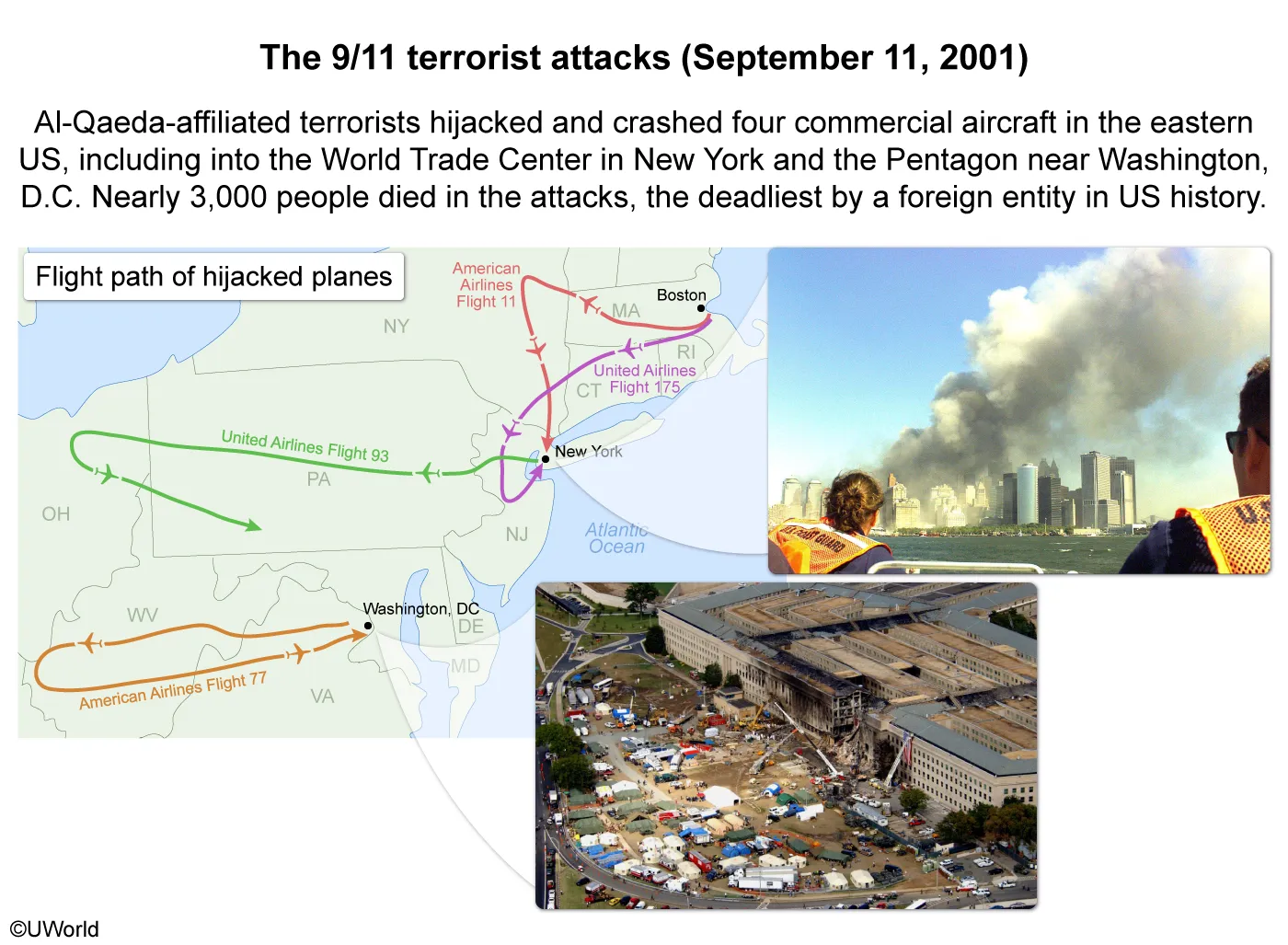
Despite previous cooperation, the "building [of] real capability…in the vitally important…Persian Gulf region" resulted in US intervention in Middle Eastern affairs and the alienation of various Islamic militant groups. Partly in response, these militant groups launched terrorist attacks against civilian targets, such as the September 11 attacks (9/11) and the Madrid train bombings, to reduce Western involvement in Middle Eastern affairs.

(Choice A) Rather than becoming alienated, the North Atlantic Treaty Organization allies felt safer as a consequence of increased military and defense spending by the US.

(Choice B) There is no evidence to suggest that US overseas capabilities resulted in more human right abuses in Western societies.

(Choice D) Whether through diplomacy or military intervention, the increase in US overseas capabilities has made it easier for the US and other Western societies to access oil and gas deposits around the world.

Things to remember:
US involvement in Middle Eastern affairs alienated various militant Islamic groups, including al-Qaeda, who ultimately used violence against civilians to effect political change.


UWorld Dark Blue logo

Review Unit 8 Concepts Anytime

Use short breaks to revisit Cold War alliances, independence movements, or political shifts. Whether you practice AP World unit 8 MCQ items during a commute or watch a quick video before class, the UWorld app helps keep your preparation consistent and effective.

Stand Out
with a Top Score in AP World History: Modern

Finish your AP World History Unit 8 review and continue mastering all units with UWorld. Our AP World History course is designed to boost your performance and help you impress admissions.

Choose Your Subscription
Dream Score Plan
360-Day
$169
Deep Learning Plan
180-Day
$149
Score Booster Plan
90-Day (No print book, only digital)
$129
Introductory Plan
30-Day (No print book, only digital)
$99

Get our all-in-one course today!

  • Focused APWHM Videos
  • Print & Digital Study Guide
  • 500+ Exam-style Practice Questions
  • Customizable Quiz Generator
  • Adjustable Study Planner
  • Realistic Timed Test Simulation
  • Colorful Visual Explanations
  • Progress Dashboard
  • Smart Flashcards
  • Digital Notebook
Explore our free trial and frequently asked questions.

Hear From Our AP Students

UWorld’s service is pretty good and helps provide a lot of explanations on subjects I haven’t been confident on before.

—Bence P.

The questions here are the most realistic to the AP tests I've seen so far! I appreciate the ability to customize tests as well.

—Kaila H.

The best part is that all options are well-explained, telling clearly why they are not the right option.

—Syeda Huma Z.

Frequently Asked Questions (FAQs)

AP World History Unit 8 focuses on the political and ideological tensions that shaped the world after World War II. You study how the United States and the Soviet Union competed for global influence, how newly independent states emerged, and how alliances and conflicts shifted power on a global scale. To understand this unit well, you need to see how these developments connect rather than memorizing isolated events. UWorld helps you break down these themes clearly, making your AP World History Unit 8 review easier and more structured.

Key themes in Unit 8 include:

  • The causes and effects of the Cold War
  • The spread of communism
  • How colonies in Asia and Africa achieved independence
  • The creation of new states after decolonization
  • The end of the Cold War

Understanding how these themes interact helps you see why global politics underwent such rapid reorganization after the war. You learn how ideological competition influenced policies, how empires collapsed, and how new states formed. This prepares you well for AP World History Unit 8 MCQs, SAQs, and FRQs.

Preparing for Unit 8 requires a clear understanding of how Cold War tensions and decolonization movements shaped the global order. Instead of trying to memorize every conflict, focus on the causes, ideologies, and regional consequences that connect these events. You want to understand why the United States and the Soviet Union competed, how nations responded, and how independence movements gained momentum. UWorld supports this by explaining each idea step by step, helping you approach AP World History Unit 8 practice more effectively.

A strong Unit 8 study plan includes:

  • Reviewing Cold War alliances and ideological goals
  • Studying proxy conflicts and why they emerged
  • Learning about major independence movements across different regions
  • Understanding the political and economic motives behind decolonization
  • Practicing stimulus-based questions with maps and excerpts
  • Working through AP World Unit 8 practice test questions regularly

This approach helps you connect events into a narrative rather than viewing them as separate pieces. You gain confidence as you learn to interpret sources and clearly explain global shifts.

Yes, there are free resources available to help you begin studying AP World History Unit 8, and one of the strongest starting points is UWorld’s free 7-day trial. It provides access to short videos, interactive notes, and exam-style AP World History Unit 8 practice questions that clearly explain Cold War tensions, proxy wars, and decolonization movements.

Teachers often provide free outlines or vocabulary lists, and you can find maps, timelines, and brief explanations online that cover alliances, independence struggles, and global realignments. AP Classroom also offers topic questions and progress checks that match the exam format, giving you an idea of how Unit 8 is tested.

While these free materials are helpful, they often focus on surface-level facts rather than the deeper cause-and-effect logic behind global change. Pairing them with UWorld’s explanation-driven approach provides a stronger understanding of how ideology, nationalism, and political competition have shaped the modern era.

The AP World History Unit 8 test includes multiple choice questions, SAQs, and FRQs that ask you to interpret maps, analyze excerpts, and explain global patterns tied to the Cold War and decolonization. These questions usually focus on ideologies, political alliances, nationalist movements, and the effects of independence. Rather than memorizing isolated names or dates, you need to understand how and why global tensions developed. UWorld helps because its explanation-driven questions reflect the AP reasoning style used in the AP World History Unit 8 MCQ prompts.

You can expect to see:

  • MCQs comparing Cold War ideologies or policies
  • Map-based questions showing proxy conflicts or shifting alliances
  • Questions examining independence movements across Africa or Asia
  • Items analyzing the Non-Aligned Movement and neutrality strategies
  • SAQs asking you to explain the causes or effects of decolonization
  • FRQs focused on global realignments, political identity, or resistance

Understanding these question types helps you approach the test with clarity. You learn to recognize ideological patterns, connect global developments, and interpret historical evidence accurately.

Strong performance on Unit 8 SAQs and FRQs requires clear explanations backed by accurate evidence. These tasks reward students who understand Cold War competition, independence movements, and the global shifts that followed. Many students struggle because they summarize events without explaining causes, effects, or connections. UWorld helps you build stronger reasoning because explanations show how to structure purposeful responses for the AP World History Unit 8 SAQ and FRQ tasks.

An effective writing approach includes:

  • Using specific examples from Cold War conflicts or independence movements
  • Explaining ideological motivations behind U.S. and Soviet actions
  • Connecting decolonization to economic and political pressures
  • Referencing the role of nationalist leaders or resistance movements
  • Breaking answers into clear points that directly address the prompt
  • Practicing FRQs and SAQs until your reasoning becomes concise and organized

With this method, written questions feel more manageable. You learn how to build arguments that match AP scoring expectations and reflect the depth needed for higher-scoring responses.

The Cold War and Decolonization unit, which is AP World History Unit 8, accounts for 8-10% of the AP exam weight because it represents a major global turning point in the twentieth century. While the College Board does not assign fixed percentages to individual units, Unit 8 regularly appears in multiple choice questions, SAQs, and FRQs due to its broad influence on global politics, ideology, and identity. 

Many AP World History Unit 8 MCQ items involve maps or excerpts tied to alliances, proxy wars, or independence movements. Written prompts often ask you to explain why decolonization accelerated after World War II, how nationalist leaders shaped new governments, or how Cold War ideology influenced global decisions. Understanding Unit 8 helps you develop strong analytical skills because the content emphasizes causation, comparison, and global interaction.

A resource like UWorld strengthens your preparation by breaking down complex events into clear reasoning steps, helping you identify patterns and explain how the Cold War and decolonization reshaped the modern world. Mastering Unit 8 makes the entire exam easier because these themes connect directly to political and economic developments in later units.

A reliable Unit 8 study guide should help you understand the global tensions created by the Cold War and the major independence movements that reshaped political boundaries in the twentieth century. Strong guides make it easier to connect ideological conflict, proxy wars, and nationalist demands for self-rule. UWorld supports your AP World History Unit 8 study guide work by offering structured explanations and visuals that help you break down these developments.

An effective Unit 8 study guide should include:

  • Clear summaries of Cold War ideologies and political strategies
  • Explanations of proxy conflicts, such as those in Korea, Vietnam, and Afghanistan
  • Overviews of major independence movements in Africa, Asia, and the Middle East
  • Notes on the Non-Aligned Movement and shifting global alliances
  • Charts comparing the causes and effects of decolonization
  • Practice questions that reinforce reasoning and not rote memorization

When a study guide helps you see how events connect, it becomes easier to understand why global tensions escalated and why so many colonies achieved independence. This structure prepares you well for AP World History Unit 8 MCQs, SAQs, and FRQs.

Yes, you can find practice tests designed for Unit 8, which are invaluable for understanding how Cold War competition and decolonization are presented in stimulus-based questions. These tests often include maps of alliances, excerpts from political speeches, or graphics showing independence movements. UWorld strengthens your preparation because its AP World History Unit 8 practice test questions mimic the exam’s structure and provide explanations that help you understand why each answer works.

A strong Unit 8 practice test should include:

  • MCQs analyzing Cold War alliances and ideological conflict
  • Map-based questions involving proxy wars or shifting influence
  • Questions about nationalist leaders and independence movements
  • Items explaining the causes and outcomes of decolonization
  • Excerpts from speeches, treaties, or political declarations
  • Detailed explanations that clarify reasoning

Working through these questions builds your ability to interpret evidence, recognize ideological patterns, and connect global developments. This leads to stronger accuracy on classroom tests and the AP exam.

Preparing for the Unit 8 progress check requires understanding how Cold War tensions developed, how states aligned themselves politically, and how decolonization movements spread across regions. The progress check MCQs often feature maps of alliances, excerpts from political speeches, or short source-based questions focused on ideological conflict and independence. Begin by reviewing the origins of the Cold War, the formation of alliances, and the major proxy wars that shaped global competition. Then study decolonization movements and the nationalist leaders who drove independence. 

UWorld helps by providing explanation-driven questions that reflect the reasoning style found in AP Classroom, showing you how to identify the key clues in maps or excerpts. After reviewing your incorrect answers, revisit those themes in your notes or study guide to reinforce understanding. With steady practice and concept review, the Unit 8 progress check MCQ in AP World History becomes easier, and you enter the exam with confidence in your ability to analyze global political change.

Many students struggle with Unit 8 because they memorize isolated events without understanding the deeper motivations behind Cold War policies or independence movements. This leads to surface-level explanations that fail to show historical reasoning. Using a clear, explanation-based resource like UWorld helps you avoid these mistakes by showing how to connect cause and effect, as well as global patterns.

Common Unit 8 mistakes include:

  • Confusing Cold War alliances or misinterpreting ideological goals
  • Treating proxy wars as separate conflicts instead of part of global tension
  • Oversimplifying decolonization by ignoring political or economic pressures
  • Forgetting the importance of nationalist leaders and local movements
  • Misreading maps or excerpts that show shifting influence
  • Giving vague examples on SAQs and FRQs rather than specific evidence
  • Mixing up the Non-Aligned Movement with full neutrality

When you avoid these pitfalls, Unit 8 becomes more logical. You start to understand why global power shifted, how independence movements progressed, and how ideology influenced decision-making.

Studying effectively for Unit 8 MCQs means understanding the logic behind Cold War policies, proxy conflicts, and decolonization movements rather than memorizing isolated events. Most questions ask you to interpret maps, evaluate excerpts, or identify patterns tied to ideology and independence. You need to understand why states acted as they did, how alliances formed, and how global tensions influenced their decisions. UWorld supports your AP World History Unit 8 MCQ preparation by offering explanation-driven questions that show you how to eliminate distractors and find the correct reasoning.

A strong MCQ strategy includes:

  • Reviewing the ideological goals behind U.S. and Soviet actions
  • Studying proxy wars to understand the regional consequences of global conflict
  • Analyzing maps of alliances, influence zones, and newly independent nations
  • Practicing with source-based questions involving speeches or political documents
  • Breaking down independence movements into causes and outcomes
  • Using AP World History Unit 8 practice test sets in spaced intervals

With this approach, you become better at recognizing historical patterns and interpreting sources. This leads to stronger accuracy and a clearer understanding of how global tensions shaped modern politics.

Yes, you can study Unit 8 offline, and doing so can be helpful when you want to review Cold War themes, independence movements, or ideological conflicts without distraction. Much of the material can be reinforced through printed notes, summary charts, and maps that show shifting alliances or newly formed nations. 

UWorld supports offline studying by letting you download question sets, review AP World History Unit 8 MCQ problems, and revisit explanations without needing an internet connection. This allows you to study during commutes, between classes, or whenever you have a few free minutes. Once you reconnect, your UWorld mobile app syncs the progress, ensuring that none of your work is lost.

Offline studying also helps you stay consistent across the week, especially if you use short sessions to review key developments such as the Non-Aligned Movement, proxy wars, or the acceleration of decolonization. This steady rhythm helps you understand global change more deeply and approach the AP exam with more confidence.

Scroll to Top

Own AP World History

Get Exam Ready
The Smart Way
No Credit Card Required
See the UWorld Difference For Yourself

Frequently Asked Questions

New Purchase: All new subscriptions go into effect from the time they are activated and not at the time of setup/purchase. A subscription can be activated immediately or any time thereafter. If your initial purchase consists of multiple courses (Qbank, Self-Assessment exam, CCS, etc.), each can be activated individually and independently via your account on our website. This process of activating a subscription after purchase allows you the flexibility to start a subscription when you are truly ready to use it.

We recommend that all subscriptions be activated within 180 days of setup/purchase. Once a subscription is activated, it cannot be paused or suspended for any reason and will run continuously for the duration of the course material.

Renewal: A renewal is an extension of time to continue access to a current activated subscription. Because a renewal is an extension to an already active subscription, it is effective from the existing expiration date, not from the day of purchase and cannot be deferred to start at a later date/time.

Note: All of our subscriptions are based on the Eastern Time Zone (GMT/UTC -5 hours or New York Time), which may be different than your local time zone.

Any of our product offerings can be purchased from our website with payment due in full at time of purchase via a credit or debit card with American Express/Discover/MasterCard or Visa logo.

You will need to register for an account in order to purchase any of our products. Once you have registered for an account or if you already have an account:

  • Log in to your UWorld account
  • Click on the Cart icon at the top of the page and then select your desired product to see a list of available packages and their prices
  • Select the package you wish to purchase
  • Verify your profile information, address, and educational status, then click the Update button
  • Enter your Billing address and credit/debit card information, then click Review Order
  • Verify that the correct product is in your cart and click Place Order
  • A purchase receipt will automatically be sent to your registered email address

If you complete your purchase but do not receive a receipt, please contact the Customer Care Team at [email protected]

You can subscribe to any of our online courses/services using a credit or debit card with a Visa, MasterCard, Discover or American Express logo. After a successful payment, your subscription will immediately be available for activation via your account on our website or available complementary mobile applications.

You can also subscribe via personal check, money order, or demand drafts taken in U.S. dollars. These types of payments should be mailed to us and should include the name of the subscription and the duration, along with the details asked for in the registration form. We will set up your account as soon as we receive your payment and notify you via email of your access credentials. All direct-mail payments must be in U.S. dollars and made payable to:

UWorld, LLC
9111 Cypress Waters Blvd
Suite 300
Dallas, TX 75019

We do not accept cash via mail, currencies other than U.S. dollars or payments via fax.

Individuals purchasing our CPA Review product may finance their purchase using Affirm during checkout process. Your eligibility depends on your credit score and other criteria, as per Affirm’s policies (outlined here). A soft credit check, a credit check that does not affect your credit score, will be performed by Affirm to determine your loan eligibility. You will need a US based bank account to qualify.

All refunds are evaluated on a case-by-case basis for products purchased directly from UWorld. One case has no bearing on another. Refund amounts determined by UWorld are final.

In-App Purchases: We are unable to process any refunds for purchases made via mobile application (in-app). Please contact Apple for all refund/credit requests for Apple in-app purchases.

USMLE Step 2 CS, Step 3 CCS, Subject Reviews & Self-Assessment Exams: These subscriptions are non-refundable, non-transferable, and cannot be converted into another subscription.

CPA Review: Students may request to cancel their CPA review product only within 10-days of activation of any of the materials. To qualify for a refund, no more than 10% of the course (lectures, Qbank, or a combination there-of) may have been used per exam section. All CPA Review refunds are subject to a cancellation fee of $75 (for single section purchases) or $250 (for package
purchases), plus any applicable shipping charges. No return of merchandise is necessary.

All other Qbanks: Refunds are considered for subscriptions of more than 30 days. Refund amounts are based on the number of days elapsed since the subscription start date or the number of questions used, whichever amounts to a higher deductible.

Example scenarion: An individual purchases a 180-day Qbank subscription and generates a few test blocks equal to 20% of the questions in the Qbank. After 45 days, he/she requests a refund. Because the elapsed duration is greater than the percentage of questions used, the refund amount will be based on a subscription converted to the closest duration (60 days) by deducting the applicable 60-day subscription fee from the refund. In the same scenario, if the individual had used 85% of the questions, the refund would be 15% of the subscription fee paid.

Note 1: A processing fee of 10% (minimum of $10 and maximum of $25) will be applied to all refund amounts.

Note 2: All refunds, pro-rated or otherwise, must be requested within 360 days of original purchase. Refunds for purchases made more than 360 days ago will be issued as non-refundable, non-transferable store credit.

Note 3: Subscribers must notify UWorld of their intent to obtain a refund before activating their subscription (or) during the active duration. If the reset option is used or all of the questions are used, no refund will be allowed (see “I want to reset/delete my Qbank test history (or) start all over again, is this possible?” below for further details). No refunds will be offered for expired subscriptions.

Note 4: For combination package purchases, individual subscription fees will be applied when calculating the refund. If any self-assessment Exam(s) is utilized from a package, the entire purchase is rendered non-refundable.

Note 5: Although access to Qbanks via certain mobile devices is provided as an additional feature, it is not intended to be a replacement for computer access, and no refunds or cancellations will be honored due to user inability to install and/or use the provided software on any mobile device (regardless of whether the device meets the minimum system requirements).

Please use the following steps to purchase a renewal for your subscription:

  • Log in to your account on our website
  • Click on the User Icon in the top right corner of the screen
  • Click on the Renew button corresponding to your subscription
  • Select the Renewal duration you wish to purchase
  • Verify your profile information, address, and educational status, then click the Update button
  • Enter your Billing address and credit/debit card information, then click Review Order
  • Verify that the correct package is in your cart and click Place Order

Upon a successful transaction, you will be sent a confirmation email receipt.

A renewal is an extension of time to continue accessing an active subscription, and it will not start the subscription over, provide a reset, or grant access to additional questions that were not previously accessible. Because a renewal is an extension to an already active subscription, it is effective from the existing expiration date, not from the date of purchase, and cannot be deferred in any way to start at a later date/time.

Please note that to qualify for renewal pricing, you will need to renew the course before it expires. Renewals are not offered to expired subscriptions. If you fail to secure a renewal before the expiration date, you will need to purchase a new subscription at the regular price directly from our website to regain access to the material.

Note: All times and dates displayed for subscription expiration correspond with the Eastern Time Zone (GMT/UTC -5 hours or New York Time), which may be different than your local time zone.

Note: If your initial purchase was a combination package, you will need to renew each active subscription individually. You do not need to renew a course that has not been activated.

You may request to upgrade or downgrade your subscription purchase as long as it has not been activated. If you purchase a combination package, all included subscriptions must be unused. Please be advised that current subscription pricing will apply.

If your subscription has been activated, unfortunately, we cannot upgrade it retroactively. If seeking to downgrade, please refer to our refund policy for available options.

We do not offer custom duration(s) or combination packages other than those outlined on the website. Please refer to our purchase page for currently available subscriptions (including discounted combination packages for some products).

Self-Assessment exam subscriptions are for 14 days each. Subscribers whose active subscription(s) have not expired can purchase renewals from 7 days or more at any time before their active subscription expires. Please refer to the respective course description page for renewal options.

We offer a demo on each of our product pages that contains a sample of the product interface and a few sample questions. We do not offer guest/trial accounts to test our software and view materials.

It is possible to purchase a subscription as a gift for someone else. However, the intended recipient will need to register an account on our website (or have an account registered for them, with their profile information entered accurately). If the user is present at the time of purchase, the purchase can be made from their account on our website using any credit or debit card with a Visa, MasterCard, American Express, or Discover logo.

If the user is not present, or you wish for the gift to be a surprise, please contact Support directly using the contact form to arrange payment for the gift subscription. You will need to provide the user’s registered email address so the account can be located.