
AP® World History: Modern Unit 7 Review and Practice Test
Study AP® World History Unit 7 with clear lessons, study guides, and practice test questions. Learn how global conflict, world wars, and major political transformations shaped the modern era so you can prepare confidently.
Strengthen Your Prep With Our AP World History Unit 7 Review
AP® World History Unit 7 explores the rise of global conflict, political ideologies, world wars, and shifting borders that shaped the modern era. This AP World History Unit 7 review helps you understand how nations mobilized their economies, built alliances, and responded to global crises.
Engaging Video Lessons
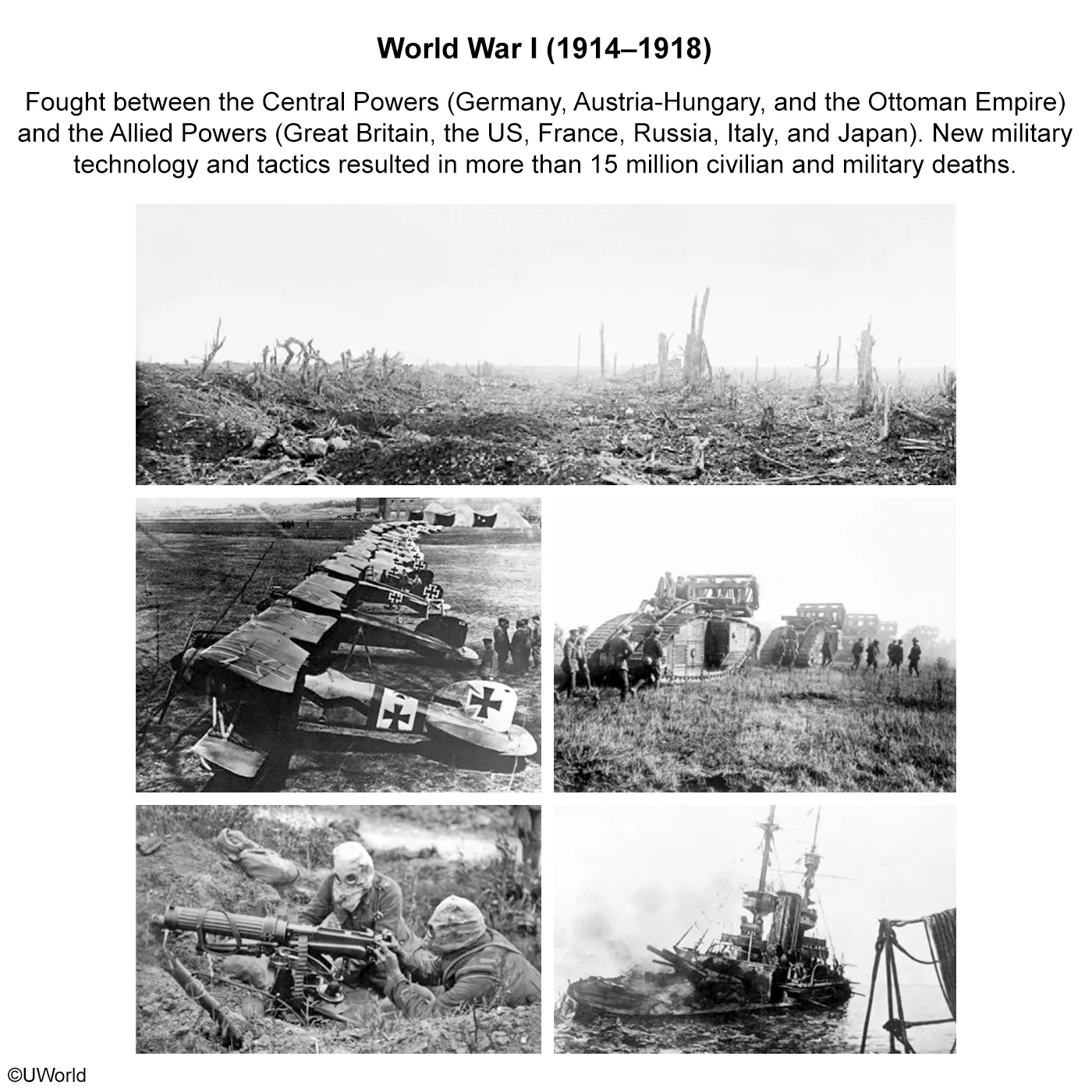
AP World History Unit 7 video lessons explain the causes and consequences of World War I, the interwar period, and the rise of global conflict in the 20th century. You'll also see how new technologies, shifting military tactics, and wartime policies affected civilians. These AP World Unit 7 review videos use clear visuals to show how events connect across regions and shape global instability.
Interactive Study Guides
AP World History Unit 7 study guides break down complex conflicts into simple, structured summaries. You’ll review Unit 7 vocab, political developments, economic crises, and global reactions to changing power. Visual charts, timelines, and comparisons help you understand how nations responded to conflict and how global systems shifted.
AP World History Unit 7 Practice Test Questions
Passage
"China's development was influenced by the alien peoples on the frontiers of Chinese civilization, who were Sinicized into the Chinese polity.… In later centuries, Chinese scholars studied Western astronomy, mathematics, and other branches of science. Westerners arrived in China in the nineteenth century…in search of trade and colonial empires. Through force of arms the Westerners imposed unequal treaties compelling China to accept humiliating compromises to its traditional system of society and government.
China reacted to intrusions from the West—and from a newly modernized Japan (to which China lost a war in 1895)—in a variety of ways, sometimes maintaining the traditional status quo, adapting Western functions to Chinese substance, or rejecting Chinese tradition in favor of Western substance and form. As the Qing dynasty declined, reforms came too late and did too little. The unsuccessful reform efforts were followed by revolution.… China saw the establishment of a republic in 1911. But warlord rule and civil war continued for nearly forty more years."
Library of Congress—Federal Research Division,
China: A Country Study, 1987
Question
Which of the following best explains the overall political trend in China described in the passage?
| A. The Qing government's increased silver reserves due to trade with Britain | |
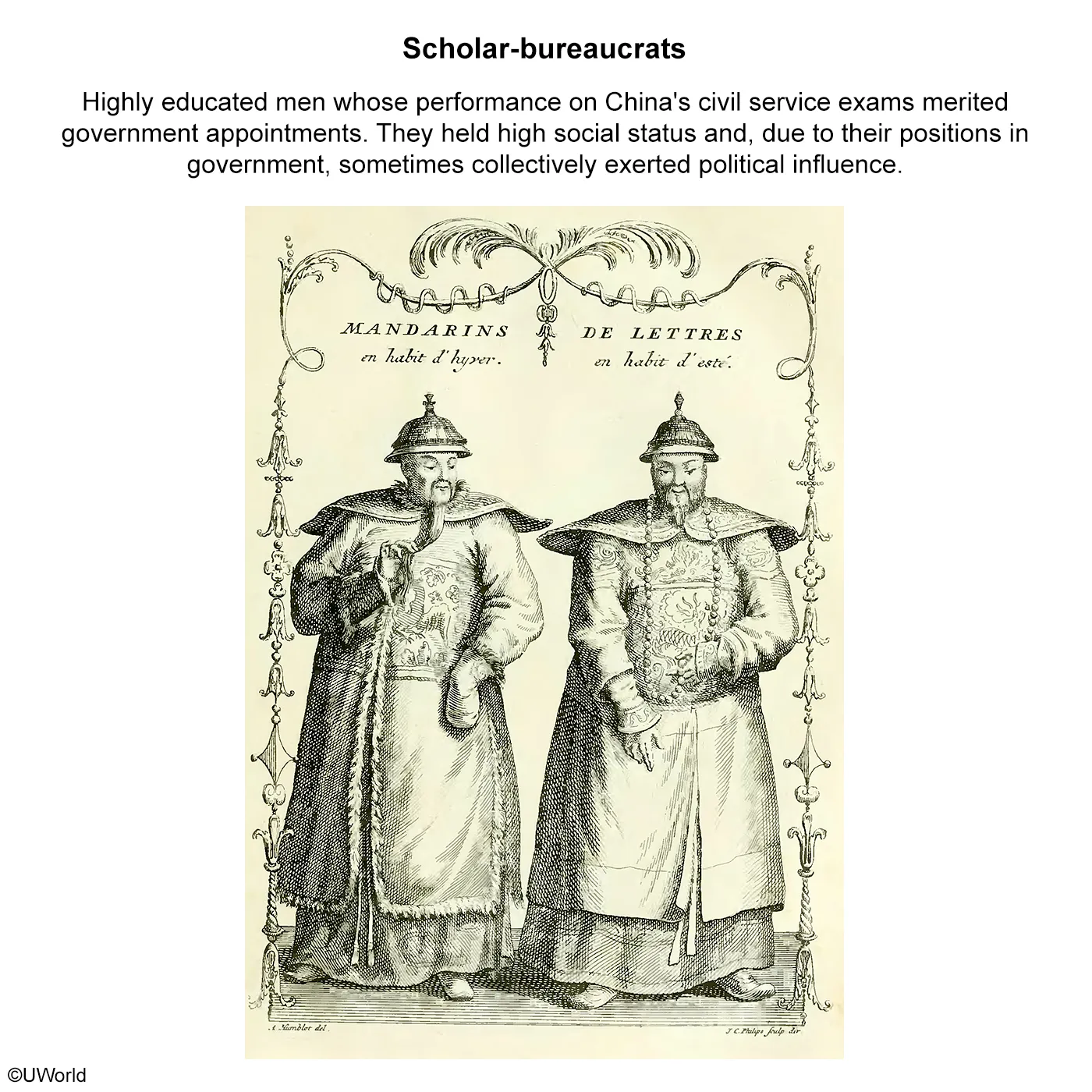
| B. The conflict between the Qing's imperial bureaucracy and scholar-bureaucrats | |
| C. The internal challenges to the Qing as a result of existing external pressures | |
| D. The Qing government's increased prestige after the Opium Wars |
Explanation
In the late 19th century, the Qing Dynasty faced several challenges, including:
- foreign invasions, particularly by Britain in the Opium Wars.
- economic pressures from the opening of China to international trade.
- foreign political pressures from the use of Chinese ports and rivers.
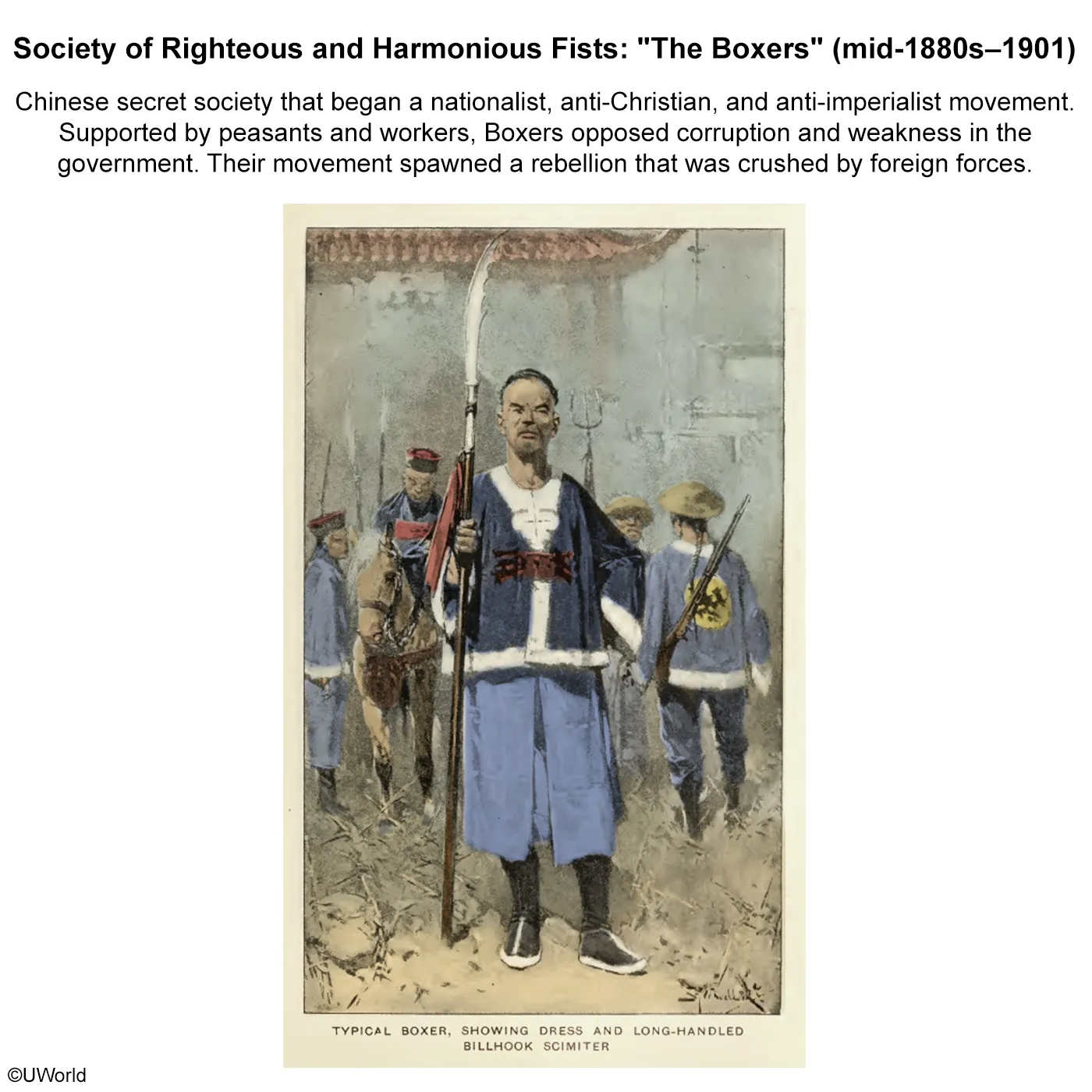
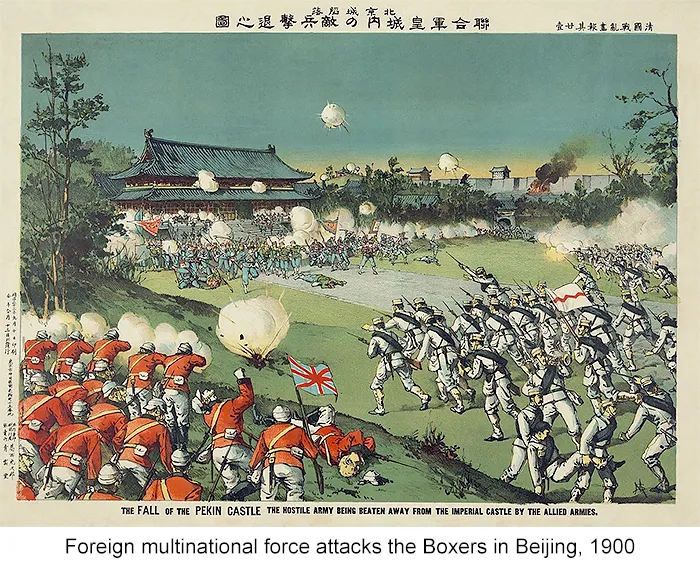
These external pressures significantly impacted the Qing government's ability to maintain stability and control. In 1899, Qing leadership supported the Boxers, who aimed to eliminate foreign influence and restore the dynasty's power. However, the Qing Dynasty—weakened by corruption and economic struggles—could not control the Boxer Rebellion or the resulting chaos.
Eventually, a coalition of foreign powers suppressed the rebellion, leaving the Qing struggling to maintain power until its collapse in 1911. Consequently, external pressures were a significant factor in the internal challenges faced by the Qing Dynasty.
(Choice A) Rather than an increase, there was a significant decrease in China's silver reserves because of the opium trade with Britain.
(Choice B) China's scholar-bureaucrats filled positions within the Qing's imperial bureaucracy, so they did not oppose its existence or operations.
(Choice D) The Qing lost to Britain in the Opium Wars, causing a loss, not an increase, of prestige.
Things to remember:
In the late 19th century, the Qing faced external pressures that played a significant role in the rise of internal challenges, contributing to the Dynasty's collapse in 1911.
Passage
"In the year 5657 (1897), at the summons of the spiritual father of the Jewish State, Theodore Herzl, the First Zionist Congress convened and proclaimed the right of the Jewish people to national rebirth in its own country.
This right was recognized in the Balfour Declaration of the 2nd November, 1917, and re-affirmed in the Mandate of the League of Nations which, in particular, gave international sanction to the historic connection between the Jewish people and Eretz-Israel and to the right of the Jewish people to rebuild its National Home.
The catastrophe which recently befell the Jewish people…was another clear demonstration of the urgency of solving the problem of its homelessness by re-establishing in Eretz-Israel the Jewish State, which would open the gates of the homeland wide to every Jew and confer upon the Jewish people the status of a fully privileged member of the comity of nations.
On the 29th November, 1947, the United Nations General Assembly passed a resolution calling for the establishment of a Jewish State in Eretz-Israel; the General Assembly required the inhabitants of Eretz-Israel to take such steps as were necessary on their part for the implementation of that resolution. This recognition by the United Nations of the right of the Jewish people to establish their State is irrevocable.
This right is the natural right of the Jewish people to be masters of their own fate, like all other nations, in their own sovereign State."
The Declaration of the Establishment of the State of Israel, 1948
1. The Declaration of Establishment of State of Israel, 1948.
Question
As described in the third paragraph, the catastrophe that befell the Jewish people is best seen as evidence of which of the following?
| A. Implementation of collectivization policies between 1900 and 1950 | |
| B. Increased ethnic violence as a result of extremist attitudes | |
| C. Disease and pathogen transmission between populations | |
| D. The increased use of labor camps in the Soviet Union |
Explanation
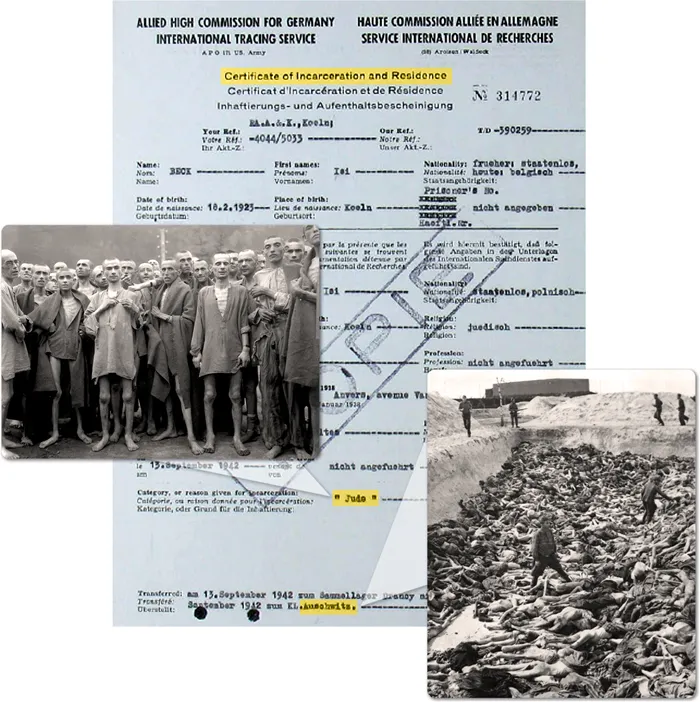
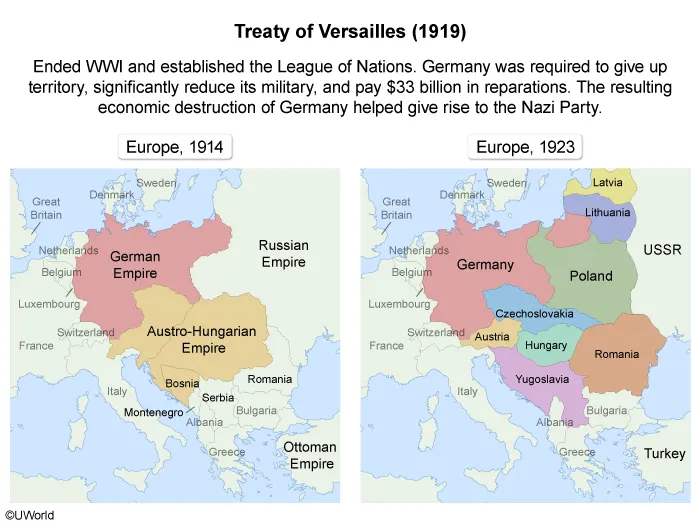
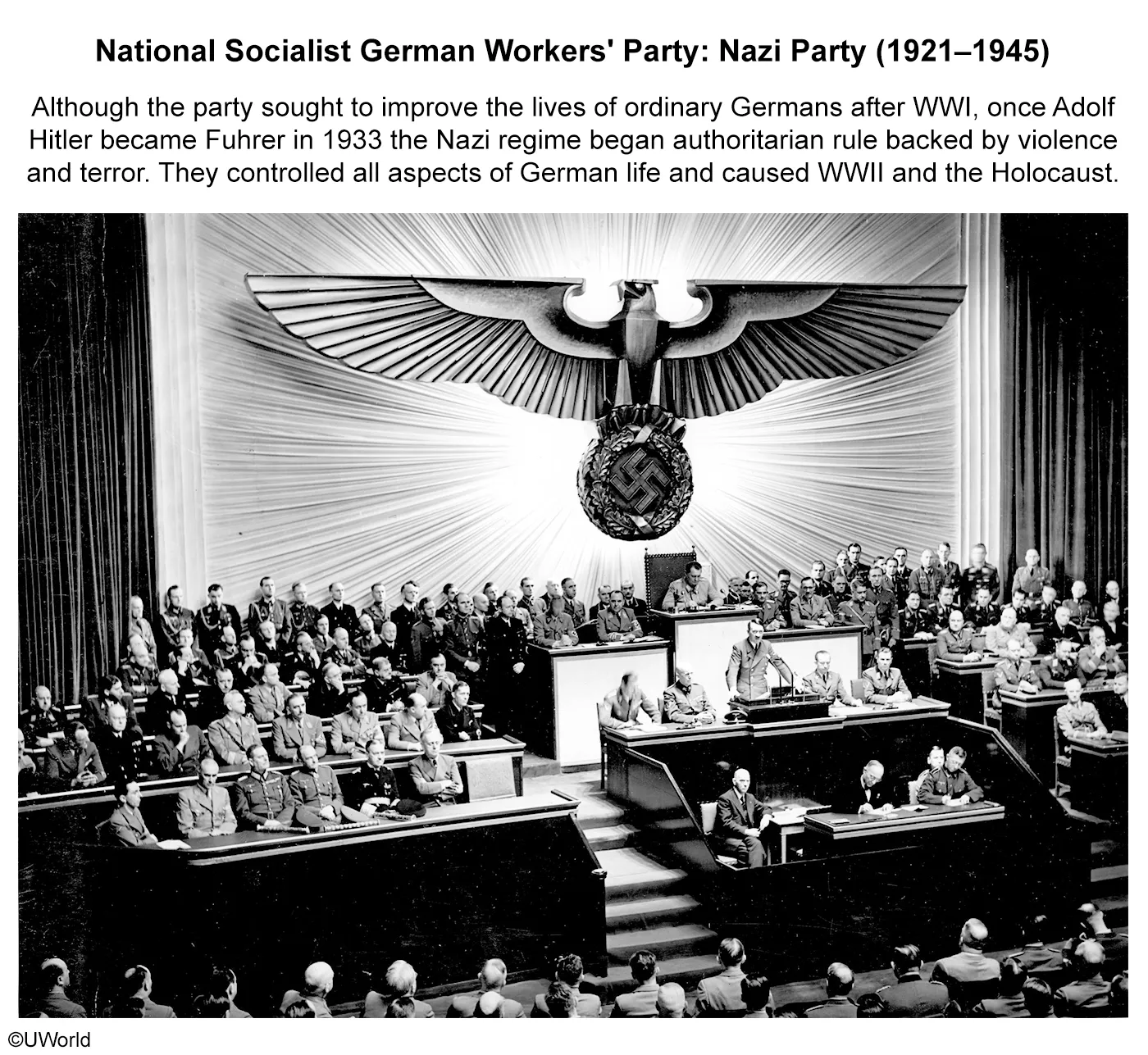
At the conclusion of WWI, the Treaty of Versailles resulted in the economic collapse of Weimar Germany, leading to increased German nationalism and extremism. Together, these two ideological viewpoints contributed significantly to the rise of the Nazi Party under Adolf Hitler, who promoted anti-treaty rhetoric and blamed Jews for Germany's economic problems.
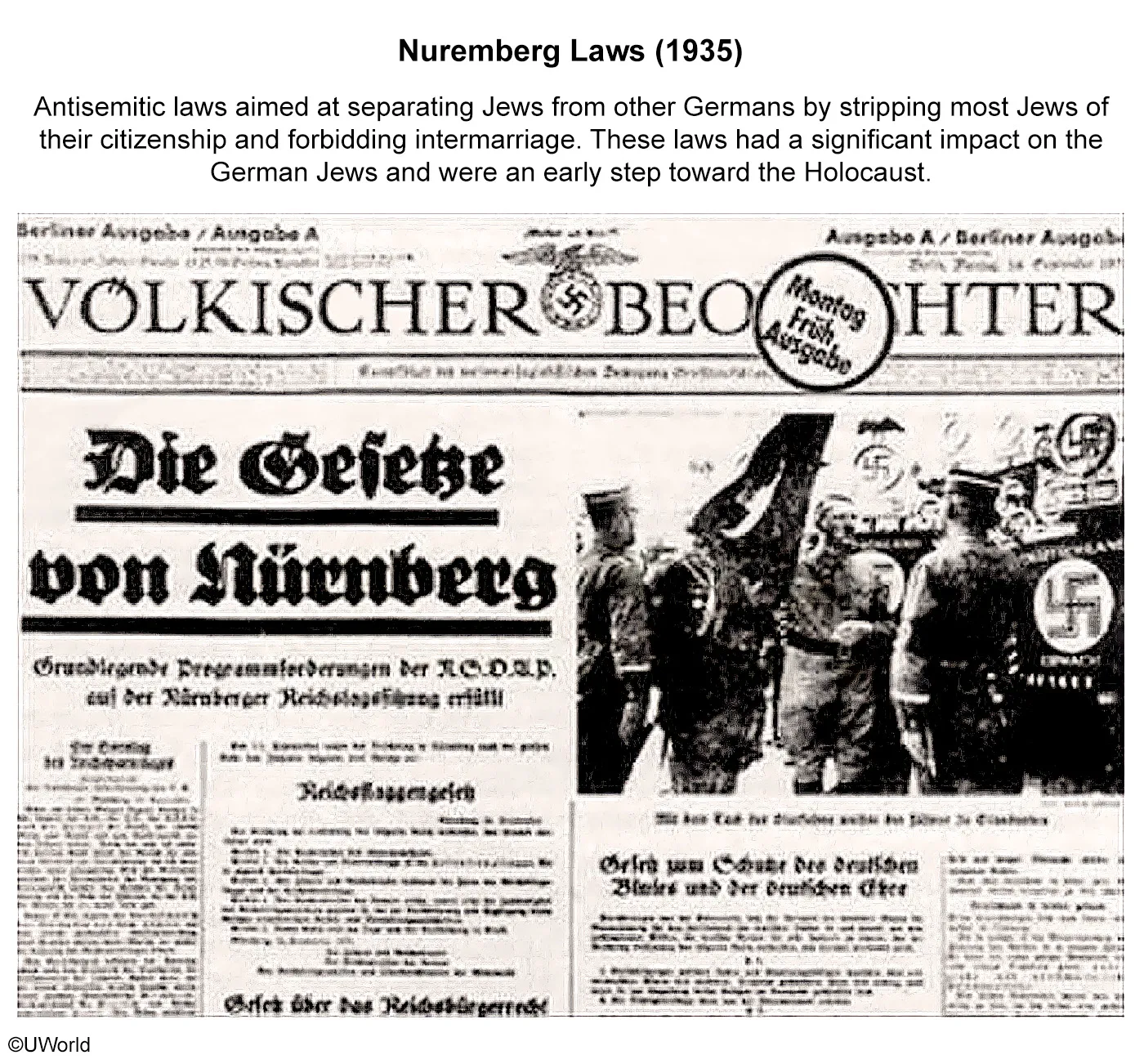
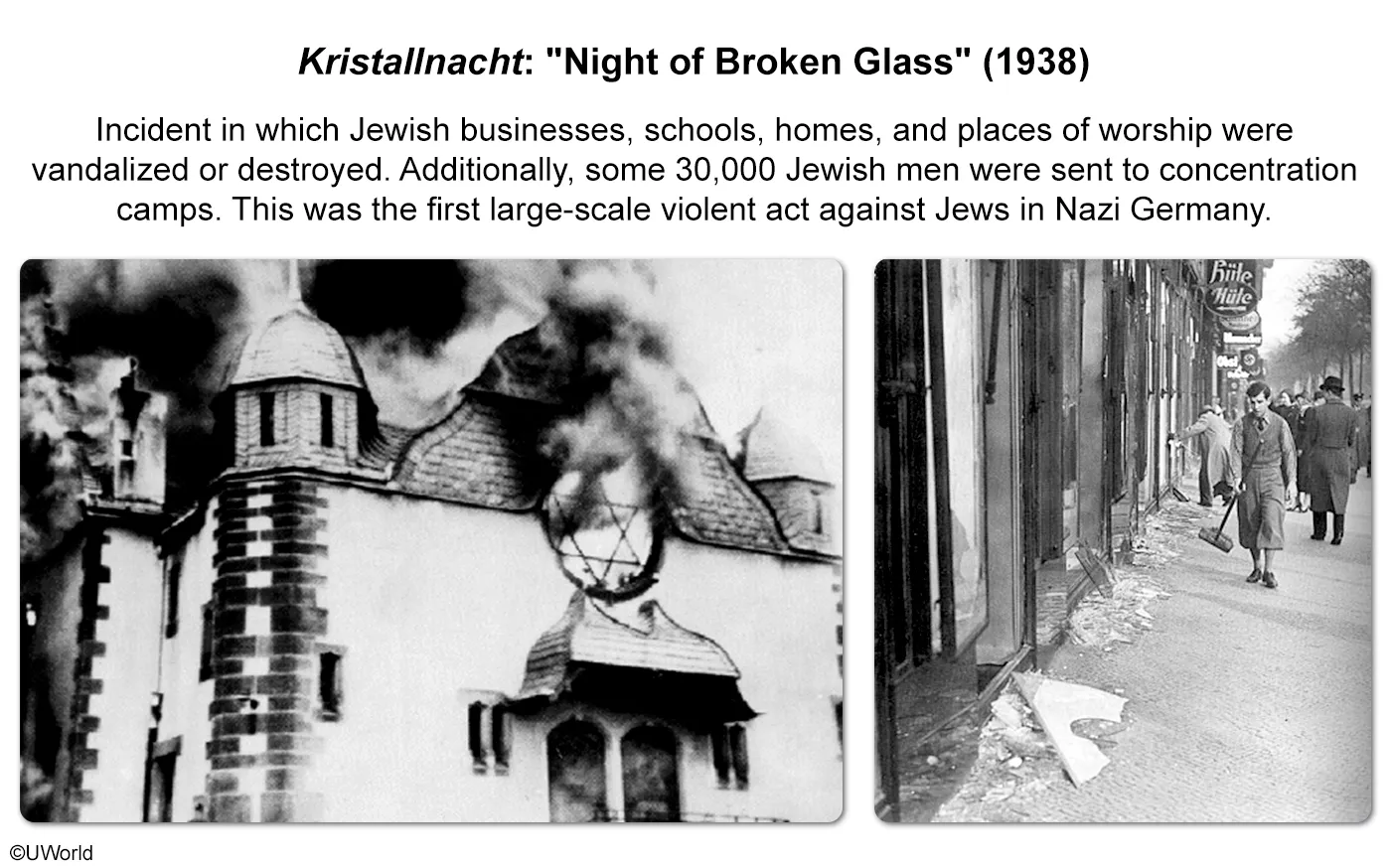
Shortly after Hitler rose to power, the Nazi Party introduced anti-Jewish policies and propaganda with the goal of making Jews the enemy of the German people. In 1935, the Nuremberg Laws stripped Jews of their German citizenship and contributed to their exclusion from all aspects of German society. In 1938, Kristallnacht marked a turning point in which the extremist ideology of the Nazi Party shifted to ethnic violence.
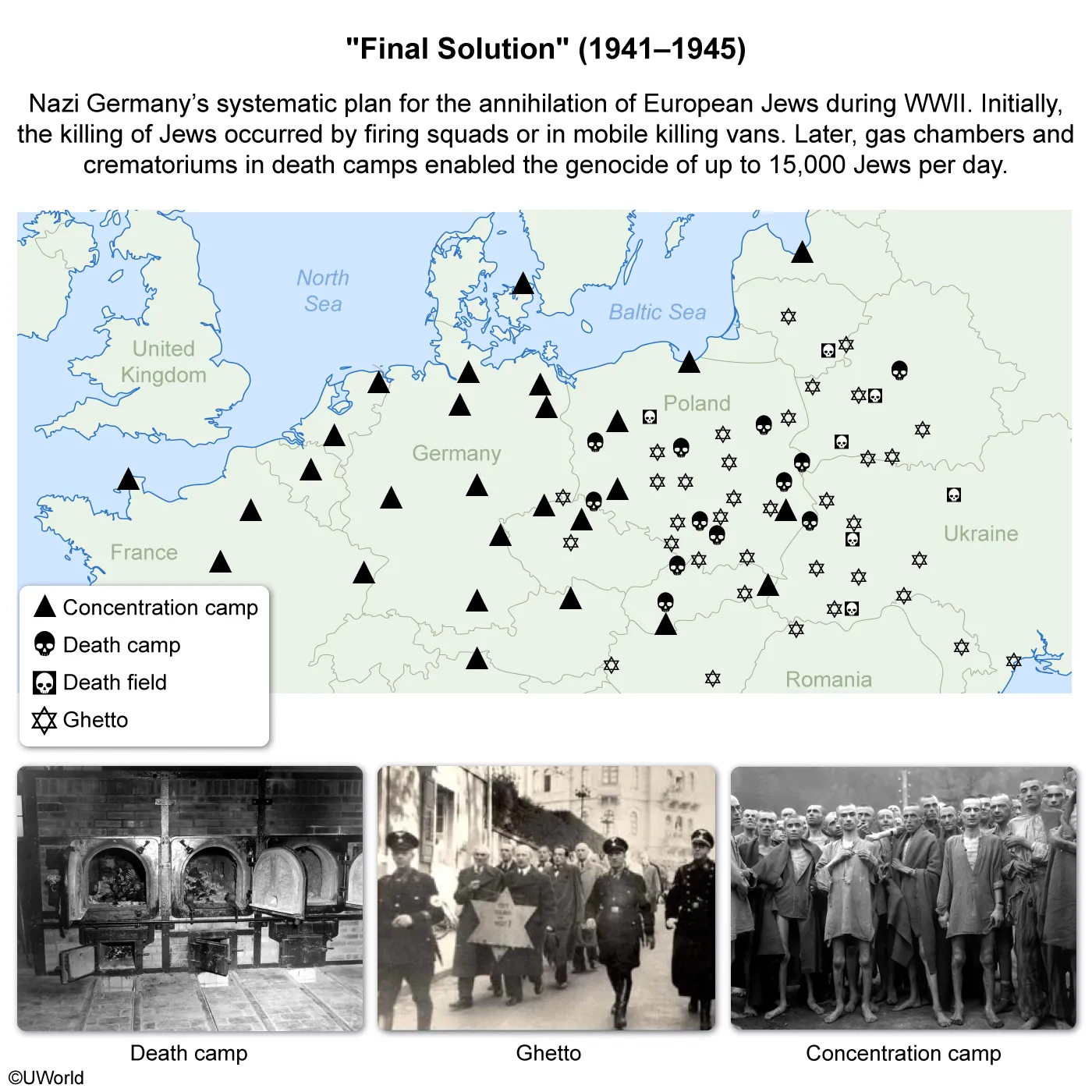
This violence escalated into genocide in 1941 when the Nazi Party's "Final Solution" became official policy, and Jews began to be arrested across Europe and sent to death camps for extermination. Through the highly organized and systematic "Final Solution," approximately 6 million Jews were murdered between 1941 and 1945. The Holocaust, as it is now known, is the "catastrophe which recently befell the Jewish people."
(Choice A) Collectivization refers to Soviet communist polices that began in the 1920s. Although some Russians suffered, collectivization helped the impoverished and persecuted Jewish populations in Russia.
(Choice C) The catastrophe discussed in the passage relates to the Holocaust, not disease transmission between populations.
(Choice D) Although labor camps in Soviet Union resulted in many arrests and executions, people sent to these camps were primarily those involved in counterrevolutionary activities; Jews were not specifically targeted.
Things to remember:
The 20th century saw the rise of extremist ideologies that resulted in mass genocide. During the Holocaust, Nazi Germany murdered 6 million Jews.
Passage
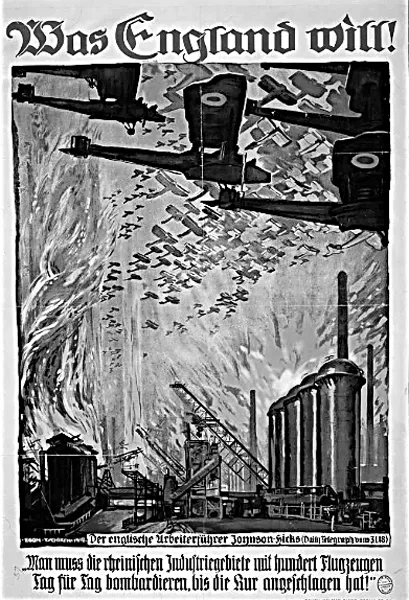
Poster from Germany, 1918
Poster title: "What England wants!"
Banner at bottom reads: "One must bomb the Rhine industrial area day by day with hundreds of airplanes, until the cure has occurred!"
Question
Which of the following best describes the likely intent of the poster?
| A. To build support for German participation in peace negotiations | |
| B. To build support for centrally directed war bonds and financing | |
| C. To promote German military policies and recruitment in the war effort | |
| D. To promote resistance to the predominant political system in Germany |
Explanation
Poster title: "What England wants!"
Banner at bottom reads: "One must bomb the Rhine industrial area day by day with hundreds of airplanes, until the cure has occurred!"
WWI was the first war in which political propaganda was widely distributed among civilians with the intent of garnering various types of support for the war effort.
- Enlistment and recruitment: Posters typically depicted a specific military corps, new wartime technology, or fear of the enemy to increase recruitment.
- Financing and war bonds: Posters generally contained text about financing (eg, war bonds, government loans, donations) or featured symbolic images relating to money with the intent of raising funds for the military.
- Domestic policies and morale: Posters showed nationalistic imagery to gain support for domestic polices and increase wartime morale.
The poster shown above depicts British airplanes bombing an industrial area in Germany with the heading, "What England wants!" Since this poster was distributed by the German government, the likely intent was to use symbolism, enemy technology, and fear to promote its own military policies and recruitment.
(Choice A) The intent of the poster's imagery was likely to spread fear among the German people. Fear tends to provoke a fighting response, not a desire for peace.
(Choice B) Although some propaganda posters were designed to raise money for the war, these posters typically included images of coins and money or mentioned finances (loans, bonds, donations).
(Choice D) Because the poster was developed and distributed by the German government, the intent wouldn't have been to promote resistance against the German political system.
Things to remember:
WWI was the first war in which governments used significant political propaganda to mobilize populations for the purpose of waging war.

Study Anywhere, Anytime
Use the UWorld app to review AP World History Unit 7 whenever you have a moment, between classes, on a bus ride, or during a quick study break. You can open AP World History Unit 7 practice test questions, watch lessons on global conflict, or skim study guides that explain major events. Everything stays synced, making review effortless and flexible.
Stand Out
with a Top Score in AP World History: Modern
Finish your AP World History Unit 7 review and continue mastering all units with UWorld. Our AP World History course is designed to boost your performance and help you impress admissions.
Get our all-in-one course today!
- Focused APWHM Videos
- Print & Digital Study Guide
- 500+ Exam-style Practice Questions
- Customizable Quiz Generator
- Adjustable Study Planner
- Realistic Timed Test Simulation
- Colorful Visual Explanations
- Progress Dashboard
- Smart Flashcards & Digital Notebook
Hear From Our AP Students
UWorld’s service is pretty good and helps provide a lot of explanations on subjects I haven’t been confident on before.
The questions here are the most realistic to the AP tests I've seen so far! I appreciate the ability to customize tests as well.
The best part is that all options are well-explained, telling clearly why they are not the right option.
Frequently Asked Questions (FAQs)
What are the main topics covered in AP World History Unit 7: Global Conflict?
AP World History Unit 7 explores how global conflicts, new ideologies, and shifting political structures reshaped the world after 1900. This unit helps you understand why nations entered major wars, how societies mobilized for total conflict, and how political change transformed international relationships in the 20th century.
Key topics include:
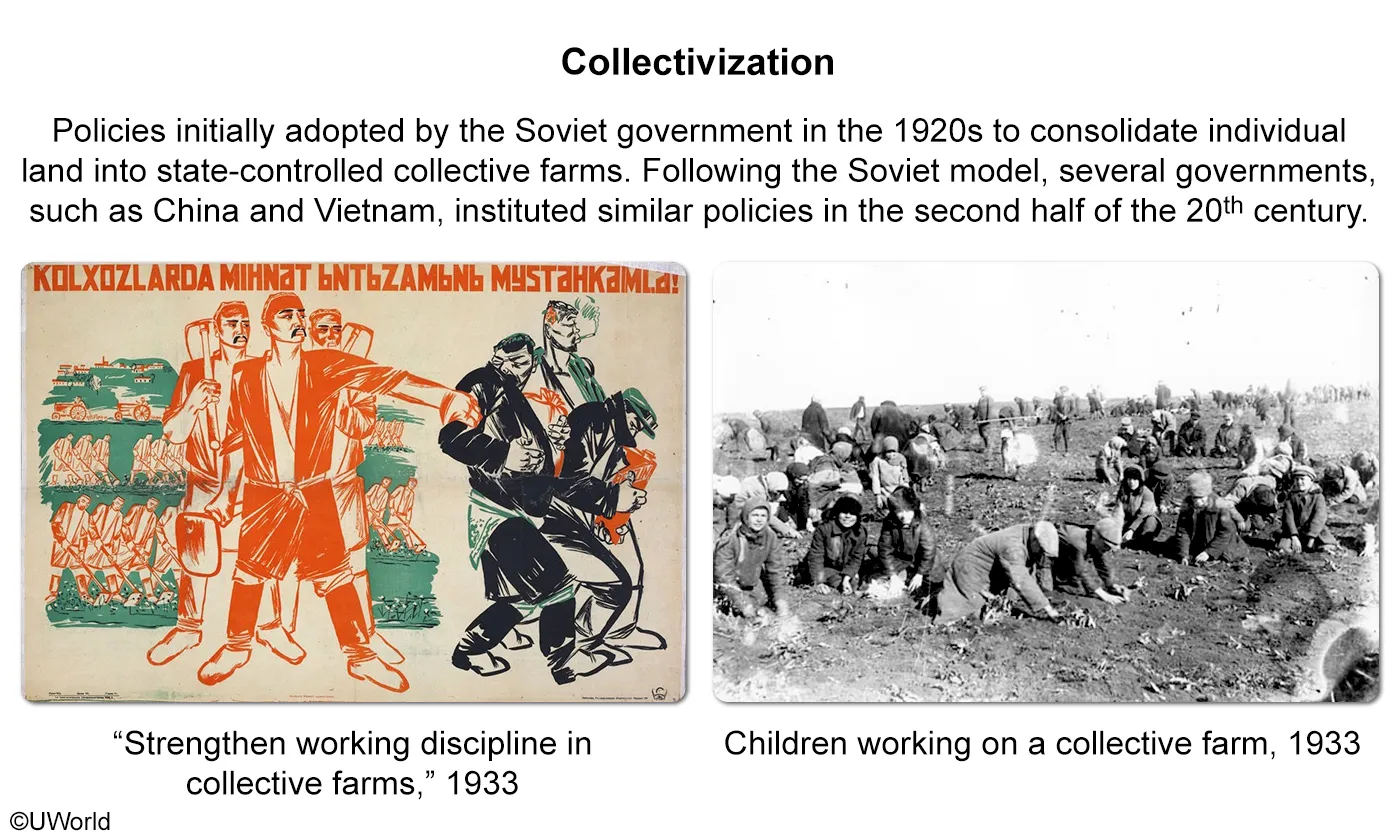
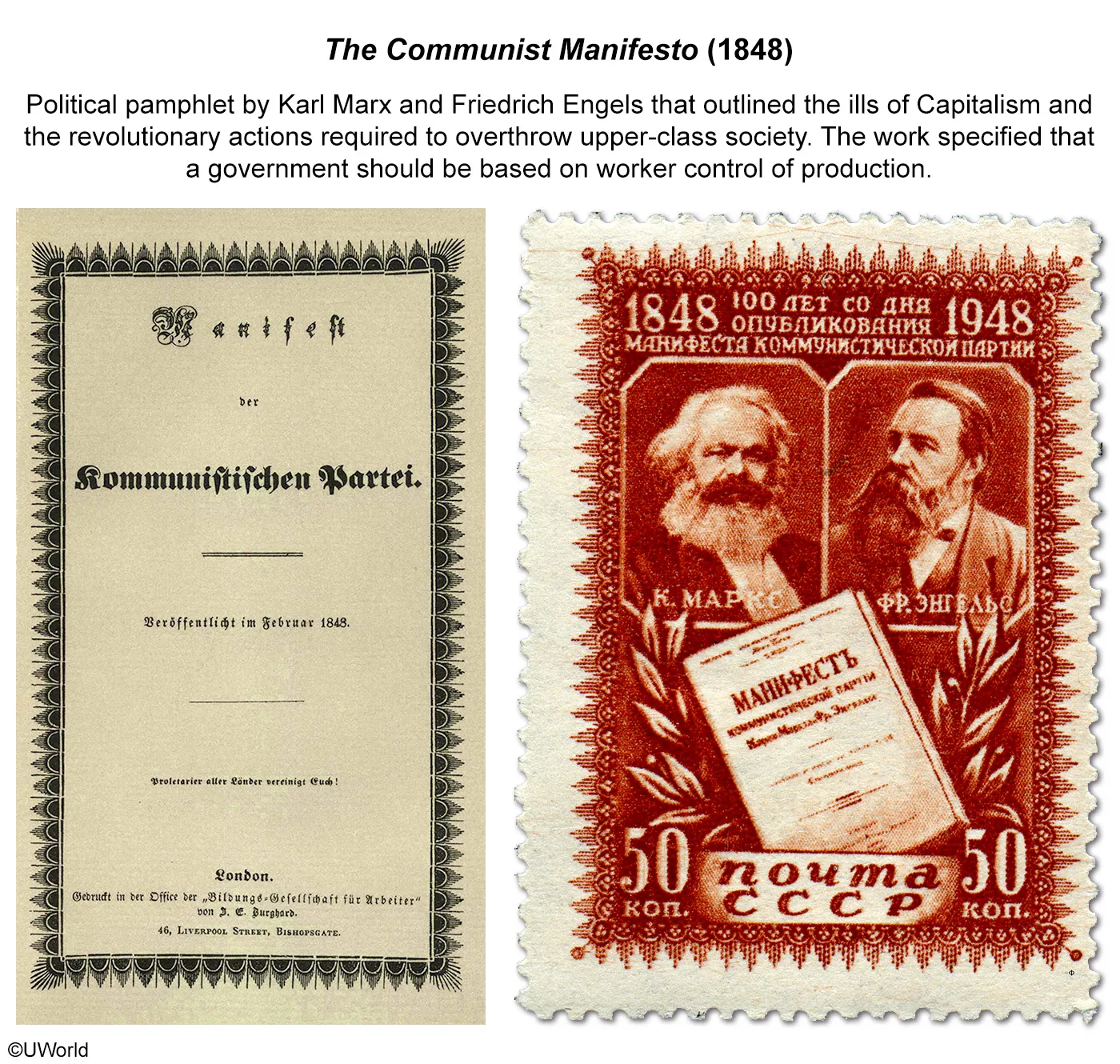
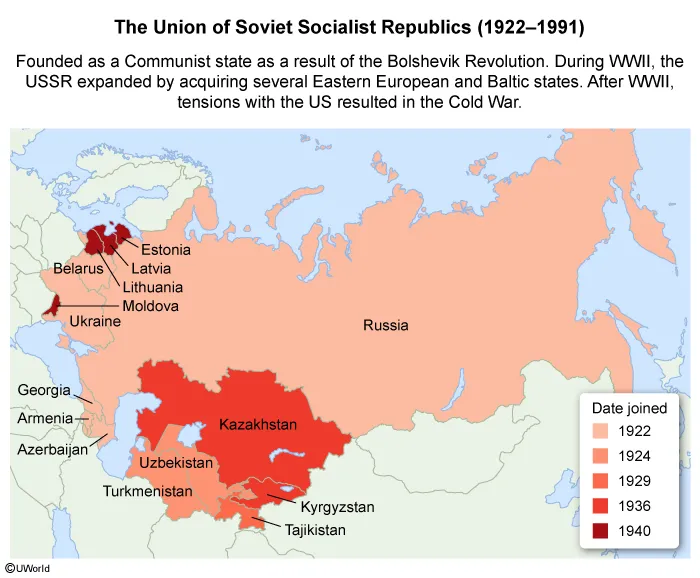
- Changes in the global political order after 1900: The fall of empires, creation of new states, and rise of ideologies like nationalism, fascism, and communism.
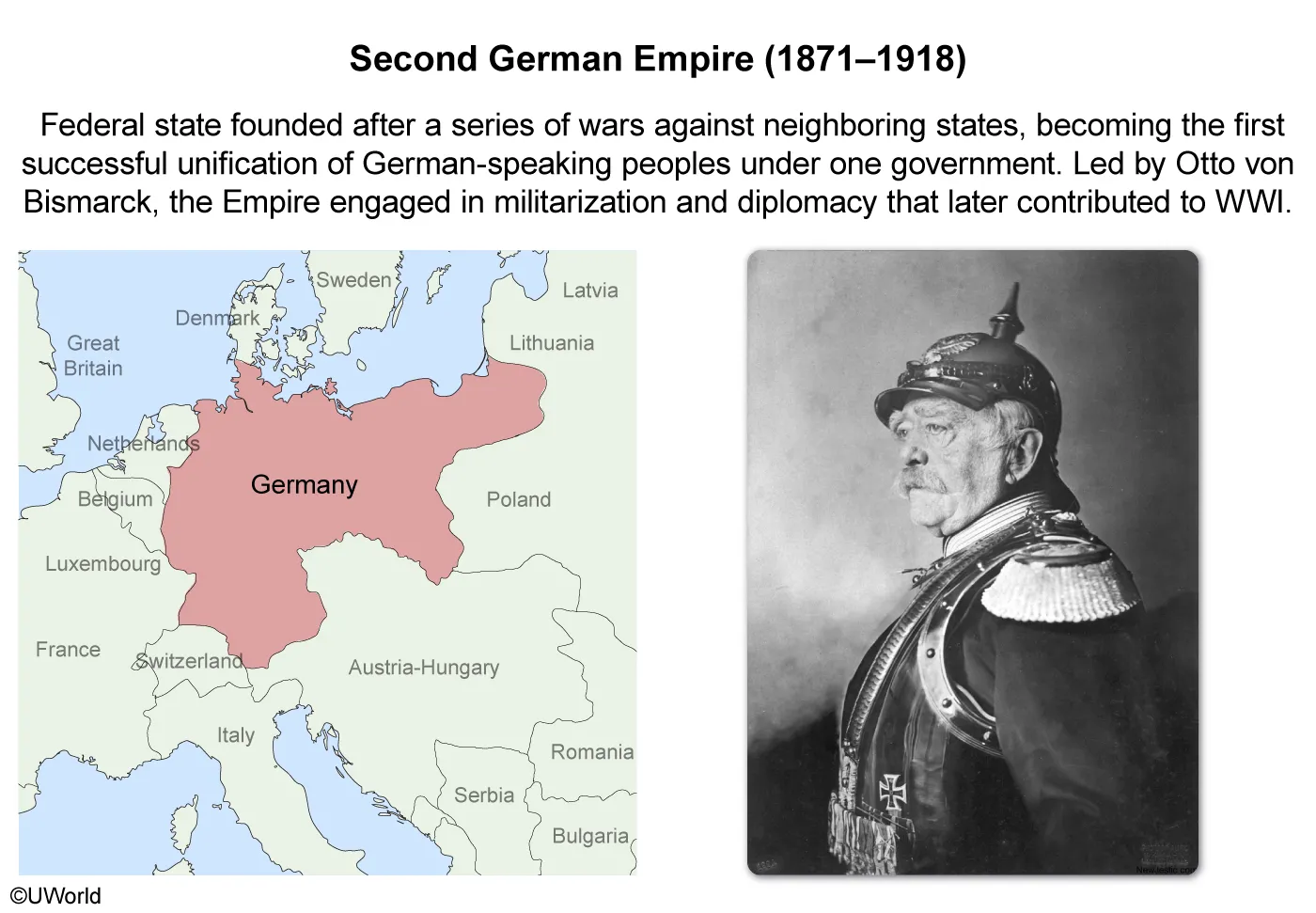
- World War I: its causes and how it was fought: Militarism, alliances, imperial competition, trench warfare, and total war.
- The interwar period: Economic collapse, authoritarian regimes, and global attempts to maintain peace.
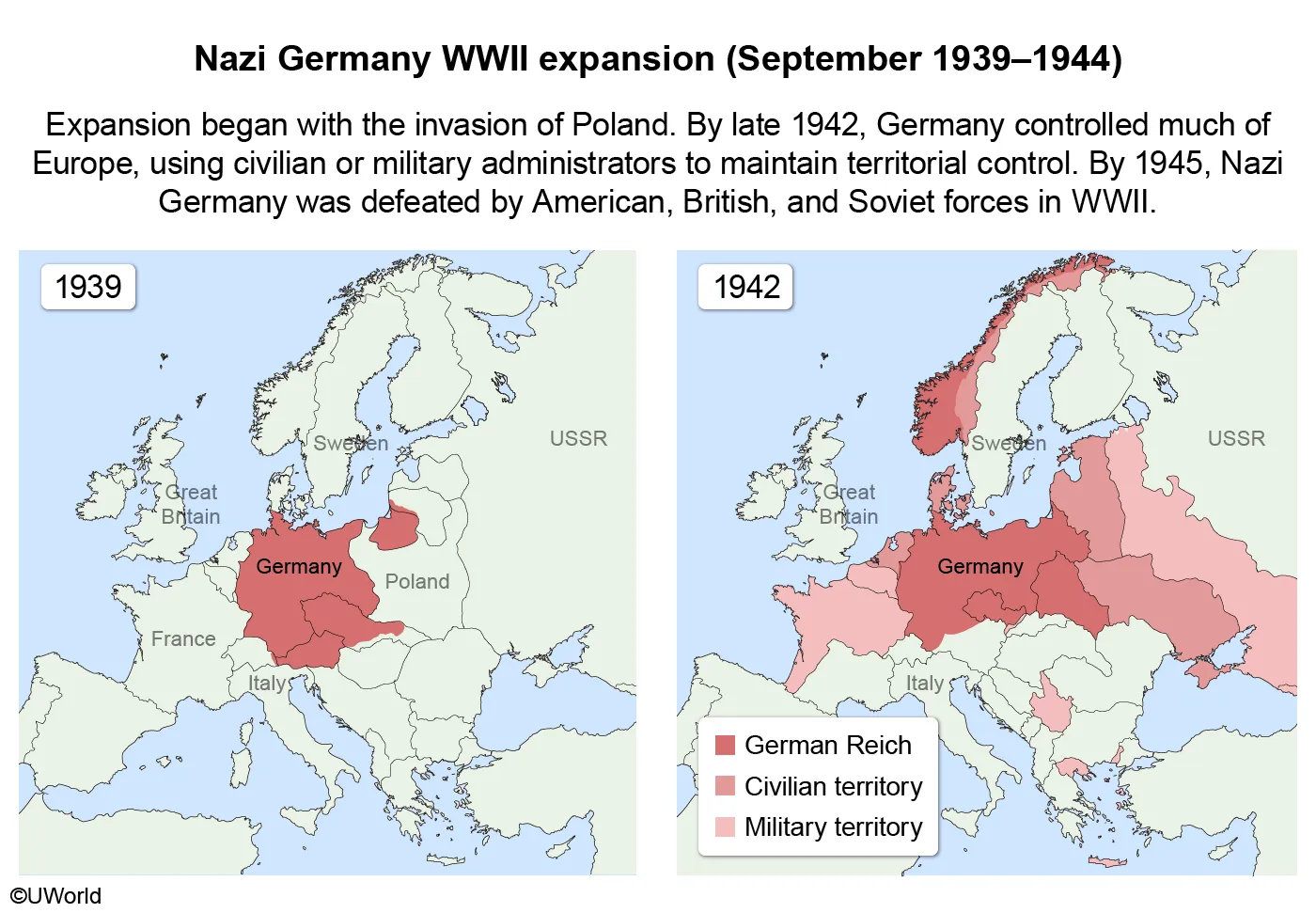
- World War II: its causes and how it was fought: Expansionist governments, shifting alliances, new military strategies, and global-scale warfare.
- Mass atrocities after 1900: The Armenian Genocide, the Holocaust, and other examples of state-sponsored violence.
Mastering these topics helps you perform well on Unit 7 AP World History MCQs, SAQs, DBQs, and LEQs. UWorld’s explanations, visual summaries, and realistic practice questions make it easier to understand these complex events and prepare confidently for the AP exam.
How should I prepare for an AP World History Unit 7 exam?
Preparing for AP World History Unit 7 is easier when you follow a clear study plan focused on understanding global conflict and political change. Start by reviewing key turning points like World War I, the interwar period, and World War II to see how rising tensions and competing ideologies shaped the 20th century.
A reliable approach is the Read–Watch–Practice method.
- Read: Use an AP World History Unit 7 study guide to learn the major causes, effects, and political shifts after 1900.
- Watch: Strengthen your understanding with short videos that explain militarism, authoritarianism, and global conflict.
- Practice: Complete AP World History Unit 7 practice test questions to see how these themes appear on MCQs, SAQs, DBQs, and LEQs.
To study more effectively, choose tools that break down complex events clearly. UWorld’s Unit 7 review resources offer exam-style questions, step-by-step explanations, and strong visuals that make global conflict easier to understand and help you prep with confidence.
Are any free resources available for AP World History Unit 7?
Several free resources can help you build a strong foundation for AP World History Unit 7. UWorld’s 7-Day Free Trial gives you access to Unit 7 practice questions, explanations, and selected video lessons that break down global conflict.
College Board AP Classroom offers official Unit 7 progress check MCQs and AP Daily videos that explain major events like the Great Depression, global warfare, and the rise of authoritarian states. Khan Academy adds free summaries and practice items to reinforce key concepts.
Using these free tools helps you understand the basics before diving into more detailed AP World History Unit 7 review and exam preparation.
What types of questions are on the AP World History Unit 7 test?
The AP World History Unit 7 test includes stimulus-based MCQs, SAQs, DBQs, and LEQs that focus on global conflict, political ideologies, and international change. MCQs may include wartime propaganda, speeches, maps, or economic charts related to prewar tensions, WWI, or the interwar period.
SAQs often ask you to analyze events like the Russian Revolution or explain the impact of ideological movements such as fascism and communism. DBQs require interpreting documents connected to political transformation or wartime mobilization, while LEQs may ask you to compare causes of global conflict or evaluate continuity and change across regions.
Practicing AP World History Unit 7 MCQs and FRQs helps you understand each format and answer confidently.
How can I improve my score on the Free-Response Questions (FRQs) for Unit 7?
To improve FRQ performance for AP World History Unit 7, focus on building clear arguments supported by accurate historical evidence. Understanding the causes of WWI, the effects of the Great Depression, and the rise of authoritarian regimes will help you respond effectively to SAQs, DBQs, and LEQs.
Practice writing concise thesis statements, organizing paragraphs logically, and connecting evidence directly to the prompt. For DBQs, learn how to analyze point of view, purpose, and historical context. For LEQs, practice comparing different regions’ responses to global conflict or explaining continuity and change over time.
UWorld’s detailed AP World History Unit 7 explanations help you understand strong historical reasoning and improve your writing.
What is the "Global Conflict" unit's weight on the AP World History exam?
AP World History Unit 7 typically accounts for 8–10% of the total AP exam score. Even though it is not the largest unit, its themes, global conflict, political change, ideologies, and economic crises, connect directly to later developments in Units 8 and 9.
Many MCQs reference Unit 7 content, and FRQs often require contextualization from this period when discussing long-term global change. Knowing the causes and consequences of WWI, the interwar period, and the rise of totalitarianism strengthens your understanding of the entire modern era.
A strong AP World History Unit 7 review boosts your ability to analyze complex global events and write deeper, more effective arguments.
Where can I find a good study guide for AP World History Unit 7?
UWorld provides a detailed AP World History Unit 7 study guide that simplifies major conflicts, political transformations, and ideological shifts. The guide breaks down WWI, the Russian Revolution, the Great Depression, and the rise of fascism and communism into easy-to-understand sections.
You’ll also find AP World History Unit 7 vocab, comparison charts, timelines, and visual explanations that help you study efficiently. These tools clarify complex global events and prepare you for MCQs and writing tasks.
Paired with AP World History Unit 7 practice questions, UWorld’s study guide makes reviewing global conflict organized, clear, and effective.
Can I find practice tests specifically for APWH Unit 7?
Yes. UWorld offers AP World History Unit 7 practice tests designed to match the difficulty and format of the real AP exam. These questions cover global conflict, wartime strategies, political ideologies, and international change.
College Board AP Classroom includes a Unit 7 progress check MCQ and SAQ set, and Khan Academy provides general Unit 7 topic reviews. However, UWorld’s detailed answer explanations help you understand both correct and incorrect choices, making your review more effective and exam-ready.
What skills do I need to succeed in AP World History Unit 7?
Success in AP World History Unit 7 starts with strong analytical skills, especially when interpreting sources about global conflict and political change. You’ll need to recognize cause-and-effect relationships and compare how different nations responded to major events after 1900.
Reading and visual analysis skills are also essential. AP World History Unit 7 practice test questions often include propaganda posters, speeches, political cartoons, or charts showing economic or military patterns. Being able to break down these sources quickly helps you answer more accurately.
Writing clearly and choosing evidence that supports your argument are key for FRQs. UWorld’s Unit 7 explanations show you how to organize your reasoning and use historical examples effectively, helping you feel more prepared for the exam.
How can I stay organized while studying AP World History Unit 7?
Staying organized during AP World History Unit 7 can make challenging content feel more manageable. Break the unit into smaller themes, World War I, the interwar period, and World War II so you can study each part without feeling overwhelmed. Short notes, charts, and timelines help simplify big ideas.
Consistency matters more than long study sessions. Quick reviews with video lessons, flashcards, or brief summaries keep information fresh and easier to recall. Keeping all your Unit 7 materials in one place, digital or physical, makes your study time more efficient.
Targeted practice also keeps you focused. UWorld’s AP World History Unit 7 practice test questions help you identify what you know and what needs more attention, making your study plan clearer and more productive.