
AP World History: Modern Unit 5 Review and Practice Test
Understand the global revolutions of AP World History Unit 5 with clear lessons, study guides, and practice test questions that explain political change, industrial growth, and social transformation to help you prepare confidently for the exam.
Excel in AP World History with a Focused Unit 5 Review
Gain clarity on the revolutionary movements, political transformations, and global shifts that shaped the modern world during Unit 5. This AP World History Unit 5 review highlights the major turning points and ideas that continue to influence global systems today.
Engaging Video Lessons
Video lessons for AP World History Unit 5 clarify the causes, key figures, and consequences of major revolutions across the world. Each segment walks you through themes like nationalism, liberalism, industrialization, and the spread of revolutionary ideas. These AP World Unit 5 review videos connect events across regions, helping you see how change unfolded globally.
Interactive Study Guides
Interactive study guides break down AP World History Unit 5 topics into understandable sections, including political ideologies, economic changes, and social movements. Organized summaries and AP World History Unit 5 vocab support quick, effective review and strengthen your grasp of key exam concepts.
AP World History Unit 5 Practice Test Questions
Question
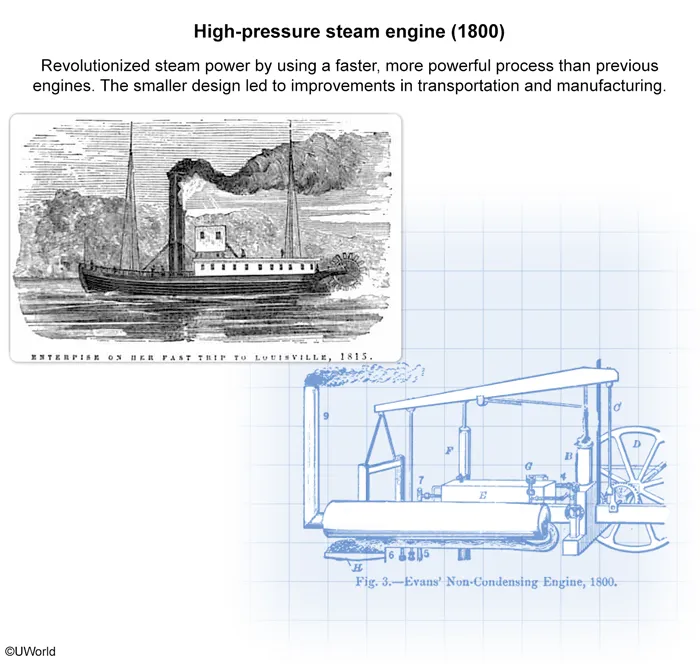
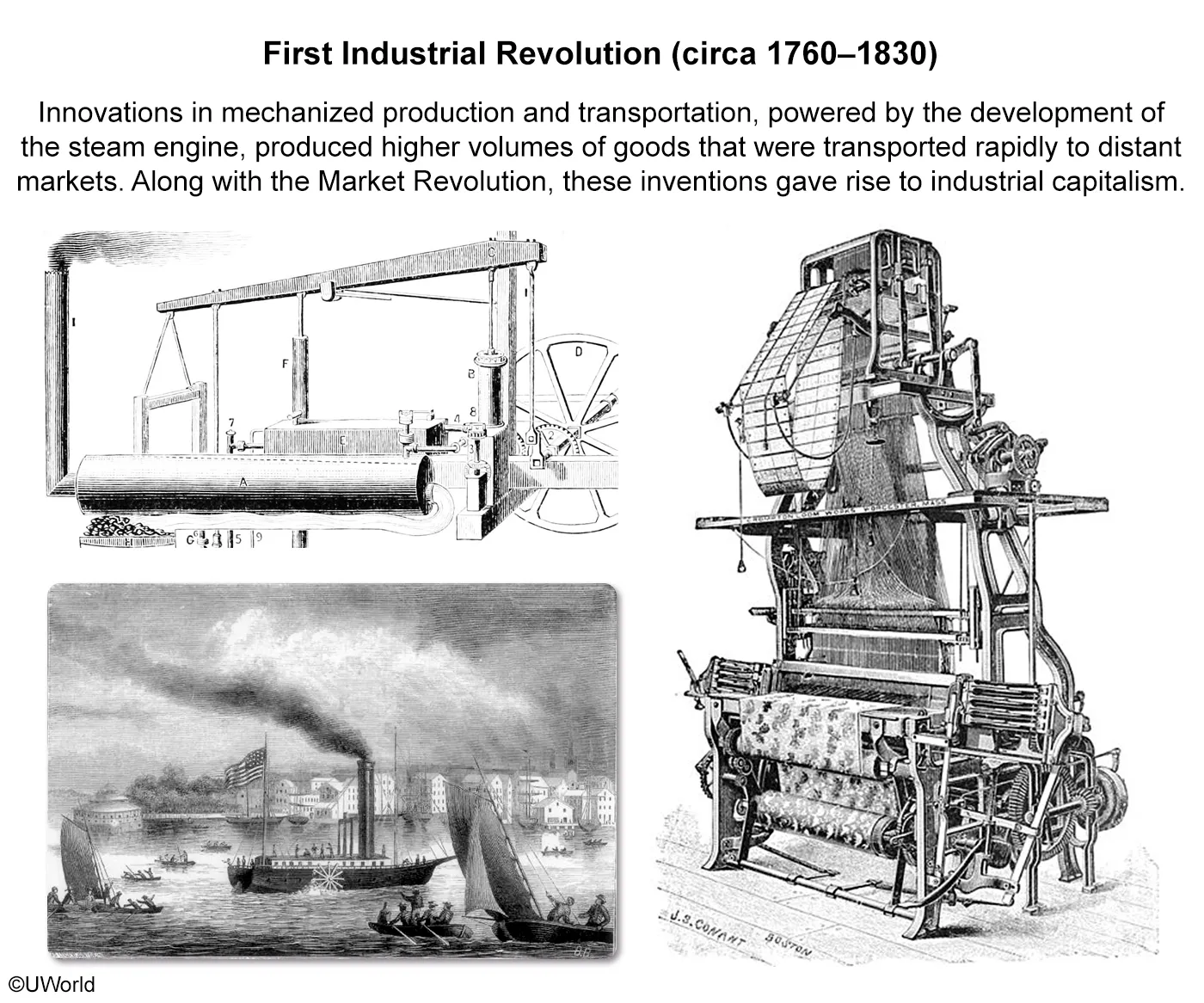
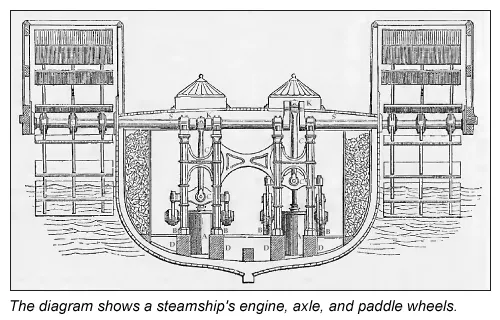
Which of the following emerged after 1750 in large part due to machinery such as that illustrated by the image?
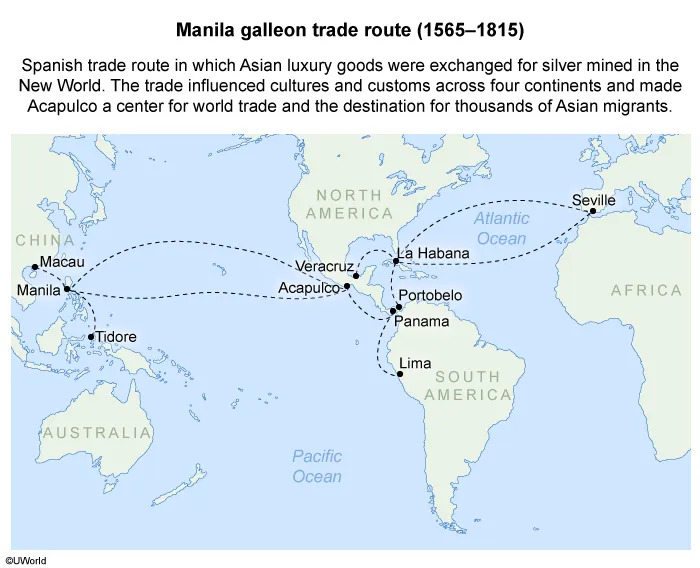
| A. The development of Spain's Manila galleon trade, which relied on New World silver | |
| B. The access to Southeast Asian interior regions as part of European colonization of that region | |
| C. The development of the four-field system during the Second Agricultural Revolution | |
| D. The increased demand for laborers in cottage industries |
Explanation
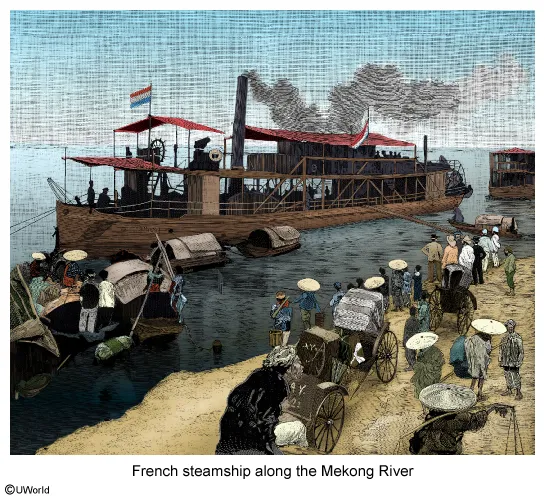
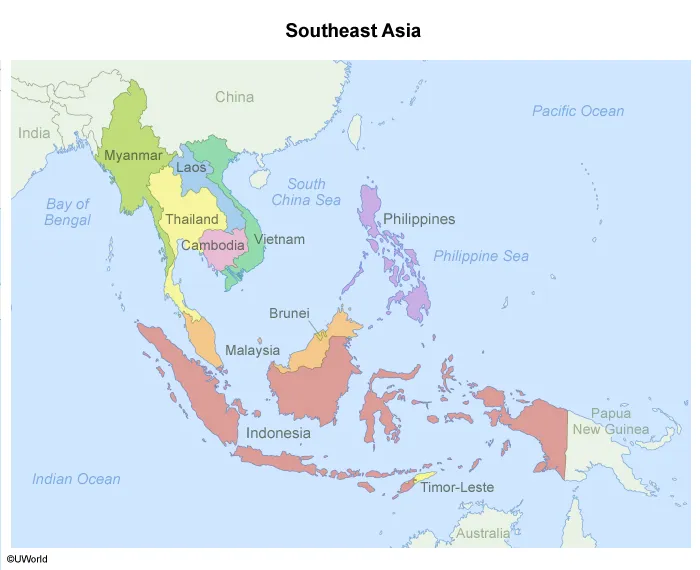
After 1750, European powers began powering ships with steam engines. Such steamships operated throughout Europe and in Southeast Asia, where European powers used them to explore and control the region's rivers. For example, steamboats were used by:
- the French on the Mekong River to establish their colonial presence in Indochina.
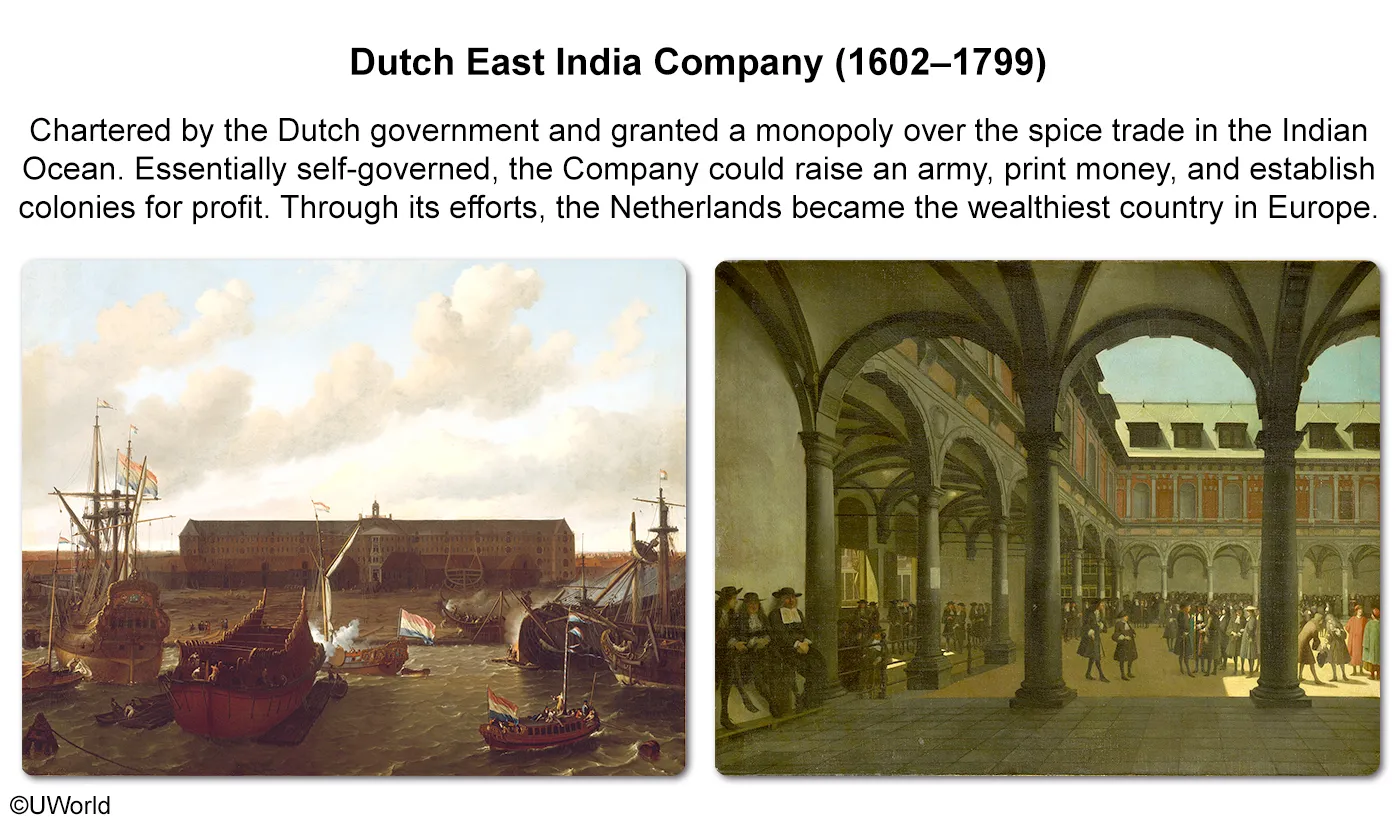
- the Dutch East India Company to explore the rivers in Java and Sumatra.
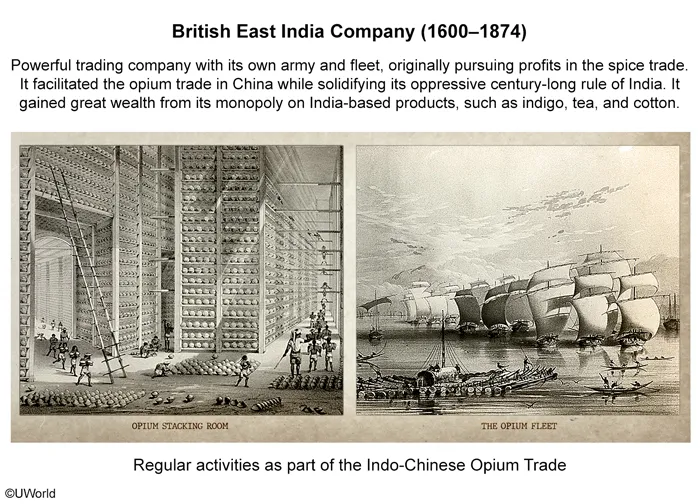
- the British East India Company on the Irrawaddy River in Burma (Myanmar).
Steamships efficiently transported European goods and people, enabling the colonial powers to establish trade links and exert greater control over their respective settlements. Therefore, after 1750, steamships facilitated European access to and colonization of Southeast Asian interior regions.
(Choice A) Although the Manila galleon trade lasted until roughly 1815, the network emerged in the mid-1500s.
(Choice C) The Second Agricultural Revolution and the four-field system emerged during the 1600s, although both continued beyond 1750.
(Choice D) The demand for laborers in cottage industries decreased, rather than increased, after 1750 as the factory system in western Europe largely replaced home-based production.
Things to remember:
After 1750, steamships facilitated European access to and colonization of Southeast Asian interior regions.
Passage
"The Meiji oligarchy, as the new ruling class is known to historians, was a privileged clique that exercised imperial power, sometimes despotically….
To accomplish the new order's goals, the Meiji oligarchy set out to abolish the Tokugawa class system through a series of economic and social reforms…. To provide revenue and develop a sound infrastructure, the new government financed harbor improvements, lighthouses, machinery imports, schools, overseas study for students, salaries for foreign teachers and advisers, modernization of the army and navy, railroads and telegraph networks, and foreign diplomatic missions….
Additionally, between 1871 and 1873, a series of land and tax laws were enacted as the basis for modern fiscal policy. Private ownership was legalized, deeds were issued, and lands were assessed at a fair market value with taxes paid in cash rather than in kind as in pre-Meiji days and at slightly lower rates."
Library of Congress—Federal Research Division,
Japan: A Country Study, 1992
Question
The development of the Meiji oligarchy becoming "the new ruling class" is a consequence of which of the following?
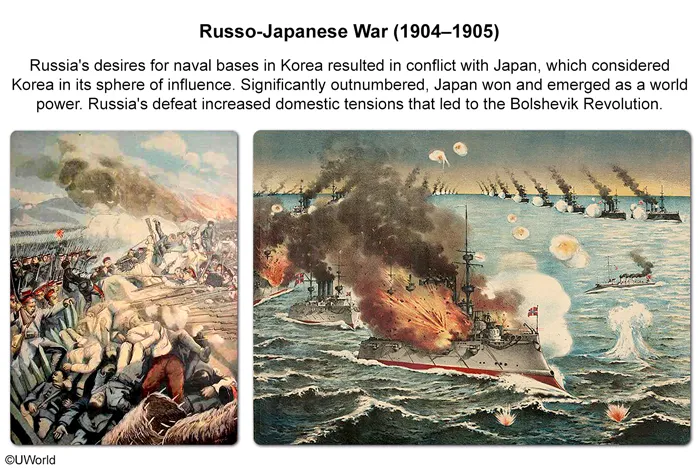
| A. The intensification of hostilities between Russia and Japan over Manchuria | |
| B. The Tokugawa government's transfer of wealth from Japan's lords to peasants | |
| C. The increased influence of the United States in East Asia | |
| D. The abolition of the samurai class within the Japanese feudal system |
Explanation
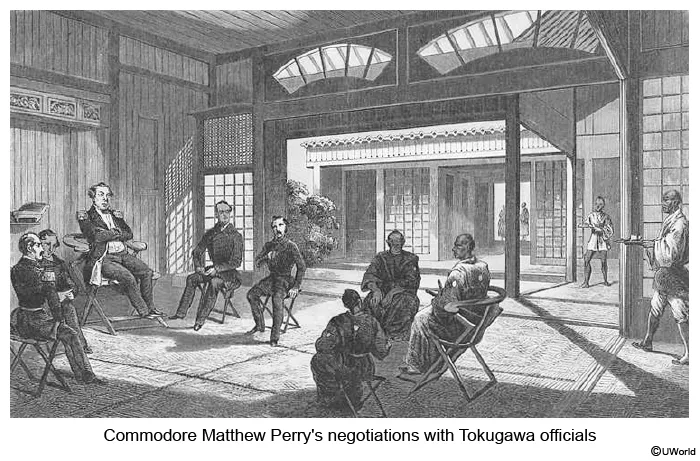
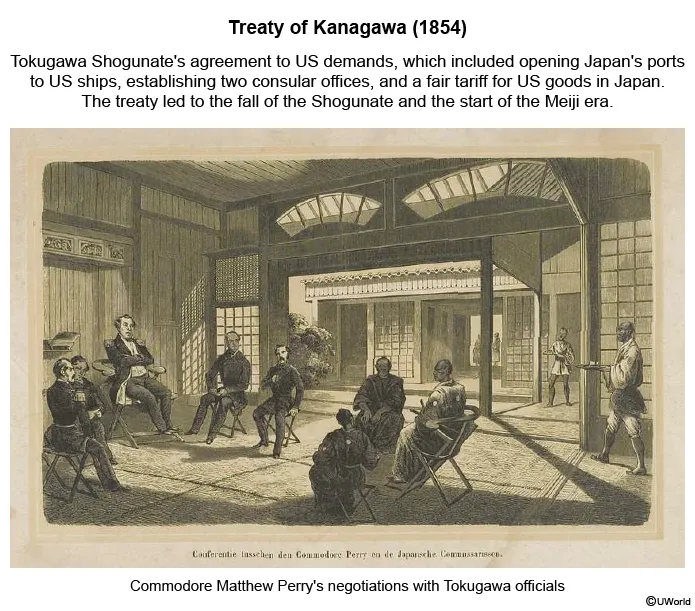
In July 1853, the US sent Commodore Matthew Perry with four ships to Japan, requesting that its leaders open their ports for US trade and naval use. The following spring, Perry returned with a much larger fleet to receive Japan's answer. In March 1854, Japanese officials reluctantly agreed to US demands in the Treaty of Kanagawa, which began the "opening of Japan."
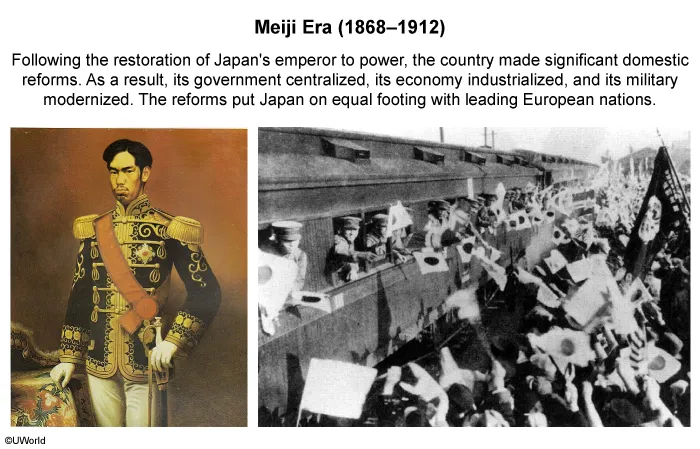
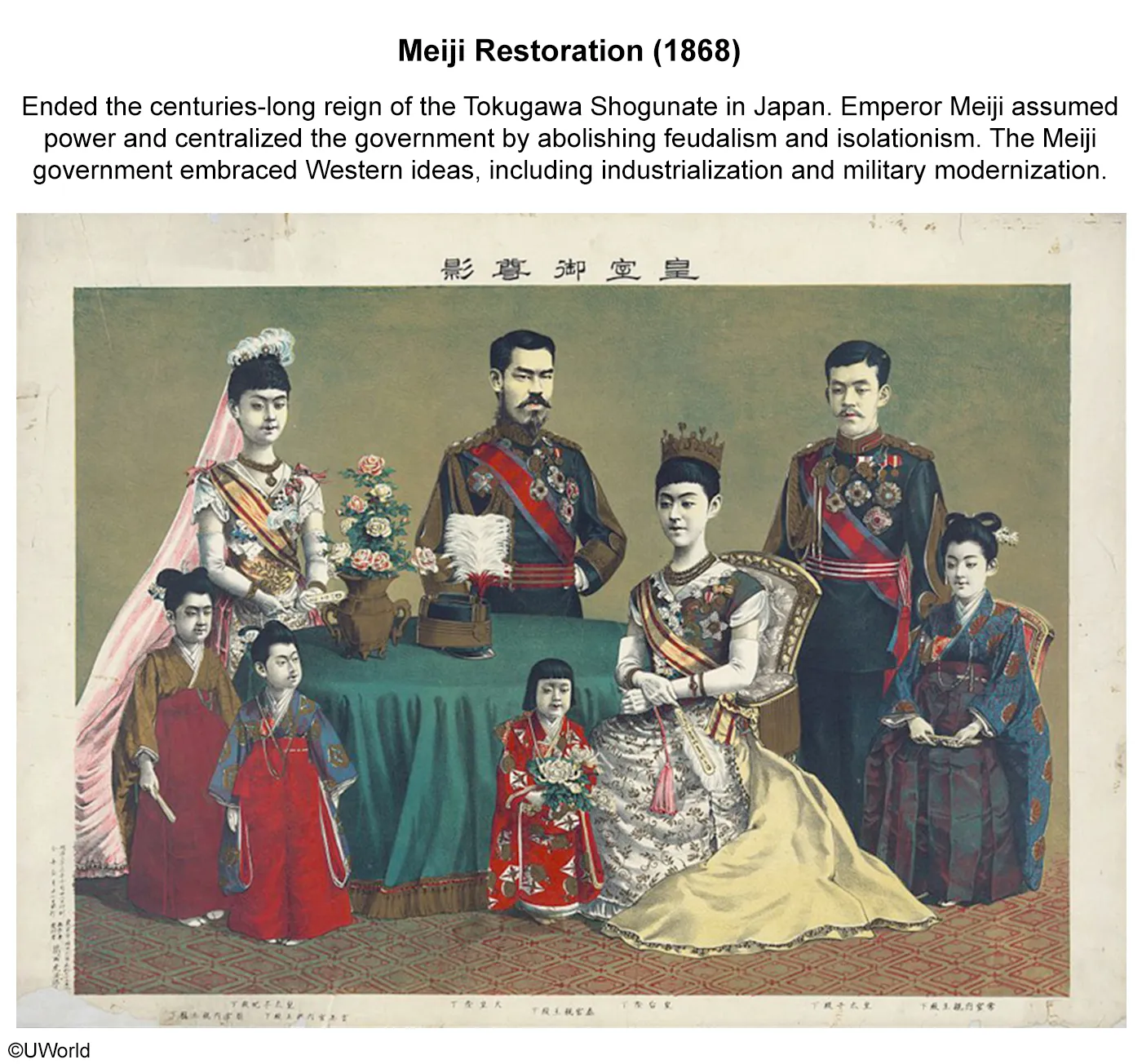
This development facilitated the fall of the Tokugawa Shogunate and the founding of the Meiji government, which consolidated political power under imperial rule and strengthened Japan's national identity. During the Meiji Restoration, the new Meiji leadership recognized the country's need to modernize in order to compete internationally and looked to the West for guidance.
Meiji leaders understood the importance of forging ties with the US, a major economic and political power, and adopted American technological and industrial advancements. Therefore, the Meiji oligarchy's rise as "the new ruling class" is a consequence of the US' increased influence in East Asia.
(Choices A and D) Increased Russo-Japanese hostilities over Manchuria and the abolition of Japan's samurai class occurred after, not before, the Meiji government took power.
(Choice B) Japanese lords supported the Tokugawa government, so the Shogunate's wealth was not transferred to Japan's peasant class.
Things to remember:
The Meiji oligarchy became Japan's new ruling class as a result of the US' increased influence in East Asia.
Passage
"But after the fall of the Tokugawa Government, the Korean Court…declared its determination to have no further relations with a country embracing Western civilization, and refused even to receive a Japanese embassy…. A year after the return of the Formosa expedition, that is to say, at the close of 1875, the Koreans completed their rupture with Japan by firing on the boats of a Japanese war-vessel engaged in the peaceful operation of coast-surveying.
No choice now remained except to dispatch an armed expedition against the [Korean] kingdom. In this matter Japan showed herself an apt pupil of occidental* methods, such as had been practiced against herself in former years…. They were well equipped with rifles and cannon; they numbered some thirty thousand, being thus nearly as numerous as the Government's standing army; they were all of the military class, and in addition to high training in Western tactics and in the use of modern arms of precision, they knew how to wield that formidable weapon, the Japanese sword, of which their opponents were for the most part ignorant.
Ostensibly their object was to restore the samurai to their old supremacy, and to secure for them all the posts in the army, the navy, and the administration…. Under any circumstances it would have been natural that the master-minds of the era, the men who had planned and carried out the great work of the Restoration, should lead the nation along all paths of progress."
Francis Brinkley, English newspaper owner living in Japan during the Meiji Restoration, 1901
Question
Western influence such as the one described in the passage most directly contributed to which of the following in Japan in the late nineteenth century?
| A. Creation of domestic reforms | |
| B. Peasant revolts against British colonization | |
| C. The adoption of Christianity by the state | |
| D. An expansion of samurais' political power |
Explanation
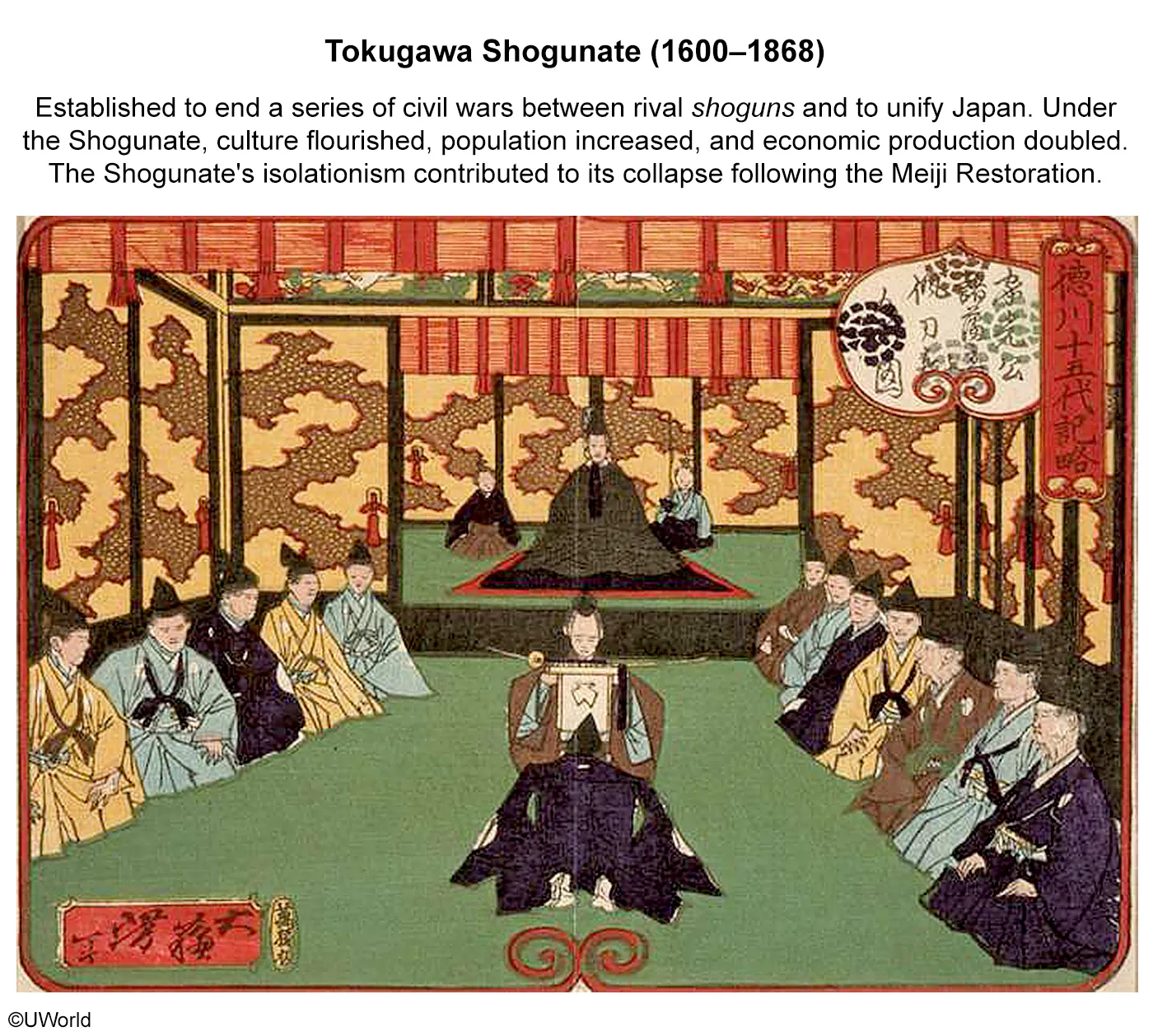
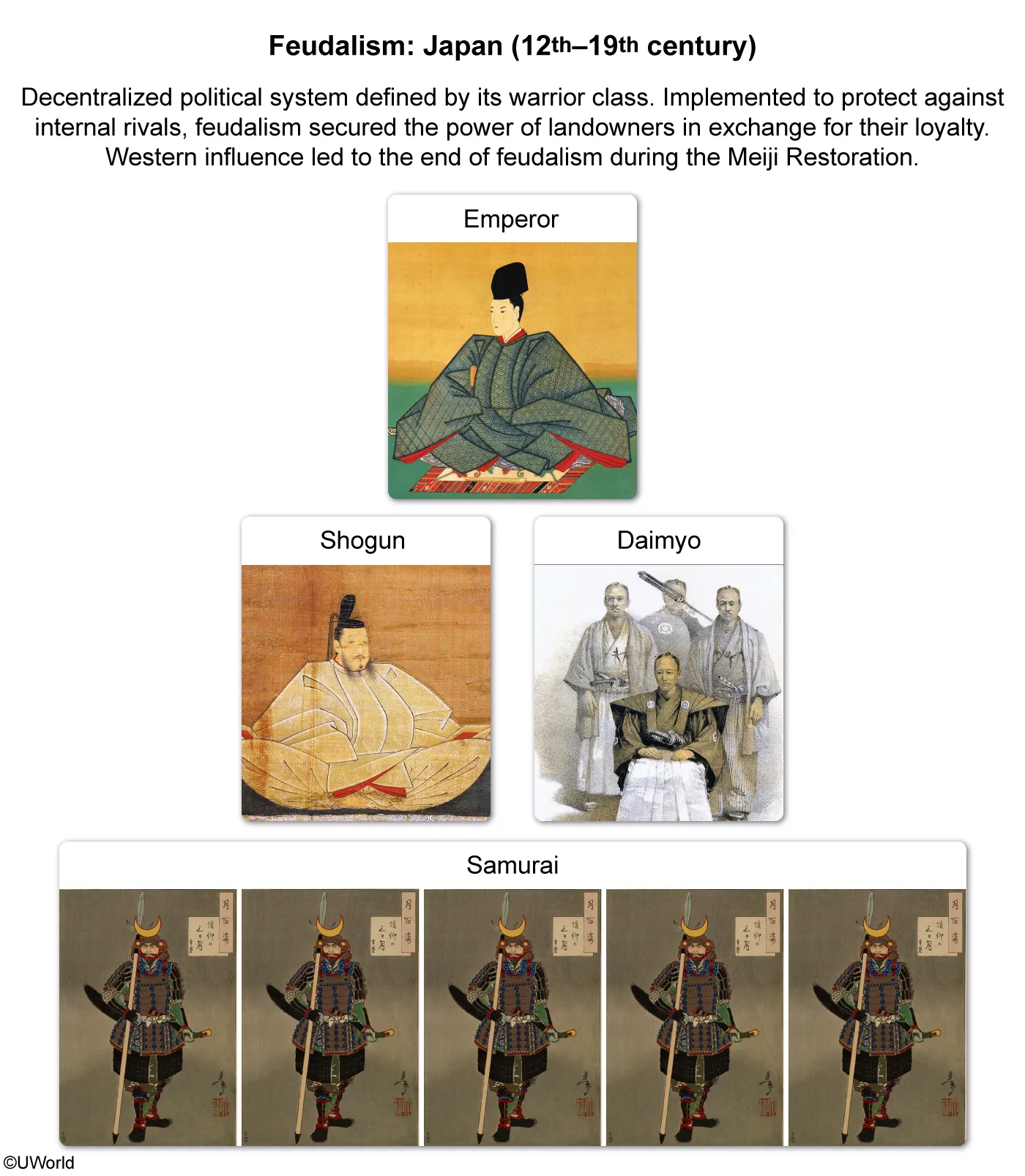
Beginning in the 12th century, Japan's feudal government was ruled by military dictators called shoguns. Despite having an emperor, it was the shoguns who governed Japan and lead domestic and foreign policy for roughly 700 years.
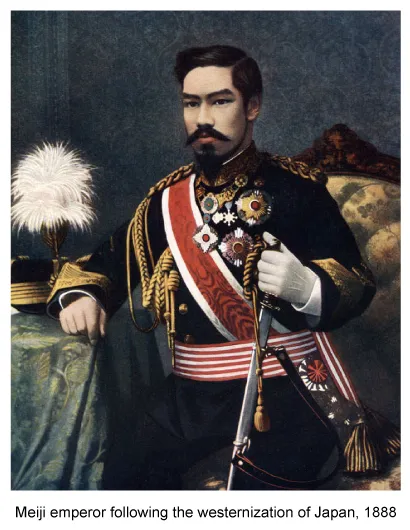
In the early 1800s, industrialized Western nations such as France, Britain, and the US made attempts to access Japanese markets. Although the Tokugawa Shogunate initially resisted, a show of force by the US Navy in 1853 resulted in the opening of Japan to significant Western influence. In addition to severe economic and agricultural crises plaguing the Tokugawa government, Western intrusion caused a domestic crisis in 1868, resulting in the Meiji Restoration of imperial power.
Following the Restoration, Japan began a series of domestic reforms, which resulted in the following:
- Implementation of constitutional government and centralization of political power.
- Tax reforms, including the abolishment of taxes payed in grain.
- Elimination of feudal social classes and infusion of Western culture.
- Modernization of the military and creation of a national army.
- Construction of modern transportation, communication, and educational infrastructure.
Although these domestic reforms caused rebellions and significant hardships, especially for peasants, they enabled Japan to become a powerful industrial society by the late 19th century.
(Choice B) Japan was never colonized by the British Empire.
(Choice C) Although the Japanese government adopted many reforms based on Western influence, Christianity was not one of them.
(Choice D) The emperor's attempt to Westernize and consolidate power reduced, not expanded, samurais' political power.
Things to remember:
In the mid- to late-19th century, Western influences contributed to an era of reforms across Japan. These domestic reforms supported industrialization and modernization and led to Japan becoming a regional and world power.

Stand Out
with a Top Score in AP World History: Modern
Finish your AP World History Unit 5 review and continue mastering all units with UWorld. Our AP World History course is designed to boost your performance and help you impress admissions.
Get our all-in-one course today!
- Focused APWHM Videos
- Print & Digital Study Guide
- 500+ Exam-style Practice Questions
- Customizable Quiz Generator
- Adjustable Study Planner
- Realistic Timed Test Simulation
- Colorful Visual Explanations
- Progress Dashboard
- Smart Flashcards & Digital Notebook
Hear From Our AP Students
UWorld’s service is pretty good and helps provide a lot of explanations on subjects I haven’t been confident on before.
The questions here are the most realistic to the AP tests I've seen so far! I appreciate the ability to customize tests as well.
The best part is that all options are well-explained, telling clearly why they are not the right option.
Frequently Asked Questions (FAQs)
What are the main topics covered in AP World History Unit 5: Revolutions?
AP World History Unit 5 examines the major intellectual, political, and economic transformations that reshaped societies between the 18th and 19th centuries. These themes appear frequently in AP World History Unit 5 practice test questions and form the foundation of this entire unit. Understanding these topics helps you analyze how ideas spread, how political systems changed, and how industrial growth altered global structures.
Key topics explored in Unit 5 include:
- The Enlightenment: New ideas about reason, natural rights, and government that challenged traditional authority.
- Revolutions against existing governments and the birth of new nation-states: Movements such as the American, French, Haitian, and Latin American Revolutions that reshaped political power.
- The Industrial Revolution: Technological innovations that transformed production, labor, and economic systems.
- Trade policies: Shifts in mercantilism, free trade, and global commerce during industrial expansion.
- The development of industrial economies: The rise of factory systems, urbanization, and new social classes resulting from industrial growth.
How should I prepare for an AP World History Unit 5 exam?
Preparation for Unit 5 involves studying revolutions across regions, comparing their causes, and connecting them to global patterns. Start by reviewing major events like the American, French, Haitian, and Latin American Revolutions, along with the global rise of industrialization.
Break topics into manageable themes: political reforms, economic shifts, and social change. Use visual timelines and comparison charts to track developments across regions.
UWorld’s AP World History Unit 5 practice questions, study guides, and explanations help you apply this knowledge to exam-style stimuli, making your preparation more effective.
Are any free resources available for AP World History Unit 5?
Yes. You can begin your Unit 5 AP World History review with reliable free resources that introduce the essential themes and concepts.
UWorld’s 7-Day Free Trial gives you access to Unit 5 practice questions, video lessons, and study guide samples designed for AP curriculum alignment. College Board’s AP Classroom offers AP Daily videos and Unit 5 progress checks for early practice. Khan Academy also provides quick topic overviews for revolutions and industrialization.
These resources help you build a strong foundation before diving into a deeper review.
What types of questions are on the AP World History Unit 5 test?
The AP World History Unit 5 test includes MCQs and writing tasks that assess your understanding of revolutions, industrialization, and global change. You’ll work with sources like political documents, images, maps, and charts.
SAQs may ask you to identify causes of revolutions, analyze industrial growth, or compare movements across regions. DBQs require analysis of documents related to political reform or economic restructuring. LEQs invite longer arguments on continuity and change in political or economic systems.
AP World History Unit 5 practice test questions help you become confident with each exam format.
How can I improve my score on the Free-Response Questions (FRQs) for Unit 5?
Improving FRQ performance starts with clear organization and accurate evidence. Focus on developing argument structures for revolutions, industrialization, and political change. Use specific examples from major movements to back up your claims.
Reviewing connections across regions can help you better explain larger historical patterns, which is essential for both DBQs and LEQs. Practice interpreting documents, recognizing perspective, and writing concise claims.
UWorld’s detailed AP World History Unit 5 explanations show you how strong historical reasoning is structured.
What is the "Revolutions" unit's weight on the AP World History exam?
AP World History Unit 5 contributes 12–15% of the total exam score, making it a major section to master. Content from this unit appears in MCQs and frequently informs SAQs, DBQs, and LEQs.
Revolutions and industrialization set the stage for many later global developments, so understanding them strengthens your ability to answer long-term continuity and change questions. Reviewing Unit 5 also supports a deeper understanding of Units 6, 7, and 8.
A thorough AP World History Unit 5 review can boost both content knowledge and historical reasoning.
Where can I find a good study guide for AP World History Unit 5?
UWorld offers a detailed AP World History Unit 5 study guide that clearly explains revolutions, industrialization, and global transformations. The guide includes summaries, diagrams, timelines, and AP World History Unit 5 vocab to make review simple and effective.
Explanations connect major developments across regions, helping you see how political, economic, and social shifts interacted. UWorld also integrates topic-based practice questions to reinforce key patterns.
This combination of structured explanations and immediate practice makes UWorld one of the strongest Unit 5 review tools available.
Can I find practice tests specifically for APWH Unit 5?
Yes. UWorld provides AP World History Unit 5 practice test questions that closely match AP exam difficulty and structure. These include stimulus-based MCQs, SAQs, and extended writing tasks that reflect real exam expectations.
College Board AP Classroom also offers Unit 5 progress checks, and Khan Academy provides general topic review. However, UWorld’s detailed answer explanations make it easier to understand both correct and incorrect choices, improving your long-term readiness.
How can I compare different revolutions effectively for AP World History Unit 5?
Comparing revolutions is one of the most important skills in AP World History Unit 5, since many exam questions ask you to analyze similarities and differences across regions. Start by identifying shared themes, such as Enlightenment influence, economic inequality, or demands for political reform and then note how each revolution expressed those ideas differently.
Creating comparison charts for the American, French, Haitian, and Latin American Revolutions can help you organize causes, key figures, outcomes, and long-term impacts. This method makes it easier to recognize patterns on MCQs and develop clear arguments for LEQs.
UWorld’s AP World History Unit 5 practice test questions often frame revolutions side-by-side, helping you get comfortable identifying meaningful connections and contrasts on the exam.
Why is industrialization an important theme in AP World History Unit 5?
Industrialization is central to AP World History Unit 5 because it reshaped global power, social structures, and economic systems. Understanding how factories, new technologies, and mechanized production emerged helps explain why certain nations gained influence while others lagged behind during the 18th and 19th centuries.
The Industrial Revolution also influenced political ideologies, labor movements, and patterns of migration, all of which appear frequently in Unit 5 AP World History practice tests. Recognizing these developments prepares you to analyze continuity and change across periods.
UWorld’s clear explanations and Unit 5 review materials help you connect industrial growth to broader historical trends, giving you the context needed for stronger DBQs, SAQs, and LEQs.