AP® World History: Modern Unit 2 Review and Practice Test
AP® World History Unit 2 explores the Silk Roads, Indian Ocean trade, Trans-Saharan routes, the rise of the Mongol Empire, and the growing interconnection of Afro-Eurasia. These networks shaped economies, cultures, and political structures, and understanding how they worked is essential for performing well on the exam. UWorld helps you break down these complex interactions so your AP World History Unit 2 review becomes clear, manageable, and exam-ready.
Break Through AP World History Unit 2 Using Review Tools That Bring the Silk Roads to Life
Trade routes can feel overwhelming when you try to memorize every detail. With UWorld, you learn how goods, people, and ideas moved across regions in ways that actually make sense. Each tool helps you understand how networks shaped world history and prepares you for AP World History Unit 2 MCQ, SAQ, and FRQ tasks.
Engaging Video Lessons That Connect Stories
These videos help you grasp Unit 2 by turning trade patterns into clear, narrative-driven explanations. You see how merchants connected distant cultures, how technology reshaped travel, and how empires supported movement across Afro-Eurasia. Each video keeps concepts simple and helps you understand what the exam wants when you encounter AP World History Unit 2 review questions.
Interactive Study Guides That Break Down Empires
These guides help you understand the states, merchants, and cultural exchanges that sustained trade networks. You see how empires supported commerce, protected routes, and encouraged innovation. Each section uses structured visuals to help you connect themes across Unit 2 and prepare confidently for AP World History Unit 2 study guide questions.
Boost Accuracy on the AP World History Unit 2 with Targeted Practice Questions
Passage
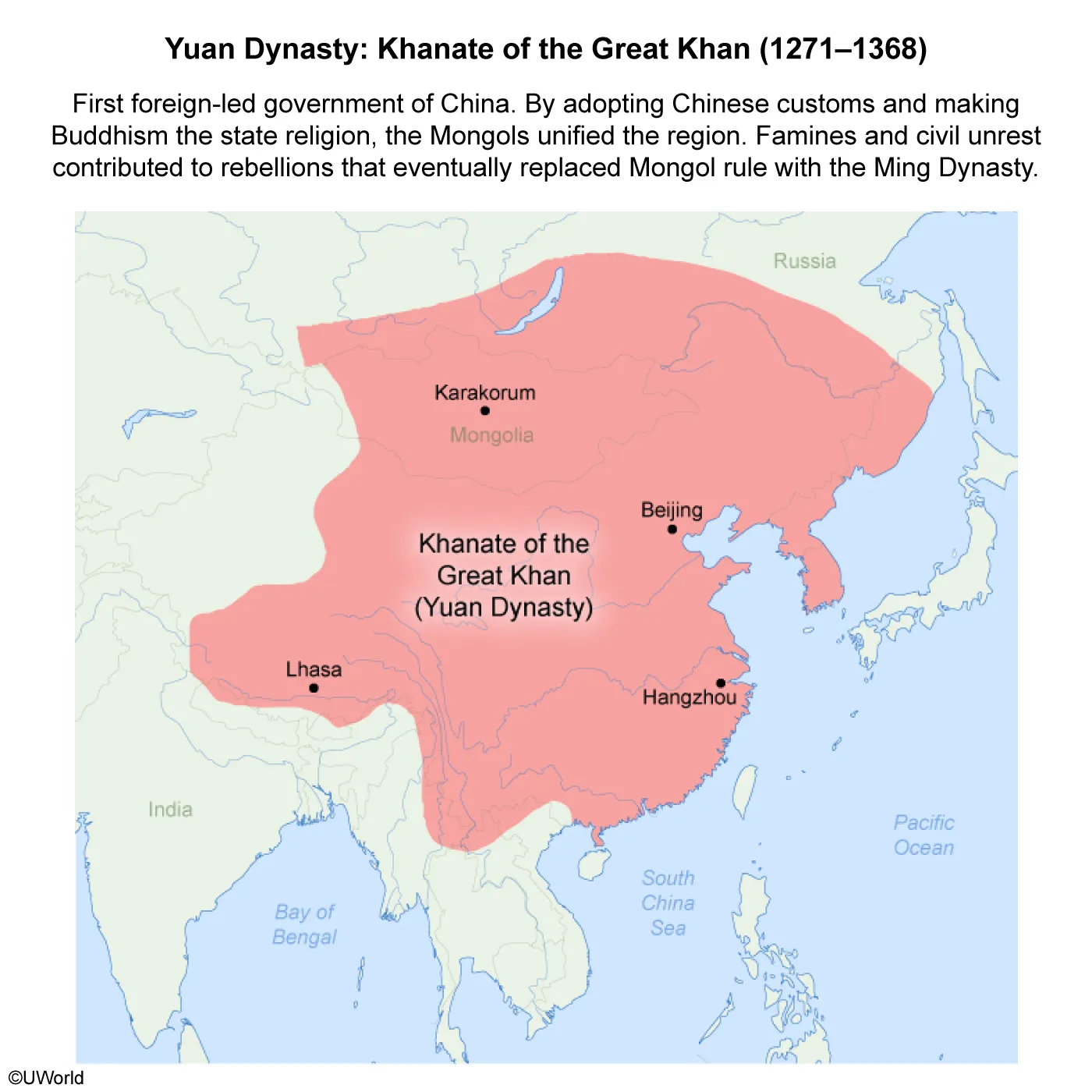
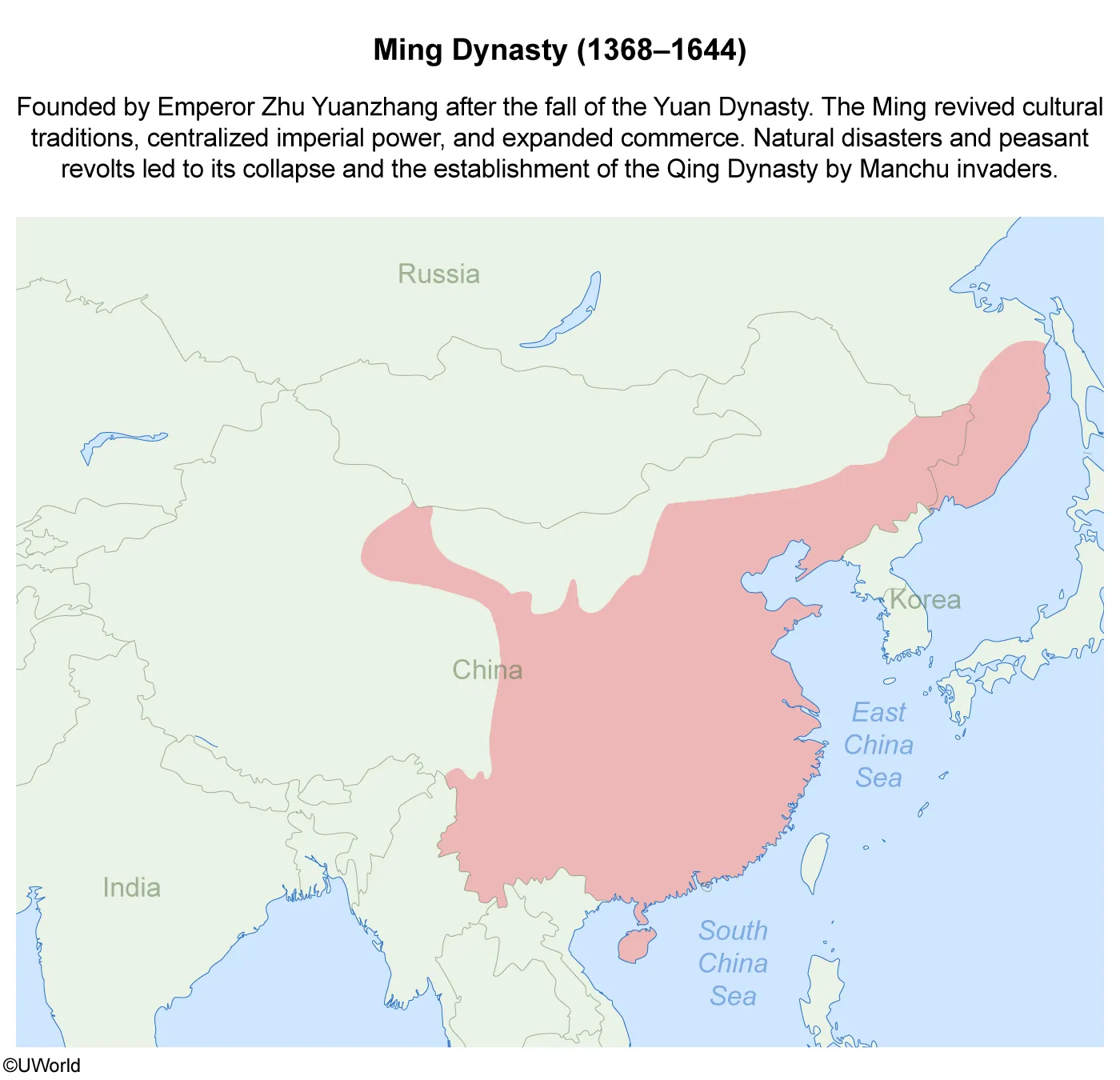
"The Great [Khan] of Cathay* is one of the most [powerful] of all the kings in the world, and all the great lords of that country be his lieges and do him homage; and in chief three great emperors; to wit, the Emperor of [the Chaghadai Khanate**], the [Il-Khan of Persia] and the [Khan of Kipchak]. These three emperors send year by year live [leopards], camels, and gerfalcons, and great store of precious jewels besides, to the said [Khan] their lord. For they acknowledge him to be their lord and suzerain***….
[I]n all his realm from city to city...dwell couriers who are sped both on foot and on horseback…. And thus the Emperor shall have in [15] days news of a country that shall be as far off as three months' journey. He receiveth also right courteously envoys and ambassadors from any foreign country or lordship….
There groweth not any oil olive in that country, nor wine of the vine, and they have none except what is brought from abroad, and for that reason the price thereof is high. But they make oil and wine from rice; and all fruits grow there in very great abundance, excepting [hazelnuts] which they have not. Sugar, however, they have in very great quantities, and therefore it is very cheap there."
Father John de Cora, Archbishop of Soltaniah in Persia,
account of China, circa 1330
Question
The territories under the Great Khan as alluded to in the first paragraph best demonstrates which of the following processes of the period 1200–1450?
| A. The political tensions between Asian lords and their vassals | |
| B. The forced conversion to Mongol religious traditions and practices | |
| C. The collapse of the indigenous Turkic empires as a result of Mongol expansion | |
| D. The initial creation of political hierarchies in China as result of political favoritism |
Explanation
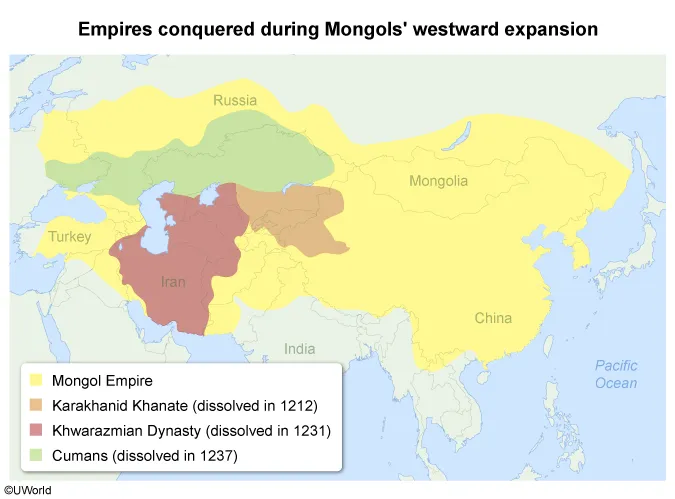
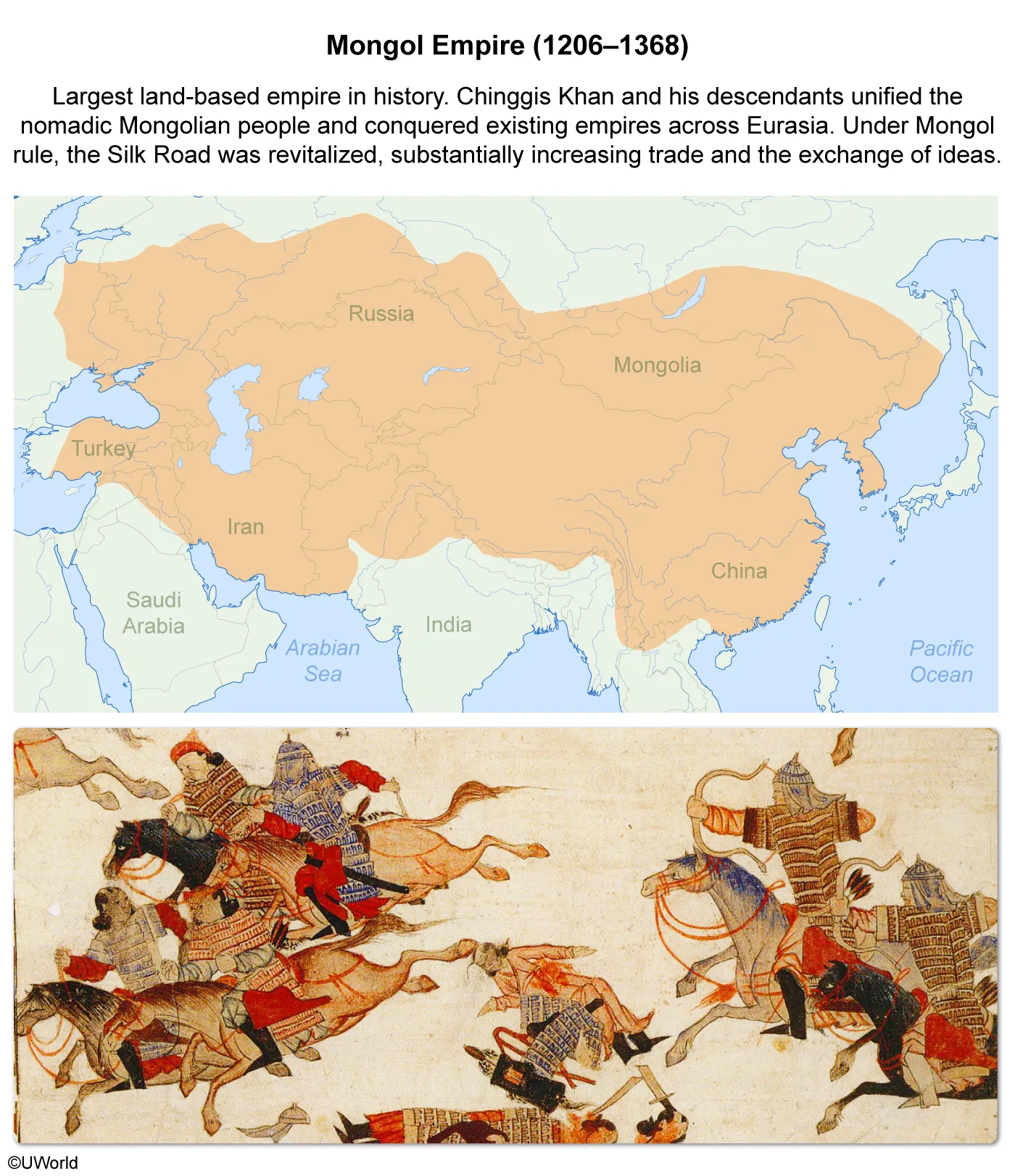
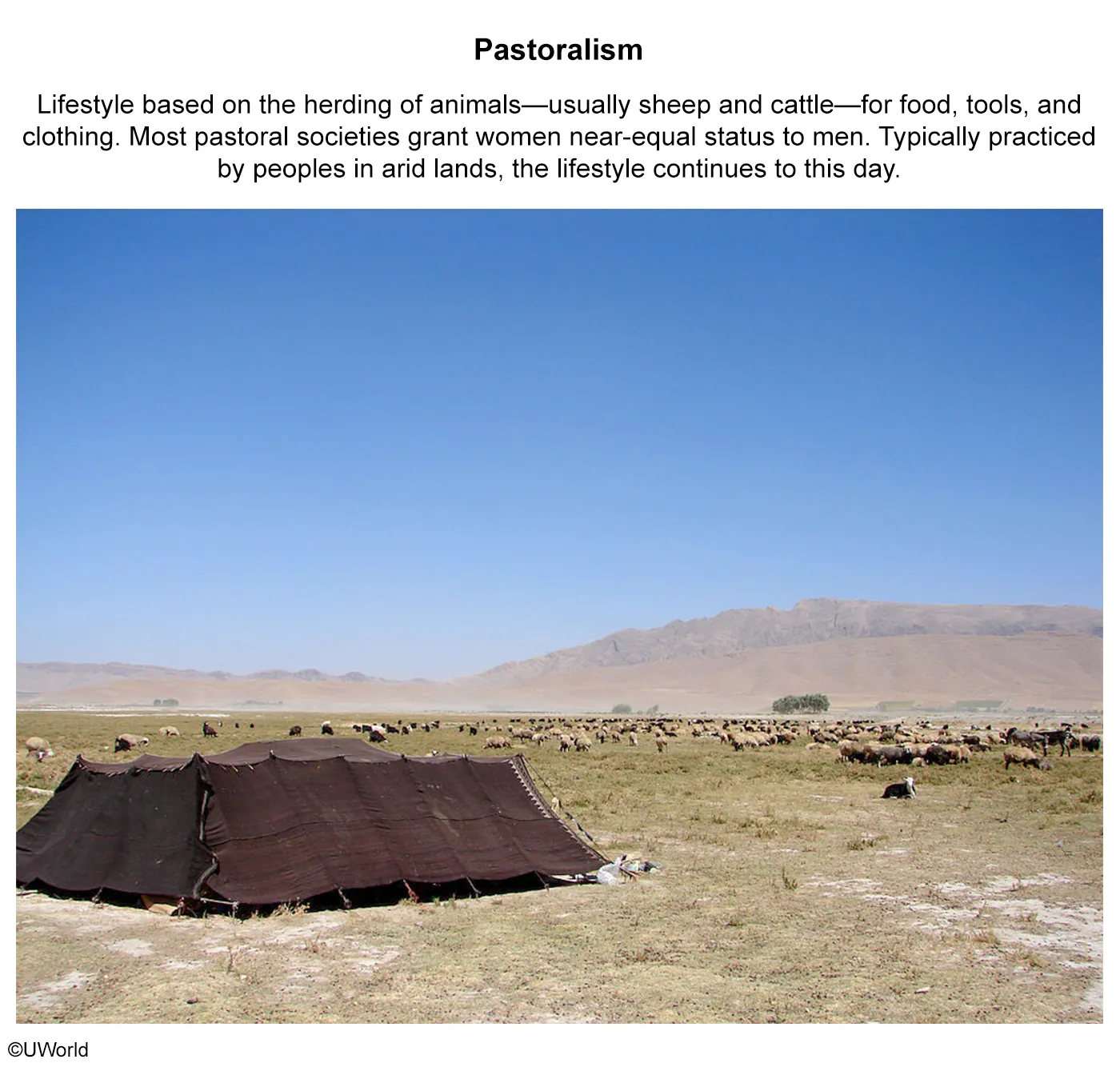
After 1200, the Mongols quickly rose to dominate most of Asia. After their long history of pastoralism north of present-day China, the Mongols engaged in a period of rapid westward expansion. Their innovative tactics in warfare and shrewd politics brought established empires to their knees. Most notable were Turkic empires that collapsed due to Mongol expansion. Fallen Turkic empires included the Cumans of the Russian steppes, the Karakhanid Khaganate of Central Asia, and the Khwarazmian Dynasty in Persia.
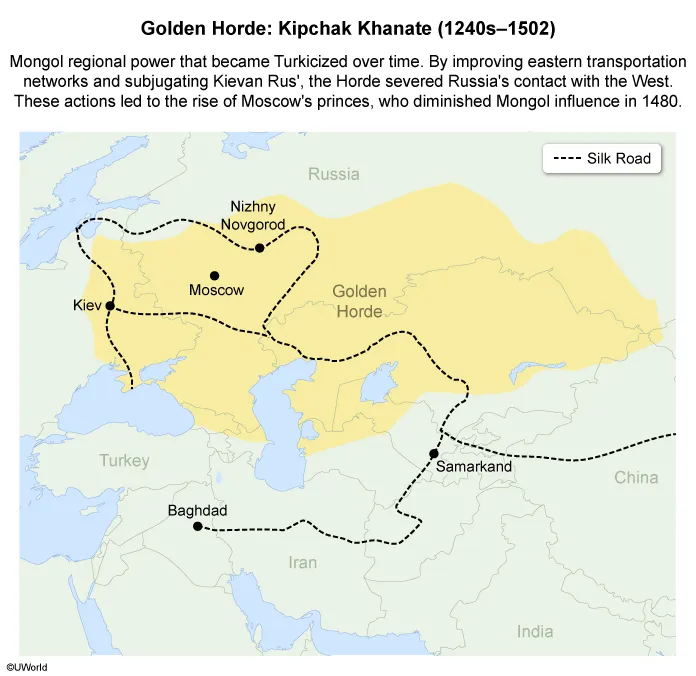
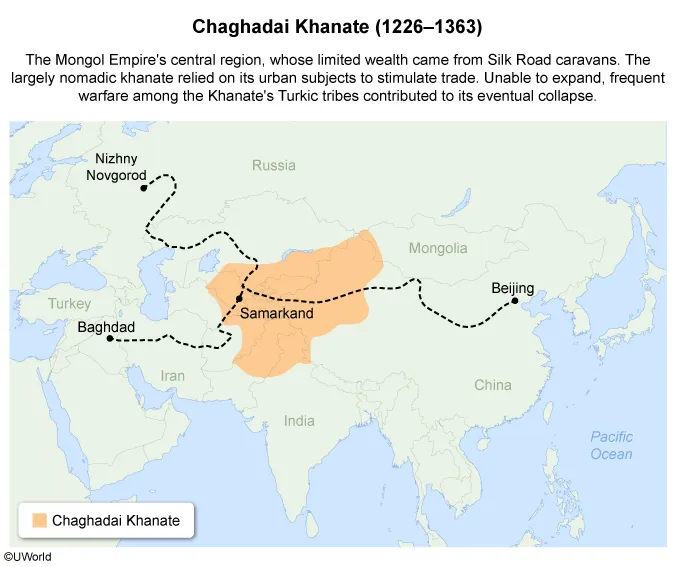
From the rubble of those empires, three Mongol khanates emerged:
- The Kipchak Khanate of the Russian steppes.
- The Chaghadai Khanate of Central Asia.
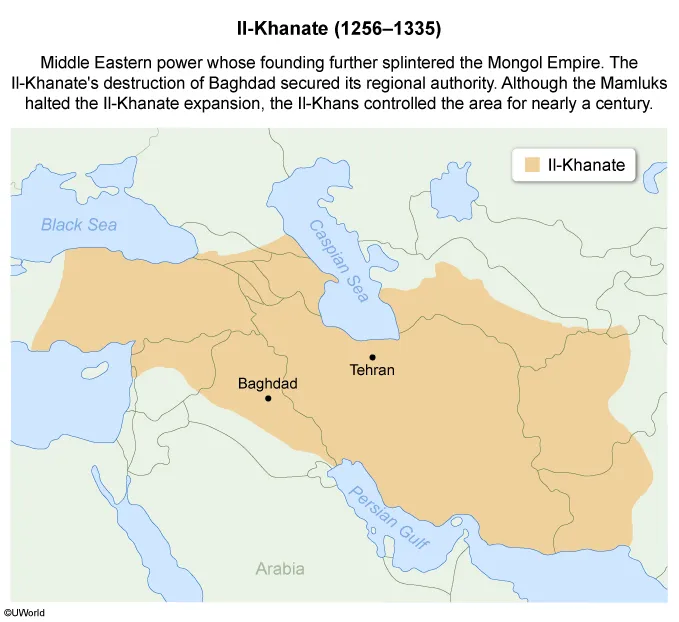
- The Il-Khanate of the Middle East.
Consequently, the lesser khans who ruled the defeated indigenous Turkic peoples owed allegiance to the Great Khan of the Yuan Dynasty.
(Choice A) Political tensions between lords and their vassals occurred in Asia. However, this passage demonstrates their submission to the Great Khan through the presentation of exotic gifts as tribute.
(Choice B) Instead of forcing others to convert to their religion, the Mongols of the Yuan Dynasty tolerated other faiths, such as Islam.
(Choice D) Although homage paid to the Great Khan demonstrates a political hierarchy, such hierarchies existed in East Asia centuries before the rise of the Mongols.
Things to remember:
After 1200, the Mongols engaged in rapid expansion. Notable conquests of the Mongol expansion were Turkic empires whose indigenous peoples came to be ruled by the Mongol khanates.
Passage
"The original home of the [Malay] people lay on Sumatra in the district of Minangkabau.* The name 'Malayu' is applied to the island of Sumatra…which carried on a brisk trade in spices. Indian civilization, it would seem, had considerable influence on Minangkabau, for according to the native traditions of the Malays it was Sri Turi Bumana,** a prince of Indian or Javanese descent…who led a part of the people over the sea to the peninsula of Malacca and in [1299] founded the centre of his power in Singapore.*** The new State is said to have aroused the jealousy of a powerful Javanese realm, presumably [Majapahit], and Singapore was ultimately conquered in the year [1398] by the Javanese.
A new Malay capital, Malacca, was subsequently founded on the mainland. In the [early 1400s] the reigning chief together with his people were converted to Islam. The Malays…multiplied in course of time so enormously that it became necessary to send out new colonies, and Malay traders and settlers appeared on all the coast districts of West Indonesia…. [T]he State of Malacca was far more powerful than the old Minangkabau, and became the political and ethnical centre of Malay life. The result was that the true insular Malays apparently spread from the mainland over the island world of the East Indies…. The Malays mixed everywhere with the aborigines, and made their language the common dialect of intercourse for the Sunda Islands."
Hans F. Helmolt, German historian, The History of the World, 1904
Question
In the 1400s, economic activities such as the one alluded to in the first paragraph had contributed most directly to which of the following?
| A. Southeast Asian states' competition over the Yuan Dynasty's luxury goods | |
| B. The Majapahit Empire's shift to paper currency | |
| C. The growth of states in Southeast Asia | |
| D. Efforts by the Ottoman Empire to capture Sumatra for its spices |
Explanation
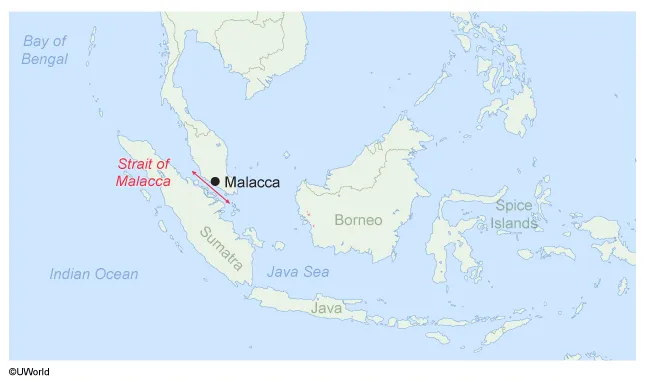
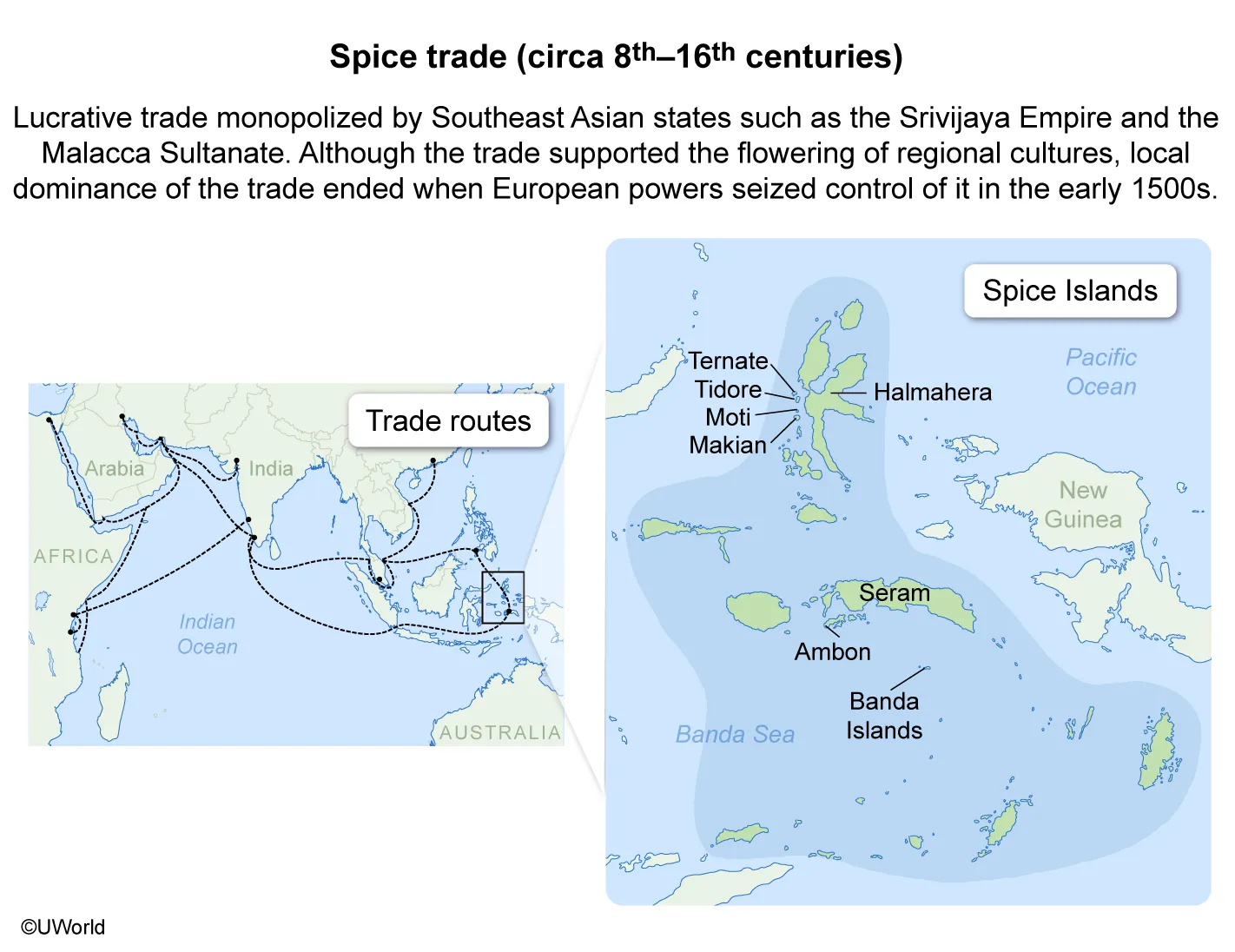
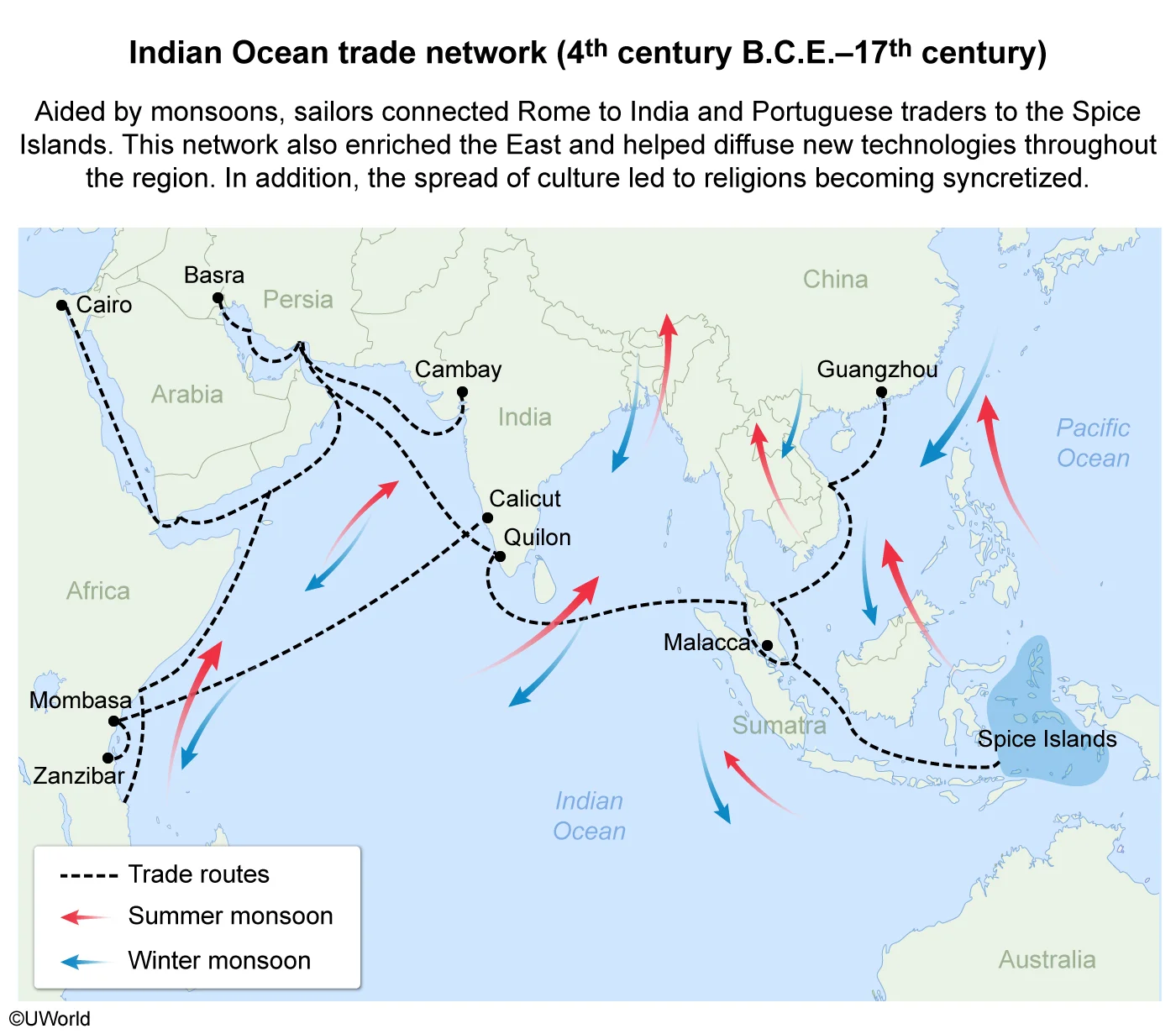
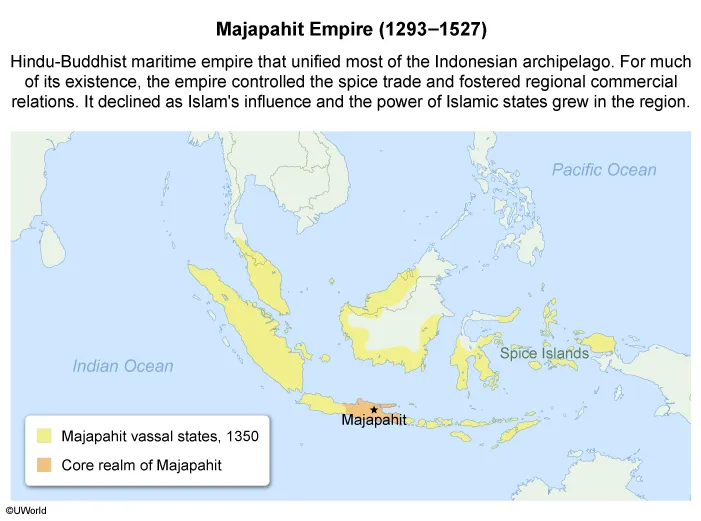
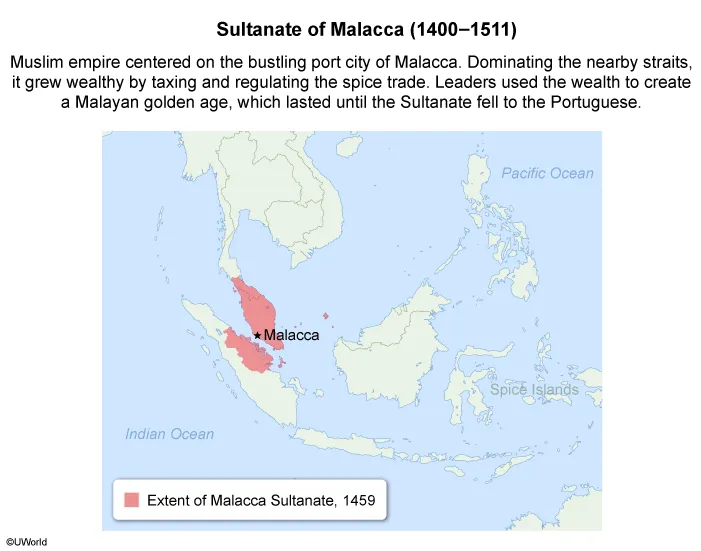
In the 1400s, the island of Sumatra was not unique in its "brisk trade in spices." In fact, Java, the Maluku Islands (also known as the Spice Islands), and Borneo all participated in the regional spice trade—an extension of the Indian Ocean network. The spice trade also contributed to the growth of states: namely, the Majapahit Empire (1293–1527) and the Sultanate of Malacca (1400–1511).
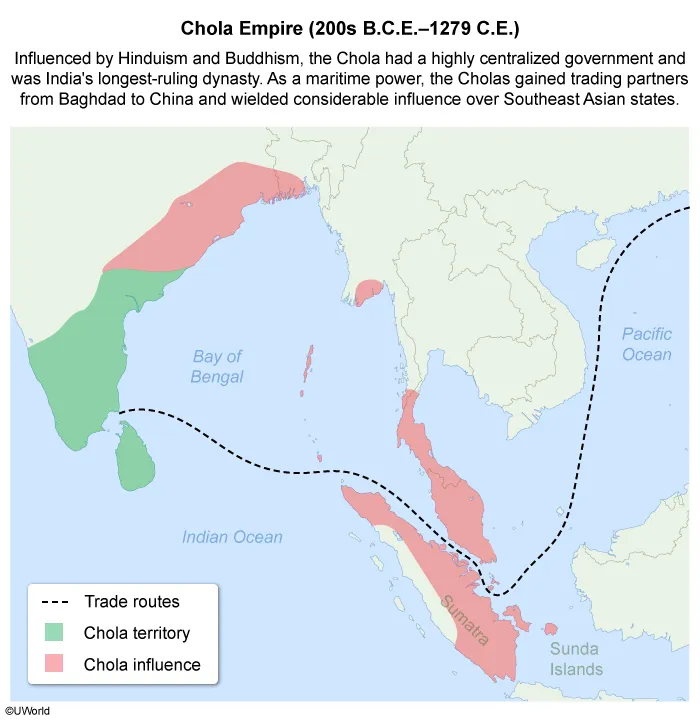
The wealth of Malacca and its sultans, grew by fostering trade relations with China's Ming Dynasty, India's Chola Empire, and Muslim merchants from Arabia. In addition, the Sultanate taxed merchants passing through the Malacca Straits, which it controlled. This further increased the Sultanate's revenues and contributed to its growth as a regional economic and military power.
(Choice A) The Yuan Dynasty collapsed in 1368; therefore, no competition over its luxury goods could have occurred in the 1400s.
(Choice B) Although the Majapahit Empire had used coins to facilitate trade since the 1300s, little evidence exists that they shifted to paper currency.
(Choice D) Although the Ottoman navy would become a formidable presence in the Indian Ocean, it did not send any expeditions to the Indonesian islands until 1565.
Things to remember:
In the 1400s, the Sultanate of Malacca became a regional economic and military power due to its participation in the Indian Ocean trade network.
Passage
Source 1
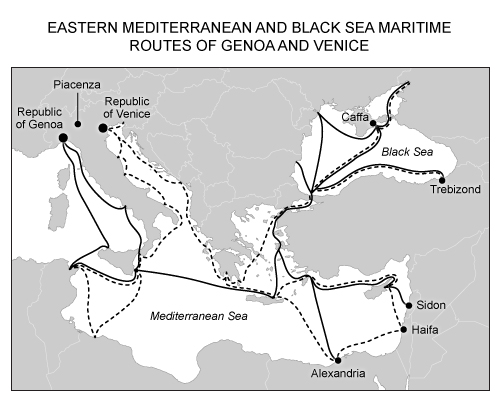
"Confess, O Genoa, what thou hast done, since we of Genoa and Venice are compelled to make God's [punishment] manifest. Alas! our ships enter the port, but of a thousand sailors hardly ten are spared. We reach our homes; our kindred and our neighbours come from all parts to visit us. Woe to us, for we cast at them the darts of death! Whilst we spoke to them, whilst they embraced us and kissed us, we scattered the poison from our lips. Going back to their homes, they in turn soon infected their whole families, who in three days succumbed, and were buried in one common grave. Priests and doctors visiting the sick returned from their duties ill, and soon were numbered with the dead. O, death! cruel, bitter, impious death! which thus breaks the bonds of affection and divides father and mother, brother and sister, son and wife. Lamenting our misery, we feared to fly, yet we dared not remain."
Source 2
Gabriele de' Mussi, a notary from Piacenza, Italy, providing his account of the Black Death, 1347
Question
Effects of the Black Death like the ones described in the passage would eventually contribute most to which of the following developments in European societies in the period 1200–1450?
| A. Reduction of land available per person | |
| B. Increasing urbanization in Europe | |
| C. Decreasing freedoms for laborers | |
| D. Emergence of the manorial system |
Explanation
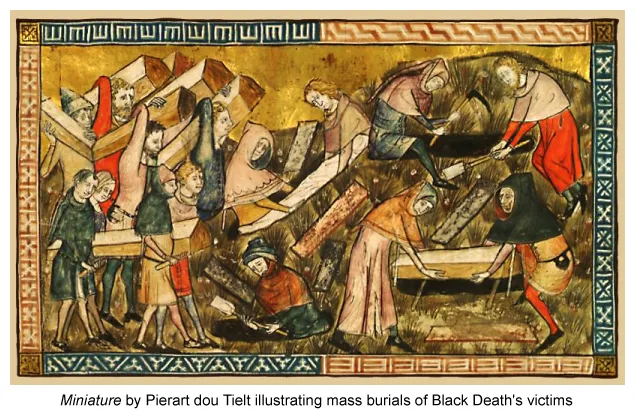
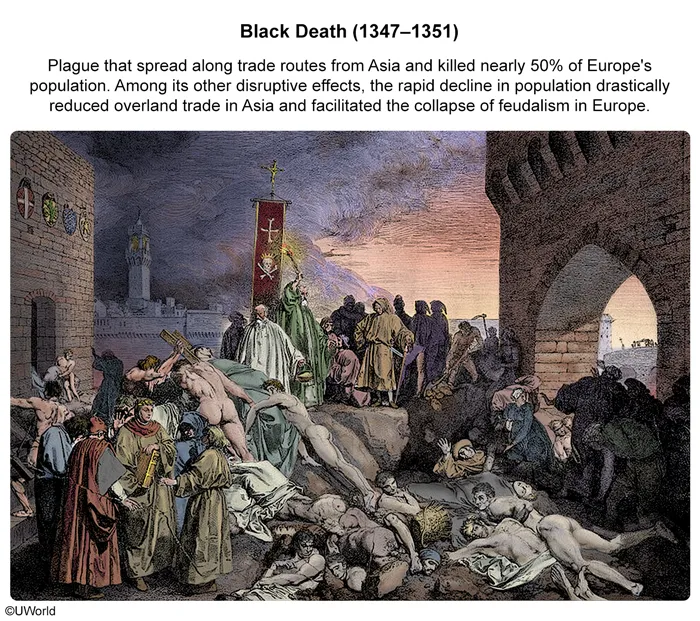
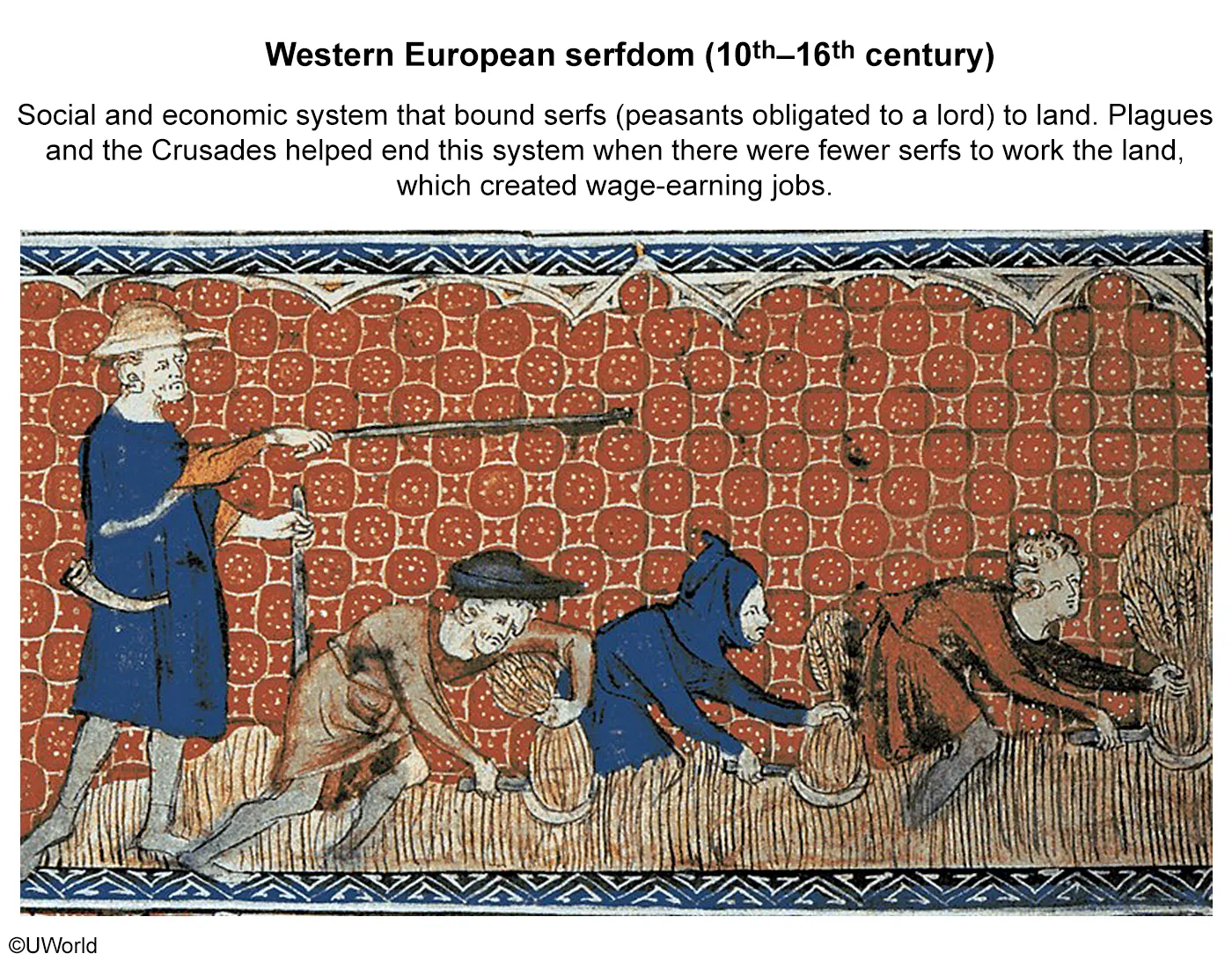
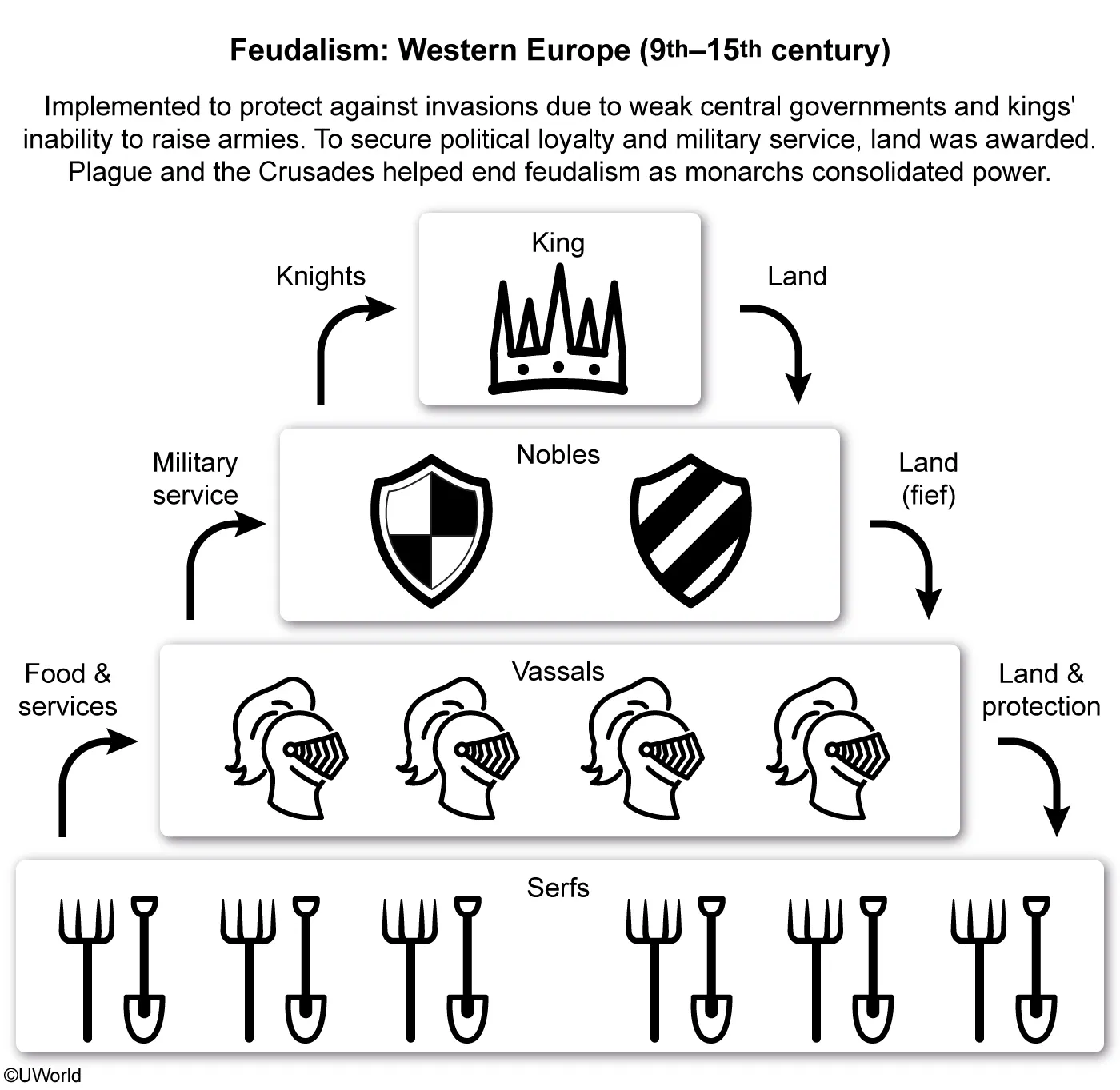
Gabriele de' Mussi recounted how the Black Death killed a high percentage of people in the port cities of Venice and Genoa. The high death rate resulted in a labor shortage and shifting medieval power dynamics, such as serfs demanding greater freedoms. Worker scarcity also allowed survivors to command higher wages, undermining the feudal system and strengthening the economic power of independent laborers.
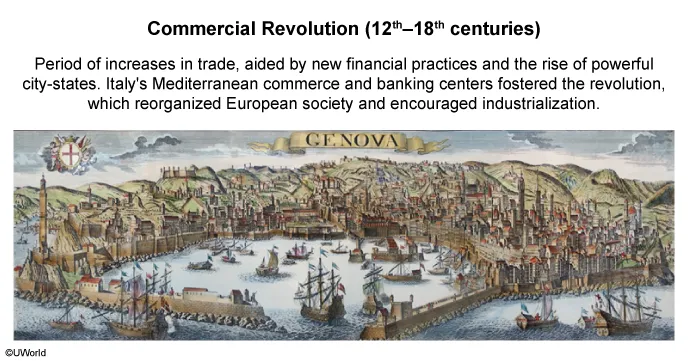
In addition, economic and social upheavals caused by the plague facilitated changes in the urban landscape and provided a boost to the Commercial Revolution. Many smaller towns and villages were abandoned or merged with larger urban centers, which attracted most villagers. This urban growth fueled opportunities for trade and commerce, including the need for specialized professions such as bankers, merchants, and craftspeople.
Over time, these developments encouraged increasing numbers of rural workers to seek better jobs in the growing cities. Therefore, although the process was gradual, the Black Death contributed to increasing urbanization in Europe due to the significant demographic and economic changes it produced.
(Choice A) The Black Death caused a significant population decline, which increased the land available per person rather than reducing it.
(Choice C) Worker scarcity caused by the Black Death resulted in many nobles granting increased, not decreased, freedoms to surviving workers.
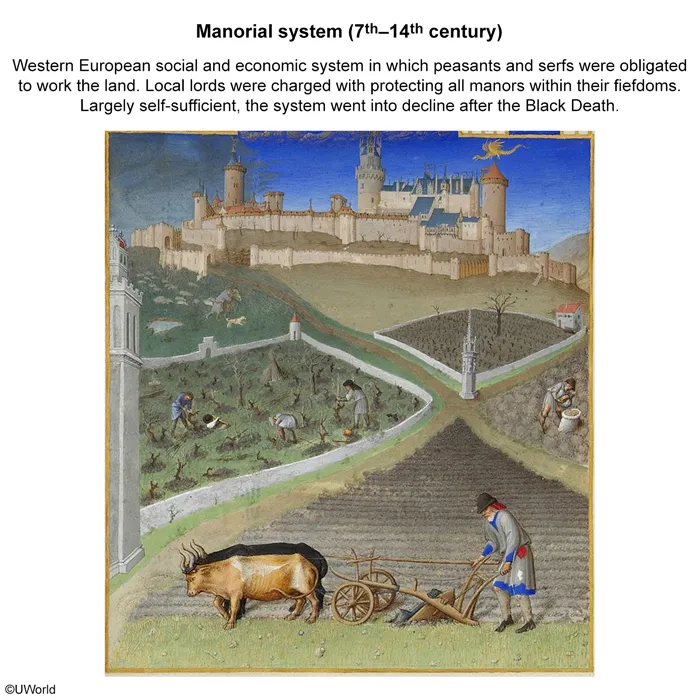
(Choice D) The manorial system emerged centuries before the Black Death struck Europe in the 1340s.
Things to remember:
Although the process was gradual, the Black Death contributed to increased urbanization in Europe because of the demographic and economic changes it produced.

Carry Your Unit 2 Practice Anywhere, Anytime
Turn short moments into real study time. Review trade networks on the bus, practice AP World History Unit 2 MCQ items at lunch, or revisit explanations between classes. The UWorld app helps you reinforce what you learn and stay ready for the AP World History exam.
Stand Out
with a Top Score in AP World History: Modern
Finish your AP World History Unit 2 review and continue mastering all units with UWorld. Our AP World History course is designed to boost your performance and help you impress admissions.
Get our all-in-one course today!
- Focused APWHM Videos
- Print & Digital Study Guide
- 500+ Exam-style Practice Questions
- Customizable Quiz Generator
- Adjustable Study Planner
- Realistic Timed Test Simulation
- Colorful Visual Explanations
- Progress Dashboard
- Smart Flashcards & Digital Notebook
Hear From Our AP Students
UWorld’s service is pretty good and helps provide a lot of explanations on subjects I haven’t been confident on before.
The questions here are the most realistic to the AP tests I've seen so far! I appreciate the ability to customize tests as well.
The best part is that all options are well-explained, telling clearly why they are not the right option.
Frequently Asked Questions (FAQs)
What are the main topics covered in AP World History Unit 2: Networks of Exchange?
AP World History Unit 2 focuses on the major trade networks that connected Afro-Eurasia between 1200 and 1450. This unit explains how merchants, states, travelers, and new technologies expanded the flow of goods, ideas, and cultures. Understanding how these systems worked helps you interpret patterns of cultural exchange, economic growth, and political influence. A structured resource like UWorld helps you break these themes down clearly, so your AP World History Unit 2 review becomes easier to manage.
Key themes in Unit 2 include:
- The Silk Roads
- The Mongol Empire
- The Indian Ocean trading network
- The trans-Saharan trade routes
- The effects of cross-cultural interactions
Understanding how these topics connect helps you see why certain regions flourished while others experienced shifts in their political or economic landscape. This clarity prepares you for AP World History Unit 2 MCQ items, SAQs, and FRQs that require strong reasoning about networks, movement, and exchange.
How should I prepare for an AP World History Unit 2 exam?
Preparing for Unit 2 requires more than memorizing trade routes. You need to understand how networks function, why states supported merchants, and how cultural ideas spread across regions. Focus on building a clear mental map of the Silk Road, Indian Ocean, and Trans-Saharan systems. UWorld’s explanations help because they break down each network into simple, logical steps, making your AP World History Unit 2 practice more effective.
A strong Unit 2 study plan includes:
- Reviewing goods, technologies, and cultural ideas that moved along each route
- Studying how states such as Song China or Mali supported trade
- Learning about key travelers like Ibn Battuta and Marco Polo
- Practicing stimulus-based questions involving maps, charts, or excerpts
- Using FRQ prompts to explain how exchange shaped societies
- Completing AP World History Unit 2 practice test items regularly
With this structure, you begin to see the connections between regions rather than treating each trade route as a separate entity. This helps you recognize patterns quickly on the exam and answer questions confidently.
Are any free resources available for AP World History Unit 2?
Yes, several free resources can help you begin your AP World History Unit 2 preparation, and the most complete starting point is UWorld’s free 7-day trial. It provides access to video lessons, interactive study guides, and realistic AP World History Unit 2 practice questions, making it easier to understand the Silk Roads, Indian Ocean networks, and Trans-Saharan routes.
Beyond UWorld, you can find free maps, primary source excerpts, and short videos online that cover travelers, states, and technologies from this era. Teachers often share vocabulary lists or summary sheets that help you review key developments. AP Classroom offers topic questions and progress checks aligned with the exam, which build familiarity with how Unit 2 concepts are tested.
Although these free tools are helpful, many lack detailed explanations, which makes it harder to understand why trade increased, how cultural syncretism happened, or why certain states rose in power. Pairing free materials with UWorld’s explanation-driven approach gives you a clearer, more complete understanding of Unit 2 and strengthens your performance on MCQs, SAQs, and FRQs.
What types of questions are on the AP World History Unit 2 test?
The AP World History Unit 2 test includes multiple choice questions, SAQs, and FRQs that assess your ability to understand trade systems, analyze historical evidence, and interpret the broader effects of interaction across Afro-Eurasia. These questions often utilize maps, charts, and brief excerpts to assess your ability to identify patterns of exchange. They test reasoning, not memorization. UWorld helps because its explanation-driven questions mirror the exam’s style, allowing you to think the way the test expects.
You can expect to see:
- MCQs comparing goods, technologies, or ideas along different networks
- Map-based items test your understanding of the Silk Roads or the Indian Ocean routes
- Questions involving travelers such as Ibn Battuta, Marco Polo, or Margery Kempe
- Scenarios showing state support for merchants and commercial growth
- SAQs asking you to explain cultural diffusion or economic change
- FRQs requiring analysis of exchange patterns and historical evidence
Once you recognize these formats, the test becomes much easier. You learn how to connect movement, commerce, and cultural interactions across regions. This prepares you to handle AP World History Unit 2 practice test questions with stronger accuracy and confidence.
How can I improve my score on the SAQs and FRQs for Unit 2?
To do well on SAQs and FRQs in Unit 2, you need to explain how trade networks shaped societies rather than simply listing facts. These questions reward clear reasoning, accurate historical evidence, and the ability to connect themes across regions. Many students lose points by repeating general statements instead of referencing specific developments. UWorld helps you improve because each explanation models how to write concise, evidence-based answers for AP World History Unit 2 SAQ or FRQ tasks.
A strong writing approach includes:
- Using direct, specific evidence from Silk Roads, Indian Ocean, or Trans-Saharan systems
- Explaining how new technologies supported long-distance trade
- Connecting examples of cultural diffusion to real regions
- Referencing states like the Mongols, Mali, or Srivijaya with a clear purpose
- Practicing stimulus responses using maps or excerpts
- Reviewing sample SAQs and FRQs to build structure and clarity
This approach helps you produce answers that are grounded, logical, and aligned with AP scoring expectations. Over time, you learn how to explain processes clearly, which improves your performance across all written portions of the exam.
What is the "Networks of Exchange" unit's weight on the AP World History exam?
Unit 2 is one of the most important units on the AP World History exam, accounting for 8-10% of the exam score, as it highlights the connections that shaped the premodern world. The Silk Roads, Indian Ocean trade, and Trans-Saharan networks influenced political growth, economic expansion, and cultural interaction across Afro-Eurasia. These networks introduced large-scale exchange, innovations, and syncretic cultural developments, forming the foundation for many later topics on the exam.
Multiple choice questions often use maps or excerpts related to commerce, travelers, technologies, or state support systems. SAQs and FRQs frequently ask students to analyze patterns of exchange, explain cultural diffusion, or evaluate the role of empires in promoting trade and economic development. Mastering these concepts strengthens your ability to think about cause and effect, comparison, continuity, and change, which are skills the AP exam relies on throughout the course.
UWorld helps you build this understanding through explanation-driven practice that connects evidence to broader historical processes. When you understand why networks expanded and how they transformed societies, the entire course becomes more manageable, and your exam performance improves.
What should be in your AP World History Unit 2 study guide?
A strong AP World History Unit 2 study guide should help you understand how trade networks operated and why they transformed societies across Afro-Eurasia. The best study guides illustrate how goods, people, and ideas traveled along the Silk Roads, Indian Ocean, and Trans-Saharan routes. They also help you connect merchants, states, and technologies in a way that makes sense rather than overwhelming you with memorization. UWorld supports this because its structured notes and explanations follow a clear progression that strengthens your AP World History Unit 2 study guide review.
A high-quality Unit 2 study guide should include:
- Explanations of major trade routes and why they expanded
- Maps showing economic and cultural exchange across regions
- Profiles of travelers such as Ibn Battuta and Marco Polo
- Diagrams connecting state support, technologies, and trade growth
- Examples of cultural diffusion, syncretism, and religious spread
- Practice questions that reinforce reasoning rather than recall
When your study guide focuses on clarity and connections, Unit 2 becomes easier to understand. You learn how movement shaped states, how merchants linked distant regions, and how empires influenced exchange. This prepares you well for AP World History Unit 2 review tasks, MCQs, and FRQs.
Can I find practice tests specifically for APWH Unit 2?
Yes, you can find practice tests specifically for Unit 2, which are essential for strengthening your understanding of trade systems and exchange patterns. Practice tests help you apply what you learned to maps, charts, and stimulus excerpts similar to what appears on the exam. They train you to recognize the economic, cultural, and political trends that shaped the Silk Roads, Indian Ocean, and Trans-Saharan networks. UWorld offers realistic AP World History Unit 2 practice test questions, accompanied by detailed explanations that guide your reasoning step by step.
A useful Unit 2 practice test should include:
- Questions analyzing maps of trade routes and major cities
- Items about technologies such as the compass, saddle, and lateen sail
- Scenarios showing the role of empires in supporting or limiting trade
- Cultural diffusion examples involving Buddhism, Islam, or new ideas
- Data interpretation using charts of goods traded or production shifts
- Explanations that clarify both correct and incorrect answers
Working through these questions helps you identify patterns quickly and understand why exchange-shaped societies developed in the way they did. This prepares you effectively for classroom tests and the AP exam.
How can I prepare for the AP World History Unit 2 progress check in AP Classroom?
Preparing for the Unit 2 progress check requires a clear understanding of trade networks, state involvement, and cultural interaction. The progress check MCQs often use maps, short passages, or charts to assess your ability to identify patterns in economic exchange, movement, or cultural diffusion. Begin by examining the major networks, including the Silk Roads, Indian Ocean, and Trans-Saharan routes, focusing on the goods that were traded, the technologies that facilitated trade, and how states maintained stability. Then practice interpreting maps that show movement across regions or shifts in commercial centers.
UWorld provides a check for understanding experience aligned with AP Classroom, offering practice with questions that mirror the reasoning and structure of the actual progress check. Explanations highlight the clues that guide you to the correct answer and show how to rule out distractors. After practicing, review any unclear topics and revisit maps or charts related to those concepts. With consistent practice and concept review, the Unit 2 progress check MCQs for AP World History become much more manageable and help prepare you for the broader exam.
How do I stay organized while studying AP World History Unit 2?
Unit 2 covers multiple regions, networks, and developments, making it easy to feel overwhelmed if your notes are scattered. Staying organized helps you see how the Silk Roads, Indian Ocean routes, and Trans-Saharan systems worked together, rather than treating each one separately. With a clear structure in place, you can identify patterns across regions and understand how each network contributes to global exchange. UWorld supports this by helping you connect themes through explanations that show how goods, ideas, and technology moved across space.
A strong organization strategy includes:
- Separating notes by trade network and then by themes like goods, technologies, and cultural diffusion
- Using color-coded maps to track different regions and key routes
- Creating charts that compare states involved in commerce, such as the Song Dynasty or Mali Empire
- Listing major travelers and what their journeys reveal about exchange
- Reviewing small batches of AP World History Unit 2 MCQ practice items daily
- Revisiting maps and diagrams regularly to reinforce spatial memory
Once you organize your material this way, Unit 2 becomes much more manageable. You begin to see similarities across regions and can explain how these networks influenced one another. This gives you a major advantage on tests, essays, and the AP exam.
What are the most common mistakes students make when studying AP World History Unit 2?
Many students struggle with Unit 2 because they focus only on memorizing goods or route names rather than understanding why trade expanded and how societies changed as a result. This leads to confusion on analytical questions and weak explanations on SAQs or FRQs. UWorld helps you avoid these pitfalls by showing how evidence fits into broader processes, giving you a clearer understanding of networks.
Common Unit 2 mistakes include:
- Memorizing trade items without understanding the impact of exchange
- Mixing up Silk Road regions with Indian Ocean states
- Forgetting the role of monsoon winds in maritime trade
- Overlooking the importance of the Mongol Empire in connecting regions
- Confusing cultural diffusion with forced conversion
- Using vague examples instead of specific states or technologies
- Ignoring how diseases spread along networks
- Treating all travelers the same instead of distinguishing their contributions
Recognizing these mistakes early helps you focus on patterns rather than isolated facts. This leads to more effective reasoning and improved performance on AP World History Unit 2 practice questions and exam prompts.
How can I study effectively for AP World History Unit 2 MCQs?
Studying effectively for Unit 2 MCQs means understanding patterns, causes, and connections rather than only memorizing lists of goods. Most questions ask you to identify how trade networks worked, how states supported commerce, or how cultural ideas spread across regions. MCQs often utilize maps, excerpts, or charts, so it is essential to feel comfortable interpreting both visual and written evidence. Using a practice resource like UWorld helps because explanations guide you through the logic behind each question, enabling you to think more clearly during the AP World History Unit 2 MCQ practice.
A strong MCQ strategy includes:
- Reviewing Silk Roads, Indian Ocean, and Trans Saharan trade patterns
- Practicing stimulus-based questions using maps or short excerpts
- Studying how new technologies, such as the caravanserai or lateen sail, changed exchange
- Comparing how different regions participated in commerce
- Reviewing how merchants spread cultural and religious ideas
- Working through AP World History Unit 2 practice questions consistently
When you study in this way, you develop the ability to recognize patterns quickly and eliminate distractors that do not align with historical evidence. Over time, you begin to connect trade, culture, and state development in a natural and structured way. This makes MCQs more predictable and strengthens your accuracy on the AP exam.
Can I study AP World History Unit 2 offline if I need to?
Yes, you can study Unit 2 offline, which is helpful if you want to review trade networks during commutes or when WiFi is limited. Many Unit 2 concepts, such as the movement of goods, cultural diffusion, and the role of states in supporting trade, can be reinforced through maps, simple notes, and quick review sheets. UWorld makes offline studying easier because you can download question sets and revisit explanations even without an internet connection. This allows you to practice AP World History Unit 2 MCQ items, reinforce major themes, or study traveler accounts like Ibn Battuta while on the go.
Once you reconnect, the UWorld mobile app syncs your progress, ensuring your performance data remains up to date. Offline study also helps you stay consistent, allowing you to strengthen your understanding of development patterns, religious spread, technological innovations, and commercial relationships without relying on constant access to your device. With offline tools and structured practice, you stay prepared for classroom assessments and the AP exam.