FREE Ground Shipping on Courses $149+ | Code: SANTASENDSFREE

AP® U.S. History Unit 9 Review and Practice Test

Period 9: 1980-Present

AP® U.S. History Unit 9 follows the shift from the 1980s into the contemporary era, covering major political changes, globalization, new social movements, and debates over America’s role in the world. UWorld’s APUSH Unit 9 review helps you transform complex developments into clear, connected ideas that you can apply confidently. Go from understanding major themes to practicing exam-style reasoning.

AP U.S. History prep course suite by UWorld

Prepare Smarter with Our AP U.S. History Unit 9 Review

APUSH Unit 9 becomes easier to master when your learning tools work together. Short videos provide quick clarity, interactive guides deepen your understanding, and structured explanations help you grasp the logic behind key developments. Everything supports your growth, so you move through your APUSH Unit 9 review with more confidence and better results.

Watch

Short, Visual Videos That Make Unit 9 Click

Focused videos guide you through essential topics, including shifting political coalitions, technological advancements, environmental debates, and emerging cultural movements. Visual cues and clear pacing help you understand patterns that appear throughout Unit 9 APUSH notes and classroom assignments.

Read

Interactive Study Guides That Build Real Understanding

These guides turn your APUSH Unit 9 notes into clear, easy-to-follow explanations with visual supports and interactive checkpoints. You learn how events connect across time and why certain themes are significant. Each guide supports the videos so you can build a deeper, stronger foundation for both classroom learning and exam preparation.

Practice

Build Exam Strength With Targeted APUSH Unit 9 Practice

Realistic APUSH Unit 9 MCQ questions help you understand how the exam tests your reasoning. Each question mirrors College Board style and comes with a full explanation showing why the correct choice works and why the others do not. This approach builds the kind of thinking you need for the APUSH exam.
Try these sample practice questions with detailed answer explanations:
Period 9: 1980–Present Practice Tests

Passage:

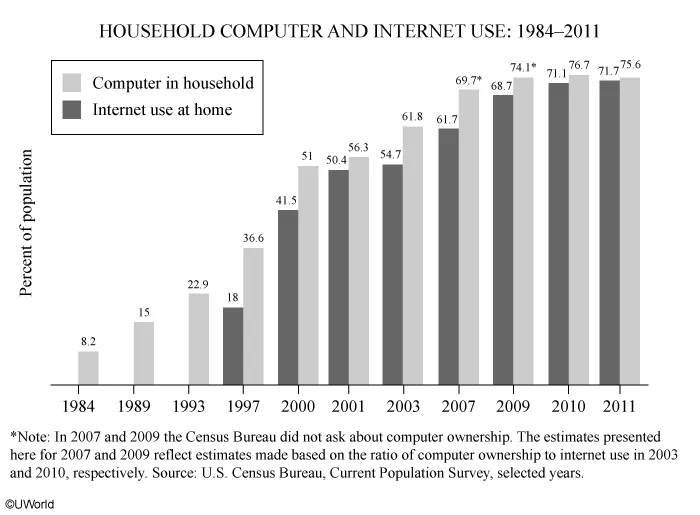
Household Computer And Internet Use

Question

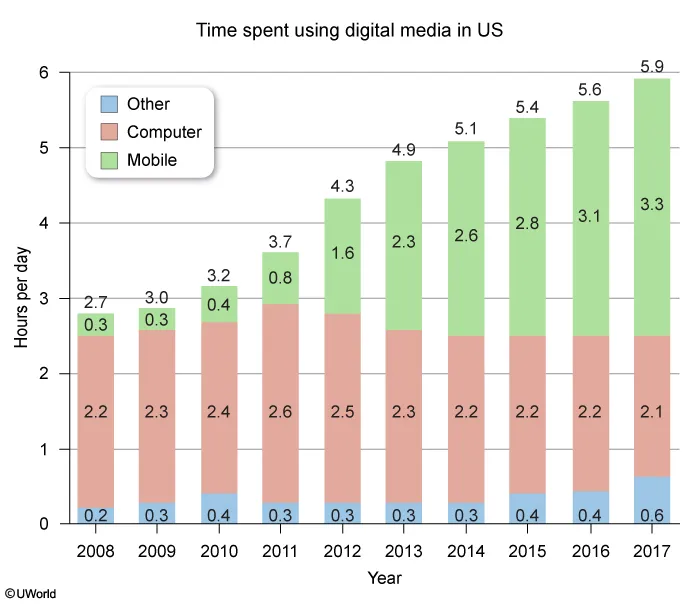
The main trend shown in the graph was most directly associated with which of the following processes occurring in the United States at the time?

A. The growing wealth gap between workers and corporate executives in technology-based firms
B. The emergence of new social behaviors and networks
C. The increased reliance on traditional ways of learning
D. The movement of high-tech companies to the East Coast

Explanation

Time Spent using digital media in US

During the 1990s, personal computers became more affordable, and by 2001, half of American households had Internet access. As a result, social networking through online communities such as MySpace and Facebook became increasingly popular. By the mid-2000s, mobile "smart" phones allowed people to be constantly connected through social media apps.

These new ways of interacting online through digital mobile technology also led to new social behaviors. For example, texting on mobile devices became a common form of communication. Such devices allowed friends and family to stay better connected, but some users became increasingly focused on social networking at the expense of face-to-face interactions. In addition, texting while driving contributed to a notable rise in car accidents, leading to laws aimed at limiting drivers' use of mobile devices.

(Choice A) Although the wealth gap between workers and corporate executives in technology-based firms has grown, this trend is not associated with the graph since it does not distinguish between income classes.

(Choice C) Reliance on traditional (teacher-driven and textbook-oriented) learning methods decreased rather than increased as modern digital technology became more available to the public.

(Choice D) Most high-tech start-ups were launched on the West Coast, and those that weren't more frequently migrated to the West Coast. This echoed a trend from earlier decades when many companies moved to the Sunbelt.

Things to remember:
As new ways of interacting online through digital mobile technology became common in US culture, new social behaviors related to these devices also emerged.

Passage:
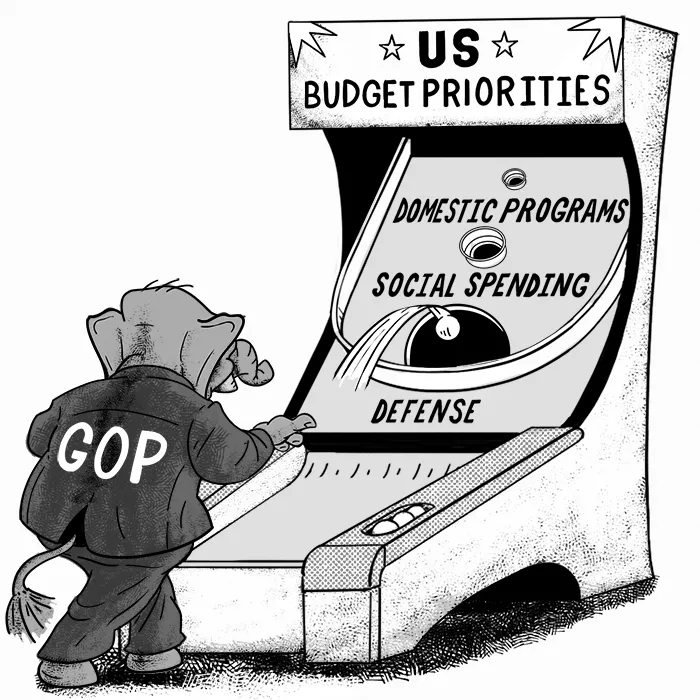
US Budget Priorities

Question

Which of the following developments was the most direct effect of the situation portrayed in the cartoon?

A.Increased national debt
B.Implementation of a new missile defense system
C.Increased taxes rates on wealthy Americans
D. Reduced influence of the president on foreign policy

Explanation

National debt adjusted for inflation

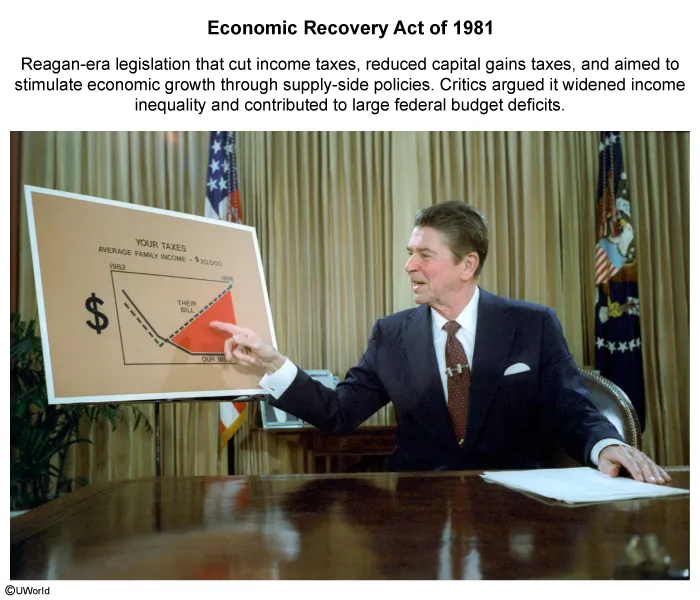
Although elected on a platform of fiscal conservatism and limited government, President Reagan oversaw a massive increase in military expenditures during the 1980s as part of a broader Cold War strategy. At the same time, Reagan signed into law major tax cuts via the Economic Recovery Tax Act of 1981, significantly reducing government revenue.

By the time Reagan left office in 1989, the national debt had nearly tripled, rising from under $1 trillion to over $3 trillion. Although elected on a platform of limited government, the image illustrates Reagan's preference for expanded military spending. Therefore, the most direct effect of the situation portrayed in the cartoon was an increase in the national debt.

(Choice B) Reagan's proposed missile defense system, the Strategic Defense Initiative, was never implemented.

(Choice C) Reagan significantly cut taxes, particularly for the wealthy, as part of his economic policy.

(Choice D) Reagan's communication skills helped him expand presidential influence in foreign affairs through unilateral military actions that bypassed Congress.

Things to remember:
Reagan's large tax cuts combined with expanded defense spending increased the national debt.

Passage:

"This is the issue…[w]hether we believe in our capacity for self-government or whether we abandon the American revolution and confess that a little intellectual elite in a far-distant capitol can plan our lives for us better than we can plan them ourselves.

You and I are told increasingly we have to choose between a left or right. Well, I'd like to suggest there is no such thing as a left or right. There's only an up or down…the ultimate in individual freedom consistent with law and order, or down to the ant heap of totalitarianism."

Ronald Reagan, "A Time for Choosing," October 1964

Question

Which of the following most likely supported the ideas expressed in the excerpt?

A.University professors
B. Racial minorities
C.Small business owners
D. Feminists

Explanation

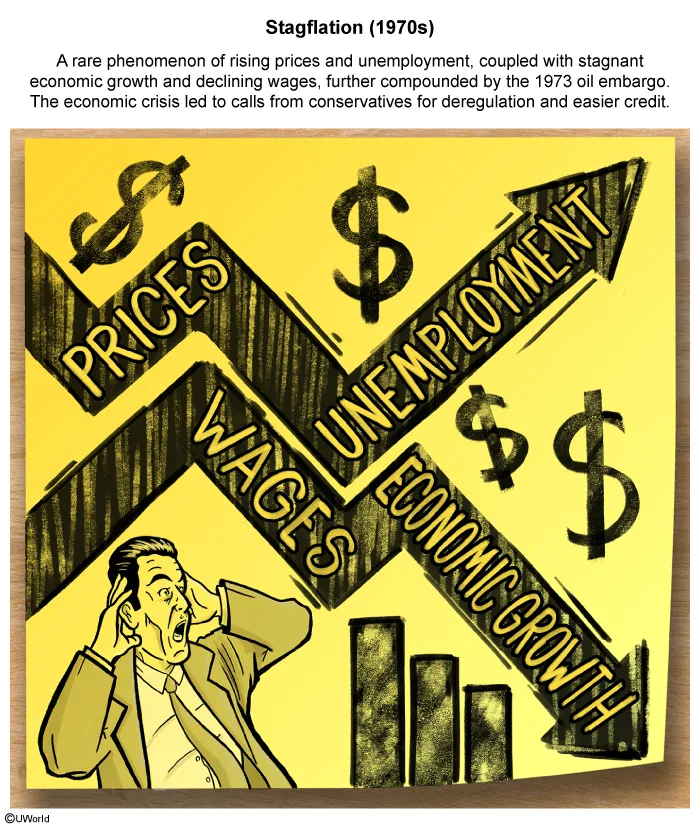
During the 1970s, small business owners confronted the stagflation threatening their livelihoods. Small businesses relied heavily on credit to finance their operations, but soaring interest rates significantly increased the cost of doing business.

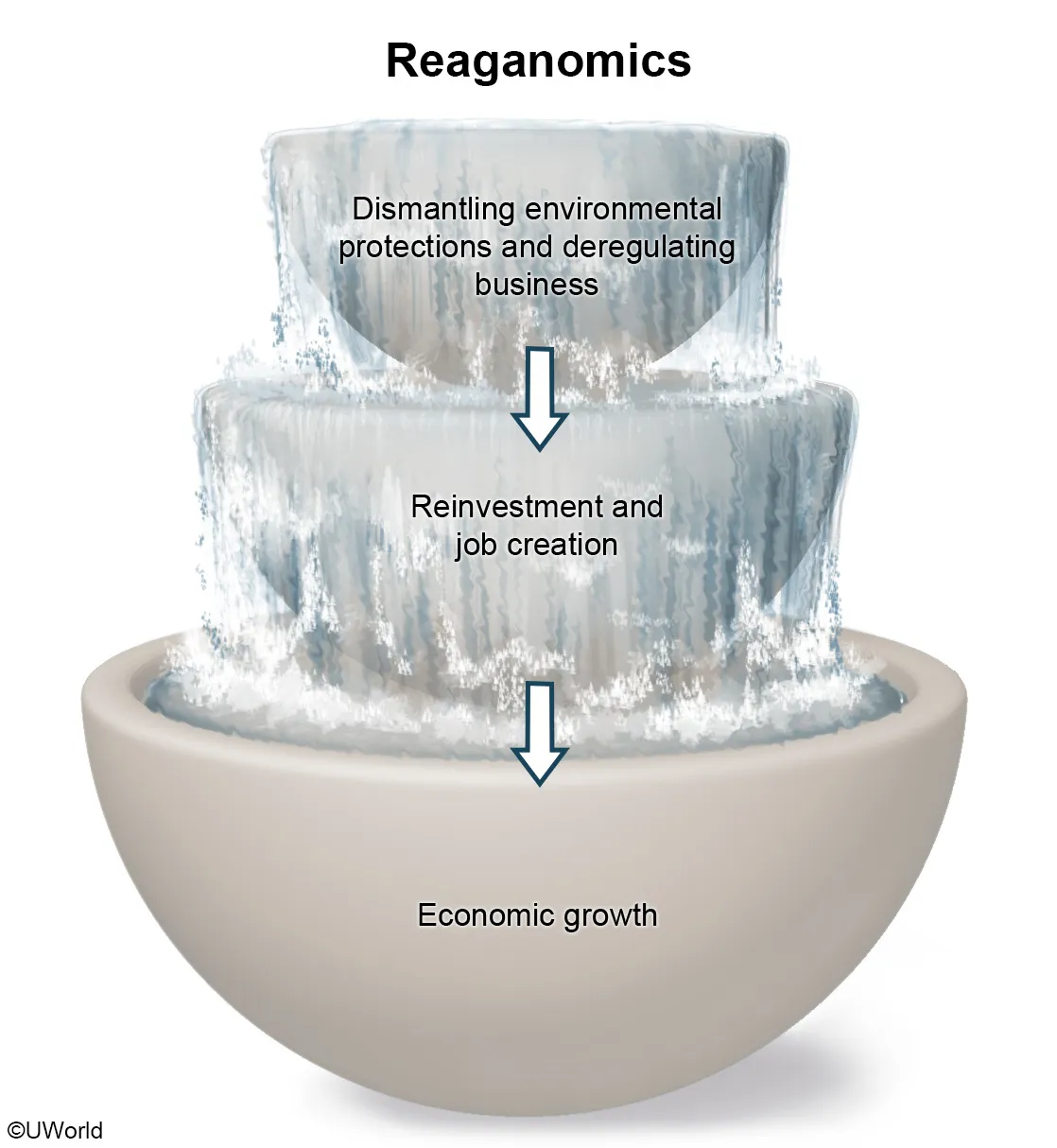
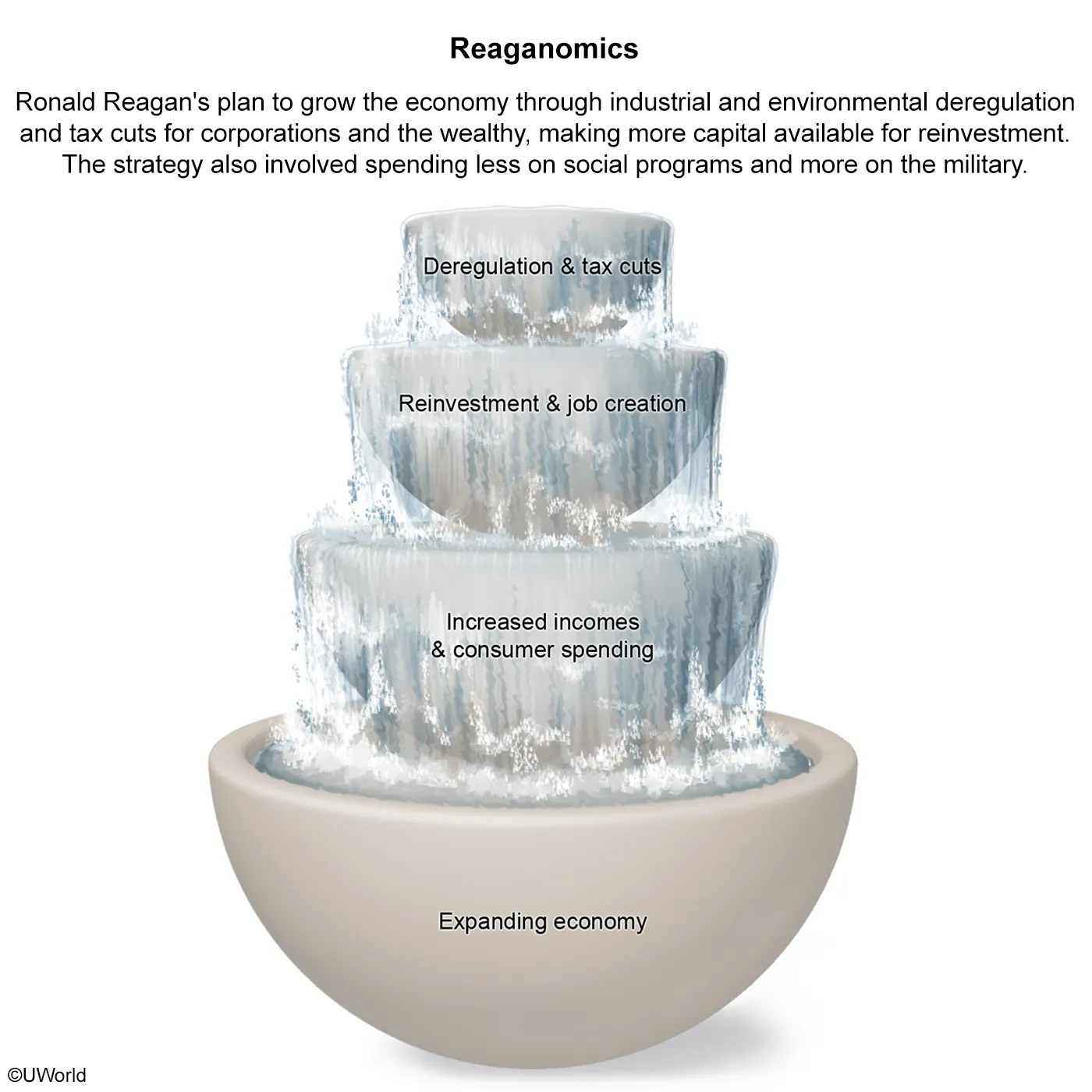
Reagan's call for a smaller government role in the economy, exemplified by financial deregulation, resonated with small business owners. These entrepreneurs valued self-reliance and individualism, aligning with Reagan's broader conservative philosophy. By reducing government intervention, deregulation empowered these business owners to take financial risks and to sustain their enterprises.

Small business owners also benefited from Reagan's Economic Recovery Tax Act of 1981, which reduced marginal tax rates and allowing small businesses more capital to reinvest. This legislation underscored the Reagan administration's commitment to fostering economic growth.

(Choice A) Most university professors tended to favor more progressive policies and government intervention, making them less supportive of Reagan's advocacy for limited government.

(Choice B) Though Reagan attracted diverse voters, racial minorities often supported policies emphasizing social equity and government intervention, which contradicted Reagan's emphasis on limited government.

(Choice D) Feminists often advocated for liberal policies that required government action, including government-enforced gender equality, which contrasted with Reagan's emphasis on smaller government.

Things to remember:
Small business owners supported Reagan's deregulation efforts and tax cuts, which prioritized economic growth.

UWorld Dark Blue logo

Make Every Minute Count with the UWorld App

Use moments throughout your day to strengthen your understanding of Unit 9. Watch a quick video on political realignment, work through APUSH Unit 9 practice test questions during a break, or revisit explanations that clarify major themes. The app keeps your learning flexible, allowing you to continue building confidence wherever you are.

Stand Out
with a Top Score in AP U.S. History

Complete your comprehensive APUSH Unit 9 review and boost your performance to make yourself a standout candidate for competitive colleges, majors, and scholarships by earning a top score.

Choose Your Subscription
Dream Score Plan
360-Day
$169
Deep Learning Plan
180-Day
$149
Score Booster Plan
90-Day (No print book, only digital)
$129
Introductory Plan
30-Day (No print book, only digital)
$99

Get your all-in-one course today!

  • Engaging APUSH Videos with Expert Instruction
  • Customizable Quiz Generator
  • Adjustable Study Planner
  • Print & Digital Study Guide with Step-by-Step Explanations
  • Realistic Timed Test Simulation
  • Progress Dashboard
  • 500+ Expert-Designed, Exam-style Practice Questions
  • Smart Flashcards
  • Mobile App
Explore our free trial and frequently asked questions.

Hear From Our AP Students

UWorld’s service is pretty good and helps provide a lot of explanations on subjects I haven’t been confident on before.

—Bence P.

The questions here are the most realistic to the AP tests I've seen so far! I appreciate the ability to customize tests as well.

—Kaila H.

The best part is that all options are well-explained, telling clearly why they are not the right option.
—Syeda Huma Z.

Frequently Asked Questions (FAQs)

AP U.S. History Unit 9 examines major political, cultural, and economic transformations that shaped the United States from 1980 to today. To understand this unit well, you need to focus on how shifts in policy, globalization, technology, and demographic changes influenced national debates. This period connects closely to themes of continuity and change, so understanding the bigger picture is more important than memorizing isolated facts. A structured approach helps you see the impact of these developments on modern society, and review tools like UWorld can support you by connecting ideas through clear explanations.

Major topics you will encounter include

  • Reagan and conservatism
  • The end of the Cold War
  • Shifts in the economy
  • Migration and immigration
  • Challenges of the 21st century

Once you see how these themes interact, Unit 9 becomes far easier to navigate. Many questions on the Unit 9 AP U.S. History assessments ask you to explain why certain changes occurred and how Americans responded to new challenges. Understanding the connections between politics, society, and global trends gives you the clarity needed for both multiple-choice and writing-based questions. When your preparation focuses on building reasoning rather than memorization, you move through Unit 9 with greater confidence and stronger retention.

Preparing for an AP U.S. History Unit 9 exam means building a balance between content knowledge and strong historical reasoning. This period encompasses new political movements, rapid technological advancements, and the evolving role of the United States in a globalized world. Begin by reviewing the major themes, then enhance your ability to interpret evidence and identify patterns. When you use a resource like UWorld, explanations help you understand not just what happened, but why those events matter for the AP U.S. History Unit 9 exam.

A reliable study routine includes

  • Reviewing key themes such as political realignment, foreign policy after the Cold War, and globalization
  • Practicing multiple-choice questions to build familiarity with the exam’s structure
  • Writing short responses to reinforce your understanding of causes and consequences
  • Using timelines or charts to visualize how developments unfold over time
  • Revisiting topics that feel inconsistent or unclear until they make sense

When you follow a structured plan, preparation becomes easier and more predictable. You start recognizing recurring themes across questions, which helps you respond more naturally during the test. Instead of struggling to recall facts, you develop a clear view of how Unit 9 shapes modern American history. With consistent practice and focused study, you enter the exam feeling more confident and in control of the material.

Yes, you can begin your AP U.S. History Unit 9 review with several helpful free resources, and the strongest starting point is UWorld’s free 7-day trial. The trial provides full access to videos, interactive study guides, and exam-style practice questions, giving you everything you need to build a strong foundation for studying this period. These tools help you understand the reasoning behind political shifts, technological growth, and global changes, which makes learning feel more manageable. 

In addition to UWorld, you can also use publicly available summaries, timelines, and primary source collections online to gain context about the transformations from 1980 to the present. Many students consult the College Board’s AP Classroom resources, which include sample questions and unit topic outlines that teachers rely on for instruction. These materials illustrate how the course is structured and highlight the key concepts emphasized. 

Once you have explored a few free sources, using UWorld as your primary study tool helps you connect classroom content with the skills needed for the exam. The explanations guide you through the logic behind each question, helping you build stronger reasoning rather than relying on memorization. This combination of classroom material, free online content, and structured practice makes studying Unit 9 more efficient and prepares you for both progress checks and the final exam.

The APUSH Unit 9 test features a mix of multiple choice, short answer, and writing-based questions that measure how well you understand the major developments from 1980 to the present. These questions often link political changes, global events, and social shifts to larger historical patterns. To perform well, you need to recognize how ideas connect across decades rather than relying on short-term memorization. Explanations from a structured resource like UWorld can help you see the reasoning behind questions and build stronger instincts for interpreting evidence.

Expect to encounter the following question types

  • Multiple-choice questions that use charts, excerpts, or political data
  • Short answer questions asking for brief explanations supported by specific evidence
  • Document-based questions centered on contemporary debates or policy changes
  • Long essay questions requiring you to evaluate trends over time or compare turning points

Understanding the structure of these questions helps you create a targeted study plan. Practice across different formats improves your ability to evaluate evidence quickly and respond with clarity. Working through explanation-driven questions also shows you common patterns and themes that appear throughout Unit 9. When you combine content review with consistent practice, you are better prepared for both classroom assessments and the final AP exam.

Improving your FRQ performance for Unit 9 begins with understanding how modern political, economic, and social developments fit into long-term historical patterns. FRQs reward strong arguments supported by clear reasoning and relevant evidence. Before writing, it is essential to establish a solid understanding of how major shifts, such as globalization, political realignment, and technological expansion, have shaped American society. Explanation-based practice, as seen in tools like UWorld, helps you understand how successful responses strike a balance between evidence and analysis.

Use the following process to strengthen your FRQs

  • Read the prompt closely to determine the task and time frame
  • Identify two or three strong pieces of evidence that directly support your argument
  • Use clear reasoning to explain how each example connects to the prompt
  • Avoid describing events without linking them to a larger theme or trend
  • Practice writing in short, timed sessions to build confidence and reduce hesitation

With consistent practice, your writing becomes more precise and your arguments more focused. You learn to select evidence that strengthens your claims rather than overwhelming the response with unnecessary details. Over time, this approach builds the clarity and control needed for all FRQ types, whether you are explaining continuity, evaluating causation, or comparing different periods. Strong FRQ skills help you perform confidently on both Unit 9 assessments and the final AP U.S. History exam.

Period 9 represents a smaller portion of the AP U.S. History exam, approximately 4-6%, compared to earlier units; however, it still carries significant weight across multiple sections. While it may not dominate the test, the College Board consistently includes questions related to political changes since 1980, the end of the Cold War, demographic shifts, cultural debates, and globalization. These topics appear not only in multiple-choice questions but also in short-answer prompts and occasional writing tasks. This period is connected to modern events, and many questions use its themes to test historical reasoning skills, such as continuity and change or argumentation. This means that even though the number of items directly tied to Period 9 is limited, the impact on your overall score can be significant.

A strong understanding of Unit 9 helps you handle questions that blend information from different periods, especially those that ask you to trace developments into the 21st century. Many students find it helpful to use structured tools like UWorld to strengthen their reasoning, as explanations show them how to connect evidence to broader trends. By becoming comfortable with the major ideas in Period 9, you gain the flexibility to answer modern context questions confidently and improve your performance across the entire exam.

A strong AP U.S. History Unit 9 study guide should help you understand how modern political, social, and economic changes shape the contemporary United States. Instead of overwhelming you with details, a good guide explains the major trends from 1980 to the present in a way that helps you see cause and effect. You want a resource that facilitates connecting new ideas to earlier periods, as this unit relies heavily on long-term historical patterns. Interactive study guides from UWorld offer this type of structure by breaking information into clear explanations supported by visuals and checkpoints that reinforce understanding.

A high-quality Unit 9 study guide should include

  • Clear explanations of political shifts, such as the rise of conservatism and changing party coalitions
  • Coverage of globalization, technology, and economic transformation
  • Visuals that show how cultural debates and demographic changes evolved
  • Examples that connect Unit 9 themes to exam-style questions
  • Guidance that strengthens your reasoning and not just memorization

Once you have a guide that focuses on understanding rather than listing facts, studying becomes far smoother. You start recognizing how modern events tie into earlier developments, which helps with multiple choice questions, SAQs, and FRQs. Pairing a strong study guide with explanation-driven practice enables you to learn the material more deeply and prepares you for both classroom progress checks and the AP exam.

Yes, there are practice tests and question sets designed specifically for AP U.S. History Unit 9, and using them gives you a clear advantage when preparing for the Unit 9 APUSH test. These practice items help you understand how the exam assesses reasoning related to modern political changes, technological shifts, and global developments. Working through exam-style questions builds your ability to interpret evidence and identify broader patterns, which is essential for handling both multiple-choice and short-answer prompts. UWorld offers Unit 9 practice questions that mirror the College Board’s formatting and include explanations for both correct and incorrect choices.

Effective Unit 9 practice tests should offer

  • Multiple choice items using contemporary charts, excerpts, or demographic data
  • Short answer prompts focused on political or cultural debates since 1980
  • Occasional FRQs tied to turning points in this period
  • Clear explanations that reinforce reasoning rather than memorization
  • Opportunities to track your progress and revisit weaker topics

As you practice, Unit 9 becomes easier to understand because you see how ideas connect across decades. You begin noticing the patterns the exam expects you to recognize, such as changes in American foreign policy or shifts in domestic priorities. This combination of targeted content and analytical practice enhances your ability to approach questions with confidence and accuracy.

Preparing for the Unit 9 progress check in AP Classroom requires a blend of content review and practice with AP-style reasoning. The progress check assesses your understanding of key developments from 1980 to the present, including changes in political coalitions, global economic integration, and the impact of new technology on American life. Before attempting the check, spend time reviewing the major themes in Unit 9 to gain a clear understanding of the timeline and the logic behind the changes. Once you have a solid foundation, use practice questions that reflect the structure and style of AP Classroom items.

UWorld offers a check for understanding experience that mirrors this format by giving you realistic multiple choice questions supported by detailed explanations. These explanations help you understand why certain choices are correct and how to eliminate distractors, which is one of the core skills evaluated in progress checks. After completing a set of questions, review your results and focus on areas that felt confusing or inconsistent. Revisiting these themes with a targeted plan helps reinforce your understanding and improves your performance on the actual progress check. With steady practice, you learn how to read evidence more effectively, recognize historical patterns, and respond with clarity even under time pressure. This preparation gives you an advantage when your teacher assigns the Unit 9 progress check.

Preparing for both MCQs and SAQs in Unit 9 requires a mix of content mastery and strong reasoning skills. MCQs test your ability to interpret evidence and identify patterns across modern political, social, and economic developments. SAQs expect clear explanations supported by precise evidence rather than long essays. Unit 9 focuses on contemporary themes; you must understand the logic behind changes rather than memorizing isolated facts. Using a structured tool like UWorld helps you strengthen these skills because each question guides you through the reasoning behind correct and incorrect choices.

Here is an approach that supports both MCQs and SAQs:

  • Begin with short content review sessions to reinforce major themes like globalization, political realignment, and technological change
  • Practice small sets of MCQs to learn how the exam frames Unit 9 evidence
  • Write brief SAQ responses that connect each example directly to the prompt
  • Review explanations carefully to understand how to eliminate distractors and strengthen reasoning
  • Revisit difficult topics until the patterns feel clear

As you repeat this process, both question types become easier because you learn to focus on cause and effect, continuity, and broader trends. MCQs feel more predictable since you recognize the logic behind each item, and SAQs become less intimidating because you know how to choose relevant evidence quickly. Consistent practice with clear explanations builds the accuracy and confidence needed for Unit 9 assessments and the AP exam.

Staying organized during Unit 9 helps you manage the wide range of modern themes covered in this period. The content spans several decades of political change, globalization, and technological transformation. Reviewing everything at once can feel overwhelming. It becomes easier when you divide the material into small, manageable pieces and follow a clear routine. Using a structured tool like UWorld supports this process because explanations and visuals help you process the information more logically.

A helpful organization strategy includes:

  • Breaking Unit 9 into themes such as politics, economy, culture, and foreign policy
  • Creating a weekly plan that assigns specific topics to each study session
  • Keeping notes color-coded or grouped by theme for faster review
  • Using timelines or charts that show how issues developed across the decades
  • Ending each study session with a short set of practice questions to reinforce learning

Once you build this structure, studying becomes smoother and more predictable. You spend less time flipping through random notes and more time understanding how events relate to each other. This approach also helps you identify which topics require more attention, allowing you to revisit them efficiently. With consistent organization, your confidence grows, and preparing for multiple-choice questions, SAQs, and FAQs becomes far less stressful.

Yes, you can study AP U.S. History Unit 9 offline, and having this flexibility helps you stay consistent even when your schedule is unpredictable. Many students review during commutes, while traveling, or in places where internet access is limited. UWorld supports offline study by allowing you to download question sets through the app, so you can keep practicing without needing a connection. This lets you review explanations, revisit earlier topics, and work through Unit 9 concepts whenever you have a few free minutes.

Offline access is especially useful because it turns brief moments into opportunities to reinforce learning. You can focus on topics such as political shifts, demographic changes, or economic debates and progress through questions at your own pace. Once you reconnect, your progress syncs automatically, keeping your performance data up to date. This option also pairs well with your own notes or printed summaries, giving you a more balanced study experience. By using offline access effectively, you can maintain a steady review rhythm and strengthen your preparation for the AP exam.

Scroll to Top

Ace AP US History

Master Every Concept
The Easy Way
No Credit Card Required
See the UWorld Difference For Yourself

Frequently Asked Questions

New Purchase: All new subscriptions go into effect from the time they are activated and not at the time of setup/purchase. A subscription can be activated immediately or any time thereafter. If your initial purchase consists of multiple courses (Qbank, Self-Assessment exam, CCS, etc.), each can be activated individually and independently via your account on our website. This process of activating a subscription after purchase allows you the flexibility to start a subscription when you are truly ready to use it.

We recommend that all subscriptions be activated within 180 days of setup/purchase. Once a subscription is activated, it cannot be paused or suspended for any reason and will run continuously for the duration of the course material.

Renewal: A renewal is an extension of time to continue access to a current activated subscription. Because a renewal is an extension to an already active subscription, it is effective from the existing expiration date, not from the day of purchase and cannot be deferred to start at a later date/time.

Note: All of our subscriptions are based on the Eastern Time Zone (GMT/UTC -5 hours or New York Time), which may be different than your local time zone.

Any of our product offerings can be purchased from our website with payment due in full at time of purchase via a credit or debit card with American Express/Discover/MasterCard or Visa logo.

You will need to register for an account in order to purchase any of our products. Once you have registered for an account or if you already have an account:

  • Log in to your UWorld account
  • Click on the Cart icon at the top of the page and then select your desired product to see a list of available packages and their prices
  • Select the package you wish to purchase
  • Verify your profile information, address, and educational status, then click the Update button
  • Enter your Billing address and credit/debit card information, then click Review Order
  • Verify that the correct product is in your cart and click Place Order
  • A purchase receipt will automatically be sent to your registered email address

If you complete your purchase but do not receive a receipt, please contact the Customer Care Team at [email protected]

You can subscribe to any of our online courses/services using a credit or debit card with a Visa, MasterCard, Discover or American Express logo. After a successful payment, your subscription will immediately be available for activation via your account on our website or available complementary mobile applications.

You can also subscribe via personal check, money order, or demand drafts taken in U.S. dollars. These types of payments should be mailed to us and should include the name of the subscription and the duration, along with the details asked for in the registration form. We will set up your account as soon as we receive your payment and notify you via email of your access credentials. All direct-mail payments must be in U.S. dollars and made payable to:

UWorld, LLC
9111 Cypress Waters Blvd
Suite 300
Dallas, TX 75019

We do not accept cash via mail, currencies other than U.S. dollars or payments via fax.

Individuals purchasing our CPA Review product may finance their purchase using Affirm during checkout process. Your eligibility depends on your credit score and other criteria, as per Affirm’s policies (outlined here). A soft credit check, a credit check that does not affect your credit score, will be performed by Affirm to determine your loan eligibility. You will need a US based bank account to qualify.

All refunds are evaluated on a case-by-case basis for products purchased directly from UWorld. One case has no bearing on another. Refund amounts determined by UWorld are final.

In-App Purchases: We are unable to process any refunds for purchases made via mobile application (in-app). Please contact Apple for all refund/credit requests for Apple in-app purchases.

USMLE Step 2 CS, Step 3 CCS, Subject Reviews & Self-Assessment Exams: These subscriptions are non-refundable, non-transferable, and cannot be converted into another subscription.

CPA Review: Students may request to cancel their CPA review product only within 10-days of activation of any of the materials. To qualify for a refund, no more than 10% of the course (lectures, Qbank, or a combination there-of) may have been used per exam section. All CPA Review refunds are subject to a cancellation fee of $75 (for single section purchases) or $250 (for package
purchases), plus any applicable shipping charges. No return of merchandise is necessary.

All other Qbanks: Refunds are considered for subscriptions of more than 30 days. Refund amounts are based on the number of days elapsed since the subscription start date or the number of questions used, whichever amounts to a higher deductible.

Example scenarion: An individual purchases a 180-day Qbank subscription and generates a few test blocks equal to 20% of the questions in the Qbank. After 45 days, he/she requests a refund. Because the elapsed duration is greater than the percentage of questions used, the refund amount will be based on a subscription converted to the closest duration (60 days) by deducting the applicable 60-day subscription fee from the refund. In the same scenario, if the individual had used 85% of the questions, the refund would be 15% of the subscription fee paid.

Note 1: A processing fee of 10% (minimum of $10 and maximum of $25) will be applied to all refund amounts.

Note 2: All refunds, pro-rated or otherwise, must be requested within 360 days of original purchase. Refunds for purchases made more than 360 days ago will be issued as non-refundable, non-transferable store credit.

Note 3: Subscribers must notify UWorld of their intent to obtain a refund before activating their subscription (or) during the active duration. If the reset option is used or all of the questions are used, no refund will be allowed (see “I want to reset/delete my Qbank test history (or) start all over again, is this possible?” below for further details). No refunds will be offered for expired subscriptions.

Note 4: For combination package purchases, individual subscription fees will be applied when calculating the refund. If any self-assessment Exam(s) is utilized from a package, the entire purchase is rendered non-refundable.

Note 5: Although access to Qbanks via certain mobile devices is provided as an additional feature, it is not intended to be a replacement for computer access, and no refunds or cancellations will be honored due to user inability to install and/or use the provided software on any mobile device (regardless of whether the device meets the minimum system requirements).

Please use the following steps to purchase a renewal for your subscription:

  • Log in to your account on our website
  • Click on the User Icon in the top right corner of the screen
  • Click on the Renew button corresponding to your subscription
  • Select the Renewal duration you wish to purchase
  • Verify your profile information, address, and educational status, then click the Update button
  • Enter your Billing address and credit/debit card information, then click Review Order
  • Verify that the correct package is in your cart and click Place Order

Upon a successful transaction, you will be sent a confirmation email receipt.

A renewal is an extension of time to continue accessing an active subscription, and it will not start the subscription over, provide a reset, or grant access to additional questions that were not previously accessible. Because a renewal is an extension to an already active subscription, it is effective from the existing expiration date, not from the date of purchase, and cannot be deferred in any way to start at a later date/time.

Please note that to qualify for renewal pricing, you will need to renew the course before it expires. Renewals are not offered to expired subscriptions. If you fail to secure a renewal before the expiration date, you will need to purchase a new subscription at the regular price directly from our website to regain access to the material.

Note: All times and dates displayed for subscription expiration correspond with the Eastern Time Zone (GMT/UTC -5 hours or New York Time), which may be different than your local time zone.

Note: If your initial purchase was a combination package, you will need to renew each active subscription individually. You do not need to renew a course that has not been activated.

You may request to upgrade or downgrade your subscription purchase as long as it has not been activated. If you purchase a combination package, all included subscriptions must be unused. Please be advised that current subscription pricing will apply.

If your subscription has been activated, unfortunately, we cannot upgrade it retroactively. If seeking to downgrade, please refer to our refund policy for available options.

We do not offer custom duration(s) or combination packages other than those outlined on the website. Please refer to our purchase page for currently available subscriptions (including discounted combination packages for some products).

Self-Assessment exam subscriptions are for 14 days each. Subscribers whose active subscription(s) have not expired can purchase renewals from 7 days or more at any time before their active subscription expires. Please refer to the respective course description page for renewal options.

We offer a demo on each of our product pages that contains a sample of the product interface and a few sample questions. We do not offer guest/trial accounts to test our software and view materials.

It is possible to purchase a subscription as a gift for someone else. However, the intended recipient will need to register an account on our website (or have an account registered for them, with their profile information entered accurately). If the user is present at the time of purchase, the purchase can be made from their account on our website using any credit or debit card with a Visa, MasterCard, American Express, or Discover logo.

If the user is not present, or you wish for the gift to be a surprise, please contact Support directly using the contact form to arrange payment for the gift subscription. You will need to provide the user’s registered email address so the account can be located.