FREE Ground Shipping on Courses $149+ | Code: SANTASENDSFREE

AP U.S. History Unit 8 Review and Practice Test

Period 8: 1945-1980

Master APUSH Unit 8 with clear explanations, helpful notes, and an easy-to-follow study guide that simplifies key topics from the post–World War II era. Explore major developments such as the Cold War, shifting domestic policies, and influential social and political movements that shaped modern America. Whether you're completing the APUSH Unit 8 progress check MCQ or preparing for an APUSH Unit 8 test by practicing with exam-style questions, UWorld’s APUSH Unit 8 review provides everything you need to learn smarter and feel confident.

AP U.S. History prep course suite by UWorld

Master APUSH Unit 8 with Confidence and Score Higher

Level up your APUSH Unit 8 review with clear explanations, easy-to-follow notes, and a study flow that actually makes sense. Whether you’re stuck on Cold War policies or major civil rights shifts, this APUSH Unit 8 study guide walks you through everything fast.

Watch

Engaging Video Lessons

Dive into APUSH Unit 8 with video lessons that break tough topics into chill, easy-to-follow explanations. Each clip helps you connect the dots faster, whether you’re reviewing key Cold War themes or gearing up for APUSH Unit 8 MCQ practice. These lessons work perfectly alongside your Unit 8 APUSH review and study guide, so you can learn smarter, not harder.

Read

Interactive Study Guides

Stay on top of APUSH Unit 8 with study guides that break everything down into clean, scroll-friendly chunks. You’ll get easy Unit 8 APUSH notes, quick timelines, and visuals that help you lock in every major shift from 1945 to 1980. Whether you’re building your APUSH Unit 8 summary for class or prepping for test day, these guides make learning faster and way less stressful.

Practice

Test Yourself with APUSH Unit 8 Practice Questions

Get exam-ready with APUSH Unit 8 practice test questions that feel just like the real thing. These MCQs help you spot what you’ve mastered and what you still need to review as you work through your Unit 8 APUSH review. It’s the fastest way to boost your confidence before the AP U.S. History Unit 8 test and crush those APUSH Unit 8 MCQ sections.
Try these sample practice questions with detailed answer explanations:
Period 8: 1945-1980 Practice Tests

Passage:

"[Secretary of Defense] Mr. McNamara pointed out that if we are going to take overt military action, it must at all costs be done on a 100% basis and before any of the missiles become operational. General Taylor pointed out that…we should establish an immediate blockade and then look toward invasion although this latter prospect did not enthuse him…

The President pointed out that the missiles certainly had to be removed one way or another… In the meantime, there was much information to be gathered and much analysis to be done… He authorized as many U-2 flights as needed to get full, complete, 100% coverage of the island. He asked for a report on the latest analysis of just what the thinking toward Cuba is in Latin American countries, as well as NATO, as to any action the US might take..."

Lt. Gen. Marshall Carter, notes from cabinet meeting on October 15, 1962

Question

The potential "military action" suggested in the excerpt was most directly a response to the

A.growth in the number of military shipments to Cuba
B.consolidation of power by Fidel Castro's government
C. efforts by the Soviet Union to blockade western Berlin
D. government policy of removing nuclear missiles from Turkey and Italy

Explanation

"Mr. McNamara pointed out that if we are going to take overt military action, it must at all costs be done on a 100% basis and before any of the missiles become operational. General Taylor pointed out that…we should establish an immediate blockade and then look toward invasion…"

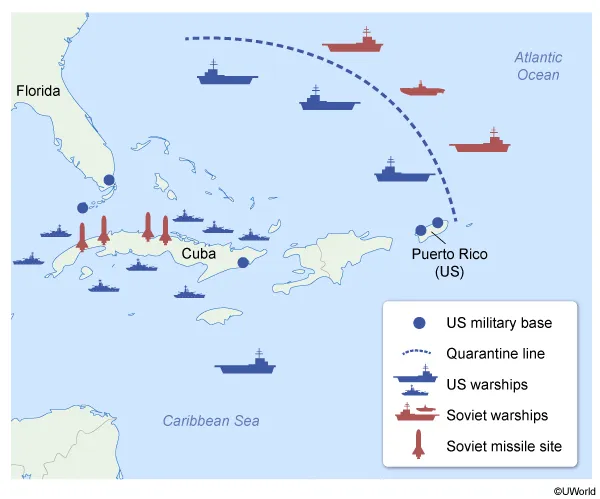
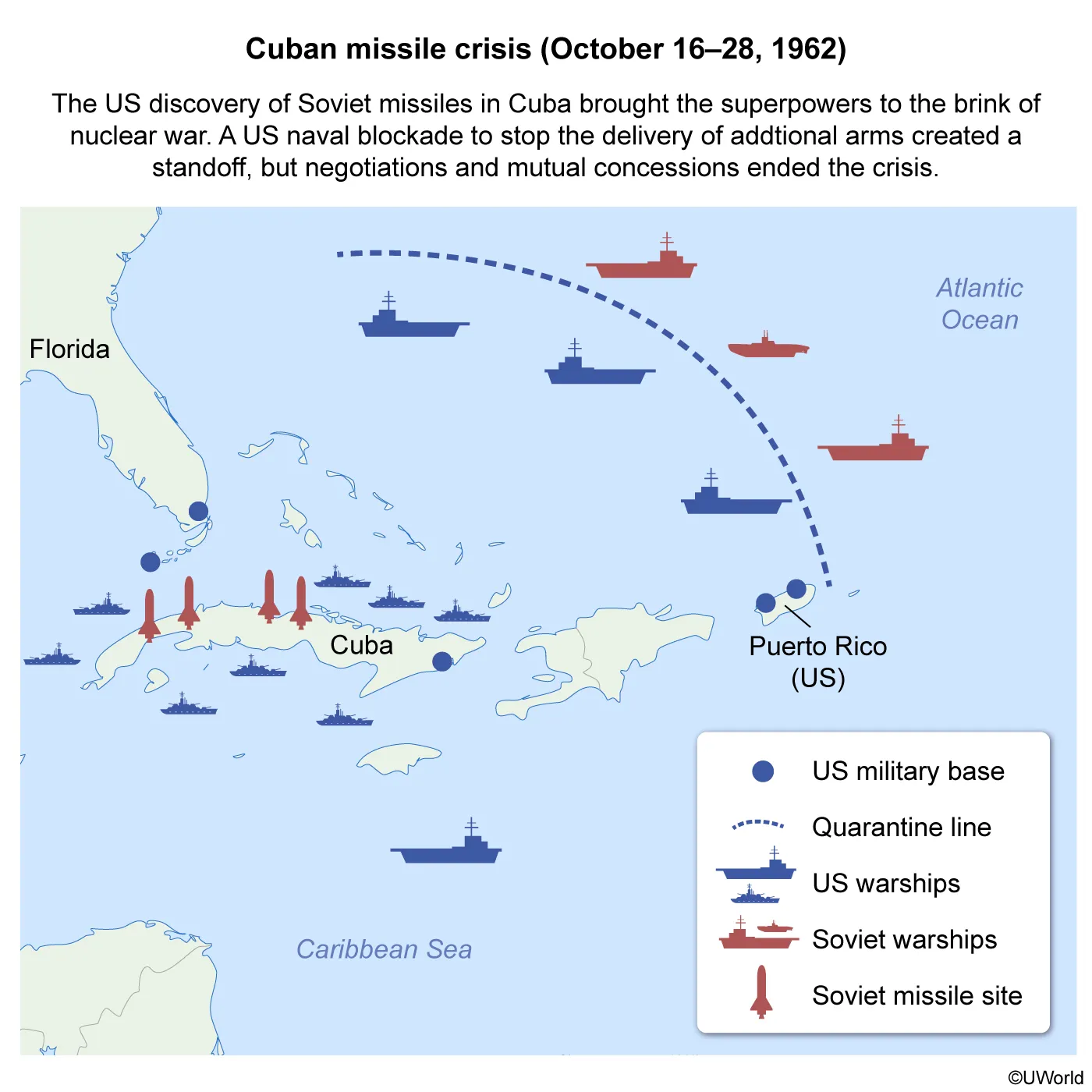
Cuban missile crisis

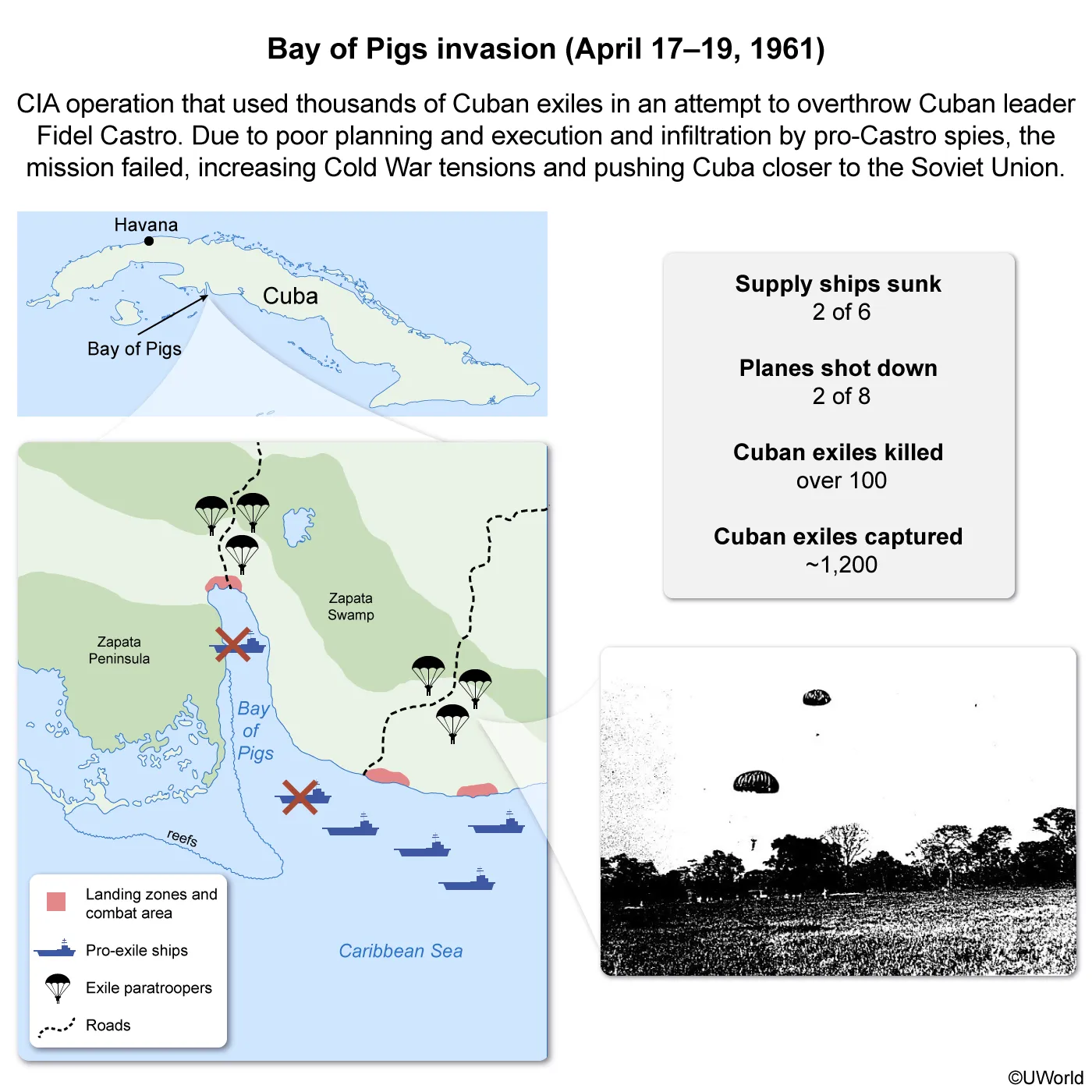
Prior to the failed, US-backed Bay of Pigs invasion in 1961, Cuba's relations with the Soviet Union (USSR) were based upon the USSR providing Cuba limited economic and military support. After the Bay of Pigs fiasco, however, Soviet-Cuban relations expanded considerably—particularly after the Cuban leader, Fidel Castro, announced he was a communist.

The Kennedy administration paid close attention to the growing Soviet-Cuban relationship, particularly after US surveillance reported Soviet ships delivering what appeared to be large volumes of military hardware to Cuba. Tensions increased as US spy planes detected nuclear missile sites on the island.

In response, the Kennedy administration planned for several contingencies, including the possibility of bombing Cuba to destroy the missile sites. Ultimately, Kennedy chose to use the US Navy to enforce a blockade of Cuba—heightening the Cuban missile crisisto stop further shipments of missiles to Cuba from the Soviet Union.

(Choice B) By itself, Castro's consolidation of power did not warrant military action. Rather, the US response in 1962 was due to Soviet shipments of nuclear missiles to Cuba.

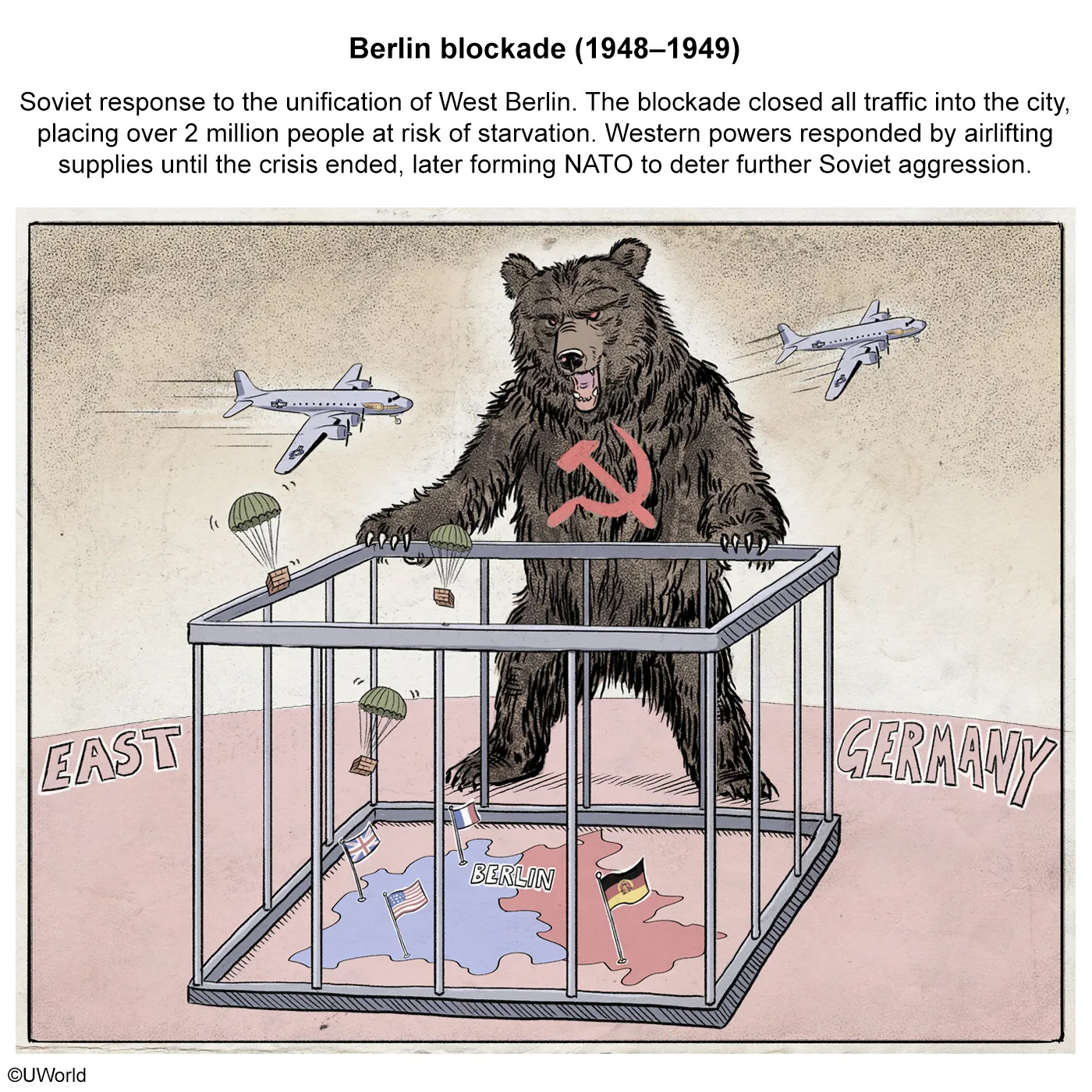
(Choice C) The Soviet blockade of Berlin was resolved in 1949 and the military action suggested in the excerpt was in response to Soviet military shipments to Cuba.

(Choice D) The removal of nuclear missiles from Turkey and Italy was a result of the Cuban missile crisis, not a cause of it.

Things to remember:
US surveillance reported an increased number of Soviet ships delivering what appeared to be missiles to Cuba. To stop further Soviet shipments, the US chose to enforce a blockade, escalating tensions during the Cuban missile crisis.

Passage:

"The Great Society…demands an end to poverty and racial injustice, to which we are totally committed in our time. But that is just the beginning.

Our society will never be great until our cities are great. Today the frontier of imagination and innovation is inside those cities and not beyond its borders…. It will be the task…to make the American city a place where future generations will come…to live the good life.

The second place we begin to build the Great Society is in our countryside…. The water we drink, the food we eat, the very air that we breathe, are threatened with pollution…. Green fields and dense forests are disappearing.

The third place to build the Great Society is in the classrooms of America…. Our society will not be great until every young mind is set free to scan the farthest reaches of thought and imagination."

President Lyndon B. Johnson, "Great Society Speech," 1964

Question

Great Society legislation resulted in

A.a decrease in the power of the executive branch
B.federal initiatives addressing environmental issues
C. extensive dismantling of New Deal programs
D. less federal protection for historical building and landmarks

Explanation

"The second place we begin to build the Great Society is in our countryside…. The water we drink, the food we eat, the very air that we breathe, are threatened with pollution…. Green fields and dense forests are disappearing."

Great Society environmental protections

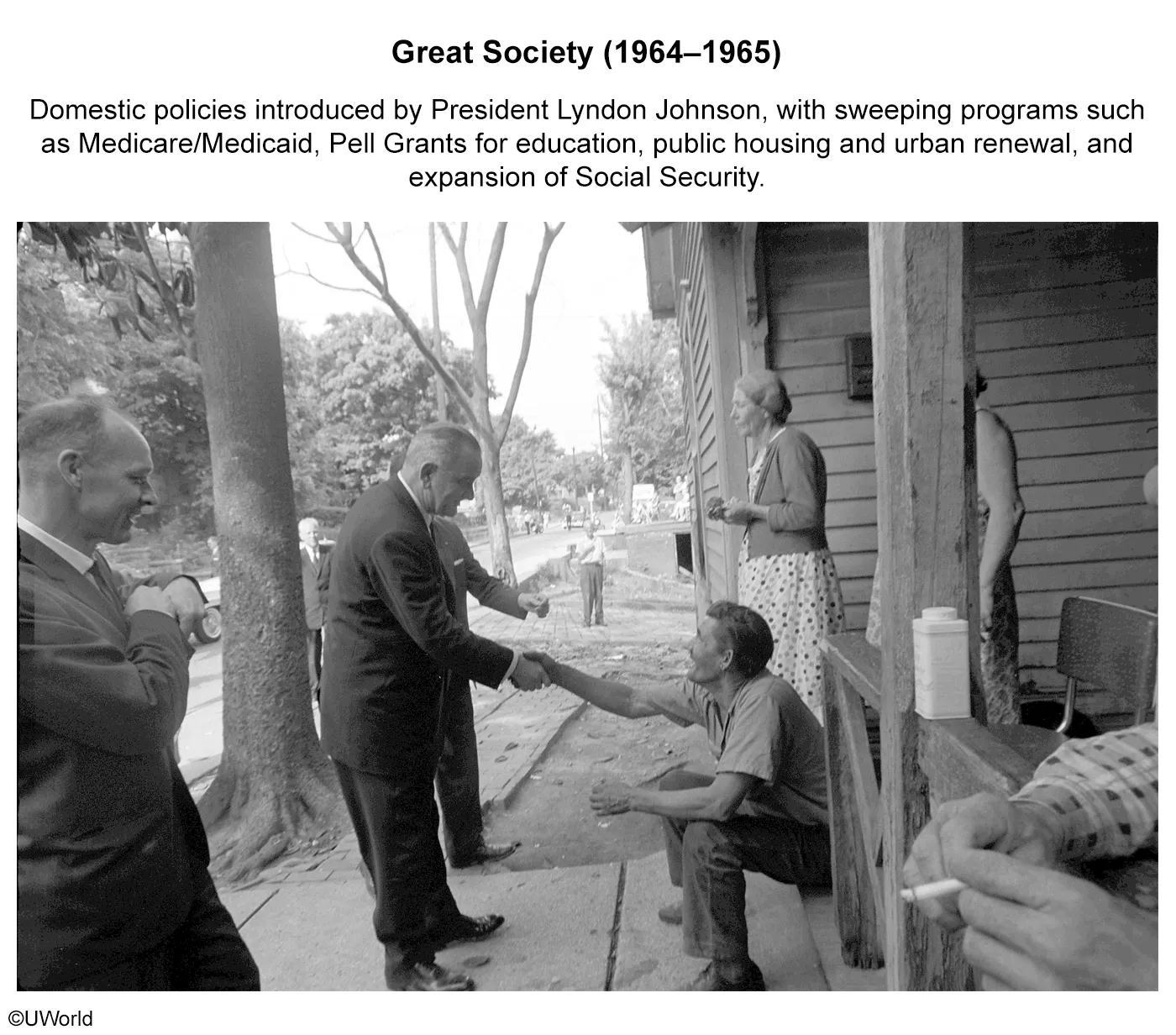
In addition to waging a "War on Poverty," President Lyndon B. Johnson's (LBJ's) Great Society also focused on social issues such as public safety and health. LBJ felt government should work to improve the lives of its citizens—a central belief of 20th century liberalism. For LBJ, this included protecting the natural world in which Americans lived.

To reduce the pollution in America's water, the Water Quality Act (1965) established standards for water quality and authorized the Federal Pollution Control Administration to enforce regulations. The Act also included federal funding for state agencies.

To reduce air pollution, the Clean Air Act was strengthened, expanding the federal government's role in reducing pollution. The Motor Vehicle Air Pollution Act (1965) set standards for automobile emissions. In addition, the Air Quality Act (1967) increased environmental research and monitoring of air pollution along interstates.

(Choices A, C, and D) These choices represent opposites of notable results of the Great Society legislation, which included:

  • Increasing the power of the executive branch.
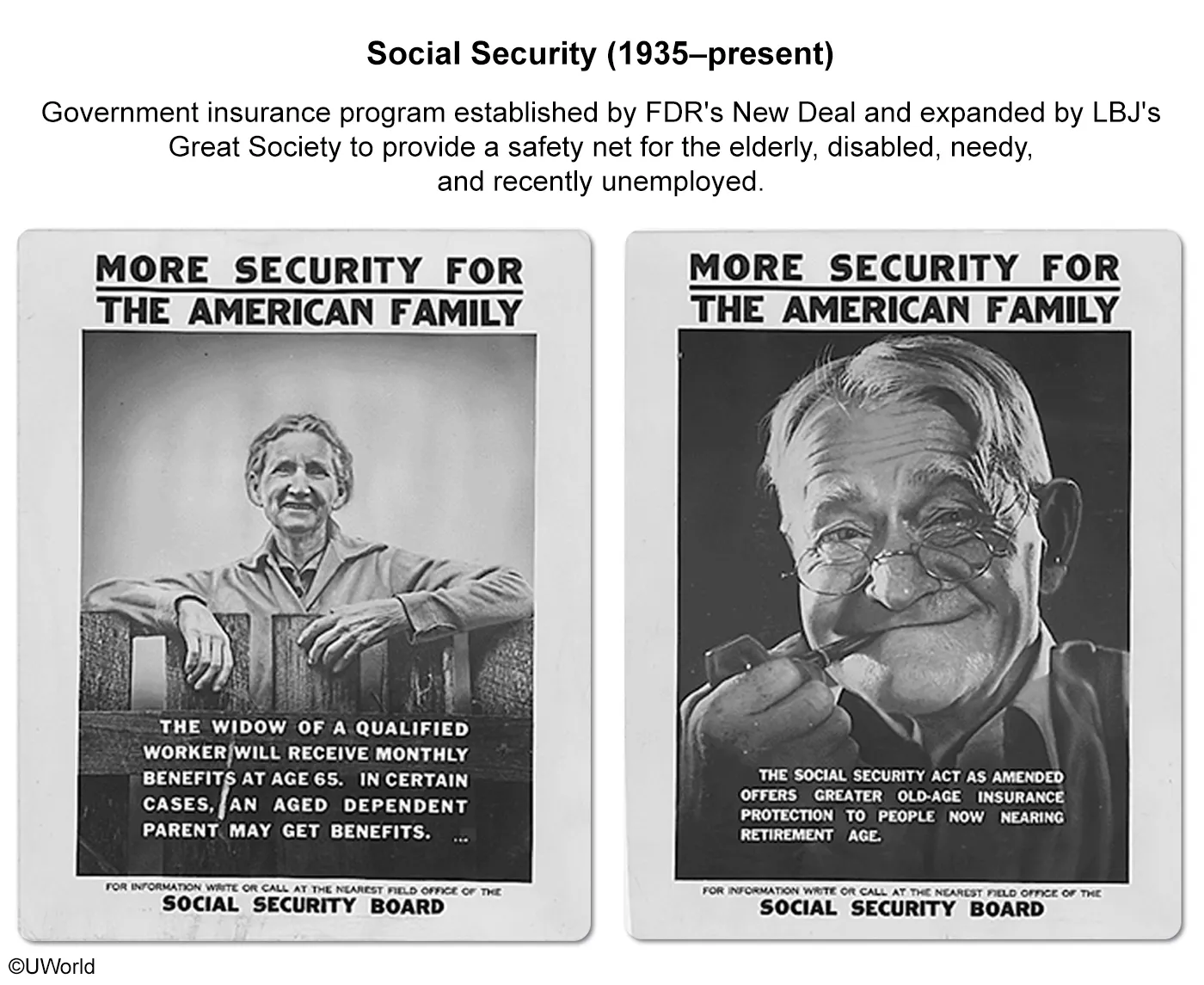
  • Expansion of New Deal programs, such as Social Security.
  • Increasing federal protections for historic buildings and landmarks, such as with the National Historic Preservation Act of 1966.

Things to remember:
In the mid-1960s, Great Society legislation strengthened and expanded the federal government's role in reducing pollution and protecting the environment.

Passage:

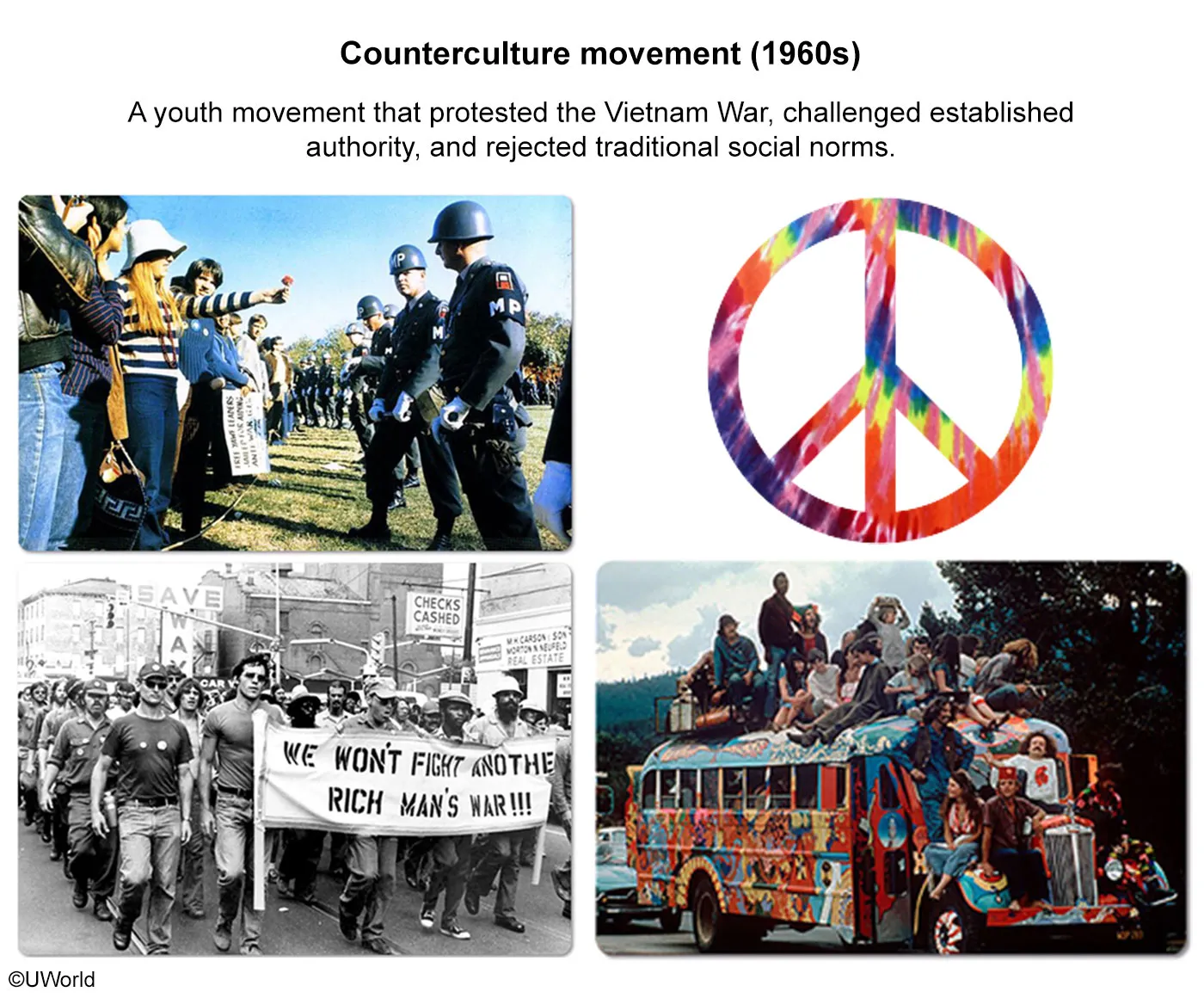
Protest at the Pentagon

1. National Archives and Records Administration, NAID: 594360

Question

Which of the following movements expressed ideas most similar to the ideas expressed by the counterculture?

A.Imperialism of the 1890s and 1900s
B. Fundamentalism of the 1910s and 1920s
C.Feminism in the late 1960s and 1970s
D. Social conservatism of the 1980s and 1990s

Explanation

Gloria Steinman

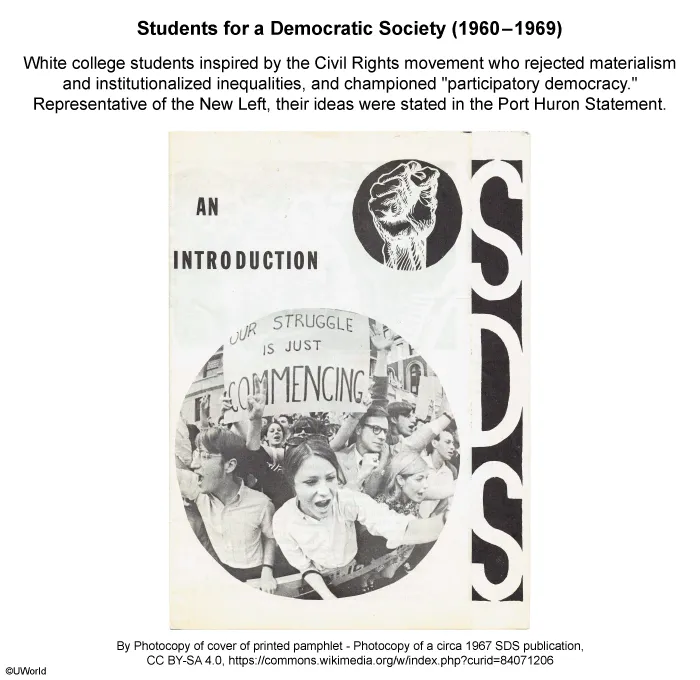
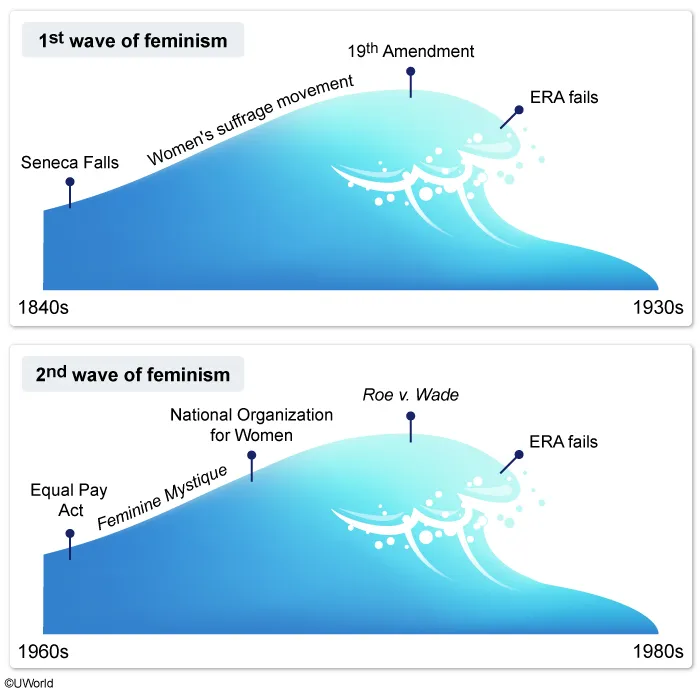
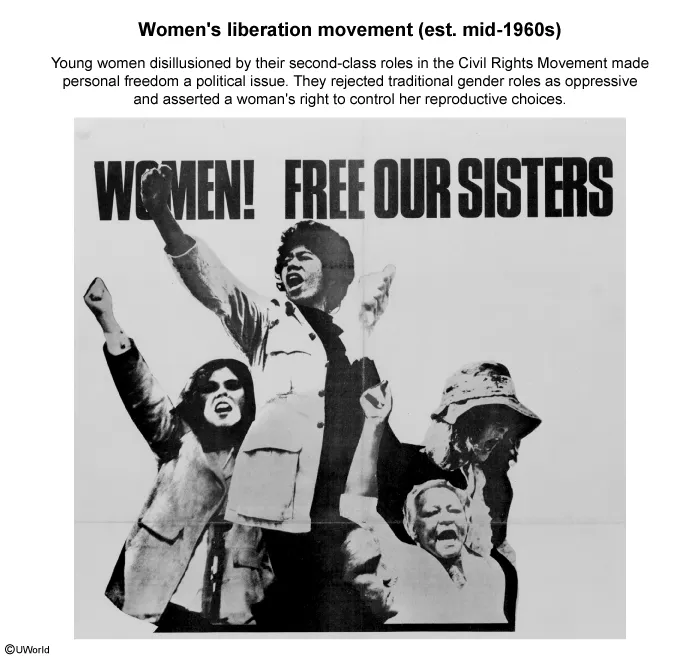
Inspired by the Civil Rights Movement, countless young women joined the cause for social justice in the 1960s. Many joined organizations such as Students for a Democratic Society but found their roles confined to typical feminine roles, such as secretaries. This exclusion led a group of politically active women to begin a second wave of feminism that shared many similarities with the counterculture movement.

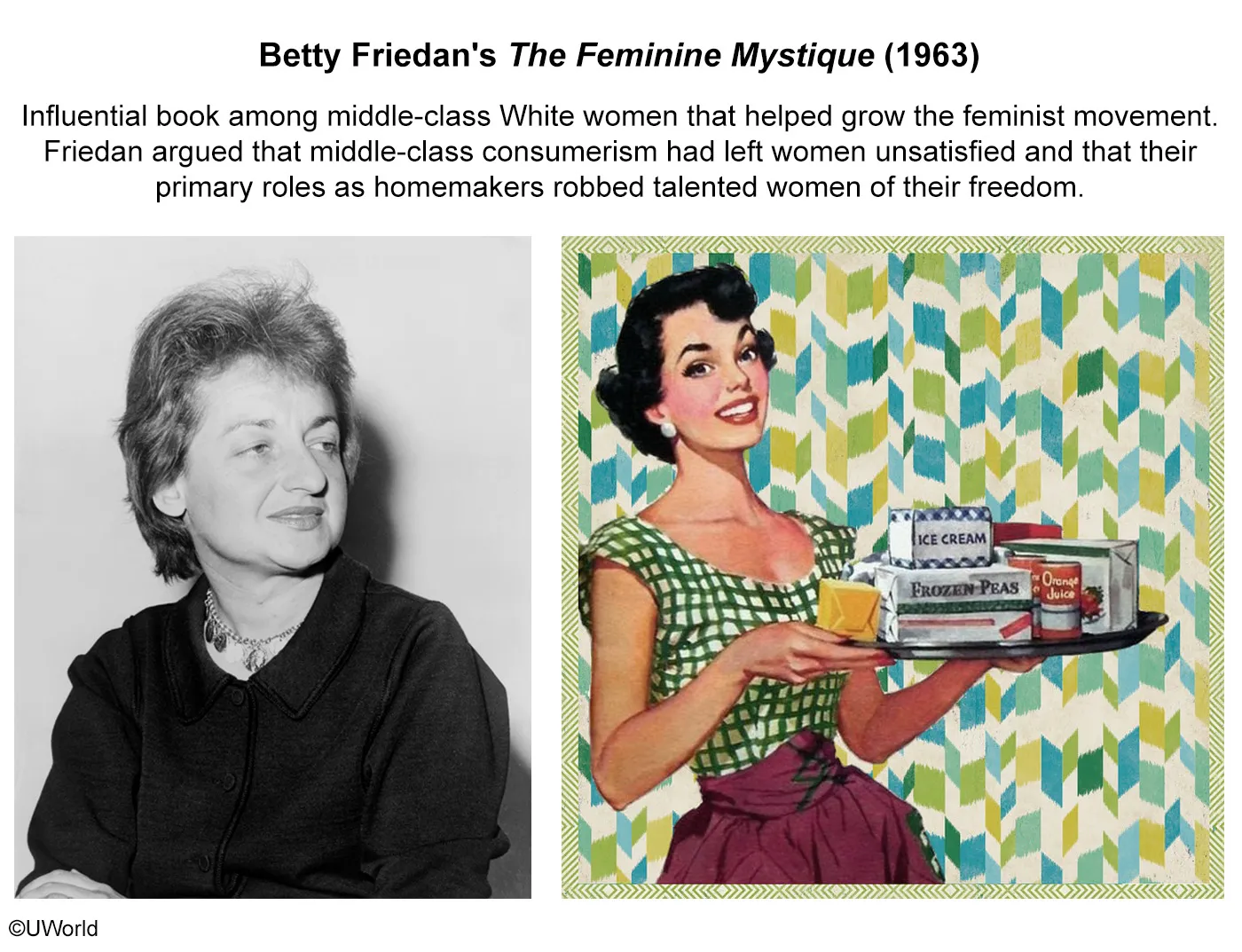
Like the counterculture movement, second-wave feminists rejected many of the social, economic, and political values of their parents' generation. For example, the counterculture's critique of mass culture was echoed in Betty Friedan's The Feminine Mystique. Freidan argued that housewives were trapped by a false promise of domestic happiness marketed to a consumer society, which became central to feminism in the 1960s and 1970s.

Other second-wave feminists, such as Gloria Steinem, helped establish the women's liberation movement. Like the counterculture, the movement challenged established power structures, championed gender freedom, and rejected traditional standards of beauty.

(Choice A) US imperialism sought to spread American culture across the globe and had little in common with the youth of the counterculture, who rejected mass culture and distrusted the government.

(Choice B) Fundamentalism in the 1910s and 1920s rejected modernity and adhered to a literal interpretation of the Bible. The counterculture rejected these ideas and embraced Eastern religions and Christian deism.

(Choice D) The social conservatism of the 1980s and 1990s called for a return to the establishment that the counterculture rejected.

Things to remember:
Like the youth of the counterculture movement, second-wave feminists rejected many of the social, economic, and political values of their parents' generation.

UWorld Dark Blue logo

Study Anywhere, Anytime

Prep for APUSH Unit 8 wherever you are: on the bus, between classes, or chilling at a café. Open the app to knock out APUSH unit 8 practice test questions, watch a quick video, or review your notes on the fly. Your full APUSH Unit 8 study guide is always right in your pocket!

Stand Out
with a Top Score in AP U.S. History

Complete your comprehensive APUSH Unit 8 review and boost your performance to make yourself a standout candidate for competitive colleges, majors, and scholarships by earning a top score.

Choose Your Subscription
Dream Score Plan
360-Day
$169
Deep Learning Plan
180-Day
$149
Score Booster Plan
90-Day (No print book, only digital)
$129
Introductory Plan
30-Day (No print book, only digital)
$99

Get your all-in-one course today!

  • Engaging APUSH Videos with Expert Instruction
  • Customizable Quiz Generator
  • Adjustable Study Planner
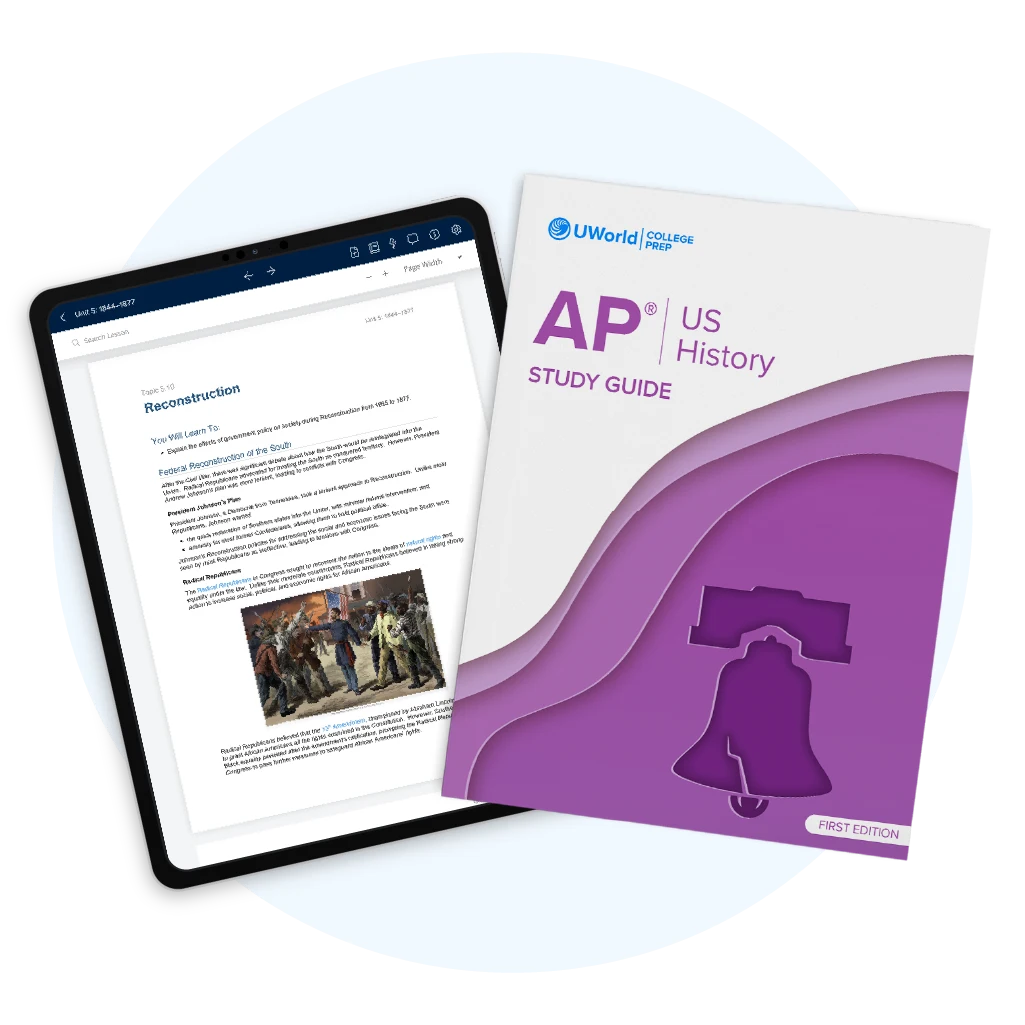
  • Print & Digital Study Guide with Step-by-Step Explanations
  • Realistic Timed Test Simulation
  • Progress Dashboard
  • 500+ Expert-Designed, Exam-style Practice Questions
  • Smart Flashcards
  • Mobile App
Explore our free trial and frequently asked questions.

Hear From Our AP Students

UWorld’s service is pretty good and helps provide a lot of explanations on subjects I haven’t been confident on before.

—Bence P.

The questions here are the most realistic to the AP tests I've seen so far! I appreciate the ability to customize tests as well.

—Kaila H.

The best part is that all options are well-explained, telling clearly why they are not the right option.
—Syeda Huma Z.

Frequently Asked Questions (FAQs)

AP U.S. History Unit 8 covers the major political, social, and global shifts from 1945 to 1980, and having a clean Unit 8 APUSH overview helps you make sense of how the U.S. moved into a new era after WWII. This period highlights America’s expanding international role, rising tensions with the Soviet Union, and major domestic reform movements that shaped modern society.

Key topics include:

  • Cold War & Red Scare: U.S.–Soviet rivalry and fears of communist influence.
  • America as a World Power: Expanding global presence and alliances.
  • Vietnam War: Escalation, protests, and long-term impact.
  • The Great Society: Landmark social and economic reforms.
  • Civil Rights Movement: Activism, legislation, and major leaders.
  • 1960s Youth Culture: Counterculture, protests, and social change.

To make your APUSH Unit 8 full review easier, UWorld breaks these topics down with visual explanations and exam-style APUSH Unit 8 MCQs that teach you the “why” behind every answer so you can walk into test day confident.

Preparing for the AP U.S. History Unit 8 exam is easier when you break things into small, manageable steps. Since this period covers huge shifts in politics, culture, and global relations, having a clear plan helps you stay focused.

A strong prep routine looks like this:

  • Read the Study Guide: Use UWorld’s APUSH Unit 8 study guide to review key events and summaries.
  • Watch Video Lessons: UWorld videos help you quickly understand tough concepts.
  • Practice Questions: Try APUSH Unit 8 practice MCQ sets and APUSH Unit 8 multiple-choice questions to see what you really know.
  • Review Progress Checks: Use APUSH Unit 8 MCQ progress check items to track improvement.

If you want full confidence before you take the exam or even a quick APUSH Unit 8 quiz, UWorld gives you everything in one place, clear explanations, step-by-step visuals, and realistic practice questions that help you understand the “why” behind every answer. It’s the most reliable way to turn your studying into real score gains.

If you’re looking for free resources to start your AP U.S. History Unit 8 prep, the best place to begin is the UWorld 7-day free trial. You’ll get access to high-quality APUSH Unit 8 MCQs, sample explanations, and a quick Unit 8 APUSH overview to help you understand the big themes before diving deeper.

You can also use College Board’s free AP Classroom materials, which include progress checks and a few APUSH Unit 8 practice MCQ sets. These help see the question style you’ll face on the real exam.

Khan Academy offers videos and review content you can use for extra support or a quick refresher before an APUSH Unit 8 quiz. Pairing all three sources gives you a strong, well-rounded start without spending anything.

The APUSH Unit 8 test includes several different question formats that check how well you understand major events, policies, and themes from 1945 to 1980. You’ll need to show your ability to analyze sources, explain historical relationships, and connect broader ideas across the unit.

You may see questions such as

  • APUSH Unit 8 multiple-choice questions (MCQs)
  • Short-Answer Questions (SAQs) and APUSH Unit 8 SAQs
  • Document-Based Questions (DBQ) like an APUSH Unit 8 DBQ
  • Long-Essay Questions (LEQs)

If you want realistic practice for all of these formats, UWorld gives you exam-style questions with detailed explanations that break down every option. Their APUSH practice builds the exact thinking skills you need to feel confident walking into the unit 8 APUSH test, making your prep smoother and way more effective.

Improving your FRQ score for Unit 8 starts with knowing the major turning points of the era: the Cold War containment, Vietnam, the Great Society, and civil rights. Strong responses come from linking evidence, historical reasoning, and clear arguments, so ensure that you understand how these themes connect across decades. Practicing this structure ahead of time makes writing on test day much easier.

It helps to review sample prompts, outline responses, and analyze what high-scoring FRQs do well. You can also take notes on APUSH Unit 8 SAQs, which build the same skills you’ll use in longer essays. Focus on clarity, evidence, and continuity.

UWorld is one of the most effective ways to level up fast because each FRQ-style question includes breakdowns of the reasoning you need. Their tools help you practice crafting arguments and using evidence just like the graders expect, giving you a huge advantage on Unit 8 FRQs.

Period 8 usually makes up a meaningful portion of the APUSH exam, carrying roughly 10–17% of the total test weight. Since it covers major themes like global conflict, domestic reform, and cultural change, the College Board pulls from this era often. You’ll see questions tied to Cold War policies, civil rights activism, and Cold War diplomacy across both the multiple-choice and free-response sections.

You can expect to see Period 8 topics in APUSH Unit 8 multiple-choice questions and essays that require you to explain foreign policy decisions or evaluate changes in civil rights. Because this era blends domestic and international developments, it becomes a favorite for FRQs.

UWorld helps you focus on the exact ideas that matter most for this weighted section. Their detailed explanations break down high-yield concepts and show you why certain themes repeat on the exam. With targeted practice, you build the confidence you need to take on Period 8 questions, no matter how they appear on test day.

A strong study guide for APUSH Unit 8 should break down the Cold War, Vietnam, the Great Society, and civil rights in a way that’s easy to follow. Since Period 8 covers huge political and cultural changes, having everything simplified into bite-sized explanations helps you review faster and remember more when you’re under test pressure.

You’ll find options online, but most general Unit 8 summaries leave out key details you’ll need for APUSH Unit 8 MCQs and essays. Some even skip the context needed to answer APUSH Unit 8 SAQs or long-form responses effectively.

Your best bet is UWorld’s Unit 8 study guide because it’s built around exam-style thinking. Every topic is broken into clear summaries, visuals, and explanations tied directly to the types of questions you’ll actually see. It’s the easiest way to build a full, reliable review without wasting time.

Yes, you can definitely find practice tests focused on APUSH Unit 8, and using them is one of the fastest ways to track what you know. Testing yourself on key topics like containment, Vietnam, civil rights, and Cold War diplomacy helps you understand exactly where your weaknesses are before you step into the real exam.

Look for APUSH Unit 8 practice test sets, APUSH Unit 8 MCQs, and targeted quizzes that mimic the official format. A good set will include APUSH unit 8 practice MCQ items with explanations, not just answer keys. These help you learn the reasoning behind each choice.

UWorld offers the most realistic Unit 8 practice because its questions match the AP exam difficulty and style. Their detailed explanations teach you the logic behind each answer, helping you improve quickly and feel fully prepared for your Unit 8 test.

Studying for APUSH Unit 8 usually takes a steady mix of review sessions over a few days because the Cold War, Vietnam, and civil rights topics need time to sink in. You don’t need to cram; instead, break the unit into small subtopics and spend 20–30 minutes a day reviewing notes or watching a quick lesson. Consistency beats long study marathons for this unit.

Try doing a daily set of APUSH Unit 8 practice questions or a short APUSH Unit 8 quiz to see what’s sticking. If certain events or policies still feel fuzzy, go back and review only those parts instead of restarting the whole unit.

UWorld makes this super manageable because you can study in short bursts: one video, one explanation, or one set of APUSH Unit 8 MCQs at a time. It fits naturally into your schedule, and the progress tracking helps you know exactly when you’ve studied enough to trust your prep.

Many students struggle with Unit 8 because they try to memorize facts instead of understanding how events connect. The Cold War, Vietnam protests, and the Great Society all overlap, and missing those links makes the whole unit confusing. Another common mistake is skipping practice until the last minute, which makes the test feel harder than it actually is.

You can avoid this by reviewing timelines, tying events to causes, and practicing with APUSH Unit 8 multiple-choice questions early. Use at least a few APUSH Unit 8 practice questions every day to keep concepts fresh. Small, steady practice beats binge-studying.

UWorld helps you avoid these common pitfalls with explanations that highlight connections and patterns you might miss on your own. Their step-by-step breakdowns build clarity and confidence, helping you study Unit 8 with less stress and better focus.

Scroll to Top

Ace AP US History

Master Every Concept
The Easy Way
No Credit Card Required
See the UWorld Difference For Yourself

Frequently Asked Questions

New Purchase: All new subscriptions go into effect from the time they are activated and not at the time of setup/purchase. A subscription can be activated immediately or any time thereafter. If your initial purchase consists of multiple courses (Qbank, Self-Assessment exam, CCS, etc.), each can be activated individually and independently via your account on our website. This process of activating a subscription after purchase allows you the flexibility to start a subscription when you are truly ready to use it.

We recommend that all subscriptions be activated within 180 days of setup/purchase. Once a subscription is activated, it cannot be paused or suspended for any reason and will run continuously for the duration of the course material.

Renewal: A renewal is an extension of time to continue access to a current activated subscription. Because a renewal is an extension to an already active subscription, it is effective from the existing expiration date, not from the day of purchase and cannot be deferred to start at a later date/time.

Note: All of our subscriptions are based on the Eastern Time Zone (GMT/UTC -5 hours or New York Time), which may be different than your local time zone.

Any of our product offerings can be purchased from our website with payment due in full at time of purchase via a credit or debit card with American Express/Discover/MasterCard or Visa logo.

You will need to register for an account in order to purchase any of our products. Once you have registered for an account or if you already have an account:

  • Log in to your UWorld account
  • Click on the Cart icon at the top of the page and then select your desired product to see a list of available packages and their prices
  • Select the package you wish to purchase
  • Verify your profile information, address, and educational status, then click the Update button
  • Enter your Billing address and credit/debit card information, then click Review Order
  • Verify that the correct product is in your cart and click Place Order
  • A purchase receipt will automatically be sent to your registered email address

If you complete your purchase but do not receive a receipt, please contact the Customer Care Team at [email protected]

You can subscribe to any of our online courses/services using a credit or debit card with a Visa, MasterCard, Discover or American Express logo. After a successful payment, your subscription will immediately be available for activation via your account on our website or available complementary mobile applications.

You can also subscribe via personal check, money order, or demand drafts taken in U.S. dollars. These types of payments should be mailed to us and should include the name of the subscription and the duration, along with the details asked for in the registration form. We will set up your account as soon as we receive your payment and notify you via email of your access credentials. All direct-mail payments must be in U.S. dollars and made payable to:

UWorld, LLC
9111 Cypress Waters Blvd
Suite 300
Dallas, TX 75019

We do not accept cash via mail, currencies other than U.S. dollars or payments via fax.

Individuals purchasing our CPA Review product may finance their purchase using Affirm during checkout process. Your eligibility depends on your credit score and other criteria, as per Affirm’s policies (outlined here). A soft credit check, a credit check that does not affect your credit score, will be performed by Affirm to determine your loan eligibility. You will need a US based bank account to qualify.

All refunds are evaluated on a case-by-case basis for products purchased directly from UWorld. One case has no bearing on another. Refund amounts determined by UWorld are final.

In-App Purchases: We are unable to process any refunds for purchases made via mobile application (in-app). Please contact Apple for all refund/credit requests for Apple in-app purchases.

USMLE Step 2 CS, Step 3 CCS, Subject Reviews & Self-Assessment Exams: These subscriptions are non-refundable, non-transferable, and cannot be converted into another subscription.

CPA Review: Students may request to cancel their CPA review product only within 10-days of activation of any of the materials. To qualify for a refund, no more than 10% of the course (lectures, Qbank, or a combination there-of) may have been used per exam section. All CPA Review refunds are subject to a cancellation fee of $75 (for single section purchases) or $250 (for package
purchases), plus any applicable shipping charges. No return of merchandise is necessary.

All other Qbanks: Refunds are considered for subscriptions of more than 30 days. Refund amounts are based on the number of days elapsed since the subscription start date or the number of questions used, whichever amounts to a higher deductible.

Example scenarion: An individual purchases a 180-day Qbank subscription and generates a few test blocks equal to 20% of the questions in the Qbank. After 45 days, he/she requests a refund. Because the elapsed duration is greater than the percentage of questions used, the refund amount will be based on a subscription converted to the closest duration (60 days) by deducting the applicable 60-day subscription fee from the refund. In the same scenario, if the individual had used 85% of the questions, the refund would be 15% of the subscription fee paid.

Note 1: A processing fee of 10% (minimum of $10 and maximum of $25) will be applied to all refund amounts.

Note 2: All refunds, pro-rated or otherwise, must be requested within 360 days of original purchase. Refunds for purchases made more than 360 days ago will be issued as non-refundable, non-transferable store credit.

Note 3: Subscribers must notify UWorld of their intent to obtain a refund before activating their subscription (or) during the active duration. If the reset option is used or all of the questions are used, no refund will be allowed (see “I want to reset/delete my Qbank test history (or) start all over again, is this possible?” below for further details). No refunds will be offered for expired subscriptions.

Note 4: For combination package purchases, individual subscription fees will be applied when calculating the refund. If any self-assessment Exam(s) is utilized from a package, the entire purchase is rendered non-refundable.

Note 5: Although access to Qbanks via certain mobile devices is provided as an additional feature, it is not intended to be a replacement for computer access, and no refunds or cancellations will be honored due to user inability to install and/or use the provided software on any mobile device (regardless of whether the device meets the minimum system requirements).

Please use the following steps to purchase a renewal for your subscription:

  • Log in to your account on our website
  • Click on the User Icon in the top right corner of the screen
  • Click on the Renew button corresponding to your subscription
  • Select the Renewal duration you wish to purchase
  • Verify your profile information, address, and educational status, then click the Update button
  • Enter your Billing address and credit/debit card information, then click Review Order
  • Verify that the correct package is in your cart and click Place Order

Upon a successful transaction, you will be sent a confirmation email receipt.

A renewal is an extension of time to continue accessing an active subscription, and it will not start the subscription over, provide a reset, or grant access to additional questions that were not previously accessible. Because a renewal is an extension to an already active subscription, it is effective from the existing expiration date, not from the date of purchase, and cannot be deferred in any way to start at a later date/time.

Please note that to qualify for renewal pricing, you will need to renew the course before it expires. Renewals are not offered to expired subscriptions. If you fail to secure a renewal before the expiration date, you will need to purchase a new subscription at the regular price directly from our website to regain access to the material.

Note: All times and dates displayed for subscription expiration correspond with the Eastern Time Zone (GMT/UTC -5 hours or New York Time), which may be different than your local time zone.

Note: If your initial purchase was a combination package, you will need to renew each active subscription individually. You do not need to renew a course that has not been activated.

You may request to upgrade or downgrade your subscription purchase as long as it has not been activated. If you purchase a combination package, all included subscriptions must be unused. Please be advised that current subscription pricing will apply.

If your subscription has been activated, unfortunately, we cannot upgrade it retroactively. If seeking to downgrade, please refer to our refund policy for available options.

We do not offer custom duration(s) or combination packages other than those outlined on the website. Please refer to our purchase page for currently available subscriptions (including discounted combination packages for some products).

Self-Assessment exam subscriptions are for 14 days each. Subscribers whose active subscription(s) have not expired can purchase renewals from 7 days or more at any time before their active subscription expires. Please refer to the respective course description page for renewal options.

We offer a demo on each of our product pages that contains a sample of the product interface and a few sample questions. We do not offer guest/trial accounts to test our software and view materials.

It is possible to purchase a subscription as a gift for someone else. However, the intended recipient will need to register an account on our website (or have an account registered for them, with their profile information entered accurately). If the user is present at the time of purchase, the purchase can be made from their account on our website using any credit or debit card with a Visa, MasterCard, American Express, or Discover logo.

If the user is not present, or you wish for the gift to be a surprise, please contact Support directly using the contact form to arrange payment for the gift subscription. You will need to provide the user’s registered email address so the account can be located.