
AP® U.S. History Unit 7 Review and Practice Test
AP® U.S. History Unit 7 brings together some of the most tested ideas on the exam, from American expansion to progressive reform to the global conflicts that reshaped the modern world. UWorld helps you turn this huge period into something you can understand, apply, and recall with confidence. Each tool here strengthens your APUSH Unit 7 review and prepares you for the exam with a solid understanding, not guesswork.
Score Higher with Our AP U.S. History Unit 7 Review
Our review helps you study smarter by connecting video lessons, interactive guides, and realistic APUSH Unit 7 MCQ practice into a single learning system. You understand the content faster, remember it longer, and feel better prepared for the AP US History Unit 7 review.
Learn Faster with Focused, High-Impact Video Lessons
Our videos break Unit 7 into clear explanations supported by visuals, timelines, and guided reasoning. Each lesson stays short, so you absorb ideas like progressivism, wartime diplomacy, and the New Deal without getting overwhelmed. By the end, you can see patterns that show up in APUSH Unit 7 questions, giving you a level of insight that builds real exam confidence.
Interactive Study Guides That Deepen Your Understanding
The study guides turn APUSH Unit 7 notes into clear, interactive explanations that help you understand the reasoning behind major events. Visual cues and structured prompts make it easier to see why policies shifted, how groups responded, and what the College Board wants you to recognize. These guides prepare you for APUSH Unit 7 SAQs and FRQs that require accurate historical logic. Each guide reinforces what you learned in the videos, strengthening your understanding and making it more connected.
Build Exam-Readiness with Our APUSH Unit 7 Practice Test Questions
Passage:
Question
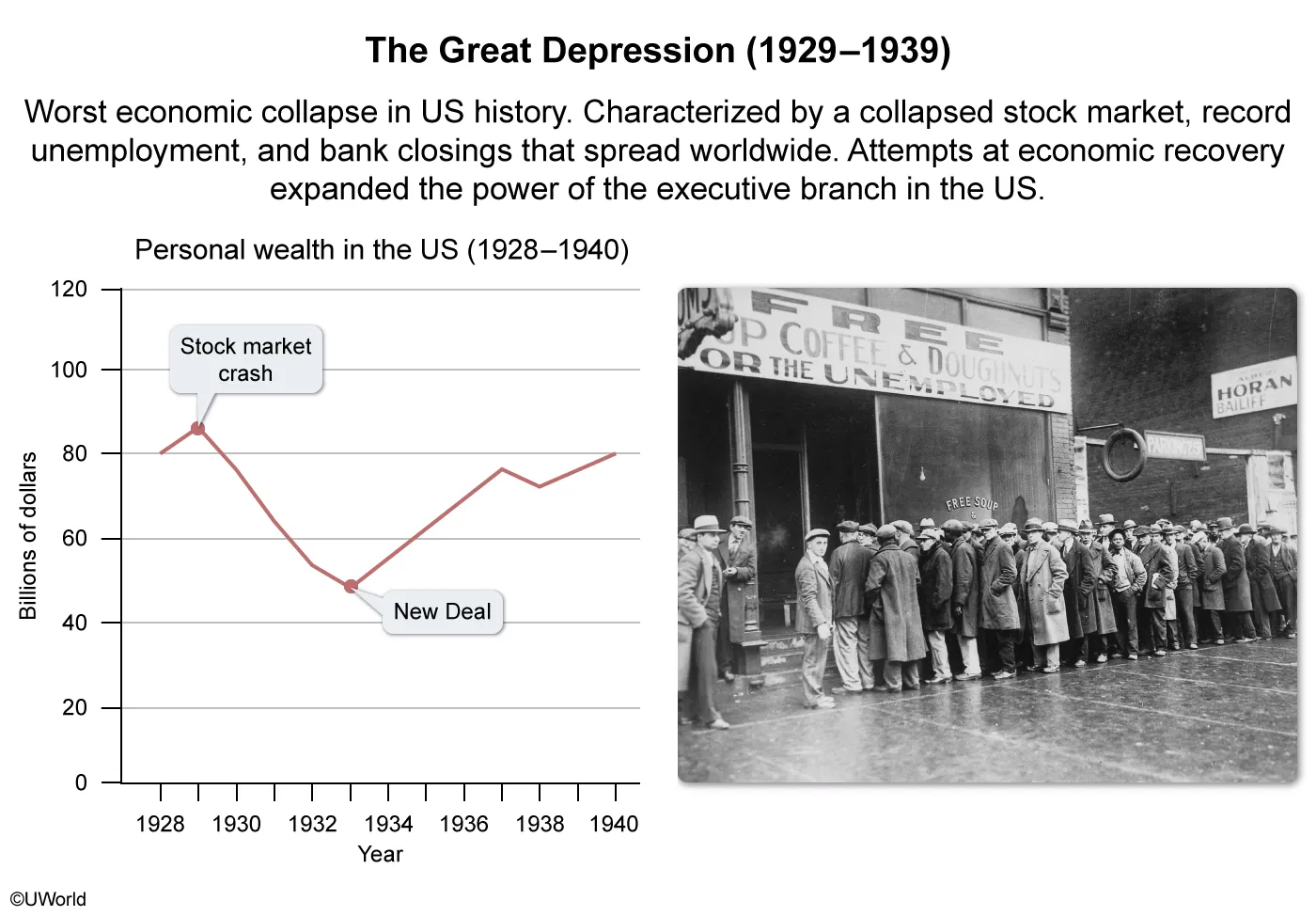
The graph most strongly supports which of the following arguments?
| A.The New Deal resulted in an expansion of the powers of the federal government and the president | |
| B.The Hoover administration's response to the Great Depression failed to stop the economic decline experienced by American families | |
| C. Direct intervention in the economy by the federal government resulted in opposition by conservatives on the Supreme Court | |
| D. The Great Depression reversed a long-standing migration trend in the United States as people moved from cities to rural areas |
Explanation
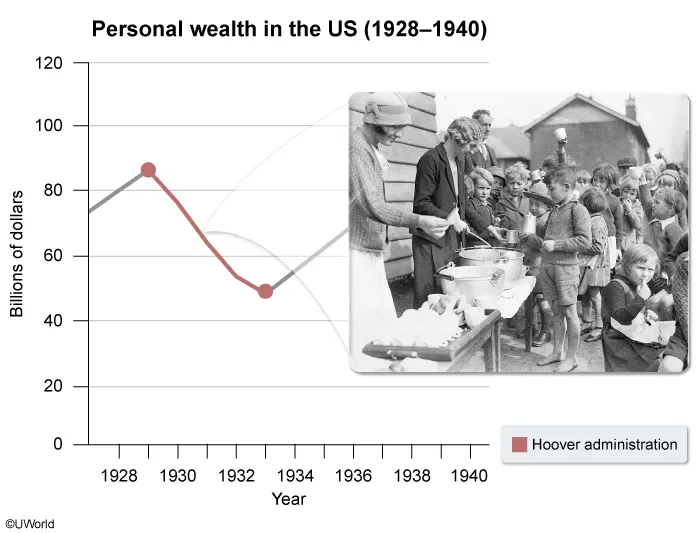
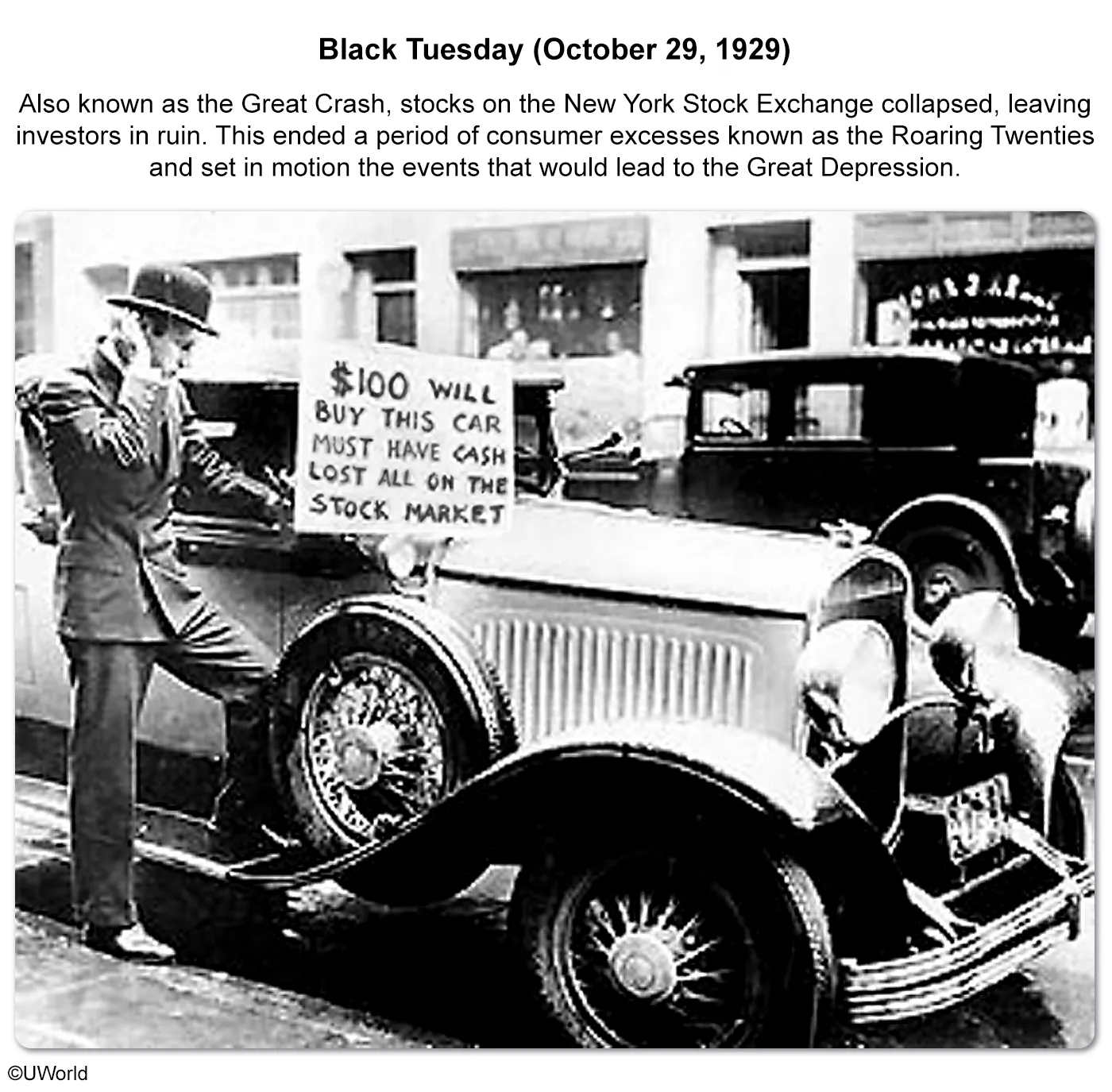
In March 1929, Herbert Hoover was sworn in as president during a period of economic optimism; seven months later the stock market collapsed. The severity of Black Tuesday set in motion a chain of events that sank the nation–and the world–into the Great Depression.
The graph shows a sharp, dramatic, three-year economic decline during the Hoover administration. During the Great Depression, President Hoover opposed direct government intervention in the economy and vetoed measures to provide federal assistance to families. Hoover felt voluntary action, such as the relief provided by private charities, was the best response.
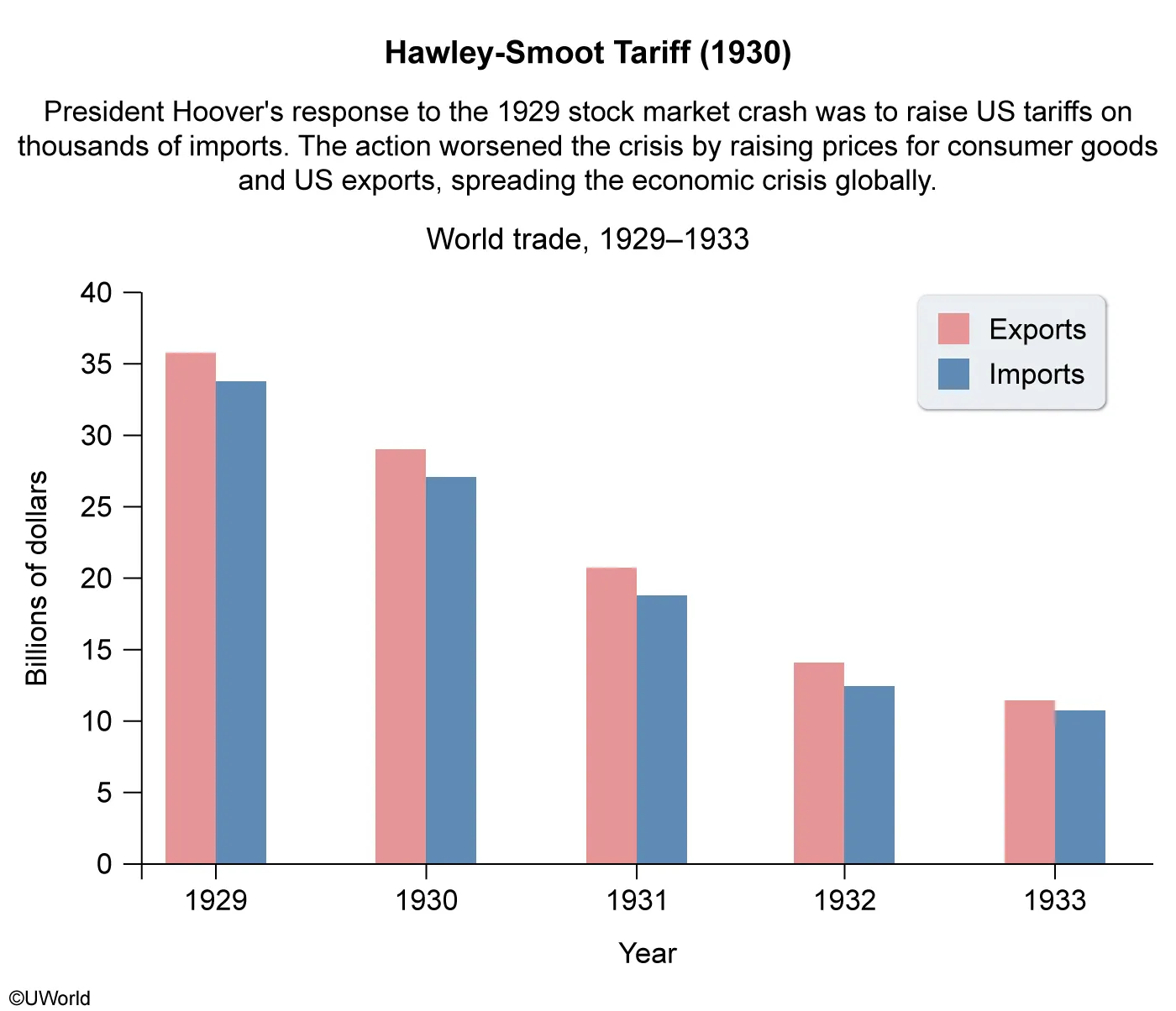
The Hoover administration also passed the Hawley-Smoot Tariff, which increased taxes on imported goods and made them less affordable for American consumers. The Hoover administration's efforts to stimulate the economy included government bailouts for banks and railroads. As the graph illustrates, the administration's response in the Great Depression failed to stop the economic decline of American families.
(Choices A, C, & D) – All these choices are true of the Great Depression; however, the information in the graph does not support them.
(Choice A) The New Deal's expansion of federal government powers would be supported by data on the number of economic programs passed, not by data on the decline of personal wealth.
(Choice C) Supreme Court conservatives' opposition to federal economic intervention would be supported by data on the number of judicial rulings against the New Deal, not by the decline of personal wealth.
(Choice D) A reversal of the long-standing migration trend in the United States as people moved from cities to rural areas would be supported by demographic data, but not the economic data presented on the graph.
Things to remember:
The Hoover administration's response to the Great Depression failed to stop the sharp economic decline experienced during his presidency. Furthermore, Hoover's refusal to provide relief for families, and the passage of the Hawley-Smoot Tariff deepened the economic crisis.
Passage:
Question
Which of the following factors most directly contributed to the economic growth after 1938 shown in the graph?
| A.An expansion of the social welfare programs enacted by the New Deal | |
| B.A growing reluctance to stimulate the economy through New Deal job creation programs | |
| C. A fear of too much direct government intervention in the economy | |
| D. An increase in economic production to supply the war-time needs of European allies |
Explanation
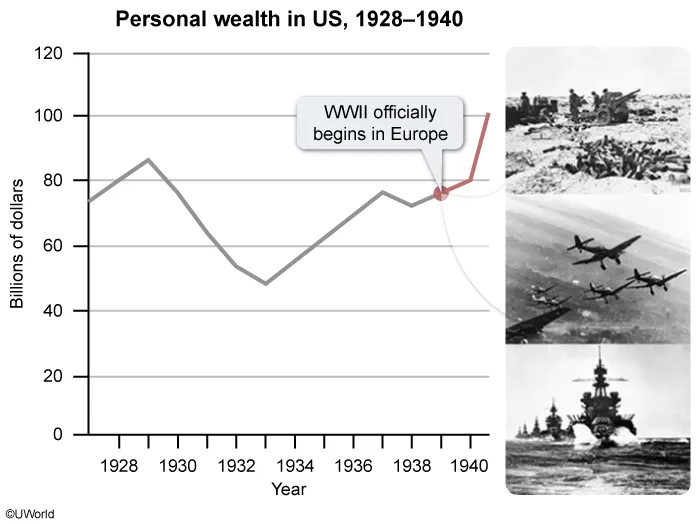
Neither the Hoover administration nor the sweeping programs of the Franklin D. Roosevelt administration can be credited with ending the Great Depression. Rather, the unfortunate development of another global war emerging on the horizon benefited the US economy the most during by 1940.
Although the US was determined to not become involved in a second global conflict, by 1938 there was no denying that Europe was headed for this fate. America's European allies needed supplies to mobilize for World War II, and the US–whose idle factories were shielded from attack by geography–was in a favorable position to produce and sell needed goods to them.
In 1938, manufacturing jobs began coming back to US factories. As the US supplied the war effort for its allies, the economy began to expand. When the US finally entered World War II in 1941, the economy began to exceed the level it had reached immediately before the stock market crash of 1929.
(Choice A) After 1938, the Roosevelt administration had to fend off challenges to New Deal social programs. However, an increase in US manufacturing supplied Europe's war effort and started the economic recovery.
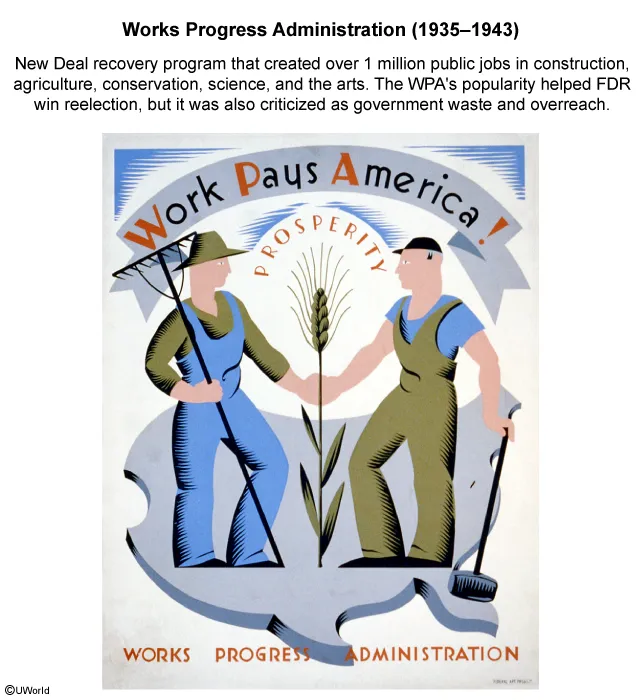
(Choice B) The stimulation of the economy through New Deal job creation programs such as the WPA was beneficial, however, America's economic recovery post-1938 was mostly the result of supplying the war-time needs of European allies.
(Choice D) After 1938, many conservatives feared the government had interfered too much in America's economy, but this was unrelated to the return of manufacturing jobs, which accounted for the sharp economic uptick during the period.
Things to remember:
After 1938, manufacturing for WWII began to grow the economy, first as the US supplied European allies and then as the country entered the war in 1941.
Passage:
"Within the last two years there has been a steady stream of Negroes into the North in such large numbers as to overshadow in its results all other movements of the kind in the United States. These Negroes have largely come from Alabama, Tennessee, Florida, Georgia, Virginia, North Carolina, Kentucky, South Carolina, Arkansas and Mississippi…. [W]e hear that…[they] are being brought North to fight organized labor, and to carry doubtful States for the Republicans....
Some say that they left the South on account of injustice in the courts, unrest, lack of privileges, denial of the right to vote, bad treatment, oppression, segregation or lynching. Others say that they left to find employment, to secure better wages, better school facilities, and better opportunities to toil upwards."
Carter G. Woodson, historian, A Century of Negro Migration, 1918
Question
The Great Migration described in the excerpt led most directly to which of the following?
| A.African American expressing identity through new forms of art and literature | |
| B. African Americans achieving racial equality in northern cities | |
| C.Labor shortages for factories in the South | |
| D. A decreasing emphasis on agriculture in the South |
Explanation
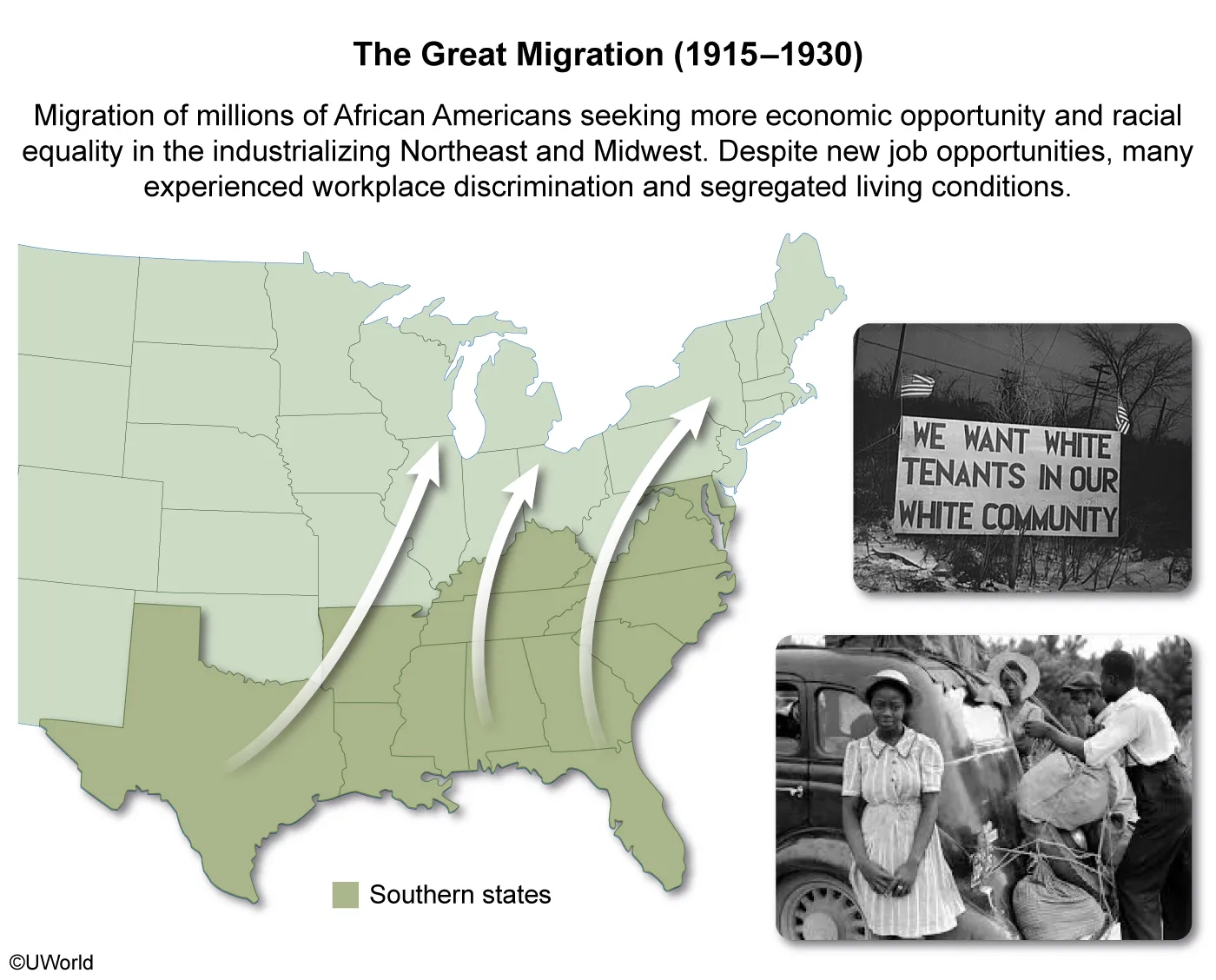
Between 1915 and 1930, millions of African Americans fled racial oppression in the South for cities in the Northeast and Midwest. This exodus, known as the Great Migration, was one of the largest internal mass migrations in US history.
Unwelcome in White neighborhoods in the North, African Americans self-segregated into neighborhoods such as Harlem in New York City and Chicago's South Side. As a result, these neighborhoods became centers of African American culture.
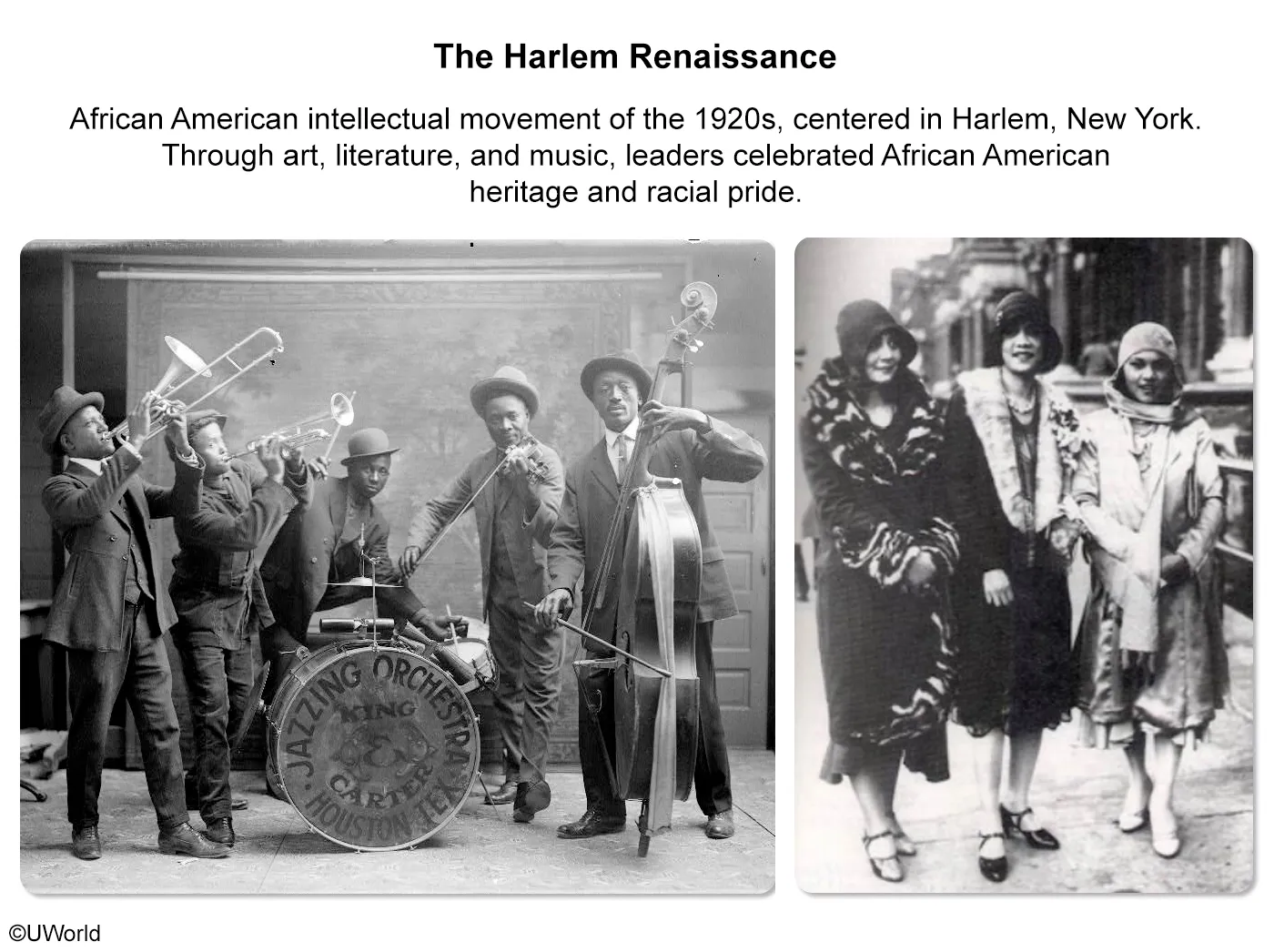
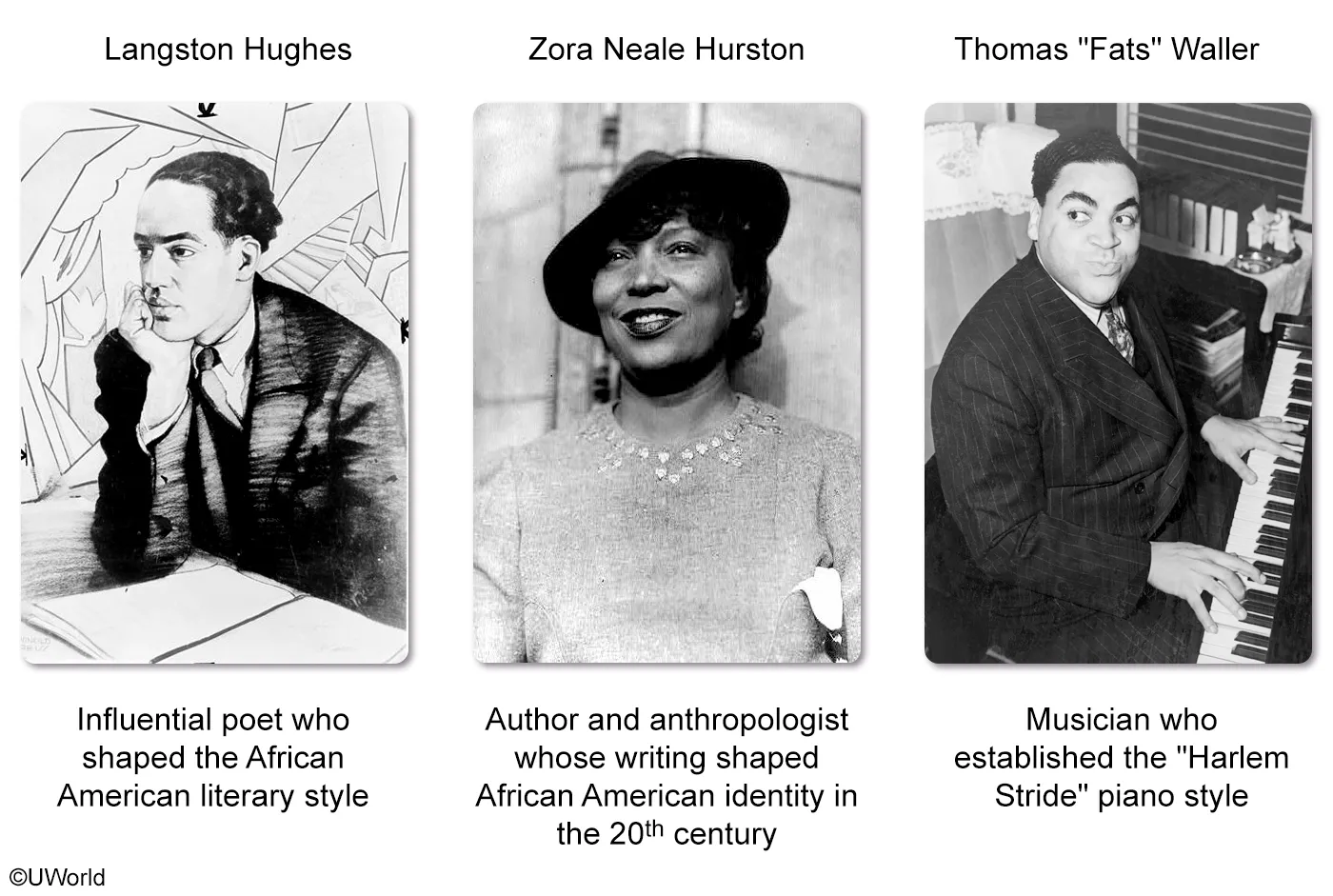
The Harlem Renaissance in the 1920s was a rebirth of African American intellectual and artistic expression. African American identity was expressed through new forms of art and literature. Writers such as Langston Hughes and Zora Neale Hurston shaped African American literary style. Harlem also produced innovative fashion and musical styles that reflected African American culture—for example, Thomas "Fats" Waller's "Harlem Stride" piano style.
(Choice B) Rather than tolerance, African American families migrating to northern cities found escalating racial tensions that sparked violence, such as the Chicago Race Riot of 1919.
(Choice C) The migration of Black labor to the North did not cause a labor shortage in Southern factories because the region was primarily agricultural with little industry.
(Choice D) Instead of diminishing in importance, agriculture remained a cornerstone of the South's economy throughout the early 20th century.
Things to remember:
During the early 20th century, mass migration of African Americans into northern cities led to what became known as the Harlem Renaissance, a celebration of African American intellectual and artistic expression.

Turn Downtime into Study Time
With the UWorld app, small moments become productive review sessions. You can watch a quick video, answer APUSH Unit 7 practice questions, or check an explanation while commuting, between classes, or waiting for friends. Each resource reinforces the others, so every short session moves you closer to mastering the APUSH Unit 7.
Stand Out
with a Top Score in AP U.S. History
Complete your comprehensive APUSH Unit 7 review and boost your performance to make yourself a standout candidate for competitive colleges, majors, and scholarships by earning a top score.
Get your all-in-one course today!
- Engaging APUSH Videos with Expert Instruction
- Customizable Quiz Generator
- Adjustable Study Planner
- Print & Digital Study Guide with Step-by-Step Explanations
- Realistic Timed Test Simulation
- Progress Dashboard
- 500+ Expert-Designed, Exam-style Practice Questions
- Smart Flashcards
- Mobile App
Hear From Our AP Students
UWorld’s service is pretty good and helps provide a lot of explanations on subjects I haven’t been confident on before.
The questions here are the most realistic to the AP tests I've seen so far! I appreciate the ability to customize tests as well.
The best part is that all options are well-explained, telling clearly why they are not the right option.

Frequently Asked Questions (FAQs)
What are the main topics covered in AP U.S. History Unit 7: Period 7: 1890–1945?
AP U.S. History Unit 7 brings together decades of rapid change, major conflict, and expanding global influence. To study this unit effectively, you need a clear understanding of the social, political, and economic forces that reshaped the United States during this era. The unit spans everything from reform movements to foreign policy shifts, and each theme contributes directly to the exam’s understanding of continuity and change. A strong review helps you connect events rather than memorizing them in isolation, and this is where structured tools like UWorld’s explanations can reinforce your understanding.
Key topics you must know include
- Debates over imperialism
- The Progressive movement
- World War I
- Innovations in communications and technology in the 1920s
- The Great Depression and the New Deal
- World War II
- Postwar diplomacy
Once you learn the larger themes, it becomes easier to see how one era influenced the next and why these decades matter for the exam. Good preparation involves more than collecting facts. It means recognizing patterns, understanding cause and effect, and being able to answer both multiple-choice and free-response questions with clarity. Using a review like UWorld helps build these connections, makes the entire process smoother, and enables you to walk into the exam with confidence.
How should I prepare for an AP U.S. History Unit 7 exam?
A strong AP U.S. History Unit 7 review strategy comes from combining content understanding with consistent practice. This unit covers a wide range of reforms, conflicts, and economic developments, so you want to build a steady routine that breaks the material into smaller parts. Begin by reviewing the bigger themes so you always understand the context behind individual events. This prevents the common problem of trying to memorize every detail without knowing why it matters. Review tools like UWorld help because they reinforce those connections through explanations and guided reasoning.
Here is an approach that works well
- Start with a clear summary of each decade so you understand the flow from imperialism to the postwar era
- Use practice questions to strengthen your ability to recognize patterns and eliminate incorrect answers
- Review charts, visuals, and timelines to build long term memory of cause and effect
- Practice writing short responses to build skills for FRQs and DBQs
- Revisit your weak areas regularly so your understanding stays balanced
Once these steps become part of your routine, you start to understand Unit 7 as a single narrative rather than as separate lessons. This helps during multiple choice questions where the exam often tests how events influence each other across time. Steady practice improves your ability to evaluate evidence, identify major turning points, and respond confidently under time pressure. The more you integrate review, practice, and explanation driven learning, the easier it becomes to perform well on classroom quizzes, progress checks, and the full AP exam.
Are any free resources available for AP U.S. History Unit 7?
Yes, you can begin your AP U.S. History Unit 7 review with several free resources, and the strongest starting point is UWorld’s free 7-day trial. The trial gives you complete access to videos, interactive study guides, and full sets of practice questions, allowing you to build understanding through structured explanations rather than scattered materials. Everything is already organized around the skills and thinking patterns the exam expects, so you get a clear picture of what matters most in this unit. Many students appreciate that the trial includes full answer explanations that walk through correct and incorrect choices, which helps you understand the reasoning behind each question instead of simply checking results.
Alongside UWorld, you can also use publicly available summaries, primary source documents, and historical collections online. These can give you additional context on wartime policies, progressive reforms, economic changes, and social movements. The College Board provides its syllabus, sample questions, and unit guides through AP Classroom, and teachers often rely on these to structure day to day instruction. After exploring these sources, using UWorld as your primary practice tool helps you reinforce the material you learn in class by turning content into usable, test ready knowledge. The explanations, visuals, and reasoning cues build long term understanding, while your classroom instruction supplies broader historical context. Together, the two approaches create a complete preparation system that helps you approach Unit 7 with confidence and clarity.
What types of questions are on the APUSH Unit 7 test?
The APUSH Unit 7 test usually includes a mix of multiple choice, short answer responses, and writing based questions that measure how well you understand both factual information and historical reasoning skills. The key to doing well is recognizing that these questions often connect events across decades rather than focusing only on isolated details. Reviewing the major themes, shifts, and turning points helps you work through these items with better accuracy. A resource like UWorld can guide you through this style of questioning with explanations that reveal the logic behind correct and incorrect answers.
Here are the main question types you should expect
- Multiple choice questions that use sources such as charts, excerpts, or images
- Short answer questions that ask for brief, direct explanations using specific evidence
- A document based question that requires evaluation of sources and historical context
- Long essay questions that test your ability to develop and defend a historical argument
Once you know how each format works, preparation becomes more predictable. Practicing with questions that reflect the exam’s structure helps you see repeated patterns and common traps. Working through a variety of sample prompts builds your ability to connect causes and consequences, identify broader trends, and support your arguments with relevant evidence. When you reinforce these skills with consistent practice and explanation driven learning, you move into the test with more confidence and a deeper understanding of how Unit 7 fits into the full course.
How can I improve my score on the Free-Response Questions (FRQs) for Unit 7?
Improving your score on the Free Response Questions (FRQs) for Unit 7 begins with understanding what each prompt asks you to demonstrate. FRQs reward clear thinking, precise evidence, and strong control over historical reasoning. Before writing, you want to build a solid understanding of major changes from 1890 to 1945 so you can select relevant examples without hesitation. Practicing with guided explanations helps you learn how to structure your responses and avoid common mistakes. This is where UWorld gives you support by showing how evidence and analysis work together in strong answers.
Use the following approach to strengthen your FRQ performance
- Read the prompt carefully and identify the task, focus, and time frame
- Choose 2-3 strong pieces of evidence that directly answer the question
- Organize your writing around a clear argument instead of a list of facts
- Connect each example to the prompt with specific reasoning
- Review sample responses so you can see what strong analysis looks like
Once you get used to breaking prompts into parts and selecting targeted evidence, your writing becomes more confident and easier to structure. Practicing regularly also helps you understand how to balance description with explanation, which is one of the most important skills on the FRQs. As you build familiarity with Unit 7 themes, you start recognizing which examples work best for each type of question. This makes your studying more focused and allows you to respond to writing prompts quickly and clearly on exam day.
What is the "Period 7: 1890–1945" unit's weight on the AP U.S. History exam?
Period 7 generally accounts for a substantial portion, around 10-17%, of the AP U.S. History exam because it covers major reforms, conflicts, and economic transformations that shaped modern America. While the exact number of questions can vary each year, this period is commonly represented across multiple choice items, short answer questions, and the writing sections. The exam often draws on Unit 7 when testing historical reasoning skills such as comparison, causation, and continuity and change because this era offers many turning points that lend themselves to deeper analysis. You can expect to see content related to progressivism, American diplomacy, the Great Depression, and wartime mobilization appear throughout the test in different formats.
Since questions often blend themes from multiple periods, a strong understanding of Unit 7 can also help you handle items that cross into earlier or later decades. Many students find it helpful to reinforce their classroom learning with structured practice that shows how the exam uses evidence and context, which is why explanation based tools like UWorld can support deeper understanding. When you become comfortable working with questions that reflect the reasoning patterns expected on the test, the weight of this unit becomes less intimidating. Instead of memorizing every detail, you start recognizing how events connect to broader shifts in government power, economic policy, and social change. This level of understanding helps you answer more confidently and increases your chances of earning higher scores across the entire exam.
Where can I find a good AP U.S. History Unit 7 study guide?
A strong AP U.S. History Unit 7 study guide should help you understand the major shifts from 1890 to 1945 without overwhelming you with unnecessary detail. The best guides organize the material clearly, break complex events into manageable ideas, and show you how different themes connect across decades. You want something that blends explanation with active learning so you can build long term understanding instead of repeating the same notes without improvement. UWorld offers this structure within its interactive study guides, which help you follow the logic behind major changes and prepare for both multiple choice and writing based tasks.
A good study guide should include the following
- Clear summaries of the Progressive Era, the New Deal, World War One, and World War Two
- Visuals that highlight cause and effect relationships
- Step-by-step explanations that strengthen your reasoning
- Examples showing how Unit 7 themes appear in real exam-style questions
- Opportunities to reinforce your learning through practice
When you use a study guide that emphasizes understanding rather than memorization, you start recognizing the deeper patterns across this period. This helps with analytical questions that expect you to explain why events happen and how different groups respond to major changes. Pairing a structured study guide with consistent practice gives you a complete preparation system that supports your progress in the classroom and on the final AP exam.
Can I find practice tests specifically for AP U.S. History Unit 7?
Yes, you can find practice tests designed specifically for AP U.S. History Unit 7, and using them helps you build familiarity with the content, pacing, and question formats. Practice tests allow you to see how the exam blends evidence, reasoning, and historical context across multiple decades. They also reveal which ideas you understand clearly and which areas need more review. Many students begin with a few targeted question sets before moving to full length practice, because this helps them build confidence step by step. UWorld offers Unit 7 practice questions that mirror real AP formatting and include explanations for both correct and incorrect choices.
Effective Unit 7 practice tests should provide
- Multiple choice questions using primary sources, visuals, or charts
- Short answer prompts based on major events from 1890 to 1945
- Practice SAQs and FRQs that highlight big themes of progressivism or wartime mobilization
- Clear explanations that show why the correct answer works
- Reasoning cues that help you connect content to exam skills
Once you integrate these into your study routine, you begin developing stronger instincts about how the exam expects you to think. You learn how to use evidence, interpret historical patterns, and respond to each question type with more confidence. Reviewing explanations after each attempt helps you improve quickly because you understand not just what the answer is, but why it is the most logical choice. This process steadily builds the skills you need for success on both classroom assignments and the AP exam.
How can I prepare for the Unit 7 progress check in AP Classroom?
The Unit 7 progress check in AP Classroom measures how well you understand the main ideas, reasoning skills, and historical relationships across this period. To prepare effectively, you want to build a solid foundation before you begin answering timed questions. Reviewing key topics such as progressive reforms, American involvement in global conflicts, and the major economic shifts leading into the Great Depression helps you recognize the patterns the progress check evaluates. Once you feel comfortable with the core themes, you should begin practicing with questions that reflect the structure and style of AP Classroom items.
UWorld offers a check for understanding experience that mirrors these expectations by giving you realistic multiple choice questions supported by detailed explanations that show how to evaluate evidence and eliminate incorrect choices. This helps you build confident habits that carry over into the progress check format. After completing a set of questions, reviewing your performance is essential. Look at which skills you used effectively and which areas felt challenging, then return to those topics with a targeted plan.
The goal of a progress check is not just to give you a score but to help you identify what to strengthen before moving on. Using a consistent practice tool alongside your classroom resources allows you to understand what the questions are really asking and gives you the clarity you need to perform well when your teacher assigns the Unit 7 progress check.
How do I stay organized while studying AP U.S. History Unit 7?
Staying organized during AP U.S. History Unit 7 can make a major difference in how quickly you absorb and retain the material. This period spans several decades of reform, conflict, and economic change, so having a clear structure keeps you from feeling overwhelmed. Begin by breaking Unit 7 into smaller themes and reviewing a few at a time rather than trying to learn everything at once. A consistent routine supported by a dependable resource, such as UWorld’s explanations and study guides, helps you maintain focus without losing track of progress.
Here are steps that help you stay organized
- Create a study schedule that assigns specific topics to each day
- Keep a running list of key terms, turning points, and major figures
- Use color coding or digital notes to separate themes, such as diplomacy or reform
- Track your progress with a checklist so you know which areas need more review
- Try short sessions with practice questions to reinforce what you learned
Once you establish a pattern, studying feels more manageable and less scattered. You start understanding how the events in this period link together, which improves performance on both multiple choice and writing tasks. Staying organized also helps you see improvement over time, especially when you revisit earlier topics with stronger comprehension. The more you build good habits, the easier it becomes to handle the depth and complexity of Unit 7 with confidence.
Can I study AP U.S. History Unit 7 offline if I need to?
Yes, you can study AP U.S. History Unit 7 offline, and having this option can make your preparation more flexible. Many students prefer reviewing during commutes, while traveling, or when internet access is limited. To make offline study easier, UWorld allows you to download question sets through the app so you can continue practicing even without a connection. This lets you work through explanations, revisit earlier material, and reinforce key concepts whenever you have a few spare minutes.
Offline access is especially helpful for this unit because it allows you to review content in short, focused sessions rather than waiting for a longer block of time. You can open a set of questions on progressivism, economic change, or wartime policy and move through them at your own pace. When you reconnect to the internet, your work syncs and your progress updates automatically. You can also pair offline question sets with your own notes or printed study materials, which gives you a balanced way to reinforce both content understanding and exam based analysis. Having the ability to study offline keeps your preparation steady even when your schedule or environment changes, and it helps ensure you stay confident and prepared as you move through all the major ideas in Unit 7.
How can I prepare effectively for both MCQs and SAQs in AP U.S. History Unit 7?
Preparing for both MCQs and SAQs in AP U.S. History Unit 7 means training two different but related skills. MCQs test your ability to interpret evidence, recognize patterns, and eliminate incorrect choices quickly. SAQs require you to explain historical ideas clearly and support your reasoning with focused evidence. Since Unit 7 covers several major transitions, you want a strategy that helps you handle both question types with confidence. A structured practice tool like UWorld helps because it shows you how each style of question expects you to think, respond, and support your answers.
Here is an approach that improves performance on both formats
- Begin with light content review so you recognize major themes such as progressivism, diplomacy, and New Deal policy shifts
- Work through a small number of MCQs and read the full explanations to understand the logic behind correct and incorrect answers
- Use SAQ style prompts to practice writing short, direct responses supported by specific evidence
- Focus on cause and effect relationships so you can apply them in both MCQs and SAQs
- Track which themes you struggle with and return to those topics regularly
Once these steps become part of your routine, you start recognizing how Unit 7 ideas connect across questions. MCQs become easier because your reasoning improves, and SAQs feel more manageable because you know how to select relevant evidence. The more you practice thinking historically rather than memorizing facts, the more comfortable you become navigating both formats. A steady mix of review, targeted practice, and explanation driven learning helps you approach classroom quizzes, progress checks, and the final exam with stronger accuracy and clearer understanding.