AP® U.S. History Unit 5 Review and Practice Test
Explore AP® U.S. History Unit 5 with clear explanations, helpful visuals, and exam-style practice questions. Strengthen your understanding of major events from Period 5 (1844–1877), including westward expansion, sectional conflict, the Civil War, and Reconstruction, to build confidence for your APUSH Unit 5 exam and classroom assessments. Start your APUSH Unit 5 review with everything you need in one place.
Strengthen Your Skills with a Focused APUSH Unit 5 Review
Navigate the pivotal era of expansion, conflict, and transformation in AP U.S. History Unit 5 with clear, structured guidance. This review helps you understand how debates over slavery, sectional tensions, and national reunification shaped America between 1844 and 1877.
Engaging Video Lessons
Explore AP U.S. History Unit 5 through videos that break down westward expansion, rising sectional tensions, and the major events leading into the Civil War. Each APUSH Unit 5 lesson uses visuals and clear explanations to help you understand the causes, course, and consequences of this critical period.
Interactive Study Guides
Work through AP U.S. History Unit 5 with study guides that organize the era’s most important themes, from Manifest Destiny and escalating sectional conflict to the Civil War and Reconstruction. With structured summaries, key terms, and focused APUSH Unit 5 review points, these guides help you build a strong understanding of Period 5.
Practice Questions for AP U.S. History Unit 5
Passage:
Question
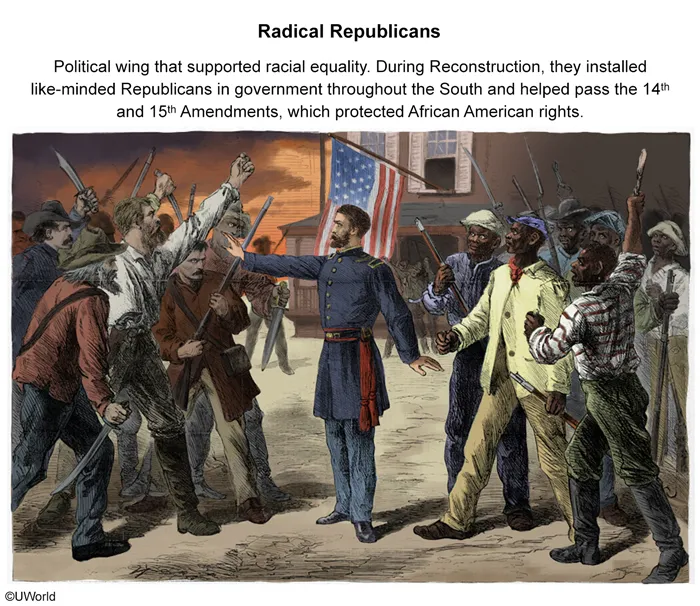
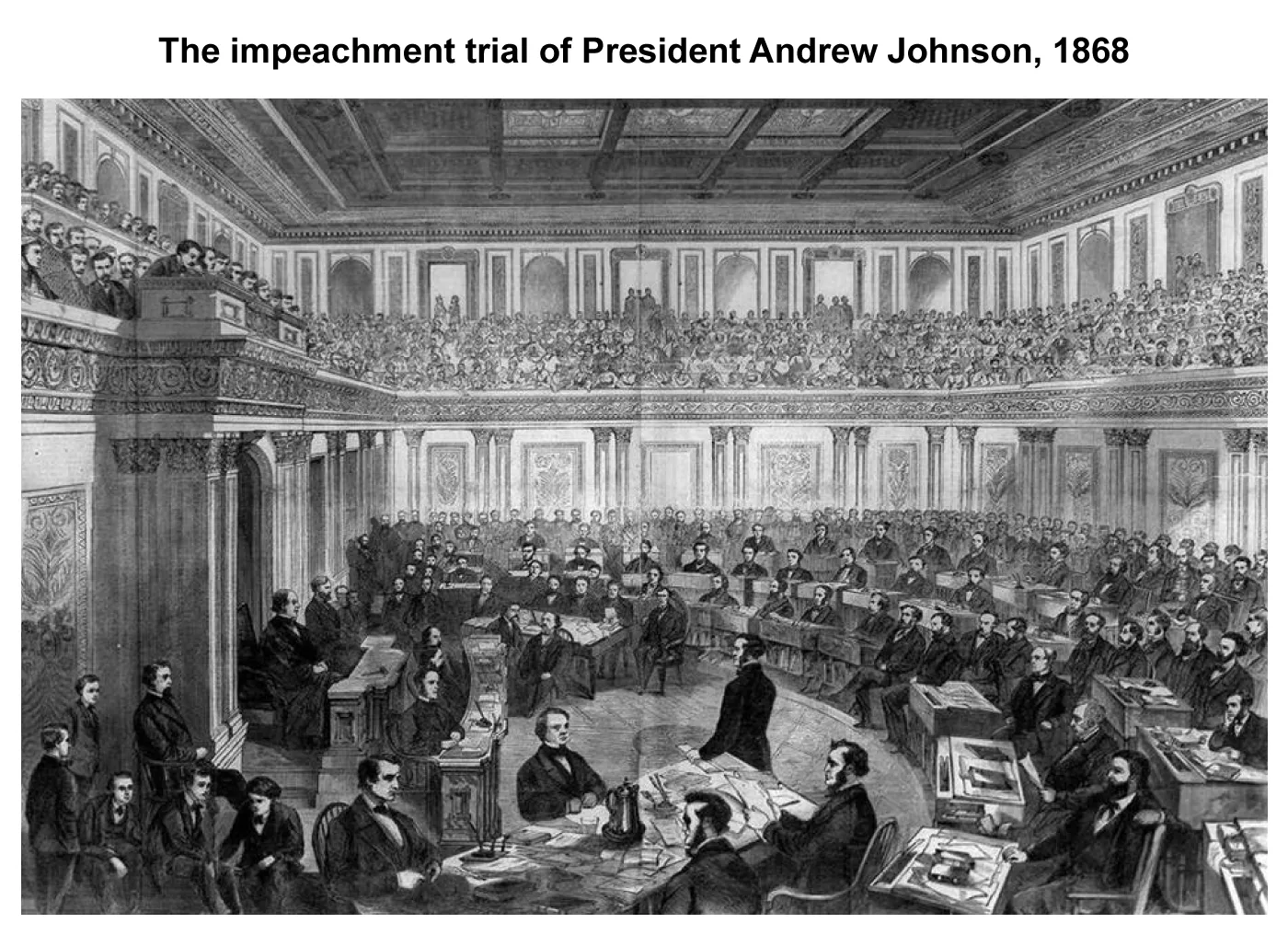
Which of the following groups would have been most likely to see the development shown in the image as desirable?
| A.Republicans who wanted to reorder Southern race relations | |
| B.Southern Democrats who lost political influence after the Civil War | |
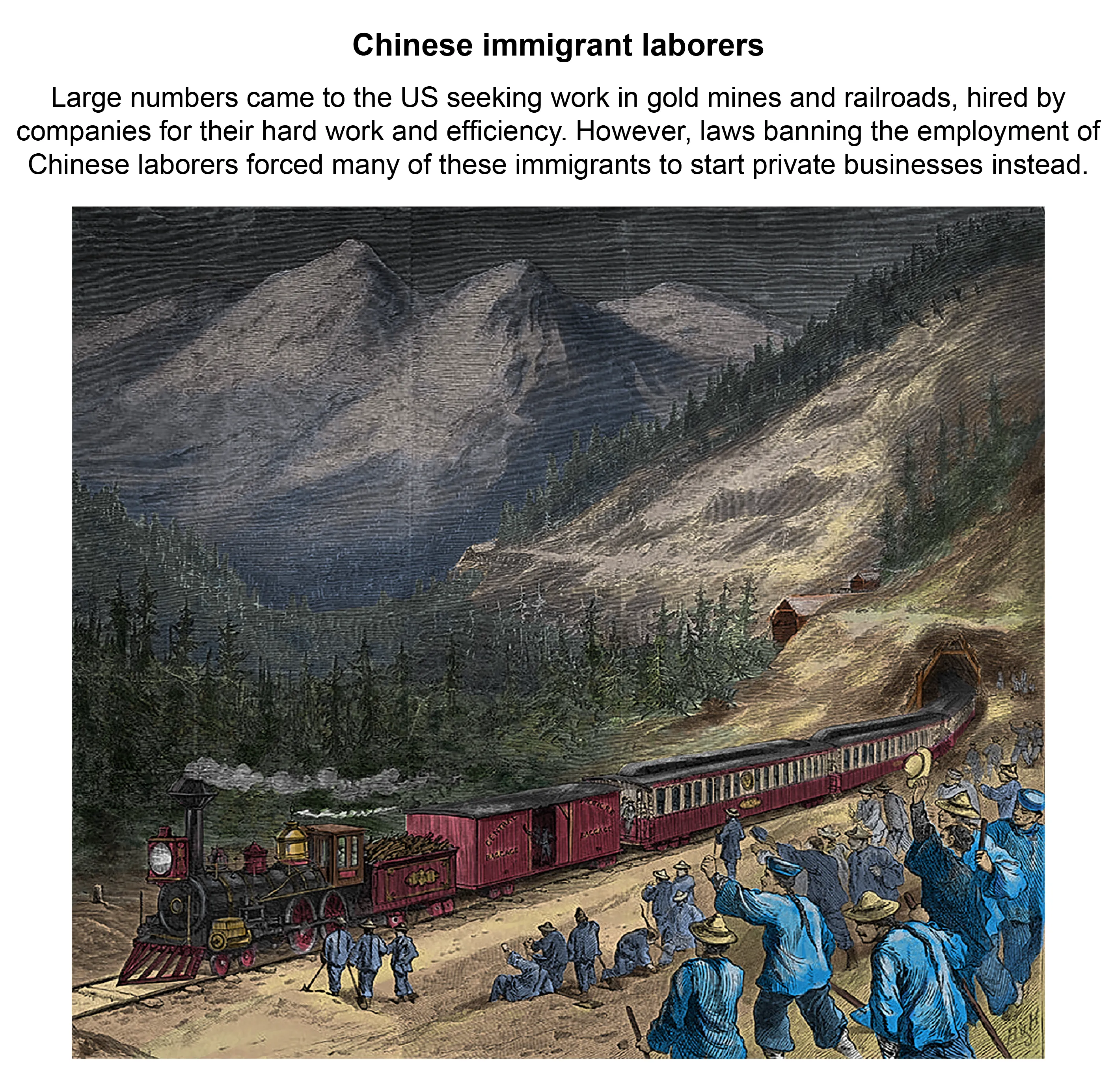
| C. Chinese laborers building the transcontinental railroads | |
| D. Whites opposed to teaching newly emancipated Blacks to read |
Explanation
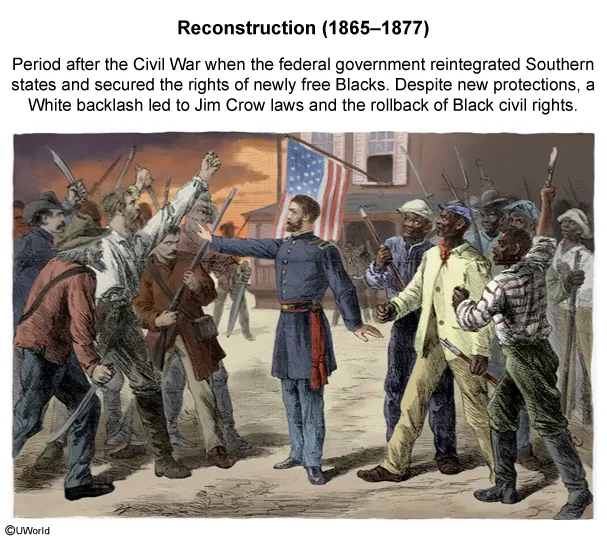
Radical Republicans, who had long advocated for abolition and equal rights, gained influence after the Civil War. They envisioned a fundamental racial reordering of the South, aiming to ensure free labor and protect equal political rights.
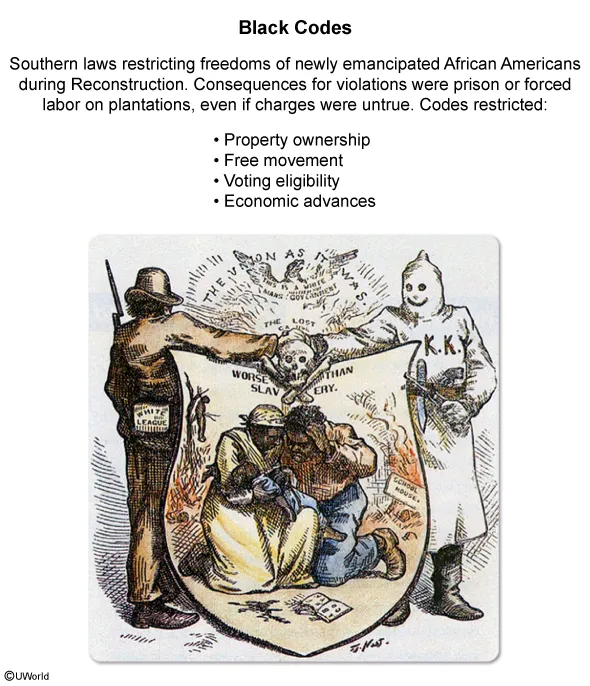
The rise of the Radical Republicans was fueled by opposition to President Johnson's Reconstruction policies, which sympathized with White Southerners and opposed political rights for freedmen. The South's adoption of restrictive Black Codes in 1865 and its ongoing racial violence further united moderate Republicans with more radical members against Johnson's approach.
Radical Republicans supported President Johnson's impeachment, believing his removal from office would end his persistent obstruction of their Reconstruction policies. They wanted to fundamentally transform Southern society and grant equal rights to formerly enslaved people.
(Choice B) Southern Democrats opposed impeachment because President Johnson championed states' rights and wanted leniency for the South.
(Choice C) The Johnson administration negotiated a treaty allowing Chinese immigration to the US, but it denied them political rights. Therefore, these laborers likely had neutral views of Johnson's impeachment.
(Choice D) Whites opposed to teaching newly emancipated Blacks to read would not likely support Johnson's impeachment, mainly because the president strongly opposed federal efforts to educate freedmen.
Things to remember:
The Radical Republicans gained influence largely due to opposition to President Johnson's Reconstruction policies, which favored White Southerners and denied political rights to freedmen.
Passage:
1. United States Census Bureau
Question
The pattern depicted in the graph in the mid-nineteenth century most directly resulted in
| A. passage of the Alien and Sedition Acts | |
| B. a federal ban on immigration from Asia | |
| C. a more inclusive system of public welfare | |
| D. the growth of ethnically diverse cities in the Northeast |
Explanation
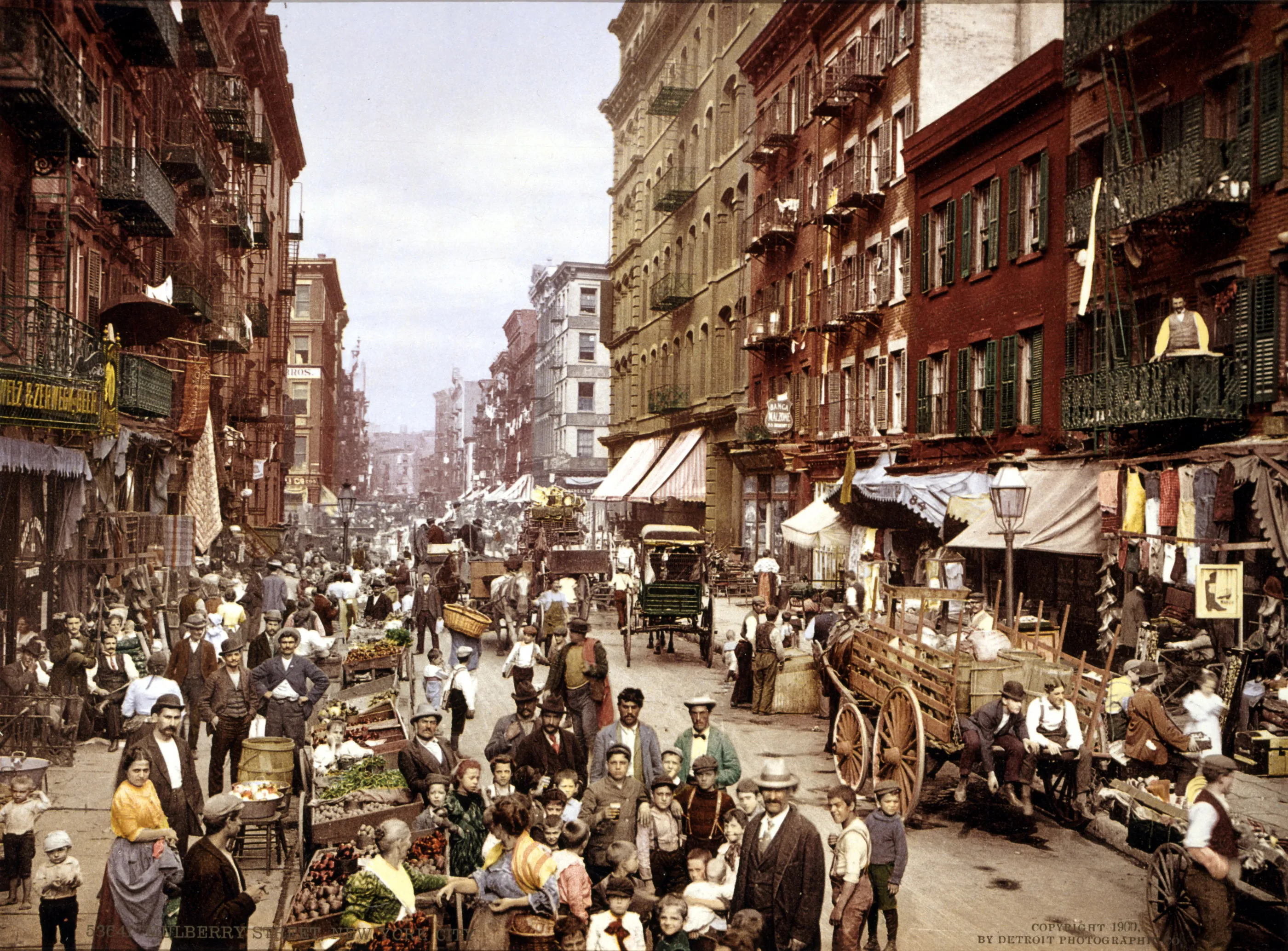
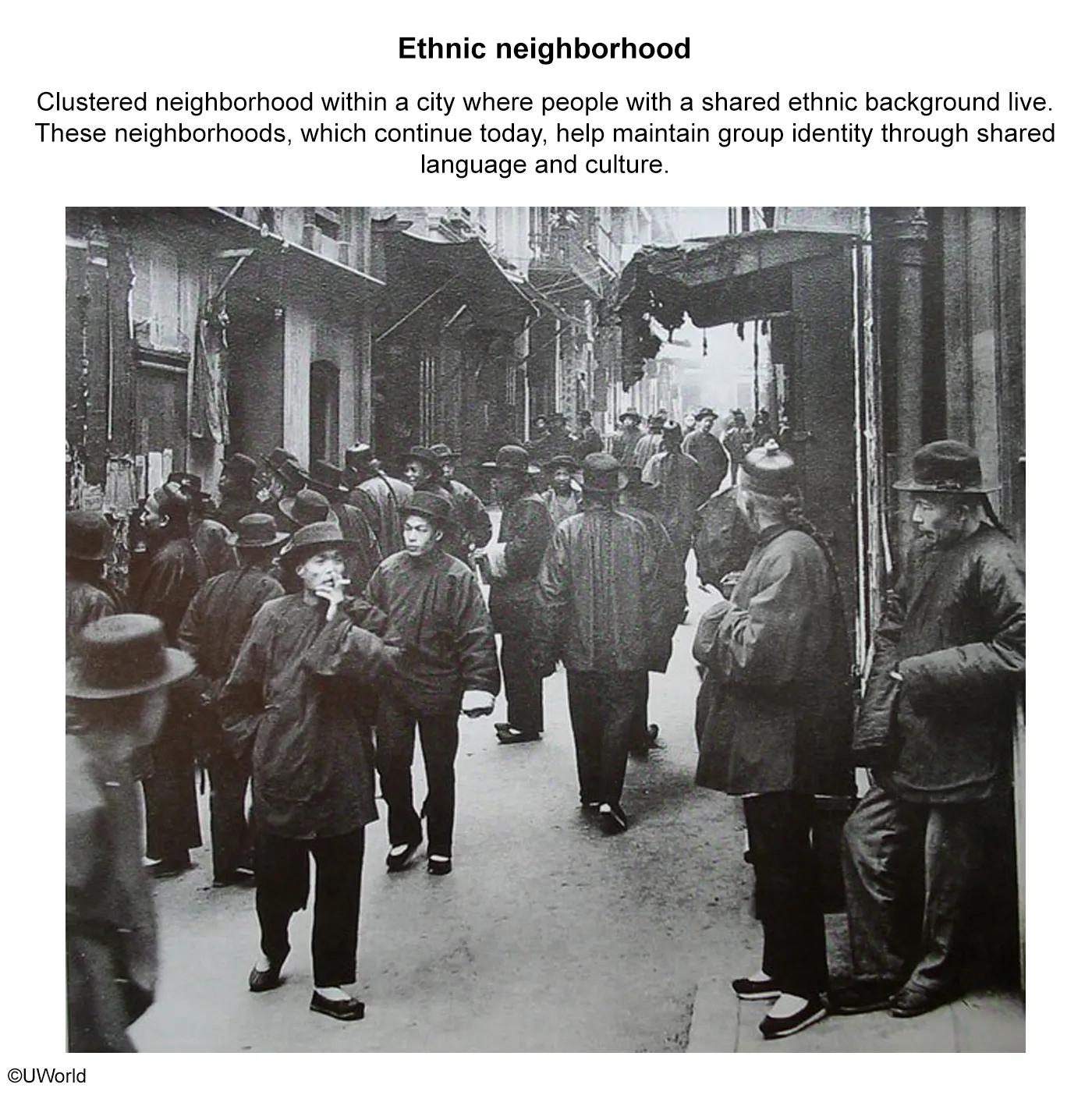
The influx of immigrants during the mid-19th century resulted in ethnically diverse cities. Large cities became crowded with immigrants and bustling with street life. Each ethnicity established neighborhoods, which provided a sense of community and helped ease the transition for newcomers. Immigrants brought their own customs, religions, foods, and languages.
As immigrants poured into the United States, many found low-paying wage jobs in large, industrialized cities of the Northeast. Despite the low pay, wage labor allowed families fleeing starvation conditions in their home countries to quickly acquire food and shelter in the United States. Immigrant neighborhoods were typically very poor, and the struggles of immigrants were often ignored by wealthier American city dwellers.
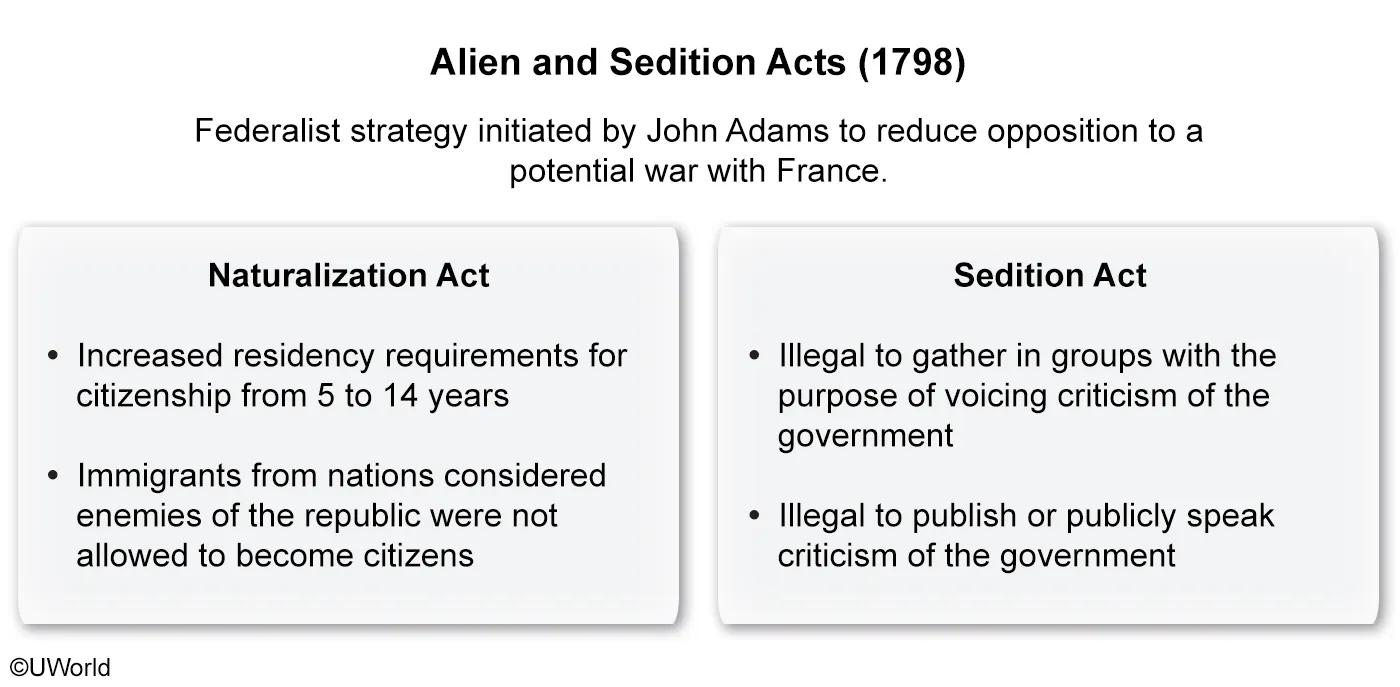
(Choice A) The Alien and Sedition Acts were an 18th century Federalist design to deny Thomas Jefferson the political support of those not born on U.S. soil, and weren't a result of the trend in the graph.
(Choice B) In the mid-19th century, Asians were a small percentage of immigrants. By the 1880s, however, nativist backlash against Asian immigrants targeted Chinese laborers.
(Choice C) Public welfare (economic assistance given by government) was extremely rare until the early 20th century, and the expansion of public welfare was not a direct result of the immigration trend seen in the graph.
Things to remember:
Immigrants crowded urban areas of the Northeast during the nineteenth century. The result was ethnically diverse cities.
Passage:
"By the proposed Amendment the right to vote will be secured to every citizen and will not depend on the will of the States…. This right should be lasting as the Constitution itself. Every type of man who is a citizen of the United States is presumed to be capable of self-government…. The gift of freedom to the colored race would be worse than worthless if not accepted by the right to vote."
William Holden, governor of North Carolina, 1869
Question
Which of the following was the most immediate result of the passage of the amendment referenced in the excerpt?
| A. Increased violence and intimidation against African Americans | |
| B. The increasing popularity of Radical Republicans among Southerners | |
| C. The decline of sharecropping as an economic system | |
| D. The desegregation of public accommodations throughout the United States |
Explanation
After the Civil War, the 13th Amendment freed nearly 4 million slaves in the South. For many African Americans, the expectation was that the freedom the amendment granted would also convey the rights and privileges of US citizens to former slaves. However, following the end of slavery, Southern states began passing laws that restricted the rights of African Americans. Known as Black Codes, these laws kept African Americans from possessing the same rights as Whites, including the right to vote.
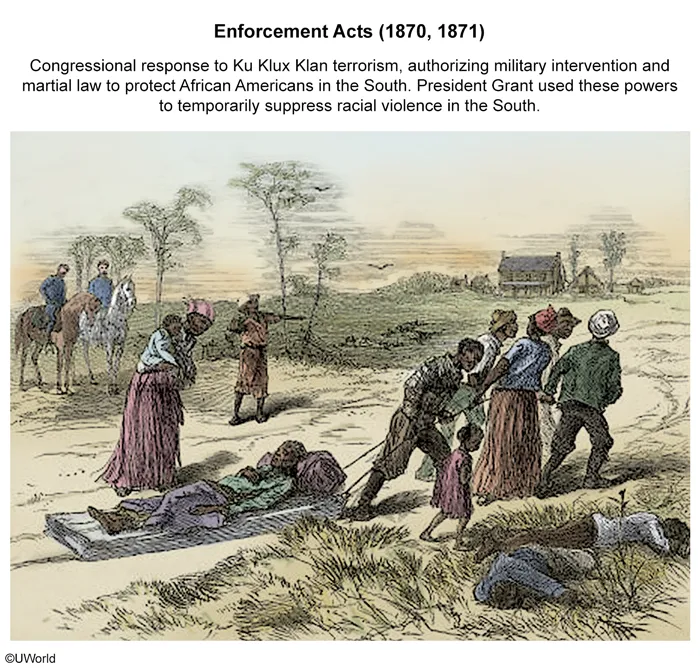
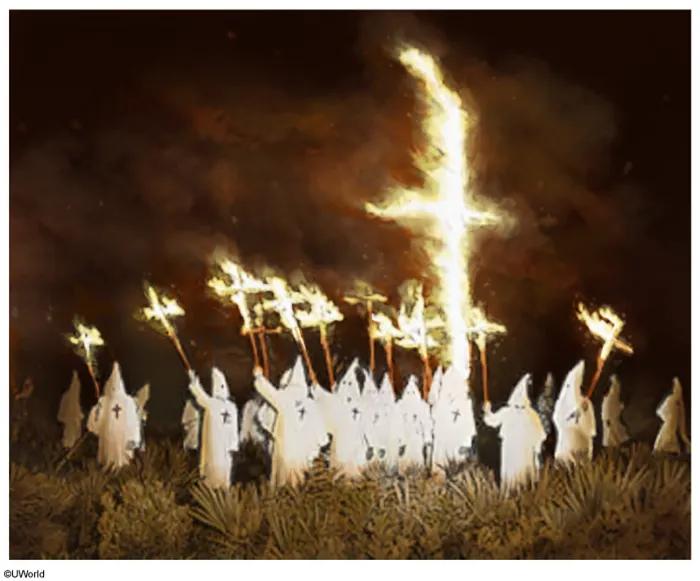
In response, the Republican-controlled Congress ratified the 15th Amendment, granting African American males the right to vote. Although supported by constitutional law, when African American males in the South began to exercise their right to vote, groups of Southerners started a campaign of violence and intimidation to keep African Americans from the polls.
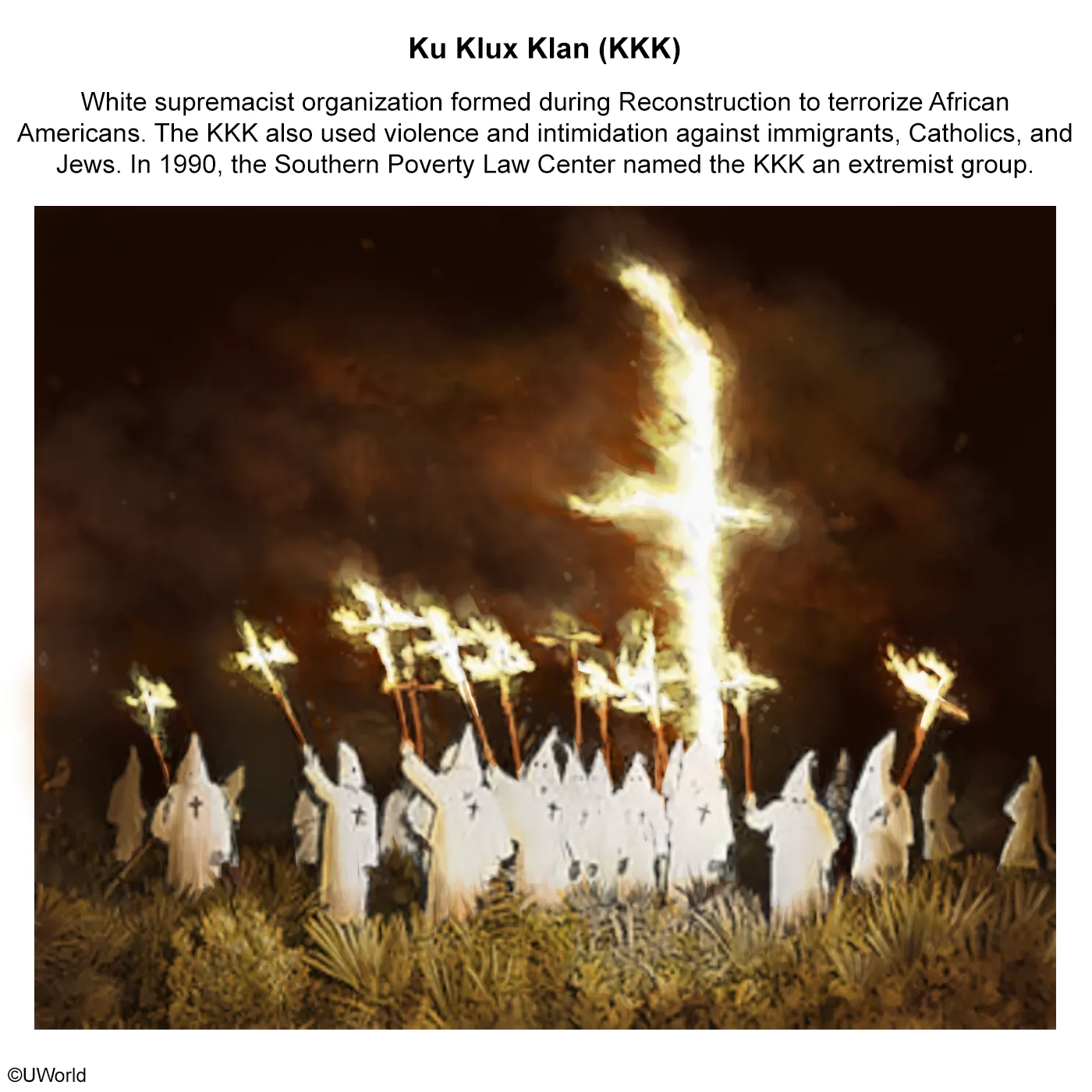
In particular, the Ku Klux Klan (KKK) instituted a reign of terror that included lynching African Americans. The intimidation, designed to keep African Americans from voting, was so severe that the federal government passed the Force Acts in the early 1870s. These laws allowed the US military to arrest suspected KKK members and protect African American voters.
(Choice B) Radical Republicans were unpopular with Southerners because they pushed for racial equality.
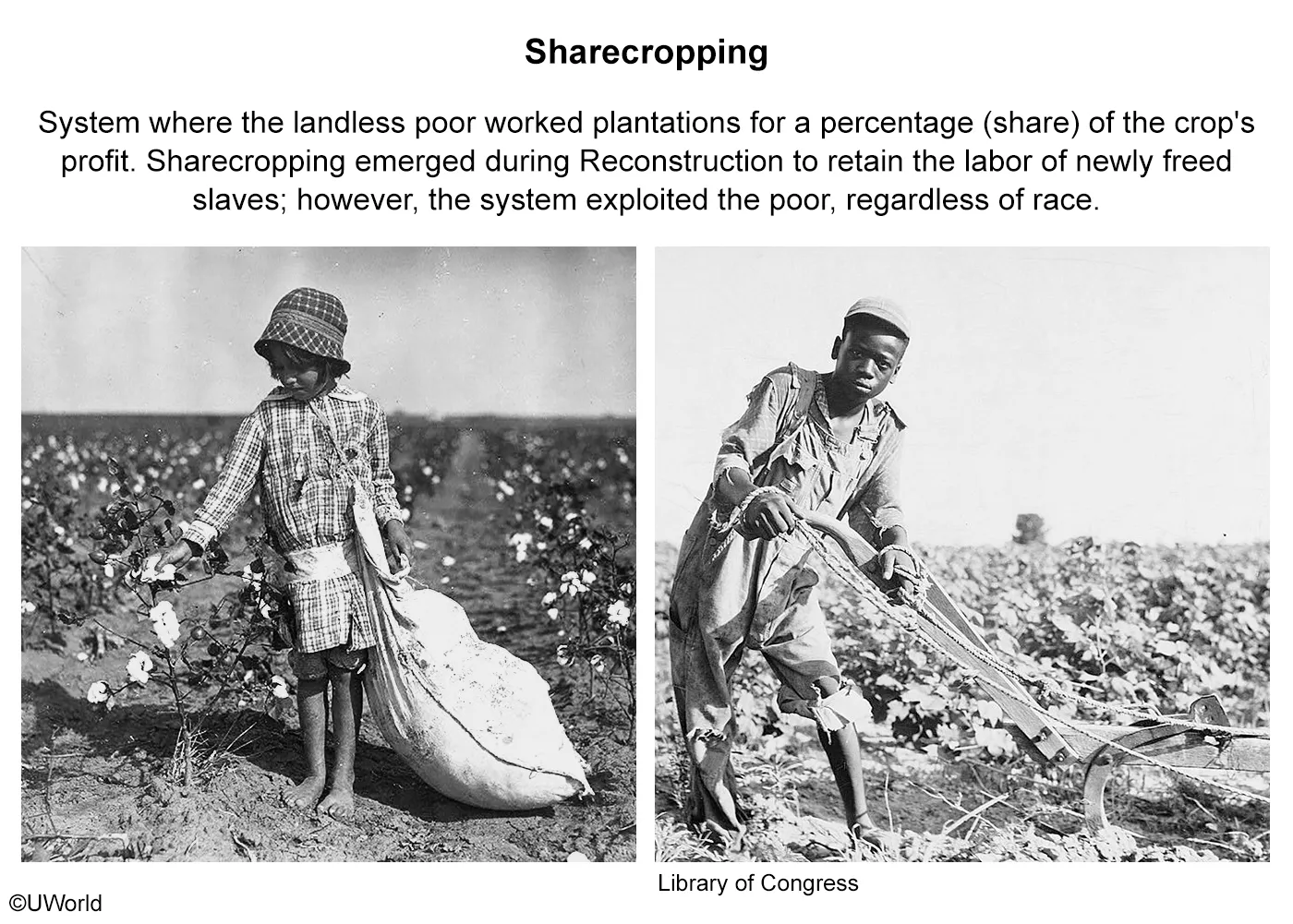
(Choice C) Sharecropping increased dramatically during Reconstruction.
(Choice D) The desegregation of public accommodations in the US did not occur until Congress passed the Civil Rights Act of 1964.
Things to remember:
The 15th Amendment granted African Americans the right to vote. However, Southern groups such as the Ku Klux Klan used violence and intimidation to keep African Americans from the polls.

Study Anywhere, Anytime
Review AP U.S. History Unit 5 whenever you have a spare moment, on the bus, between classes, or winding down at the end of the day. The UWorld app keeps practice questions, videos, and study guides easy to reach. Your APUSH Unit 5 review stays simple, flexible, and always available.
Stand Out
with a Top Score in AP U.S. History
Complete your comprehensive APUSH Unit 5 review and boost your performance to make yourself a standout candidate for competitive colleges, majors, and scholarships by earning a top score.
Get your all-in-one course today!
- Engaging APUSH Videos with Expert Instruction
- Customizable Quiz Generator
- Adjustable Study Planner
- Print & Digital Study Guide with Step-by-Step Explanations
- Realistic Timed Test Simulation
- Progress Dashboard
- 500+ Expert-Designed, Exam-style Practice Questions
- Smart Flashcards
- Mobile App
Hear From Our AP Students
UWorld’s service is pretty good and helps provide a lot of explanations on subjects I haven’t been confident on before.
The questions here are the most realistic to the AP tests I've seen so far! I appreciate the ability to customize tests as well.
The best part is that all options are well-explained, telling clearly why they are not the right option.

Frequently Asked Questions (FAQs)
What are the main topics covered in AP U.S. History Unit 5: Period 5: 1844–1877?
AP U.S. History Unit 5 examines a period defined by expansion, sectional conflict, civil war, and national rebuilding. This unit forms a major part of APUSH Unit 5 notes, summaries, and progress check MCQs.
Topics may include:
- Manifest Destiny: The belief in U.S. expansion across the continent.
- The Mexican–American War: Causes, outcomes, and territorial changes.
- Conflicts over slavery’s expansion: Political debates and national divisions.
- The Election of 1860 & Secession: How political tensions triggered disunion.
- The Civil War: Major battles, strategies, and turning points.
- Reconstruction: Federal policies, social changes, and regional tensions.
A structured AP U.S. History Unit 5 review is easier with UWorld’s clear explanations, visuals, and exam-style practice questions designed for Period 5.
How should I prepare for an AP U.S. History Unit 5 exam?
A reliable way to prepare for an APUSH Unit 5 exam is to use the read–watch–practice method. Start by reading a focused AP U.S. History Unit 5 study guide to get a clear overview of topics like Manifest Destiny, slavery debates, the Civil War, and Reconstruction. Then watch short, targeted video lessons that explain major events, political developments, and cause-and-effect relationships in a visual way that’s easier to remember.
Finish by practicing with realistic APUSH Unit 5 MCQs and progress check-style questions. UWorld’s detailed explanations help you see why correct answers work and how exam writers think, making your preparation more effective and building confidence for the test.
Are any free resources available for AP U.S. History Unit 5?
Yes, there are several useful free resources you can turn to while studying APUSH Unit 5. A great first step is trying UWorld’s free trial, which lets you sample AP U.S. History Unit 5 practice questions and detailed explanations that break down how Period 5 ideas are tested. It’s an easy way to see the quality of the platform before diving into the full course.
You can then supplement your review with College Board’s AP Classroom, which includes official Unit 5 progress check MCQs and topic summaries aligned with the exam outline. Khan Academy also offers free videos and notes that walk through major Unit 5 themes at a steady pace.
For a complete, exam-style practice experience, UWorld remains the strongest option, offering realistic questions and clear reasoning that help you master AP U.S. History Unit 5 with confidence.
What types of questions are on the APUSH Unit 5 test?
The APUSH Unit 5 test follows the structure of the official AP U.S. History exam. Section IA includes multiple-choice questions (MCQs) tied to short texts, charts, maps, or images that cover topics like Manifest Destiny, the Civil War, and Reconstruction. Section IB features short-answer questions (SAQs) that require concise explanations using evidence from Period 5 to address comparisons, causes, or historical developments.
Section II includes free-response questions (FRQs): one Document-Based Question (DBQ) and one Long Essay Question (LEQ). Although the official DBQ is not limited to Unit 5, the skills apply across all periods. UWorld’s APUSH Unit 5 practice mirrors these formats so you learn how to apply evidence and reasoning effectively.
How can I improve my score on the Free-Response Questions (FRQs) for Unit 5?
Improving your FRQ score for APUSH Unit 5 starts with a solid understanding of the era’s major themes: westward expansion, sectional division, the Civil War, and Reconstruction. Spend time reviewing how these developments connect, and practice outlining responses that clearly address each part of the prompt. Your outline should include specific evidence and a short explanation showing how that evidence supports your claim.
- When planning or practicing your FRQs, it helps to keep a few guiding steps in mind:
- Restate the prompt in your own words to clarify what’s being asked
- Create a simple claim that answers every part of the question
- Choose two to three strong examples from Unit 5
- Explain the historical significance of each example, not just what happened
- Connect your points to broader trends, such as federal power shifts or political realignment
Reviewing sample FRQ structures is also valuable, especially for understanding how to build analytical paragraphs and transitions that flow logically. UWorld’s AP U.S. History Unit 5 practice questions and explanations walk you through this process step-by-step, showing exactly how effective arguments are assembled. With regular practice using these strategies, raising your FRQ score becomes much more achievable.
What is the "Period 5: 1844–1877" unit's weight on the AP U.S. History exam?
Period 5 typically represents about 10–17% of the AP U.S. History exam, making it one of the most heavily tested units. This period’s themes—territorial expansion, slavery debates, wartime developments, and Reconstruction—form the backbone of several MCQs, SAQs, and potential essay prompts. Understanding how political, economic, and social tensions built over time can also strengthen your reasoning across multiple exam sections.
Because Period 5 links directly to themes from both earlier and later units, mastering it improves your ability to recognize patterns throughout the course. UWorld’s APUSH Unit 5 study materials organize these connections and provide practice that helps you approach the exam with greater confidence.
Where can I find a good AP U.S. History Unit 5 study guide?
If you want a clear and reliable AP U.S. History Unit 5 study guide, UWorld is the strongest place to start. The platform breaks down complex issues—like sectional conflict, the Civil War, and Reconstruction—into simple explanations supported by visuals and examples. These guides match the structure of the exam and emphasize the reasoning skills needed for MCQs, SAQs, and FRQs.
College Board’s AP Classroom also offers official Unit 5 topic guides, and Khan Academy provides free videos to support your review. But for a study guide created specifically to mirror AP exam logic, UWorld’s APUSH Unit 5 materials offer the most complete and student-friendly approach.
Can I find practice tests specifically for AP U.S. History Unit 5?
Yes, several resources provide APUSH Unit 5 practice tests, but UWorld offers the most realistic exam experience. You can build targeted quizzes that focus on Manifest Destiny, slavery debates, the Civil War, or Reconstruction, mirroring the style of AP MCQs and FRQs. Each question includes a full explanation, helping you see how historical evidence is used on the real exam.
College Board’s AP Classroom includes Unit 5 progress check questions, and some websites offer smaller sets of free practice items. Still, UWorld remains the best choice for timed, exam-style practice tests designed specifically for AP U.S. History Unit 5.
How do Period 5 themes connect to modern American history?
Period 5 introduces debates and decisions that continue to shape the United States today. Ideas about federal versus state power, civil rights, citizenship, and political realignment all trace back to conflicts and reforms between 1844 and 1877. Understanding these roots helps students make stronger APUSH connections when questions link short-term events to long-term outcomes.
These connections also appear in MCQs and FRQs that ask you to evaluate continuity and change across periods. UWorld’s explanations highlight these links so you can see how events in Unit 5 echo through later eras and respond more effectively to analytical prompts on the AP U.S. History exam.
What are the common challenges students face when studying APUSH Unit 5?
Students often struggle with the amount of detail in APUSH Unit 5, especially when distinguishing political, military, and social developments across the Civil War and Reconstruction. Many also find it difficult to track the rapid changes in laws, constitutional amendments, and federal policies that shaped the era.
Another challenge is connecting causes and consequences, such as how territorial expansion heightened sectional tensions or how Reconstruction policies reshaped national identity. UWorld helps solve these issues by breaking complex topics into manageable explanations and offering APUSH Unit 5 practice questions that reinforce cause-and-effect thinking through clear, exam-style reasoning.