FREE Ground Shipping on Courses $149+ | Code: SANTASENDSFREE

AP® U.S. History Unit 4 Review and Practice Test

Period 4: 1800–1848

Strengthen your APUSH Unit 4 preparation with a complete, exam-focused review of the political, social, and economic transformations that defined early America. UWorld's AP® US History Unit 4 review combines streamlined video lessons, targeted practice questions, and a high-yield study guide to help you score higher on MCQs, SAQs, and FRQs. If you need fast clarity, structured guidance, and exam-ready confidence, this Unit 4 APUSH resource delivers exactly that.

AP U.S. History prep course suite by UWorld

Your Complete APUSH Unit 4 Advantage with Our Review

Master the essential Unit 4 storylines with the tools that make studying easier: clean visuals, real exam-style questions, and explanations that cut straight to what matters. We turn the complex political shifts, reform movements, and foreign policy debates of this period into a clear, test-ready roadmap.

Watch

Focused Video Lessons Simplifying Unit 4

Our short and engaging videos guide you through the rise of political parties, pivotal moments in foreign policy, the impact of technological innovation, and the reform movements sparked by the Second Great Awakening. Each lesson is built for AP exam performance, helping you quickly understand cause-and-effect relationships and common scoring patterns.

Read

High-Yield Study Guides for Better Understanding

Our AP U.S. History Unit 4 study guide materials distill the essential political, economic, and social transformations into clear explanations crafted for high performance. You get interactivity with visuals, timelines, and structured summaries that support MCQ accuracy, stronger SAQs, and FRQs.

Practice

Try These AP U.S. History Unit 4 Practice Test Questions

Get exam-level practice with stimulus-based MCQs, targeted SAQs, and evidence-driven prompts built around early American political conflict, expanding federal power, and the emerging reform landscape. These APUSH Unit 4 practice test items help you understand how the exam frames Unit 4 content and how to respond with precision.
Try these sample practice questions with detailed answer explanations:
Period 4: 1800–1848 Practice Tests

Passage:

"Humanity has often wept over the fate of the aborigines of this country and philanthropy has long been busily employed in devising means to avert it, but its progress has never for a moment been arrested, and one by one have many powerful tribes disappeared from the earth….But true philanthropy reconciles the mind to these vicissitudes as it does to the extinction of one generation to make room for another….Philanthropy could not wish to see this continent restored to the condition in which it was found by our forefathers.  What good man would prefer a country covered with forests and ranged by a few thousand savages to our extensive Republic, studded with cities, towns, and prosperous farms, embellished with all the improvements which art can devise or industry execute, occupied by more than 12,000,000 happy people, and filled with all the blessings of liberty, civilization, and religion?"

Andrew Jackson's Second Annual Message to Congress, 1830

Question

The excerpt most directly reflects which of the following developments in the United States during the first half of the nineteenth century?

A. The Indian Removal Act
B.The success of the Texas Revolution
C. The ban on the importation of African slaves
D. The end of the War of 1812

Explanation

"Humanity has often wept over the fate of the aborigines…and one by one have many powerful tribes disappeared from the earth….What good man would prefer a country covered with forests and ranged by a few thousand savages to our extensive Republic, studded with cities, towns, and prosperous farms, embellished with all the improvements which…industry [can] execute, occupied by more than 12,000,000 happy people, and filled with all the blessings of liberty, civilization, and religion?"

Andrew Jackson's Second Annual Message to Congress
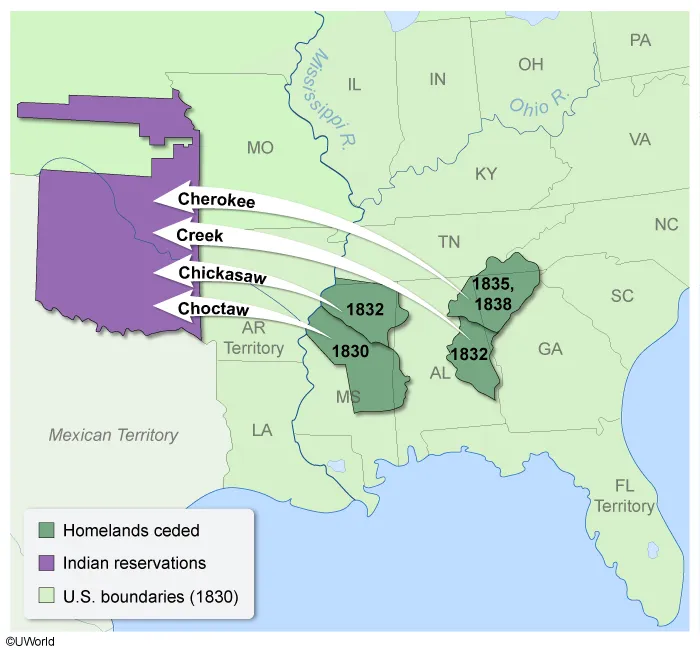
The Indian Removal Act

To understand the excerpt, determine the following:

When: Who: Why:
The title "Andrew Jackson's Second Annual Message to Congress" specifies the second year of Jackson's presidency—1830. References to "aborigines," "powerful tribes," and "savages" indicate that Jackson's subject is American Indians. According to Jackson, removal of the American Indians from their land is justified because expansion of American settlements ensures the nation's continued prosperity.

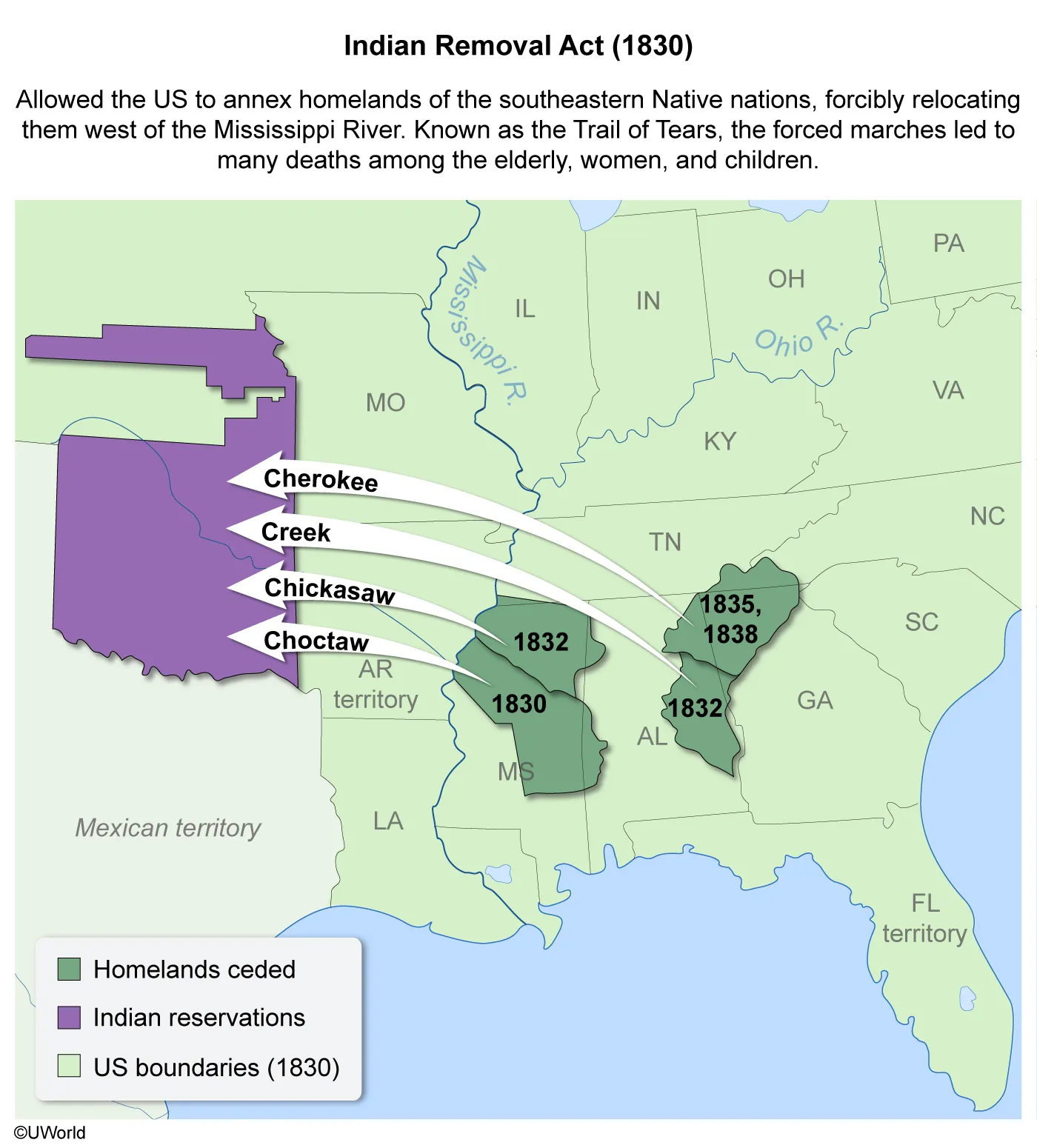
The U.S. government had been slowly annexing (taking over) lands of Native American tribes since the 1780s, but the Indian Removal Act (1830) increased the seizure of lands east of the Mississippi River. The Act began the forcible relocation of tribes to Indian Territory, in present-day Oklahoma.

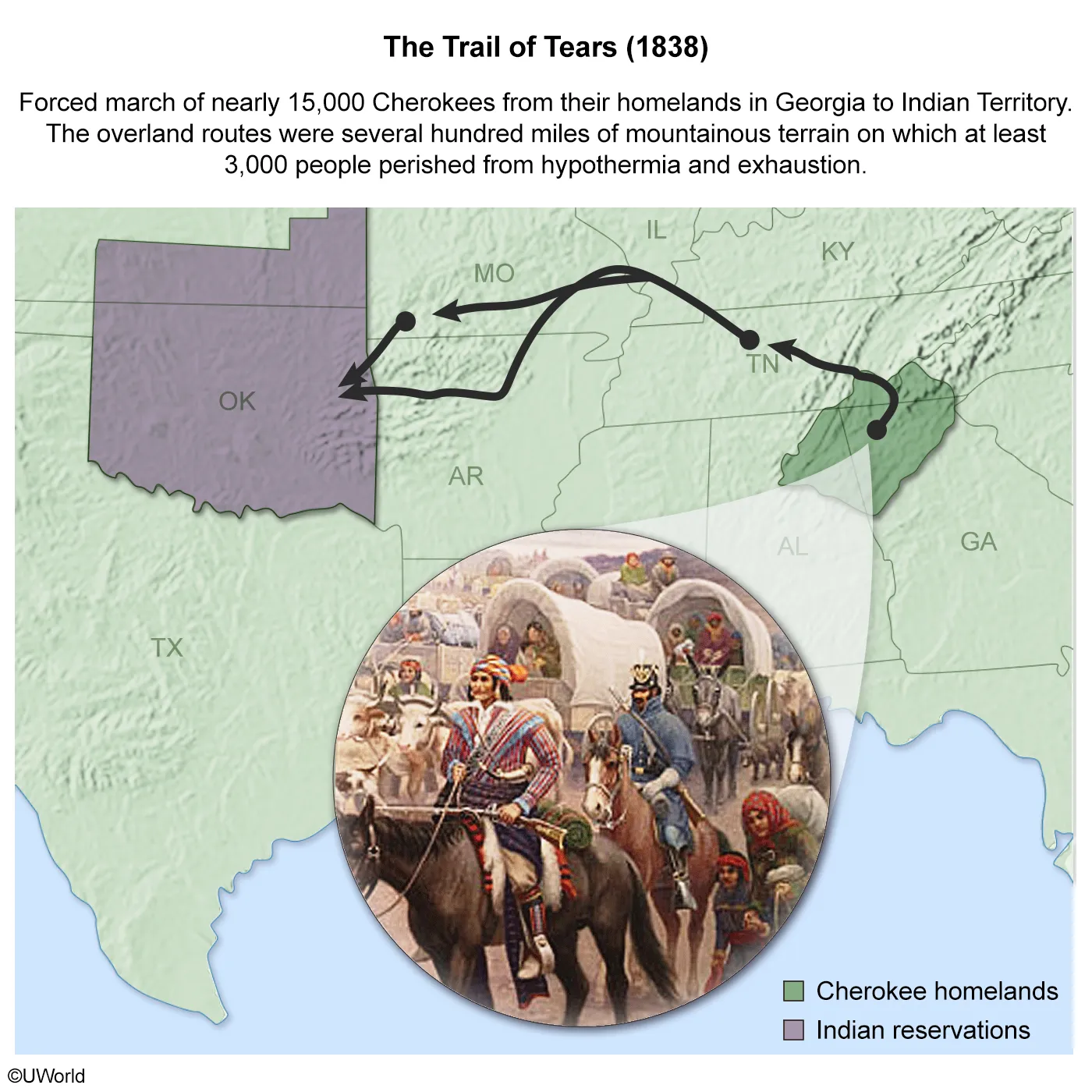
In 1838, the federal government evicted over 15,000 Cherokees from their homes and marched men, women, and children several hundred miles across mountainous terrain to Indian Territory. Known as the Trail of Tears, nearly 4,000 Cherokee perished during the journey due to hypothermia and exhaustion.

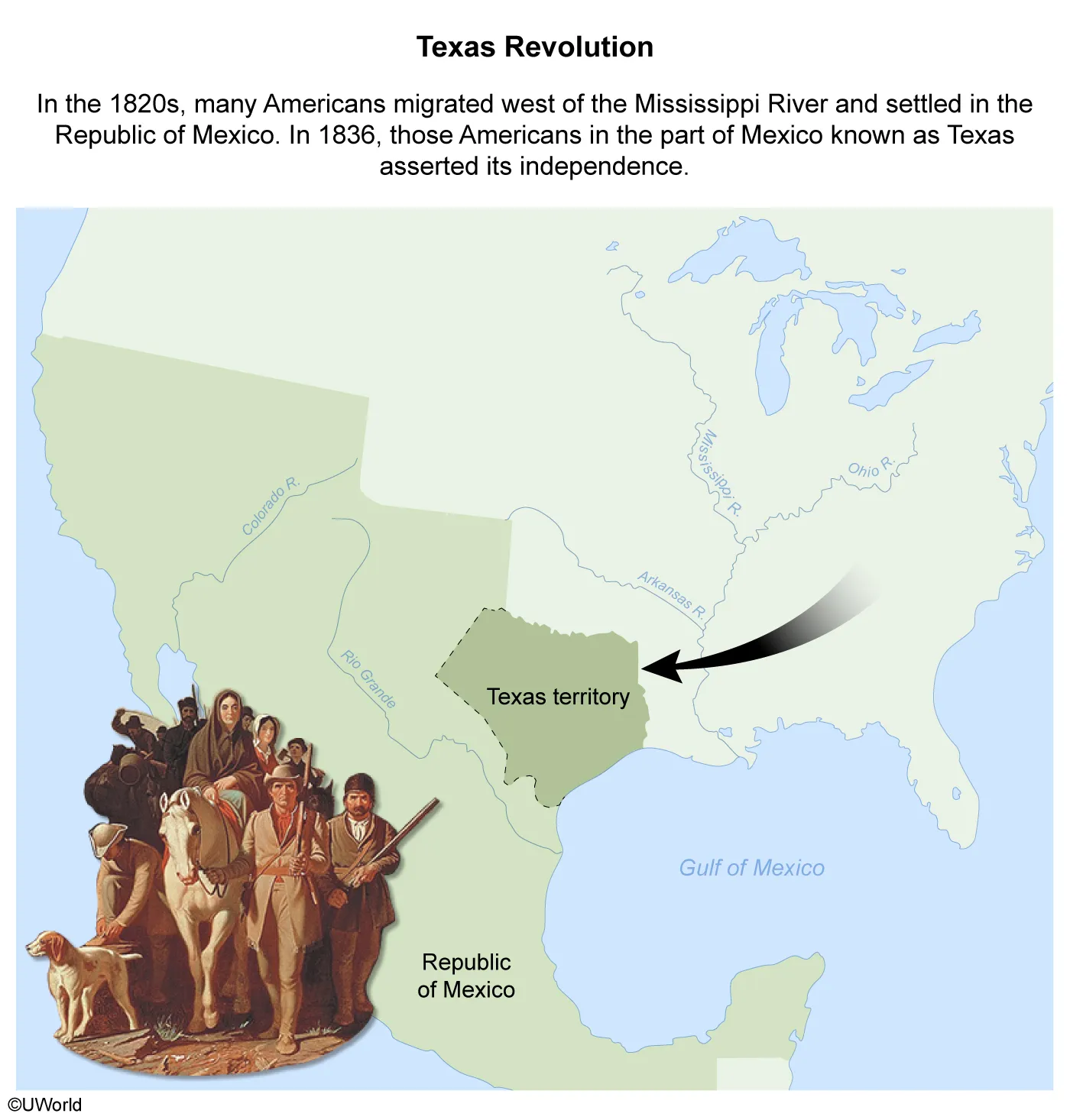
(Choice B) The Texas Revolution occurred in 1836, and this development isn't reflected in Jackson's 1830 address.

(Choice C) Congress banned the international slave trade in 1808, but this isn't directly related to Indian removal.

(Choice D) As a general, Andrew Jackson was considered a hero of the War of 1812; contributing to his victory in the presidential election of 1828. However, President Jackson's address to Congress in 1830 concerned the justification for the Indian Removal Act.

Things to remember:
As president, Andrew Jackson promoted the Indian Removal Act of 1830, the forced removal of American Indians living east of the Mississippi River.

Passage:

Where lieth woman's sphere?—Not there
Where strife and fierce contentions are,
Not in the wild and angry crowd,
Mid threat'nings high and clamors loud;
Nor in the halls of rude debate
And legislation, is her seat.

What then is woman's sphere? The sweet
And quiet precincts of her home:
Home!—where the blest affections meet,
Where strife and hatred may not come:
Home!—sweetest word in mother-tongue,
Long since in verse undying sung!

L. J. Cist, The Women's Sphere, 1845

Woman's Sphere, L. J. Cist

Question

In the late 1840s, the sentiments described in the poem would be most challenged by

A. Can effort by social reformers to limit alcohol consumption
B. the spread of religious revivals during the Second Great Awakening
C. the growing support among middle-class women for slavery's abolition
D. the calls for women's suffrage by the Seneca Falls Convention

Explanation

Women's movement origins

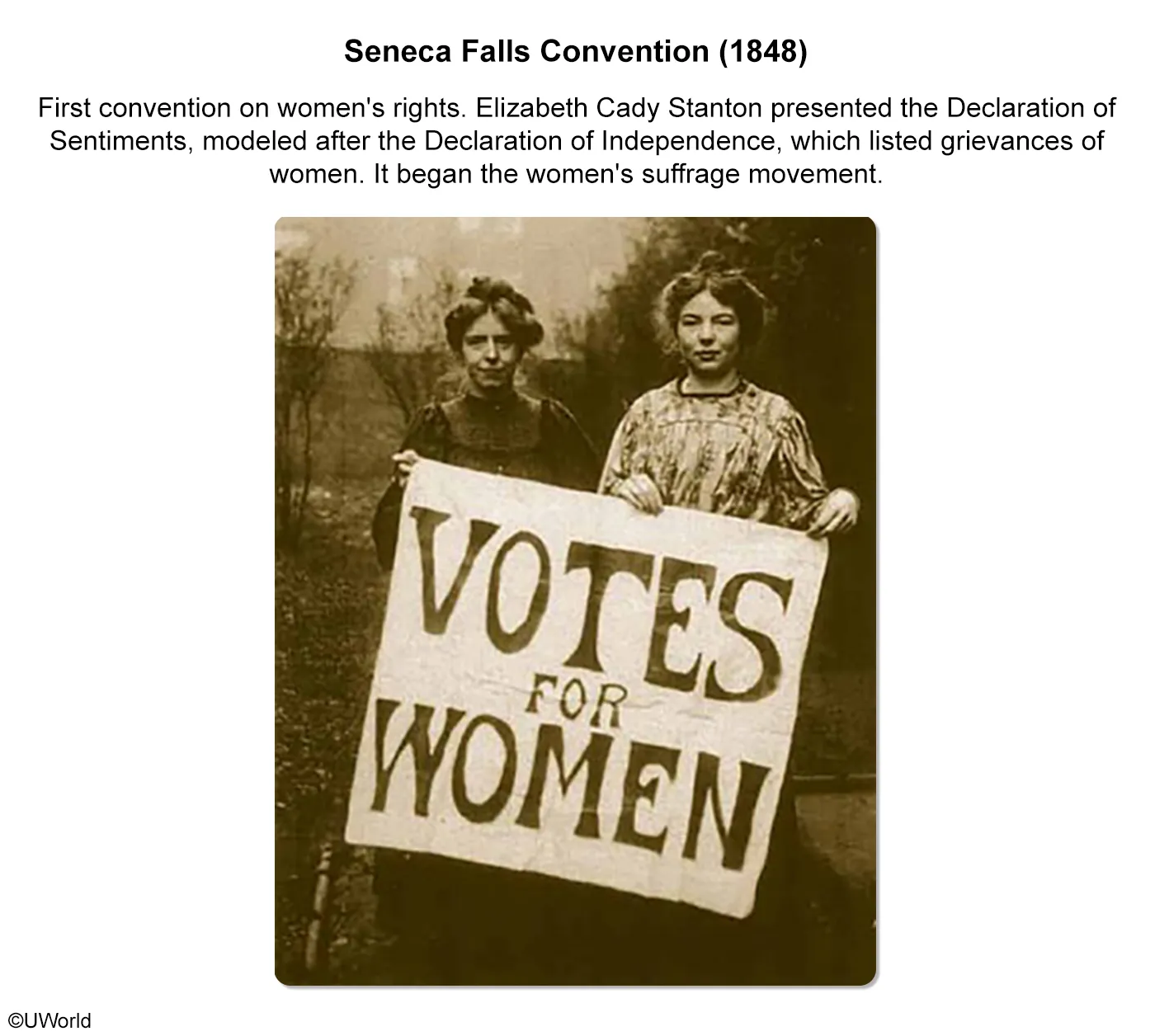
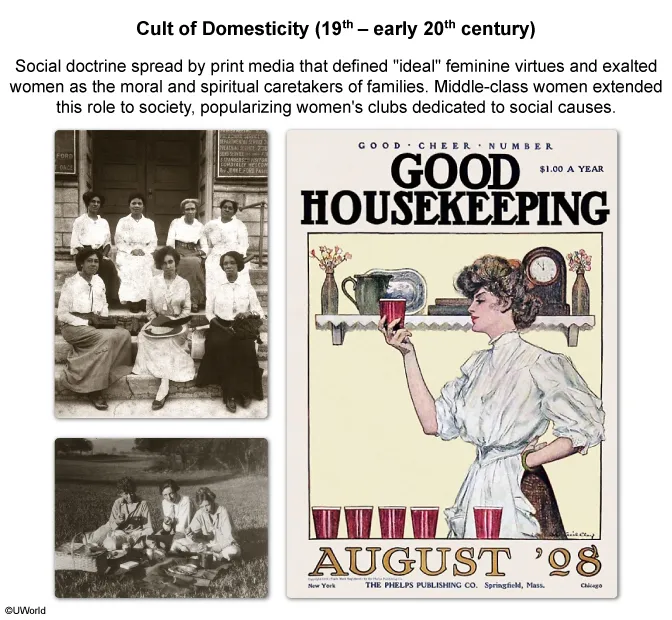
The Declaration of Sentiments, presented at the Seneca Falls Convention, raised concerns about gender inequality, including issues related to property rights, education, and legal status. Although the convention addressed a wide range of reforms, Elizabeth Cady Stanton's controversial call for women's suffrage most directly challenged the separate spheres ideology reflected in the poem.

Although many women were active in antebellum reform movements, suffrage placed women in the political sphere, traditionally reserved for men. Stanton's calls for suffrage challenged the period's gender roles by demanding a political voice, something many contemporaries viewed as incompatible with women's domestic responsibilities.

(Choices A and C) Antebellum reform movements, such as temperance and abolition, aligned with the cult of domesticity because they were seen as a natural extension of women's role in protecting the home.

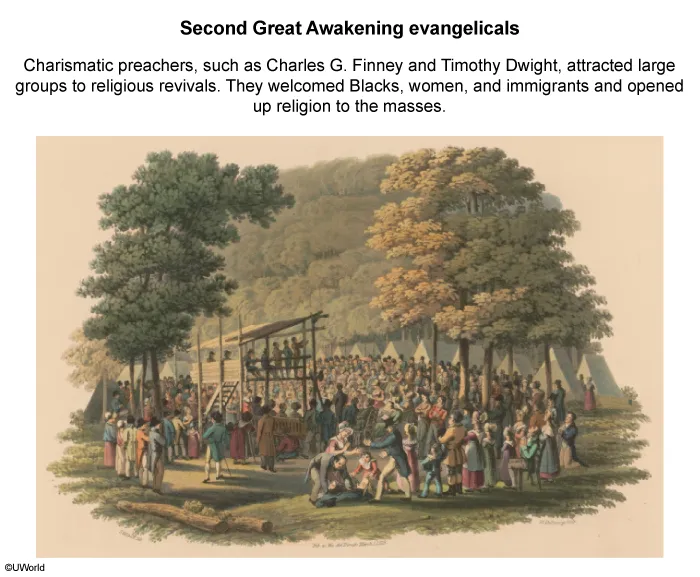
(Choice B) The Second Great Awakening supported the ideals in the poem, often reinforcing traditional gender roles by encouraging women to fulfill their moral duties within the family.

Things to remember:
Elizabeth Cady Stanton's call for suffrage during the Seneca Falls Convention challenged the cult of domesticity's insistence that women would be confined to private life.

Passage:
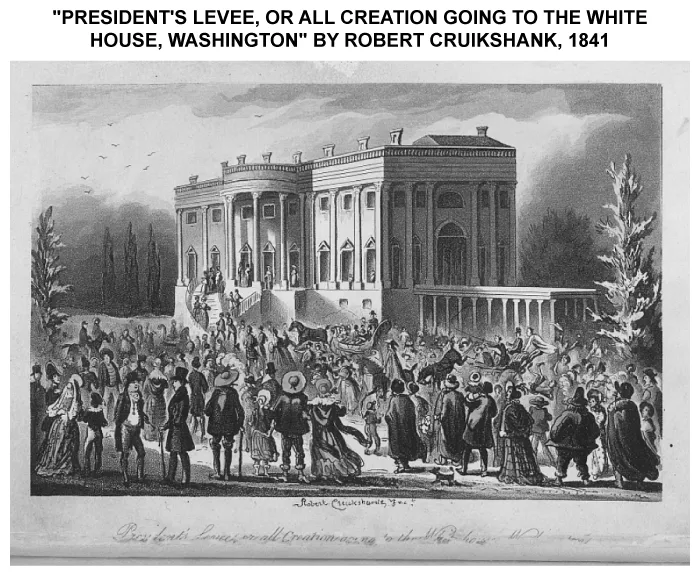
President's Levee, or All Creation going to the White House, Washington 1841

Robert Cruikshank, "President's Levee, or All Creation going to the White House, Washington," 1841

1. "President's Levee, or All Creation going to the White House, Washington" by Robert Cruikshank, 1841

Question

Which of the following developments could best be interpreted as reflecting the actions depicted in the image?

A. The spread of nativism due to Irish immigration
B. The passage of the Indian Removal Act
C. The impact of universal White male suffrage
D. The growing success of antebellum reform movements

Explanation

Property ualifications

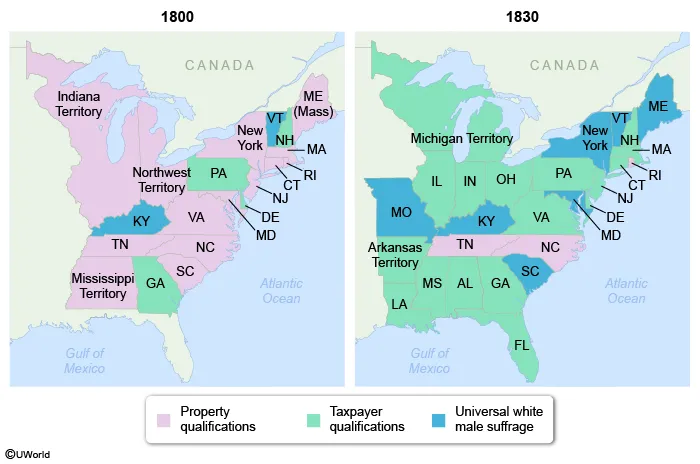
The 1820s saw American politics become more participatory as most states eliminated property requirements for White male voters. Politicians often supported these changes both out of principle, or to gain or maintain power. These developments gave rise to a broader and more socially diverse class of White male voters, reflected in the image's depiction of a rowdy and informal political culture wherein citizens socialized and politicians actively courted potential supporters.

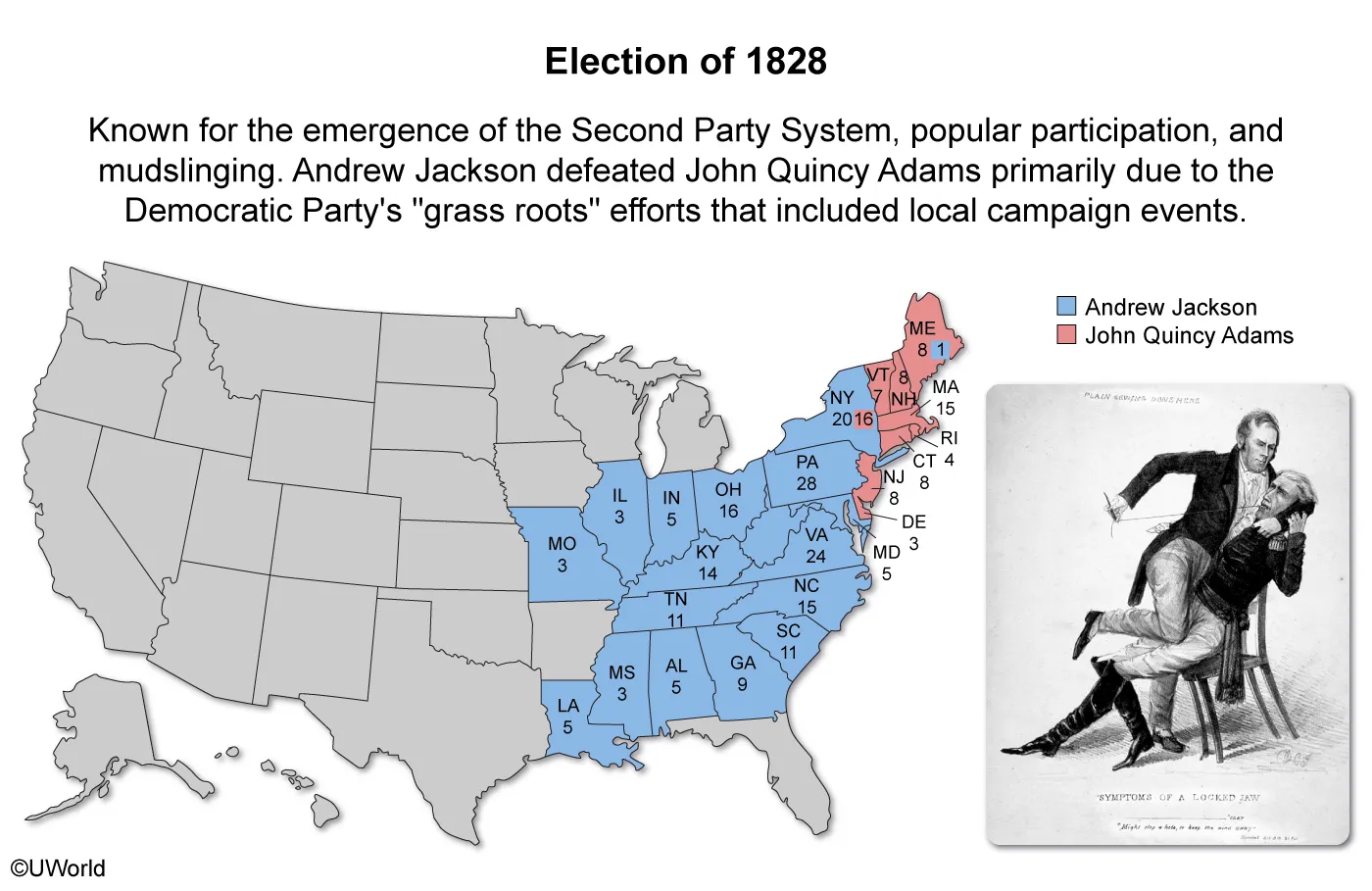
For example, the image depicts ordinary Americans crowding toward the White House to celebrate Andrew Jackson's 1829 inauguration. Jackson made direct appeals to these voters during the election of 1828, a sharp contrast with the Federalist period when open campaigning was considered undignified.

This shift reflects the impact of universal White male suffrage and a more performative style of American politics, one that prioritized a candidate's charisma and public image alongside ideological debate.

(Choice A) The image portrays White voters and local campaigning, which often included immigrant participants.

(Choice B) The image makes no reference to Native peoples or federal land policies.

(Choice D) The scene depicts election activity, often involving alcohol, rather than reform movements such as temperance or abolition.

Things to remember:
Universal White male suffrage expanded voter participation, encouraged informal campaign tactics, and created a more competitive, populist political culture.

UWorld Dark Blue logo

Study APUSH Unit 4 Anytime You Need

Study on your schedule! Use the UWorld app to review political party evolution on the go, revisit Market Revolution themes during short breaks, or practice APUSH Unit 4 MCQ sets offline when WiFi isn’t available. Your entire APUSH Unit 4 review is always with you for quick, flexible, high-impact study sessions.

Stand Out
with a Top Score in AP U.S. History

Complete your comprehensive APUSH Unit 4 review and boost your performance to make yourself a standout candidate for competitive colleges, majors, and scholarships by earning a top score.

Choose Your Subscription
Dream Score Plan
360-Day
$169
Deep Learning Plan
180-Day
$149
Score Booster Plan
90-Day (No print book, only digital)
$129
Introductory Plan
30-Day (No print book, only digital)
$99

Get your all-in-one course today!

  • Engaging APUSH Videos with Expert Instruction
  • Customizable Quiz Generator
  • Adjustable Study Planner
  • Print & Digital Study Guide with Step-by-Step Explanations
  • Realistic Timed Test Simulation
  • Progress Dashboard
  • 500+ Expert-Designed, Exam-style Practice Questions
  • Smart Flashcards
  • Mobile App
Explore our free trial and frequently asked questions.

Hear From Our AP Students

UWorld’s service is pretty good and helps provide a lot of explanations on subjects I haven’t been confident on before.

—Bence P.

The questions here are the most realistic to the AP tests I've seen so far! I appreciate the ability to customize tests as well.

—Kaila H.

The best part is that all options are well-explained, telling clearly why they are not the right option.
—Syeda Huma Z.

Frequently Asked Questions (FAQs)

APUSH Unit 4 covers one of the most transformational periods in early American history, and understanding its structure is essential for a strong APUSH Unit 4 review. This era marks the rise of political parties, major ideological shifts about the role of the federal government, and the emergence of sweeping social and religious movements. You also track how innovations, transportation improvements, and the market revolution reshaped daily life, economic relationships, and regional identities. The AP exam often tests Unit 4 through causation, comparison, and continuity questions, students need more than memorization; they need a connected understanding of how these themes reinforce each other.

Core themes include:

  • The rise of political parties
  • American foreign policy
  • Innovations in technology, agriculture, and business
  • Debates about federal power
  • The Second Great Awakening
  • Reform movements
  • The experience of African Americans

These themes form the backbone of Unit 4 and explain why this period shapes so many political developments that tie directly to economic and social patterns, how reform movements connect to religious revivals, and how debates over federal authority influence later sectional tension. By recognizing these links early, your Unit 4 preparation becomes more intuitive, and you’ll enter the exam with a deeper sense of how this period drives the long arc of U.S. history.

Preparing for Unit 4 APUSH requires a blend of targeted content review, practice with stimulus-based questions, and regular writing to strengthen analytical reasoning. Unit 4 asks you to move beyond names and dates and instead explain how political, economic, and social shifts interact across decades. The best preparation plans treat factual details as evidence rather than trivia and focus on the reasoning patterns that appear repeatedly in AP U.S. History Unit 4 tests. To work effectively, you need a system that builds recall, helps you analyze primary and secondary sources, and trains you to write concise, defensible arguments under time pressure.

Use this structure as a guide:

  • Organize the era thematically: Create a compact outline of political realignments, Market Revolution changes, and reform movements so you always know how concepts intersect when answering.
  • Practice in AP-style formats: Use timed practice to strengthen evidence usage, document interpretation, and argument clarity.

Once these fundamentals are in place, focus on recognition patterns. Unit 4 exam questions often revolve around federal power disputes, Jacksonian democracy, transportation advances, and social reform responses. Timed practice helps you quickly spot these threads and match them to the correct evidence. One of the most effective ways to do this is by using UWorld’s APUSH tools, which break down each question with visual explanations that show why specific choices are right or wrong. Pair that with periodic content refreshers, and your AP U.S. History Unit 4 review becomes structured, predictable, and aligned with what the exam actually measures.

Yes. Students beginning their AP U.S. History Unit 4 review can start with UWorld’s free 7-day trial, which provides full access to exam-style MCQs, structured explanations, and visual reasoning tools. This is valuable because Unit 4 is dense with political developments, religious movements, economic transformation, and shifts in federal authority, and the best free resources are those that make the complexity feel manageable. 

The trial allows you to see how political conflicts translate into stimulus-based questions, how reform movements show up in SAQs, and how Market Revolution themes appear in comparison prompts. Alongside UWorld, the College Board’s AP Classroom videos, topic summaries, and released practice questions are excellent supplemental sources, especially when used to reinforce ideas you’ve already learned. Other free tools, such as reputable crash course videos, museum archives, and academic summaries are helpful for quick overviews, but they do not replace the need for deep practice with exam-format questions. 

The strongest approach is to rely on a primary system that teaches you how to think within AP exam structures and then use supplemental free resources to deepen your contextual understanding. When combined, these tools give you a balanced and cost-free starting point for Unit 4 preparation, allowing you to understand political realignment, economic change, African American experiences, and reform movements in a way that translates naturally into stronger exam performance.

The APUSH Unit 4 test mixes every major AP U.S. History question format, and Unit 4’s content lends itself especially well to stimulus-based MCQs and analytical writing. Expect prompts that weave together political realignment, federal power debates, Market Revolution changes, and reform movements. Since Unit 4 spans 1800-1848, many questions revolve around cause-and-effect relationships, shifts in political ideology, and comparisons across regions. You also regularly encounter primary source excerpts from presidents, reformers, Supreme Court rulings, and observers of industrial change. To handle these well, you need both content fluency and the ability to interpret historical arguments quickly.

What you will commonly see:

  • Stimulus-based MCQs: excerpts on Jacksonian democracy, court cases, transportation shifts, or religious reform, followed by reasoning-heavy questions
  • SAQs, FRQs: prompts on the Market Revolution, the Second Great Awakening, changing roles of the federal government, and differing experiences of African Americans in free and enslaved communities

Together, these formats test your ability to link evidence to broader arguments rather than just recalling facts. This is where using a system like UWorld becomes valuable, because seeing dozens of political, economic, and reform-based questions helps you recognize patterns the exam repeats. When you engage with these formats consistently, the evidence becomes easier to retrieve, the documents become easier to interpret, and the logic behind the time period becomes clearer. That clarity is what helps you handle Unit 4 questions with confidence and precision.

Improving your FRQ performance for Unit 4 APUSH requires sharpening both your historical reasoning and your ability to translate evidence into concise analytical writing. Unit 4’s themes, such as political realignment, federal power debates, the market revolution, religious revival, reform movements, and shifting experiences of African Americans, lend themselves to FRQs that test causation, comparison, and continuity. The strongest answers come from students who treat evidence as a tool, not a list to memorize. Start by building a compact set of go-to examples for each theme and practice converting them into arguments. FRQs reward clarity more than creativity; what matters is whether you can explain why a development mattered and how it connects to the broader story.

Use this preparation structure:

  • Anchor your arguments: Pair one precise piece of evidence with a direct explanation such as “This expanded federal power because…” or “This reform movement changed American culture by…”
  • Train with multiple formats: Write quick five-minute thesis drills, short SAQ-style paragraphs, and brief outlines to strengthen your ability to retrieve evidence under pressure

When you practice consistently, your writing becomes more controlled, predictable, and purposeful. You begin recognizing the reasoning patterns the exam expects. UWorld helps reinforce this by giving you exam-style prompts and explanations that show exactly how to shape evidence into arguments. Over time, you’ll see that the FRQ isn’t about writing more; it’s about writing precisely, using targeted evidence, and showing how Unit 4 developments influence long-term changes in the United States.

The AP U.S. History Unit 4 covers 10-17% of the exam score and consistently appears across a wide range of question types. This period shapes much of the nation’s political and social foundation, which explains why so many MCQs, SAQs, FRQs draw from it even when the question technically belongs to a different unit. The rise of political parties, evolving debates about federal power, major Supreme Court decisions, transportation and economic change from the Market Revolution, the influence of the Second Great Awakening, early reform movements, and the lived experiences of African Americans all supply the kind of thematic material AP questions love. These topics sit at the intersection of multiple historical reasoning skills, making them ideal for testing causation, continuity and change, and comparison. Unit 4 connects the early republic to the antebellum era, it also provides the bridge that helps students contextualize later conflicts over sectionalism, expansion, and slavery. 

This gives Unit 4 more weight than its chronological size suggests. Strong preparation here is worth the investment, and using a system like UWorld can help you recognize the long-term patterns that reappear throughout the exam. The unit’s centrality to major 19th-century developments means you’ll encounter it repeatedly in both multiple-choice and free-response formats.

Yes. It is absolutely possible to find focused APUSH Unit 4 practice test materials designed for political change, economic transformation, reform movements, and evolving American identity between 1800 and 1848. Unit 4 practice tests are most effective when they mirror the AP exam’s stimulus-based format and force you to apply evidence rather than recall isolated facts. UWorld is especially helpful here because its Unit 4-aligned questions reflect the complexity of real AP prompts, guiding you through reasoning tasks step by step.

Look for these features in any strong Unit 4 practice resource:

  • Stimulus-based MCQs involving excerpts from political speeches, reform literature, religious commentary, or economic observers that require interpretation, not memorization.
  • Targeted writing practice that includes mini-SAQs or FRQs snippets.

When your practice tests include these components, the exam becomes far more predictable. You start seeing how often the AP exam returns to recurring ideas, economic shifts driving social change, the expansion of presidential power, conflict over states’ rights, or the influence of religious revival. With repetition, you learn to anticipate how a question is structured and which evidence best fits the prompt’s claim. Using practice tests consistently builds the timing, argument clarity, and document interpretation skills required for a strong performance on your Unit 4 exam and beyond.

For a reliable and exam-aligned AP U.S. History Unit 4 study guide, the best starting point is one that organizes the era’s political, social, and economic transformations in a way that mirrors the structure of AP-style questions. The most effective guides focus less on overwhelming detail and more on relationships between events: how the Market Revolution reshaped gender, labor, and regional identities; how political parties evolved in response to federal power debates; how the Second Great Awakening sparked reform; and how African Americans navigated differing conditions across regions. A strong study guide should help you identify these patterns and show you how to apply them. 

UWorld’s APUSH materials provide this structure by breaking down Unit 4 through clear visuals and exam-style explanations, allowing you to see not only what developments occurred but why they mattered. Supplement this with targeted reading from AP Classroom topic pages, a reputable textbook, and primary sources such as presidential addresses, reformers’ writings, and economic commentary from the era. UWorld’s interactive study guides helps you move between content and reasoning seamlessly, showing how Jacksonian democracy connects to federal authority debates, how religious revival shapes reform, or how technological change transforms society. When your study guide supports this kind of analytical thinking, Unit 4 becomes less about memorizing dates and more about seeing the logic of the period, which is exactly what the exam expects.

Many students approach Unit 4 APUSH by memorizing isolated facts rather than understanding how the era’s political, economic, and social changes intersect. This creates trouble on both MCQs and FRQs because Unit 4 questions often combine themes. Another frequent mistake is misreading stimulus excerpts. Instead of analyzing point of view, historical context, or the author’s intent, students skim for keywords and choose answers based on topic recognition alone. This leads to errors, especially when political speeches, court decisions, or reform writings include unfamiliar phrasing. Students also struggle when they try to plug in memorized evidence without connecting it back to causation, continuity, or comparison, which are essential reasoning skills on every part of the AP U.S. History exam.

Common pitfalls to avoid include:

  • Using evidence without explanation: Show why they mattered or how they shaped the era.
  • Treating themes as isolated: Studying separately rather than recognizing how events influence each other.

The best way to correct these issues is through structured practice that teaches you how to think historically rather than memorize. UWorld helps with this by breaking down each question into reasoning steps, making it easier to understand what the prompt is actually asking and how evidence should be linked to a claim. When you train yourself to identify patterns, such as evolving federal power, economic growth, or cultural reform, you answer Unit 4 questions with clearer logic and greater precision.

Improving your performance across all question types in APUSH Unit 4 requires a blend of content fluency, pattern recognition, and timed analytical practice. Unit 4 is rich with interconnected themes, such as political realignment, evolving federal power, economic transformation, reform movements, and the lived experiences of African Americans. These threads overlap, the exam often tests your ability to link events rather than memorize isolated information. Strong scorers build a habit of interpreting stimulus excerpts, forming concise claims, and choosing evidence that directly supports historical reasoning. Before anything else, you should understand the logic of the period: why the Market Revolution changed social roles, how the Second Great Awakening energized reform, and why Jacksonian policies reshaped political authority.

Structure your preparation around these steps:

  • Practice in mixed formats: combine MCQs for pattern recognition and SAQs for rapid explanation, making sure each exercise includes political, economic, and cultural elements of the era
  • Train your evidence bank: choose fewer, stronger examples and practice explaining their significance rather than collecting long lists of facts

As you repeat this structure, you begin to see how Unit 4 questions are built, why certain distractors appear, how prompts layer political and economic themes, and what kinds of reasoning points the exam expects. UWorld is especially useful for this because its explanations show how to think through a question, not just how to pick the correct answer. When you use this approach consistently, your accuracy improves across all formats, and Unit 4 becomes far easier to navigate under timed pressure.

Progress checks in AP Classroom are meant to diagnose understanding, and the best way to prepare for them, especially for a dense topic like APUSH Unit 4 is to use a practice system that builds both recall and reasoning. UWorld helps you do this by breaking Unit 4 concepts into exam-style MCQs and short-form written prompts that mirror the reasoning patterns you’ll see on progress check items. Before going into those assessments, you want to be comfortable interpreting political speeches, reform documents, economic commentary, and court decisions, because these sources commonly appear in Unit 4 progress check MCQ and SAQ items. The goal is not just getting questions right but understanding how to think through them systematically.

Here’s how to structure your prep:

  • Warm up with UWorld MCQs: Focus on interpreting the author’s perspective, evaluating context, and recognizing why distractors are incorrect.
  • Follow with short writing drills: Use SAQ-style practice to strengthen explanation and evidence selection based on Unit 4 themes.

When you practice this way, the progress check becomes more than a quiz, and becomes feedback on whether you can apply Unit 4’s political, economic, and cultural themes to real sources. That’s the same skill the AP exam tests. UWorld’s explanations help you see the logic behind each question so you’re not just remembering content; you’re learning how to think historically. By the time you reach the progress check, you’ll approach it with clarity and confidence, and you’ll be better prepared for the more demanding questions that appear on the actual AP U.S. History exam.

Yes, you can study Unit 4 APUSH offline, which is helpful when you want to review material without relying on constant internet access. UWorld’s mobile app allows offline access to your question bank, saved questions, and notes, which means you can continue practicing even while traveling, commuting, or studying in places with limited connectivity. This is particularly valuable for Unit 4 because the material spans political evolution, the Market Revolution, the Second Great Awakening, reform movements, and shifting regional dynamics, topics that benefit from repeated review. Having the ability to study offline allows you to reinforce concepts whenever you have small pockets of time, improving both recall and reasoning.

Spending time reviewing these components offline helps you internalize the relationships between events instead of depending solely on long study sessions. UWorld supports this by making explanations and questions available without Wi-Fi, so you can revisit the Market Revolution’s impact, examine how reform movements developed, or refine your understanding of federal power debates anywhere. With this flexibility, your Unit 4 preparation becomes steadier and more consistent. The exam rewards students who revisit material frequently rather than study in large, inconsistent blocks, and offline access makes that pattern possible regardless of your schedule or environment.

Scroll to Top

Ace AP US History

Master Every Concept
The Easy Way
No Credit Card Required
See the UWorld Difference For Yourself

Frequently Asked Questions

New Purchase: All new subscriptions go into effect from the time they are activated and not at the time of setup/purchase. A subscription can be activated immediately or any time thereafter. If your initial purchase consists of multiple courses (Qbank, Self-Assessment exam, CCS, etc.), each can be activated individually and independently via your account on our website. This process of activating a subscription after purchase allows you the flexibility to start a subscription when you are truly ready to use it.

We recommend that all subscriptions be activated within 180 days of setup/purchase. Once a subscription is activated, it cannot be paused or suspended for any reason and will run continuously for the duration of the course material.

Renewal: A renewal is an extension of time to continue access to a current activated subscription. Because a renewal is an extension to an already active subscription, it is effective from the existing expiration date, not from the day of purchase and cannot be deferred to start at a later date/time.

Note: All of our subscriptions are based on the Eastern Time Zone (GMT/UTC -5 hours or New York Time), which may be different than your local time zone.

Any of our product offerings can be purchased from our website with payment due in full at time of purchase via a credit or debit card with American Express/Discover/MasterCard or Visa logo.

You will need to register for an account in order to purchase any of our products. Once you have registered for an account or if you already have an account:

  • Log in to your UWorld account
  • Click on the Cart icon at the top of the page and then select your desired product to see a list of available packages and their prices
  • Select the package you wish to purchase
  • Verify your profile information, address, and educational status, then click the Update button
  • Enter your Billing address and credit/debit card information, then click Review Order
  • Verify that the correct product is in your cart and click Place Order
  • A purchase receipt will automatically be sent to your registered email address

If you complete your purchase but do not receive a receipt, please contact the Customer Care Team at [email protected]

You can subscribe to any of our online courses/services using a credit or debit card with a Visa, MasterCard, Discover or American Express logo. After a successful payment, your subscription will immediately be available for activation via your account on our website or available complementary mobile applications.

You can also subscribe via personal check, money order, or demand drafts taken in U.S. dollars. These types of payments should be mailed to us and should include the name of the subscription and the duration, along with the details asked for in the registration form. We will set up your account as soon as we receive your payment and notify you via email of your access credentials. All direct-mail payments must be in U.S. dollars and made payable to:

UWorld, LLC
9111 Cypress Waters Blvd
Suite 300
Dallas, TX 75019

We do not accept cash via mail, currencies other than U.S. dollars or payments via fax.

Individuals purchasing our CPA Review product may finance their purchase using Affirm during checkout process. Your eligibility depends on your credit score and other criteria, as per Affirm’s policies (outlined here). A soft credit check, a credit check that does not affect your credit score, will be performed by Affirm to determine your loan eligibility. You will need a US based bank account to qualify.

All refunds are evaluated on a case-by-case basis for products purchased directly from UWorld. One case has no bearing on another. Refund amounts determined by UWorld are final.

In-App Purchases: We are unable to process any refunds for purchases made via mobile application (in-app). Please contact Apple for all refund/credit requests for Apple in-app purchases.

USMLE Step 2 CS, Step 3 CCS, Subject Reviews & Self-Assessment Exams: These subscriptions are non-refundable, non-transferable, and cannot be converted into another subscription.

CPA Review: Students may request to cancel their CPA review product only within 10-days of activation of any of the materials. To qualify for a refund, no more than 10% of the course (lectures, Qbank, or a combination there-of) may have been used per exam section. All CPA Review refunds are subject to a cancellation fee of $75 (for single section purchases) or $250 (for package
purchases), plus any applicable shipping charges. No return of merchandise is necessary.

All other Qbanks: Refunds are considered for subscriptions of more than 30 days. Refund amounts are based on the number of days elapsed since the subscription start date or the number of questions used, whichever amounts to a higher deductible.

Example scenarion: An individual purchases a 180-day Qbank subscription and generates a few test blocks equal to 20% of the questions in the Qbank. After 45 days, he/she requests a refund. Because the elapsed duration is greater than the percentage of questions used, the refund amount will be based on a subscription converted to the closest duration (60 days) by deducting the applicable 60-day subscription fee from the refund. In the same scenario, if the individual had used 85% of the questions, the refund would be 15% of the subscription fee paid.

Note 1: A processing fee of 10% (minimum of $10 and maximum of $25) will be applied to all refund amounts.

Note 2: All refunds, pro-rated or otherwise, must be requested within 360 days of original purchase. Refunds for purchases made more than 360 days ago will be issued as non-refundable, non-transferable store credit.

Note 3: Subscribers must notify UWorld of their intent to obtain a refund before activating their subscription (or) during the active duration. If the reset option is used or all of the questions are used, no refund will be allowed (see “I want to reset/delete my Qbank test history (or) start all over again, is this possible?” below for further details). No refunds will be offered for expired subscriptions.

Note 4: For combination package purchases, individual subscription fees will be applied when calculating the refund. If any self-assessment Exam(s) is utilized from a package, the entire purchase is rendered non-refundable.

Note 5: Although access to Qbanks via certain mobile devices is provided as an additional feature, it is not intended to be a replacement for computer access, and no refunds or cancellations will be honored due to user inability to install and/or use the provided software on any mobile device (regardless of whether the device meets the minimum system requirements).

Please use the following steps to purchase a renewal for your subscription:

  • Log in to your account on our website
  • Click on the User Icon in the top right corner of the screen
  • Click on the Renew button corresponding to your subscription
  • Select the Renewal duration you wish to purchase
  • Verify your profile information, address, and educational status, then click the Update button
  • Enter your Billing address and credit/debit card information, then click Review Order
  • Verify that the correct package is in your cart and click Place Order

Upon a successful transaction, you will be sent a confirmation email receipt.

A renewal is an extension of time to continue accessing an active subscription, and it will not start the subscription over, provide a reset, or grant access to additional questions that were not previously accessible. Because a renewal is an extension to an already active subscription, it is effective from the existing expiration date, not from the date of purchase, and cannot be deferred in any way to start at a later date/time.

Please note that to qualify for renewal pricing, you will need to renew the course before it expires. Renewals are not offered to expired subscriptions. If you fail to secure a renewal before the expiration date, you will need to purchase a new subscription at the regular price directly from our website to regain access to the material.

Note: All times and dates displayed for subscription expiration correspond with the Eastern Time Zone (GMT/UTC -5 hours or New York Time), which may be different than your local time zone.

Note: If your initial purchase was a combination package, you will need to renew each active subscription individually. You do not need to renew a course that has not been activated.

You may request to upgrade or downgrade your subscription purchase as long as it has not been activated. If you purchase a combination package, all included subscriptions must be unused. Please be advised that current subscription pricing will apply.

If your subscription has been activated, unfortunately, we cannot upgrade it retroactively. If seeking to downgrade, please refer to our refund policy for available options.

We do not offer custom duration(s) or combination packages other than those outlined on the website. Please refer to our purchase page for currently available subscriptions (including discounted combination packages for some products).

Self-Assessment exam subscriptions are for 14 days each. Subscribers whose active subscription(s) have not expired can purchase renewals from 7 days or more at any time before their active subscription expires. Please refer to the respective course description page for renewal options.

We offer a demo on each of our product pages that contains a sample of the product interface and a few sample questions. We do not offer guest/trial accounts to test our software and view materials.

It is possible to purchase a subscription as a gift for someone else. However, the intended recipient will need to register an account on our website (or have an account registered for them, with their profile information entered accurately). If the user is present at the time of purchase, the purchase can be made from their account on our website using any credit or debit card with a Visa, MasterCard, American Express, or Discover logo.

If the user is not present, or you wish for the gift to be a surprise, please contact Support directly using the contact form to arrange payment for the gift subscription. You will need to provide the user’s registered email address so the account can be located.