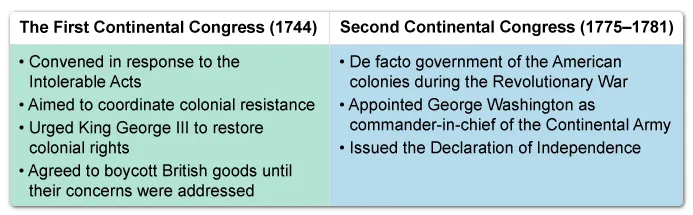
AP® U.S. History Unit 3 Review and Practice Test
Build a solid foundation for understanding the political, social, and economic shifts of the 1750–1800 era with our AP® U.S. History Unit 3 review. Explore major themes like colonial resistance, revolutionary ideals, and the formation of the U.S. government through engaging, easy-to-follow lessons. Reinforce your learning with realistic APUSH unit 3 MCQ practice crafted to mirror the style and depth of the actual exam.
Boost Your Confidence and Score High with Our AP U.S. History Unit 3 Review
Turn tricky Unit 3 topics into strengths with our focused Unit 3 APUSH review. Clear explanations, engaging examples, and realistic practice questions help you master the Revolution, the Articles, and the Constitution with confidence. With structured support every step of the way, you’ll feel ready to score higher on the APUSH Unit 3 test.
Engaging Video Lessons
Make early American history come alive with our APUSH Unit 3 video lessons. Each clip uses visuals, timelines, and clear explanations to break down complex topics like the road to independence and the creation of the Constitution. It’s a fun, memorable way to strengthen your understanding before the AP® U.S. History Unit 3 test.
Interactive Study Guides
Stay organized and focused with our AP U.S. History Unit 3 study guide, built to make this era easier to understand. Concise notes, visual timelines, and quick checkpoints help you review major events efficiently and track your progress as you prepare for the APUSH Unit 3 test.
Try These AP U.S. History Unit 3 Practice Test Questions
Passage:
"The American Spelling Book…when first published, encountered an opposition, which few new publications have sustained with success. It however maintained its ground, and its reputation has been gradually extended and established, until it has become the principal elementary book in the United States.
In a great part of the northern States, it is the only book of the kind used; it is much used in the middle and southern States; and its annual sales indicate a large and increasing demand. Its merit is evinced not only by this general use, but by a remarkable fact, that…attempts made to rival it…have most…illegally copied a considerable part of the tables, with little or no alteration; and others have altered them, by additions, mutilations and subdivisions, numerous and perplexing. In most instances, this species of injustice has been discountenanced by the citizens of the United States, and the public sentiment has protected the original work, more effectually than the penalties…."
Preface to Noah Webster's The American Spelling Book, 1806 edition
Question
Which of the following best describes the primary purpose of the document from which the excerpt was taken?
| A. Promoting a distinctive national culture | |
| B.Increasing national literacy rates | |
| C. Advocating for the abolition of slavery | |
| D. Establishing a national public education system |
Explanation
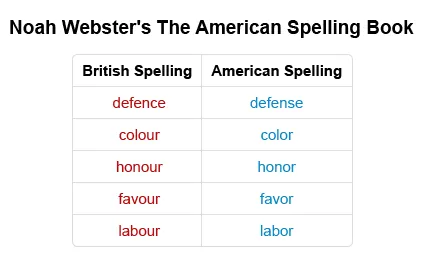
Written for American classrooms during the post-Revolutionary era, Noah Webster's The American Spelling Book introduced new spellings for common English words. As the excerpt notes, by 1806, Webster's speller had "become the principal elementary book" in the nation.
Following the Revolution, many prominent Americans, including Webster, wanted to replace British cultural elements with those reflecting a uniquely American identity. He hoped his new spellings would easily distinguish American texts and writings from British ones. For example, certain words ending in "-ce," such as "defence," were changed to "-se," as in "defense." Similarly, the "u" was removed from words such as "color" and "labor."
The primary purpose of The American Spelling Book was to promote a distinct national culture, which many believed was crucial to solidifying American independence and differentiating themselves from the citizens of Great Britain.
(Choice B and D) Although The American Spelling Book was designed for elementary education, Webster's primary goal was not to improve literacy or establish a national education system, but to create a distinctly American version of the English language.
(Choice C) There was increased support for abolition following independence, but it was not related to The American Spelling Book.
Things to remember:
Following independence, Americans looked to replace many British cultural elements with those that reflected a uniquely American identity.
Passage:
"Whereas all the constitutional authority, ever possessed by the kings of Great Britain over these colonies, or their other dominions, was, by compact, derived from the people, and held of them for the common interest of the whole society, allegiance and protection are, in the nature of things, reciprocal ties, each equally depending upon the other, and liable to be dissolved by the other's being refused or withdrawn.
[A]ll inhabitants of this colony of full age, who are worth fifty pounds proclamation money clear estate in the same, and have resided within the county in which they claim a vote for twelve months immediately preceding the election, shall be entitled to vote for representatives in council and assembly; and also for all other public officers that shall be elected by the people of the county at large."
New Jersey State Constitution, 1776
Question
The excerpt best reflects which of the following?
| A. Conflicts over how to define citizenship | |
| B. Fear of unchecked democracy by the unpropertied classes | |
| C. Disagreement over the role of a centralized authority | |
| D. Creation of state governments based on natural rights of citizens |
Explanation
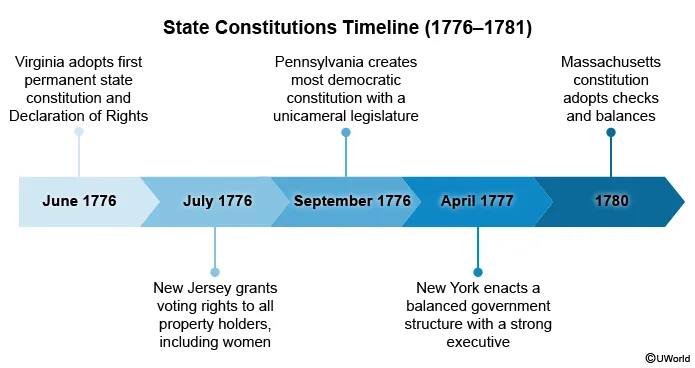
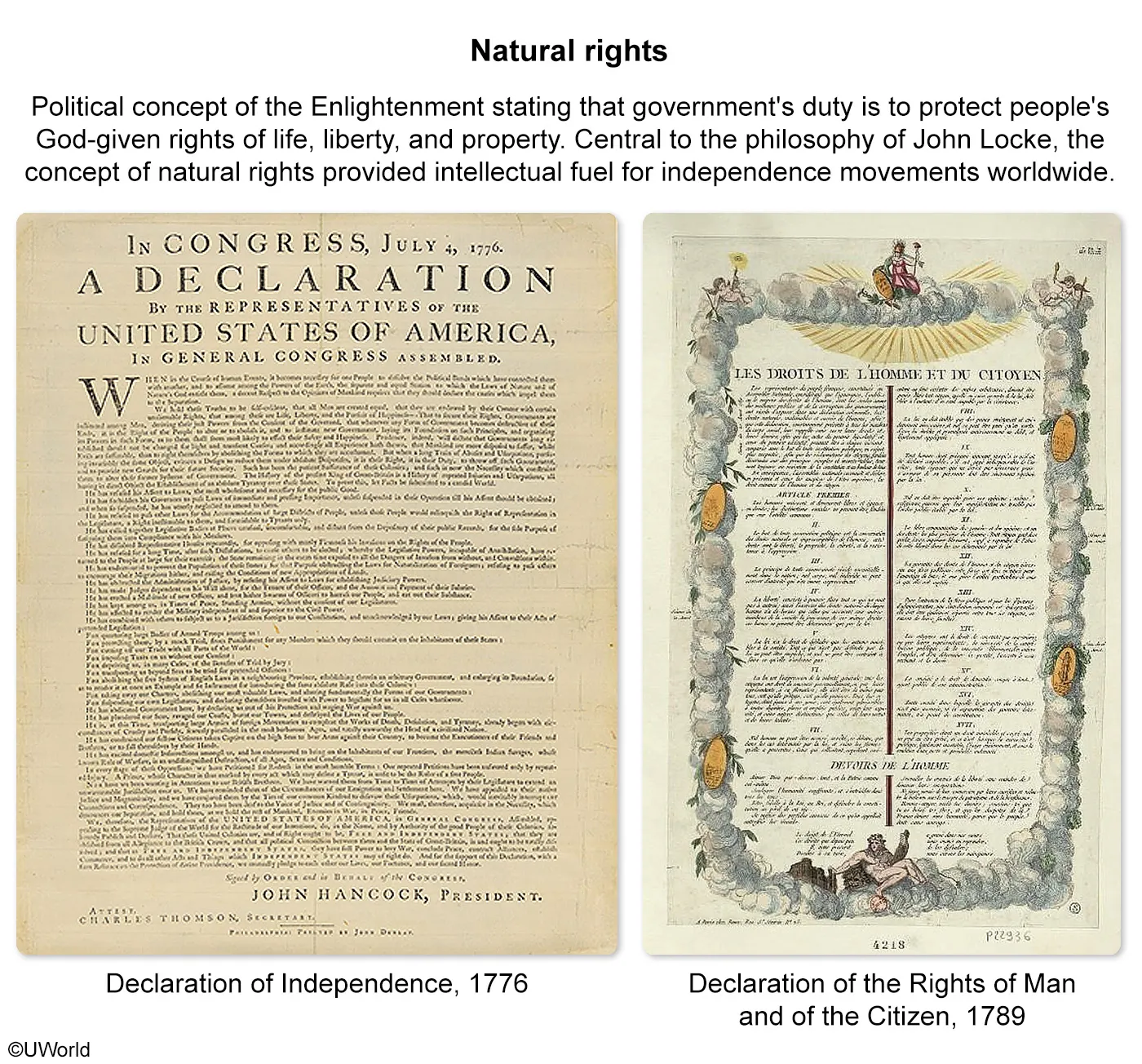
During the American Revolution, the thirteen colonies, having become independent states, experimented with various forms of governance in their constitutions. These documents empowered their legislatures, limited executive powers, and replaced royally appointed governors with elected officials. All state constitutions, including New Jersey's, reflected Enlightenment ideals of natural rights.
For example, New Jersey's constitution declares that "[A]ll the constitutional authority…was, by compact, derived from the people…[and] all inhabitants," rejecting the divine right of European monarchs and embracing the ideas of citizens' natural rights, notably, the ideas of John Locke.
Locke argued that all individuals possess inalienable, God-given rights to life, liberty, and property. The purpose of government, in Locke's view, was to protect those rights.
(Choice A) The excerpt does not reflect conflicts over unchecked democracy; rather, it discusses voting qualifications and emphasizes the idea that legitimate authority is derived from the people.
(Choice B) Although the excerpt includes a property requirement for voting, it does not express fear of lower-class political participation.
(Choice C) New Jersey's state constitution defined who had political held legitimacy; it did not include information about a disagreement about the role of a centralized authority in the federal government.
Things to remember:
State constitutions such as New Jersey's reflected Enlightenment ideas by grounding government in the natural rights of the people and popular consent rather than monarchic authority.
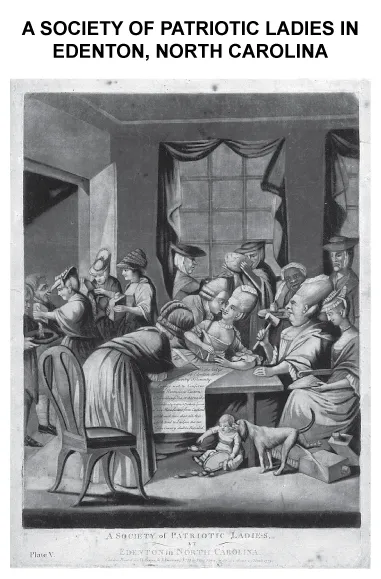
Question
The efforts depicted in the political cartoon emerged most directly from the context of which of the following?
| A. Calls to appease imperial authorities in the colonies | |
| B. Southern planters' desire for British luxury goods | |
| C. Challenges by poor farmers to the authority of elite planters | |
| D. Colonial resistance to new forms of British taxation |
Explanation
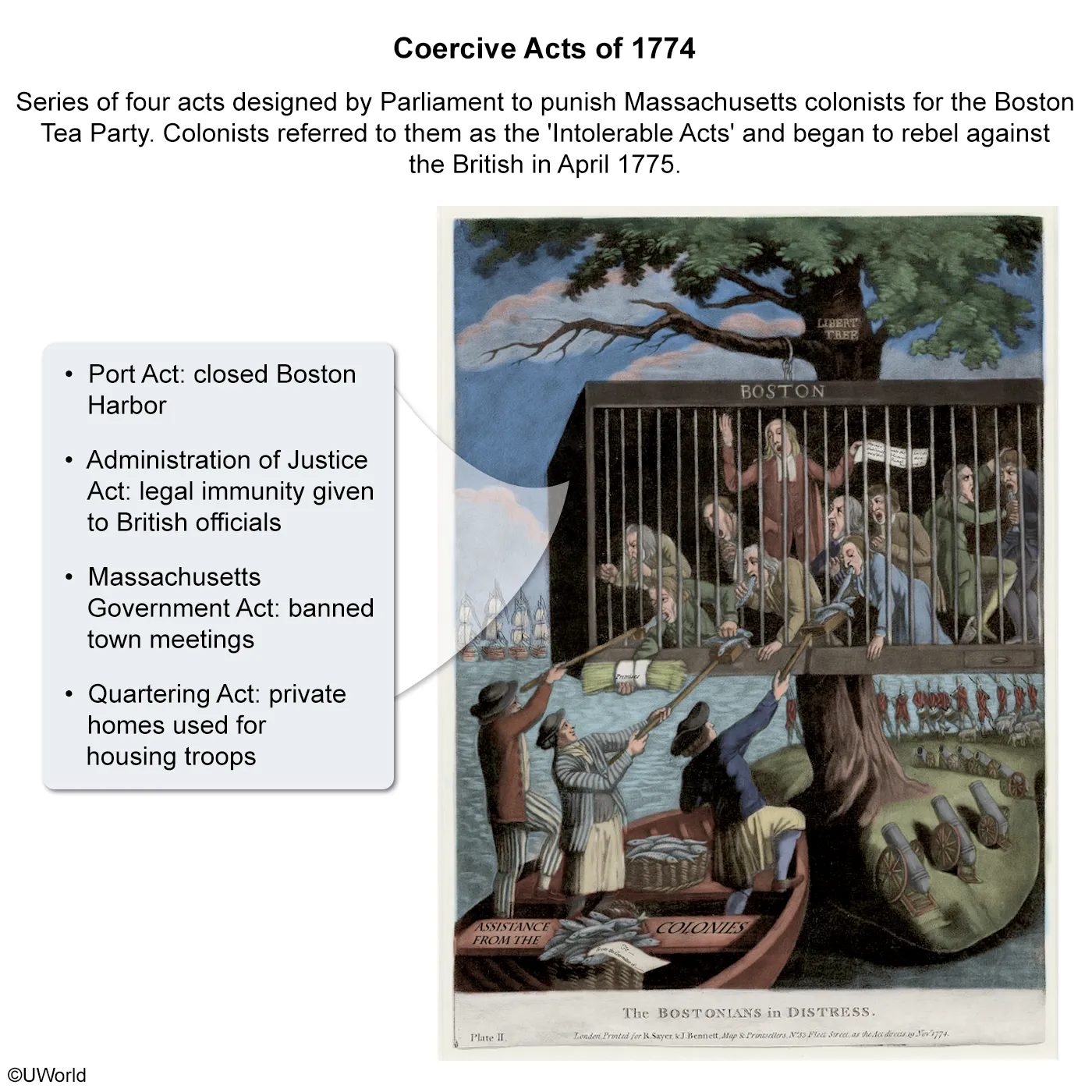
In response to new taxes, such as the Tea Act and the Intolerable Acts, colonists organized boycotts of British goods. To weaken British economic interests, the First Continental Congress endorsed a widespread boycott, encouraging colonists to use locally produced goods. These actions united the colonies against British oppression, fostering a shared American identity and purpose.
Boycotts were critical forms of resistance to British taxation and authority. The 1775 cartoon emerged from a reaction to colonial boycotts associated with the American Revolution. Although the portrayal of the colonial women is satirical, intended to ridicule them for stepping outside their traditional roles, the cartoon reflects colonial efforts to replace British imports with local goods as a form of protest.
(Choice A) Colonial boycotts reflected resistance, not appeasement, to imperial authorities.
(Choice B) The efforts depicted colonists avoiding the purchase of British goods as a means of resistance; the image did not indicate a desire for British luxury goods.
(Choice C) The efforts challenged the British Parliament's authority, not that of elite planters.
Things to remember:
Leading up to the American Revolution, women's participation in boycotts served as a critical form of resistance against British taxation and authority.
Stand Out
with a Top Score in AP U.S. History
Complete your comprehensive APUSH Unit 3 review and boost your performance to make yourself a standout candidate for competitive colleges, majors, and scholarships by earning a top score.
Get your all-in-one course today!
- Engaging APUSH Videos with Expert Instruction
- Customizable Quiz Generator
- Adjustable Study Planner
- Print & Digital Study Guide with Step-by-Step Explanations
- Realistic Timed Test Simulation
- Progress Dashboard
- 500+ Expert-Designed, Exam-style Practice Questions
- Smart Flashcards
- Mobile App
Hear From Our AP Students
UWorld’s service is pretty good and helps provide a lot of explanations on subjects I haven’t been confident on before.
The questions here are the most realistic to the AP tests I've seen so far! I appreciate the ability to customize tests as well.
The best part is that all options are well-explained, telling clearly why they are not the right option.
Frequently Asked Questions (FAQs)
What is AP U.S. History Unit 3 and why is it important for the exam?
AP U.S. History Unit 3 explores the crucial period when tensions between Britain and the colonies escalated into the American Revolution and ultimately shaped the foundations of the new nation. Because these events drive so many political and constitutional themes on the exam, students who understand Unit 3 can more easily tackle APUSH Unit 3 MCQ, SAQ, and document-based questions.
Key topics in APUSH Unit 3 include:
- Colonial resistance to British taxation and tighter imperial control
- Enlightenment ideas that influenced the push for independence
- Major battles and turning points of the American Revolution
- Weaknesses of the Articles of Confederation and the need for stronger federal authority
- The constitutional debates that shaped early American government
- Early political divisions and their impact on national identity
Mastering these themes helps students connect causes, consequences, and historical arguments. These skills are essential for interpreting stimulus-based questions and writing clear, evidence-based responses. A strong foundation in Unit 3 strengthens overall exam performance because its concepts echo throughout later units on political development, federal power, and civic identity.
What topics are covered in AP U.S. History Unit 3?
AP U.S. History Unit 3 examines the transformative period from colonial unrest to the establishment of the United States government. Understanding these topics is essential for performing well on the APUSH Unit 3 test and mastering both multiple-choice and short-answer questions. This unit lays the groundwork for later developments in federalism, political parties, and early American identity.
Major topics in APUSH Unit 3 include:
- Causes of the American Revolution: taxation policies, colonial protests, and philosophical influences
- The Revolutionary War: key battles, military strategies, and foreign alliances
- Articles of Confederation: weaknesses, governance challenges, and economic issues
- Constitutional Convention: debates over representation, federalism, and ratification
- Early political conflicts: emergence of Federalists and Democratic-Republicans
- Economic and social changes: impacts of war on trade, slavery, and migration
- Key documents: Declaration of Independence, Federalist Papers, and early legislative acts
UWorld’s APUSH Unit 3 lessons provide interactive explanations of key events, documents, and debates, helping students break down complex topics into clear, manageable insights. Its practice questions mirror College Board® expectations, giving guided feedback that strengthens reasoning, improves accuracy on APUSH Unit 3 MCQ, and builds confidence for both multiple-choice and short-answer sections.
How should I study for the AP U.S. History Unit 3 review?
Studying for AP U.S. History Unit 3 requires a combination of chronological understanding, thematic connections, and practice with exam-style questions. Unit 3 covers the American Revolution, the creation of the Constitution, and the early Republic, topics that frequently appear on both APUSH Unit 3 MCQ and short-answer sections. A structured approach ensures students can analyze cause-and-effect relationships and interpret historical documents confidently.
Effective study strategies include:
- Concept review: Focus on key events such as colonial resistance, revolutionary battles, and the constitutional debates
- Timeline creation: Map events chronologically to understand the flow of causes and consequences
- Primary source analysis: Examine excerpts from the Declaration of Independence, Federalist Papers, and early legislation
- Practice questions: Use APUSH Unit 3 study guide questions to test comprehension and identify weak areas
- Thematic connections: Relate political, economic, and social changes to one another for a deeper understanding
By combining these strategies, students can strengthen both memory and analytical skills. Regular review of key events, documents, and debates ensures familiarity with the types of prompts likely to appear on the APUSH Unit 3 test, improving performance on multiple-choice, SAQ, and DBQ questions. A consistent, structured approach makes complex historical developments more manageable and exam-ready.
What’s the best study sequence for AP U.S. History Unit 3?
A well-planned study sequence for AP U.S. History Unit 3 helps students build understanding progressively, ensuring that each topic reinforces the next. Organizing your review in a logical order allows you to tackle APUSH Unit 3 MCQ and SAQ questions more efficiently and with greater confidence.
Recommended study sequence:
- Start with causes of the American Revolution: taxation, colonial protests, and philosophical influences
- Move to the Revolutionary War: key battles, strategies, and foreign support
- Examine the Articles of Confederation: weaknesses, economic challenges, and governance issues
- Study the Constitutional Convention: debates, compromises, and the ratification process
- Explore early political developments: Federalists vs. Democratic-Republicans and the formation of early policies
- Review economic and social changes: slavery, migration, and post-war trade impacts
Following this sequence allows students to gradually increase comprehension while connecting political, social, and economic themes. Organizing study sessions around this framework ensures that high-yield topics are thoroughly reviewed and that patterns in historical events become easier to recognize on the APUSH Unit 3 test. This approach promotes both conceptual understanding and exam-ready application.
What is the most effective AP U.S. History Unit 3 review plan in the last two weeks?
In the final two weeks before the exam, an organized review plan for AP U.S. History Unit 3 helps students consolidate knowledge of revolutionary and early national period topics, improving performance on both APUSH Unit 3 MCQ and short-answer questions. Focusing on high-yield content and timed practice ensures that understanding translates into exam readiness.
Two-week review plan:
Week 1:
- Revisit major causes and effects of the American Revolution
- Study key documents such as the Declaration of Independence and Federalist Papers
- Review Articles of Confederation and the Constitutional Convention debates
- Create timelines linking events, policies, and social changes
Week 2:
- Focus on practice with APUSH Unit 3 test questions, including MCQs and SAQs
- Identify weak areas from previous practice and re-study those topics
- Summarize essential dates, terms, and themes in a concise review sheet
- Complete timed practice sessions to simulate exam conditions
Following this plan ensures students can recall key events, understand cause-and-effect relationships, and interpret primary sources efficiently. A structured two-week approach helps reinforce conceptual understanding and improve speed on multiple-choice questions for the APUSH Unit 3 test.
What are the main FRQ question types for AP U.S. History Unit 3?
AP U.S. History Unit 3 FRQs test students’ ability to analyze historical events, interpret documents, and connect political, social, and economic developments. Understanding the common types of questions helps students focus their study and approach free-response questions with clarity.
Common FRQ types in Unit 3 include:
- Document-based analysis: Evaluate primary-source excerpts such as letters, speeches, or legislative documents and connect them to broader historical themes
- Causation and effect: Explain how British policies led to colonial resistance, revolution, and early federal challenges
- Comparison questions: Contrast political ideologies, social groups, or regional differences during the Revolutionary and early national periods
- Continuity and change: Trace shifts in governance, political participation, and social structures over time
- Argument development: Construct evidence-based responses linking causes, consequences, and historical context
Focusing on these FRQ types allows students to develop analytical reasoning and evidence-based writing skills. By practicing structured responses and connecting events logically, learners can increase accuracy and efficiency on both APUSH Unit 3 test and exam-style prompts.
How can I improve my score on AP U.S. History Unit 3 progress check MCQs?
Improving performance on APUSH Unit 3 progress check MCQ requires a combination of content mastery, strategic practice, and analytical reasoning. These multiple-choice questions often assess knowledge of causes, events, and consequences from the colonial, revolutionary, and early national periods, making it essential to connect facts with broader themes.
Strategies to boost MCQ performance:
- Review core concepts: Focus on the causes of the American Revolution, key battles, Articles of Confederation, and constitutional debates
- Practice with timelines: Understand the chronological flow of events and how one development influenced the next
- Analyze primary sources: Become comfortable interpreting excerpts from the Declaration of Independence, Federalist Papers, and early legislation
- Timed practice sessions: Simulate exam conditions with APUSH Unit 3 test questions to improve speed and accuracy
- Identify patterns in mistakes: Review errors from practice questions to pinpoint conceptual gaps or misread prompts
UWorld’s APUSH Unit 3 practice questions provide targeted feedback and step-by-step explanations, helping students identify gaps in their knowledge and reinforce key concepts. Their realistic APUSH Unit 3 progress check MCQ simulations build analytical reasoning and time-management skills, ensuring students are prepared for both multiple-choice and short-answer sections on the exam.
How are core concepts connected in AP U.S. History Unit 3?
In AP U.S. History Unit 3, core concepts are deeply interconnected, and understanding these relationships helps students analyze historical events and answer both APUSH Unit 3 MCQ and FRQ questions effectively. Political, social, and economic developments during the Revolutionary and early national periods influenced one another, creating patterns that recur throughout the unit.
Key connections among Unit 3 topics:
- Colonial resistance and revolution: Tensions from British taxation policies and Enlightenment ideas led directly to revolutionary actions
- Revolution and government formation: Outcomes of the war influenced the creation of the Articles of Confederation and, later, the Constitution
- Constitution and political factions: Debates over federal power and states’ rights shaped the rise of Federalists and Democratic-Republicans
- Economic and social changes: Post-war trade, slavery, and migration trends interacted with political developments to shape early national society
Recognizing these relationships allows students to see history as a connected system rather than isolated events. This understanding improves the ability to interpret primary sources, predict cause-and-effect relationships, and apply analytical reasoning on both the APUSH Unit 3 test and exam-style questions.
How can I retain complex concepts in AP U.S. History Unit 3?
Retaining complex concepts in AP U.S. History Unit 3 requires combining understanding with active practice. Topics like revolutionary causes, constitutional debates, and early political developments appear frequently in APUSH Unit 3 MCQ and FRQs, so memorization alone is insufficient. Students need strategies that link facts to broader themes and analytical reasoning.
Strategies for retention:
- Active note-taking: Summarize key events, causes, and effects in your own words
- Visual aids: Use timelines, flow charts, and thematic maps to connect political, social, and economic changes
- Practice questions: Apply knowledge through APUSH Unit 3 study guide exercises and sample MCQs
- Flashcards and self-quizzing: Test recall of dates, key figures, and foundational concepts regularly. UWorld’s APUSH Unit 3 flashcards provide targeted practice for high-yield topics, reinforcing memory through active recall and spaced repetition
- Teach or explain concepts: Explaining topics aloud reinforces memory and conceptual clarity
By combining these strategies, students can internalize complex historical developments and recall essential information under exam conditions. Consistent practice and active engagement improve performance on both the APUSH Unit 3 test and progress check questions.
How do I study document and source analysis effectively for the AP U.S. History Unit 3 test?
Studying documents and source analysis in AP U.S. History Unit 3 requires combining content knowledge with critical reasoning skills. Many FRQs and APUSH Unit 3 MCQ questions ask students to interpret primary sources, identify author perspectives, and connect evidence to broader historical themes.
Strategies for effective analysis:
- Contextual understanding: Learn the background of key documents, including the Declaration of Independence, Federalist Papers, and early legislation
- Identify purpose and audience: Determine why a document was created and who it was intended to influence
- Cross-reference events: Link documents to political, social, and economic developments in Unit 3
- Practice active reading: Annotate passages, highlight key arguments, and summarize main points in your own words
- Timed practice: Use APUSH Unit 3 test or study guide questions to simulate exam conditions and improve response speed
By applying these strategies, students can interpret historical evidence more accurately and craft concise, evidence-based responses. Regular practice helps connect documents to larger themes, reinforcing analytical skills needed for both multiple-choice and free-response sections of the APUSH Unit 3 test.
What is the best AP U.S. History Unit 3 practice test format?
The most effective APUSH Unit 3 practice test mirrors the structure and rigor of the actual exam, combining multiple-choice and short-answer questions to build both content knowledge and analytical skills. Practicing under realistic conditions helps students strengthen performance on APUSH Unit 3 MCQ and SAQ sections.
Recommended practice test format:
- Multiple-choice questions: 20–25 questions covering revolutionary causes, constitutional debates, early political parties, and economic trends. Focus on interpreting timelines, primary sources, and historical data.
- Short-answer questions (SAQs): 2–3 prompts requiring concise, evidence-backed responses that connect events, documents, and consequences.
- Timing: Allocate 50–60 minutes to complete the test, simulating exam pacing.
- Review: Analyze mistakes to differentiate between conceptual misunderstandings and misread prompts, then revisit those areas in your notes or study guide.
Using a structured practice test format ensures students are comfortable with the range of question types and time constraints they will face on the test. UWorld’s APUSH Unit 3 practice tests replicate exam-style multiple-choice and short-answer questions with detailed explanations, helping students track errors, strengthen reasoning, and build confidence for the real test.
When should I begin preparing for the AP U.S. History Unit 3 test?
Preparation for the APUSH Unit 3 test should start as soon as students are introduced to key revolutionary and early national period concepts. Early review allows for repeated practice with APUSH Unit 3 MCQ, SAQs, and helps build confidence in interpreting documents, timelines, and historical trends.
Suggested preparation timeline:
- 3–4 weeks before the test: Review foundational topics such as causes of the American Revolution, Articles of Confederation, the Constitution, and early political factions. Begin practicing with small sets of MCQs and short-answer questions.
- 2 weeks before the test: Focus on applying knowledge to interpret primary sources, analyze cause-and-effect relationships, and connect social, economic, and political changes. Attempt timed MCQs and SAQs.
- Final week: Complete full-length APUSH Unit 3 practice tests, review mistakes, and summarize high-yield events and documents in a concise study sheet.
Starting preparation early ensures students build a solid conceptual foundation, refine test-taking skills, and can tackle both multiple-choice and short-answer sections efficiently. UWorld’s APUSH Unit 3 lessons and practice tests provide interactive, exam-style questions with guided explanations, helping students pace their study effectively, track progress, and target weak areas for maximum score improvement.
What are the common mistakes students make in AP U.S. History Unit 3?
Students often lose points on the APUSH Unit 3 test and progress check questions due to conceptual misunderstandings, misreading prompts, or weak analysis. Recognizing these common mistakes helps learners avoid them and improve overall performance.
Frequent errors include:
- Chronology mistakes: Confusing the order of revolutionary events, constitutional debates, or early national policies
- Document misinterpretation: Misreading primary sources or failing to identify author perspective and purpose
- Weak connections: Not linking political, economic, and social developments when answering FRQs or SAQs
- Incomplete explanations: Providing factual details without contextualizing causes, effects, or significance
- Overlooking key figures or terms: Missing important names, legislation, or ideological movements that frequently appear on APUSH Unit 3 MCQ
Students who want to identify and correct these common mistakes can benefit from UWorld’s APUSH Unit 3 practice questions. The platform provides detailed explanations for both correct and incorrect answers, helping learners understand where errors occur and reinforcing strategies to avoid them on the APUSH Unit 3 test.
Where can I find AP U.S. History Unit 3 notes, cheat sheets, or study guides?
High-quality study materials can make reviewing AP U.S. History Unit 3 more efficient and effective. These resources summarize key events, concepts, and documents, which frequently appear in both APUSH Unit 3 MCQ and FRQs.
Recommended resources:
- Comprehensive notes: Step-by-step explanations of causes of the American Revolution, Articles of Confederation, Constitutional debates, and early political developments. Include timelines, summaries, and key terms.
- Cheat sheets: Quick-reference guides covering dates, documents, and high-yield concepts for last-minute review.
- Study guides: Structured materials combining concise summaries with sample questions and exercises to reinforce understanding.
- Interactive tools: Some platforms provide annotated visuals, timelines, and practice sets to reinforce concepts and connect events logically.
Using well-organized notes, cheat sheets, and study guides helps students review efficiently, track progress, and identify areas that require further practice, improving readiness for both APUSH Unit 3 test and progress check questions.
Are there downloadable AP U.S. History Unit 3 study guide PDFs and practice materials?
Students can access a variety of downloadable resources from the College Board to support their AP U.S. History Unit 3 review. These include official PDFs with sample multiple-choice questions, short-answer prompts, and thematic outlines for Unit 3. Concise study guides summarize key events, dates, and primary sources, while practice worksheets provide exercises for applying historical reasoning, analyzing documents, and completing timed questions. Many interactive PDFs also allow note-taking and highlighting for more active review.
In addition to College Board resources, UWorld offers APUSH Unit 3 practice sets and study guides that provide interactive explanations, targeted exercises, and detailed feedback on mistakes. Using UWorld alongside official materials helps students reinforce key concepts, track performance, and build confidence for both APUSH Unit 3 test and progress check questions, ensuring a well-rounded, effective study plan.