AP® Statistics Unit 8 Review and Practice Test
Preparing for Inference for Categorical Data doesn’t have to be stressful! This AP® Statistics Unit 8 review helps you break down chi-square concepts like expected counts, residuals, and test statistics into easy-to-understand lessons. You’ll see how to choose the right chi-square test and interpret results correctly, skills that often show up on the exam. Wrap up your review with AP Stats Unit 8 progress check MCQs and FRQs, designed to mirror real AP questions and help you feel confident walking into test day.
Boost Your Confidence and Score High with Our AP Statistics Unit 8 Review
Ace AP® Statistics Unit 8 with confidence! This structured review covers everything you need to master Inference for Categorical Data, from chi-square concepts to interpreting results. With interactive lessons, detailed examples, and targeted AP Stats Unit 8 progress check MCQ and FRQ practice, you’ll strengthen your problem-solving skills and get ready to score high on exam day.
Engaging Video Lessons
Say goodbye to dry lectures! Our interactive video lessons bring AP Statistics Unit 8 to life with clear explanations and real examples of chi-square tests in action. Whether you’re reviewing for a quiz or your AP Stats Unit 8 progress check, you’ll stay engaged, learn faster, and retain longer.
Interactive Study Guides
Study smarter with UWorld’s AP Stats Unit 8 study guide, built to align with the College Board® CED. It includes concise notes, step-by-step explanations, and visual examples to simplify concepts, turning your AP Statistics Unit 8 review into meaningful progress toward a 5.
Try These AP Statistics Unit 8 Practice Test Questions
Question
A national research group conducted an internet survey in which random samples of 2,000 people who own their home and 2,000 people who rent their home were asked what characteristic of their current living arrangements they consider to be the most desirable. The results of the survey are summarized in the table below.
| Characteristic | |||||
|---|---|---|---|---|---|
| Monthly Costs | Location | Property Features | Size of Living Area | Other | |
| Homeowner | 1,100 | 520 | 195 | 75 | 110 |
| Renter | 950 | 798 | 135 | 45 | 72 |
What is the contribution to the chi-square statistic for homeowners who answered that the size of the living area was the most desirable characteristic?
| A. 0.25 | |
| B. 3 | |
| C. 3.75 | |
| D. 60 | |
| E. 75 |
Hint:
The chi-square statistic is for the chi-square test for homogeneity of proportions.
Explanation
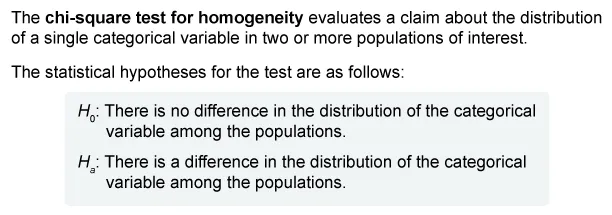
The appropriate hypothesis test to compare the distribution of a categorical variable (characteristic) in two or more populations (homeowners and renters) is the chi-square test for homogeneity of proportions.
When the conditions for inference are met, use the following formula to calculate a chi-square test statistic (χ²) for the chi-square test of homogeneity.
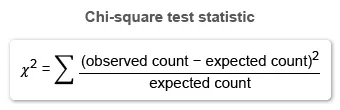
The individual contribution of a cell is . To determine the contribution of homeowners who answered that the size of the living area was the most desirable characteristic, calculate the observed and expected counts.
Identify the observed cell count of homeowners who said that the size of living area was the most desirable characteristic (75) from the table. Now use the following formula to calculate the expected cell count:
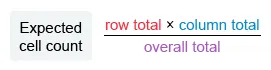
It is given that the overall total is 4,000 (2,000 homeowners and 2,000 renters). Use the table to determine that the row total for homeowners is 2,000 and the column total for characteristic is 120 (calculation).
| Expected Cell Count | |
| Plug in row total = 2,000, column total = 120, and overall total = 4,000 | |
| 60 | Simplify |
Plug the expected count (60) and the observed count (75) into the chi-square statistic formula.
| Contribution to chi-square statistic | |
| Plug in observed cell count = 75 and expected cell count = 60 | |
| 3.75 | Simplify |
Therefore, the contribution to the chi-square statistic for homeowners who answered that the size of the living area was the most desirable characteristic is 3.75.
(Choice A) 0.25 results from mistakenly using (Observed Count − Expected Count) as the numerator of the formula for the contribution the chi-square statistic, rather than (Observed Count − Expected Count)².
(Choice B) 3 results from mistakenly using the observed count rather than the expected count as the denominator of the formula for the contribution of the chi-square statistic.
(Choices D and E) 60 and 75 are the expected count and observed count of homeowners who answered that the size of the living area was the most desirable characteristic.
Things to remember:
- The appropriate hypothesis test to compare the distribution of a categorical variable (characteristic) in two or more populations is the chi-square test for homogeneity of proportions.
- The individual contribution of a cell to the chi-square statistic is .
Question
Consider again the survey of road conditions. For that survey, the researcher conducted an email-based survey of residents living in a large city in the northern U.S. The residents were asked in which region of the city they lived and how they would rate the roads in the city.
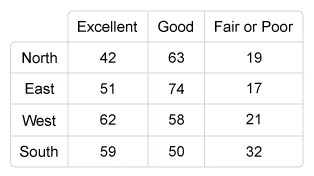
If the researcher instead selected separate random samples of 125 residents living in each region to rate the roads, which of the following procedures would be most appropriate to use for determining if the distribution of road ratings differs among the regions?
| A. Chi-square goodness-of-fit test | |
| B. Chi-square test of independence | |
| C. Chi-square test of homogeneity |
Explanation
It is given that the researcher selected separate random samples of 125 residents living in each region to rate the roads (a stratified sample). The test that compares the distribution of a categorical variable (how residents rate the roads) across different populations (city regions) is the chi-square test of homogeneity.
Question
A researcher conducted an email-based survey of residents living in a large city in the northern U.S. The residents were asked in which region of the city they lived and how they would rate the roads in the city.
Which of the following procedures would be most appropriate to use for determining whether there is a relationship between where people live and how they rate the roads?
| A. Chi-square goodness-of-fit test | |
| B. Chi-square test of independence | |
| C. Chi-square test of homogeneity |
Explanation
It is given that a single sample of residents living in a large city in the northern U.S. was selected and each resident was categorized based on the region of the city in which they lived and how they would rate the roads in the city. The test that evaluates the relationship between two categorical variables (city regions and how residents rate the roads) is the chi-square test of independence.

Stand Out
with a Top Score on the AP Statistics Exam
Finish your AP Statistics Unit 8 review and continue mastering all units with UWorld. Complete our AP Statistics full review course to boost your performance and stand out as a top candidate for competitive colleges, majors, and scholarships by earning a top score.
Get our all-in-one course today!
- Focused AP Stats Videos
- Print & Digital Study Guide
- 1300+ Exam-style Practice Questions
- Customizable Quiz Generator
- Adjustable Study Planner
- Realistic Timed Test Simulation
- Colorful Visual Explanations
- Progress Dashboard
- Smart Flashcards & Digital Notebook
Hear From Our AP Students
UWorld’s service is pretty good and helps provide a lot of explanations on subjects I haven’t been confident on before.
The questions here are the most realistic to the AP tests I've seen so far! I appreciate the ability to customize tests as well.
The best part is that all options are well-explained, telling clearly why they are not the right option.

Frequently Asked Questions (FAQs)
What are the main topics covered in AP Statistics Unit 8: Inference for Categorical Data: Chi-Square?
Unit 8 of the AP Statistics course focuses on inference for categorical data using the chi-square test. This unit helps students understand how to analyze relationships and distributions within categorical variables using statistical methods. Topics include:
- Introducing Statistics — Are My Results Unexpected?: Introduces how to evaluate whether differences between observed and expected outcomes are due to random chance or a real effect.
- Setting Up a Chi-Square Goodness of Fit Test: Covers how to establish hypotheses and calculate expected counts to test if data fit a specified distribution.
- Carrying Out a Chi-Square Test for Goodness of Fit: Explains how to compute the chi-square statistic, determine degrees of freedom, and interpret p-values.
- Expected Counts in Two-Way Tables: Focuses on finding expected counts for categorical variables in contingency tables to prepare for homogeneity and independence tests.
- Setting Up a Chi-Square Test for Homogeneity: Guides you through defining hypotheses and conditions for comparing categorical data across multiple populations.
- Carrying Out a Chi-Square Test for Homogeneity or Independence: Teaches how to perform and interpret chi-square tests to determine whether two categorical variables are related or independent.
These topics form the foundation of the AP Stats Unit 8 progress check MCQ and FRQ, which assess your ability to select and perform the correct chi-square test, interpret results, and communicate conclusions clearly. Using UWorld’s AP Statistics Unit 8 review materials, you can practice each test type through guided examples, quizzes, and detailed explanations to build mastery and confidence before exam day.
How should I prepare for an AP Statistics Unit 8 exam?
Preparing for the AP Statistics Unit 8 exam requires a focused approach that combines clear concept understanding, active practice, and consistent review. Here’s how you can make the most of your prep:
- Build a Strong Conceptual Foundation: Begin with UWorld’s video lessons and interactive study guides for AP Stats Unit 8. They simplify key chi-square concepts — such as expected counts, degrees of freedom, and interpreting results — using visuals and real-world examples.
- Practice with Exam-Style Questions: Work through AP Stats Unit 8 progress check MCQ and FRQ practice to strengthen your problem-solving skills. These questions mirror the real exam format and help you apply concepts under test-like conditions.
- Review Detailed Explanations: After every practice question, carefully read the explanations for both correct and incorrect answers. This helps reinforce the logic behind chi-square tests and clears up any confusion.
- Focus on Weak Areas: Use performance insights from quizzes to identify topics that need extra work, whether it’s setting up hypotheses or interpreting p-values. Targeted review ensures steady improvement.
- Simulate the Exam: Take timed practice tests to build endurance and accuracy. This helps you manage pacing during the AP Statistics Unit 8 progress check and the actual exam.
- Reinforce Consistently: Revisit difficult topics frequently and mix up question types to test your understanding. Consistent practice and review are key to mastering Inference for Categorical Data and earning a top score on the AP Stats exam.
Are any free resources available for AP Statistics Unit 8?
Yes. UWorld offers a free trial that gives you access to AP Statistics Unit 8 content, including AP Stats Unit 8 practice questions, interactive explanations, and study materials that simplify chi-square inference. You can explore both multiple-choice and free-response question formats modeled after real AP Stats Unit 8 MCQ and FRQ examples. Each includes detailed step-by-step solutions to help you understand how the chi-square test AP Stats is applied to categorical data.
While using UWorld as a primary resource, you can complement it with the College Board’s official resources and Khan Academy’s video lessons. The College Board provides sample AP Statistics Unit 8 FRQ sets and the full framework for Inference for Categorical Data – Chi-Square, while Khan Academy reinforces conceptual understanding.
What types of questions are on the AP Stats Unit 8 test?
The AP Statistics Unit 8 test evaluates both your understanding of categorical data inference and your ability to apply chi-square concepts in real-world contexts. Question types include:
- Multiple-Choice Questions (MCQs): The AP Stats exam includes 40 MCQs to be completed in 90 minutes. These may appear as individual questions or grouped in sets with a shared stimulus, such as a contingency table or categorical dataset. Expect questions that assess your ability to choose the correct chi-square test, calculate expected counts, interpret p-values, and evaluate statistical significance.
- Free-Response Questions (FRQs): You’ll have 6 FRQs in 90 minutes—five multipart questions and one investigative task. FRQs test your ability to design or interpret statistical investigations, perform chi-square calculations, and explain reasoning clearly in context. The investigative task often integrates multiple skills, asking you to connect concepts from AP Stats Unit 8 with broader areas like sampling, probability, or inference.
- Data Analysis & Interpretation: Many questions present categorical data through tables or experimental results. You’ll be asked to apply chi-square tests for goodness-of-fit, homogeneity, or independence, interpret statistical evidence, and justify conclusions.
- Mathematical & Conceptual Reasoning: Be prepared to compute expected counts, degrees of freedom, and chi-square statistics while explaining the logic behind your steps. Questions often require linking numerical results to conceptual understanding in AP Statistics Unit 8.
These question formats reflect the AP exam’s emphasis on analytical thinking and applied reasoning. UWorld’s AP Stats Unit 8 progress check MCQ and FRQ practice mirrors these formats with detailed explanations for every answer choice, helping you build confidence and master chi-square inference before test day.
How can I improve my score on the Free-Response Questions (FRQs) for Unit 8?
Raising your AP Stats Unit 8 FRQ score takes deliberate, structured practice. Begin by reviewing past chi-square FRQ AP Stats problems to understand how responses earn points. The FRQs usually test inference reasoning, defining hypotheses, verifying conditions, calculating expected counts, finding the chi-square statistic, and interpreting the p-value in context.
Here’s a focused method that our experts recommend:
- Write out every step, even when answers seem obvious. Scorers award points for process and justification
- Use complete sentences when interpreting results, state what your conclusion means for the data set
- Double-check that your sample size conditions and categorical assumptions are clearly met
UWorld offers AP Stats Unit 8 FRQ practice with step-by-step explanations and detailed rationales, helping you see exactly what graders look for. Each solution shows how to organize your work and phrase interpretations precisely.
Pair this with UWorld’s AP Stats chi-square review videos to reinforce why certain conditions must be checked. Over time, this feedback-driven practice helps you build not only accuracy but also exam-ready reasoning. When your explanations become structured and contextual, FRQs stop being intimidating, and start becoming point-rich opportunities to show mastery.
How can I improve my score on the Multiple-Choice Questions (MCQs) for Unit 8?
Improving your AP Stats Unit 8 MCQ score begins with recognizing patterns and maintaining precision under time pressure. The multiple-choice section often combines conceptual reasoning with simple calculations, so understanding the rationale behind each chi-square test is as important as the math.
Here’s how to strengthen your performance:
- Classify question type: Identify whether it’s testing goodness-of-fit, homogeneity, or independence. This determines which chi-square test AP Stats procedure applies.
- Eliminate concept traps: Wrong choices usually stem from confusion between categorical and quantitative inference. Remember, chi-square AP Stats only handles categorical variables.
- Use your scratch work: Sketch quick tables for observed vs. expected counts to visualize differences.
- Time practice: Aim to complete each question in about 90 seconds to simulate exam pacing.
UWorld’s AP Statistics Unit 8 practice test includes hundreds of AP Stats Unit 8 MCQ Part B and conceptual questions that mirror the College Board style. Each question includes detailed rationales explaining not just what’s correct, but why other choices fail. Reviewing those explanations daily significantly improves accuracy.
By combining repetition, review, and reflection using UWorld’s AP Stats Unit 8 review platform, your MCQ approach becomes fast, accurate, and structured for full-credit reasoning.
What is the "Inference for Categorical Data: Chi-Square" unit's weight on the AP Statistics exam?
The AP Statistics Unit 8 – Inference for Categorical Data: Chi-Square section typically accounts for approximately 2-5% of the total AP Statistics exam. That may sound light, but the unit is disproportionately important because it introduces a new family of inferential techniques. Mastering this portion allows you to evaluate how categorical variables relate, skills that resurface throughout AP Stats chi-square FRQ and other inference units.
This section introduces three key chi-square AP Stats procedures:
- Goodness-of-fit test – determining if an observed distribution matches expectations
- Test for homogeneity – comparing categorical distributions across multiple groups
- Test for independence – determining if two categorical variables are related
Each one requires different degrees of freedom, conditions, and interpretation strategies. Teachers typically spend about 6–9 class days on this topic because the reasoning can initially feel abstract. That’s where UWorld’s AP Statistics Unit 8 review helps most—interactive explanations turn abstract logic into concrete understanding.
Where can I find a good study guide for AP Statistics Unit 8?
A strong AP Statistics Unit 8 study guide should help you understand Inference for Categorical Data – Chi-Square conceptually, not just memorize formulas. The best guides blend worked examples, real-data applications, and targeted review questions that mirror the AP Stats Unit 8 practice test structure.
UWorld’s Unit 8 AP Statistics review materials are built exactly that way. Each section explains how and when to use the chi-square test AP Stats methods: goodness-of-fit, homogeneity, and independence, while walking you through examples that clarify how expected counts, degrees of freedom, and p-values connect. Color-coded tables and annotated visuals make even complex distributions easy to interpret.
Unlike static PDFs, UWorld’s AP Stats chi-square review integrates quizzes directly into the explanations. As you read, you can test your comprehension instantly with AP Stats Unit 8 MCQ samples and short written prompts. The adaptive feedback then guides you toward the right reasoning steps.
For flexible study, the UWorld mobile app includes flashcards that summarize every formula and condition, as well as digital notes that sync with your dashboard. You can even start free and upgrade later to access all AP Statistics Unit 8 review modules. This combination of guided study, practice, and self-assessment ensures you’re not just passively reading but actively preparing to ace your AP Stats chi-square FRQ and MCQ sections with confidence.
Can I find practice tests specifically for AP Stats Unit 8?
Absolutely. UWorld’s AP Statistics Unit 8 practice test options are designed to target Inference for Categorical Data – Chi-Square directly. Each set simulates real exam conditions, combining both AP Stats Unit 8 MCQ and FRQ problems at authentic AP difficulty. These tests train you to think statistically, not mechanically, helping you apply inference logic accurately under time pressure.
Every question is paired with instant feedback, step-by-step solutions, and chi-square review AP Stats visuals showing how to check assumptions and interpret p-values. You can reattempt questions as many times as needed, track accuracy trends, and target weak areas through UWorld’s dashboard analytics.
Timed practice is crucial because Unit 8 questions often require multi-step reasoning, including forming hypotheses, calculating expected counts, considering conditions, performing calculations, and drawing conclusions. Practicing this flow repeatedly builds exam stamina and consistency.
Unlike generic worksheets, UWorld’s Unit 8 AP Stats review tests mimic the AP exam tone and logic exactly, preparing you for what the graders expect. Whether you’re completing full-length tests or quick quizzes, these exercises transform theory into applied skill, and that’s what earns a 5.
What’s the checklist to review before the AP Stats Unit 8 test?
Before your AP Statistics Unit 8 test, you should be able to move confidently from concept to computation. Use this checklist to verify readiness:
- Core Understanding
- Know when to apply each chi-square AP Stats test: goodness-of-fit, homogeneity, and independence.
- Recall all chi-square test AP Stats conditions: random sampling, independence, expected count ≥ 5.
- Understand how to calculate expected counts and degrees of freedom for any table.
- Application Skills
- Practice multiple AP Stats Unit 8 MCQ sets under time pressure.
- Complete at least two AP Stats Unit 8 FRQ problems, fully written with context-based interpretations.
- Use AP Statistics Unit 8 practice test sessions to simulate exam pacing and accuracy checks.
- Review & Mindset
- Review the AP Stats Unit 8 review notes daily for terminology and formula recall.
- Focus on interpreting results logically: what does statistical significance imply about the data relationship?
Finally, analyze your mistakes through UWorld’s detailed explanations, as each one highlights the reasoning gap, not just the incorrect step. Completing this checklist ensures that by the time you sit for your Unit 8 AP Stats review, you’ll approach every question with structure, speed, and confidence.
What are the common mistakes students make in AP Stats Unit 8?
The biggest mistakes in AP Statistics Unit 8 typically occur when students mix up test types or skip condition checks. Students often confuse when to use the chi-square test AP Stats for independence versus homogeneity, or they forget to confirm that expected counts are large enough.
Common pitfalls include:
- Treating data as quantitative instead of categorical.
- Forgetting to check the random sample and expected count ≥ 5 conditions.
- Writing vague hypotheses without context or clear variables.
- Misinterpreting the p-value. Remember, small p-values indicate stronger evidence against the null.
UWorld’s AP Stats chi-square review tutorials highlight these patterns in context, showing how even one skipped check can void your test conclusion. Each AP Statistics Unit 8 practice test item comes with line-by-line reasoning so you can see exactly where common logic fails.
Reviewing these explanations transforms mistakes into learning patterns. Over time, you’ll spot traps instantly, like independence questions disguised as goodness-of-fit problems. Students who complete just 30-40 UWorld AP Stats Unit 8 MCQ and FRQ items weekly reduce their conceptual errors by half. Correcting these foundational gaps early is the fastest way to secure points on the Unit 8 AP Stats FRQ and MCQ sections.
How does Unit 8 connect to earlier and later AP Statistics topics?
Unit 8: Inference for Categorical Data – Chi-Square bridges descriptive statistics and formal inference. Earlier units (like proportions and sampling distributions) teach you how to handle single or paired data. This unit expands on that by testing relationships among multiple categorical variables using the chi-square test framework in AP Statistics.
For example, while a two-proportion z-test compares proportions, the chi-square test in AP Stats can evaluate multiple categories simultaneously. Later, in regression and inference units, you’ll reuse these reasoning patterns, such as checking conditions, interpreting p-values, and connecting significance to context.
Mastering AP Stats chi-square review problems gives you a statistical mindset that carries through the entire course. You’ll learn to think probabilistically, interpret patterns beyond single samples, and communicate results clearly.
UWorld’s AP Statistics Unit 8 review materials integrate cross-unit learning automatically. Practice problems often reference earlier topics, such as randomness, sample size, and simulation. Seeing how they tie together reinforces conceptual continuity. When you can explain how categorical inference differs from quantitative inference, you’ve achieved the deep understanding that separates a 3 from a 5 on the AP Stats Unit 8 FRQ and MCQ sections.
What UWorld features best support AP Statistics Unit 8 prep?
UWorld’s AP Statistics Unit 8 review combines smart design, real exam simulation, and adaptive feedback to build deep competence in the chi-square AP Statistics unit. Every feature is designed to teach, test, and reinforce reasoning in a single loop.
You’ll benefit from:
- Targeted Practice Mode: Filter questions by concept, such as goodness-of-fit, homogeneity, or independence, to focus your preparation.
- Step-by-Step Solutions: Detailed reasoning and visuals accompany each AP Stats chi-square test question.
- Smart Flashcards: Auto-generate cards from missed AP Stats Unit 8 MCQ or FRQ attempts to review formulas and definitions.
- Progress Analytics: Track improvement in response accuracy and speed over time.
The platform also mirrors real AP Stats Unit 8 practice test conditions so that you can experience true pacing pressure before exam day. Unlike textbooks or PDF banks, UWorld adapts to your performance and boosts difficulty when you’re ready, and reinforces weak areas automatically.
Students who use these tools consistently report better conceptual retention and reduced test anxiety. By integrating UWorld’s digital notebook and feedback-driven review, you’ll transform your Unit 8 AP Stats review from passive study into active skill mastery, exactly what’s needed to earn a 5.
Learn More About Specific Unit
Exploring One-Variable Data
Exploring Two-Variable Data
Collecting Data
Probability, Random Variables, and Probability Distributions
Sampling Distributions
Inference for Categorical Data: Proportions
Inference for Quantitative Data: Means
Inference for Quantitative Data: Slopes