AP® Statistics Unit 5 Review and Practice Test
Prepare for your Unit 5 AP® Statistics test with our complete Sampling Distributions review. Unit 5 explores how sampling distributions form and how they allow statisticians to estimate population characteristics and measure confidence. Use our AP Statistics Unit 5 review to study with exam-style MCQs, FRQs, practice tests, and study guides that mirror the real AP exam. Whether you prefer quick video explanations, concise notes, or realistic practice, this resource builds your understanding of sampling variability and confidence levels to help you earn a top score.

Boost Your Confidence and Score High with Our AP Statistics Unit 5 Review
Build confidence in AP Statistics Unit 5: Sampling Distributions with expert-designed tools and resources. This AP Stats Unit 5 review breaks down the Central Limit Theorem, standard error, and the connection between population and sample statistics. Practice with AP Stats Unit 5 MCQs and practice tests that mirror the real exam, and reinforce learning with our detailed study guide and engaging videos.
Engaging Video Lessons
Understanding sampling distributions can feel abstract, but UWorld’s AP Statistics Unit 5 review videos make each concept clear and approachable. Through step-by-step visuals, you’ll see how sample means and proportions behave across repeated samples and how the Central Limit Theorem predicts their patterns. These short, focused lessons explain ideas like standard error and variability in context, helping you apply them confidently in AP Stats Unit 5 MCQs and FRQs. Whether you’re preparing for a quiz or the full exam, these videos simplify complex ideas and connect theory to real-world data interpretation.

Interactive Study Guides
Grasping the logic behind sampling distributions becomes easier with UWorld’s AP Statistics Unit 5 study guide. Each topic; from standard error and expected value to the Central Limit Theorem, is broken into concise, visual explanations that connect formulas to meaning. You’ll learn how sampling variability shapes estimates of population parameters and why larger samples produce more reliable results. Built-in knowledge checks help you apply concepts immediately, while examples and real-data visuals show how theory translates to practice. Access the AP Statistics Unit 5 review PDF or use the interactive digital version in the UWorld app to study anytime, anywhere.
Try These AP Statistics Unit 5 Practice Test Questions
Question
According to data collected by a national association, 67 percent of households in the United States owned a pet in 2019. For random samples of size 75 from households in the United States, which of the following is the best description of the sampling distribution of , the sample proportion of households in the United States that owned a pet in 2019?
| A. The sampling distribution is approximately normal, with mean 0.67 and standard deviation 0.003. | |
| B. The sampling distribution is approximately normal, with mean 0.67 and standard deviation 0.054. | |
| C. The sampling distribution is approximately normal, with mean 0.33 and standard deviation 0.054. | |
| D. The sampling distribution is skewed to the left, with mean 0.33 and standard deviation 0.003. | |
| E. The sampling distribution is skewed to the right, with mean 0.67 and standard deviation 0.054. |
Hint:
Consider the size of the population and the sample drawn to describe the sampling distribution of the sample proportion in terms of shape, center, and spread.
Explanation
To describe the sampling distribution of , determine its shape (symmetric or skewed), center (mean), and spread (standard deviation, SD).
Shape
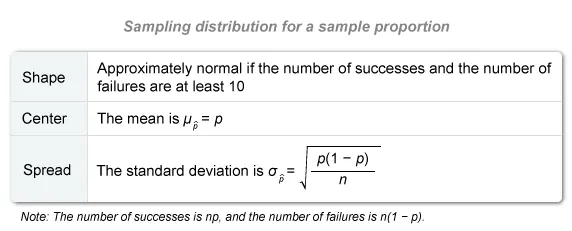
The central limit theorem (CLT) states that the sampling distribution of is approximately normal if the expected numbers of successes np and failures n(1 − p) are both at least 10.
A success is that the household owned a pet, and a failure is that it did not. Plug in the given values for the sample size n (75) and the probability of success p (0.67) to calculate the expected successes and failures.
| Expected successes | Expected failures | |
|---|---|---|
| np ≥ 10 | Formula for expected numbers | n(1 − p) ≥ 10 |
| 75(0.67) ≥ 10 | Plug in the given values | 75(1-0.67) ≥ 10 |
| 50.25 ≥ 10 | Simplify and verify inequality | 24.75 ≥ 10 |
| True | Expected count is greater than 10 | True |
The expected numbers of successes and failures are both greater than 10. Therefore, the shape of the sampling distribution of is approximately normal. It is possible to eliminate Choices D and E.
Center and Spread
The mean of the sampling distribution of p̂ is equal to the population mean , so the mean of the sampling distribution must be 0.67. It is possible to eliminate Choices C and D.
To calculate the SD of the sampling distribution in terms of the given values (population proportion p and sample size n), use the following formula:
Note: The population size must be at least 10 times greater than the sample size to use this formula.
| Formula for the SD | |
| Plug in p = 0.67 and n = 75 | |
| Simplify |
The SD of the sampling distribution of p̂ is 0.054. It is possible to eliminate Choices A and D.
Therefore, the sampling distribution of p̂ is approximately normal, with mean 0.67 and standard deviation 0.054.
(Choice A) This choice may result from mistakenly dividing by n (instead of the square root of n) when calculating the standard deviation.
(Choice C) This choice may result from the misconception that the mean of the sampling distribution of p̂ is 1 − p (instead of p).
(Choices D and E) The sampling distribution of p̂ is approximately normal (not skewed) because the expected number of successes and failures is large enough to apply the CLT.
Things to remember:
A sampling distribution of p̂ is described in terms of its shape (symmetric or skewed), center (mean), and spread (standard deviation, SD).
The shape is approximately normal when the expected numbers of successes and failures are both at least 10.
- The mean is equal to and the formula for the SD is , where is valid if the population size N is at least 10 times larger than the sample size n.
Question
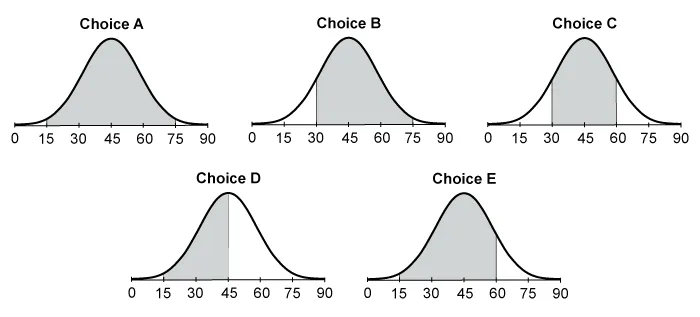
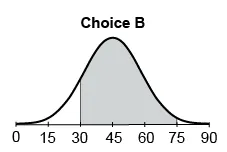
Let X be a normally distributed random variable with mean 45 and SD 15. Which of the following shaded areas represents P(30 < X < 75)?
| A. A | |
| B. B | |
| C. C | |
| D.D | |
| E. E |
Explanation
The shaded area should extend from X = 30 to X = 75.
Question
The 1983 Atlantic hurricane season was the least active Atlantic hurricane season since 1930. The season included only four named storms. The named storms as well as their peak wind speeds are given in the following table.
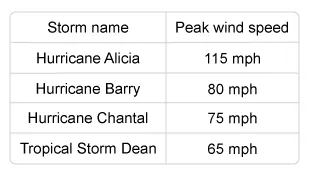
Suppose that a random sample of two storms is selected (without replacement). Which of the following is the probability distribution of the minimum peak wind speed of the sample?
A.  |
|
B. 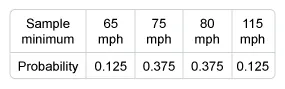
|
|
C. 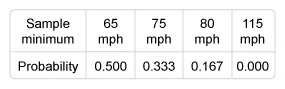 |
|
D. 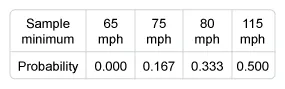 |
|
E.  |
Explanation
There are 12 different samples consisting of two storms selected without replacement. Of those 12 samples:
- 6 have a minimum peak wind of 65 mph (P(Minimum = 65 mph) = 0.500),
- 4 have a minimum peak wind of 75 mph (P(Minimum = 75 mph) = 0.333),
- 2 have a minimum peak wind of 80 mph (P(Minimum = 80 mph) = 0.167), and
- 0 have a minimum peak wind of 115 mph (P(Minimum = 115 mph) = 0.000).
Therefore, the probability distribution of the minimum peak wind speed of the sample is:


Study Anywhere, Anytime
Tackle AP Stats Unit 5 practice questions on your commute, review sampling distributions lessons between classes, or explore a Unit 5 study guide while waiting for friends at the coffee shop. With the UWorld app, you can access AP Statistics Unit 5 review materials, including MCQs, FRQs, and videos, anytime, anywhere!


Stand Out
with a Top Score on the AP Statistics Exam
Finish your AP Statistics Unit 5 review and continue mastering all units with UWorld. Complete our AP Statistics full review course to boost your performance and stand out as a top candidate for competitive colleges, majors, and scholarships by earning a top score.
Get our all-in-one course today!
- Focused AP Stats Videos
- Print & Digital Study Guide
- 1300+ Exam-style Practice Questions
- Customizable Quiz Generator
- Adjustable Study Planner
- Realistic Timed Test Simulation
- Colorful Visual Explanations
- Progress Dashboard
- Smart Flashcards & Digital Notebook
Hear From Our AP Statistics Students

UWorld’s service is pretty good and helps provide a lot of explanations on subjects I haven’t been confident on before.
The questions here are the most realistic to the AP tests I've seen so far! I appreciate the ability to customize tests as well.
The best part is that all options are well-explained, telling clearly why they are not the right option.
Frequently Asked Questions (FAQs)
What topics are covered in AP Statistics Unit 5?
AP Statistics Unit 5 explores Sampling Distributions, which connect data from random samples to population inference. You’ll study sampling variability, unbiased estimators, sample means and proportions, the Central Limit Theorem (CLT), and standard error. These concepts explain how and why random samples differ, and how that variability becomes predictable in large samples.
Together, they form the foundation for inference topics introduced later in the course. You’ll also learn to describe the shape, center, and spread of an AP Stats distribution and apply this understanding to real data situations. During preparation, students typically work through short progress check MCQs to measure how well they’ve understood each subtopic before advancing to longer practice sets. UWorld’s AP Statistics sampling distributions content, aligned with the College Board’s CED, reinforces every idea through targeted examples, visual explanations, and data-driven question sets, helping you master Unit 5 with clarity and confidence.
Why are sampling variability and unbiased estimators important?
In AP Statistics Unit 5, you’ll learn that sampling variability describes how sample statistics differ from one another and that unbiased estimators ensure those differences average out to the true population value. Together, they explain why repeated random sampling produces stable, reliable results over time. Understanding this concept is essential for interpreting any AP Stats distribution and serves as the foundation for the CLT and standard error.
UWorld’s AP Stats Unit 5 review lessons use simulations and visuals to demonstrate how random variation behaves predictably as the sample size grows. Candidates often use progress check MCQs to practice recognizing when an estimator is unbiased or when a statistic might be affected by sample design. By revisiting these exercises through AP Statistics Unit 5 review, you’ll build strong conceptual reasoning, ensuring that you can apply unbiased estimation confidently in both MCQs and FRQs on the AP Statistics exam.
How does the Central Limit Theorem relate to sampling distributions?
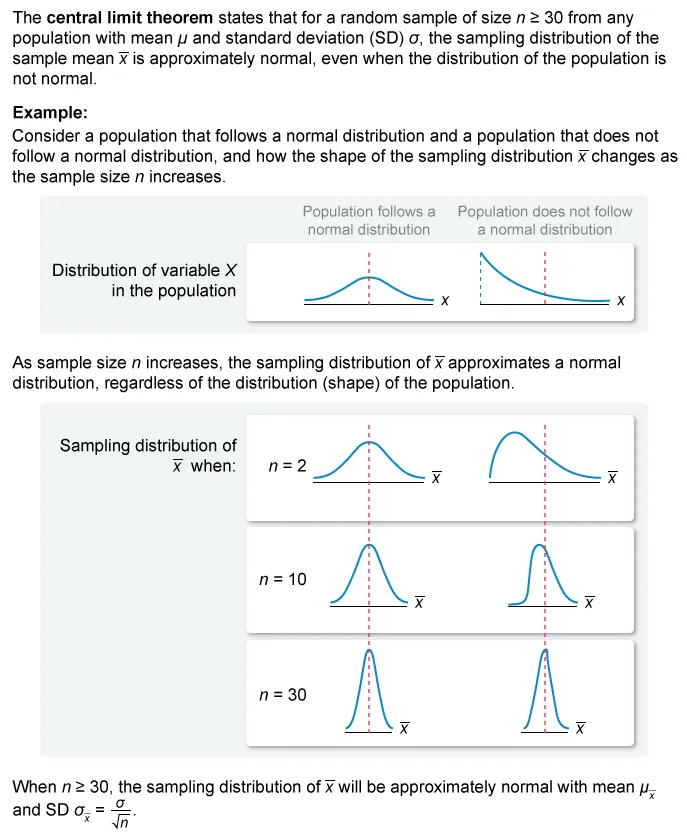
The Central Limit Theorem (CLT) is the most important principle in AP Stats sampling distributions and AP Stats Unit 5 review. It explains that when random samples are large enough, the distribution of their means becomes approximately normal, regardless of the population’s shape. This makes probability models and inference possible. The CLT helps you predict how sample means behave, showing that larger samples yield smoother distributions and smaller variability.
UWorld’s AP Statistics Unit 5 review lessons simplify the CLT using visuals and guided examples that reveal its practical meaning. Students often strengthen their understanding by practicing applied questions drawn from AP Stats Unit 5 MCQ sets and brief progress check exercises that confirm when the normal model can be used. Mastering the CLT is essential for solving problems related to confidence intervals, hypothesis testing, and the reasoning behind the normal approximation in the AP Statistics exam.
What is the role of standard error in AP Statistics Unit 5?
Standard error quantifies how much sample statistics are expected to differ from the true population value due to random sampling. It acts as the standard deviation of the sampling distribution and is central to AP Statistics Unit 5. Smaller standard errors mean more precise estimates, while larger ones indicate greater uncertainty. You’ll learn how standard error depends on both sample size and population variability, making it crucial for reliable inference.
UWorld’s AP Stats Unit 5 review materials teach you how to calculate and interpret the standard error conceptually and mathematically, connecting it to AP Statistics sampling distributions questions and FRQs. Short progress check MCQs help reinforce how changes in sample size affect precision. By mastering standard error, you’ll be able to evaluate the quality of sample-based conclusions and understand how variability shapes accuracy across all forms of data analysis in AP Statistics.
What concepts should I master before the Unit 5 test?
Before taking any AP Statistics Unit 5 review or AP Stats Unit 5 progress check, ensure you can:
- Explain sampling variability and why unbiased estimators matter.
- Apply the Central Limit Theorem correctly.
- Calculate and interpret standard error for means and proportions.
- Distinguish between sample statistics and population parameters.
- Describe the shape, center, and spread of sampling distributions.
UWorld’s AP Stats Unit 5 review content connects these elements through step-by-step explanations and interactive visuals. Incorporating short progress checks during study sessions helps track retention and identify weak areas. These core ideas prepare you for exam components such as AP Stats Unit 5 FRQ and MCQs, where reasoning with variability, normality, and precision determines success. Building fluency in these areas transforms abstract theory into practical statistical thinking, ensuring a confident performance on the AP Statistics exam.
Where can I find the best AP Statistics Unit 5 study guide and notes?
The best AP Statistics Unit 5 study guide presents complex ideas simply, linking reading, visuals, and practice. UWorld’s resources cover sampling variability, standard error, and the CLT in detail, aligned precisely with the College Board’s CED. Every section transitions smoothly into related questions from AP Stats Unit 5 review practice tests and FRQs. Candidates often use brief progress check MCQs between lessons to test comprehension before moving to full-length sets.
The UWorld app offers digital notes, customizable flashcards, and progress analytics, letting you track improvement over time. These integrated features turn passive reading into active learning. For anyone preparing for AP Statistics Unit 5 review, this combination of explanation and reinforcement builds both conceptual mastery and test readiness through consistent application and feedback.
Where can I find AP Statistics Unit 5 practice tests with detailed explanations?
A strong AP Stats Unit 5 practice test or AP Statistics Unit 5 practice test mimics the real exam’s structure with both MCQs and FRQs. UWorld’s practice sets do exactly that, pairing each question with full explanations that clarify reasoning and identify common mistakes. You can also create custom quizzes targeting topics like sampling variability, standard error, and the CLT.
Candidates often incorporate short progress check MCQs as checkpoints during review to gauge readiness before longer tests. Analytics track trends across topics, allowing you to measure growth and accuracy. UWorld’s AP Statistics Unit 5 review platform ensures you learn both the process and logic behind every question, building the precision and confidence needed for the AP Statistics Unit 5 exam.
What types of questions appear on the AP Statistics Unit 5 test?
The AP Statistics Unit 5 test features a mix of multiple-choice and free-response questions that test your ability to reason with data, interpret variability, and apply the CLT. Topics often include AP Stats sampling distributions, standard error, and unbiased estimation. Some MCQs involve interpreting graphs or simulation results, while FRQs require multi-step reasoning with context-based justification. Students typically practice using AP Stats Unit 5 MCQ sets, followed by brief progress check questions that confirm readiness. UWorld’s AP Statistics Unit 5 review materials help you transition from concept to application, ensuring that by exam time, you can explain statistical logic clearly and perform calculations accurately across all question types.
Are there free AP Statistics Unit 5 resources available?
Yes. UWorld offers a free trial that includes AP-style questions from AP Statistics Unit 5 review, detailed explanations, and short video lessons on sampling distributions and the CLT. The trial includes short quizzes modeled after typical progress check questions, giving you a sense of the real exam’s difficulty and reasoning depth. You can explore features like customizable practice, flashcards, and performance analytics to identify strengths and weaknesses. Pairing these with official College Board resources creates a complete study loop: concept, practice, and reflection. For students beginning AP Stats Unit 5 review, this free trial provides an excellent foundation for structured preparation before advancing to full-length practice tests.
How can I prepare efficiently for the AP Statistics Unit 5 exam?
An effective AP Stats Unit 5 review balances concept learning with steady practice. Begin with lessons on sampling variability, unbiased estimators, and the CLT, then reinforce them using UWorld’s applied AP Statistics sampling distributions exercises. Short progress check-style questions between study sessions help you monitor retention without disrupting momentum. Once confident, move to a full AP Statistics Unit 5 practice test to assess pacing and application. UWorld’s detailed analytics highlight weak areas and recommend focused review sets. Use flashcards or notes as a quick AP Stats Unit 5 cheat sheet in the final days. This structured approach: learn, apply, analyze, ensures consistent improvement and readiness for both the multiple-choice and free-response portions of the AP Statistics Unit 5 exam.
Learn More About Specific Unit
Exploring One-Variable Data
Exploring Two-Variable Data
Collecting Data
Probability, Random Variables, and Probability Distributions
Inference for Categorical Data: Proportions
Inference for Quantitative Data: Means
Inference for Categorical Data: Chi-Square
Inference for Quantitative Data: Slopes