
AP® Statistics Unit 1 Review and Practice Test
Prepare for your Unit 1 AP® Statistics test with our complete Exploring One-Variable Data review. Unit 1 focuses on describing and interpreting data distributions using shape, center, and spread; core concepts that set the stage for all future statistical analysis. Use our AP Stats Unit 1 review to master these foundations with realistic practice tests, FRQs, and MCQs modeled after the AP exam. Whether you’re reviewing notes, watching video lessons, or testing your skills, this resource ensures you understand every concept and perform your best on exam day.
Boost Your Confidence and Score High with Our AP Statistics Unit 1 Review
Build a strong foundation with our AP Statistics Unit 1 review, designed to make data interpretation simple and intuitive. You’ll learn how to describe distributions using shape, center, and spread; skills essential for mastering future topics. These lessons align closely with the Unit 1 AP Stats review and exam expectations, helping you connect theory to real data. Use this review as a starting point before attempting your AP Stats Unit 1 practice test, and approach every question with confidence and clarity.
Engaging Video Lessons
Struggling to make sense of data displays or dense statistical explanations? UWorld’s AP Stats Unit 1 review videos give you the clarity of a personal tutor whenever you need it. Learn at your own pace with concise, visual lessons that simplify one-variable data analysis, so concepts like variability, center, and spread become clear and intuitive. Whether you’re tackling AP Stats Unit 1 MCQs or preparing written explanations for the AP Stats Unit 1 FRQ, our videos help you connect theory to real data interpretation. Each lesson builds confidence by showing how to read graphs, interpret distributions, and explain results using correct statistical reasoning.
Interactive Study Guides
Strengthen your understanding of essential Unit 1 concepts with our AP Statistics Unit 1 study guide, designed to make complex ideas clear through visuals and real-world examples. You’ll learn how to interpret distributions, compare data sets, and analyze measures of center and spread with confidence. Whether you’re preparing for a Unit 1 AP Stats practice test or reviewing class notes, this guide keeps your study process structured and efficient. Pair it with your AP Stats Unit 1 review to stay focused and exam-ready.
Try These AP Statistics Unit 1 Practice Test Questions
Question
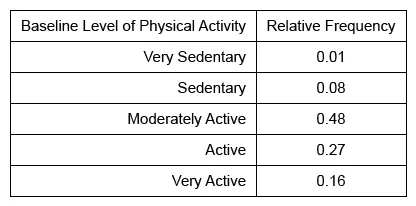
Arthur is the manager of a recently opened 24-hour gym. He wanted to know the baseline level of physical activity (PA) of new gym enrollees and decided to include a small survey in the enrollment application during a certain month. The survey asked individuals to rate their baseline level of PA as very sedentary, sedentary, moderately active, active, or very active. The relative frequency of each baseline level of PA of new enrollees who completed the survey is shown in the table below.
Which of the following statements must be true?
| A. Fewer new enrollees reported an active or very active rather than a moderately active baseline level of PA. | |
| B. More than half of the new enrollees reported having a moderately active baseline level of PA. | |
| C. Out of all new enrollees who completed the survey, 10 reported having a sedentary baseline level of PA. | |
| D. The number of new enrollees who reported having a very sedentary or sedentary baseline level of PA is 12. | |
| E. The proportion of new enrollees who reported having an active baseline level of PA is 0.91. |
Hint:
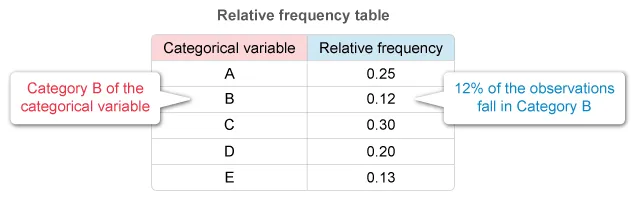
A relative frequency table gives the proportion of observations that fall into each category of a categorical variable.
Explanation
A relative frequency table gives the proportion of observations that fall into each category of a categorical variable.
The table of physical activity (PA) shows the proportion of the baseline levels of PA of new gym enrollees. Eliminate Choices C and D because the total number of enrollees is unknown and cannot be determined from the information given.
Notice that the proportion of new enrollees reporting a moderately active baseline PA level is 0.48 and that the proportion reporting an active or very active baseline PA level is 0.27 + 0.16 = 0.43.
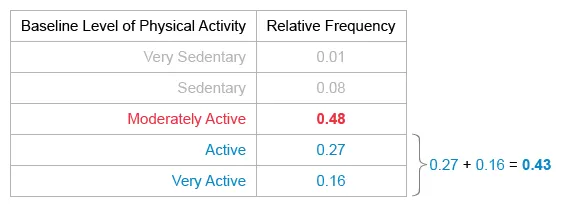
This finding means that the proportion of new enrollees reporting an active or very active baseline PA level (0.43) is less than the proportion reporting a moderately active baseline PA level (0.48).
Therefore, the statement that must be true is:
| Fewer new enrollees reported an active or very active rather than a moderately active baseline level of PA. |
(Choice B) The proportion of new enrollees who reported having a moderately active baseline level of PA (0.48) is less (not more) than half (0.50).
(Choices C and D) It is not possible to determine the number of new enrollees reporting each baseline level of PA because no information is given about the total number of new enrollees surveyed.
(Choice E) The proportion of new enrollees who reported having an active baseline level of PA is 0.27 (not 0.91). The value 0.91 is the proportion of new enrollees who reported having a moderately active, active, or very active baseline level of PA (0.48 + 0.27 + 0.16 = 0.91).
Things to remember:
A relative frequency table gives the proportion of observations that fall into each category of a categorical variable.
Question
The frequency distribution of students by class in a random sample of 50 students in a particular academic year at a local college is shown in the table below.
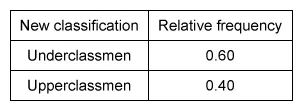
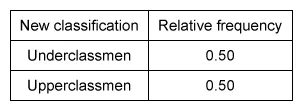
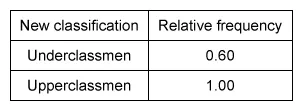
The Office of Academic Affairs decides to reclassify students. It will now group freshmen and sophomores together as underclassmen and group juniors and seniors together as upperclassmen. Which of the following represents the relative frequency distribution of students for the new classification?
A. ![]() |
|
B. ![]() |
|
C. ![]() |
|
D.
|
|
E.
|
Hint:
A frequency table gives the number of observations for each category of a categorical variable.
A relative frequency table gives the proportion of observations for each category.
Explanation
A frequency table gives the number of observations that fall into each category of a categorical variable.
A relative frequency table gives the proportion of observations that fall into each category.
A proportion in fraction form represents a part (numerator) of a whole (denominator):
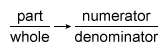
It is possible to calculate the entire relative frequency table, but notice that all the choices have a different value for upperclassmen. Calculate the proportion of upperclassmen in the sample.
The whole (denominator) is the total number of students in the sample.
The part (numerator) is the number of upperclassmen.
The number of students in the sample is 50, so the whole is 50.
To find the part, add together the number of juniors and seniors (upperclassmen).
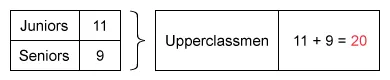
To calculate the proportion of upperclassmen, divide the number of upperclassmen (part) by 50 (whole).
Among the choices, only Choice B shows a relative frequency table with a proportion of 0.40 for upperclassmen.
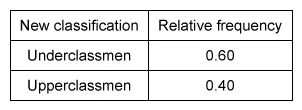
(Choice A) This table may result from mistakenly dividing the observed distribution in each class by 100, rather than by the total number of students in the sample (50).
(Choice C) This table represents a relative distribution where all classes have the same frequency of students, but the classes do not have the same frequency.
(Choice D) This table may result from mistakenly switching the frequencies of underclassmen and upperclassmen when creating the new classification table.
(Choice E) This table represents the cumulative distribution, not the relative distribution.
Things to remember:
- A frequency table gives the number of observations that fall into each category of a categorical variable.
- A relative frequency table gives the proportion of observations that fall into each category.
Question
A teacher asked the 20 students in a classroom which season of the year they liked the most. The results of the survey are shown in the relative frequency table below. Notice that the information about students who liked fall the most is missing.
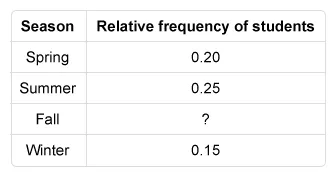
Which of the following is the frequency of students who liked fall the most?
| A. 8 | |
| B. 10 | |
| C. 12 | |
| D. 20 | |
| D. 40 |
Explanation
The relative frequencies must add up to 1, so the relative frequency of students who liked fall is 1 − 0.20 − 0.25 − 0.15 = 0.40. Multiply this relative frequency by the total number of students in the classroom to find the frequency: 0.40 × 20 = 8.

Study Anywhere, Anytime
Study on your schedule with the UWorld AP Statistics app, built for flexibility and focus. Review key Unit 1 topics, watch short video lessons, or try a quick AP Stats Unit 1 practice test; all from your phone or tablet. Whether you’re commuting, between classes, or relaxing at home, you’ll have every tool from your AP Statistics Unit 1 review right at your fingertips. Stay consistent, stay confident, and keep learning wherever you are.
Stand Out
with a Top Score on the AP Statistics Exam
Finish your AP Stats Unit 1 review and continue mastering all units with UWorld. Complete our AP Statistics full review course to boost your performance and stand out as a top candidate for competitive colleges, majors, and scholarships by earning a top score.
Get our all-in-one course today!
- Focused AP Stats Videos
- Print & Digital Study Guide
- 1300+ Exam-style Practice Questions
- Customizable Quiz Generator
- Adjustable Study Planner
- Realistic Timed Test Simulation
- Colorful Visual Explanations
- Progress Dashboard
- Smart Flashcards & Digital Notebook
Hear From Our AP Statistics Students
UWorld’s service is pretty good and helps provide a lot of explanations on subjects I haven’t been confident on before.
The questions here are the most realistic to the AP tests I've seen so far! I appreciate the ability to customize tests as well.
The best part is that all options are well-explained, telling clearly why they are not the right option.

Frequently Asked Questions (FAQs)
What is AP Statistics Unit 1 and why is it important for the exam?
AP Statistics Unit 1: Exploring One-Variable Data introduces the foundations of data description and analysis. Students learn to describe distributions using shape, center, and spread, interpret variability, and identify outliers. These skills are fundamental for all future units and form the basis of data reasoning tested on the AP Statistics Unit 1 FRQ and MCQ sections.
To study effectively, practice identifying patterns in real datasets and describing them using correct statistical language. Work through examples of dot plots, histograms, and boxplots, and analyze how mean, median, and standard deviation describe a dataset’s behavior.
UWorld’s AP Stats Unit 1 review simplifies this process through visuals and interactive practice questions that mirror College Board expectations. By combining theory and interpretation, you’ll build a strong foundation for more complex topics like probability and inference.
Which topics are covered in AP Statistics Unit 1?
Unit 1 in AP Statistics focuses on describing and interpreting one-variable data using graphical and numerical methods. Key topics include:
- Data Displays: Dot plots, histograms, and boxplots for visualizing distributions.
- Summary Statistics: Mean, median, range, and standard deviation to represent center and spread.
- Shape and Outliers: Identifying skewness, clusters, and extreme values.
- Comparing Distributions: Describing differences in center, spread, and shape between groups.
- Contextual Interpretation: Translating statistics into meaningful conclusions.
Mastering these topics ensures success on the AP Stats Unit 1 MCQ and FRQ questions, where you’ll be asked to interpret graphs, summarize variability, and compare distributions accurately.
How should I study for the AP Statistics Unit 1 review?
A productive AP Stats Unit 1 review balances conceptual learning with hands-on application. Begin by reviewing the College Board Course and Exam Description to see how Exploring One-Variable Data fits into the exam structure. Then:
- Summarize formulas for mean, median, and standard deviation.
- Create visuals of sample data to describe shape, center, and spread.
- Practice identifying outliers and comparing distributions in context.
- Review FRQ prompts to understand how written justifications are scored.
Regular practice builds fluency in describing data precisely and efficiently.
UWorld’s AP Statistics Unit 1 study guide combines visual learning and detailed explanations, reinforcing every step through adaptive questions and timed quizzes. Pairing these tools with official College Board examples helps you master variability and summary measures in preparation for the exam.
What’s the best study sequence for AP Stats Unit 1?
A logical order helps you connect individual concepts into a complete picture of data analysis. Follow this sequence:
- Start with Data Displays: Learn how to construct and interpret dot plots and histograms.
- Move to Summary Statistics: Understand how measures like mean, median, and range describe central tendency and spread.
- Analyze Shape and Outliers: Identify skewness and extreme values that affect interpretation.
- Compare Distributions: Use numerical and graphical reasoning to explain differences between datasets.
- Interpret in Context: Relate findings to real-world conclusions.
This progression prepares you to approach both AP Stats Unit 1 practice tests and future units with confidence, ensuring you can move seamlessly from observation to analysis.
What is the most effective AP Stats Unit 1 review plan before the exam?
A structured timeline ensures consistent progress in mastering Exploring One-Variable Data. Break your preparation into three focused stages:
Three Months Before the Exam:
- Learn core ideas: shape, center, spread, and variability.
- Watch short lessons explaining data interpretation.
- Solve small practice sets to strengthen basic understanding.
One Month Before the Exam:
- Review AP Statistics Unit 1 FRQ samples to practice written explanations.
- Take one AP Stats Unit 1 practice test weekly to evaluate retention.
- Summarize formulas and reasoning steps into a personalized quick-review sheet.
Two Weeks Before the Exam:
- Attempt mixed MCQs and FRQs under timed conditions.
- Focus on analyzing graphs and comparing distributions quickly.
- Revisit weak areas using adaptive quizzes or flashcards.
UWorld’s AP Statistics Unit 1 review supports this schedule with clear lessons, progress tracking, and exam-style question sets, helping you refine timing and interpretation before test day.
What are the main FRQ question types for AP Stats Unit 1?
The AP Statistics Unit 1 FRQs test your ability to describe and interpret data using clear reasoning and proper statistical vocabulary. You’ll encounter prompts that require you to:
- Explain the shape, center, and spread of a distribution using numerical and graphical evidence.
- Compare two datasets and justify differences using context.
- Identify and interpret outliers or unusual patterns.
- Describe how variability affects conclusions drawn from data.
Many questions combine interpretation with brief calculations or real-world contexts, such as analyzing survey data or test-score distributions. Practicing both written and numerical responses helps develop fluency for later topics like sampling and inference.
How can I use UWorld’s AP Stats Unit 1 progress-check questions effectively?
UWorld’s AP Stats Unit 1 progress-check MCQs and short quizzes are built to test comprehension after each topic. Treat these as reflective checkpoints rather than graded assessments.
Effective strategy:
- Attempt a set right after studying a concept, such as center or spread.
- Read every explanation carefully to understand why an answer is correct.
- Tag questions you struggled with and retry them after a few days to reinforce memory.
- Use the analytics dashboard to spot recurring weaknesses (for example, misinterpreting skewness or variability).
Approaching progress checks this way helps you retain patterns, compare reasoning methods, and recognize common traps before you attempt full AP Statistics Unit 1 practice tests.
UWorld’s adaptive system adjusts to your performance, guiding you toward mastery through feedback and visuals that clarify statistical interpretation.
How are center, spread, and shape connected in AP Statistics Unit 1?
Center, spread, and shape describe the three core features of a distribution. Together, they reveal how data behaves and how best to summarize it.
- Center shows the “typical” value (mean or median).
- Spread measures variability (range, IQR, or standard deviation).
- Shape indicates how data values are distributed—symmetric, skewed, or uniform.
These elements are interrelated. A skewed distribution, for instance, shifts the mean away from the median, while higher spread increases variability and uncertainty. Understanding this relationship helps explain why two datasets with the same mean can still differ dramatically in interpretation.
Mastery of these concepts strengthens your explanations on both AP Stats Unit 1 MCQs and FRQs, where you must analyze patterns logically and in context.
How can I retain key formulas and concepts for Unit 1?
Retention depends on repetition and visualization. To remember Unit 1 formulas and relationships:
- Create flashcards for mean, median, range, variance, and standard deviation.
- Build a formula sheet organized by concept: measures of center, spread, and position.
- Practice with real data, plot small datasets and compute summaries by hand.
- Teach aloud, explaining a concept strengthens memory and reveals gaps.
Revisiting these steps weekly ensures long-term recall. Connecting formulas to visual graphs (like histograms or boxplots) improves understanding of how each measure reflects the dataset’s structure.
How do I study one-variable data analysis for the Unit 1 test?
Studying one-variable data analysis effectively means blending theory with hands-on practice.
Focus on:
- Reviewing definitions and conditions for mean, median, and standard deviation.
- Practicing graphical interpretation; reading histograms, dot plots, and boxplots.
- Comparing datasets with both numerical and contextual reasoning.
- Explaining patterns concisely in writing for AP Stats Unit 1 FRQ questions.
UWorld’s AP Statistics Unit 1 practice test integrates MCQs and FRQs modeled after the AP exam, offering instant feedback and explanations. Analyzing each solution helps connect formulas, visuals, and reasoning, ensuring readiness for both classroom and exam assessments.
What is the best AP Stats Unit 1 practice-test format?
The most effective AP Statistics Unit 1 practice test combines multiple-choice questions for conceptual breadth and free-response questions for applied reasoning.
Recommended format:
- 30–35 MCQs: Focus on describing shape, center, and spread; interpreting boxplots and histograms.
- 2 FRQs: One interpretation-based and one calculation-based prompt.
- 60 minutes total: Allow about 1 minute per MCQ and 15 minutes per FRQ.
Simulating the real exam structure helps build pacing and stamina. Afterward, review incorrect answers by identifying whether errors came from misreading graphs, misusing formulas, or overlooking context.
Regular, timed practice strengthens both speed and precision, helping you perform confidently on the official exam.
When should I begin preparing for the Unit 1 test?
Begin preparing for AP Stats Unit 1 as soon as the topic is introduced in class. Start by reviewing definitions and practicing simple data descriptions each week.
About three weeks before the test, increase intensity by scheduling daily short sessions: one day for graphs, another for summary statistics, and another for comparing distributions.
During the final week, transition to mixed practice, complete small sets of MCQs and FRQs, check timing, and revisit weaker areas. This steady-pace approach prevents cramming and reinforces both conceptual understanding and exam-style application.
What are common mistakes students make in AP Stats Unit 1?
Students often lose points in AP Stats Unit 1 by overlooking context or mixing up terminology.
Frequent errors include:
- Confusing mean with median when data are skewed.
- Ignoring the effect of outliers on measures of center or spread.
- Failing to describe a distribution’s shape clearly (e.g., writing “normal” instead of “roughly symmetric”).
- Forgetting units or context when comparing data sets.
Careful reading and precise language help avoid these traps.
UWorld’s analytics tools flag common error patterns and allow targeted review through similar practice sets. Revisiting detailed explanations reinforces proper reasoning and helps convert mistakes into learning opportunities before exam day.
Where can I find AP Statistics Unit 1 notes, cheat sheets, or study guides?
Look for guides that combine definitions, visuals, and step-by-step examples. A good AP Statistics Unit 1 study guide should include:
- Explanations of shape, center, spread, and outliers.
- Sample dot plots, histograms, and boxplots.
- Quick formulas for mean, median, standard deviation, and IQR.
- Short summaries of how to compare distributions in context.
Concise notes and visual summaries are best for pre-test review, while detailed guides deepen conceptual understanding. Pair both types to balance comprehension and recall.
Are there downloadable AP Statistics Unit 1 study-guide PDFs and practice materials?
Yes. Several AP Stats Unit 1 review PDFs and practice sets summarize formulas, definitions, and worked examples for quick reference. Prioritize resources aligned with the College Board Course and Exam Description and that include both MCQs and FRQs with answer explanations.
UWorld provides printable and digital AP Statistics Unit 1 study guides, smart flashcards, and progress-tracking tools. Using these alongside official materials ensures that your preparation combines conceptual review with real-exam practice, giving you complete readiness for Exploring One-Variable Data.
Learn More About Specific Unit
Exploring Two-Variable Data
Collecting Data
Probability, Random Variables, and Probability Distributions
Sampling Distributions
Inference for Categorical Data: Proportions
Inference for Quantitative Data: Means
Inference for Categorical Data: Chi-Square
Inference for Quantitative Data: Slopes