

Bundle 3+ College Prep products for 20% off

AP® Psychology Unit 5 Review and Practice Test

Mental and Physical Health

Unit 5 explores how mental and physical health influence the way people think, cope, and function in everyday life. UWorld’s AP® Psychology Unit 5 review helps you make sense of these ideas with clear explanations, guided practice, and questions that mirror the style of the AP exam. With the right tools and steady practice, you can approach the AP Psych Unit 5 test feeling prepared, confident, and in control of the material.

Build a Strong Understanding of Mental and Physical Health Concepts with Our AP Psych Unit 5 Review

Develop mastery over Unit 5 AP Psychology with in-depth resources that decode the intricacies of psychopathology, stress management, and therapeutic interventions. UWorld ensures you can distinguish between similar diagnoses and apply health psychology principles to ace your exam.

Watch

Learn Key Unit 5 Ideas Through Clear, Engaging Videos

These videos make challenging topics easier to learn by showing visuals, simple explanations, and short connected examples. You will learn how stress affects the body, how disorders are understood, and how different therapies are applied. Many students prefer watching a quick lesson before attempting multiple-choice questions, especially when preparing for an AP Psychology Unit 5 test.

Read

Study Guides That Make It Easier to Learn

These guides break down disorders, stress responses, coping strategies, and treatment options into simple, easy-to-follow sections. The format makes studying more manageable and provides space to review challenging topics without feeling overwhelmed. Students often use these interactive study guides to prepare for chapter quizzes and to establish a strong foundation before a unit test.

Practice

Boost Your Skills with AP Psychology Unit 5 Practice Questions

These AP Psychology Unit 5 practice test questions show you how the AP exam presents real scenarios involving stress, disorders, and treatments. Practicing this way helps you understand how to apply concepts, recognize patterns, and avoid common mistakes. Each question includes a clear explanation to help you understand why the answer is correct. This prepares you well for the Unit 5 AP Psychology exam.
Try these sample practice questions with detailed answer explanations:
Mental and Physical Health Practice Tests

Question

From a very young age, David has struggled with communication and social interaction. When under stress, he engages in repetitive behaviors, such as hand flapping. He shows an intense interest in trains but lacks other hobbies. Which of the following psychological disorders is David most likely exhibiting?

A. Schizophrenia
B. Autism spectrum
C. Social anxiety
D. Antisocial personality

Explanation

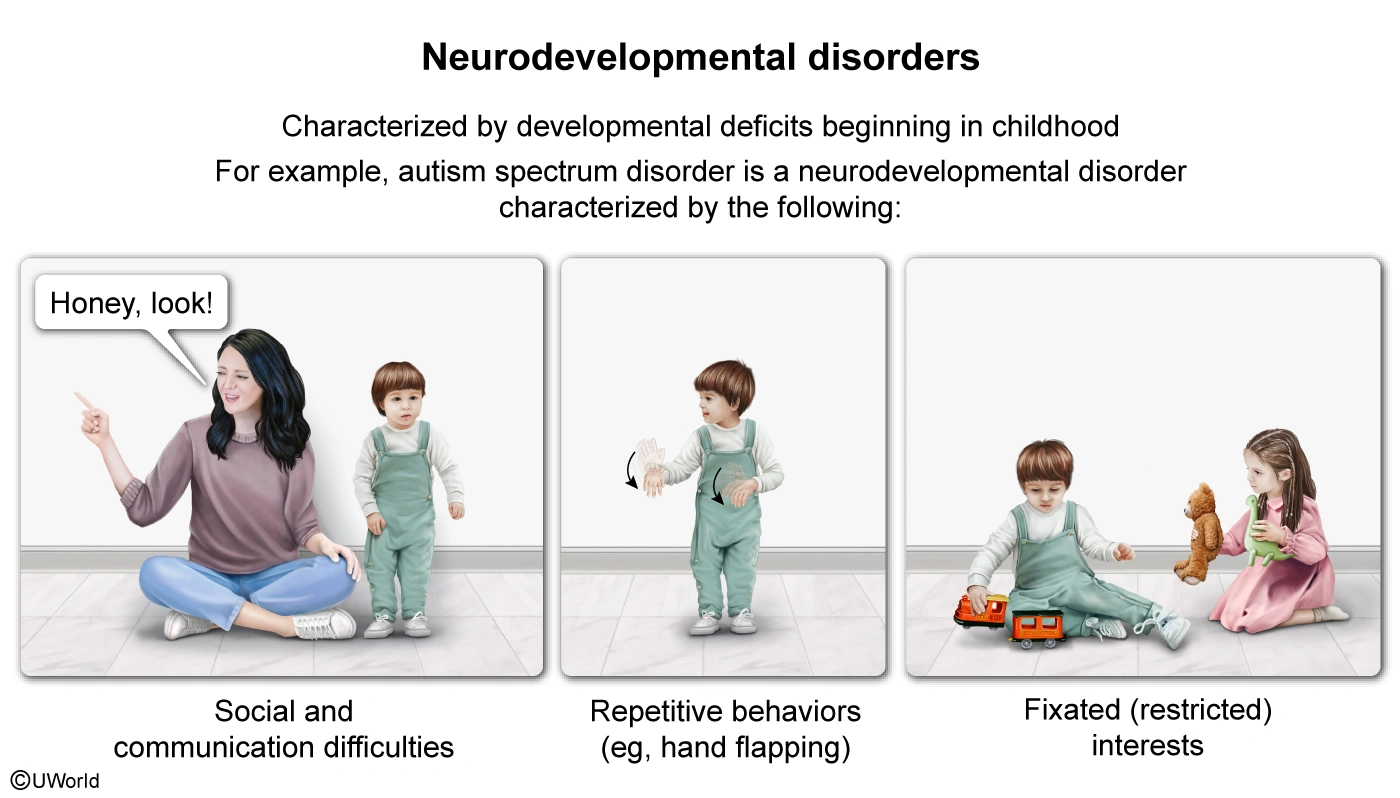
neurodevelopmental disorders

Neurodevelopmental disorders are characterized by developmental deficits beginning in childhood.

One neurodevelopmental disorder, autism spectrum disorder, is characterized by social and communication difficulties, repetitive behaviors (eg, hand flapping), and fixated (ie, restricted, intense) interests.

Autism spectrum disorder may vary in severity.  Higher-functioning people with autism have normal (or even higher) levels of intelligence but struggle socially, whereas those with more severe forms of autism may be unable to use language.

Therefore, David, who struggles with communication and social interaction, engages in repetitive behaviors (eg, hand flapping), and shows a fixated interest (eg, trains) is most likely exhibiting autism spectrum disorder.

(Choice A)  Schizophrenia is a psychotic disorder which typically involves both positive symptoms (eg, hallucinations, delusions) and negative symptoms (eg, flat affect).

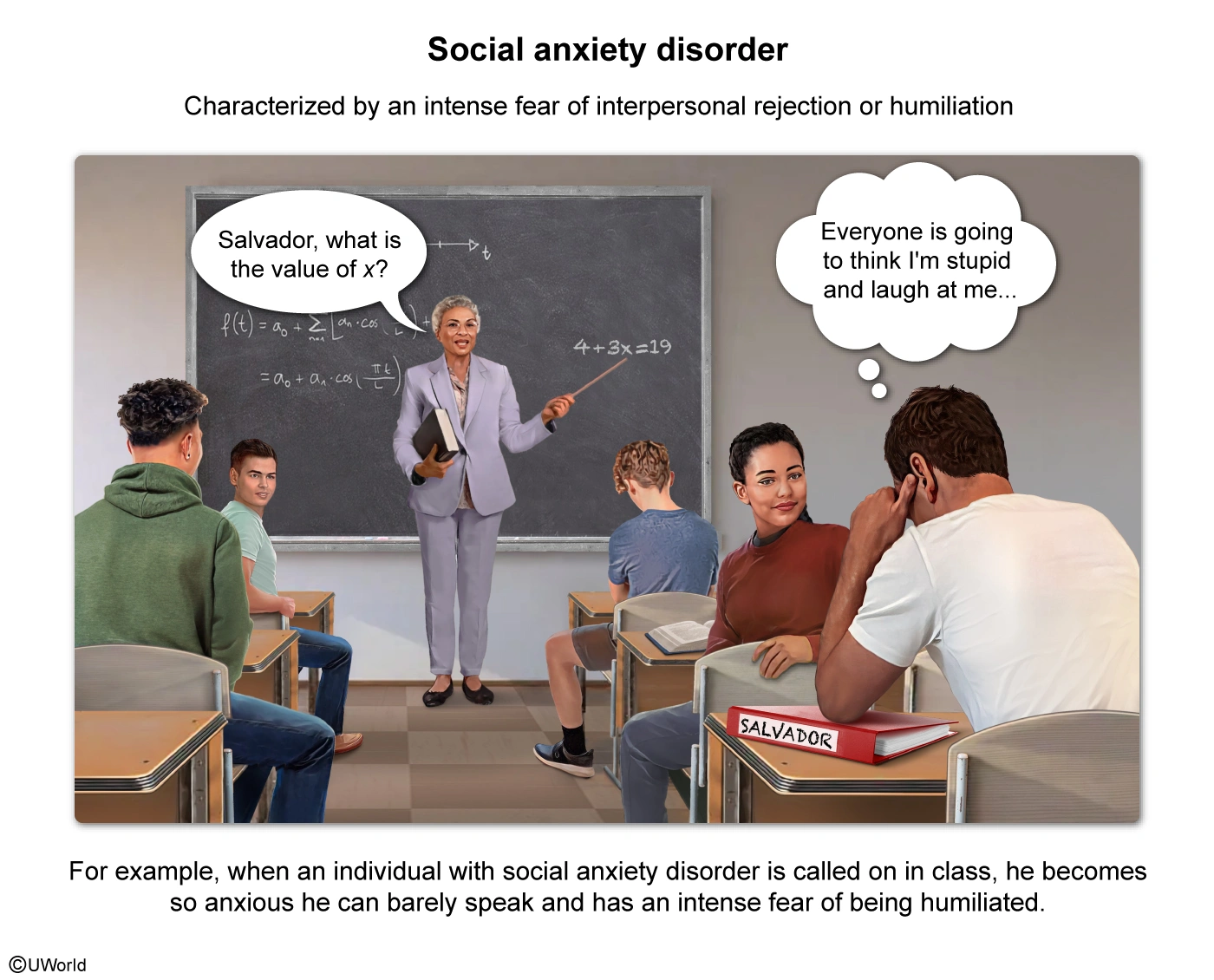
(Choice C)  Social anxiety disorder is characterized by an intense fear of interpersonal rejection or humiliation.

(Choice D)  Antisocial personality disorder is characterized by a pattern of violation and exploitation of others, impulsivity, and breaking the law, along with a lack of remorse and empathy.

Things to remember:
Neurodevelopmental disorders are characterized by developmental deficits beginning in childhood.  Autism spectrum disorder involves social and communication difficulties, repetitive behaviors, and fixated interests.

Question

Neha is taking final exams. During her first exam, Neha was sweating, her heart rate was elevated, and she felt very stressed. Now, on her third day of exams, Neha's body has adjusted to the ongoing stress. Hans Selye would probably say that Neha is demonstrating

A. an approach-avoidance conflict
B. the resistance stage of the general adaptation syndrome
C. the exhaustion stage of the general adaptation syndrome
D. systematic desensitization

Explanation

General Adaptation syndrome

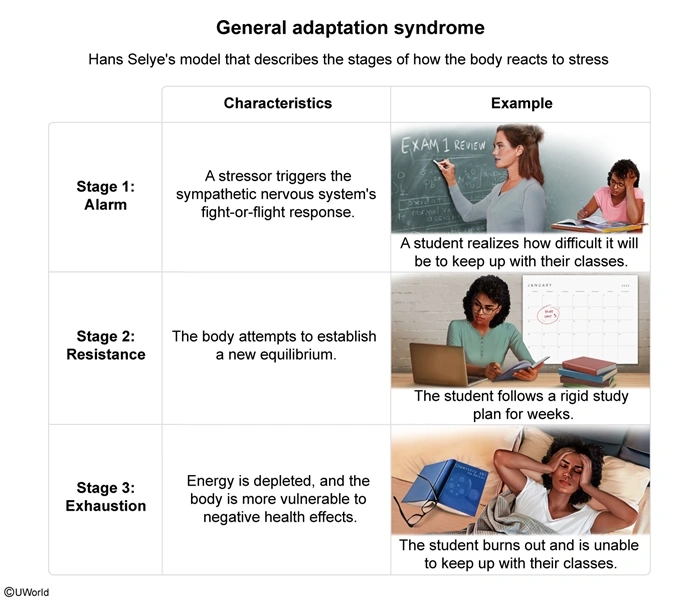
The general adaptation syndrome, proposed by Hans Selye, is a model describing how the body reacts to stress.  According to this model, there are three stages of the stress response:

  • The alarm stage occurs during the first few minutes of the stress response when a stressor triggers the sympathetic nervous system's fight-or-flight response (eg, increasing the heart rate and perspiration).
  • The resistance stage can last for hours (eg, exercise), days (eg, final exams), or months (eg, taking several AP courses).  During this stage, the body attempts to establish a new equilibrium in response to an ongoing stressor.
  • The exhaustion stage occurs if the stressor continues.  Prolonged stress depletes energy and results in the body being more vulnerable to negative health effects (eg, depression, viral illness) (Choice C).

Therefore, Hans Selye would probably say that Neha (whose body has adjusted to the ongoing stress) is demonstrating the resistance stage of the general adaptation syndrome.

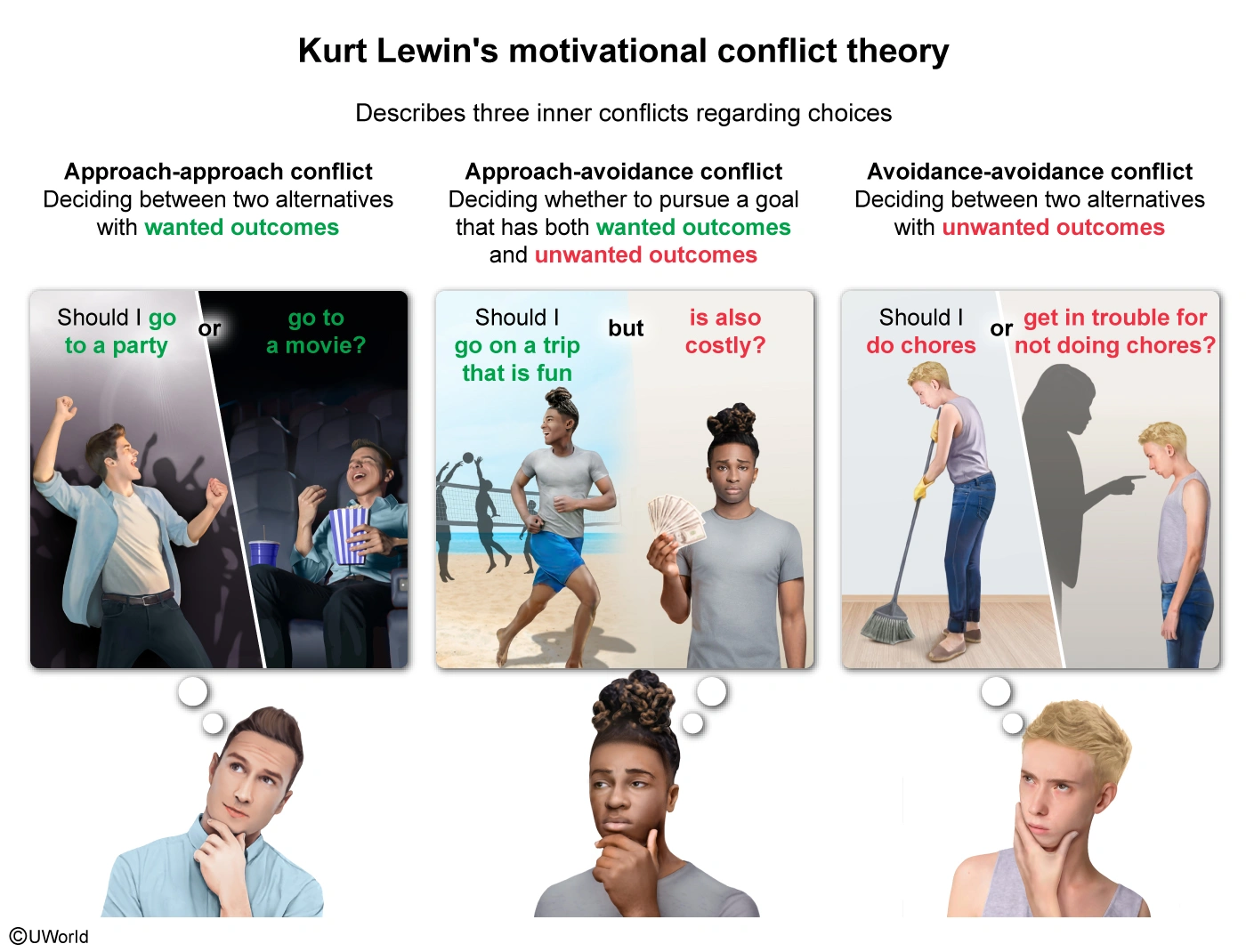
(Choice A)  In motivational conflict theory, an approach-avoidance conflict occurs when a person decides whether to pursue a goal that has both wanted and unwanted outcomes (eg, going on a trip is fun but costs a lot of money).

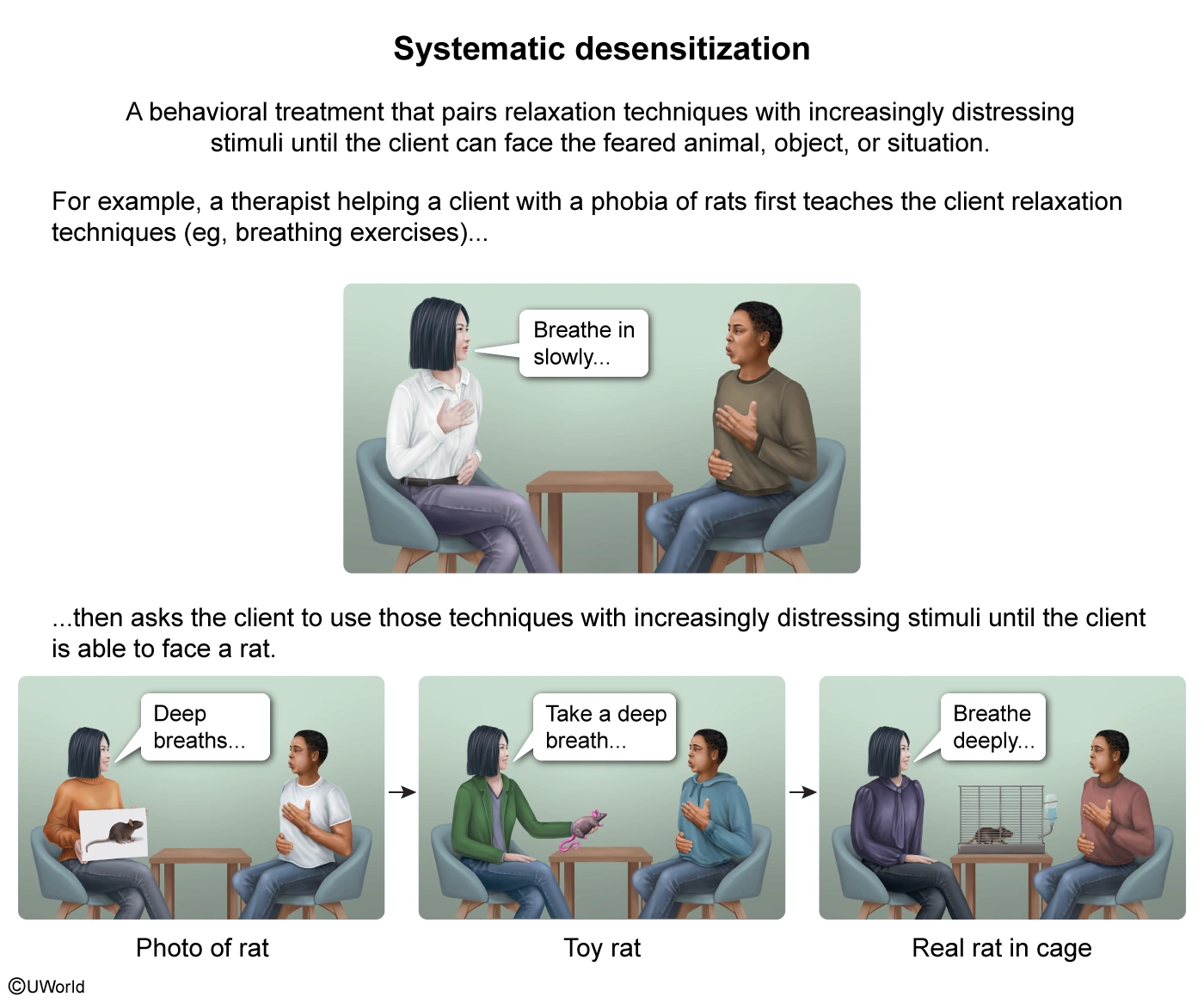
(Choice D)  Systematic desensitization pairs relaxation techniques with increasingly distressing stimuli until the client can face the feared animal/object or situation (eg, client who fears spiders first looks at a picture of a spider while breathing deeply, then handles a toy spider, and so on until seeing a live spider does not cause intense anxiety).

Things to remember:
The general adaptation syndrome, proposed by Hans Selye, is a model describing how the body reacts to stress.  During the resistance stage (which can last for hours, days, or months), the body attempts to establish a new equilibrium in response to an ongoing stressor.


Question

Which of the following is characteristic of the resistance stage in Hans Selye's general adaptation syndrome?

A. It occurs during the first few moments of encountering a stressor.
B. A new equilibrium is established as the body adjusts to an ongoing stressor.
C. It occurs when prolonged stress has resulted in depleted energy.
D. A fight-or-flight response is triggered by a stressor.

Explanation

General adaptation syndrome

The general adaptation syndrome, proposed by Hans Selye, is a model describing how the body reacts to stress.  According to this model, there are three stages of the stress response:

  • The alarm stage occurs during the first few minutes of the stress response, when a stressor triggers the sympathetic nervous system's fight-or-flight response (Choices A and D).
  • The resistance stage can last for hours (eg, exercise), days (eg, final exams), or months (eg, taking several AP courses).  During this stage, the body attempts to establish a new equilibrium in response to an ongoing stressor.
  • The exhaustion stage occurs if the stressor continues.  Prolonged stress depletes energy and results in the body being more vulnerable to negative health effects (eg, depression, viral illness) (Choice C).

Therefore, the choice that is characteristic of the resistance stage in Hans Selye's general adaptation syndrome is a new equilibrium being established as the body adjusts to an ongoing stressor.

Things to remember:
The general adaptation syndrome, proposed by Hans Selye, is a model describing how the body reacts to stress.  During the resistance stage (which can last for hours, days, or months), the body attempts to establish a new equilibrium in response to an ongoing stressor.

UWorld Dark Blue logo

Review Anytime With the UWorld Mobile App

The UWorld app lets you fit studying into your day wherever you are. You can practice questions, read explanations, and review tough topics even when you do not have WiFi. Many students use the app to prepare steadily for Unit 5 AP Psychology because short, consistent practice builds long-term confidence.

Stand Out
with a Top Score in AP Psychology

Earn a top score and stand out for colleges, majors, and scholarships. With UWorld’s AP Psychology online course, you’ll be ready from your first unit review to your final exam.

Choose Your Subscription
Dream Score Plan
360-Day
$169
Deep Learning Plan
180-Day
$149
Score Booster Plan
90-Day (No print book, only digital)
$129
Introductory Plan
30-Day (No print book, only digital)
$99

Get our all-in-one course today!

  • Focused AP Psychology Videos
  • Print & Digital Study Guide
  • 350+ Exam-style Practice Questions
  • Customizable Quiz Generator
  • Adjustable Study Planner
  • Realistic Timed Test Simulation
  • Colorful Visual Explanations
  • Progress Dashboard
  • Smart Flashcards & Digital Notebook
Explore our free trial and frequently asked questions.

Hear From Our AP Students

UWorld’s service is pretty good and helps provide a lot of explanations on subjects I haven’t been confident on before.

— Bence P.

The questions here are the most realistic to the AP tests I've seen so far! I appreciate the ability to customize tests as well.

— Kaila H.

The best part is that all options are well-explained, telling clearly why they are not the right option.

— Syeda Huma Z.

Frequently Asked Questions (FAQs)

AP Psychology Unit 5 explores how mental and physical health shape behavior, stress responses, and well-being. This section introduces you to psychological disorders, how they are identified, and the many ways people cope with stress or seek treatment. Understanding these ideas helps you build a strong foundation for your AP Psychology Unit 5 review and prepares you for unit quizzes and practice questions.

Key ideas in this unit include:

  • An introduction to health and positive psychology 
  • Standards for diagnosing and approaches to explaining psychological disorders  
  • Neurodevelopmental and schizophrenic spectrum disorders  
  • Bipolar, depressive, anxiety, and obsessive-compulsive disorders  
  • Dissociative and trauma- and stress-related disorders  
  • Eating disorders and personality disorders  
  • Historical developments in psychological treatment  
  • Modern treatment options and methods  

These topics become easier when you study them step by step rather than trying to memorize everything at once. Watching short lessons and practicing questions helps bring clarity to the material. UWorld explanations also support this by illustrating how these concepts are applied in real-world situations similar to those encountered on class tests and AP-style questions.

Preparing for the AP Psychology Unit 5 exam becomes much easier when you break the material into smaller parts and study in short, consistent sessions. Unit 5 covers stress, coping, disorders, and treatments. Begin by reviewing these core ideas with simple explanations and real-world examples. This helps you build a strong foundation before moving on to practice questions that reflect AP style testing.

To study effectively for the exam:

  • Review vocabulary in your own words so the terms feel familiar
  • Group related disorders or treatments together to avoid confusion
  • Practice reading short scenarios and identifying the correct concept
  • Use active recall techniques like flashcards or quick quizzes
  • Work through AP style questions to learn how the test presents ideas

After you complete a study session, check your understanding with a few practice questions. This is the step that helps the most because it shows you which topics you have mastered and which ones need more attention. Many students also use UWorld during this stage because its explanations guide you through the reasoning behind each question, helping you build accuracy for the AP Psychology Unit 5 test. With regular review and steady practice, the exam becomes much more manageable.

Yes. You can find several free resources to support your AP Psychology Unit 5 review, with UWorld’s 7-day free trial being the best free resource. The trial provides access to video lessons, study guides, and practice questions, so you can be entirely sure when you decide to upgrade to the package. Additionally, many teachers provide slide decks, summary guides, and vocabulary sheets that offer a quick overview of mental and physical health topics. You can also watch short educational videos that explain disorders, symptoms, and therapies in simple terms. Websites with psychology notes often share free outlines that help you organize your studying. These tools are especially helpful during early review or when you want to refresh a topic before beginning more intensive practice. 

However, free resources typically provide only brief explanations and rarely include detailed reasoning on how to approach exam questions. When you want a deeper understanding or need practice that matches the difficulty level of AP-style questions, structured resources become more useful. This is why some students pair free materials with a tool like UWorld, which provides realistic questions and clear explanations that help you learn how the exam expects you to think. Free resources are great for starting, but meaningful progress usually comes from a mix of review and targeted practice.

The Unit 5 AP Psychology test includes questions that focus on how stress, coping strategies, and psychological disorders influence behavior. Multiple choice items often present short scenarios and ask you to match symptoms, identify a treatment method, or recognize stress responses. Free-response questions ask you to define terms clearly and apply them directly to examples. Understanding the structure of these questions helps you feel more confident during practice and test day.

You can expect questions involving:

  • Identifying symptoms or features of a disorder
  • Matching treatments to appropriate situations
  • Explaining stress responses or coping strategies
  • Analyzing behavior or mood changes
  • Applying concepts to real or hypothetical examples

As you practice, pay close attention to how scenarios are worded. Reading carefully helps you avoid choosing an answer that appears correct but does not align with the provided details. UWorld is helpful for preparation because its explanations demonstrate how to interpret clues and select the option that matches the psychological principle being tested. With consistent practice, the question styles become predictable and easier to navigate.

Improving your FRQ score starts with learning how to write clear, accurate explanations in short, direct sentences. In AP Psychology Unit 5, FRQs often involve defining stress concepts, describing disorders, or explaining treatment approaches. The key is to answer in a structured, purposeful way that addresses every part of the prompt. You do not need long paragraphs, but you do need clarity and correct application.

To boost your FRQ performance:

  • Define each term in simple language
  • Apply the concept directly to the scenario
  • Label each part of your answer clearly
  • Use short examples that demonstrate understanding
  • Review scoring guidelines to learn how points are awarded

After practicing a few FRQs, compare your work with scoring samples and look for areas where your explanations can be clearer. This helps you identify weak spots and improve your writing strategy. Many students also use UWorld to strengthen their FRQ reasoning because the explanations model how to apply concepts step-by-step. With steady practice, you will become more confident in writing FRQs for Unit 5.

The “Mental and Physical Health” section of AP Psychology appears regularly on the exam, accounting for 15-25% of the exam score because it covers disorders, stress, coping, and treatment approaches that connect to many areas of behavior. They are also woven into broader concepts throughout the course, making them valuable to learn thoroughly. Students typically encounter questions that ask them to identify symptoms, explain stress responses, or differentiate between treatment types. As these topics rely on real-world examples, they often feel easier to understand and remember once you have practiced applying them. Using structured practice questions, such as those found on platforms like UWorld, can help you get familiar with the way these concepts appear on the exam. In general, Unit 5 is considered an important section because it strengthens your understanding of mental health and prepares you for several question formats.

A good study guide for AP Psychology Unit 5 should make stress, coping, disorders, and treatments easy to understand. Look for guides that break down complex topics into simple summaries and offer examples that help you visualize each concept. A guide with organized sections enables you to review without feeling overwhelmed, especially when preparing for quizzes or AP-style questions.

Helpful features to look for include:

  • Clear definitions written in everyday language
  • Side-by-side comparisons of disorders or treatments
  • Charts, diagrams, or quick reference lists
  • Short practice checks at the end of sections
  • Realistic examples that reinforce understanding

Once you choose a guide, pair it with short sets of practice questions to apply what you’ve learned. This step helps turn information into long-term understanding. Many students use UWorld after reviewing a guide because the explanations connect the content to real exam-style scenarios. A good study guide helps you learn the material, but practice is what makes it stick.

Yes. Practice tests have been created specifically for AP Psych Unit 5, focusing on disorders, stress responses, coping methods, and treatment approaches. These tests help you understand how the unit’s ideas appear in real multiple-choice or scenario-based questions. Using unit-specific practice is one of the most effective ways to assess what you already know and what you still need to review.

Unit 5 practice tests often include:

  • Scenario-based questions that match the AP format
  • Symptom identification and disorder classification
  • Treatment matching and therapy application
  • Stress and coping examples
  • Mixed concept review items

After completing a practice test, review the explanations to understand why the correct answer fits the scenario. This helps you build stronger reasoning skills and prepares you for both class tests and the AP exam. UWorld is a popular option for this because the questions closely resemble the difficulty of real exams and include explanations that guide you through the thought process. Practicing regularly helps build confidence and enables steady progress.

Preparing for the AP Psychology Unit 5 progress check is easier when you combine short review sessions with targeted practice. The progress check focuses on how well you understand stress, coping strategies, disorders, and treatment ideas. Since AP Classroom questions often use scenario-based examples, the goal is to practice recognizing patterns instead of memorizing long lists of terms.

To prepare effectively, try the following approach:

  • Review the main concepts one section at a time
  • Practice connecting each idea to a simple real-world example
  • Work through small sets of multiple-choice questions to build confidence
  • Compare similar disorders or coping strategies to avoid confusion
  • Revisit incorrect answers and study why the right answer fits

After reviewing the content, practice with AP-style scenarios to strengthen your reasoning. This shows you how the progress check frames questions and prepares you to think more critically. Many students find UWorld especially helpful because its questions mirror AP wording and provide clear explanations that teach you how to interpret the scenario correctly. By mixing review with targeted practice, you can approach the progress check with confidence and clarity.

Preparing for Unit 5 MCQs is most effective when you practice applying concepts to short examples. Memorizing definitions is useful, but the exam often asks you to interpret symptoms, stress responses, or treatments in context. Focusing on understanding rather than memorization helps you feel more comfortable with both classroom tests and AP-style practice items.

Use this strategy for MCQs:

  • Study vocabulary in your own words
  • Read short scenarios and identify the concept before checking the answer
  • Group disorders or therapies that look similar, so you can tell them apart
  • Practice small sets of questions and analyze your mistakes
  • Review explanations, so you understand the reasoning, not just the answer

Once you get used to how questions are written, the MCQs become much more manageable. UWorld is especially useful for this because it provides realistic questions and detailed explanations that walk you through the logic behind each answer. With steady review and practice, your speed and accuracy will improve naturally.

Students often encounter difficulties in Unit 5 when they attempt to memorize lengthy lists of symptoms or treatment details without grasping their underlying principles. This makes it more challenging to answer scenario-based questions, which are a significant part of both class tests and AP-style assessments. Understanding patterns and relationships makes studying more effective and reduces confusion.

Common mistakes include:

  • Mixing up disorders with similar symptoms
  • Overlooking how stress affects the body and behavior
  • Forgetting to connect coping strategies to real situations
  • Treating disorders as separate ideas instead of part of broader categories
  • Studying passively instead of practicing active recall

Avoiding these mistakes becomes easier when you slow down and learn concepts with simple examples. Practicing regularly helps you recognize patterns instead of relying on memorization. UWorld supports this by providing scenario-based questions that demonstrate how each concept is applied in context, helping you avoid common errors and study more confidently.

Yes. You can study AP Psychology Unit 5 offline, and offline review can make your study sessions more flexible and less stressful. Many students like printing notes, organizing vocabulary lists, or reviewing disorder categories when they are away from WiFi. If you prefer studying digitally, the UWorld mobile app supports offline access, allowing you to download questions and explanations ahead of time so you can practice anywhere. This is especially useful when preparing for quizzes or AP-style multiple-choice sets because you can review a handful of questions during short breaks. 

Offline studying gives you the freedom to practice concepts at your own pace without needing an internet connection. With the UWorld app, you can continue learning with high-quality explanations even when you are traveling, waiting between classes, or working in a quiet space. Offline access ensures consistency, which is one of the most important aspects of preparing for AP Psychology Unit 5. 

Learn More About Specific Unit

Strengthen your grasp of AP Psychology by exploring related units that build on these concepts.
Scroll to Top

Ace AP Psych

No Credit Card Required
Try UWorld FREE for 7 Days