Bundle 3+ College Prep products for 20% off

AP® Psychology Unit 2 Review and Practice Test

Cognition

AP® Psychology Unit 2 covers cognition, memory, and thinking. This AP Psych Unit 2 review helps you understand key cognitive processes with clear explanations and practice so you can prepare for your Unit 2 AP Psychology test with confidence.

Your Essential AP Psychology Unit 2 Study Review for Cognition

Build confidence for your Unit 2 AP Psychology practice test with step-by-step lessons that simplify memory, decision-making, and cognitive processes. UWorld helps you learn smarter and prepare for every type of question you’ll see.

Watch

Engaging Video Lessons

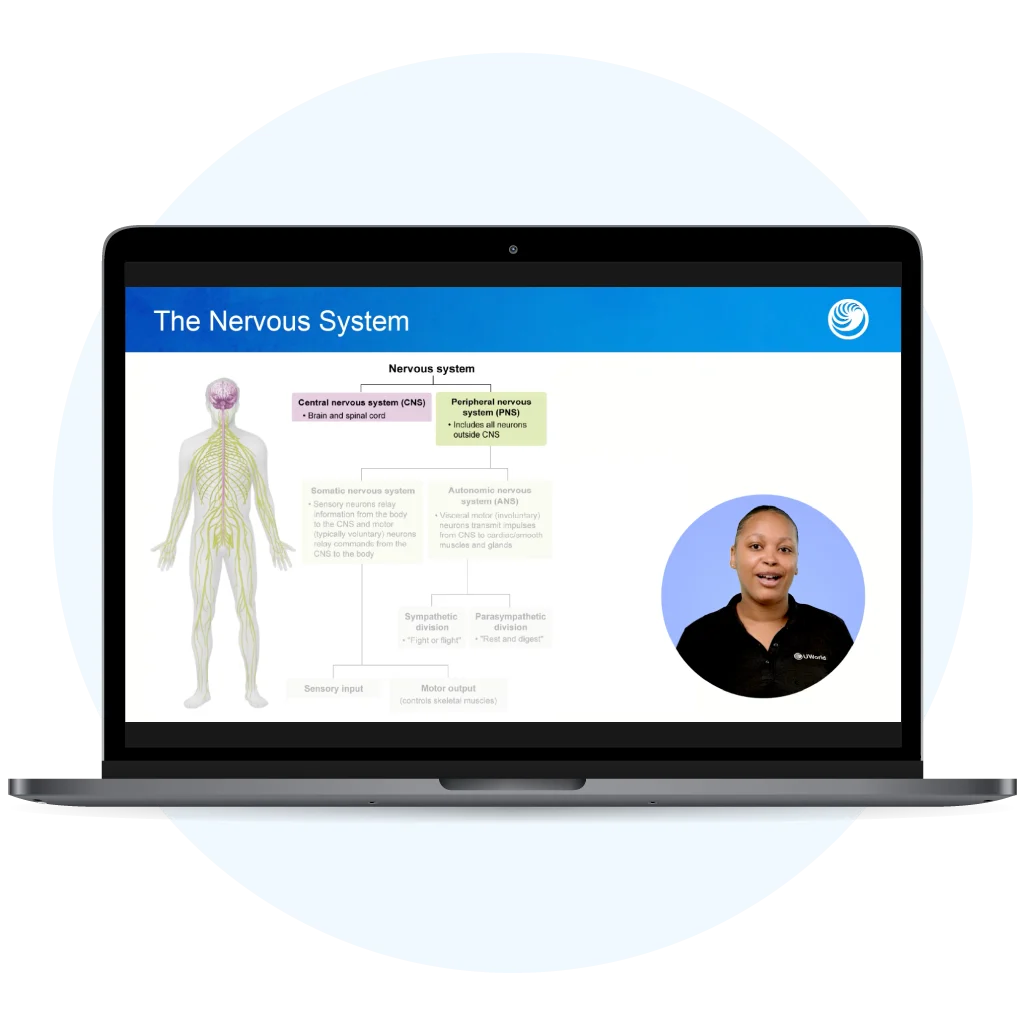
UWorld’s video lessons make AP Psychology Unit 2 easier to understand by breaking down cognition with simple explanations and real examples. You’ll see how memory, attention, and problem-solving actually work in the brain. These AP Psych Unit 2 videos help you connect concepts quickly so you feel confident for your Unit 2 AP Psychology test.

Read

Interactive Study Guides

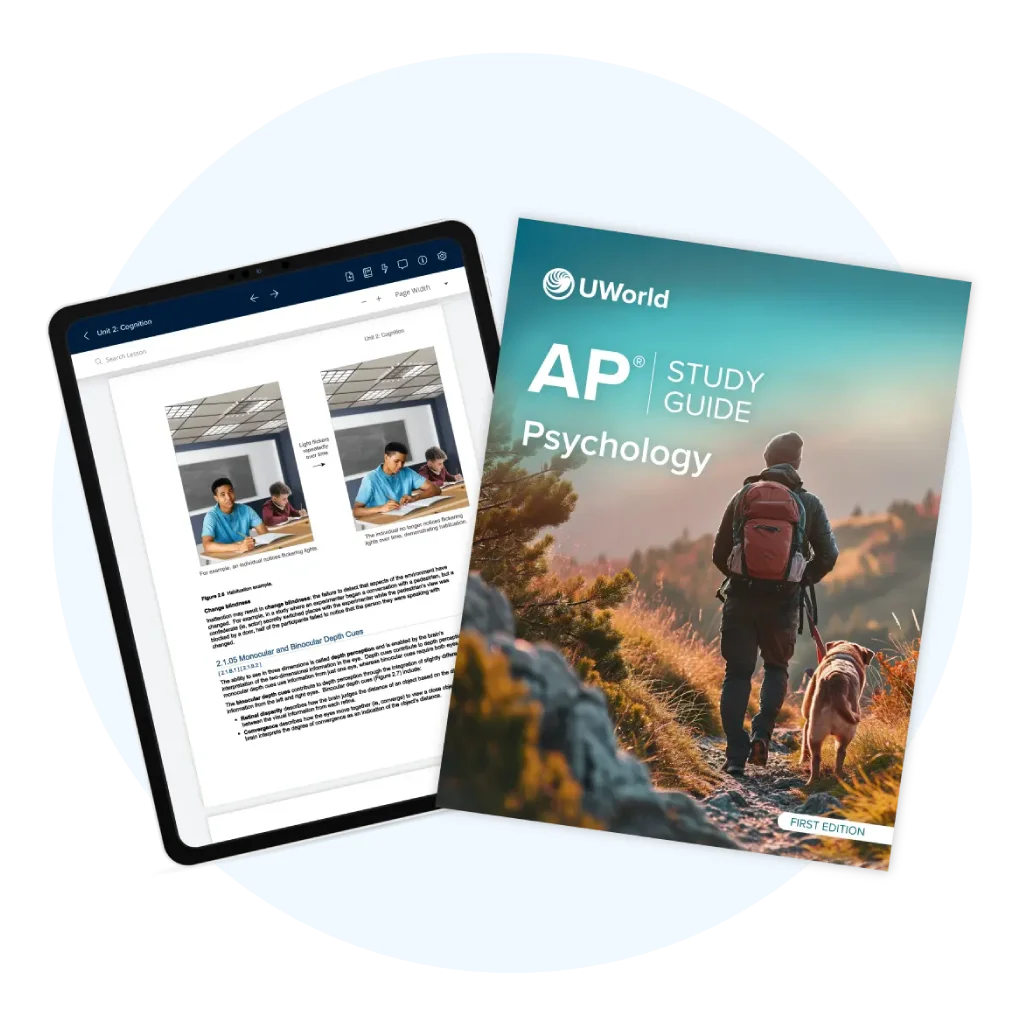
UWorld’s AP Psychology Unit 2 study guide breaks down cognition into simple explanations you can review quickly. You’ll learn key ideas like memory processes, problem-solving, and how we think and reason. With visuals, examples, and clear summaries, these AP Psych Unit 2 notes help you understand tough concepts and feel prepared for your practice tests and progress checks.

Practice

Prepare for Your AP Psych Unit 2 Test with Real Practice Questions

Get exam-ready with AP Psychology Unit 2 practice questions that mirror the style and difficulty of the real test. UWorld’s cognition-focused items help you apply what you learned about memory, thinking, and problem-solving. Each AP Psych Unit 2 practice test question includes a clear explanation so you can learn from mistakes and build confidence for your Unit 2 exam.
Try these sample practice questions with detailed answer explanations:
Cognition Practice Tests

Question

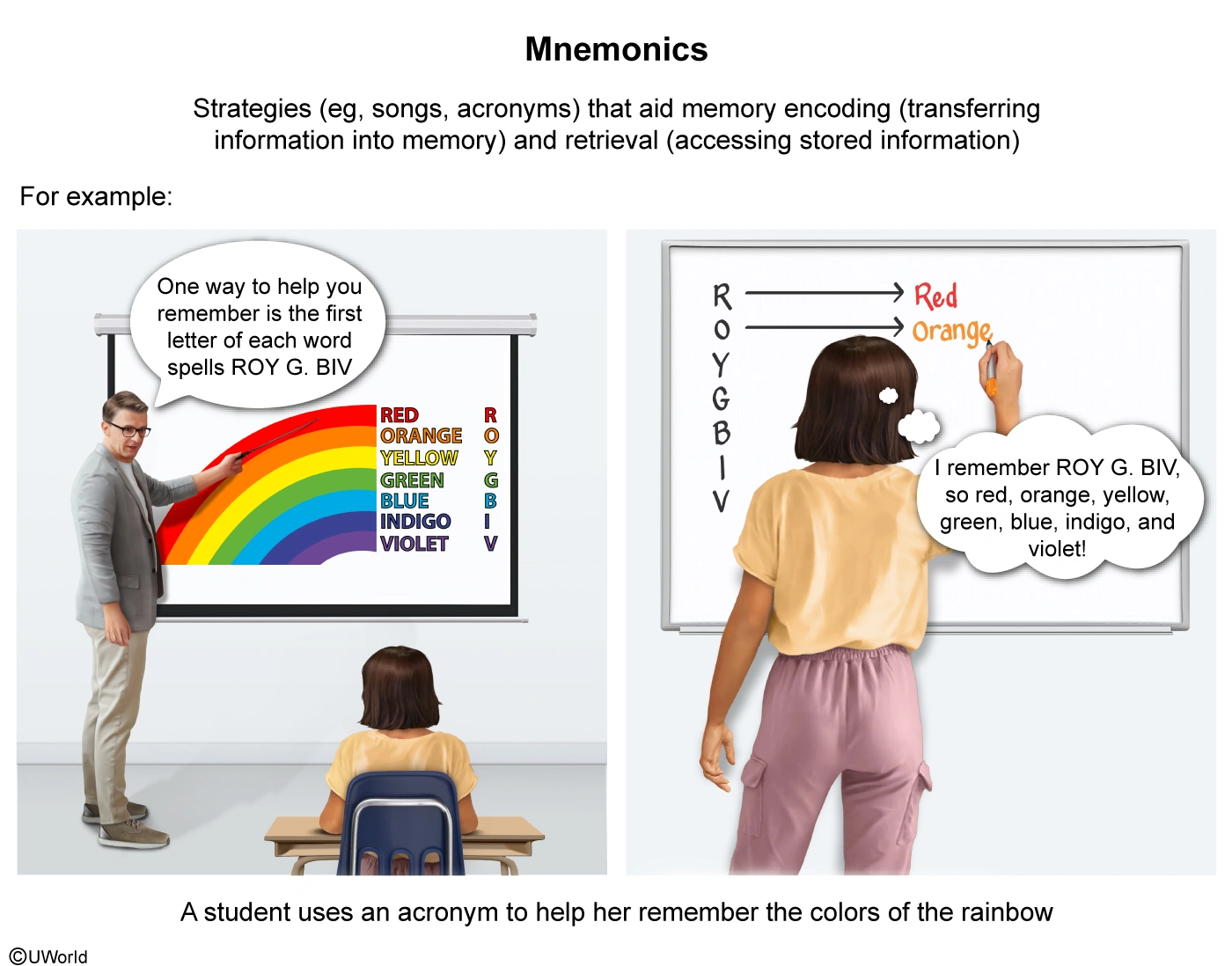
Xue wants to memorize the colors of the rainbow. She uses the acronym ROY G. BIV to help her remember that the colors are red, orange, yellow, green, blue, indigo, and violet. This illustrates

A. maintenance rehearsal
B. the spacing effect
C. implicit memory
D. a mnemonic

Explanation

mnemonics

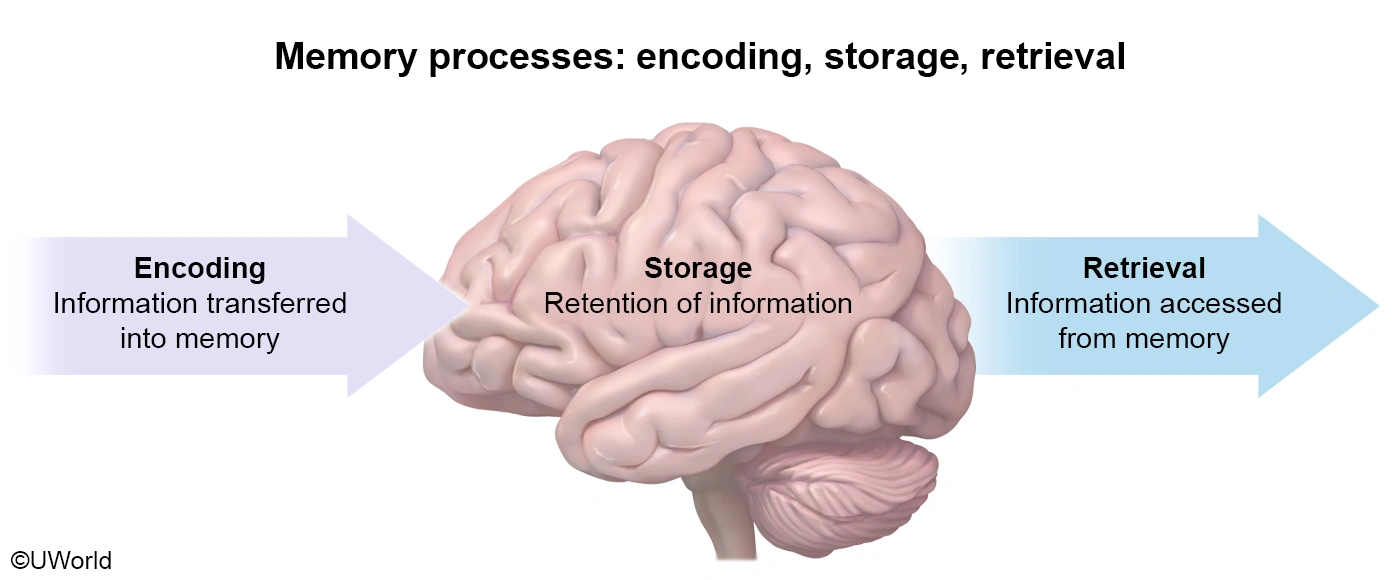
Memory involves encoding, the transfer of information into memory, storage (retaining the information), and retrieval (accessing the information).

Mnemonics are strategies (eg, songs, acronyms) that aid memory encoding and retrieval.  For example, reciting the ABCs in tune with a song helps people learn the alphabet.

Therefore, Xue using an acronym to help her remember the colors of the rainbow illustrates a mnemonic.

(Choice A)  Maintenance rehearsal, mentally repeating something over and over, can prolong the duration of short-term memory.

(Choice B)  The spacing effect refers to how repeated rehearsal of information over time (ie, distributed practice) leads to better recall than all at once (ie, massed practice).

(Choice C)  Implicit memory (also called nondeclarative memory) is memory for things that cannot be consciously recalled, such as skills, tasks, emotions, and reflexes.

Things to remember:
Memory involves encoding (transferring information into memory), storage (retaining the information), and retrieval (accessing the information).  Mnemonics are strategies (eg, songs, acronyms) that aid memory encoding and retrieval.

Question

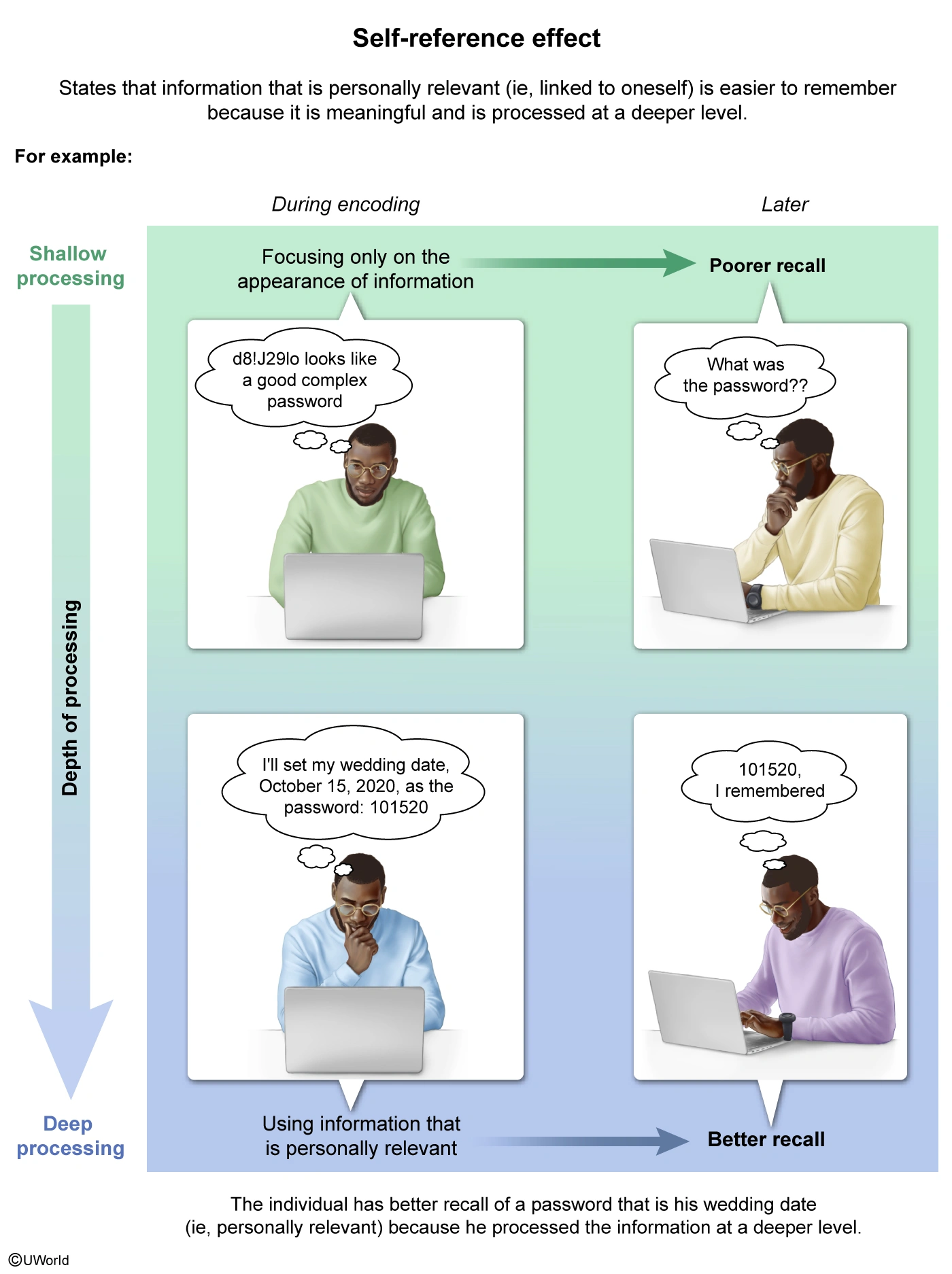
Malik has a difficult time remembering passwords, so he decides to change his email password to the date he was married. Now he can easily recall his password. Malik's memory strategy is an example of the

A. self-reference effect
B. availability heuristic
C. representativeness heuristic
D. serial position effect

Explanation

self-reference effect

The self-reference effect states that information that is personally relevant (ie, linked to oneself) is easier to remember because personally relevant information is meaningful and so is processed at a deeper level.

For example, Malik, who has difficulty remembering passwords, more easily remembers his email password after changing it to the date of his wedding because this makes the information personally relevant, which leads to easier retrieval.

Therefore, Malik's memory strategy (ie, choosing a password that is personally relevant) is an example of the self-reference effect.

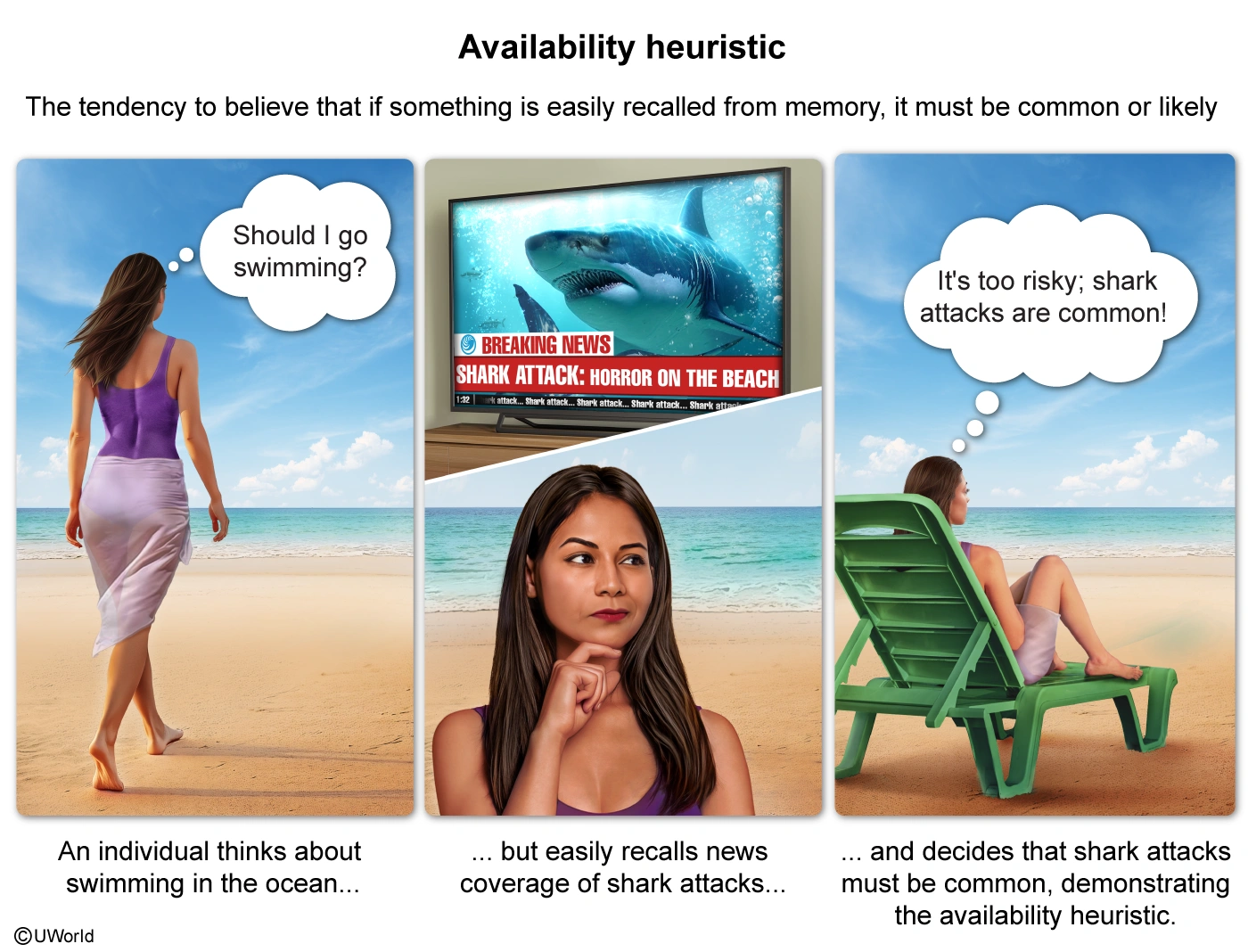
(Choice B)  The availability heuristic is the tendency to believe that if something is easily recalled from memory, it must be common or likely (eg, easily recalling news of a plane crash and incorrectly assuming that plane crashes are common).

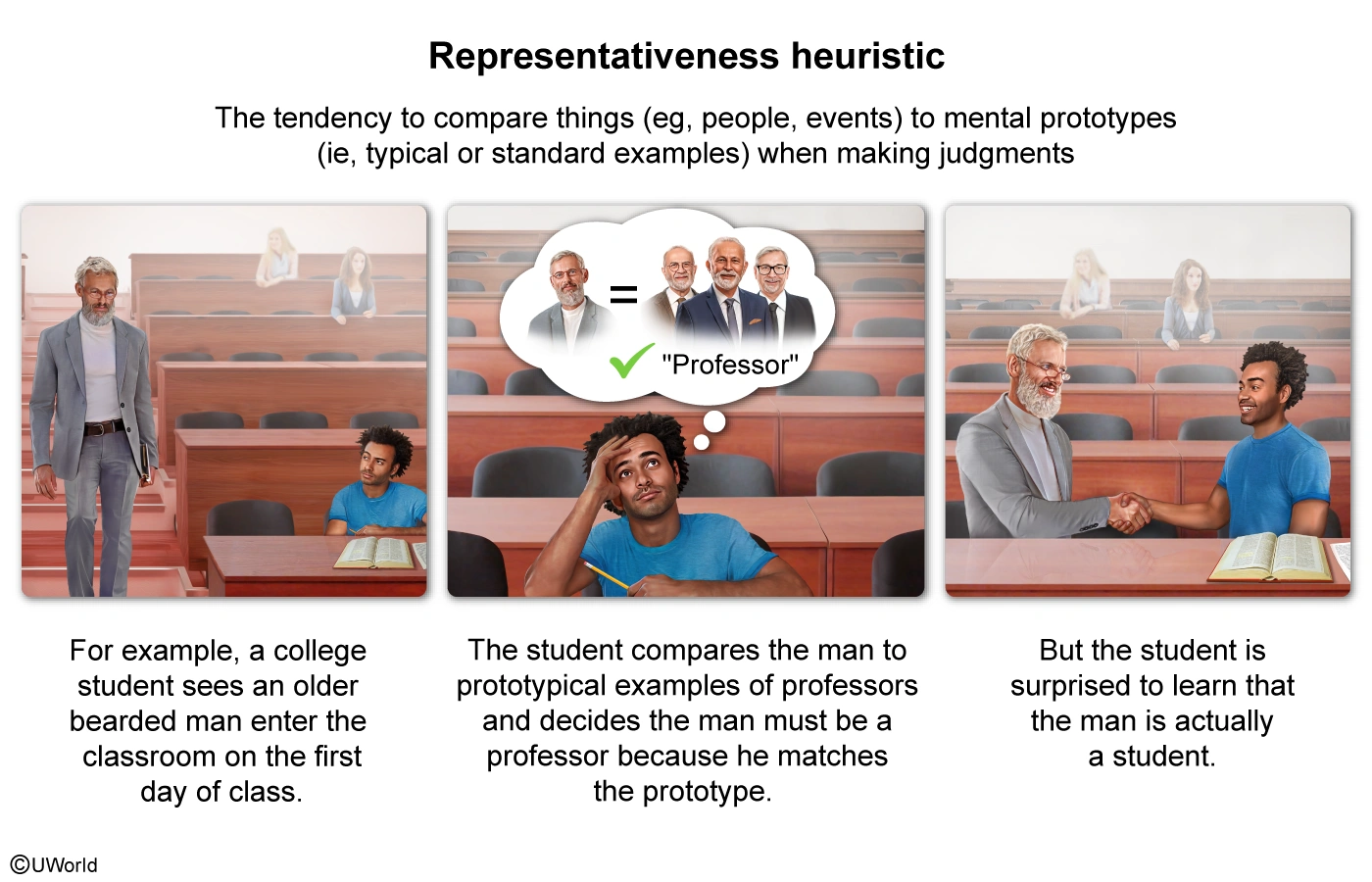
(Choice C)  The representativeness heuristic is the tendency to compare things (eg, people) to mental prototypes when making judgments (eg, a mental prototype of a nurse as female leads to the inaccurate assumption that a male nurse is a doctor).

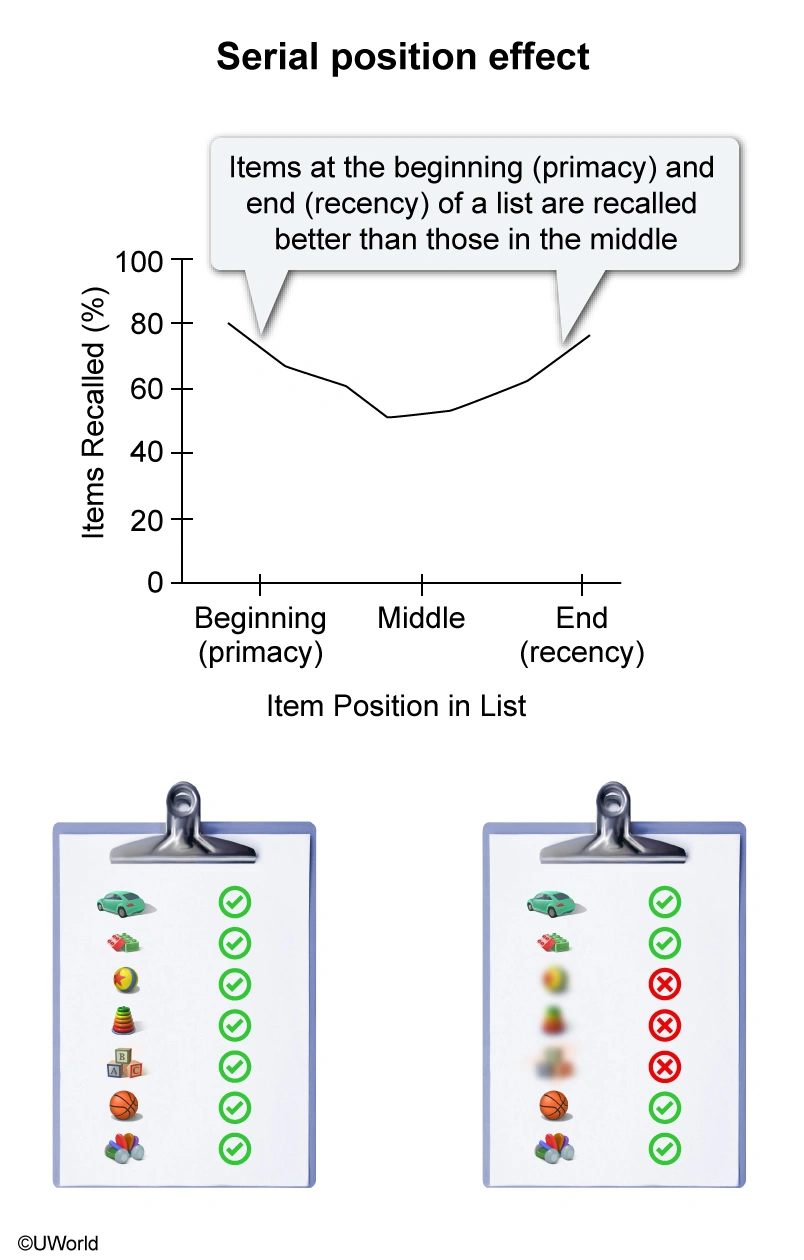
(Choice D)  The serial position effect explains how the relative ease (or difficulty) of remembering an item from a list is related to the item's position on the list; items at the beginning or end of a list are easier to recall.

Things to remember:
The self-reference effect states that information that is personally relevant (ie, linked to oneself) is easier to remember because personally relevant information is meaningful and so is processed at a deeper level.

Question

Tamera just moved to a new house and memorized her new address. Now, she can recite her new address but struggles to recall her old address. Tamera's difficulty is most likely due to a memory error known as

A. anterograde amnesia
B. proactive interference
C. retrograde amnesia
D. retroactive interference

Explanation

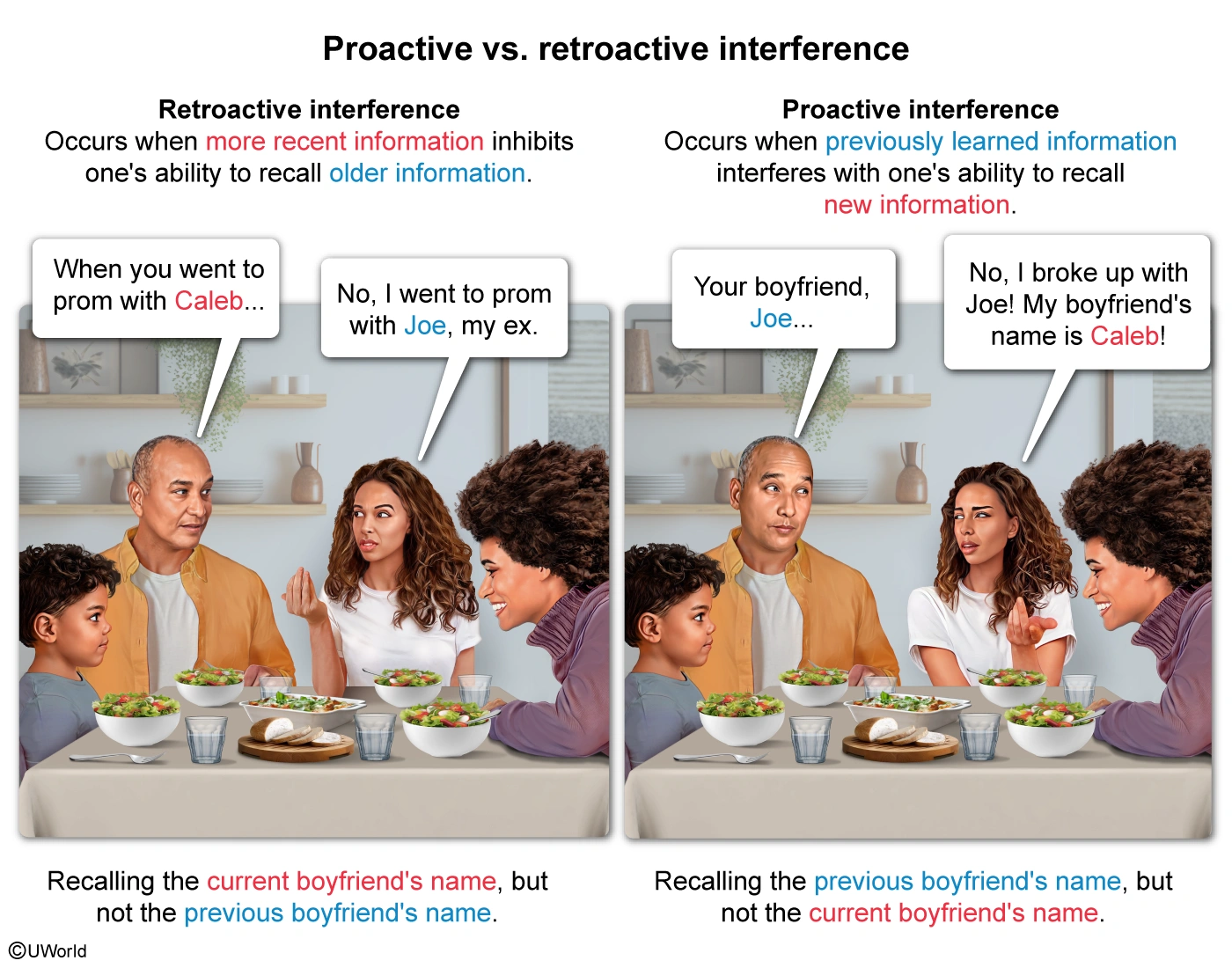
procative-vs-retroactive interference

Many factors impact how easily memories are retrieved.  Encoding is the first step in memory and is necessary for memory storage and retrieval; in other words, information must be encoded to be remembered.

A common memory error that occurs when previously learned information interferes with the ability to recall new information is called proactive interference (Choice B).  For example, an individual cannot remember their new phone number (ie, recent information) and repeatedly confuses it with their old phone number (ie, older information).

Conversely, retroactive interference occurs when recently encoded information prevents the recall of older information.  For example, an individual cannot remember their old phone number (ie, older information) and repeatedly confuses it with their new phone number (ie, recent information).

Therefore, Tamera's difficulty (struggling to recall her old address once she memorized her new address) is most likely due to a memory error known as retroactive interference.

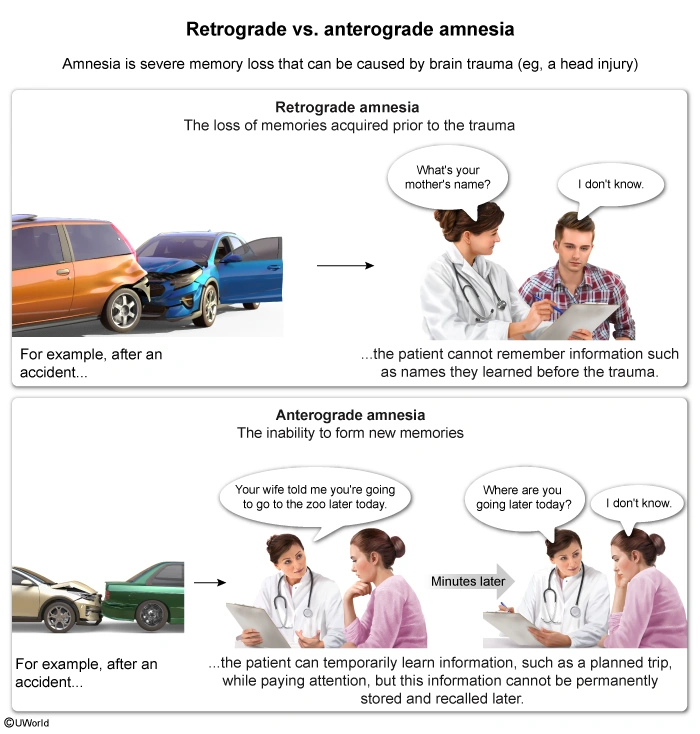
(Choice A)  Anterograde amnesia is a medical disorder in which a person cannot form new memories following a physiological trauma (eg, head injury, stroke).  For example, while the patient is paying attention, information such as a new name can be temporarily learned but not permanently stored and recalled later.

(Choice C)  Retrograde amnesia is a medical disorder in which a person cannot access old memories acquired prior to a physiological trauma (eg, head injury, stroke).  For example, the patient cannot remember what they were doing before the trauma.

Things to remember:
Retroactive interference occurs when recently encoded information prevents the recall of older information.  For example, an individual's new address interferes with her ability to recall her old address.

UWorld Dark Blue logo

Study Anywhere, Anytime

Study for AP Psychology Unit 2 whenever you have a spare moment. You can answer a few cognition practice questions on the bus, watch a quick video lesson between classes, or review your notes while hanging out at the coffee shop. With the UWorld app, your entire AP Psych Unit 2 review is always ready when you are.

Stand Out
with a Top Score in AP Psychology

Earn a top score and stand out for colleges, majors, and scholarships. With UWorld’s AP Psychology online course, you’ll be ready from your first unit review to your final exam.

Choose Your Subscription
Dream Score Plan
360-Day
$169
Deep Learning Plan
180-Day
$149
Score Booster Plan
90-Day (No print book, only digital)
$129
Introductory Plan
30-Day (No print book, only digital)
$99

Get our all-in-one course today!

  • Focused AP Psychology Videos
  • Print & Digital Study Guide
  • 350+ Exam-style Practice Questions
  • Customizable Quiz Generator
  • Adjustable Study Planner
  • Realistic Timed Test Simulation
  • Colorful Visual Explanations
  • Progress Dashboard
  • Smart Flashcards
  • Digital Notebook
Explore our free trial and frequently asked questions.

Hear From Our AP Students

UWorld’s service is pretty good and helps provide a lot of explanations on subjects I haven’t been confident on before.

— Bence P.

The questions here are the most realistic to the AP tests I've seen so far! I appreciate the ability to customize tests as well.

— Kaila H.

The best part is that all options are well-explained, telling clearly why they are not the right option.

— Syeda Huma Z.

Frequently Asked Questions (FAQs)

AP Psychology Unit 2 focuses on cognition, which includes the mental processes we use to think, solve problems, remember information, and understand the world. This unit helps you see how the mind works behind the scenes and why people make certain decisions, forget things, or approach problems differently.

The main topics covered in AP Psychology Unit 2 include:

  • Perception: How we interpret information from our senses.
  • Biases and errors in thinking: How mental shortcuts can lead to mistakes.
  • Creative thinking and problem solving: How we generate ideas and find solutions.
  • Memory processes: How information is encoded, stored, and retrieved.
  • Forgetting and memory errors: Why we lose information or remember things incorrectly.
  • Intelligence and achievement: How cognitive abilities are defined and measured.

Studying these cognition topics with UWorld helps you understand each idea clearly and apply them confidently on Unit 2 MCQs, progress checks, and FRQs.

A helpful way to prepare for the AP Psychology Unit 2 exam is to follow a simple Read, Watch, and Practice routine with UWorld. Start by reading the Unit 2 study guide to learn the main ideas behind cognition, such as perception, memory systems, and problem-solving. This gives you a solid understanding before you take on more complex Unit 2 tasks.

After reading, continue by watching UWorld’s AP Psychology Unit 2 video lessons. These videos help you understand cognitive biases, creative thinking, and how memory errors happen. Seeing the information explained visually makes the concepts easier to remember during the Unit 2 AP Psychology test.

Finally, practice with UWorld’s AP Psych Unit 2 questions. These questions match the style and difficulty of the actual exam, and each one includes a detailed explanation. Practicing consistently helps you get comfortable with cognition concepts and perform better on test day.

Yes, there are good free resources that can help you prepare for AP Psychology Unit 2. UWorld offers a free trial with a selection of AP Psych Unit 2 practice questions, sample explanations, and short lesson previews. These resources help you understand key cognition topics such as perception, memory, and thinking processes.

You can also review free Unit 2 materials from the College Board®. Their website includes sample FRQs, progress check-style items, and the official AP Psychology Course and Exam Description. These tools show how cognitive topics appear on the actual exam, including intelligence, memory errors, and reasoning tasks.

Khan Academy provides free AP Psych videos on cognition and memory. When you combine these videos with UWorld’s detailed explanations and realistic practice questions, you build a stronger understanding of Unit 2 content and perform better on your AP Psychology exam.

The AP Psychology Unit 2 test includes multiple-choice questions, free-response questions, and evidence- and article-based question formats. UWorld helps you prepare by giving you practice questions that cover perception, memory, cognitive biases, and problem-solving. These questions match the style and difficulty of real AP Psych Unit 2 exams.

You will see traditional multiple-choice questions along with two newer formats. The Article Analysis Question asks you to read a short passage and apply cognition concepts to it. The Evidence-Based Question requires you to analyze data or research related to memory, intelligence, or thinking. UWorld gives step-by-step guidance for approaching each question type.

FRQs often ask you to define cognition terms or apply concepts like forgetting, memory errors, or problem-solving strategies. Practicing with UWorld helps you write clear and accurate responses that follow AP scoring expectations.

To improve your FRQ score for AP Psychology Unit 2, start by reviewing the main cognition concepts using UWorld’s study guide. Understanding perception, memory processes, intelligence, and common thinking errors helps you write stronger explanations on your FRQs. A clear understanding of these topics increases your confidence when applying them to scenarios.

Next, practice explaining cognition terms in your own words. FRQs often require you to apply concepts like forgetting, cognitive biases, or problem-solving strategies. UWorld shows you how to break down each question so you can write responses that are organized and accurate.

Finally, work through UWorld’s AP Psych Unit 2 FRQ-style questions. These guided practice items help you understand how to structure your answers and avoid common mistakes. With consistent practice, your FRQ writing becomes more precise and aligned with scoring guidelines.

The Cognition unit, also known as AP Psychology Unit 2, usually makes up 15%–25% of the AP Psychology exam. UWorld helps you understand all key topics in this section so you are ready for both MCQs and FRQs. Since cognition covers skills like perception, memory, and problem solving, it shows up often on the test.

Many Unit 2 questions focus on memory processes, forgetting, intelligence, and cognitive biases. UWorld’s practice questions help you review these skills and apply them to realistic scenarios that mirror actual exam questions.

Because the Cognition unit appears frequently on the AP Psychology test, using UWorld’s study guides, videos, and practice questions helps you build a strong foundation and improve your overall exam performance.

UWorld offers one of the best study guides for AP Psychology Unit 2. The guide makes cognition easy to understand by breaking it down into simple, organized parts. This makes it easier to understand perception, memory systems, problem-solving, and intelligence. Each topic is broken into clear sections that help you learn faster.

The UWorld study guide includes visuals, charts, and examples that show how cognitive processes work in real situations. These explanations also match the style of Unit 2 progress checks, quizzes, and MCQs. This helps you understand what the AP Psychology exam expects.

If you want a study guide that feels easy to follow and is designed for students, UWorld is the best place to start. It prepares you for both practice tests and real AP Psychology Unit 2 exam questions.

You can find AP Psych Unit 2 practice tests that focus on cognition, and UWorld is one of the best places to get them. Their question bank includes realistic Unit 2 AP Psychology practice test questions that match the difficulty and style of the AP exam. This helps you get comfortable with real cognition scenarios.

UWorld’s practice tests cover memory, perception, problem solving, thinking, and intelligence. Each question includes a detailed explanation, which helps you understand why the answer is correct and how to avoid mistakes on the real exam.

Practicing with UWorld builds confidence for Unit 2 MCQs, FRQs, and progress checks. With enough repetition, you will feel ready for any cognition question the AP Psychology exam includes.

Memory plays a major role in AP Psychology Unit 2, since much of cognition involves how we encode, store, and retrieve information. Your performance on this unit improves when you understand how memory works and which strategies help you learn more efficiently. Techniques like spaced practice, retrieval practice, and elaboration help strengthen the connections in your brain.

Some helpful strategies include:

  • Reviewing information over several days to strengthen long-term memory
  • Testing yourself regularly to make recall more automatic
  • Connecting new ideas to things you already understand
  • Teaching the material to someone else to deepen understanding
  • Breaking content into smaller chunks to improve focus and memory retention

Using UWorld with these study strategies helps you retain Unit 2 concepts like perception, problem solving, and memory processes more effectively. Their explanations reinforce what you learn so you remember it for tests and progress checks.

Cognitive biases are a major part of AP Psychology Unit 2 because they explain why people think the way they do, even when their thinking is not fully logical. Understanding these mental shortcuts helps you see how individuals make decisions, judge situations, and solve problems. Many AP questions ask you to identify these patterns in real-life examples.

Unit 2 focuses on several key biases, such as:

  • Confirmation bias, when people look for information that supports their beliefs
  • Availability heuristic, where recent or vivid examples come to mind more easily
  • Overconfidence, when someone believes they know more than they actually do
  • Representativeness heuristic, when people rely on stereotypes to make judgments

Learning these biases with UWorld helps you apply them accurately on AP Psych Unit 2 MCQs and FRQs. Their examples and explanations make it easier to recognize how these errors show up in real scenarios and test questions.

Learn More About Specific Unit

Strengthen your grasp of AP Psychology by exploring related units that build on these concepts.
Scroll to Top

Ace AP Psych

No Credit Card Required
Try UWorld FREE for 7 Days

Frequently Asked Questions

New Purchase: All new subscriptions go into effect from the time they are activated and not at the time of setup/purchase. A subscription can be activated immediately or any time thereafter. If your initial purchase consists of multiple courses (Qbank, Self-Assessment exam, CCS, etc.), each can be activated individually and independently via your account on our website. This process of activating a subscription after purchase allows you the flexibility to start a subscription when you are truly ready to use it.

We recommend that all subscriptions be activated within 180 days of setup/purchase. Once a subscription is activated, it cannot be paused or suspended for any reason and will run continuously for the duration of the course material.

Renewal: A renewal is an extension of time to continue access to a current activated subscription. Because a renewal is an extension to an already active subscription, it is effective from the existing expiration date, not from the day of purchase and cannot be deferred to start at a later date/time.

Note: All of our subscriptions are based on the Eastern Time Zone (GMT/UTC -5 hours or New York Time), which may be different than your local time zone.

Any of our product offerings can be purchased from our website with payment due in full at time of purchase via a credit or debit card with American Express/Discover/MasterCard or Visa logo.

You will need to register for an account in order to purchase any of our products. Once you have registered for an account or if you already have an account:

  • Log in to your UWorld account
  • Click on the Cart icon at the top of the page and then select your desired product to see a list of available packages and their prices
  • Select the package you wish to purchase
  • Verify your profile information, address, and educational status, then click the Update button
  • Enter your Billing address and credit/debit card information, then click Review Order
  • Verify that the correct product is in your cart and click Place Order
  • A purchase receipt will automatically be sent to your registered email address

If you complete your purchase but do not receive a receipt, please contact the Customer Care Team at [email protected]

You can subscribe to any of our online courses/services using a credit or debit card with a Visa, MasterCard, Discover or American Express logo. After a successful payment, your subscription will immediately be available for activation via your account on our website or available complementary mobile applications.

You can also subscribe via personal check, money order, or demand drafts taken in U.S. dollars. These types of payments should be mailed to us and should include the name of the subscription and the duration, along with the details asked for in the registration form. We will set up your account as soon as we receive your payment and notify you via email of your access credentials. All direct-mail payments must be in U.S. dollars and made payable to:

UWorld, LLC
9111 Cypress Waters Blvd
Suite 300
Dallas, TX 75019

We do not accept cash via mail, currencies other than U.S. dollars or payments via fax.

Individuals purchasing our CPA Review product may finance their purchase using Affirm during checkout process. Your eligibility depends on your credit score and other criteria, as per Affirm’s policies (outlined here). A soft credit check, a credit check that does not affect your credit score, will be performed by Affirm to determine your loan eligibility. You will need a US based bank account to qualify.

All refunds are evaluated on a case-by-case basis for products purchased directly from UWorld. One case has no bearing on another. Refund amounts determined by UWorld are final.

In-App Purchases: We are unable to process any refunds for purchases made via mobile application (in-app). Please contact Apple for all refund/credit requests for Apple in-app purchases.

USMLE Step 2 CS, Step 3 CCS, Subject Reviews & Self-Assessment Exams: These subscriptions are non-refundable, non-transferable, and cannot be converted into another subscription.

CPA Review: Students may request to cancel their CPA review product only within 10-days of activation of any of the materials. To qualify for a refund, no more than 10% of the course (lectures, Qbank, or a combination there-of) may have been used per exam section. All CPA Review refunds are subject to a cancellation fee of $75 (for single section purchases) or $250 (for package
purchases), plus any applicable shipping charges. No return of merchandise is necessary.

All other Qbanks: Refunds are considered for subscriptions of more than 30 days. Refund amounts are based on the number of days elapsed since the subscription start date or the number of questions used, whichever amounts to a higher deductible.

Example scenarion: An individual purchases a 180-day Qbank subscription and generates a few test blocks equal to 20% of the questions in the Qbank. After 45 days, he/she requests a refund. Because the elapsed duration is greater than the percentage of questions used, the refund amount will be based on a subscription converted to the closest duration (60 days) by deducting the applicable 60-day subscription fee from the refund. In the same scenario, if the individual had used 85% of the questions, the refund would be 15% of the subscription fee paid.

Note 1: A processing fee of 10% (minimum of $10 and maximum of $25) will be applied to all refund amounts.

Note 2: All refunds, pro-rated or otherwise, must be requested within 360 days of original purchase. Refunds for purchases made more than 360 days ago will be issued as non-refundable, non-transferable store credit.

Note 3: Subscribers must notify UWorld of their intent to obtain a refund before activating their subscription (or) during the active duration. If the reset option is used or all of the questions are used, no refund will be allowed (see “I want to reset/delete my Qbank test history (or) start all over again, is this possible?” below for further details). No refunds will be offered for expired subscriptions.

Note 4: For combination package purchases, individual subscription fees will be applied when calculating the refund. If any self-assessment Exam(s) is utilized from a package, the entire purchase is rendered non-refundable.

Note 5: Although access to Qbanks via certain mobile devices is provided as an additional feature, it is not intended to be a replacement for computer access, and no refunds or cancellations will be honored due to user inability to install and/or use the provided software on any mobile device (regardless of whether the device meets the minimum system requirements).

Please use the following steps to purchase a renewal for your subscription:

  • Log in to your account on our website
  • Click on the User Icon in the top right corner of the screen
  • Click on the Renew button corresponding to your subscription
  • Select the Renewal duration you wish to purchase
  • Verify your profile information, address, and educational status, then click the Update button
  • Enter your Billing address and credit/debit card information, then click Review Order
  • Verify that the correct package is in your cart and click Place Order

Upon a successful transaction, you will be sent a confirmation email receipt.

A renewal is an extension of time to continue accessing an active subscription, and it will not start the subscription over, provide a reset, or grant access to additional questions that were not previously accessible. Because a renewal is an extension to an already active subscription, it is effective from the existing expiration date, not from the date of purchase, and cannot be deferred in any way to start at a later date/time.

Please note that to qualify for renewal pricing, you will need to renew the course before it expires. Renewals are not offered to expired subscriptions. If you fail to secure a renewal before the expiration date, you will need to purchase a new subscription at the regular price directly from our website to regain access to the material.

Note: All times and dates displayed for subscription expiration correspond with the Eastern Time Zone (GMT/UTC -5 hours or New York Time), which may be different than your local time zone.

Note: If your initial purchase was a combination package, you will need to renew each active subscription individually. You do not need to renew a course that has not been activated.

You may request to upgrade or downgrade your subscription purchase as long as it has not been activated. If you purchase a combination package, all included subscriptions must be unused. Please be advised that current subscription pricing will apply.

If your subscription has been activated, unfortunately, we cannot upgrade it retroactively. If seeking to downgrade, please refer to our refund policy for available options.

We do not offer custom duration(s) or combination packages other than those outlined on the website. Please refer to our purchase page for currently available subscriptions (including discounted combination packages for some products).

Self-Assessment exam subscriptions are for 14 days each. Subscribers whose active subscription(s) have not expired can purchase renewals from 7 days or more at any time before their active subscription expires. Please refer to the respective course description page for renewal options.

We offer a demo on each of our product pages that contains a sample of the product interface and a few sample questions. We do not offer guest/trial accounts to test our software and view materials.

It is possible to purchase a subscription as a gift for someone else. However, the intended recipient will need to register an account on our website (or have an account registered for them, with their profile information entered accurately). If the user is present at the time of purchase, the purchase can be made from their account on our website using any credit or debit card with a Visa, MasterCard, American Express, or Discover logo.

If the user is not present, or you wish for the gift to be a surprise, please contact Support directly using the contact form to arrange payment for the gift subscription. You will need to provide the user’s registered email address so the account can be located.