AP® Physics 1 Unit 8 Review and Practice Test
Get ready for your AP® Physics 1 Unit 8 fluids review with a clear breakdown of essential fluids AP Physics 1 concepts, from key fluids equations to buoyancy and pressure applications. This study guide includes AP Physics 1 fluids practice problems, MCQs, and fluids FRQs to help you master challenging topics. With Unit 8 AP Physics 1 progress check tips, formulas, and practice resources, you’ll build confidence and prep smarter for the AP Physics 1 Unit 8 test.
Strengthen Your AP Physics 1 Unit 8 Fluids Review
Build confidence in AP Physics 1 fluids with clear explanations, essential equations, and practice problems that match real exam questions. This Unit 8 review breaks down pressure, density, and fluid forces in a way that feels simple and easy to follow.
Engaging Video Lessons
Get AP Physics 1 Unit 8 fluids explained through quick, easy-to-follow videos that break down pressure, density, and fluid forces step by step. Whether you're reviewing buoyancy or working through Unit 8 AP Physics 1 practice problems, these videos make tough topics feel way simpler.
Interactive Study Guides
Explore AP Physics 1 Unit 8 fluids with study guides that break everything down into simple visuals, quick notes, and clear explanations. These guides also connect directly to Unit 8 AP Physics 1 MCQs and FRQs, so you know exactly how to apply what you learn.
Build Skills with AP Physics 1 Unit 8 Fluids Practice Questions
Question
A cube of mass 900 kg and side length 1.5 m floats at rest in a pool of water that has a density of . What percentage of the cube is submerged under the surface of the water?
| A. 27% | |
| B. 40% | |
| C.60% | |
| D. 90% |
Explanation
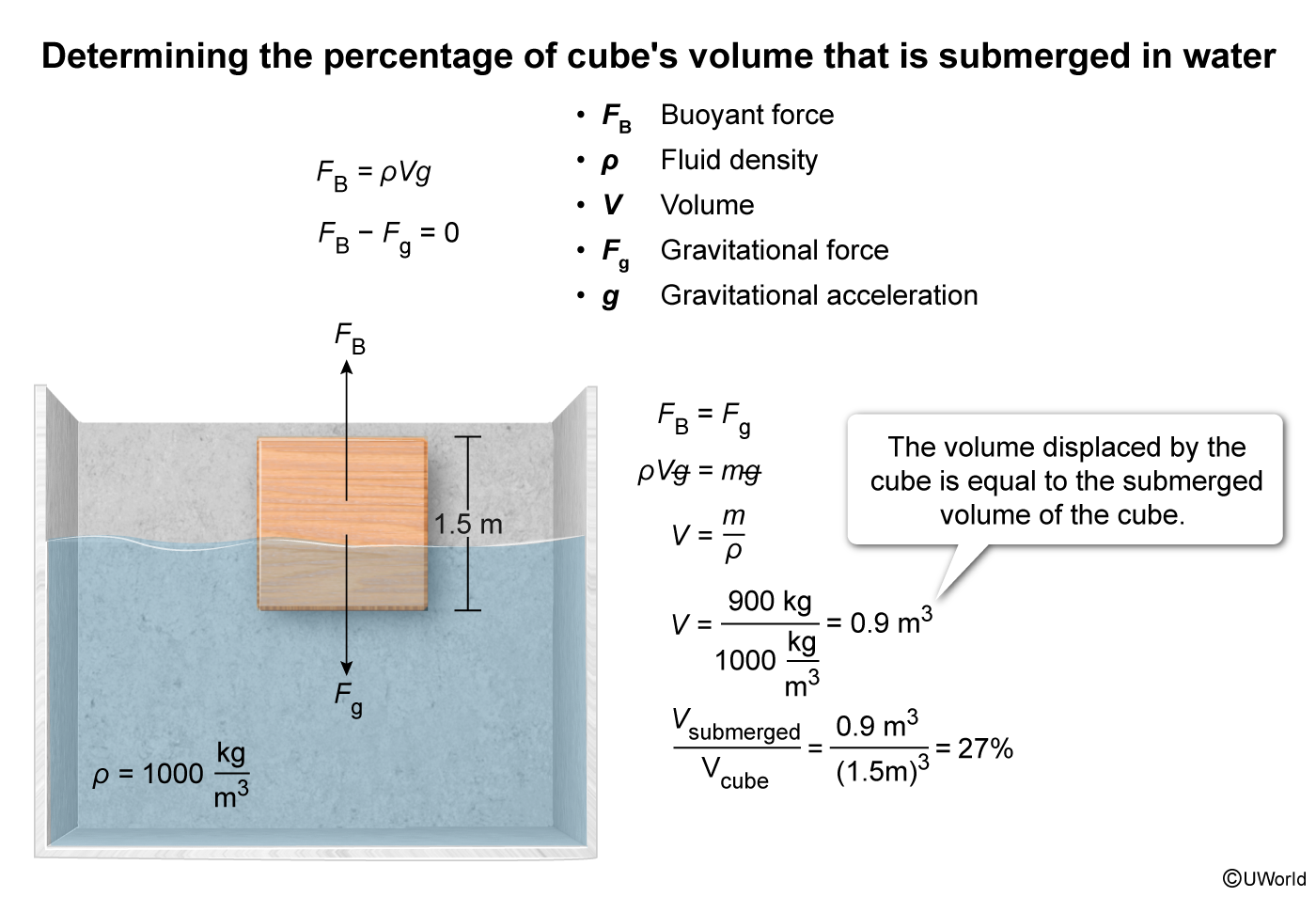
Newton's third law of motion implies that an object suspended in a fluid is in static equilibrium, where the buoyant force is equal and opposite to its weight Fg:
In this question, a cube of mass 900 kg and side length 1.5 m floats at rest in a pool of water. The buoyant force is equal to the product of the density of the fluid the volume of the displaced fluid , and the gravitational constant :
Substituting these quantities into the equilibrium equation yields:
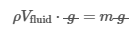
Note that is also the volume of the cube submerged under the surface of the water, . Solving for using the cube mass m = 900 kg and density of water ρ = 1,000 kg/m 3 yields:
The percentage of the cube's volume submerged in the water can be calculated by taking the ratio of the submerged volume to the volume of the whole cube :
(Choice B) 40% follows from calculating the percentage of the cube's volume submerged by incorrectly squaring the cube side length.
(Choice C) 60% follows from calculating the percentage of the cube's volume submerged and forgetting to cube the side length.
(Choice D) 90% follows from calculating only the volume of the cube that is submerged.
Things to remember:
The buoyant force is equal to the weight of the fluid an object displaces.
Question
Liquid 1 of density ρ and liquid 2 of density are poured into a single cylindrical container of volume . The liquids have equal masses m and take up volumes and respectively, in the container, filling it completely. What is the volume of the container in terms of the volume of liquid 2?
| A. | |
| B. | |
| C. | |
| D. |
Explanation
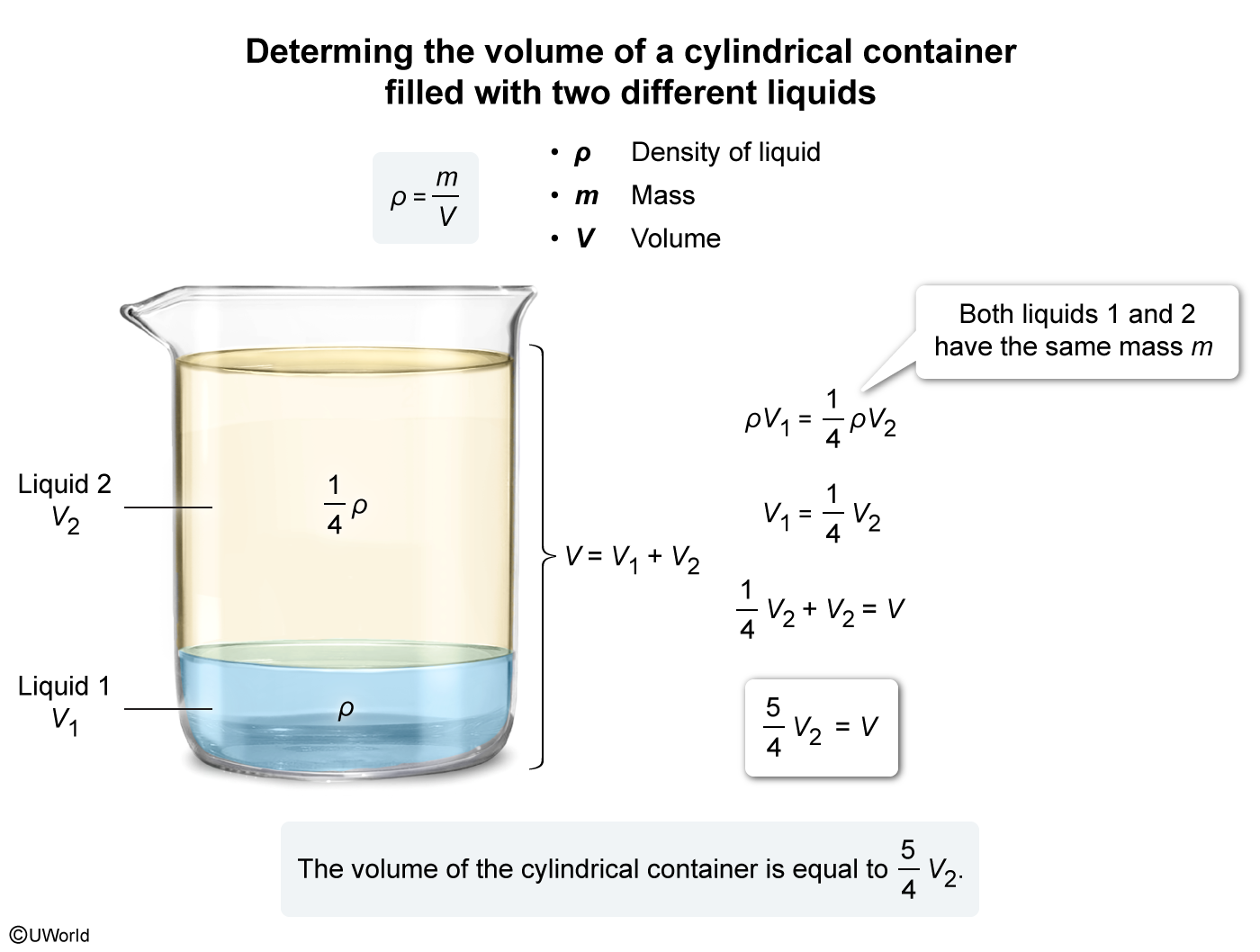
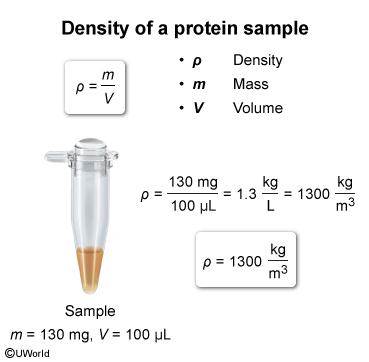
Density is equal to the ratio of an object's mass to its volume:
In this question, equal masses of liquid 1 and liquid 2 of densities and , respectively, fill a single cylindrical container of volume . Liquid 1 fills a volume , and liquid 2 fills a volume . The overall volume of the cylindrical container is equal to the sum of both volumes and :
Furthermore, the density of each fluid is the ratio of the mass m and the respective volumes:
Because the fluids contain equal masses, can be found in terms of :
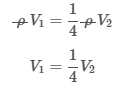
Therefore, substituting in the volumes to solve for in terms of yields the relationship between and :
(Choice A) follows from solving for the volume of in terms of .
(Choice B) incorrectly assumes that liquid 1 and liquid 2 have equal volumes.
(Choice D) incorrectly assumes that is equal to .
Things to remember:
The density of a fluid is determined from the ratio of its mass and its volume.
Question
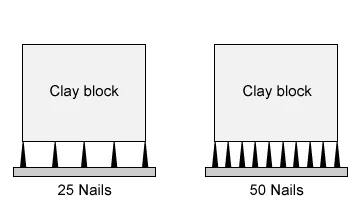
A soft clay block is at rest on an even distribution of 25 sharp nails, as shown in the diagram above. The same clay block is then put on an even distribution of 50 sharp nails. Which of the following must decrease between the clay block and a single nail?
| A. The force exerted by the nail | |
| B. The pressure between the clay block and the nail | |
| C. Both the force exerted by the nail and the pressure between the clay block and the nail | |
| D. Neither the force exerted by the nail nor the pressure between the clay block and the nail |
Explanation
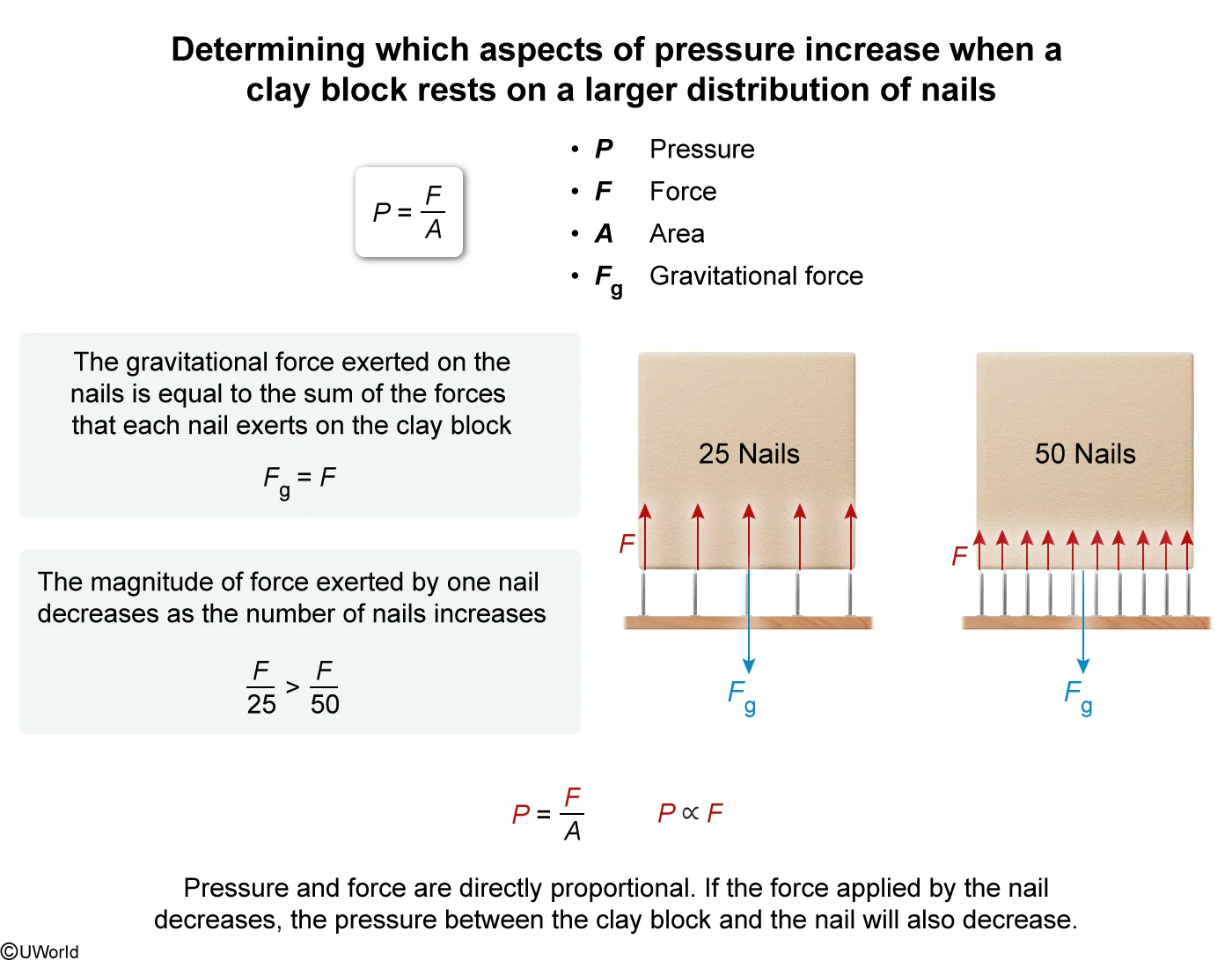
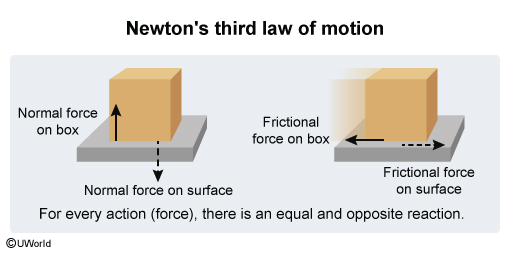
In this question, a soft clay block is put on two even distributions of sharp nails. The first set has 25 nails, whereas the second set has 50 nails, and the block is at rest in each scenario. Newton's third law of motion implies that the block is in static equilibrium when the weight of the block is equal and opposite to the cumulative force applied by the nails :
Consequently, is evenly distributed among the number of nails; thus, is equal to the product of the number of nails and the force F exerted by one nail:
Hence, the magnitude of the force exerted by each nail:
decreases when the number of nails increases:
The force exerted by the nails results in a pressure P. Pressure is defined as the ratio of the perpendicular component of the applied force and the amount of surface area over which the force acts:
With the surface area of the clay block constant, the pressure between the block and the nails is directly proportional to the force exerted by each nail. Therefore, if the force exerted by an individual nail decreases in magnitude, the pressure must also decrease.
(Choices A and B) These options both incorrectly assume the pressure and the force applied are not directly proportional.
(Choice D) This option incorrectly assumes the number of nails does not affect the pressure or the force applied.
Things to remember:
Pressure is directly proportional to the applied force and inversely proportional to the area it acts on.

Study Anywhere, Anytime
Review AP Physics 1 Unit 8 fluids wherever you are; work through practice problems on the bus, watch quick fluids videos between classes, or scroll through your study guide at a cafe. Whether you’re tackling pressure, density, or buoyancy questions, the UWorld app keeps every AP Physics 1 fluids resource right at your fingertips so you can prep whenever it fits your day.
Stand Out
with a Top Score in AP Physics 1
Finish your AP Physics 1 Unit 8 review and continue mastering all units with UWorld. Boost your performance and make yourself a standout candidate for competitive colleges, majors, and scholarships by mastering your AP Physics 1 course and scoring a 5 on the exam.
Get our all-in-one course today!
- Focused AP Physics 1 Review Videos
- Print & Online AP Physics 1 Study Guide
- 450+ Physics 1 Exam-style Practice Questions
- Customizable Quiz Generator
- Adjustable Study Planner
- Realistic AP Physics 1 Exam Review
- Timed Test Simulation
- Progress Dashboard
- Smart Flashcards
- Digital Notebook
Hear From Our AP Students
UWorld’s service is pretty good and helps provide a lot of explanations on subjects I haven’t been confident on before.
The questions here are the most realistic to the AP tests I've seen so far! I appreciate the ability to customize tests as well.
The best part is that all options are well-explained, telling clearly why they are not the right option.

Frequently Asked Questions (FAQs)
What are the main topics covered in AP Physics 1 Unit 8: Fluids?
AP Physics 1 Unit 8 focuses on understanding how fluids behave through key concepts that connect structure, forces, and conservation laws. These ideas show up in both MCQs and FRQs, so getting comfortable with them is important for scoring higher on the exam.
- Internal structure and density: How particles in a fluid determine mass per unit volume and affect behavior.
- Pressure: How fluids exert force over an area and how it changes with depth.
- Fluids and Newton’s laws: How forces, acceleration, and motion apply to fluids.
- Fluids and conservation laws: How energy, mass, and momentum are conserved in fluid systems.
If you want these topics broken down clearly with practice that matches the real test, UWorld’s AP Physics 1 Unit 8 fluids resources make studying way easier.
How should I prepare for an AP Physics 1 Unit 8 exam?
Preparing for the AP Physics 1 Unit 8 exam starts with reading a solid fluids study guide that explains density, pressure, buoyant force, and how fluids relate to Newton’s laws. Clear notes make it easier to understand key fluids equations before you start solving problems.
Then, watch engaging lessons that show Unit 8 concepts in action. Seeing pressure changes, fluid flow, and conservation laws visually helps you make sense of formulas and apply them correctly. Video explanations make tough fluids topics feel a lot more manageable.
Finally, practice with AP Physics 1 fluids MCQs and FRQs to build speed and confidence. UWorld’s Unit 8 fluids practice problems, explanations, and review tools give you everything you need to prep like a pro and raise your score.
Are any free resources available for AP Physics 1 Unit 8?
You can start your AP Physics 1 Unit 8 fluids prep with UWorld’s free trial, which gives you access to sample fluids practice problems, videos, and explanations. It’s an easy way to test out high-quality review tools without committing right away.
You can also use the College Board’s free AP Classroom materials, including Unit 8 progress check MCQs and FRQs. These show you the style of questions you’ll see on the actual AP Physics 1 fluids test.
For extra videos, Khan Academy offers lessons on pressure, density, and buoyancy. But if you want the clearest breakdowns and the most realistic AP Physics 1 fluids practice, UWorld is your best go-to.
What types of questions are on the AP Physics 1 Unit 8 test?
On the AP Physics 1 Unit 8 fluids test, you’ll mainly encounter two kinds of questions that check your understanding of pressure, density, fluid forces, and conservation laws.
- Multiple-choice questions (MCQs): These test how well you apply fluids equations, interpret diagrams, and analyze situations involving buoyancy, pressure differences, and forces.
- Free-response questions (FRQs): These require written explanations, calculations, and reasoning based on fluid behavior, Newton’s laws for fluids, and conservation principles.
To get comfortable with both question types, UWorld’s AP Physics 1 Unit 8 fluids practice problems give you step-by-step explanations that make tough concepts easier to understand.
How can I improve my score on the Free-Response Questions (FRQs) for Unit 8?
Improving your score on AP Physics 1 Unit 8 FRQs starts with learning how to explain your reasoning clearly. Make sure you understand how density, pressure, and fluid forces work so your answers show strong conceptual understanding rather than guesswork.
Practice drawing diagrams, labeling forces, and writing out each step of your calculations. FRQs in fluids often reward clear justification and connections to Newton’s laws and conservation laws, even if your final answer isn’t perfect.
The best way to get better is through consistent practice. UWorld’s AP Physics 1 Unit 8 fluids FRQs include detailed explanations that show you exactly how high-scoring answers are written.
What is the "Fluids" unit's weight on the AP Physics 1 exam?
The AP Physics 1 Unit 8 fluids section typically counts for about 10-15% of the overall exam. It may look like a small chunk, but topics like pressure, density, and fluid forces appear in both MCQs and FRQs, making these points valuable.
This unit focuses on how fluids behave under different forces and how conservation laws apply to fluid systems. Because questions often require equation use and reasoning, even a few well-prepared responses can make a noticeable difference in your score.
To make the most of that 10 –15%, UWorld’s AP Physics 1 fluids explanations and practice questions help you review efficiently and build real exam confidence.
Where can I find a good study guide for AP Physics 1 Unit 8?
A good study guide for AP Physics 1 Unit 8 should break down fluids concepts like pressure, density, buoyancy, and conservation laws in a simple and organized way. UWorld’s AP Physics 1 fluids study guide does exactly that by using visuals, clear explanations, and step-by-step examples.
The guide connects key fluids equations to real exam-style problems, helping you understand not just what to memorize but how to apply it. It also pairs smoothly with MCQs and FRQs so you can practice immediately after reviewing a topic.
If you want a study guide that makes Unit 8 feel less overwhelming, UWorld’s AP Physics 1 fluids materials are one of the most reliable choices.
Can I find practice tests specifically for AP Physics 1 Unit 8?
You can find practice tests focused specifically on AP Physics 1 Unit 8 fluids. These targeted sets strengthen your understanding of pressure, density, buoyancy, and fluid forces in a more focused way than general AP Physics 1 practice.
Unit-specific practice helps you get comfortable with the exact types of MCQs and FRQs you’ll see in the Unit 8 progress checks and on the AP exam. It’s a great way to identify what you know well and what still needs review.
For the most realistic experience, UWorld offers AP Physics 1 Unit 8 fluids practice tests with clear explanations that help you learn from every question and improve your score.
How do fluids equations help on the AP Physics 1 Unit 8 exam?
Fluids equations are a huge part of the AP Physics 1 Unit 8 test because they help you describe how pressure, density, and fluid forces behave. Knowing when and how to use the right formulas for fluid pressure and buoyancy helps you solve problems quickly and accurately.
These formulas aren’t just plug-and-chug. You’ll need to understand the relationships behind them, how pressure changes with depth, how density affects buoyant force, and how Newton’s laws apply to fluid motion. That deeper understanding helps you approach MCQs and FRQs with confidence.
If you want practice applying these equations the right way, UWorld’s AP Physics 1 fluids problems walk you through each step with clear explanations.
Why do students struggle with AP Physics 1 Unit 8: Fluids?
Many students find AP Physics 1 Unit 8 challenging because fluids behave differently from solid objects. Concepts like pressure differences, buoyant force, and density feel abstract at first, especially when combined with Newton’s laws and conservation laws.
Another reason Unit 8 feels tough is the math. Fluids equations may look simple, but using them correctly requires understanding how depth, area, and forces interact. Interpreting diagrams and applying formulas to real scenarios can take some practice.
The good news is that once you see a few worked examples, the patterns become clear. UWorld’s AP Physics 1 fluids review gives you step-by-step solutions that make even the tricky parts feel manageable.