AP® Physics 1 Unit 7 Review and Practice Test
Get ready for your AP® Physics 1 Unit 7 review with a focused breakdown of oscillations and simple harmonic motion. This guide walks you through key concepts, common pitfalls, and strategies for tackling AP Physics 1 oscillations FRQs, Unit 7 progress check FRQs, and MCQs. With targeted practice tests, AP Physics 1 Unit 7 practice problems, and tips for mastering oscillation-based questions, you’ll build the confidence needed for the Unit 7 AP Physics 1 assessments.
Crush Your AP Physics 1 Unit 7 Review: Oscillations Made Easy
Get a clear, no-stress breakdown of AP Physics 1 Unit 7 oscillations, progress check FRQs, and MCQs. This review helps you level up your Unit 7 AP Physics 1 prep with simple explanations and practice that actually make sense.
Engaging Video Lessons
Dive into chill, easy-to-follow videos that break down AP Physics 1 Unit 7 oscillations, progress check FRQs, and tricky MCQs. Each lesson shows real examples, step-by-step setups, and problem-solving tips you can actually use. Whether you're stuck on simple harmonic motion or reviewing Unit 7 AP Physics 1 practice problems, these videos keep things clear and stress-free.
Interactive Study Guides
Explore AP Physics 1 Unit 7 study guides that make oscillations, simple harmonic motion, and progress check FRQs way easier to understand. Swipe through visuals, quick tips, and practice setups that break down every Unit 7 AP Physics 1 concept. These guides help you review faster, stay organized, and feel confident tackling any oscillations MCQ or FRQ.
AP Physics 1 Unit 7 Oscillations Practice Test Questions
Question
A pendulum bob is pulled back and released from rest at a height h above the lowest point in its swing. What is the magnitude of the vertical displacement of the pendulum the first time it reaches half its maxumum speed?
| A. | |
| B. | |
| C. | |
| D. |
Explanation
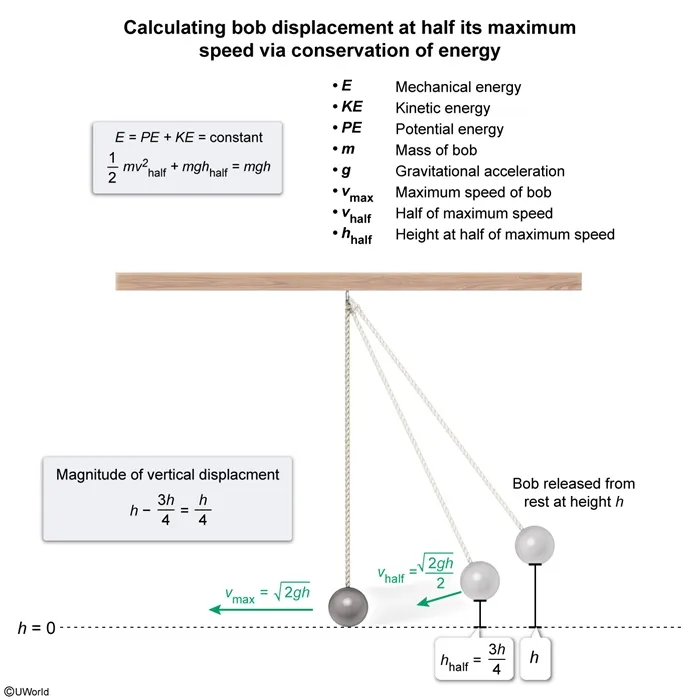
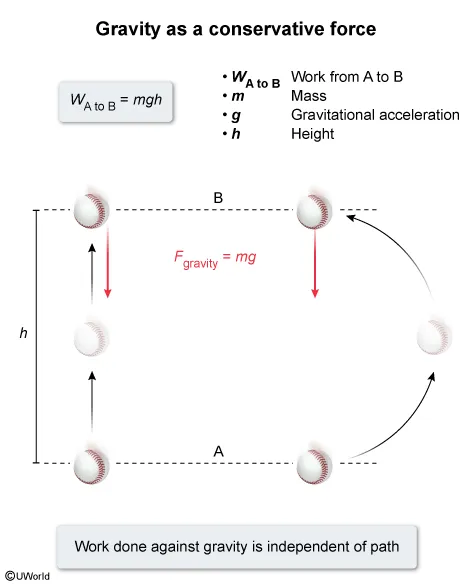
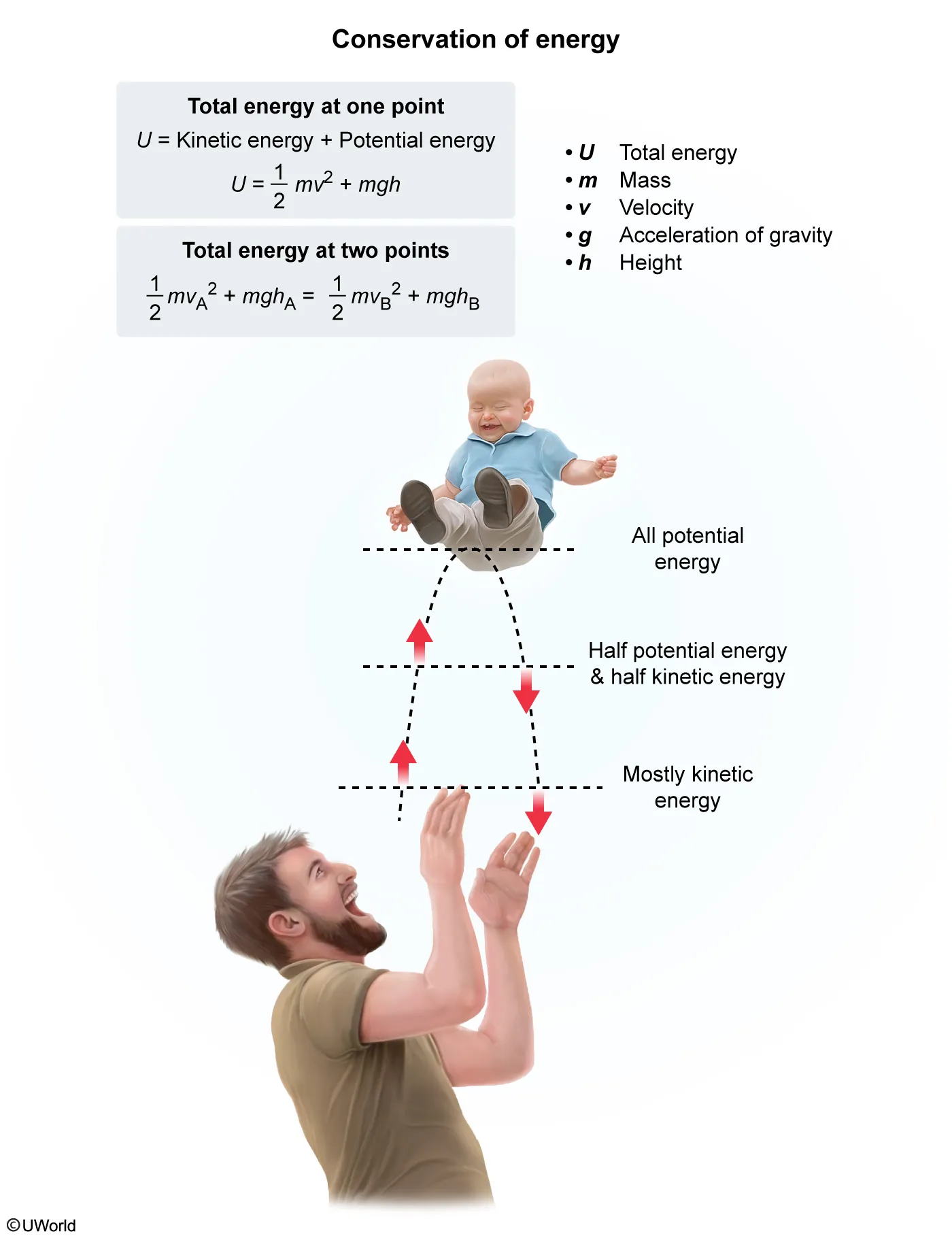
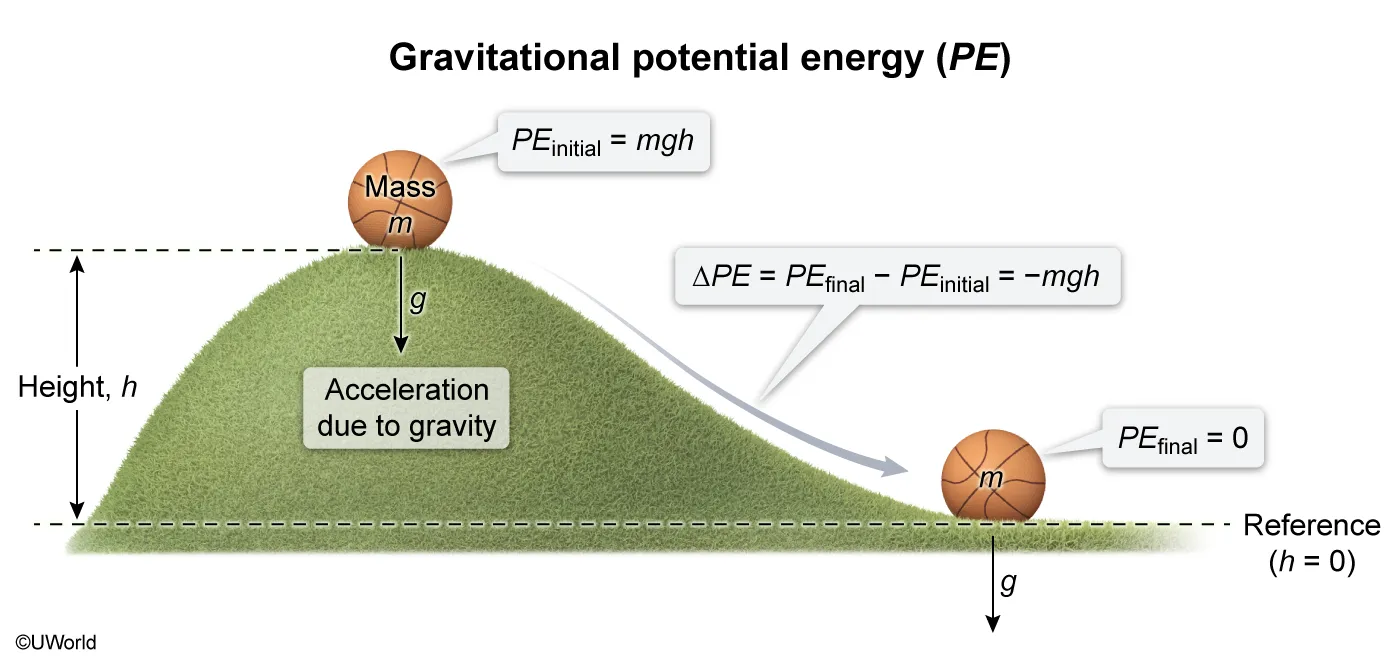
When a system is influenced only by conservative forces (eg, gravity), its total mechanical energy (E) is conserved. This means that the sum of its kinetic energy (KE) and gravitational potential energy (PE) remains constant at all points in time:
In this question, the pendulum bob of mass m is subject only to gravitational acceleration g, therefore its total energy is conserved. Initially, the bob is at rest (KE = 0) when released from height h. Consequently, its total energy at the start is equal to:
The bob reaches its maximum speed vmax at the bottom of its swing (h = 0), and therefore its total energy at the bottom is:
wheConservation of energy implies that:
Therefore, half the bob's maximum speed is equal to:
At vertical position hhalf, the bob has half its maximum speed and the total energy at this position is:
Applying conservation of energy yields:
Therefore, the magnitude of the bob's vertical displacement from initial position h to position hhalf is equal to .
(Choices A and C) and result from incorrectly obtaining an extra factor of or an extra factor of 2, respectively, in the conservation of energy equation.
(Choice D) is the bob's height above the lowest point when moving at half its maximum speed. Therefore, the magnitude of the bob's displacement from height h to height is equal to .
Things to remember:
The mechanical energy of a pendulum is a constant at any point throughout its motion. Conservation of energy can be used to calculate the speeds and heights of the pendulum bob at various positions.
Question
A block of mass m oscillates on a horizontal frictionless surface while it is attached to a spring with spring constant k. At the instant the block is passing through its equilibrium position, why is the block neither gaining nor losing kinetic energy?
| A. Because the acceleration of the block at that instant is zero | |
| B. Because the velocity of the block is maximized at that instant | |
| C. Because the block has no elastic potential energy at that instant | |
| D. Because the block begins a new oscillation period when it reaches the equilibrium position and has not begun to change its kinetic energy |
Explanation
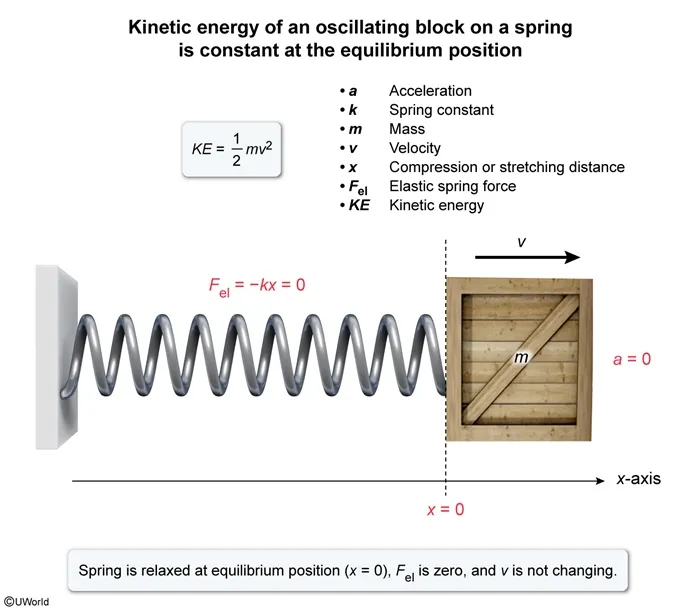
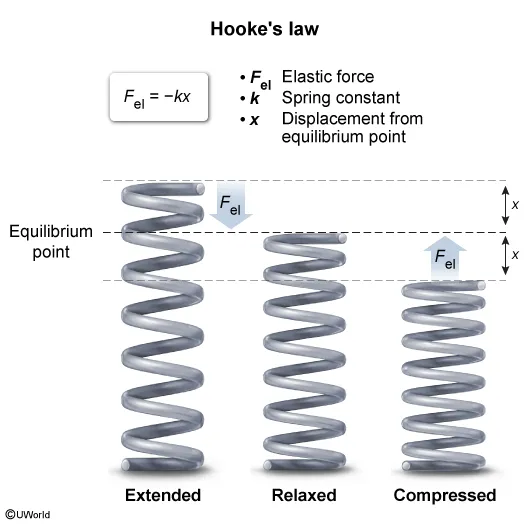
According to Hooke's law, the elastic spring force (Fel) is equal to the product of the spring constant (k) and the displacement (x) from the equilibrium point:
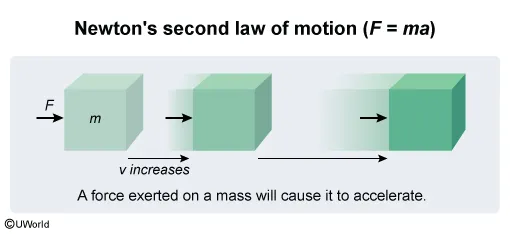
Hence, Newton's second law of motion implies the acceleration (a) of an object of mass (m) attached to the spring is:
In this question, a block of mass m is oscillating on a spring along a frictionless surface. When the block reaches the equilibrium position (x = 0), Hooke's law and Newton's second law imply Fel and the acceleration are zero at that point:
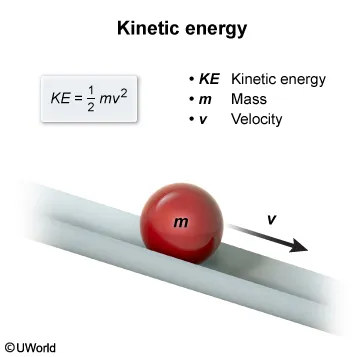
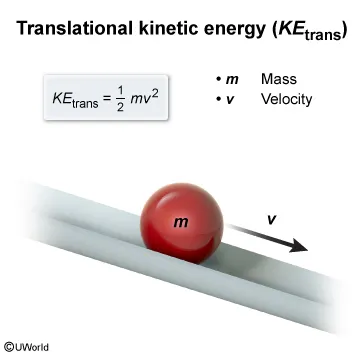
Furthermore, because the block is in translational motion with velocity v, it has translational kinetic energy (KE):
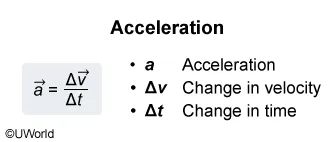
Because the acceleration is zero at the equilibrium position, the instantaneous change in velocity at that time is also zero. Therefore, at the instant the block is passing through the equilibrium position, its kinetic energy is also not changing, ie, the block neither gains nor loses kinetic energy (Choice A).
(Choice B) The velocity of the block is a maximum at the equilibrium position, but this does not explain why the block does not lose or gain kinetic energy.
(Choice C) The spring does have zero elastic potential energy (PEe) at equilibrium. However, the value of elastic potential energy is unrelated to the change in the block's kinetic energy at that instant.
(Choice D) The period of oscillation is unrelated to the change in kinetic energy at any time.
Things to remember:
The acceleration of an object on a spring depends on the object's displacement from equilibrium. At the instant the object passes through equilibrium, its acceleration is zero and its kinetic energy is unchanging.
Question
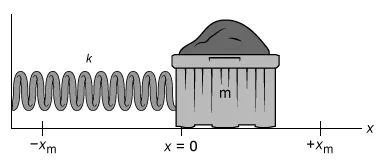
A container is filled with sand to an initial mass m and attached to a horizontal spring with spring constant k. The container is displaced a distance xm from equilibrium and released, allowing it to oscillate on a frictionless surface, as shown above. Each time the container reaches its maximum displacement on either side, a little bit of sand flies out of the container, reducing the mass. How does the maximum elastic potential energy of the container-spring system change, and why?>
| A. The maximum elastic potential energy of the system does not change, because the maximum displacement does not change. | |
| B. The maximum elastic potential energy of the system increases, because the container will move through equilibrium at a greater velocity. | |
| C. The maximum elastic potential energy of the system decreases, because the mass of the container decreases. | |
| D. The maximum elastic potential energy of the system cannot be determined without knowing the mass of the container. |
Explanation
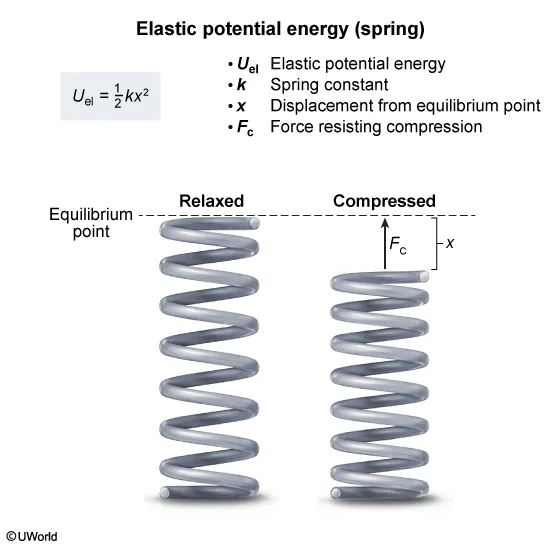
According to Hooke's law, the elastic spring force (Fel) is equal to the product of the spring constant (k) and the displacement (x) from the equilibrium point:
As the elastic force does work on the object, an elastic potential energy Uel, which is equal to half the product of k and the square of the displacement, is stored in the object-spring system:
The maximum elastic potential energy of a object-spring system occurs when the object is at its maximum displacement from equilibrium.
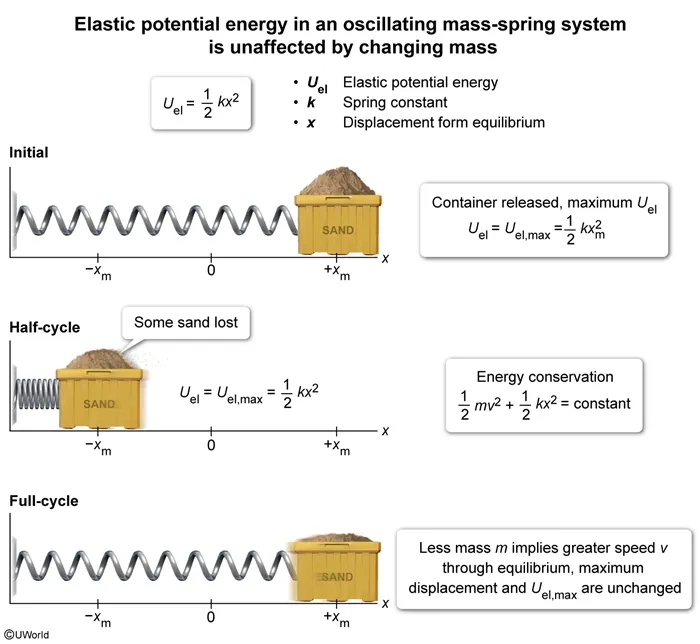
In this question, the container-spring system has maximum elastic potential energy and zero kinetic energy (KE) when the container is released at displacement xm. As the container oscillates, conservation of energy implies the sum of KE and Uel is constant:
As the system loses elastic potential energy, it gains an equal amount of kinetic energy. When the container reaches displacement −xm, Uel is again a maximum and KE is zero. At this location, some sand is lost and the mass of the container decreases. However, there is no change to the maximum elastic potential energy Uel,max:
Although the container's mass decreases, conservation of energy implies that the velocity of the container increases as it passes back through equilibrium. Therefore, at each cycle of the container's motion, the maximum velocity becomes greater but Uel,max is unchanged because the maximum displacement does not change.
(Choice B) The container moves through equilibrium with a greater velocity because the container's mass has decreased. However, the maximum KE and maximum Uel are the same.
(Choices C and D) The mass of the container decreases, but the maximum Uel of the system does not depend on the mass.
Things to remember:
The maximum elastic potential energy of an object-spring system depends on the maximum displacement of the object from equilibrium. Changes to the object's mass do not affect the maximum elastic potential energy.

Study Anywhere, Anytime
Prep for AP Physics 1 Unit 7 wherever you are: knock out oscillations practice tests on the bus, watch quick Unit 7 AP Physics 1 videos between classes, or flip through study guides while you’re waiting for friends. From progress check FRQs to simple harmonic motion tips, everything you need for AP Physics 1 Unit 7 is always ready to go with the UWorld app.
Stand Out
with a Top Score in AP Physics 1
Finish your AP Physics 1 Unit 7 review and continue mastering all units with UWorld. Boost your performance and make yourself a standout candidate for competitive colleges, majors, and scholarships by mastering your AP Physics 1 course and scoring a 5 on the exam.
Get our all-in-one course today!
- Focused AP Physics 1 Review Videos
- Print & Online AP Physics 1 Study Guide
- 450+ Physics 1 Exam-style Practice Questions
- Customizable Quiz Generator
- Adjustable Study Planner
- Realistic AP Physics 1 Exam Review
- Timed Test Simulation
- Progress Dashboard
- Smart Flashcards
- Digital Notebook
Hear From Our AP Students
UWorld’s service is pretty good and helps provide a lot of explanations on subjects I haven’t been confident on before.
The questions here are the most realistic to the AP tests I've seen so far! I appreciate the ability to customize tests as well.
The best part is that all options are well-explained, telling clearly why they are not the right option.

Frequently Asked Questions (FAQs)
What are the main topics covered in AP Physics 1 Unit 7: Oscillations?
AP Physics 1 Unit 7 focuses on oscillations, starting with the basics of simple harmonic motion (SHM) and what makes an object move back and forth in a repeating cycle. You’ll also learn how to measure motion using frequency and period, two key ideas that describe how fast something oscillates.
- Defining simple harmonic motion (SHM): Understanding restoring forces and repetitive motion.
- Frequency and period of SHM: Measuring how fast an object oscillates.
- Representing and analyzing SHM: Using graphs, equations, and models.
- Energy of simple harmonic oscillators: Exploring kinetic and potential energy changes.
If you want clearer explanations and practice that actually feels like the real test, UWorld’s AP Physics 1 Unit 7 tools make oscillations way easier to learn.
How should I prepare for an AP Physics 1 Unit 7 exam?
A solid AP Physics 1 Unit 7 exam prep routine starts with reading a clear study guide. Focus on oscillations, simple harmonic motion, and the progress check FRQs so you understand the core ideas before jumping into problems.
Next, watch short, focused video lessons that break down Unit 7 concepts visually. Seeing oscillations, graphs, and equations in action makes the tricky parts feel way simpler and easier to remember.
Finally, practice with exam-style Unit 7 questions, including MCQs and FRQs. UWorld’s study guides, video lessons, and realistic oscillations practice tests give you everything you need to prep smarter and score higher.
Are any free resources available for AP Physics 1 Unit 7?
You can start your AP Physics 1 Unit 7 prep with UWorld’s free trial, which gives you access to oscillations practice questions, progress check FRQs, and sample video lessons. It’s the easiest way to see what high-quality prep actually feels like.
You can also check out the College Board’s free AP Classroom materials. Their Unit 7 progress check MCQs and FRQs give you an idea of the exam style, though explanations may feel limited.
If you want extra review videos, Khan Academy offers free oscillations tutorials. But for the most realistic practice and breakdowns that actually make sense, UWorld is your best go-to.
What types of questions are on the AP Physics 1 Unit 7 test?
On the AP Physics 1 Unit 7 test, you’ll see two main types of questions that check how well you understand oscillations, simple harmonic motion, and energy in oscillators.
- Multiple-choice questions (MCQs): These test your ability to analyze graphs, interpret motion, and apply SHM(Simple Harmonic Motion) equations in different scenarios. Expect both single questions and short sets tied to a situation.
- Free-response questions (FRQs): These require written explanations, calculations, and justification of your reasoning as you break down oscillations and Unit 7 concepts in detail.
If you want practice that feels exactly like the real exam, UWorld’s Unit 7 AP Physics 1 questions come with step-by-step explanations that help you learn faster and score higher.
How can I improve my score on the Free-Response Questions (FRQs) for Unit 7?
Improving your AP Physics 1 Unit 7 FRQ score starts with learning how to break problems into smaller, easy-to-manage steps. Focus on understanding oscillations, SHM graphs, and energy changes so you can explain your reasoning clearly instead of guessing.
Next, practice writing out full solutions the way the exam expects, label your diagrams, show every calculation, and connect each idea back to the physics behind the motion. Clear, logical explanations earn big points, even if the math gets tricky.
The best way to build confidence is repeated FRQ practice. UWorld’s AP Physics 1 Unit 7 FRQs come with detailed, student-friendly explanations that show you exactly how top scorers think.
What is the "Oscillations" unit's weight on the AP Physics 1 exam?
The Oscillations unit in AP Physics 1 typically makes up about 5–8% of the total exam. That may seem small, but Unit 7 concepts show up in both MCQs and FRQs, so a solid understanding can still boost your score.
This unit covers simple harmonic motion, energy in oscillators, and analyzing motion using graphs and equations—topics the exam loves to test through reasoning and explanation-based questions. Even a few secure points here can make a meaningful difference.
To feel confident with that 5–8% slice, UWorld’s AP Physics 1 Unit 7 practice questions and explanations walk you through every oscillation concept step-by-step.
Where can I find a good study guide for AP Physics 1 Unit 7?
A reliable study guide for AP Physics 1 Unit 7 should break down oscillations and simple harmonic motion in a way that actually makes sense, and UWorld delivers exactly that. Their Unit 7 study guide explains every concept clearly, using visuals, examples, and step-by-step breakdowns to help you understand the motion, graphs, and energy changes behind SHM.
What makes UWorld especially helpful is how organized everything is. Each section connects directly to the types of MCQs and FRQs you’ll see on the exam, so you know you’re studying the right material. The guide also pairs perfectly with their videos and practice questions.
If you want a study guide that feels easy to follow and truly prepares you for the test, UWorld’s AP Physics 1 Unit 7 resources are your best bet.
Can I find practice tests specifically for AP Physics 1 Unit 7?
Yes, you can find practice tests that focus specifically on AP Physics 1 Unit 7 and the oscillations topics covered in this unit. These targeted sets help you build confidence with simple harmonic motion, energy in oscillators, and interpreting SHM graphs.
Unit-specific practice is especially helpful because it lets you focus on the exact types of MCQs and FRQs you’ll see in the Unit 7 progress checks and on the exam. Working through these questions shows you patterns and boosts your speed and accuracy.
UWorld offers dedicated AP Physics 1 Unit 7 practice tests with detailed explanations that make every concept easier to understand, helping you prep smarter and score higher.
How hard is AP Physics 1 Unit 7 compared to other units?
AP Physics 1 Unit 7 can feel challenging at first because oscillations and simple harmonic motion introduce new vocabulary and graphs you might not be used to. But once you understand how motion repeats and how forces create SHM, the concepts start to click fast.
Compared to units like momentum or torque, Unit 7 is more about patterns, equations, energy changes, and interpreting motion visually. If you’re comfortable reading graphs and identifying relationships, this section becomes much easier.For extra support, UWorld’s AP Physics 1 Unit 7 review breaks everything down with clear examples and practice questions that help you get comfortable with oscillations quickly.
What’s the best way to review oscillations right before the AP Physics 1 exam?
The best last-minute strategy for AP Physics 1 Unit 7 is to focus on high-impact ideas: simple harmonic motion, energy in oscillators, and interpreting SHM(Simple Harmonic Motion) graphs. Reviewing these essentials helps you score points even if you’re short on time.
Next, go through a few Unit 7 progress check MCQs and FRQs to refresh your problem-solving flow. Identify which steps you tend to skip and tighten up your reasoning so your answers stay clean and complete on exam day.
If you want fast, effective review, UWorld’s AP Physics 1 Unit 7 practice tests and explanations help you lock in oscillations concepts without cramming or stressing out.