AP® Physics 1 Unit 6 Review and Practice Test
AP® Physics 1 Unit 6 brings together work, energy, power, and the conservation principles that connect motions across different situations. These ideas form the backbone of many exam problems. With UWorld, you learn how energy transforms, how to analyze systems, and how to apply formulas confidently. Our tools help you move through your AP Physics 1 Unit 6 review with stronger intuition, clearer reasoning, and better exam readiness.
Boost Your Score with Our AP Physics 1 Unit 6 Review
Understanding Unit 6 becomes easier when each resource supports the next. Short videos lay the foundation, interactive guides deepen your knowledge, and structured explanations help you learn how to apply work and energy concepts from AP Physics 1 with confidence. Everything works together to strengthen your AP Physics 1 Unit 6 review.
Understand Work and Energy with Easy, Guided Videos
These short, visual lessons simplify complex ideas like work, kinetic energy, gravitational potential energy, and conservation of energy AP Physics 1 relationships. You see how energy transforms within a system and how to calculate work done by different forces. Each clip helps you understand the logic behind AP Physics 1 Unit 6 MCQ items and prepares you to recognize patterns in real exam questions.
Break Down Work and Energy with Interactive Study Guide
This study guide organizes work and energy concepts from AP Physics 1 into clear, structured explanations supported by visuals and checkpoints. You learn how to analyze systems, calculate work, interpret energy diagrams, and apply the conservation of energy AP Physics 1 rules. It also prepares you for AP Physics 1 Unit 6 FRQ tasks, where you must explain reasoning clearly. Everything builds a deeper understanding.
Build Exam Confidence with AP Physics 1 Unit 6 Practice Test Problems
Question
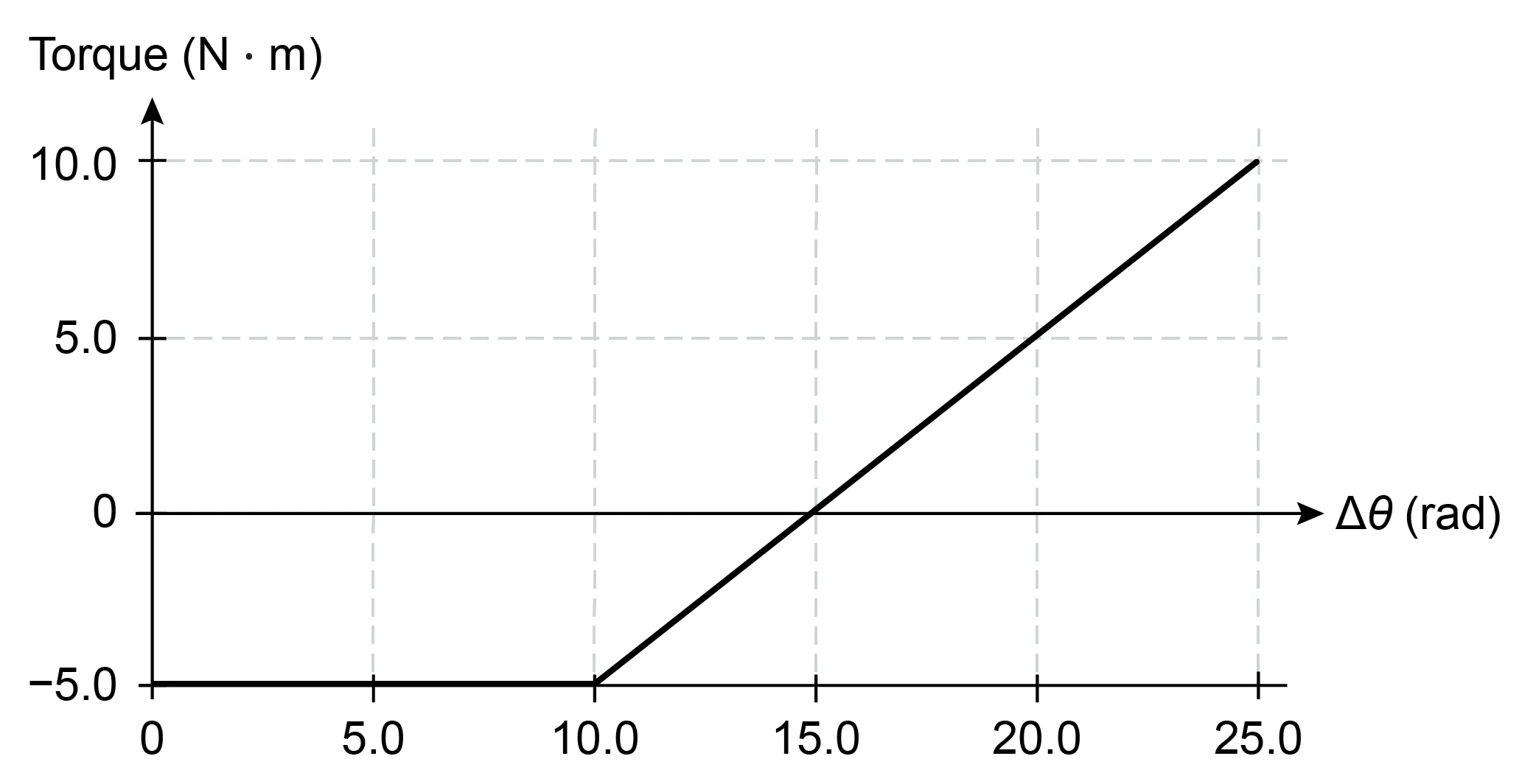
The figure above shows the torque applied on an object as a function of its angular displacement. What is the net work done by the torque on the object after an angular displacement of 25.0 rad?
| A. −12.5 J | |
| B. 0 J | |
| C. 50 J | |
| D. 112.5 J |
Explanation
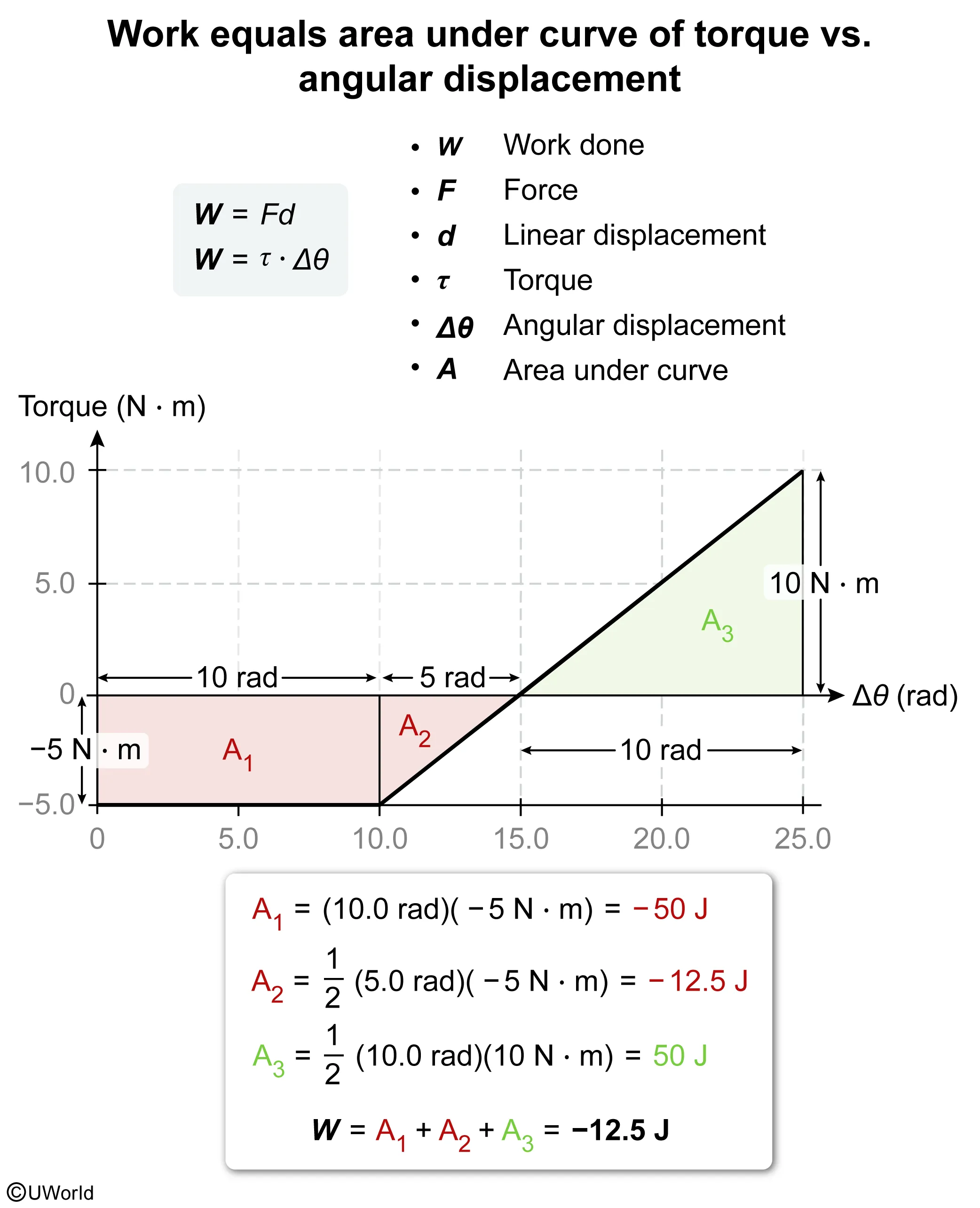
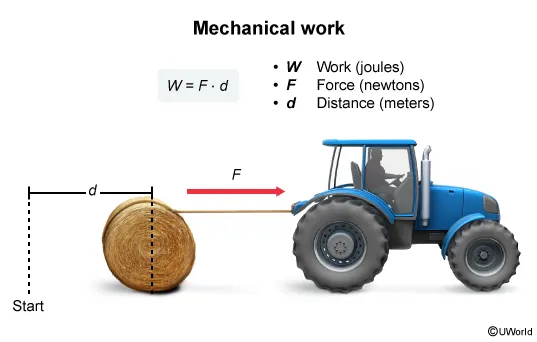
The work done by a constant force F that is exerted parallel to the direction of an object's displacement equals the product of F and the magnitude of the linear displacement d:
In this question, the torque exerted on an object is graphed as a function of the object's angular displacement . The relationship between linear and angular displacement mplies that work is the product of torque and :
Furthermore, the area under the curve with respect to the horizontal axis represents the work done on the object. The graph can be broken into three distinct areas, a rectangle and two triangles, respectively. The areas below the horizontal axis show negative work while the area above show positive work. Calculating the area of each region yields:
Therefore, the net work done by the torque exerted on the object through an angular displacement of 25.0 rad is calculated by taking the sum of all three areas:
(Choices B and C) 0 J and 50 J follow from incorrectly calculating the area under the curve.
(Choice D) This answer choice incorrectly sums the areas under the curve, mistaking all regions to be positive work done on the object.
Things to remember:
The work done by a variable torque can be calculated by finding the area under the curve when it is graphed as a function of angular displacement.
Question
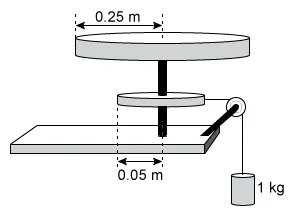
A rotational system consists of a large disk of radius 0.25 m and a small disk of radius 0.05 m that will rotate together, as shown above. A long string is wound around the small disk. A cylinder with mass of 1 kg is attached to the end of the string and hangs over a pulley. The string exerts a force equal to the weight of the cylinder along the edge of the small disk. A student releases the cylinder, which falls for 1 s. What is the change in angular momentum of the two-disk system?
| A. 0.5 N∙m∙s | |
| B. 2.5 N∙m∙s | |
| C. 10 N∙m∙s | |
| D. The change in angular momentum cannot be determined without knowing the masses of the disks. |
Explanation
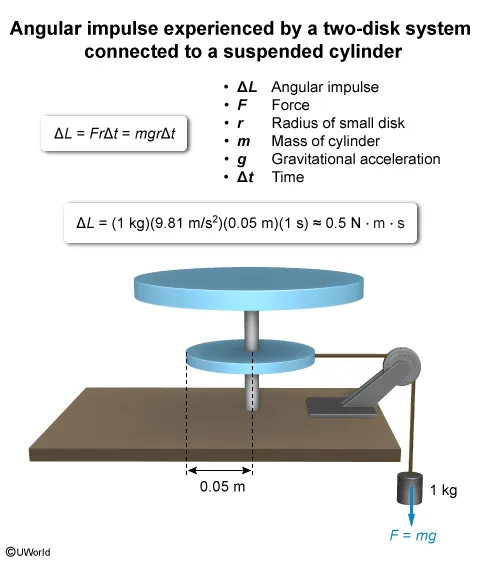
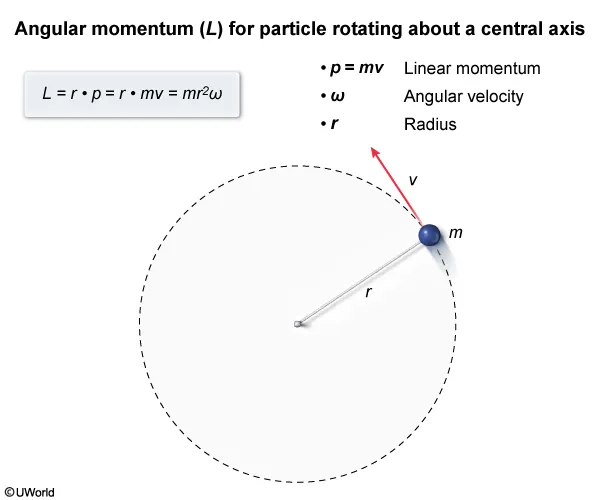
Angular momentum (L) of a rotating object is the product of its radius of rotation r and linear momentum P:
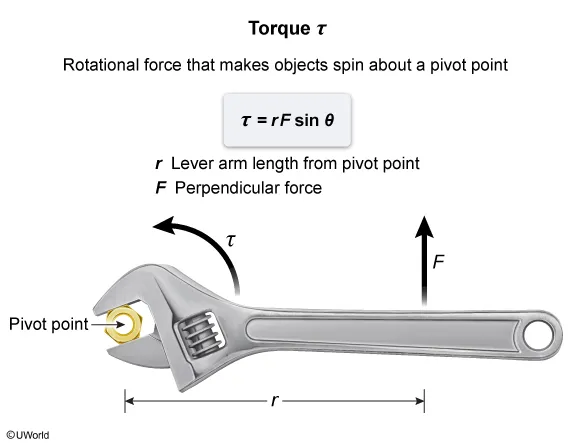
Torque is needed to produce rotation and is the product of the applied force F, the distance r from the force to the axis of rotation, and the sine of the angle θ between the force and radius vectors:
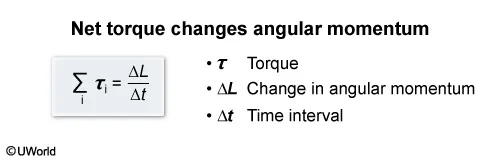
Newton's second law of motion implies that a torque exerted on an object over a time interval Δt changes the object's angular momentum. The angular impulse, defined as the change in the object's angular momentum ΔL, is the product of and Δt:
Hence, plugging in the expression for torque yields:
In this question, the force of gravity mg (ie, weight) on the cylinder equals the force exerted by the string on the smaller disk. The force acts perpendicular to the radius of the smaller disk (ie, sin θ = 1) and causes it to rotate. Because the disks rotate together, an angular impulse is applied to the two-disk system. Substituting mg for the force F in the equation above gives:
For m = 1 kg, r = 0.05 m, and Δt = 1 s, it follows that:
(Choice B) 2.5 N∙m∙s results from using the radius of the large wheel instead of the radius of the smaller wheel.
(Choice C) 10 N∙m∙s results from not including the radius in the equation for angular impulse.
(Choice D)&nbs The ΔL of the two-disk system equals the product of torque exerted and the radius of the small disk; it is independent of the masses of the disks.
Things to remember:
Angular impulse is the product of torque and time and is equal to the change in the object's angular momentum.
Question
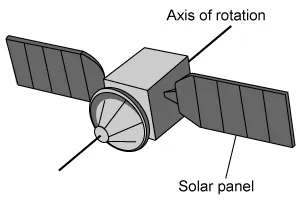
A communications satellite in orbit around Earth spins about a central axis with a known angular speed, as shown above. The satellite has two solar panels that can fold toward or unfold away from the body of the satellite. When the panels are folded toward the body of the satellite, the angular speed increases from 2 rad/s to 4 rad/s. Which of the following could account for the increase in the satellite's angular speed?
| A. Folding the panels exerts a positive net torque that increased the rotational inertia of the satellite. | |
| B. Folding the panels exerts a positive net torque that decreased the rotational inertia of the satellite. | |
| C. The rotational inertia of the satellite decreased in the absence of a net torque. | |
| D. The angular momentum of the satellite increased as a result of the folding panels. |
Explanation
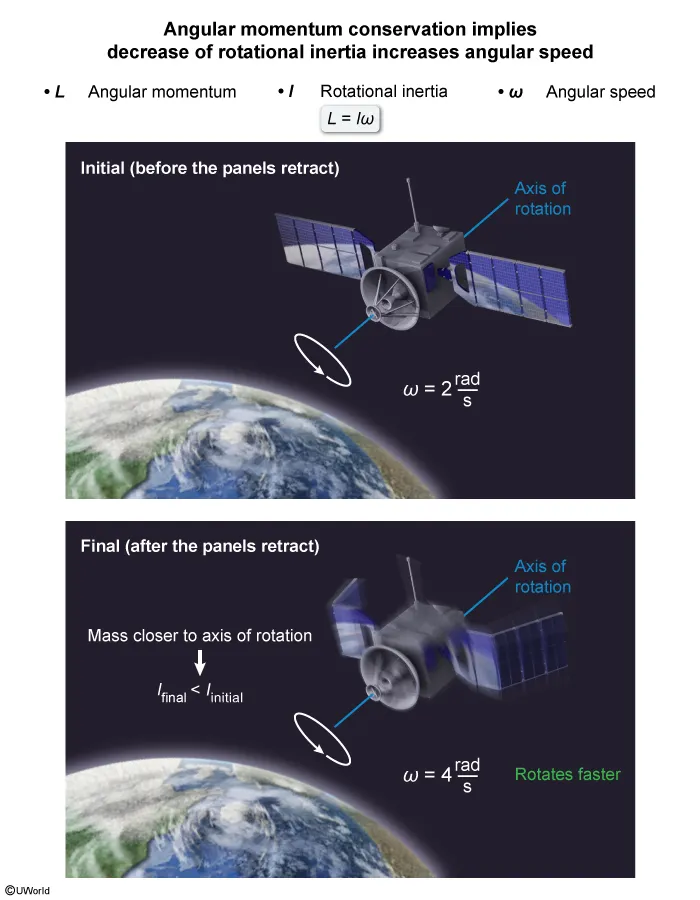
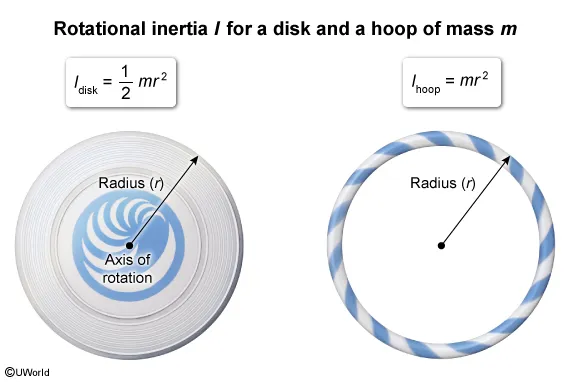
Rotational inertia (I) measures the resistance of an object to changes in its rotation. It is proportional to the object's mass (m) multiplied by the square of the radial distance r from the axis of rotation:
The angular momentum (L) of a rotating object is the product of its rotational inertia and angular speed (ω):
According to Newton's second law of motion, a net external torque exerted on a system changes the angular momentum of the system. Conservation of angular momentum implies that the angular momentum at an initial time Li is equal to the angular momentum at a final time Lf when the net external torque is zero:
In this question, angular momentum is conserved because the folding of the solar panels exerts zero external torque on the satellite. However, folding the solar panels inward moves some of the satellite's mass closer to the axis of rotation, decreasing both r and I:
Because the satellite's angular momentum is conserved, the decrease in rotational inertia must be compensated by an increase in angular speed (ie, the satellite begins rotating faster):
Therefore, the increase in the satellite's angular speed accounts for the decrease in rotational inertia in the absence of net external torque.
(Choices A and B) Folding the panels will not exert a net external torque on the satellite. Regardless, torque cannot increase or decrease rotational inertia because rotational inertia is a property of the system.
(Choice D) No net external torque is exerted on the satellite during the folding of the panels. Therefore, angular momentum is conserved and does not increase.
Things to remember:
The angular momentum of a rotating object is conserved when the net external torque on the object is zero. When angular momentum is conserved, changes in rotational inertia cause changes in angular speed.

Make Every Minute Count with the UWorld App
Use spare moments throughout your day to review work and energy concepts, solve AP Physics 1 energy practice problems, or revisit explanations. The UWorld app keeps everything at your fingertips so you can continue building confidence for AP Physics 1 Unit 6 review.
Stand Out
with a Top Score in AP Physics 1
Finish your AP Physics 1 Unit 6 review and continue mastering all units with UWorld. Boost your performance and make yourself a standout candidate for competitive colleges, majors, and scholarships by mastering your AP Physics 1 course and scoring a 5 on the exam.
Get our all-in-one course today!
- Focused AP Physics 1 Review Videos
- Print & Online AP Physics 1 Study Guide
- 450+ Physics 1 Exam-style Practice Questions
- Customizable Quiz Generator
- Adjustable Study Planner
- Realistic AP Physics 1 Exam Review
- Timed Test Simulation
- Progress Dashboard
- Smart Flashcards
- Digital Notebook
Hear From Our AP Students
UWorld’s service is pretty good and helps provide a lot of explanations on subjects I haven’t been confident on before.
The questions here are the most realistic to the AP tests I've seen so far! I appreciate the ability to customize tests as well.
The best part is that all options are well-explained, telling clearly why they are not the right option.

Frequently Asked Questions (FAQs)
What are the main topics covered in AP Physics 1 Unit 6: Energy and Momentum of Rotating Systems?
AP Physics 1 Unit 6 focuses on understanding how work, energy, and power describe the motion of objects and how energy transforms within a system. This unit provides the foundation for solving problems involving conservation of energy and its applications. Many later topics build on these ideas, and developing a strong intuition here helps you across the entire course. Using guided explanations, such as those in UWorld, strengthens your reasoning and helps you connect equations to real physical situations.
Core Unit 6 topics include:
- Rotational kinetic energy
- Torque and work
- Angular momentum and angular impulse
- Conservation of angular momentum
- Rolling
- Motion of orbiting satellites
When you see how these ideas connect, solving AP Physics 1 energy practice problems becomes easier and more predictable. Instead of attempting to memorize equations in isolation, you begin to understand why energy changes in a system and how forces contribute to that change. This approach helps you prepare for AP Physics 1 Unit 6 MCQs and FRQs that require clear reasoning rather than long calculations. With steady practice, Unit 6 becomes one of the most intuitive parts of the course.
How should I prepare for an AP Physics 1 Unit 6 exam?
Studying for Unit 6 requires equal focus on conceptual understanding and problem-solving. Work and energy topics often challenge students because they involve abstract concepts such as energy transformation, conservative forces, and system analysis. The best way to prepare is to start with clarity on basic definitions and then apply those ideas repeatedly in different scenarios. A structured tool like UWorld helps because it explains why energy changes the way it does and shows how to connect concepts in AP Physics 1 energy problems.
A strong study strategy includes:
- Reviewing definitions of work, mechanical energy, and power
- Practicing drawing system diagrams to identify energy transfers
- Using conservation of energy AP Physics 1 equations to analyze systems
- Comparing how friction, springs, and gravity affect motion
- Solving a mix of conceptual and numerical AP Physics 1 Unit 6 Practice Problems
- Reviewing explanations to understand mistakes and refine the approach
Once you combine concept clarity with consistent practice, Unit 6 becomes much more manageable. You start recognizing patterns such as when energy is conserved, when nonconservative forces do work, and why power increases with greater force or velocity. These insights help you approach the AP Physics 1 exam confidently.
Are any free resources available for AP Physics 1 Unit 6?
Yes, several helpful free resources are available for AP Physics 1 Unit 6, and the most complete starting point is UWorld’s free 7-day trial. The trial provides you with full access to guided videos, interactive study guides, and realistic AP Physics 1 practice problems, including work and energy exercises. This is especially useful because Unit 6 concepts often feel abstract without a clear explanation. Beyond UWorld, many students also utilize free online tools, including physics simulation websites, formula sheets, short video walkthroughs, and textbook sample problems. These resources can help you visualize energy transfers, understand the difference between conservative and nonconservative forces, and see how system diagrams connect to equations.
The College Board’s AP Classroom also offers topic questions and progress check items that align with classroom instruction. While these free materials build helpful background knowledge, they rarely provide the step-by-step reasoning needed to master the unit. That is why many students combine them with UWorld’s explanations, which show both the correct approach and the logic behind eliminating incorrect answers. This combination provides the strongest foundation for success in Unit 6.
What types of questions are on the AP Physics 1 Unit 6 test?
The AP Physics 1 Unit 6 test includes a mix of multiple-choice questions, conceptual reasoning tasks, and free-response questions. These questions assess your understanding of energy transformations, work energy relationships, and how forces affect a system’s energy. To do well, you must connect diagrams, equations, and reasoning. A structured practice resource like UWorld helps you strengthen this connection by showing how energy changes and why certain choices in AP Physics 1 Unit 6 MCQ questions are correct or incorrect.
You can expect to see:
- Multiple choice questions involving work done by forces, energy bar charts, and conservation of energy
- Conceptual items asking how friction, springs, or gravity change system energy
- Numerical problems where you calculate work, kinetic energy, or potential energy
- Rotational kinetic energy tasks connecting Unit 6 to earlier rotation lessons
- FRQs that require diagrams, explanations, and step-by-step reasoning
When you understand how these question types work, the unit becomes far easier to handle. You begin to recognize what each problem is truly asking: what energy changes occur, which forces do work, and whether mechanical energy is conserved. With explanation-driven practice, you walk into the exam with stronger intuition and confidence.
How can I improve my score on the Free-Response Questions (FRQs) for Unit 6?
Improving your score on Unit 6 FRQs requires clear explanations, accurate diagrams, and a strong understanding of energy relationships. FRQs often ask you to identify energy transfers, justify the use of conservation of energy, or calculate work done by specific forces. Many students lose points because they rely only on equations without explaining the underlying physics. A guided approach, such as practicing with UWorld’s explanations, helps you learn how to communicate your reasoning for AP Physics 1 Unit 6 FRQ tasks.
A strong FRQ strategy includes:
- Starting with a clean system diagram showing forces, directions, and reference levels
- Identifying when mechanical energy is conserved and when external work is involved
- Explaining verbally how each term in your equation connects to the scenario
- Checking units and reasoning, not just calculations
- Practicing short, timed responses to build clarity and confidence
Over time, these habits help you produce FRQ answers that are both accurate and well supported. You learn how to justify steps, interpret energy diagrams, and describe why energy increases or decreases. This combination of explanation and calculation strengthens your performance on the exam.
What is the "Energy and Momentum of Rotating Systems" unit's weight on the AP Physics 1 exam?
Unit 6 accounts for 5-8% of the weight on the AP Physics 1 exam because work, energy, and power form the backbone of many problem types throughout the test. Although the exact percentage varies from year to year, energy concepts appear frequently in both multiple-choice and free-response sections. Many questions utilize conservation of energy or work-energy principles, even when they appear to focus on other units, such as circular motion, rotation, or momentum.
Energy connects so many parts of the course; a strong understanding of Unit 6 boosts your performance well beyond this single unit. You can expect several AP Physics 1 Unit 6 MCQ questions involving energy bar charts, work calculations, or energy transfer in springs and gravitational fields. FRQs commonly include tasks that ask you to justify energy conservation or explain how forces influence system energy. Using clear, explanation-driven practice tools like UWorld helps you recognize the patterns behind these questions, improving your reasoning and reducing guesswork. When you understand how energy flows through a system, you can handle a wide range of exam topics more confidently. This makes Unit 6 one of the most valuable areas to master for exam success.
Where can I find a good study guide for AP Physics 1 Unit 6?
A strong AP Physics 1 Unit 6 study guide should help you understand work, energy, power, and how these quantities change in different systems. The best guides organize concepts clearly and use visuals to show how energy transforms. You want a resource that explains when mechanical energy is conserved, when external work is involved, and how to connect force diagrams to energy equations. UWorld provides interactive, structured study guides that support this type of learning by breaking down each idea into manageable steps.
A high-quality Unit 6 study guide should include:
- Clear explanations of work, kinetic energy, potential energy, and mechanical energy
- Visuals showing energy bar charts, system boundaries, and energy flow
- Conservation of energy examples using springs, gravity, and external work
- Step-by-step practice problems with structured reasoning
- Diagrams that connect forces and motion to energy changes
- Concept checks to reinforce understanding as you learn
When your study guide emphasizes understanding instead of memorization, the entire unit becomes easier to navigate. You start seeing patterns, such as how friction removes mechanical energy or how gravitational potential energy changes with height. These insights help you tackle AP Physics 1 Unit 6 MCQ items and FRQ prompts, and practice tests with more confidence. A strong study guide gives you the foundation to solve problems accurately and explain your reasoning clearly.
Can I find practice tests specifically for AP Physics 1 Unit 6?
Yes, there are targeted practice tests designed specifically for AP Physics 1 Unit 6, and using them helps you build confidence with concepts related to work and energy. These practice tests train you to recognize patterns, such as when to apply the work-energy theorem, when mechanical energy is conserved, and how non-conservative forces affect a system. They also help you pace your problem-solving and improve your accuracy on AP Physics 1 Unit 6 MCQ and FRQ questions. UWorld offers practice problems that mirror exam-style questions and include detailed explanations for each answer.
Strong Unit 6 practice tests should include:
- Multiple choice questions involving energy bar charts and force diagrams
- Problems requiring conservation of energy calculations
- Tasks comparing systems with and without nonconservative forces
- Rotational kinetic energy questions connecting Units 5 and 6
- FRQ-style reasoning problems about energy changes and work done
- Explanations that show why incorrect options fail
As you work through these questions, you will begin to recognize how energy principles apply across different scenarios. You learn when it is more efficient to use conservation of energy instead of kinematics, and how to interpret what the problem is asking. Building these skills prepares you not only for Unit 6 assessments but also for later units where energy and momentum concepts combine.
How can I prepare for the AP Physics 1 Unit 6 progress check in AP Classroom?
Preparing for the Unit 6 progress check in AP Classroom requires a solid understanding of work, energy, and power concepts, along with strong critical thinking and reasoning skills. Progress checks focus heavily on conceptual questions that test your ability to identify whether mechanical energy is conserved, determine the work done by forces, and analyze energy transformations within a system.
To prepare, begin by reviewing visuals such as energy bar charts and system diagrams that clarify which quantities change. Then practice AP-style multiple-choice questions that mirror the format used in AP Classroom. UWorld offers a check for understanding experience that matches this structure, providing questions that simulate the logic and difficulty level of the official progress checks. The explanations help you see why one answer is correct and how to rule out distractors, which is essential for scoring well.
After finishing a practice set, spend time reviewing the reasoning behind any mistakes so you can strengthen weak areas before taking the progress check. This approach helps you build confidence, improve accuracy, and feel more prepared for classroom assessments and the AP exam.
How do I stay organized while studying AP Physics 1 Unit 6: Work and Energy?
Staying organized is essential when studying Unit 6 because work and energy concepts connect to many parts of the course. Without structure, it is easy to mix up when energy is conserved, how nonconservative forces affect a system, or which formulas apply to which situations. Breaking the unit into smaller, clear ideas helps you avoid that confusion. Using guided explanations from a tool like UWorld supports this structure because each question reinforces the logic behind energy transformation.
Effective organization strategies include
- Dividing Unit 6 into topics such as work, kinetic energy, potential energy, and conservation
- Keeping a system diagram notebook to visualize energy flow
- Color-coding notes to separate conservative and nonconservative forces
- Creating summary sheets of key equations and when they apply
- Ending each study session with a small set of AP Physics 1 energy practice problems
- Tracking progress to identify weak areas
Once you develop these habits, Unit 6 becomes much easier to understand. You begin to see how energy changes in predictable ways and recognize which approach fits each type of problem. Staying organized also helps you build confidence for the AP Physics 1 Unit 6 because you always know exactly what you reviewed and what you still need to strengthen.
How can I study effectively for AP Physics 1 Unit 6 MCQs?
Preparing for AP Physics 1 Unit 6 MCQs requires strong conceptual understanding and the ability to interpret energy relationships quickly. Most of the multiple-choice questions in this unit test whether you understand how energy transforms in a system, when mechanical energy is conserved, and how forces influence work. To perform well, you need to move beyond memorizing formulas and focus instead on recognizing patterns that appear repeatedly across AP Physics 1 Unit 6 MCQ problems. Using a practice resource like UWorld strengthens this skill because each explanation demonstrates how to interpret the scenario and why the correct answer aligns with the physical situation.
A strong MCQ strategy includes:
- Reviewing core ideas such as work, kinetic energy, potential energy, and power
- Studying energy bar charts and system diagrams to understand energy flow
- Practicing MCQs that mix conceptual and numerical reasoning
- Looking for relationships rather than plugging into equations immediately
- Eliminating choices by identifying incorrect assumptions or impossible outcomes
- Revisiting missed questions to understand exactly where your reasoning slipped
As you build these habits, MCQs become much easier to approach. You learn to recognize whether a scenario involves conservation of energy or external work, which quickly narrows down the correct solution path. Over time, you begin predicting how the system should behave before calculating anything, a sign of strong conceptual mastery. With consistent, explanation-focused practice, you develop the speed, clarity, and accuracy needed to perform well on the AP exam.
Can I study AP Physics 1 Unit 6 offline if I need to?
Yes, you can study AP Physics 1 Unit 6 offline, which is especially useful when you want to review on the go or when internet access is limited. Offline study works well for this unit because many work and energy problems can be solved with diagrams, scratch paper, and structured practice sets. UWorld allows you to download question sets through the app, enabling you to work through AP Physics 1 energy practice problems, review explanations, and revisit complex topics without needing an internet connection.
This flexibility allows you to study during commutes, school breaks, or other brief moments throughout the day. Offline access is valuable because it maintains your progress and prevents learning gaps. When you reconnect, the app automatically syncs your work, keeping your performance data up to date. You can also pair downloaded questions with printed formula sheets or your own summaries to reinforce understanding. Having the ability to study offline helps you stay consistent, build long-term retention, and approach your AP exam with confidence.