AP® Physics 1 Unit 1 Review and Practice Test: Kinematics
Master displacement, velocity, acceleration, and how to solve AP® Physics 1 kinematics equations and problems with precision. A deep understanding of AP Physics 1, Unit 1, is essential for success in later topics, such as dynamics and energy. Whether you’re working through kinematics AP Physics 1 practice problems or gearing up for the exam, UWorld’s AP Physics 1 Unit 1 review delivers exam-level mastery through engaging videos, interactive guides, and AP Physics 1 Unit 1 practice problems with detailed solutions.
Achieve Exam-Readiness with UWorld’s AP Physics 1 Unit 1 Review
Grasping AP Physics 1 kinematics early prevents significant gaps in understanding mechanics. Our platform helps you interpret motion graphs, apply kinematic equations in AP Physics 1, and visualize acceleration patterns, enabling you to excel in every AP Physics Unit 1 practice test and FRQ.
Learn Through Dynamic Video Lessons
UWorld’s AP Physics 1 kinematics video lessons make complex ideas simple through visuals and real-world examples. Each clip links intuition to calculation, preparing you for AP Physics 1 Unit 1 MCQ and FRQ questions similar to those on the exam. Connect theory with actual AP exam-style questions to strengthen conceptual understanding and problem-solving speed.
Study Smarter with Interactive Physics Guides
Our AP Physics Unit 1 study guide breaks down each concept visually and step-by-step, making complex problems simple to understand. You’ll learn vector decomposition, slope interpretation, and time-displacement reasoning for the AP Physics 1 Unit 1 review PDF or pre-test revision. It’s the fastest way to reinforce logic before your AP Physics 1 Unit 1 test.
Sharpen Your Skills with Realistic Practice Tests
Question
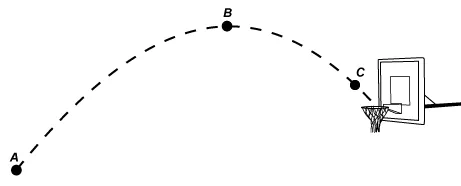
Which of the following statements is true about the speed of the projectile shown at points A, B, and C?
| A. | |
| B. | |
| C. | |
| D. |
Explanation
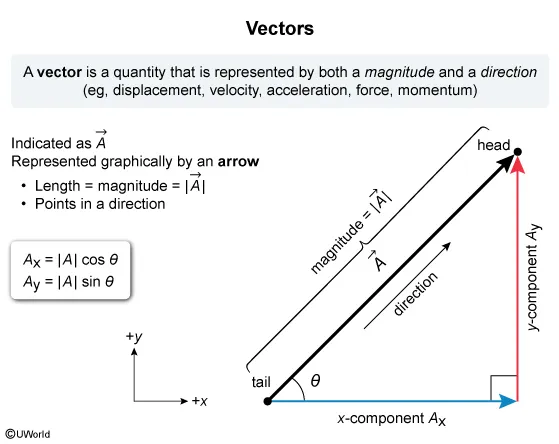
The velocity vector of the ball has both horizontal and vertical components. The horizontal component vx is constant due to zero net force in the x-direction. The vertical component vy changes at a rate of −g due to gravity.
At points A and C, the ball has both horizontal and vertical components to the velocity. At point B (the peak height), the velocity of the ball has only a horizontal component:
Therefore, the magnitude of the velocity (ie, the speed) v at B is smaller than the speed of the ball at either point A or C.
Furthermore, we know that the ball starts with total velocity vA. As the ball travels to point B, the vertical velocity decreases to zero, as discussed previously. As the ball travels back down to C, the ball gains velocity again in the vertical direction.
However, the ball does not reach the initial vertical speed value until it returns to its starting height. Therefore, its speed at point C is smaller than its velocity at point A.
Question
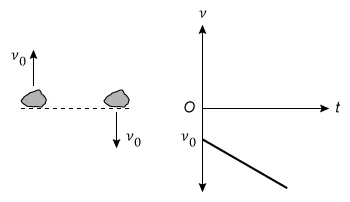
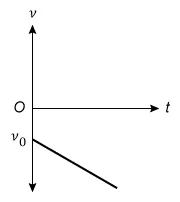
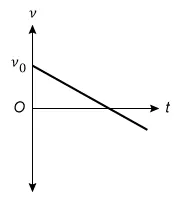
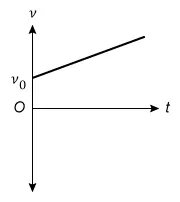
The figure above shows two identical rocks being thrown vertically upward and downward, each with the same initial speed . The graph shows the velocity as a function of time for the rock thrown vertically downward. Which of the following shows the corresponding graph for the rock thrown vertically upward?
A. ![]() |
|
B. ![]() |
|
C. ![]() |
|
D. ![]() |
Explanation
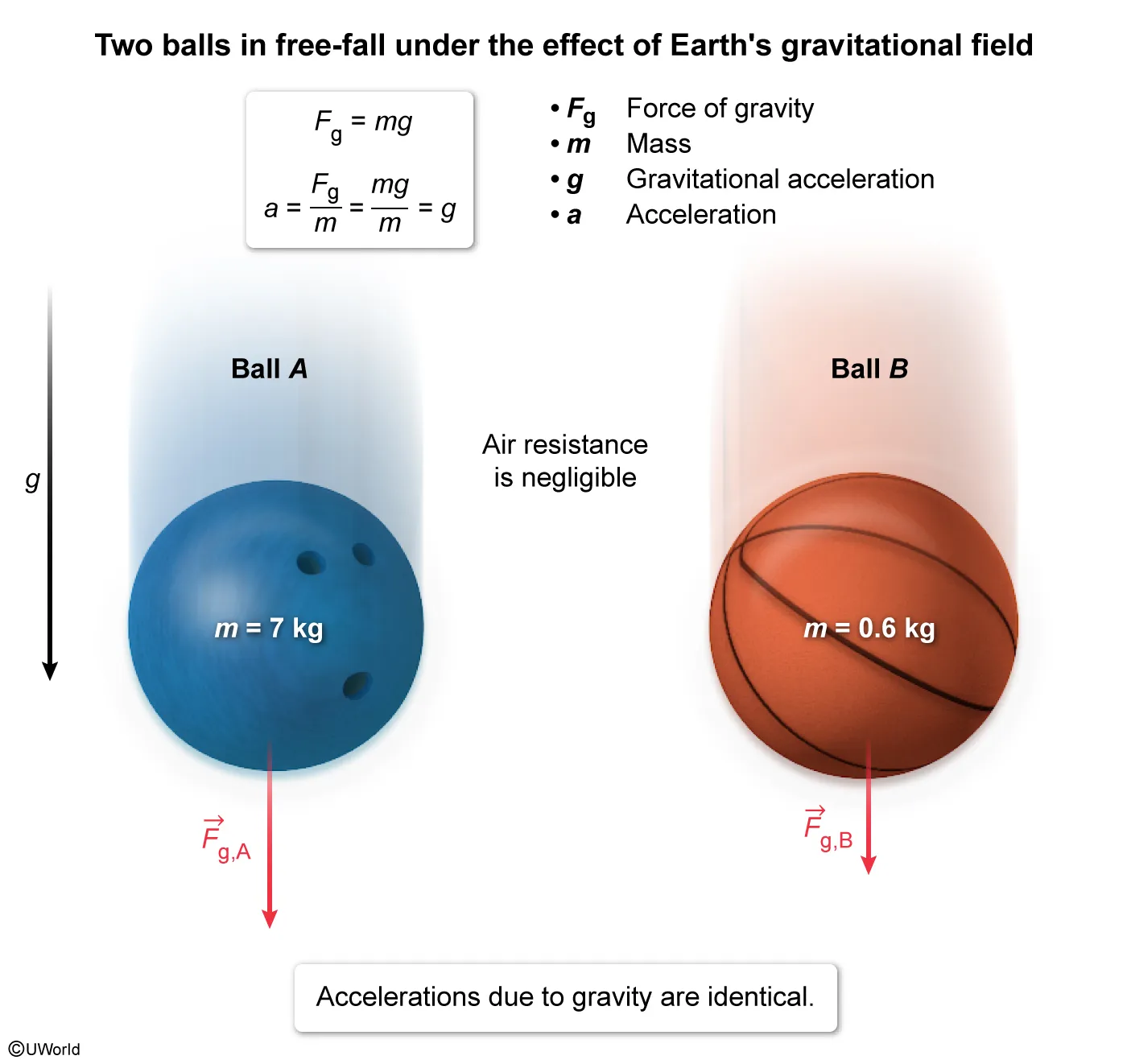
An object is in free-fall when it is subject only to the downward force of gravity. The acceleration a of an object in free-fall near Earth's surface is also downward and is equal to the free-fall acceleration constant g:
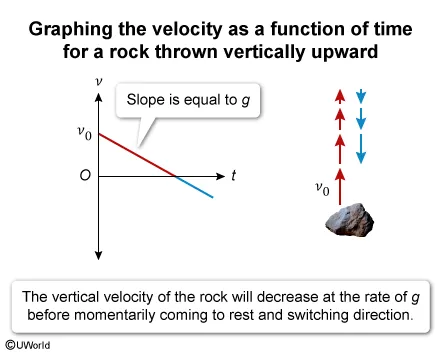
In this question, two identical rocks are thrown vertically upward and downward, each with an initial speed . Both rocks experience an acceleration . Consequently, the slopes of their respective velocity vs. time graphs are both equal to .
The graph in the question shows the velocity for the rock thrown vertically downward with . The velocity of this rock as a function of time t is:
Both rocks are thrown at the same initial speed, but they are thrown in opposite directions. Hence, the rock that is thrown vertically upward has an initial velocity of +v0. The velocity of this rock as a function of time t is:
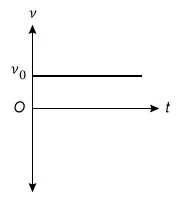
Therefore, the velocity vs. time graph for this rock will show a positive initial velocity v0 with a downward slope equal to g, as shown in the graph for Choice C.
(Choice A) This graph follows from representing the motion of the rock as if it maintained a constant velocity.
(Choice B) This graph follows from incorrectly representing the motion of the rock as if it were thrown vertically downward.
(Choice D) This graph corresponds to the case where the rock accelerates vertically upward instead of experiencing a downward free-fall.
Things to remember:
When an object undergoes free-fall near Earth's surface, it experiences only acceleration due to gravity in the downward direction.
Question
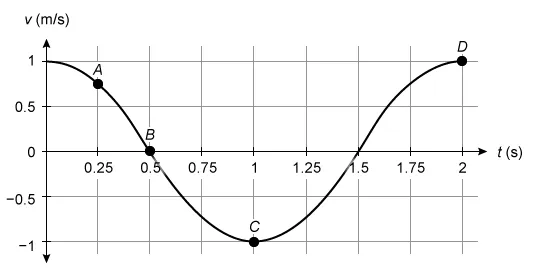
A graph of the velocity as a function of time for an object is shown above. If the object is at x = 0 m at time t = 0 s, at which of the labeled points does the object have the greatest magnitude of displacement and acceleration?
| A. A | |
| B. B | |
| C. C | |
| D. D |
Explanation
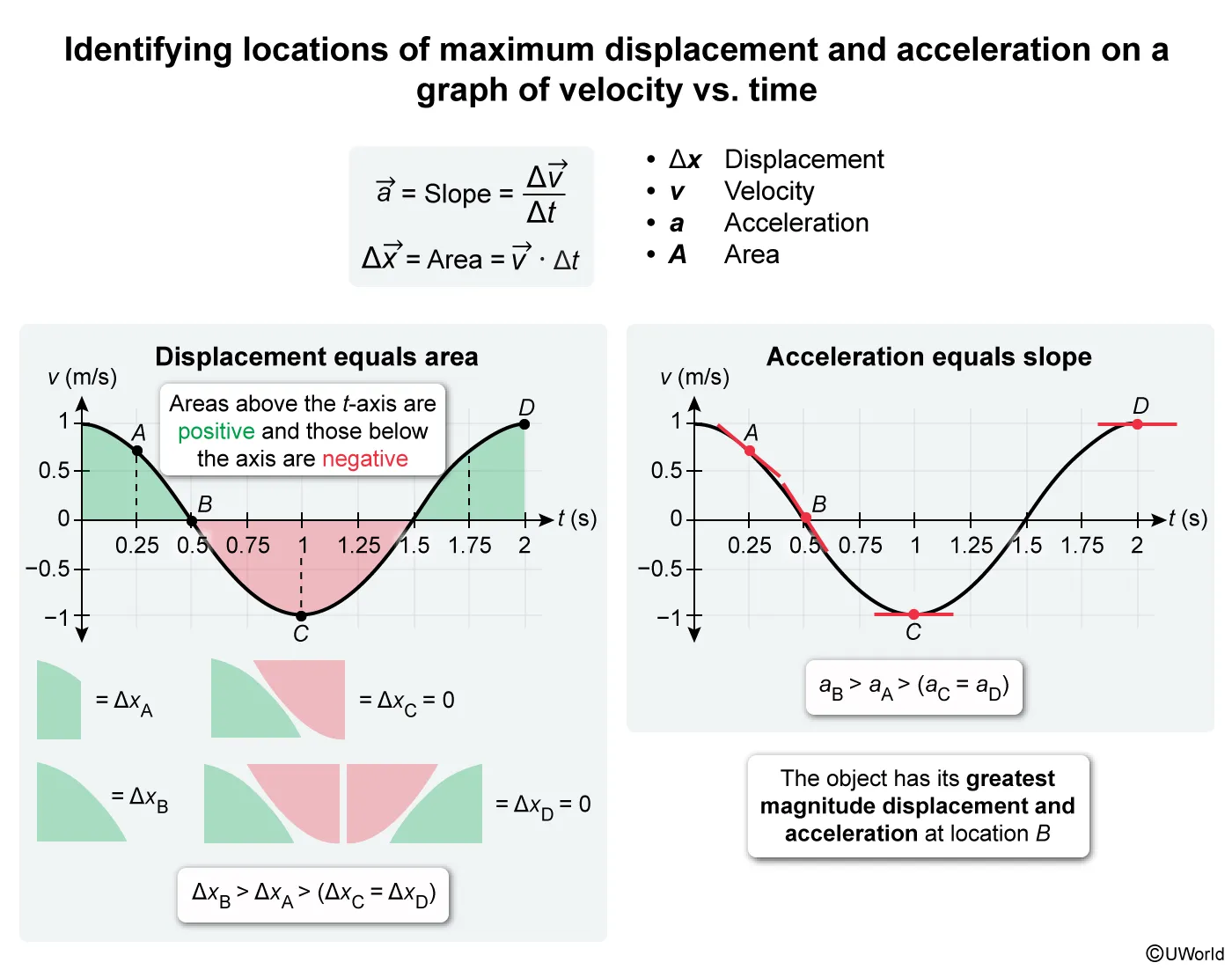
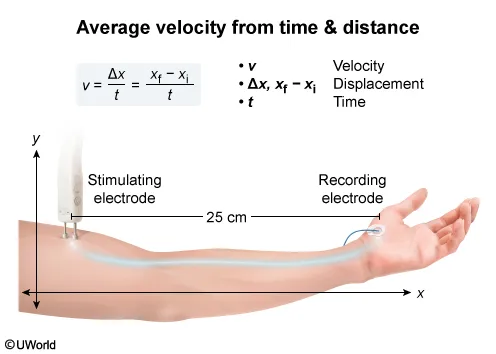
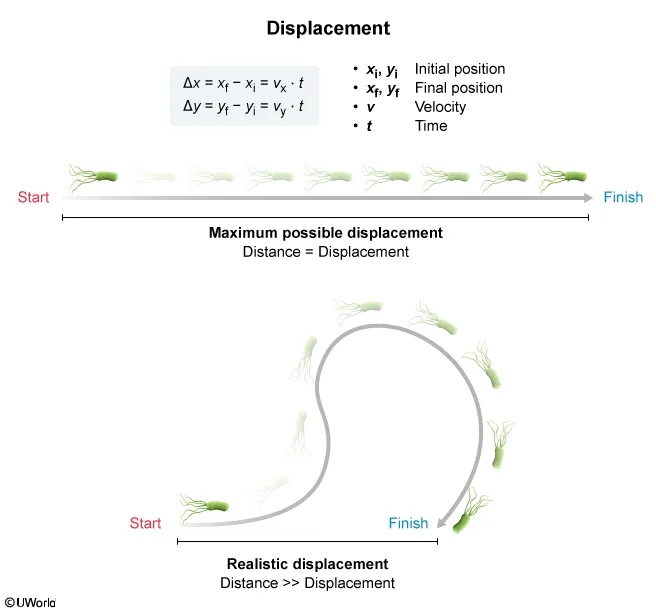
An object's velocity v is a vector quantity defined as the ratio of displacement Δx over an interval Δt:
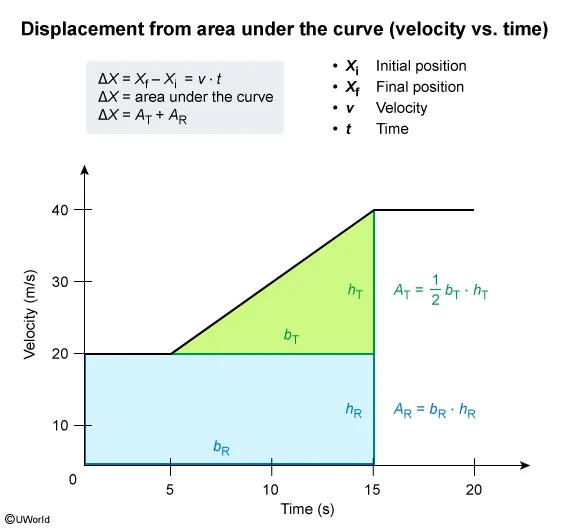
Consequently, the displacement is equal to the total area under the curve of a graph of velocity as a function of time:
Displacement is positive when the area is above the x-axis and negative when it is below the x-axis.
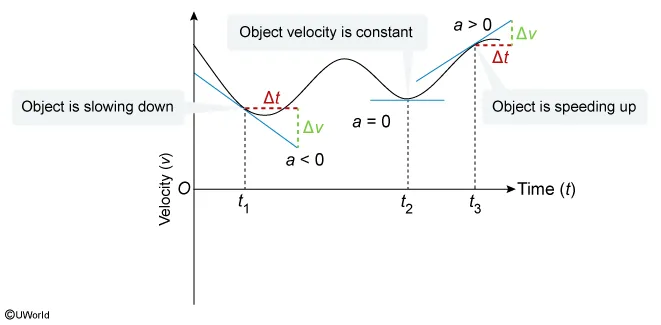
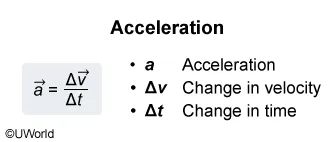
Furthermore, the acceleration a of an object is defined as the change in velocity divided by the change in time:
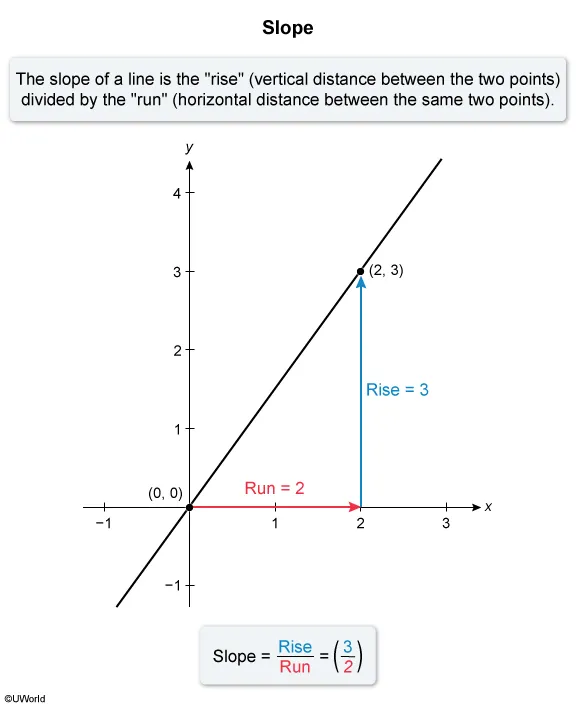
Thus, acceleration is equal to the slope of a graph of velocity as a function of time:
In this question, the velocity as a function of time graph for an object is given. Hence, the slope represents the instantaneous acceleration of the object, and the area between the curve and the t-axis is equal to its displacement.
The slope of the graph has its greatest magnitude at location B. Since the slope of a graph of velocity as a function of time equals acceleration, the object must have its greatest magnitude of acceleration at location B.
In addition, the total area beneath the curve on a graph of velocity as a function of time equals the displacement of the object, where areas above and below the t-axis represent positive and negative displacement, respectively.
The total area beneath the curve is greater at location B than at A. Furthermore, the total area beneath the curve at locations C and D are equal to zero because the areas above and below the t-axis are equal but opposite in sign.
Therefore, the object has its greatest magnitude of displacement and acceleration at location B.
(Choice A) The displacement and acceleration have a smaller magnitude at location A than at B because the slope of the graph and the area beneath the graph are smaller at A than at B.
(Choices C and D) The displacement and acceleration are both zero at locations C and D because the slope of the graph and the total area beneath the graph are equal to zero at C and D.
Things to remember:
The displacement of an object equals the area beneath the curve on a graph of velocity as a function of time. The acceleration of the object equals the slope of the graph.

Stand Out
with a Top Score in AP Physics 1
Finish your AP Physics 1 Unit 1 review and continue mastering all units with UWorld. Boost your performance and make yourself a standout candidate for competitive colleges, majors, and scholarships by mastering your AP Physics 1 course and scoring a 5 on the exam.
Get our all-in-one course today!
- Focused AP Physics 1 Review Videos
- Print & Online AP Physics 1 Study Guide
- 450+ Physics 1 Exam-style Practice Questions
- Customizable Quiz Generator
- Adjustable Study Planner
- Realistic AP Physics 1 Exam Review
- Timed Test Simulation
- Progress Dashboard
- Smart Flashcards
- Digital Notebook
Hear From Our AP Students
UWorld’s service is pretty good and helps provide a lot of explanations on subjects I haven’t been confident on before.
The questions here are the most realistic to the AP tests I've seen so far! I appreciate the ability to customize tests as well.
The best part is that all options are well-explained, telling clearly why they are not the right option.

Frequently Asked Questions (FAQs)
What are the main topics covered in AP Physics 1 Unit 1: Kinematics?
AP Physics 1 Unit 1 focuses on kinematics, the study of motion without considering forces. This unit establishes every concept you’ll need later in the course: velocity, acceleration, displacement, and time relationships. You’ll learn to interpret and construct position-time, velocity-time, and acceleration-time graphs, and apply the kinematic equations of AP Physics 1 to solve for unknowns in motion scenarios.
Key topics include:
- Scalars and vectors in one dimension
- Displacement, velocity, and acceleration
- Representing motion
- Reference frames and relative motion
- Vectors and motion in two dimensions
UWorld’s AP Physics 1 unit 1 review brings these ideas to life through conceptual videos, step-by-step explanations, and targeted practice problems. You’ll move from identifying motion types to solving realistic exam-level questions, improving both accuracy and confidence.
Mastering AP Physics 1 kinematics early strengthens your understanding of Newton’s Laws, circular motion, and energy in later units. This foundational knowledge is not only essential for the AP Physics 1 Unit 1 test but also crucial for maintaining speed and precision throughout the entire AP Physics 1 exam. UWorld’s platform makes that mastery efficient through structured study paths and timed practice tests.
How should I prepare for an AP Physics 1 Unit 1 exam?
Start by mastering the fundamentals of kinematics in AP Physics 1, including displacement, velocity, and acceleration. Learn to visualize motion through velocity-time and position-time graphs, then move into applying kinematic equations AP Physics 1 to both numerical and conceptual problems. Reviewing theory without applying it is ineffective, so the best way to prepare is by solving large sets of AP Physics 1 Unit 1 practice problems with immediate feedback.
UWorld’s course gives you a structured approach:
- Watch short, concept-focused videos on each kinematic principle
- Reinforce learning using the AP Physics Unit 1 study guide for quick formula review
- Attempt AP Physics 1 Unit 1 practice tests under timed conditions to simulate real exam pressure
When reviewing errors, note whether they stem from units, sign conventions, or misapplied equations. Correcting those patterns early prevents repeated mistakes in the test. Finally, practice a few AP Physics 1 kinematics FRQ items to train your written reasoning. Explain each step as you solve to improve your memory and ensure rubric alignment. Consistent daily review of 30-45 minutes with UWorld’s AP Physics 1 kinematics practice tools helps build retention and sharpness before test day.
Are any free resources available for AP Physics 1 Unit 1?
Yes, there are free ways to start preparing for AP Physics 1 Unit 1 Kinematics before purchasing a full course. UWorld offers a 7-day free trial of AP Physics 1 unit 1 practice problems that demonstrate reasoning about motion, graph interpretation, and step-by-step solutions. These examples show how to apply the kinematic equations of AP Physics 1 to real exam-style questions.
Students can also access a study guide that features short summaries of displacement, acceleration, and velocity relationships. Additionally, concept videos are available to illustrate motion graphs and vector analysis for AP Physics 1 kinematics beginners.
Other resources, such as the College Board’s Course and Exam Description, outline learning objectives, but they lack the depth of problems and explanations that UWorld provides. Free PDFs or AP Physics 1 Unit 1 notes can be good refreshers, but they won’t replace consistent testing and guided feedback.
To transition from passive review to active mastery, UWorld’s full version offers hundreds of AP Physics 1 Unit 1 practice test questions, interactive rationales, and built-in performance tracking. Starting free gives you a preview of how UWorld’s methods simplify even complex AP Physics 1 kinematics practice problems with answers in a PDF. Upgrading ensures comprehensive coverage is in place to secure a top score.
What types of questions are on the AP Physics 1 Unit 1 test?
The AP Physics 1 Unit 1 test features a combination of multiple-choice questions (MCQs) and free-response questions (FRQs), designed to assess conceptual understanding and quantitative reasoning. The MCQs often include visual analysis, requiring students to interpret position-time or velocity-time graphs, while FRQs demand written explanations, equation application, and reasoning consistent with scientific practice.
You can expect MCQs that ask you to:
- Determine displacement or velocity from graphs
- Choose which kinematic equations AP Physics 1 applies to a specific situation
- Evaluate experimental data from a simulated lab setup
The FRQs, such as those in the AP Physics 1 kinematics FRQ sets, may involve multi-step reasoning: describing a motion scenario, solving numerical problems, and justifying answers in words.
UWorld’s AP Physics 1 Unit 1 practice test covers both MCQ and FRQ question types, simulating exact exam timing and difficulty. Each question is accompanied by a detailed explanation that connects concepts to real-world motion, enabling students to learn from their mistakes. Practicing these regularly not only builds speed and precision but also ensures you’re ready for every type of AP Physics 1 kinematics question on test day.
How can I improve my score on the MCQs and FRQs for Unit 1?
To improve your score on AP Physics 1 Unit 1 MCQs and FRQs, you need to combine conceptual clarity, applied problem-solving, and timed testing. Begin by revisiting kinematics AP Physics 1 theory, focusing on how displacement, velocity, and acceleration relate graphically and mathematically. Then, repeatedly solve AP Physics 1 Unit 1 practice problems that include both quantitative and conceptual variations.
UWorld’s approach breaks this process into three simple steps:
- Study short videos to understand core motion patterns
- Use the AP Physics 1 Unit 1 study guide to memorize all kinematic equations
- Practice a large set of mixed MCQs and FRQs daily
In MCQs, eliminate impossible answers through dimensional reasoning. If units don’t make sense, the choice is wrong. In FRQs, organize your solution into “knowns,” “unknowns,” and “equations.” Write brief explanations for every calculation step.
Regularly completing AP Physics 1 Unit 1 practice test sets builds rhythm under exam pressure. UWorld’s performance tracking also highlights weak concepts, allowing you to refine your study plan. Improvement comes not from memorization but from deep repetition of structured, feedback-driven practice; that’s precisely what UWorld’s AP Physics 1 kinematics practice provides.
What is the “Kinematics” unit’s weight on the AP Physics 1 exam?
The AP Physics 1 Unit 1 Kinematics portion typically accounts for 10-15% of the total AP Physics 1 exam. This makes it one of the most heavily weighted topics, as it establishes the groundwork for every mechanics-based problem. Students who master AP Physics 1 kinematics early gain a significant advantage when they face later topics, such as dynamics, circular motion, and energy.
Within this section, both AP Physics 1 Unit 1 MCQ and FRQ questions test your ability to analyze motion using graphs and the kinematic equations AP Physics 1. Expect direct quantitative questions (solving for acceleration, displacement, or velocity) and conceptual questions that test your understanding of relationships between motion variables.
Even when questions in later units appear unrelated, many still depend on your Unit 1 reasoning, such as interpreting velocity-time graphs or connecting acceleration with net force. UWorld structures its AP Physics Unit 1 review materials according to this emphasis, ensuring proportional exposure to question types seen on the real exam. A solid grasp of kinematics AP Physics 1 principles can easily add several percentage points to your total AP score.
Where can I find a good study guide for AP Physics 1 Unit 1?
The best resource is a guide that combines concise explanations, visual clarity, and problem integration. UWorld’s AP Physics 1 Unit 1 study guide checks all three boxes. It breaks down concepts such as displacement, average velocity, acceleration, and vector motion into intuitive explanations, supported by diagrams and motion graphs.
Each section includes worked examples drawn directly from AP Physics 1 kinematics practice problems and review PDF materials. The guide also pairs with UWorld’s video lessons for instant reinforcement, which is ideal for visual learners. Beyond formulas, it emphasizes understanding: when to apply which kinematic equations AP Physics 1, how to translate graphs into numbers, and how to handle direction conventions. Combined with AP Physics 1 Unit 1 practice tests, it ensures you’re not just memorizing, but reasoning your way through problems.
While free online summaries exist, few integrate exam-style logic the way UWorld does. Having a guide that mirrors the actual AP Physics 1 Unit 1 test structure means you learn in the same format you’ll be assessed. This continuity saves study time and increases retention, making the UWorld guide the most efficient preparation choice available.
How should I interpret data or graphs for this unit’s problems?
Graph interpretation is a crucial skill in AP Physics 1, specifically in Unit 1: Kinematics. Motion graphs illustrate the relationship between position, velocity, and acceleration over time. A position-time graph’s slope indicates velocity, while a velocity-time graph’s slope gives acceleration, and its area represents displacement.
Common traps include mistaking a steep slope for acceleration or reading negative velocity as negative acceleration. Understanding these distinctions is crucial for every AP Physics 1 Unit 1 practice test and FRQ.
Here’s how to analyze effectively:
- Identify which quantity the axes represent
- Check slope direction and curvature for motion type
- Calculate slope or area only when appropriate
- Verify unit consistency throughout
UWorld’s AP Physics 1 kinematics review teaches these visual reasoning steps with animated examples and targeted AP Physics 1 kinematics practice problems. Each explanation clarifies the physical meaning behind equations, ensuring that when you encounter an AP Physics 1 FRQ Unit 1 graph, you can instantly identify what it shows.
Strong graph literacy transforms what seems abstract into intuitive motion logic, one of the biggest differentiators between average and top scorers on the AP Physics 1 exam.
Can I find practice tests specifically for AP Physics 1 Unit 1?
Yes. You can take dedicated AP Physics 1 Unit 1 practice tests designed exclusively around kinematics topics. These tests cover displacement, velocity, acceleration, and time relationships using the exact kinematic equations AP Physics 1 you’ll need on exam day. Each UWorld test follows College Board standards, combining both multiple-choice and FRQ questions.
The MCQs assess your ability to read motion graphs, apply formulas, and eliminate distractors using dimensional reasoning. The FRQs test written justification, unit consistency, and interpretation of motion scenarios. With each AP Physics 1 Unit 1 practice test, UWorld provides immediate feedback—detailing where errors occur and how to correct them.
Students can also create custom quizzes using question filters that target specific subtopics, such as constant acceleration, free fall, or projectile motion. This flexibility ensures consistent progress across all areas of kinematics in AP Physics 1.
Unlike static worksheets, these online tests adapt to your performance, gradually pushing you toward exam-level mastery. Consistently completing these AP Physics 1 kinematics practice tests not only improves accuracy but also enhances your speed and problem organization—critical under AP time constraints.
What’s the checklist to review before the AP Physics 1 Unit 1 test?
Before your AP Physics 1 Unit 1 test, make sure you can handle every conceptual and quantitative aspect of kinematics AP Physics 1 confidently. The following checklist keeps your review efficient and targeted:
Formulas and Concepts:
- Memorize all kinematic equations AP Physics 1 and understand when to apply each
- Know definitions for displacement, velocity, and acceleration (including signs)
- Interpret velocity-time and position-time graphs accurately
Skills and Application:
- Solve mixed AP Physics 1 unit 1 practice problems under time constraints
- Review FRQs to ensure your written reasoning aligns with College Board rubrics
- Revisit any weak spots flagged by your AP Physics 1 kinematics practice tests
Final Preparation:
Spend your last session on quick quizzes and conceptual flashcards—UWorld’s analytics show where you lose points, helping you refine your focus. A 30-minute warm-up set before the test (three MCQs and one FRQ) keeps your brain active and reduces anxiety.
By the time you finish this checklist, you’ll be ready for any AP Physics Unit 1 practice test or official exam scenario with complete control.
What are common mistakes to avoid in Unit 1 Kinematics?
Students often lose points in AP Physics 1, Unit 1, due to minor but consistent errors in logic and setup. The most common mistake is confusing velocity and acceleration, especially when interpreting motion graphs. Many students also fail to apply the correct kinematic equations in AP Physics 1 under conditions of constant versus non-constant acceleration.
Typical issues include:
- Ignoring negative signs in velocity or displacement
- Misreading velocity-time slopes as distances instead of rates of change
- Mixing vector and scalar quantities without direction
- Using incorrect units or skipping unit conversions
To avoid these traps, build a habit of clearly defining your coordinate system before solving any AP Physics 1 kinematics question. Always label known and unknown variables, keep track of signs, and check that your final answers have logical magnitudes.
UWorld’s AP Physics 1 Unit 1 practice problems highlight these errors directly within each solution. When you review the step-by-step rationale, you’ll see where logic commonly breaks down and how to correct it. This structured reflection ensures that by the time you reach your AP Physics Unit 1 practice test, these recurring mistakes no longer cost you valuable points.
Why is mastering kinematics essential for success in AP Physics 1?
Kinematics is the single most essential unit in the AP Physics 1 curriculum. Every topic that follows: forces, circular motion, energy, and momentum, depends on your understanding of velocity, displacement, and acceleration. Scoring a 5 correlates with near-perfect performance on AP Physics 1 Unit 1 questions.
By mastering AP Physics 1 kinematics, you develop the pattern-recognition skills that let you interpret graphs, reason about motion intuitively, and solve multi-step problems under pressure. The kinematic equations AP Physics 1 are used directly in roughly 30–40% of all mechanics questions, so fluency here gives you a major scoring edge.
UWorld’s AP Physics 1 Unit 1 practice test materials are intentionally calibrated to this level. They feature mixed FRQs, adaptive question difficulty, and detailed feedback to mirror real-exam conditions. Completing these tests regularly ensures that you approach each motion problem—whether graph-based or numeric—with immediate confidence. Simply put, students who consistently review AP Physics 1 Unit 1 kinematics through structured UWorld practice not only excel in this unit but also set themselves up to dominate the rest of the exam. It’s the foundation every 5-score starts from.
Can I access AP Physics Unit 1 materials offline or download them for study?
Yes. UWorld’s AP Physics 1 unit 1 review materials can be accessed both online and offline through our mobile app. Once you download a question set or study guide section, it’s available without an internet connection—perfect for commutes, travel, or study sessions away from Wi-Fi.
You can download AP Physics 1 kinematics practice problems, review saved FRQs, and even highlight key formulas within the kinematic equations AP Physics 1 summary. All notes sync automatically once you reconnect, so your progress and performance data stay updated across devices.
Offline mode includes:
- Access to AP Physics 1 unit 1 practice problems and flashcards
- Saved explanations for key kinematics AP Physics 1 concepts
- Downloadable study guide PDFs for motion and vector review
Students who use offline study report higher consistency—short, frequent practice sessions help retain formulas and reasoning patterns better than occasional long ones. Whether you’re reviewing AP Physics 1 unit 1 test material during a commute or solving practice questions at home, UWorld keeps learning continuous, connected, and distraction-free.