AP® Macroeconomics Unit 2 Review and Practice Test
AP® Macroeconomics Unit 2 moves from simple choice models to measuring the entire economy. You learn how GDP is calculated, why unemployment and inflation behave the way they do, and how economists track expansions and contractions in the business cycle. UWorld helps you turn them into something manageable, so your AP Macroeconomics Unit 2 review feels clear instead of numbers-heavy.
Make AP Macroeconomics Unit 2 Easier With Structured Review Tools
Unit 2 introduces the major economic indicators that underpin the rest of the course. GDP, unemployment, inflation, and the distinction between real and nominal values determine how economists evaluate the state of the economy. UWorld’s structured AP Macro Unit 2 review helps you move through these topics gradually, so concepts like output gaps, CPI interpretation, and business cycle phases make sense long before you hit timed tests.
Walkthroughs That Make the Business Cycle Simple to Visualize
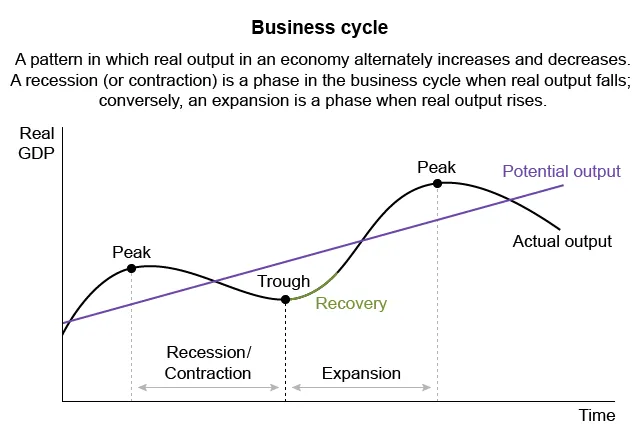
The videos break down how expansions, peaks, recessions, and recoveries appear on graphs and in real economic data. Instead of memorizing definitions, you learn to read the shape of the cycle, understand where output stands relative to potential, and interpret how unemployment and inflation change through each phase. This makes AP Macroeconomics Unit 2 review tasks easier because you learn how indicators behave in different economic conditions.
Interactive Guides That Break Down Unit 2 Equations and Logic
These study guides simplify GDP formulas, CPI and inflation calculations, unemployment categories, and conversions between real and nominal values. Each step shows how to apply formulas without getting stuck, so the AP Macroeconomics Unit 2 study guide becomes far less intimidating. You learn not only how to compute values, but also how to interpret what they mean for the economy.
Prepare Faster With Focused Unit 2 Practice That Mirrors the AP Exam
Question
Which of the following is used in the income approach of measuring a country's gross domestic product?
| A. The number of jobs created | |
| B. The value of exports minus imports | |
| C. The total sum of transfer payments | |
| D. The cost of intermediate goods | |
| E. The dollar amount of interest paid |
Hint:
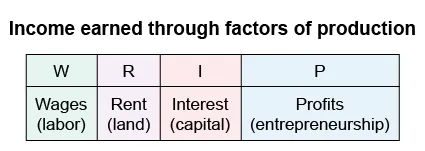
The factors accounted for by the income approach to GDP are represented in the formula: GDP = W + R + I + P
Explanation:
A country's gross domestic product (GDP) is the total value of all final goods and services it produces within a given period. GDP is often calculated using the expenditure approach, but GDP can also be calculated using the income approach.
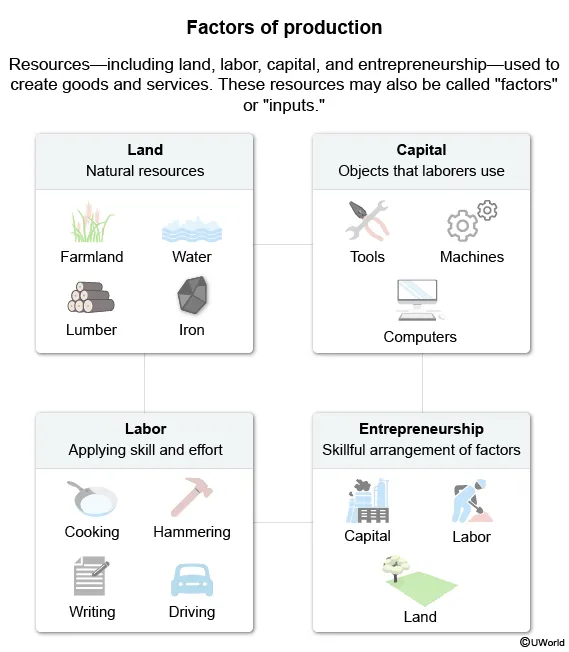
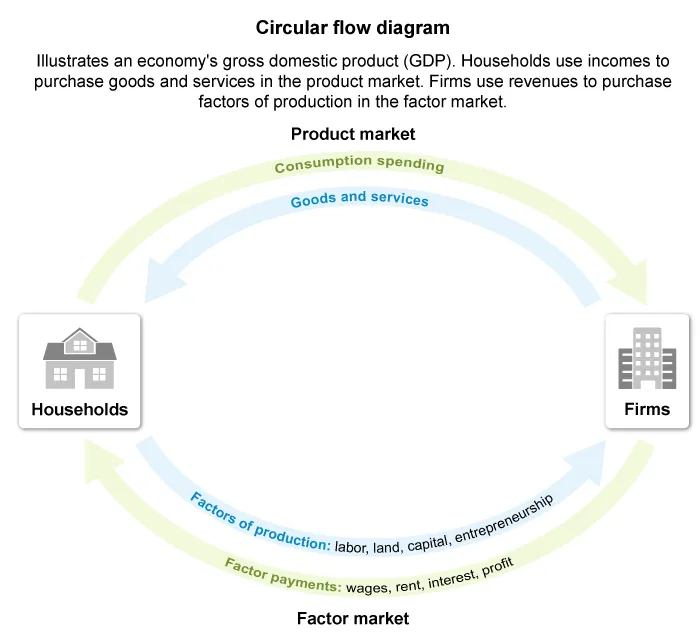
The income approach accounts for total income earned through factors of production. This approach sums income from wages for labor, rent for land, interest from capital, and profits from entrepreneurship (GDP = W + R + I + P).
Capital is the machinery and other man-made resources needed to supply a good or service, such as all ovens that businesses use to make pizza. Producers borrow money to obtain capital. In the circular flow model, money for capital is lent to firms by households in the factor market. Firms pay interest on the loans, which is household income. The income approach to GDP accounts for the dollar amount of interest paid on capital.
(Choice A) The number of jobs created is not a part of calculating GDP.
(Choice B) Net exports are accounted for in the expenditure approach, not the income approach.
(Choice C) The government pays transfer payments to individuals for reasons other than labor or the purchase of goods or services; these payments are not accounted for in GDP.
(Choice D) The cost of intermediate goods is a factor accounted for by the value-added approach to GDP.
Things to remember:
The income approach to GPD accounts for income earned by households that supply firms with factors of production, including the dollar amount of interest paid on borrowed capital.
Question
In an economy, the unemployment rate is falling and real gross domestic product is rising. Which of the following must be true of the economy's position in the business cycle?
| A. The economy is in a recession and has not yet reached a trough | |
| B. The economy is in a recession and is producing less than potential output | |
| C. The economy is in an expansion and is producing more than potential output | |
| D. The economy is at a trough and will begin to expand | |
| E. The economy is in an expansion and has not yet reached a peak |
Explanation:
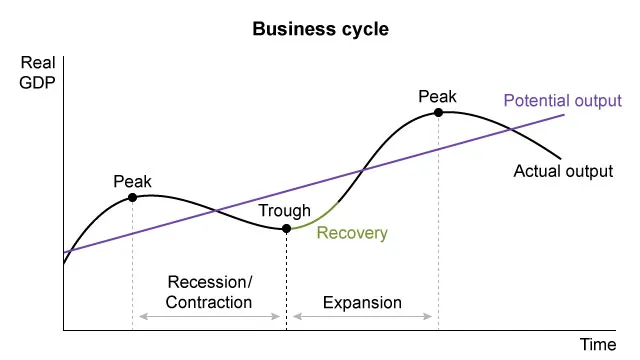
Economies experience alternating periods of increasing and decreasing real gross domestic product (GDP)—a measure of national output—called the business cycle. Periods of declining economic output (recession) coincide with increasing unemployment as companies lay off unneeded workers. After reaching a trough, the economy enters a recovery, and these trends reverse.
The economy then begins an expansion, where economic activity increases until it reaches a peak, after which the cycle repeats. Because national output increases during an expansion, firms hire more workers and unemployment falls. If national output is increasing and unemployment is falling, the economy has not yet reached the peak of the expansion.
(Choices A and B) In a recession, economic activity decreases, real GDP falls, and unemployment rises.
(Choice C) An increase in real GDP and a decrease in unemployment characterize an economic expansion, but the relationship of actual output to potential output cannot be determined from the given information.
(Choice D) A trough is a turning point in the business cycle, but at a point where real GDP has not yet begun to rise and the unemployment rate has not yet begun to fall.
Things to remember:
The phases of a business cycle include expansions that end at a peak and recessions that end at a trough.
Question
An output gap occurs when
| A. actual output differs from potential output | |
| B. a good's actual price rises above the market equilibrium price | |
| C. nominal output differs from real output | |
| D. the quantity supplied of a good exceeds the quantity demanded | |
| E. the production possibilities curve shifts outward |
Explanation:
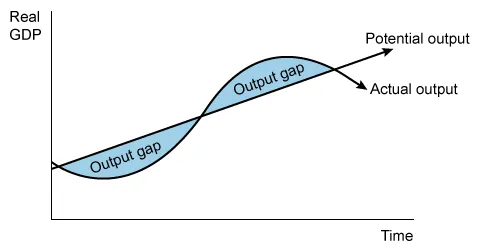
An economy's actual output fluctuates, reflecting changes in macroeconomic factors such as aggregate demand and cyclical unemployment. This fluctuation is illustrated on a business cycle diagram, which shows actual output moving toward and away from potential output over time. Therefore, output gaps occur when actual output differs from potential output.
(Choices B and D) An output gap accounts for economy-wide output, not the price or supply of a particular good.
(Choice C) Output gaps are characterized by changes in real GDP; they do not track changes in nominal GDP.
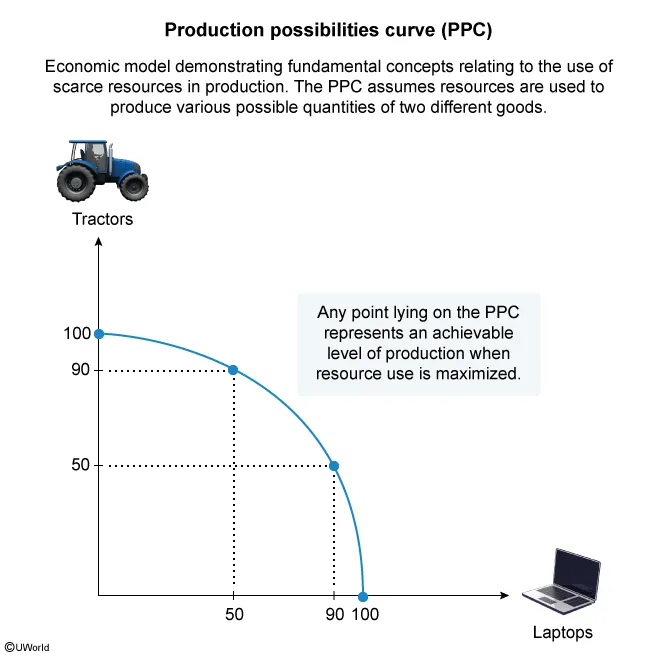
(Choice E) An outward shift of the production possibilities curve, which illustrates potential output, would not necessarily result in an output gap. For example, if the economy had a positive output gap and potential output increased, this increase could close the gap rather than create one.
Things to remember:
An output gap occurs when actual output differs from potential output.

Stand Out
with a Top Score on the AP Macroeconomics Exam
Finish your AP Macro Unit 2 review and continue mastering all units with UWorld. Boost your performance and stand out as a top candidate for competitive colleges, majors, and scholarships by earning a top score.
Get our all-in-one course today!
- Focused AP Macro Videos
- Print & Digital Study Guide
- 200+ Exam-style Practice Questions
- Customizable Quiz Generator
- Adjustable Study Planner
- Realistic Timed Test Simulation
- Colorful Visual Explanations
- Progress Dashboard
- Smart Flashcards & Digital Notebook
Hear From Our AP Students
UWorld’s service is pretty good and helps provide a lot of explanations on subjects I haven’t been confident on before.
The questions here are the most realistic to the AP tests I've seen so far! I appreciate the ability to customize tests as well.
The best part is that all options are well-explained, telling clearly why they are not the right option.
Frequently Asked Questions (FAQs)
What are the main topics covered in AP Macroeconomics Unit 2: Economic Indicators and the Business Cycle?
Unit 2 focuses on how economists measure overall economic performance. This unit shifts from individual decision-making to national-level indicators that track the flow of goods, services, and prices. Students sometimes expect Unit 2 to be only formulas, but the real challenge is learning to interpret what these numbers say about the economy. UWorld helps you understand these patterns by connecting each indicator to real changes in output, employment, and prices during your AP Macroeconomics Unit 2 review.
Unit 2 typically includes:
- The circular flow and GDP
- Unemployment
- Price indices and inflation
- Real vs. nominal GDP
- Business cycles
Understanding these topics helps you read economic conditions, even outside the test. The AP exam expects you to compute values quickly and then interpret what they reveal about the broader economy. Once you learn the reasoning behind these indicators, Unit 2 begins to feel logical rather than formula-heavy.
How should I prepare for an AP Macroeconomics Unit 2 exam?
Unit 2 combines math and interpretation, so the most effective preparation strategy is to practice both simultaneously. Memorizing formulas is not enough. You must know why a change in CPI matters or what rising unemployment implies for the business cycle. A strong study approach focuses on repetition, graph reasoning, and reading economic scenarios efficiently. UWorld’s AP Macroeconomics Unit 2 practice question sets help reinforce this by guiding you through each calculation and its meaning.
Helpful preparation steps include:
- Redoing GDP and CPI calculations until the method becomes automatic
- Practicing unemployment scenarios and identifying which category applies
- Redrawing the business cycle and labeling output gaps clearly
- Working with actual AP-style MCQs to improve speed and accuracy
- Solving FRQ-type prompts that require short, targeted economic reasoning
- Reviewing common mistakes, especially nominal vs real mix-ups
- Checking how indicator changes connect to recessions and expansions
This balanced approach helps you avoid cramming formulas and instead builds genuine economic intuition. Once you can explain what a number means rather than simply compute it, Unit 2 becomes much easier.
Are any free resources available for AP Macroeconomics Unit 2?
Yes, several free resources can help you begin your AP Macroeconomics Unit 2 preparation, and they vary in depth and quality. One of the most useful starting points is UWorld’s free 7-day trial, which includes guided examples, step-by-step explanations, and AP Macroeconomics Unit 2 practice test questions that walk you through GDP, CPI, unemployment, and business cycle analysis. Beyond that, AP Classroom provides topic questions and the official Unit 2 progress check, which mirrors AP exam formatting and is especially helpful for identifying weak areas. Many teachers share concise formula sheets, CPI market basket practice, or unemployment classification worksheets through their LMS.
You can also find free economic indicator datasets from government websites, which allow you to see real GDP and inflation trends instead of hypothetical values. While video platforms offer Unit 2 walkthroughs, their accuracy varies, particularly in areas such as GDP exclusions or CPI pitfalls. These free tools are good for reinforcement, but only resources that explain the reasoning behind calculations, rather than simply showing final answers, will help you develop actual AP-level understanding. Combining UWorld’s explanation-based practice with these free materials gives you both repetition and conceptual clarity, which is essential for mastering Unit 2.
What types of questions are on the AP Macroeconomics Unit 2 test?
The AP Macroeconomics Unit 2 test mixes numerical calculations with interpretation, so you will see a blend of straightforward math and reasoning-based scenarios. The exam aims to determine whether you understand what GDP, unemployment, and inflation represent, not just how to calculate them. Many questions ask you to move between formulas and real-world meaning. UWorld helps by exposing you to AP Macro Unit 2 MCQ problems that feel like mini case studies rather than simple worksheet questions.
Common Unit 2 question types include:
- GDP component identification (consumption, investment, government, net exports)
- Real vs nominal GDP comparisons and GDP deflator calculations
- CPI market basket computations and inflation rate questions
- Unemployment classification: cyclical, structural, frictional
- Natural rate vs actual unemployment scenarios
- Business cycle phase identification with output or unemployment data
- Output gap scenarios that require connecting indicator changes
- Multiple-choice items involving misleading nominal values or irregular price changes
- FRQ parts with short, precise calculations
Understanding these structures early helps you avoid surprises on test day. Once you practice a few sets, the patterns become predictable: most questions boil down to applying definitions correctly, interpreting indicator changes accurately, and avoiding common pitfalls such as mixing nominal and real values. With repetition, Unit 2 becomes much more systematic and less intimidating.
How can I improve my score on the Free-Response Questions (FRQs) for Unit 2?
Unit 2 FRQs reward precision, not lengthy explanations. Since most prompts require short calculations or economic classification, your primary task is to present clear reasoning step by step. Many students lose points by mislabeling indicators or mixing up formulas. UWorld’s explanations help you develop habits that prevent those errors by showing exactly how an AP Macroeconomics Unit 2 FRQ is expected to be structured.
Key strategies that raise your FRQ accuracy include:
- Writing formulas before plugging in values to avoid mismatched numbers
- Labeling units on GDP or inflation results (percent, dollars, index values)
- Using arrows or quick notes to identify whether values are rising or falling
- Redrawing the business cycle and marking output gaps if needed
- Treating each FRQ part independently; don’t assume answers carry over
- Showing one line of reasoning, even for simple calculations
- Practicing old FRQs until the steps become automatic
After several rounds of practice, you’ll notice that FRQs don’t try to trick you. They’re predictable: a few calculations, a classification question, and a short interpretation. Once you adopt a clean method, Unit 2 written work becomes straightforward.
What is the "Economic Indicators and the Business Cycle" unit's weight on the AP Macroeconomics exam?
Unit 2 carries substantial influence on the AP Macroeconomics, accounting for 12-17% of the exam score because economic indicators are foundational for multiple later units. Questions involving GDP, inflation, unemployment, and business cycle interpretation consistently appear on both the multiple-choice and FRQ sections. Many AP Macroeconomics Unit 2 progress check MCQ patterns also appear, sometimes in nearly identical formats, in your AP classroom learning. Unit 2 concepts reappear throughout the course: for example, inflation interacts with money supply in Unit 4, unemployment dynamics connect to long-run adjustments in Unit 5, and real versus nominal values become essential for growth analysis in Unit 3.
This makes Unit 2 a “high-leverage” unit; mastering it improves performance across the entire exam. Even when questions do not explicitly reference Unit 2, they often require understanding how indicators behave during recessions or expansions. UWorld helps strengthen this cross-unit understanding by breaking each indicator into digestible explanations, showing how minor calculation errors can lead to big interpretation mistakes. The AP exam expects students to transition smoothly between formulas and economic concepts. Unit 2 often feels more heavily weighted than it is. Students who understand indicator behavior find the rest of the exam far more intuitive.
What are common mistakes students make on AP Macro Unit 2 questions?
Most Unit 2 mistakes happen because students treat the math as disconnected from meaning. They crunch numbers without pausing to ask what the result actually represents. This creates problems on both MCQs and FRQs because the AP exam expects interpretation, not just calculation. UWorld helps students avoid these errors because each solution explains the economic story behind the math, which strengthens the AP Macroeconomics Unit 2 review outcomes.
Common errors include:
- Mixing up real and nominal values, especially in GDP or wage problems
- Forgetting to use base-year prices for CPI calculations
- Misclassifying unemployment types
- Assuming inflation is always harmful, or that unemployment always falls during expansions
- Confusing GDP deflator with CPI because both involve price indices
- Forgetting that some transactions, like intermediate goods, do not count toward GDP
- Overlooking the fact that inflation rate calculations require dividing the change by the original value
When you know what to look for, these mistakes become easy to avoid. The exam tends to recycle the same patterns, so recognizing them early gives you an advantage. Once you internalize the logic behind each indicator, Unit 2’s difficulty drops sharply.
Where can I find a good study guide for AP Macroeconomics Unit 2?
If you’re looking for actual places to get a reliable Unit 2 study guide, you have several dependable options. Unit 2 involves formulas, indicator interpretation, and business cycle logic, so the best guides are the ones that explain how to use the numbers rather than just listing them. UWorld is a strong starting point because its guides work through GDP components, inflation calculations, and unemployment classification in a structured, example-driven way that supports your AP Macroeconomics Unit 2 study guide work.
You can find trustworthy Unit 2 study materials in:
- UWorld’s guided explanations and sample indicator problems
- AP Classroom’s Unit 2 overview and topic summaries
- Your teacher’s posted notes or curated review packets
- High-quality AP Macro lecture notes shared by experienced teachers online
- Review books with chapter breakdowns, provided they offer worked examples
- Classroom handouts containing formula sheets, CPI tables, and GDP practice sets
The strongest guides are the ones that teach interpretation, not just computation. For example, knowing how to calculate CPI is only half the task; you also need to understand whether inflation is accelerating or slowing and what that means for the economy. If a guide helps you connect formulas to meaning, it will support you throughout Unit 2 and beyond.
Can I find practice tests specifically for AP Macro Unit 2?
Yes. Unit 2 practice tests are widely available, and they’re extremely valuable because the AP exam expects you to transition smoothly between formulas and interpretation. A strong practice set should blend number-based questions with scenario-based items involving inflation, unemployment, GDP, and business cycle behavior. UWorld’s AP Macro Unit 2 practice test questions are especially useful because they show the reasoning behind each calculation and highlight common traps, such as misreading nominal versus real values.
Sources for Unit 2 focused practice tests include:
- UWorld’s AP Macro Unit 2 practice tests, which is closest in format to AP-style MCQs
- AP Classroom’s progress check and topic questions for Unit 2
- Teacher-made practice tests posted on Google Classroom or Canvas
- Review books that include focused sections on economic indicators
- Online resources that provide CPI market baskets, GDP scenarios, and unemployment drills
- Released-style practice sets created by AP instructors
Working through multiple Unit 2 tests helps you spot predictable patterns. After a few sessions, you’ll recognize how GDP questions are structured, how inflation items are phrased, and how unemployment scenarios are typically framed. This recognition builds the confidence needed for exam day.
What are the key formulas I need to know for AP Macro Unit 2?
Unit 2 introduces several formulas that appear frequently on both MCQs and FRQs, and knowing them well can dramatically improve your speed and accuracy. The AP exam expects you to move from formula to calculation and interpretation quickly, so memorizing only the math isn’t enough. You must understand what each formula means and how it relates to economic conditions, such as inflation, recession, or output growth. UWorld supports this because its AP Macroeconomics Unit 2 practice questions require you to apply these formulas in context, rather than in isolation.
Core formulas you must know include:
- GDP (Expenditure Approach): C + I + G + NX
- Real GDP: (Nominal GDP ÷ GDP Deflator) × 100
- CPI: (Current Basket Cost ÷ Base-Year Basket Cost) × 100
- Inflation Rate: [(New CPI – Old CPI) ÷ Old CPI] × 100
- Unemployment Rate: (Unemployed ÷ Labor Force) × 100
- Labor Force Participation Rate: (Labor Force ÷ Adult Population) × 100
- Real Wage / Real Income: (Nominal Value ÷ Price Index) × 100
Once these formulas become automatic, Unit 2 becomes much easier because you free up mental energy to interpret what the numbers reveal about the economy. Memorizing is only the first step; understanding why these formulas matter is what ensures strong AP performance.
How can I study effectively for AP Macroeconomics Unit 2 MCQs?
Unit 2 MCQs often combine quick calculations with reasoning about economic indicators. The best preparation focuses on building speed with formulas and sharpening your ability to interpret economic conditions. Students usually miss MCQs because they rush through tables or confuse nominal and real values. UWorld helps by providing you with AP Macro unit 2 MCQ sets that require you to read carefully, compute accurately, and avoid common traps.
A strong MCQ strategy includes:
- Practicing CPI and inflation calculations until you can do them in under 20 seconds
- Redrawing GDP component tables to make the structure familiar
- Reviewing unemployment scenarios and identifying the correct category quickly
- Learning what each business cycle phase implies for unemployment and inflation
- Working through mixed-format practice sets instead of only formula worksheets
- Reviewing mistakes to identify whether the issue was a calculation or an interpretation
- Using short daily sessions to keep indicators fresh in your mind
This approach trains you to move smoothly between math and meaning. After enough repetition, you’ll begin to recognize AP-style patterns before you even finish reading the question, which is exactly what top scorers experience.
Can I study AP Macroeconomics Unit 2 offline if needed?
Yes, Unit 2 lends itself well to offline studying because most of the core skills involve rewriting formulas, solving small numerical problems, and practicing how to interpret changes in indicators. Working through GDP tables, CPI market baskets, or unemployment classifications on paper can strengthen your understanding more effectively than passively watching videos. Offline practice forces you to think through each step without relying on automated tools. UWorld supports this style by allowing you to download AP Macroeconomics Unit 2 practice test questions so you can continue solving problems even when you’re away from WiFi.
Once you reconnect, the UWorld mobile app syncs your progress. Reviewing Unit 2 offline can be especially helpful for understanding business cycle logic, as repeatedly drawing the cycle helps reinforce the concepts of expansions, recessions, and output gaps. Offline study also reduces distractions, improving accuracy for formula-based questions. When combined with periodic online practice to check your reasoning, offline work gives you the kind of repetition Unit 2 demands. The more you interact with the numbers and graphs directly, the easier it becomes to interpret real versus nominal changes, inflation patterns, and shifts in unemployment. This balance of offline repetition and online explanation builds a durable understanding for the exam.