AP® Macroeconomics Unit 1 Review and Practice Test
AP® Macroeconomics Unit 1 sets the foundation for the entire course. You learn how scarcity shapes choices, why opportunity cost matters, and how models like the PPC and circular flow diagram help explain real-world behavior. These ideas are powerful but can feel abstract at first. UWorld helps you make sense of them by breaking down each concept with clear examples, step-by-step reasoning, and practice that builds real confidence for your AP Macroeconomics Unit 1 review.
Start AP Macroeconomics Unit 1 With A Review That Makes the Basics Click
Unit 1 introduces the language economists use to explain the world. Concepts such as marginal thinking, trade-offs, specialization, and supply and demand lay the groundwork for everything that follows. UWorld helps you learn these ideas intuitively so you can approach AP Macro Unit 1 notes, graphs, and practice problems without getting overwhelmed.
Videos That Make the Language of Economics Easy to Understand
The videos utilize short, real-world examples to illustrate concepts such as scarcity, opportunity cost, production possibilities, and market behavior. Instead of memorizing definitions, you see how these ideas appear in everyday decisions. This approach strengthens your understanding of AP Macroeconomics Unit 1 review assignments and helps you recognize patterns on MCQs and FRQs.
Guides Designed to Build Real Understanding of Unit 1 Foundations
The interactive study guides walk you through each model slowly and clearly. You learn how to read and interpret PPC curves, compare absolute and comparative advantage, and understand the logic behind specialization and trade. Each guide helps you build a mental framework that makes the AP Macroeconomics Unit 1 study guide tasks feel easier and more intuitive.
Strengthen Your Reasoning With Exam Style AP Macro Unit 1 Practice Questions
Question
Which of the following would increase the supply of running shoes?
| A. An expected increase in the price of running shoes | |
| B. An increase in consumer preference for running shoes | |
| C. An unexpected implementation of a price ceiling in the market for running shoes | |
| D. A decrease in the cost of shoe leather | |
| E. An increase in the price of basketball shoes |
Explanation:
| Supply of running shoes | |
|---|---|
| Price | Quantity supplied |
| $50 | 100 |
| $75 | 200 |
| $100 | 300 |
| $125 | 400 |
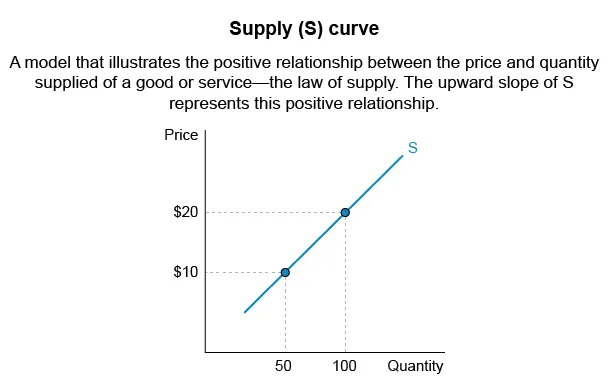
The supply schedule above shows that as the price of running shoes rises, so does the quantity supplied. An increase in the quantity supplied occurs when producers are incentivized to make more of their product because of increased profits.
| Supply of running shoes | ||
|---|---|---|
| Price | Quantity supplied 1 | Quantity supplied 2 |
| $50 | 100 | 150 |
| $75 | 200 | 250 |
| $100 | 300 | 350 |
| $125 | 400 | 450 |
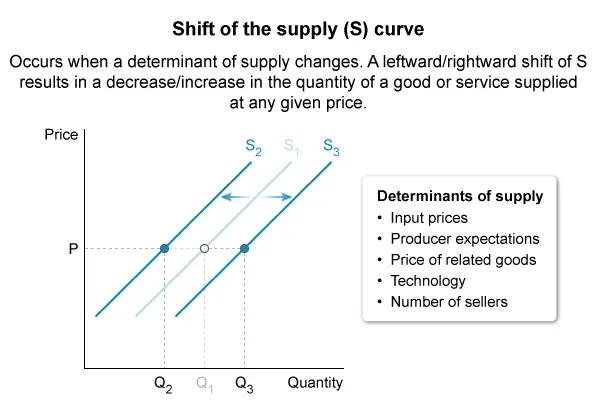
When a determinant of supply changes, producers will change the quantity supplied at every price. For example, when the cost of shoe leather—a raw material—decreases, producers will make more running shoes at each price. The lowered costs of production increase profitability, and the supply of running shoes increases, indicating that producers are more willing and able to produce running shoes.
Producers want to sell goods at higher levels of profit. Market conditions decreasing the profitability of running shoes decrease, not increase, its supply:
- (Choice A) If the price of running shoes is likely to rise in the future, producers will supply less in the present to earn greater profit from future prices.
- (Choice E) If the price of basketball shoes rises, the supply of running shoes will fall because producers can easily shift their production to basketball shoes—a similar good.
(Choice B) A change in consumer preference determines demand, not supply.
(Choice C) A price ceiling changes the price of running shoes and lowers the quantity supplied. Such a change would be represented by a movement along the existing supply curve—it doesn't shift the supply curve.
Things to remember:
Supply increases or decreases when a determinant of supply changes, as shown by a shift of the supply curve.
Question
Annabel prefers to buy her family members' birthday gifts in January when many stores have sales. Annabel's shopping preference can be illustrated by
| A. an upward movement along the supply curve | |
| B. a rightward shift of the supply curve | |
| C. a leftward shift of the demand curve | |
| D. a rightward shift of the demand curve | |
| E. a downward movement along the demand curve |
Explanation:
A demand curve illustrates the law of demand—consumers will buy more of a good when the price falls and will buy fewer goods when the price increases. Annabel's demand for birthday gifts can be illustrated by the demand curve below:
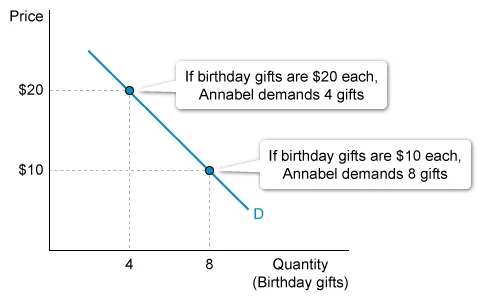
Annabel's shopping preference—to purchase more birthday gifts when the price is lower—is illustrated by a downward movement along a demand curve.
(Choices A and B) Because Annabel's shopping preference to buy goods on sale represents demand, her preference is illustrated by a demand curve, not a supply curve.
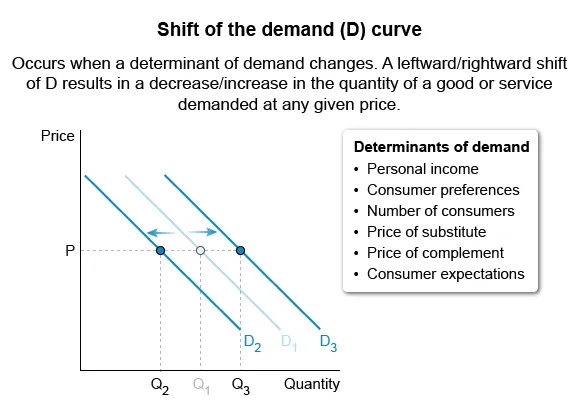
(Choices C and D) A decrease in a good's price will not cause a demand curve to shift, but instead will cause a downward movement along a demand curve.
Things to remember:
A demand curve illustrates the law of demand—the inverse relationship between price and quantity demanded.
Question
Assume that a nation specializes in the production of phone chargers instead of phone cases. It can be concluded that
| A. the opportunity cost to produce phone chargers will decrease as the nation continues to produce them | |
| B. the nation's trade partners can produce phone chargers at a lower opportunity cost | |
| C. the nation can produce more phone chargers than its trade partners | |
| D. the nation has an absolute advantage in producing phone chargers | |
| E. the nation's consumption opportunities will increase if it trades phone chargers for phone cases |
Explanation:
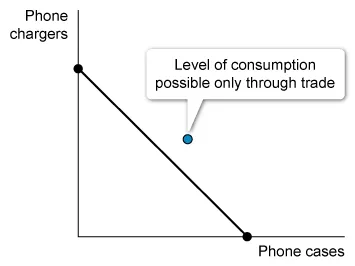
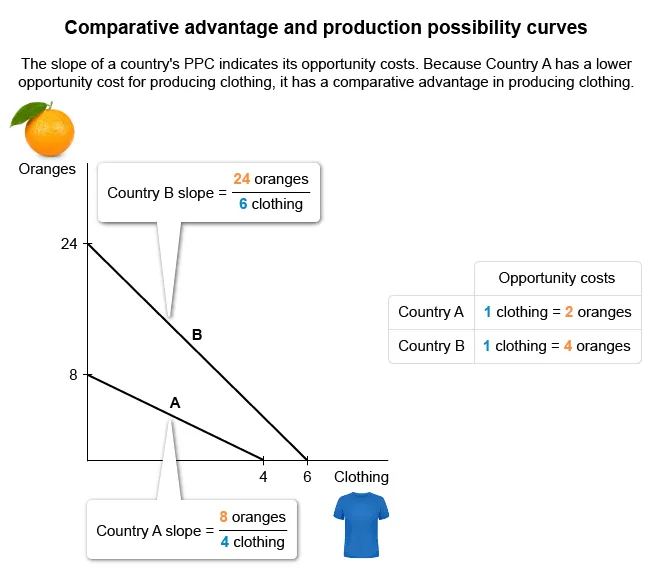
The production possibilities curve (PPC) illustrates an economy's opportunity costs of production and, when compared with another economy's PPC, can show comparative advantages. A nation with a comparative advantage in producing a certain good can benefit by specializing in that good's production and trading for a good that another nation specializes in producing.
Such trade allows a nation to consume more than it can produce; increased consumption opportunities are gains from trade that can be shown by a point lying outside the PPC. For example, if a nation specializes in phone charger production, its consumption opportunities will increase beyond its PPC if it trades phone chargers for phone cases, as shown in the image.
(Choice A) Opportunity costs can increase, decrease, or remain constant; the question doesn't provide enough information to conclude which of these will occur.
(Choice B) A nation specializes in phone charger production because that nation, not its trade partners, has a lower opportunity cost to produce that good.
(Choices C and D) A nation that specializes in producing a particular good might or might not be able to produce more of that good than its trading partners. An absolute advantage in producing phone chargers can be identified only by evaluating the number of chargers each nation produces, which is not provided in the question.
Things to remember:
A nation gains consumption opportunities beyond its production possibilities curve by specializing in the production of the good for which it has a comparative advantage and trading that good with another nation.

Stand Out
with a Top Score on the AP Macroeconomics Exam
Finish your AP Macro Unit 1 review and continue mastering all units with UWorld. Boost your performance and stand out as a top candidate for competitive colleges, majors, and scholarships by earning a top score.
Get our all-in-one course today!
- Focused AP Macro Videos
- Print & Digital Study Guide
- 200+ Exam-style Practice Questions
- Customizable Quiz Generator
- Adjustable Study Planner
- Realistic Timed Test Simulation
- Colorful Visual Explanations
- Progress Dashboard
- Smart Flashcards
- Digital Notebook
Hear From Our AP Students
UWorld’s service is pretty good and helps provide a lot of explanations on subjects I haven’t been confident on before.
The questions here are the most realistic to the AP tests I've seen so far! I appreciate the ability to customize tests as well.
The best part is that all options are well-explained, telling clearly why they are not the right option.
Frequently Asked Questions (FAQs)
What are the main topics covered in AP Macroeconomics Unit 1: Basic Economic Concepts?
AP Macroeconomics Unit 1 is the backbone of the entire course. It teaches you how economists think and how to translate real-world behavior into graphs and decision-making models. Every model you learn later, from AD AS to loanable funds and monetary policy, is built on the vocabulary and reasoning patterns introduced here. UWorld helps by showing each idea with clear illustrations and explanations that make your AP Macroeconomics Unit 1 review easier to absorb.
Unit 1 usually includes:
- Scarcity
- Opportunity Cost and the Production Possibilities Curve
- Comparative advantage and gains from trade
- Supply and demand
- Market equilibrium, disequilibrium, and changes in equilibrium
Understanding these areas provides the lens through which economists explain everything from unemployment to inflation to policy decisions. Once these foundations are established, the rest of the course feels much more logical, rather than being memorization-heavy.
How should I prepare for an AP Macroeconomics Unit 1 exam?
Unit 1 rewards students who focus on reasoning instead of memorizing vocabulary. The AP exam tests whether you understand why choices are made, how opportunity cost operates, and what PPC shifts represent. A strong approach blends conceptual understanding, graph interpretation, and targeted practice. UWorld helps because its explanations walk you through the logic behind each AP Macroeconomics Unit 1 practice question, rather than simply providing answers.
An effective Unit 1 study plan could include:
- Redrawing key graphs (PPC, supply, and demand) until they feel natural
- Practicing opportunity cost calculations in both table and graph form
- Revisiting specialization and comparative advantage problems
- Reviewing economic systems through real-world examples
- Completing AP Macroeconomics Unit 1 MCQ sets in short, spaced sessions
- Checking FRQ style prompts to strengthen reasoning under time pressure
This structure fosters intuition rather than relying on rote memorization. When you can explain – why a curve shifts or why a trade benefits both sides, you’re prepared for anything Unit 1 throws at you.
Are any free resources available for AP Macroeconomics Unit 1?
Yes, you can start preparing for Unit 1 with several free options. The most comprehensive is UWorld’s free 7-day trial, which gives access to guided videos, interactive notes, and a large set of AP Macroeconomics Unit 1 practice test questions with explanations that actually teach you the reasoning behind each answer. Beyond that, teachers often provide PDF summaries or problem sets that cover opportunity cost, PPC shifts, and trade calculations.
You can also find introductory macro playlists on educational channels, though the quality varies widely and many lack clear economic reasoning. AP Classroom provides topic questions and the Unit 1 progress check, which closely mirrors the style of AP MCQs. These tools are helpful, but they often focus on definitions; UWorld complements them by walking you through the ‘why’ behind each concept. When you combine free materials with explanation-driven practice, Unit 1 becomes much easier to understand and far less abstract.
What types of questions are on the AP Macroeconomics Unit 1 test?
Unit 1 questions usually test whether you understand the logic of economic thinking, not whether you memorized vocabulary. The AP exam leans heavily on reasoning patterns like identifying trade-offs, evaluating opportunity costs, and interpreting PPC movements. Many students expect only definitions, but the test asks you to apply concepts to short scenarios or numerical setups. UWorld prepares you for that reasoning style by giving you AP Macroeconomics Unit 1 MCQ questions that mimic actual AP patterns.
You should expect question types like:
- Scenario-based MCQs asking you to determine opportunity cost
- Table or graph-based questions involving specialization and comparative advantage
- PPC movement questions testing efficiency, growth, or shifts
- Supply and demand basics, especially equilibrium changes
- Circular flow model reasoning (households vs firms, factor vs product markets)
- FRQ-style prompts that ask you to justify logic concisely
Once you get comfortable interpreting short prompts instead of memorizing terms, Unit 1 becomes much more predictable. You’ll recognize that the AP test repeats the same styles of reasoning, just wrapped in different contexts.
How can I improve my score on the Free-Response Questions (FRQs) for Unit 1?
Unit 1 FRQs reward clarity, accuracy, and economic logic. The graders don’t want long explanations; they want clean reasoning supported by a correct interpretation of graphs or tables. Most FRQs ask you to compute opportunity cost, evaluate comparative advantage, or determine how a shift affects a PPC. UWorld helps because its solutions demonstrate the exact thought process expected in an AP Macroeconomics Unit 1 FRQ response.
To improve quickly:
- Practice labeling PPC graphs from scratch until the structure is automatic
- Write out step-by-step comparative advantage calculations (you’ll see patterns fast)
- Use short, direct sentences that show economic reasoning clearly
- Check every curve movement: shift vs movement along, increase vs decrease
- Practice timing: FRQs are short but require precision
- Compare your responses to scoring guidelines to see what earns points
The more you write with intention, the easier it becomes to explain economic logic cleanly. You’ll notice that FRQ prompts repeat the same underlying skills across different units once you master Unit 1 foundations.
What is the "Basic Economic Concepts" unit's weight on the AP Macroeconomics exam?
Unit 1, despite being introductory, carries 5-10% weight on the AP Macroeconomics exam because it establishes the logic behind every model used later. The material consistently appears across the multiple-choice section, particularly in questions involving opportunity cost, PPC interpretation, specialization, marginal decision-making, and the circular flow model. Many AP Macroeconomics Unit 1 progress check MCQ items reappear in concept form on the exam because they test reasoning, not memorization.
Even when Unit 1 is not directly referenced, the thinking patterns it teaches are evident everywhere: understanding trade-offs aids in monetary policy, marginal analysis is applied in cost-benefit questions, and comparative advantage is evident in international trade. The FRQ section often includes at least one part that touches Unit 1 foundations, usually through a PPC graph or a simple resource allocation scenario. Using UWorld helps because it trains you to think the way the exam requires via rigorous, step-by-step logic rather than memorized terms. Mastering Unit 1 makes later units more intuitive, which indirectly improves overall performance across the exam.
Where can I find a good study guide for AP Macroeconomics Unit 1?
If you’re looking for an actual place to get a Unit 1 study guide, you have several options depending on how you prefer to learn. Students often seek explanations that walk them through graphs step by step, particularly for PPC curves and opportunity cost reasoning. UWorld is a strong starting point because its Unit 1 guides break down the logic behind scarcity, marginal thinking, and comparative advantage without overwhelming you with jargon.
You can find reliable Unit 1 study guides through:
- UWorld’s interactive study guides and stepwise explanations
- AP Classroom’s Unit 1 overview and topic summaries
- Teacher-created packets and review sheets shared through the school’s LMS platforms
- Review books, though quality varies significantly
The key is choosing a guide that explains rather than lists. That’s where UWorld’s AP Macro Unit 1 study guides help you see why a PPC shifts or how trade creates gains, and support your review effectively. Tools rooted in reasoning, not memorization, tend to pay off the most.
Can I find practice tests specifically for AP Macro Unit 1?
Yes, Unit 1 practice tests are available from multiple sources, and they’re extremely useful because this unit is heavy on graphs and numerical reasoning. A solid practice test shows you how the AP exam frames opportunity cost, efficiency, specialization, and circular flow interactions. UWorld’s AP Macroeconomics Unit 1 practice test questions closely mirror that style, helping you become comfortable with the pacing and logic required.
You can find Unit 1 practice tests:
- In UWorld’s AP Macro practice tests
- On AP Classroom’s progress check and topic questions
- In teacher-generated quizzes shared through Google Classroom or Canvas
- In high-quality AP Macro review books like UWorld, with multiple test forms
Practicing with these sources helps you recognize the patterns embedded in AP-style questions. After a few sets, the structure of Unit 1 feels predictable, which builds confidence before moving into more complex macro models.
How can I prepare for the AP Macro Unit 1 progress check in AP Classroom?
The Unit 1 progress check in AP Classroom places a strong emphasis on reasoning, so preparation is more about understanding economic scenarios than memorizing definitions. Start by reviewing your core graphs: PPCs, basic supply and demand, and simple tables for comparative advantage. Pay attention to how opportunity cost is calculated differently depending on whether you’re looking at input or output problems. Next, revisit the logic behind specialization and trade; AP progress checks frequently include problems where you must identify who should specialize and what the potential gains are.
Finally, work through a set of AP Macroeconomics Unit 1 MCQ questions that mimic AP style, such as those in UWorld’s AP Macroeconomics Unit 1 practice tests. The explanations teach you how to eliminate distractors and identify what the question is really asking, which is essential for success on progress checks. After practicing, review missed questions carefully. Progress checks often reuse reasoning patterns, so understanding your mistakes now will save you time later in the course. With this targeted approach, the progress check becomes less intimidating and far more manageable.
What are the most common mistakes students make in AP Macro Unit 1?
A major reason students struggle in Unit 1 is that they try to memorize definitions rather than understand how the concepts work together. AP Macro rewards reasoning, not recall. Misinterpreting graphs, confusing input and output tables, and mixing up opportunity cost calculations are common mistakes. UWorld helps reduce these errors because its explanations guide you through each step, rather than leaving you to guess.
Frequent Unit 1 mistakes include:
- Treating the PPC as a picture instead of a model with meaning
- Forgetting that opportunity cost changes depending on the direction of the trade-off
- Mixing up input and output comparative advantage problems
- Misreading efficiency vs inefficiency on the PPC
- Assuming specialization is always based on who produces more
- Ignoring marginal thinking and focusing only on totals
- Memorizing supply and demand terms without seeing how markets actually adjust
Once you recognize these patterns, you can correct them early. This prevents larger conceptual problems later, especially in Units 2 and 3, where opportunity cost and specialization remain essential.
Can I study AP Macroeconomics Unit 1 offline if I need to?
Yes, you can study Unit 1 offline, and doing so helps you slow down enough to understand the underlying logic of economic models. Many Unit 1 tasks can be practiced without the internet, such as redrawing PPC curves, calculating opportunity cost from simple tables, or working through specialization problems. The circular flow diagram, for example, is easy to sketch and annotate offline. UWorld supports offline studying by letting you download sets of AP Macroeconomics Unit 1 practice test questions, which means you can continue building reasoning skills anywhere.
Once you reconnect, UWorld’s mobile app syncs your progress. Offline studying is especially effective for Unit 1 because economics rewards repetition. Redrawing graphs and reworking comparative advantage tables by hand strengthens intuition far more than passive computer-based reading. When you combine offline graph practice with periodic online review of UWorld explanations, your understanding becomes both flexible and durable. This hybrid approach helps you enter the AP exam with stronger confidence in your ability to interpret graphs and evaluate economic decisions.