
FREE Ground Shipping on Courses $149+ | Code: SANTASENDSFREE

AP® Human Geography Unit 7 Review and Practice Test

Industrial and Economic Development Patterns and Processes

AP Human Geography Unit 7 explores how industries develop, why economies grow unevenly, and how globalization shapes production and labor patterns. These ideas can feel abstract without clear explanations, but UWorld helps you break them down so your AP Human Geography Unit 7 review becomes more focused, intuitive, and exam-ready.

AP Human Geography prep course suite by UWorld

Boost Exam Confidence and Score High with
Our AP Human Geography Unit 7 Review

Unit 7 becomes much clearer when you can see how industry, development, and global trade interact with one another. UWorld helps you connect these patterns through visual lessons, structured guides, and explanation-driven practice, so your understanding of industrial and economic development becomes solid and exam-ready.

Watch

Video Walkthroughs That Turn Complex Ideas Into Simple Steps

These short, visual videos help you understand development models, industrial location factors, global supply chains, and the causes of unequal economic growth. You see how industry shifts across regions, why labor and capital move, and how development indices compare countries. Each video prepares you for AP Human Geography Unit 7 MCQ questions by simplifying ideas that students often struggle with.

Read

Interactive Study Guides That Explain Development Patterns Clearly

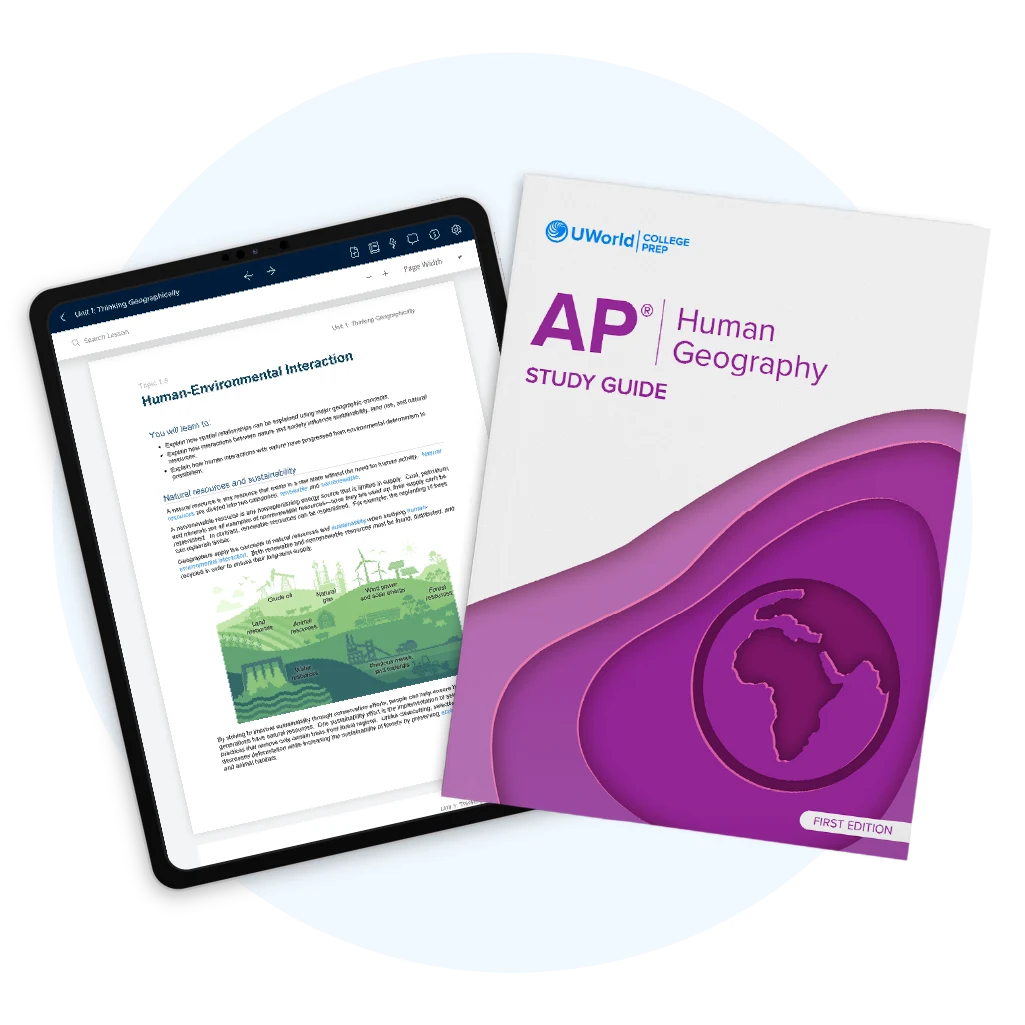
The study guide organizes economic development content into structured notes with visuals, diagrams, comparison charts, and checkpoints. You learn development theories, industrial location factors, global trade routes, economic sectors, and how to interpret HDI, GII, and other indices. This structure prepares you for AP Human Geography Unit 7 FRQ prompts that require clear reasoning.

Practice

Raise Your Exam Performance with Realistic AP Human Geography Unit 7 Practice Test Questions

Practice is essential to mastering Unit 7. These AP Human Geo Unit 7 practice test questions mirror real exam items with map analysis, data interpretation, and development model application. Detailed explanations help you understand both the correct answer and the logic behind eliminating distractors.
Try these sample practice questions with detailed answer explanations:
Industrial and Economic Development Patterns and Processes Practice Tests

Question

Which of the following is a likely outcome of microfinancing?

A. Increasing a country's Gross Domestic Product through loans to corporations
B. Raising the price of food and other basic necessities in the periphery
C. Diverting money from government defense projects to social welfare programs
D. Increasing the involvement of women in the family decision-making process
E. Slowing economic growth in less developed countries

Explanation

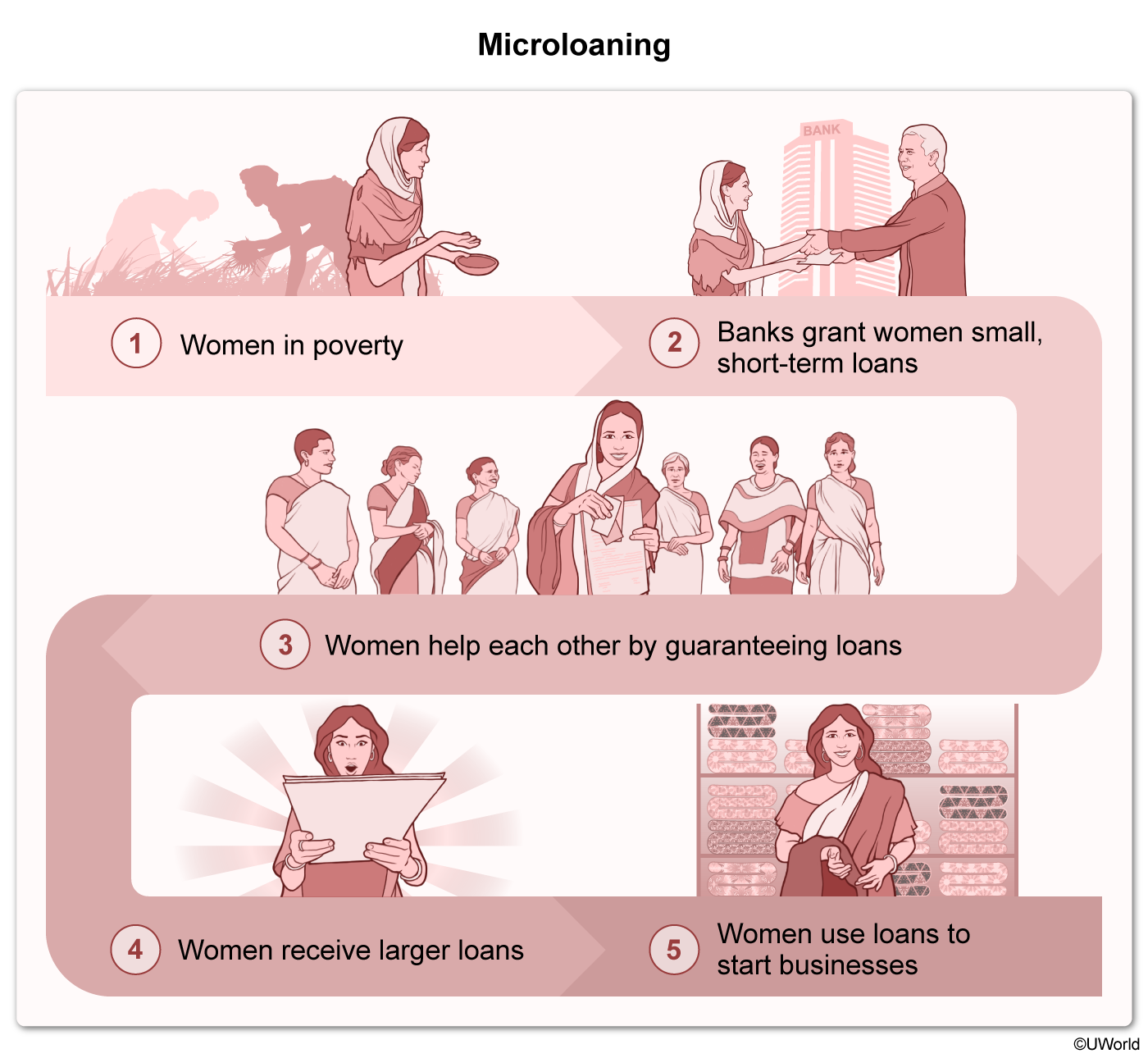
Microloans to women

Microfinancing is the act of giving by providing microloans (small loans) to individuals and small businesses, particularly in developing countries. Most of these loans, ranging from $200 to $2,000, are granted to women to improve their economic status in a community. In 2015, 100 million women received roughly $80 billion in microloans.

As a result of their improved economic status, women who receive microloans are increasingly involved in family decisions. For example, they are more likely to make financial choices independent of others in the home.

(Choice A) Microfinancing is directed toward individuals or small businesses, not corporations.

(Choice B) Microfinancing loans are small; therefore, the prices of food and basic necessities in the periphery are unlikely to rise.

(Choice C) Since microfinancing is directed at individuals and small businesses rather than governments, the money cannot be diverted from the military to social programs.

(Choice E) Since microfinancing improves the economic status of individuals and small businesses in less developed countries, it is more likely that economic growth in developing countries would rise, not decline.

Things to remember:
Microfinancing provides small loans to both small businesses and individuals, particularly women in developing countries. As a result, these women experience improved economic status and greater involvement in family decisions.

Question

The photograph above reflects which of the following?

A. Religious differences among Indonesians
B. The importance of foreign diplomacy
C. The significance of high crude death rates
D. The influence of rapid deindustrialization
E. The impact of low human development

Explanation

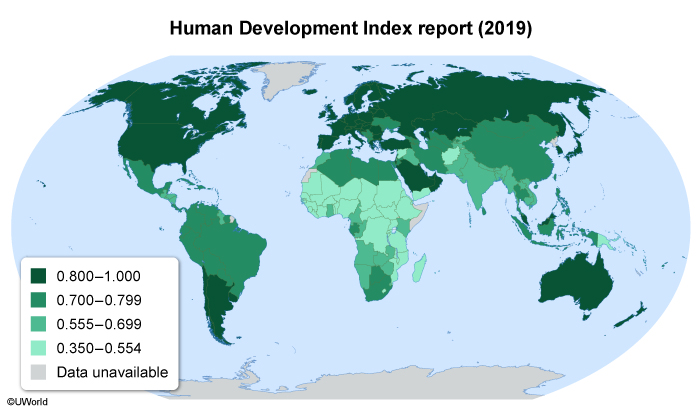
Human Development Index Report

Indonesia's Bantar Gebang landfill contains several villages and as many as 20,000 people. The on-site population consists of families whose children attend underfunded village schools. To supplement their parents' income, most children leave school by age ten to scavenge for recyclables full time, earning the equivalent of $2–$10 per day. This cycle of poverty is largely responsible for the area's low human development.

A country's Human Development Index (HDI) is based on its citizens' life expectancy, educational attainment, and the gross national income per capita. Currently at 0.718, Indonesia's HDI is considered high, but they rank 107th out of 189 countries.

Indonesia's overall HDI ranking has been negatively impacted by the low human development found in Bantar Gebang, where children rarely escape poverty. In response, international observers have pressured Indonesia to help address this concern and raise the area's HDI.

(Choices A and B) The photograph doesn't show religious differences among Indonesians or indicate the importance of foreign diplomacy.

(Choice C) Indonesia has a crude death rate of 6.57 per 1,000 people, which is considered low.

(Choice D) Classified as a newly industrialized country, Indonesia has not undergone deindustrialization.

Things to remember:
A country's Human Development Index (HDI) is based on its citizens' life expectancy, educational attainment, and gross national income per capita. The circumstances of people living and working near Indonesia's Bantar Gebang landfill indicate low human development, which negatively impacts the country's HDI.

Question

Which of the following concepts is most relevant to Rostow's modernization model?

A. Colonialism
B. Devolution
C. Cultural divergence
D. Economic development
E. Possibilism

Explanation

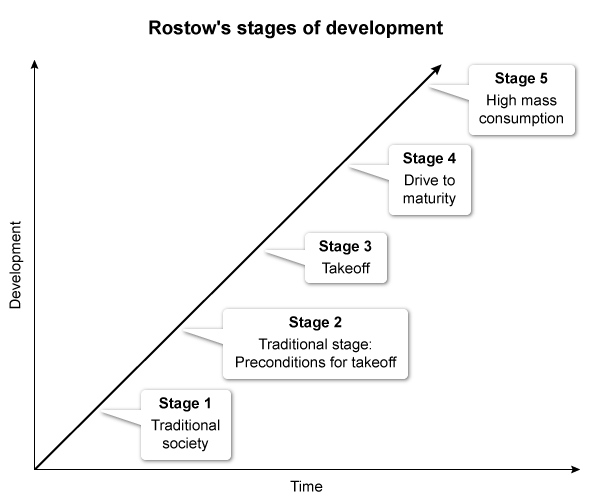
Rostow's modernization model

The decolonization of developing countries increased after WWII, and researchers began studying the economic development of the newly independent countries. The economist W.W. Rostow developed a theory that outlines the necessary stages of economic development a country must go through to modernize to be considered a developed nation:

  • In Stage 1, a traditional society becomes a developing country.
  • In Stage 2, educated individuals or wealthy groups introduce new technology and infrastructure.
  • In Stage 3, a limited amount of production occurs in a few industries.
  • In Stage 4, technologies spread to other industries and workers become specialized laborers.
  • In Stage 5, the country transitions from heavy industry to producing consumer goods.

(Choice A) Rostow's model was created during the postcolonial era and therefore isn't relevant to colonialism.

(Choices B and E) Devolution and possibilism aren't associated with any stage in Rostow's model.

(Choice C) Cultural divergence, the process by which cultural barriers cause increasing difference within cultures over time, doesn't apply to Rostow's model.

Things to remember:
The economist W.W. Rostow developed a theory suggesting that countries pass through five stages of economic development as they modernize and become developed nations.


UWorld Dark Blue logo

Carry Your Unit 7 Prep Wherever You Go

Turn short moments into powerful review sessions. Watch a video on development theories, answer AP Human Geo Unit 7 practice test questions during a break, or revisit explanations on the bus. The UWorld app helps you stay consistent and confident throughout your Unit 7 preparation.

Stand Out
with a Top Score in AP Human Geography

Complete your comprehensive AP Human Geo Unit 7 review to boost your performance and make yourself a standout candidate for competitive colleges, majors, and scholarships by earning a top score.

Choose Your Subscription
Dream Score Plan
360 Day
$169
Deep Learning Plan
180 Day
$149
Score Booster Plan
90-Day (No print book, only digital)
$129
Introductory Plan
30-Day (No print book, only digital)
$99

Get our all-in-one AP HUG review course today!

  • Focused AP HUG Videos
  • Print & Digital Study Guide
  • 300+ Exam-style Practice Questions
  • Customizable Quiz Generator
  • Adjustable Study Planner
  • Realistic Timed Test Simulation
  • Colorful Visual Explanations
  • Progress Dashboard
  • Smart Flashcards & Digital Notebook
Explore our free trial and frequently asked questions.

Hear From Our AP Students

UWorld’s service is pretty good and helps provide a lot of explanations on subjects I haven’t been confident on before.

—Bence P.

The questions here are the most realistic to the AP tests I've seen so far! I appreciate the ability to customize tests as well.

—Kaila H.

The best part is that all options are well-explained, telling clearly why they are not the right option.

—Syeda Huma Z.

Frequently Asked Questions (FAQs)

AP Human Geography Unit 7 focuses on why economic development varies across regions, how industries grow, and how globalization changes production and labor. To succeed, you need to understand models that explain economic change, as well as the spatial factors that influence where industries relocate. This unit enhances your ability to interpret data, analyze maps, and apply theories to real-world contexts. Using a structured resource like UWorld helps you make sense of these patterns in a way that feels logical rather than overwhelming.

Key topics in Unit 7 include:

  • The Industrial Revolution
  • Economic sectors and patterns
  • How economic development affects the roles of women
  • Trade and the world economy

Once you understand how these topics connect, Unit 7 AP Human Geography becomes much easier. You begin to understand why core and periphery relationships emerge, how industrial shifts impact labor, and why countries progress through development stages at varying rates. This prepares you well for AP Human Geography Unit 7 MCQ questions, FRQs, and progress checks.

Preparing for Unit 7 AP Human Geography requires understanding development theories and being able to apply them to real examples. You need to understand how industries evolve, why some countries industrialize more rapidly, and how economic inequality develops. Instead of trying to memorize every term, focus on understanding the logic behind industrial location and development stages. Using explanation-driven practice from UWorld helps because it shows you how to interpret economic data and identify spatial patterns accurately.

A strong Unit 7 study routine includes:

  • Reviewing development indicators and what each one measures
  • Studying models like Rostow, Wallerstein, and Weber
  • Analyzing maps that show industrial growth or development levels
  • Comparing economic sectors across core, semi-periphery, and periphery regions
  • Practicing AP Human Geo Unit 7 practice test questions
  • Using FRQ prompts to practice development-based explanations

This approach builds confidence because you learn how to recognize economic relationships instead of memorizing concepts out of context. Once you can tie development theories to real situations, you are ready for classroom tests, progress checks, and the AP exam.

Yes, several free resources can help you study AP Human Geography Unit 7, and the strongest starting point is UWorld’s free 7-day trial. It provides clear video lessons, interactive study guides, and realistic AP Human Geo Unit 7 practice test questions that explain development models, industrial shifts, and economic data step by step.

Beyond UWorld, you can find free global development datasets, short video explainers on industrialization, and map-based resources that show economic growth patterns. Teachers often share worksheets on Rostow’s model, Wallerstein’s theory, and industrial location factors. AP Classroom offers topic questions and progress checks aligned with the exam that help you see how Unit 7 is tested.

However, most free resources lack detailed explanations, which makes it harder to understand why countries develop differently or why industries relocate. That is why many students pair free materials with UWorld’s deeper reasoning support. This combination strengthens your understanding of Unit 7 and helps you prepare efficiently for both MCQs and FRQs.

The AP Human Geography Unit 7 test includes multiple choice questions, data interpretation, development model application, and FRQs that focus on economic growth, globalization, and industrial shifts. Instead of memorizing definitions, you need to recognize patterns in development indicators, understand spatial relationships, and explain why economic processes differ across regions. Many AP Human Geography Unit 7 MCQ questions require analyzing graphs, maps, and charts. UWorld helps you prepare because explanations show how to read economic data and identify the logic behind each pattern.

You can expect to see:

  • MCQs involving HDI, GII, GNI, and economic sector distribution
  • Data-based questions comparing development levels across countries
  • Model application tasks using Rostow or Wallerstein concepts
  • Items on industrial location, Weber’s theory, and cost minimization
  • Questions about globalization, outsourcing, and free trade zones
  • FRQs requiring explanations of development processes or economic change

Understanding how these question types work helps you approach the unit confidently. You begin to recognize economic patterns, interpret data more quickly, and apply theories accurately. This prepares you well for classroom quizzes and the AP Human Geo Unit 7 exam.

Improving your Unit 7 FRQ performance requires a clear understanding of development models, the ability to compare countries, and strong economic reasoning. FRQs often ask you to explain why development varies, how globalization affects production, or how industries relocate. Many students lose points because they describe terms without connecting them to real examples. Using explanation-driven practice, such as UWorld, strengthens your reasoning by showing you how to justify each point clearly for AP Human Geography Unit 7 FRQ tasks.

An effective FRQ strategy includes:

  • Defining economic concepts before applying them
  • Using real examples from the core, semi-periphery, and periphery regions
  • Referencing development indicators to support your reasoning
  • Explaining how industrial location factors influence economic growth
  • Organizing responses in separate, clear points
  • Practicing with FRQ prompts to build clarity and speed

With this method, FRQs become easier to handle. You learn how to explain economic relationships, compare development patterns, and apply theories correctly. This builds strong confidence for classroom FRQs and the AP exam.

Unit 7, which accounts for 12-17% of the exam score, directly connects to patterns in agriculture, migration, political geography, and cities, making it a central part of the course. Economic development plays a major role on the AP Human Geography exam because it explains why countries grow at different rates, how global systems shape economies, and how industries move across space. 

Several AP Human Geography Unit 7 MCQ items require analyzing development indicators, comparing countries, or understanding how globalization influences production. FRQs often ask students to apply development models, explain why certain regions industrialize faster, or evaluate the effects of outsourcing and trade networks. The exam rewards students who understand the logic behind economic disparities rather than memorizing terms. 

Using a resource like UWorld helps you break these concepts down with clear explanations that link theories to real-world examples. Understanding economic development enables you to interpret data graphs, read global maps, and explain why economic change occurs. This makes Unit 7 one of the most important foundations for success across the entire AP Human Geography exam.

A strong AP Human Geography Unit 7 study guide should help you understand how industry, development, and globalization shape each other. This unit contains several models and indicators, and without a clear guide, it is easy to feel lost. You want a resource that clearly explains each concept, provides real-world examples, and effectively utilizes visuals to connect ideas. UWorld supports this because its structured notes and explanations walk you through development patterns step by step, making your AP Human Geography Unit 7 study guide review more effective.

A high-quality Unit 7 study guide should include:

  • Development indicators such as HDI, GNI, GII, and economic sectors
  • Explanations of development models like Rostow and Wallerstein
  • Industrial location concepts, including Weber’s Least Cost Theory
  • Real examples of outsourcing, deindustrialization, and global supply chains
  • Questions that reinforce understanding instead of memorization

When your guide presents information clearly and visually, Unit 7 becomes easier to grasp. You begin to recognize why some countries industrialize rapidly while others lag, and you develop the ability to connect development theory to real-world regions. This helps you answer AP Human Geo Unit 7 review questions with confidence.

Yes, there are practice tests specifically focused on Unit 7, which help you understand how the exam assesses industrial and economic development concepts. These practice tests challenge you to interpret data, apply development models, and analyze global economic relationships. They also prepare you for the style and difficulty level of AP Human Geography Unit 7 MCQ questions. UWorld offers realistic practice tests with detailed explanations that strengthen your reasoning and help you identify patterns across economic development scenarios.

A strong Unit 7 practice test should include:

  • MCQs that compare development indicators across countries
  • Questions using Rostow or Wallerstein models
  • Scenarios involving industrial location and Weber’s theory
  • Items on outsourcing, deindustrialization, and free trade zones
  • Data interpretation tasks using charts or maps
  • Explanations that show how the economic process works

Working through these questions helps you predict what the exam expects. You learn to quickly interpret graphs, apply theories correctly, and understand how development varies across different regions. This leads to stronger performance on AP Human Geo Unit 7 practice test assessments.

Preparing for the AP Human Geography Unit 7 progress check requires a clear understanding of economic development models, global production patterns, and the indicators that measure development. The progress check MCQs focus heavily on data interpretation and theoretical application, so start by reviewing key concepts such as HDI, GII, GNI, development sectors, and major models like Rostow’s and Wallerstein’s. Then spend time analyzing maps and charts that show industrial growth, economic disparities, or trade networks. 

After reviewing the concepts, practice with AP-style questions to strengthen your reasoning. UWorld offers a check for understanding experience that mirrors the logic and structure of AP Classroom, enabling you to work through real-world development scenarios. The explanations not only show why an answer is correct but also why the distractors fail, which is essential for building accuracy. Reviewing your mistakes is key because it helps you identify weak areas before taking the progress check. When you combine concept review with consistent practice, the Unit 7 progress check MCQs for AP Human Geography become much easier to handle, boosting both clarity and confidence for the exam.

Unit 7 encompasses a range of complex components, including development indicators, global trade networks, industrial location factors, and world systems. Without structure, these concepts can blend. Staying organized helps you not only understand each idea but also see how they connect. A clear study structure, combined with reasoning-based practice from UWorld, enables you to build a predictable and effective review system, making your AP Human Geography Unit 7 review less stressful.

A strong organization method includes:

  • Separating topics into themes like development models, indicators, and industrial location
  • Using charts to compare Rostow’s stages and Wallerstein’s world system framework
  • Taking notes on examples of outsourcing, deindustrialization, and trade zones
  • Reviewing AP Human Geo Unit 7 MCQ items in small, consistent batches
  • Revisiting economic indicators regularly to reinforce understanding

Once you create this structure, Unit 7 content becomes easier to navigate. You start recognizing patterns more quickly, making it easier to interpret data and apply models accurately. This organization helps you build confidence for the AP exam, classroom tests, and FRQs.

Many students struggle with Unit 7 because the concepts involve data analysis, theoretical application, and understanding how development varies across real places. Mistakes often occur when trying to memorize all the vocabulary instead of understanding how the ideas work together. Using guided explanations from a resource like UWorld helps you avoid these errors by strengthening your reasoning and building clearer links between concepts.

The most common mistakes include:

  • Confusing development indicators or misreading economic data
  • Mixing up Rostow’s model stages or applying them incorrectly
  • Misinterpreting Wallerstein’s core and periphery relationships
  • Treating GII and GNI as interchangeable instead of distinct measures
  • Applying Weber’s Least Cost Theory without considering transport or labor costs
  • Forgetting how globalization changes production and supply chains
  • Providing weak, vague examples in FRQs instead of concrete cases

Recognizing these mistakes early helps you avoid them on exams. When you focus on understanding processes rather than memorizing terms, industrial and economic development patterns become easier to explain and apply. This leads to stronger performance on AP Human Geography Unit 7 MCQs, FRQs, and progress checks.

Yes, you can study Unit 7 offline, which is especially useful for reviewing economic development concepts without needing constant internet access. Offline study works well for this unit because many ideas can be reinforced through diagrams, notes, and practice with economic indicators. 

UWorld allows you to download question sets so you can work through AP Human Geo Unit 7 practice test problems, revisit explanations, or check development models even when you’re offline. Pairing downloaded questions with printed charts or maps helps you practice interpreting HDI, GII, GNI, and sector data. 

Offline study also gives you the freedom to review industrial location factors, globalization impacts, or trade networks during commutes or short breaks. Once you reconnect, the UWorld mobile app syncs your progress, keeping your performance data up to date. This flexibility helps you stay consistent, avoid gaps in studying, and build confidence for the AP Human Geography Unit 7 exam. By combining offline practice with your regular study sessions, you strengthen your understanding of development patterns and walk into your test feeling prepared.

Scroll to Top

Master AP Geo

Everything You Need
For a Top Score
No Credit Card Required
See the UWorld Difference For Yourself

Frequently Asked Questions

New Purchase: All new subscriptions go into effect from the time they are activated and not at the time of setup/purchase. A subscription can be activated immediately or any time thereafter. If your initial purchase consists of multiple courses (Qbank, Self-Assessment exam, CCS, etc.), each can be activated individually and independently via your account on our website. This process of activating a subscription after purchase allows you the flexibility to start a subscription when you are truly ready to use it.

We recommend that all subscriptions be activated within 180 days of setup/purchase. Once a subscription is activated, it cannot be paused or suspended for any reason and will run continuously for the duration of the course material.

Renewal: A renewal is an extension of time to continue access to a current activated subscription. Because a renewal is an extension to an already active subscription, it is effective from the existing expiration date, not from the day of purchase and cannot be deferred to start at a later date/time.

Note: All of our subscriptions are based on the Eastern Time Zone (GMT/UTC -5 hours or New York Time), which may be different than your local time zone.

Any of our product offerings can be purchased from our website with payment due in full at time of purchase via a credit or debit card with American Express/Discover/MasterCard or Visa logo.

You will need to register for an account in order to purchase any of our products. Once you have registered for an account or if you already have an account:

  • Log in to your UWorld account
  • Click on the Cart icon at the top of the page and then select your desired product to see a list of available packages and their prices
  • Select the package you wish to purchase
  • Verify your profile information, address, and educational status, then click the Update button
  • Enter your Billing address and credit/debit card information, then click Review Order
  • Verify that the correct product is in your cart and click Place Order
  • A purchase receipt will automatically be sent to your registered email address

If you complete your purchase but do not receive a receipt, please contact the Customer Care Team at [email protected]

You can subscribe to any of our online courses/services using a credit or debit card with a Visa, MasterCard, Discover or American Express logo. After a successful payment, your subscription will immediately be available for activation via your account on our website or available complementary mobile applications.

You can also subscribe via personal check, money order, or demand drafts taken in U.S. dollars. These types of payments should be mailed to us and should include the name of the subscription and the duration, along with the details asked for in the registration form. We will set up your account as soon as we receive your payment and notify you via email of your access credentials. All direct-mail payments must be in U.S. dollars and made payable to:

UWorld, LLC
9111 Cypress Waters Blvd
Suite 300
Dallas, TX 75019

We do not accept cash via mail, currencies other than U.S. dollars or payments via fax.

Individuals purchasing our CPA Review product may finance their purchase using Affirm during checkout process. Your eligibility depends on your credit score and other criteria, as per Affirm’s policies (outlined here). A soft credit check, a credit check that does not affect your credit score, will be performed by Affirm to determine your loan eligibility. You will need a US based bank account to qualify.

All refunds are evaluated on a case-by-case basis for products purchased directly from UWorld. One case has no bearing on another. Refund amounts determined by UWorld are final.

In-App Purchases: We are unable to process any refunds for purchases made via mobile application (in-app). Please contact Apple for all refund/credit requests for Apple in-app purchases.

USMLE Step 2 CS, Step 3 CCS, Subject Reviews & Self-Assessment Exams: These subscriptions are non-refundable, non-transferable, and cannot be converted into another subscription.

CPA Review: Students may request to cancel their CPA review product only within 10-days of activation of any of the materials. To qualify for a refund, no more than 10% of the course (lectures, Qbank, or a combination there-of) may have been used per exam section. All CPA Review refunds are subject to a cancellation fee of $75 (for single section purchases) or $250 (for package
purchases), plus any applicable shipping charges. No return of merchandise is necessary.

All other Qbanks: Refunds are considered for subscriptions of more than 30 days. Refund amounts are based on the number of days elapsed since the subscription start date or the number of questions used, whichever amounts to a higher deductible.

Example scenarion: An individual purchases a 180-day Qbank subscription and generates a few test blocks equal to 20% of the questions in the Qbank. After 45 days, he/she requests a refund. Because the elapsed duration is greater than the percentage of questions used, the refund amount will be based on a subscription converted to the closest duration (60 days) by deducting the applicable 60-day subscription fee from the refund. In the same scenario, if the individual had used 85% of the questions, the refund would be 15% of the subscription fee paid.

Note 1: A processing fee of 10% (minimum of $10 and maximum of $25) will be applied to all refund amounts.

Note 2: All refunds, pro-rated or otherwise, must be requested within 360 days of original purchase. Refunds for purchases made more than 360 days ago will be issued as non-refundable, non-transferable store credit.

Note 3: Subscribers must notify UWorld of their intent to obtain a refund before activating their subscription (or) during the active duration. If the reset option is used or all of the questions are used, no refund will be allowed (see “I want to reset/delete my Qbank test history (or) start all over again, is this possible?” below for further details). No refunds will be offered for expired subscriptions.

Note 4: For combination package purchases, individual subscription fees will be applied when calculating the refund. If any self-assessment Exam(s) is utilized from a package, the entire purchase is rendered non-refundable.

Note 5: Although access to Qbanks via certain mobile devices is provided as an additional feature, it is not intended to be a replacement for computer access, and no refunds or cancellations will be honored due to user inability to install and/or use the provided software on any mobile device (regardless of whether the device meets the minimum system requirements).

Please use the following steps to purchase a renewal for your subscription:

  • Log in to your account on our website
  • Click on the User Icon in the top right corner of the screen
  • Click on the Renew button corresponding to your subscription
  • Select the Renewal duration you wish to purchase
  • Verify your profile information, address, and educational status, then click the Update button
  • Enter your Billing address and credit/debit card information, then click Review Order
  • Verify that the correct package is in your cart and click Place Order

Upon a successful transaction, you will be sent a confirmation email receipt.

A renewal is an extension of time to continue accessing an active subscription, and it will not start the subscription over, provide a reset, or grant access to additional questions that were not previously accessible. Because a renewal is an extension to an already active subscription, it is effective from the existing expiration date, not from the date of purchase, and cannot be deferred in any way to start at a later date/time.

Please note that to qualify for renewal pricing, you will need to renew the course before it expires. Renewals are not offered to expired subscriptions. If you fail to secure a renewal before the expiration date, you will need to purchase a new subscription at the regular price directly from our website to regain access to the material.

Note: All times and dates displayed for subscription expiration correspond with the Eastern Time Zone (GMT/UTC -5 hours or New York Time), which may be different than your local time zone.

Note: If your initial purchase was a combination package, you will need to renew each active subscription individually. You do not need to renew a course that has not been activated.

You may request to upgrade or downgrade your subscription purchase as long as it has not been activated. If you purchase a combination package, all included subscriptions must be unused. Please be advised that current subscription pricing will apply.

If your subscription has been activated, unfortunately, we cannot upgrade it retroactively. If seeking to downgrade, please refer to our refund policy for available options.

We do not offer custom duration(s) or combination packages other than those outlined on the website. Please refer to our purchase page for currently available subscriptions (including discounted combination packages for some products).

Self-Assessment exam subscriptions are for 14 days each. Subscribers whose active subscription(s) have not expired can purchase renewals from 7 days or more at any time before their active subscription expires. Please refer to the respective course description page for renewal options.

We offer a demo on each of our product pages that contains a sample of the product interface and a few sample questions. We do not offer guest/trial accounts to test our software and view materials.

It is possible to purchase a subscription as a gift for someone else. However, the intended recipient will need to register an account on our website (or have an account registered for them, with their profile information entered accurately). If the user is present at the time of purchase, the purchase can be made from their account on our website using any credit or debit card with a Visa, MasterCard, American Express, or Discover logo.

If the user is not present, or you wish for the gift to be a surprise, please contact Support directly using the contact form to arrange payment for the gift subscription. You will need to provide the user’s registered email address so the account can be located.