

FREE Ground Shipping on Courses $149+ | Code: SANTASENDSFREE

AP® Human Geography Unit 5 Review and Practice Test

Agriculture and Rural Land-Use Patterns and Processes

Prepare for AP® Human Geography Unit 5 with clear videos, study guides, and AP Human Geo Unit 5 practice test questions that break down agriculture and rural land-use patterns so you can strengthen your understanding and build confidence for the exam.

AP Human Geography prep course suite by UWorld

Explore AP Human Geography Unit 5 with Targeted,
Concept-Driven Review

Understand how agriculture shapes economies, landscapes, and communities with an AP® Human Geo Unit 5 review built for clarity and real exam alignment. These resources guide you through food production systems and rural land-use patterns so you can approach Unit 5 questions with confidence.

Watch

Engaging Video Lessons

Explore AP Human Geography Unit 5 with video lessons that break down agriculture, food production systems, and rural land-use patterns in a clear, visual way. Each AP Human Geo Unit 5 lesson connects real-world farming examples to exam topics. These videos make complex geographic processes easier to follow and retain.

Read

Interactive Study Guides

Work through AP Human Geography Unit 5 topics with interactive study guides that simplify agricultural systems, land-use models, and farming practices. Each AP Human Geo Unit 5 study guide uses clear visuals, summaries, and definitions to help you understand how agriculture shapes rural landscapes.

Practice

Test Your Knowledge with AP Human Geography Unit 5 Practice Sets

Prepare for the AP Human Geography Unit 5 test by working through practice sets focused on agriculture, food production, and rural land-use processes. These AP Human Geo Unit 5 practice test questions reflect real exam expectations, giving you a stronger foundation for success.
Try these sample practice questions with detailed answer explanations:
Agriculture and Rural Land-Use Patterns and Processes Practice Tests

Passage:

Question

Which of the following best describes an effect of irrigation?

A. Land cover change
B. Acid precipitation
C. Monoculture
D. Soil salinization
E. No-tillage cultivation

Explanation

Increased Soil Salinization

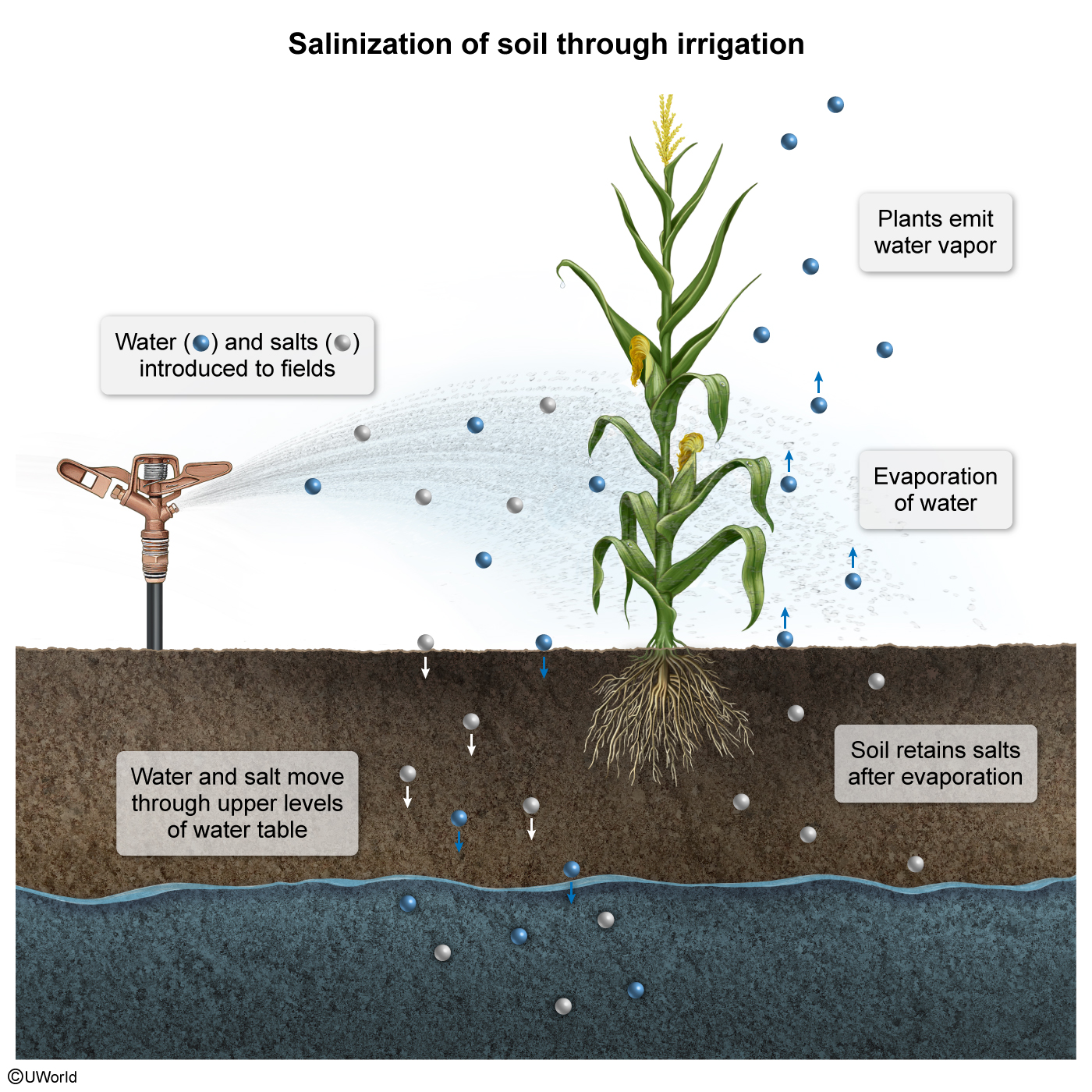
Irrigation systems contribute to the growth of crops by drawing water from environmental sources, such as rivers and reservoirs. In those waters are sediments composed of various minerals, including salt. When fields are irrigated and the water evaporates, the salt is left behind in the soil. Therefore, one effect that irrigation has on the environment is increased soil salinization.

Soil salinization decreases fertility because the high salt content reduces plants' ability to absorb water from the ground. To prevent this, farmers must carefully monitor the irrigation of their fields and periodically test the soil for salinity (salt content).

(Choice A) Irrigation tends to extend or preserve agricultural areas. Therefore, it is unlikely to contribute to land cover change, in which agricultural lands are lost to the growth of urban areas.

(Choice B) Acid precipitation is caused by sulfur dioxide and nitrogen oxide mixing with atmospheric moisture, not water from irrigation.

(Choices C and E) The irrigation of crops has little influence on whether farmers practice monoculture or no-tillage cultivation.

Things to remember:
One adverse effect of irrigation on the environment is increased soil salinization, which reduces the ability of plants to absorb water.
Question

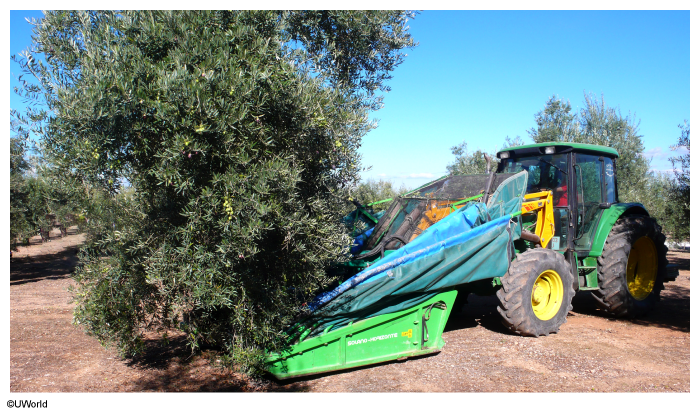
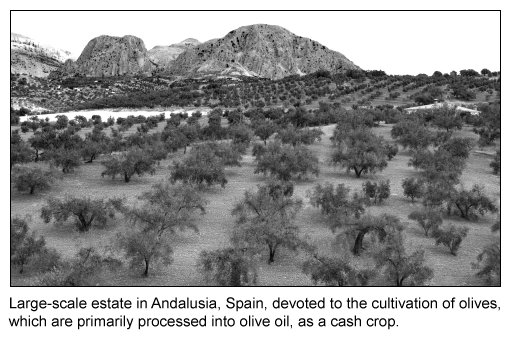
Which factor is most responsible for the large-scale cultivation of Spanish olives shown in the picture above?

A. A decrease in Spain's dependence on olive oil exports
B. An improvement in harvesting technologies
C. An increase in the salinity of Spanish soils
D. The United States' increased tariffs on Spanish olive oil
E. The reterritorialization of Spanish olives

Explanation

Improvements in Harvesting

Mechanization has permitted the expansion of both businesses and economies. In the olive industry, improvements in harvesting technologies increase efficiency and eliminate the cost of harvesting by hand, which is the highest cost in olive production worldwide.

By mechanizing their harvests, Spain's olive growers can expand by buying more land on which to grow olives. This process increases olive producers' economies of scale, a factor that permits the large-scale cultivation of olives worldwide.

(Choice A) Spain exports nearly 50% of the world's olive oil, which has increased the country's dependence on its olive production.

(Choice C) Soil salinization is known to hinder the growth of plants, including olives, so increasing soil salinity would typically prevent the emergence of large-scale olive plantations.

(Choice D) US import tariffs on Spanish olive oil likely restrict the large-scale cultivation of Spanish olives.

(Choice E) Olive production has been a part of this region's culture for thousands of years, so reterritorialization doesn't apply to Spanish olives.

Things to remember:
In the olive industry, mechanical harvesters increase efficiency and eliminate the cost of hand harvesting. This allows Spain's olive growers to expand by buying more land, which increases olive producers' economies of scale.

Passage:

Image 1:
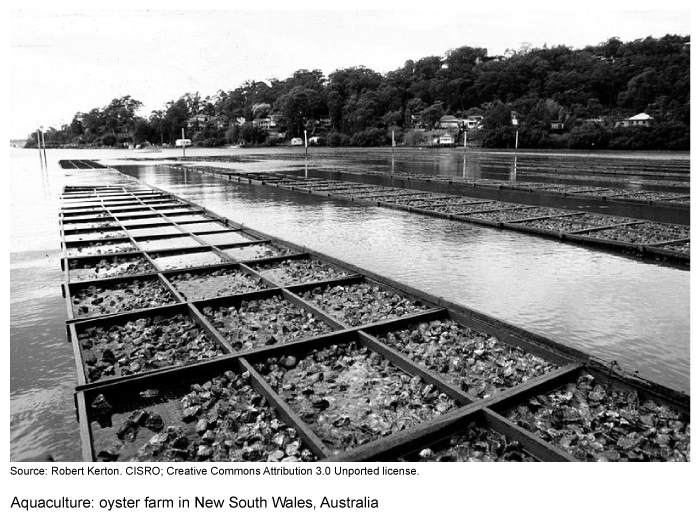
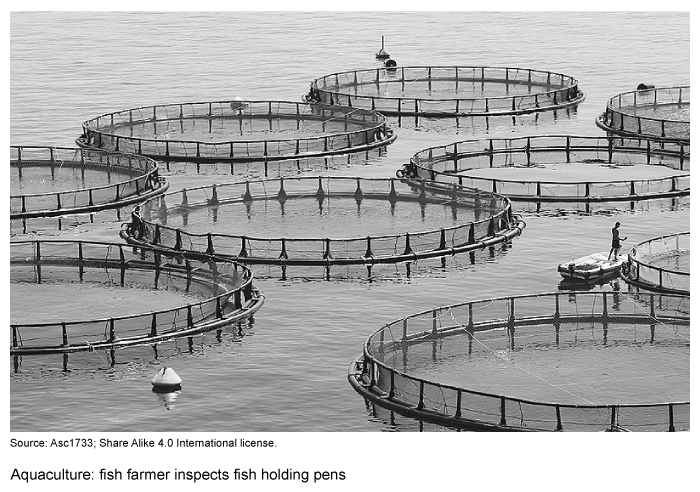
Aquaculture: pros

Image 2:

Aquaculture: cons

Question

Which of the following statements best describes the effects of aquaculture on developing nations?

A. Since aquaculture accounts for a small percentage of total food production, the economies of developing countries will likely not change
B. Through the fair trade of cultured fish in international markets, the economies of developing nations will likely improve
C. Owing to the large differences in food distribution systems, the economies of developing nations will likely decline
D. Because of aquaculture's positive effects on the oxygen cycle, the economies of developing nations will likely improve
E. Because of the global trend away from primary economic activities, the economies of developing nations will likely decline

Explanation

Globalization has Eroded Native Cultures

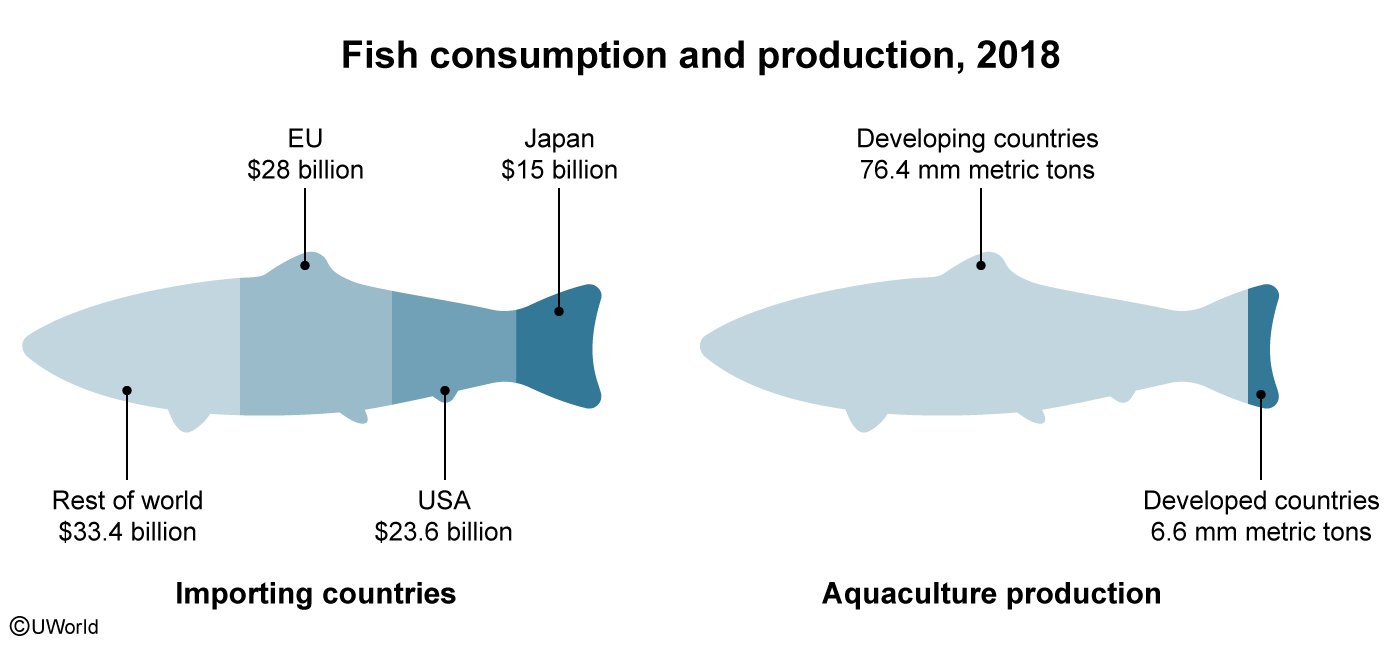
In 2019, the nearly $285 billion aquaculture industry accounted for over 50% of the fish consumed worldwide. Developed nations such as Japan, the US, and European states import the majority of farmed and captured fish harvests—most of which come from aquaculture in the developing world.

To boost their economies, developing nations—which are responsible for 90% of worldwide aquacultural production—pursue fair trade deals to ensure the best prices for their fish farmers. Considering the industry's value and the percentage produced by developing nations, the fair trade of cultured (farm-raised) fish in international markets will likely improve developing nations' economies.

(Choice A) Developing countries account for over 90% of cultured fish consumed worldwide, which helps improve their economies.

(Choice C) Farmers in developing nations sell their fish harvests wholesale and aren't a part of the distribution process.

(Choice D) Aquaculture generally has negative, not positive, effects on the oxygen cycle. These include increased biochemical oxygen demand and undesirable levels of dissolved oxygen in marine ecosystems.

(Choice E) Because primary economic activities are the base source of food for global populations, there isn't a global trend to turn away from activities like aquaculture.

Things to remember:
Accounting for roughly 90% of all aquacultural production, developing nations' economies will likely improve through the fair trade of cultured (farm-raised) fish that they export in international markets.


UWorld Dark Blue logo

Study Anywhere, Anytime

Study on your schedule with instant access to AP Human Geography Unit 5 review tools wherever you are. Whether you’re commuting, between classes, or taking a quick break, you can review agriculture concepts, explore rural land-use patterns, or complete practice test questions right from the UWorld app.

Stand Out
with a Top Score in AP Human Geography

Boost your performance and make yourself a standout candidate for competitive colleges, majors, and scholarships by earning a top score.

Choose Your Subscription
Dream Score Plan
360 Day
$169
Deep Learning Plan
180 Day
$149
Score Booster Plan
90-Day (No print book, only digital)
$129
Introductory Plan
30-Day (No print book, only digital)
$99

Get our all-in-one AP HUG review course today!

  • Focused AP HUG Videos
  • Print & Digital Study Guide
  • 300+ Exam-style Practice Questions
  • Customizable Quiz Generator
  • Adjustable Study Planner
  • Realistic Timed Test Simulation
  • Colorful Visual Explanations
  • Progress Dashboard
  • Smart Flashcards & Digital Notebook
Explore our free trial and frequently asked questions.

Hear From Our AP Students

quote

UWorld’s service is pretty good and helps provide a lot of explanations on subjects I haven’t been confident on before.

—Bence P.
quote

The questions here are the most realistic to the AP tests I've seen so far! I appreciate the ability to customize tests as well.

—Kaila H.
quote

The best part is that all options are well-explained, telling clearly why they are not the right option.

—Syeda Huma Z.

Frequently Asked Questions (FAQs)

AP Human Geography Unit 5 explores how agriculture develops, spreads, and operates across different landscapes. These concepts appear frequently in AP Human Geo Unit 5 practice test questions and help explain how farming shapes rural and global systems.

Key Unit 5 Topics:

  • How physical geography influences farming practices: Terrain, climate, and soil determine what farmers grow and how they grow it.
  • The origins and spread of agriculture: Examines early agricultural hearths and how farming innovations diffused worldwide.
  • The Green Revolution: High-yield seeds and modern technology that dramatically increased food production.
  • How farming practices affect the environment and society: Analyzes sustainability, pollution, land use, labor systems, and economic impacts.

These ideas form the foundation of your AP Human Geography Unit 5 review and appear often in AP HUG Unit 5 FRQs and MCQs.

A strong study plan for Unit 5 focuses on understanding agricultural systems, land-use patterns, and the geographic forces behind them. Using a balanced structure like Read, Watch, and Practice helps you prepare efficiently.

  • Read: Use UWorld’s AP Human Geo Unit 5 study guides to review key models, farming types, and the environmental effects of agriculture.
  • Watch: Engaging Unit 5 video lessons help you visualize land-use patterns, the Green Revolution, and the historical development of agriculture.
  • Practice: Work through AP Human Geography Unit 5 practice test questions to strengthen your ability to interpret maps, graphs, and real-world examples.

This approach prepares you to handle both MCQs and FRQs with confidence.

Yes. You can begin your AP Human Geography Unit 5 review with several high-quality free resources that introduce the essential agricultural concepts covered in this unit.

UWorld’s 7-Day Free Trial gives you access to Unit 5 video lessons, interactive study guides, and AP Human Geo Unit 5 practice test questions, allowing you to experience how the platform simplifies agriculture and rural land-use patterns.

College Board AP Classroom provides AP Daily videos, Unit 5 progress checks, and official course materials, while Khan Academy offers free lessons that reinforce agricultural patterns and rural land-use concepts. These resources help you build a strong foundation before choosing a full study program.

The AP Human Geography Unit 5 test features questions that measure your understanding of agricultural processes, spatial patterns, and environmental impacts.

You’ll encounter:

  • Multiple-choice questions (MCQs): Interpret maps, land-use models, charts, agricultural regions, and case studies related to farming and food production.
  • Free-Response Questions (FRQs): Require written analysis using agricultural concepts, environmental impacts, and real-world rural land-use examples.

Practicing AP Human Geo Unit 5 practice test questions helps you recognize how Unit 5 concepts appear on the exam.

Scoring well on Unit 5 FRQs requires clear explanations and accurate application of agricultural concepts. Strong responses break down geographic relationships and connect farming practices to broader consequences.

To improve your performance:

  • Use diagrams such as the Von Thünen Model when relevant.
  • Describe how physical geography guides farming decisions.
  • Incorporate examples from the Green Revolution or agricultural diffusion.
  • Explain economic and environmental impacts using precise geographic terms.

Review UWorld’s step-by-step explanations in AP Human Geo Unit 5 practice items to see effective reasoning in action. Consistent practice builds the clarity and organization needed for high-scoring FRQs.

Unit 5 carries notable importance on the AP Human Geography exam because agriculture plays a central role in connecting economic systems, environmental challenges, and global development trends. Understanding these relationships helps you interpret how farming shapes both local and global landscapes.

On the multiple-choice section, Unit 5 typically represents about 12–17% of the exam, and Free-Response Questions (FRQs) often include agricultural examples even when prompts blend content from multiple units. This makes agricultural concepts relevant across different question types.

Topics such as farming types, land-use models, food production systems, and sustainability appear frequently throughout the exam. A strong AP Human Geography Unit 5 review can significantly strengthen your overall performance and boost your confidence on test day.

You’ll find one of the most effective AP Human Geography Unit 5 study guides in UWorld’s AP Human Geography Course. The guide breaks down agricultural origins, farming systems, the Green Revolution, and rural land-use patterns in a way that is easy for students to understand and apply.

UWorld’s Unit 5 study guide features visual summaries of major agricultural concepts, clear definitions of AP Human Geo Unit 5 vocabulary, and simplified explanations of land-use models and environmental impacts. These elements help you grasp complex ideas quickly and accurately.

In addition to concise summaries, the study guide includes integrated practice questions that reinforce each topic and support faster recall. It’s designed to help you understand and remember the most important Unit 5 concepts so you feel confident going into the exam.

Yes. UWorld offers AP HUG Unit 5 practice test questions that closely match real exam style and difficulty. These questions cover agricultural origins, food production systems, and rural land-use processes with detailed explanations to reinforce understanding.

Other sources include:

  • College Board AP Classroom: Unit 5 progress checks
  • Khan Academy: Limited agriculture-related practice

For the most realistic preparation, UWorld remains the strongest option for Unit 5 MCQs and FRQs.

AP Human Geography Unit 5 builds a bridge between classroom concepts and real-world agricultural challenges. By understanding farming systems, land-use patterns, and food production methods, students can better interpret global issues shaping communities today.

Many of the environmental and economic concerns discussed in the unit, such as soil degradation, sustainability, and shifts in food demand, mirror the problems countries face as populations grow and resources become strained. These connections help you see how agricultural decisions directly affect societies and landscapes.

Reviewing AP Human Geo Unit 5 study guides and practice test questions makes it easier to visualize how local farming practices contribute to broader environmental outcomes. This perspective strengthens your ability to analyze current events through a geographical lens, a valuable skill for both the exam and real-life understanding.

Agricultural models are essential tools in AP Human Geography Unit 5 because they help explain how farmers choose land, resources, and production methods. Models such as Von Thünen’s and the Boserup Theory show how economic forces, population pressures, and land value shape farming decisions.

These models also help you identify patterns such as where certain crops are grown, why some areas specialize in livestock, or how market access affects food production. Understanding these relationships strengthens your confidence when interpreting maps, diagrams, and spatial patterns on the exam.

When you use UWorld’s AP Human Geo Unit 5 practice test questions, you see how these models appear in real exam-style scenarios. This exposure builds your ability to apply each model accurately, which is a key skill for both multiple-choice questions and FRQs on the AP exam.

Scroll to Top

Master AP Geo

Everything You Need
For a Top Score
No Credit Card Required
See the UWorld Difference For Yourself

Frequently Asked Questions

New Purchase: All new subscriptions go into effect from the time they are activated and not at the time of setup/purchase. A subscription can be activated immediately or any time thereafter. If your initial purchase consists of multiple courses (Qbank, Self-Assessment exam, CCS, etc.), each can be activated individually and independently via your account on our website. This process of activating a subscription after purchase allows you the flexibility to start a subscription when you are truly ready to use it.

We recommend that all subscriptions be activated within 180 days of setup/purchase. Once a subscription is activated, it cannot be paused or suspended for any reason and will run continuously for the duration of the course material.

Renewal: A renewal is an extension of time to continue access to a current activated subscription. Because a renewal is an extension to an already active subscription, it is effective from the existing expiration date, not from the day of purchase and cannot be deferred to start at a later date/time.

Note: All of our subscriptions are based on the Eastern Time Zone (GMT/UTC -5 hours or New York Time), which may be different than your local time zone.

Any of our product offerings can be purchased from our website with payment due in full at time of purchase via a credit or debit card with American Express/Discover/MasterCard or Visa logo.

You will need to register for an account in order to purchase any of our products. Once you have registered for an account or if you already have an account:

  • Log in to your UWorld account
  • Click on the Cart icon at the top of the page and then select your desired product to see a list of available packages and their prices
  • Select the package you wish to purchase
  • Verify your profile information, address, and educational status, then click the Update button
  • Enter your Billing address and credit/debit card information, then click Review Order
  • Verify that the correct product is in your cart and click Place Order
  • A purchase receipt will automatically be sent to your registered email address

If you complete your purchase but do not receive a receipt, please contact the Customer Care Team at [email protected]

You can subscribe to any of our online courses/services using a credit or debit card with a Visa, MasterCard, Discover or American Express logo. After a successful payment, your subscription will immediately be available for activation via your account on our website or available complementary mobile applications.

You can also subscribe via personal check, money order, or demand drafts taken in U.S. dollars. These types of payments should be mailed to us and should include the name of the subscription and the duration, along with the details asked for in the registration form. We will set up your account as soon as we receive your payment and notify you via email of your access credentials. All direct-mail payments must be in U.S. dollars and made payable to:

UWorld, LLC
9111 Cypress Waters Blvd
Suite 300
Dallas, TX 75019

We do not accept cash via mail, currencies other than U.S. dollars or payments via fax.

Individuals purchasing our CPA Review product may finance their purchase using Affirm during checkout process. Your eligibility depends on your credit score and other criteria, as per Affirm’s policies (outlined here). A soft credit check, a credit check that does not affect your credit score, will be performed by Affirm to determine your loan eligibility. You will need a US based bank account to qualify.

All refunds are evaluated on a case-by-case basis for products purchased directly from UWorld. One case has no bearing on another. Refund amounts determined by UWorld are final.

In-App Purchases: We are unable to process any refunds for purchases made via mobile application (in-app). Please contact Apple for all refund/credit requests for Apple in-app purchases.

USMLE Step 2 CS, Step 3 CCS, Subject Reviews & Self-Assessment Exams: These subscriptions are non-refundable, non-transferable, and cannot be converted into another subscription.

CPA Review: Students may request to cancel their CPA review product only within 10-days of activation of any of the materials. To qualify for a refund, no more than 10% of the course (lectures, Qbank, or a combination there-of) may have been used per exam section. All CPA Review refunds are subject to a cancellation fee of $75 (for single section purchases) or $250 (for package
purchases), plus any applicable shipping charges. No return of merchandise is necessary.

All other Qbanks: Refunds are considered for subscriptions of more than 30 days. Refund amounts are based on the number of days elapsed since the subscription start date or the number of questions used, whichever amounts to a higher deductible.

Example scenarion: An individual purchases a 180-day Qbank subscription and generates a few test blocks equal to 20% of the questions in the Qbank. After 45 days, he/she requests a refund. Because the elapsed duration is greater than the percentage of questions used, the refund amount will be based on a subscription converted to the closest duration (60 days) by deducting the applicable 60-day subscription fee from the refund. In the same scenario, if the individual had used 85% of the questions, the refund would be 15% of the subscription fee paid.

Note 1: A processing fee of 10% (minimum of $10 and maximum of $25) will be applied to all refund amounts.

Note 2: All refunds, pro-rated or otherwise, must be requested within 360 days of original purchase. Refunds for purchases made more than 360 days ago will be issued as non-refundable, non-transferable store credit.

Note 3: Subscribers must notify UWorld of their intent to obtain a refund before activating their subscription (or) during the active duration. If the reset option is used or all of the questions are used, no refund will be allowed (see “I want to reset/delete my Qbank test history (or) start all over again, is this possible?” below for further details). No refunds will be offered for expired subscriptions.

Note 4: For combination package purchases, individual subscription fees will be applied when calculating the refund. If any self-assessment Exam(s) is utilized from a package, the entire purchase is rendered non-refundable.

Note 5: Although access to Qbanks via certain mobile devices is provided as an additional feature, it is not intended to be a replacement for computer access, and no refunds or cancellations will be honored due to user inability to install and/or use the provided software on any mobile device (regardless of whether the device meets the minimum system requirements).

Please use the following steps to purchase a renewal for your subscription:

  • Log in to your account on our website
  • Click on the User Icon in the top right corner of the screen
  • Click on the Renew button corresponding to your subscription
  • Select the Renewal duration you wish to purchase
  • Verify your profile information, address, and educational status, then click the Update button
  • Enter your Billing address and credit/debit card information, then click Review Order
  • Verify that the correct package is in your cart and click Place Order

Upon a successful transaction, you will be sent a confirmation email receipt.

A renewal is an extension of time to continue accessing an active subscription, and it will not start the subscription over, provide a reset, or grant access to additional questions that were not previously accessible. Because a renewal is an extension to an already active subscription, it is effective from the existing expiration date, not from the date of purchase, and cannot be deferred in any way to start at a later date/time.

Please note that to qualify for renewal pricing, you will need to renew the course before it expires. Renewals are not offered to expired subscriptions. If you fail to secure a renewal before the expiration date, you will need to purchase a new subscription at the regular price directly from our website to regain access to the material.

Note: All times and dates displayed for subscription expiration correspond with the Eastern Time Zone (GMT/UTC -5 hours or New York Time), which may be different than your local time zone.

Note: If your initial purchase was a combination package, you will need to renew each active subscription individually. You do not need to renew a course that has not been activated.

You may request to upgrade or downgrade your subscription purchase as long as it has not been activated. If you purchase a combination package, all included subscriptions must be unused. Please be advised that current subscription pricing will apply.

If your subscription has been activated, unfortunately, we cannot upgrade it retroactively. If seeking to downgrade, please refer to our refund policy for available options.

We do not offer custom duration(s) or combination packages other than those outlined on the website. Please refer to our purchase page for currently available subscriptions (including discounted combination packages for some products).

Self-Assessment exam subscriptions are for 14 days each. Subscribers whose active subscription(s) have not expired can purchase renewals from 7 days or more at any time before their active subscription expires. Please refer to the respective course description page for renewal options.

We offer a demo on each of our product pages that contains a sample of the product interface and a few sample questions. We do not offer guest/trial accounts to test our software and view materials.

It is possible to purchase a subscription as a gift for someone else. However, the intended recipient will need to register an account on our website (or have an account registered for them, with their profile information entered accurately). If the user is present at the time of purchase, the purchase can be made from their account on our website using any credit or debit card with a Visa, MasterCard, American Express, or Discover logo.

If the user is not present, or you wish for the gift to be a surprise, please contact Support directly using the contact form to arrange payment for the gift subscription. You will need to provide the user’s registered email address so the account can be located.