
AP® Human Geography Unit 4 Review and Practice Test
AP® Human Geography Unit 4 explores political geography, state structures, territoriality, boundaries, governance, and the forces that shape geopolitical relationships. Understanding how political power is organized across space is essential for performing well on the exam. UWorld helps you make sense of these concepts, making your AP Human Geography Unit 4 review clearer, easier, and more confidence-driven.
Prepare Smarter and Boost Your Confidence with Our AP Human Geography Unit 4 Review
Unit 4 can feel overwhelming without a system that explains how political patterns form and change. UWorld helps you understand major AP HUG political geography themes with short videos, structured study guides, and clear reasoning, so your AP Human Geography Unit 4 review becomes more intuitive and less stressful.
Engage with Political Geography with Video Lessons that Click
These concise, visual lessons guide you through key political geography topics, including the evolution of states, various boundary types, supranationalism, electoral geography, and territorial disputes. Each video helps you understand how political power is organized and how these ideas appear on the Unit 4 AP Human Geography and the subsequent review assessments. The pacing keeps concepts manageable while helping you identify patterns that the exam repeatedly tests.
Break Down Each Topic with Interactive Study Guides
The study guide organizes Unit 4 AP Human Geography content into clear explanations, accompanied by visuals, diagrams, and structured checkpoints. You learn to analyze political boundaries, identify state shapes, understand internal and external political forces, and interpret geopolitical maps. These guides also support your preparation for Unit 4 AP HUG FRQ tasks, where you must explain political processes clearly and accurately.
Improve Your Score with Our Realistic AP HUG Unit 4 Practice Test Questions
Question
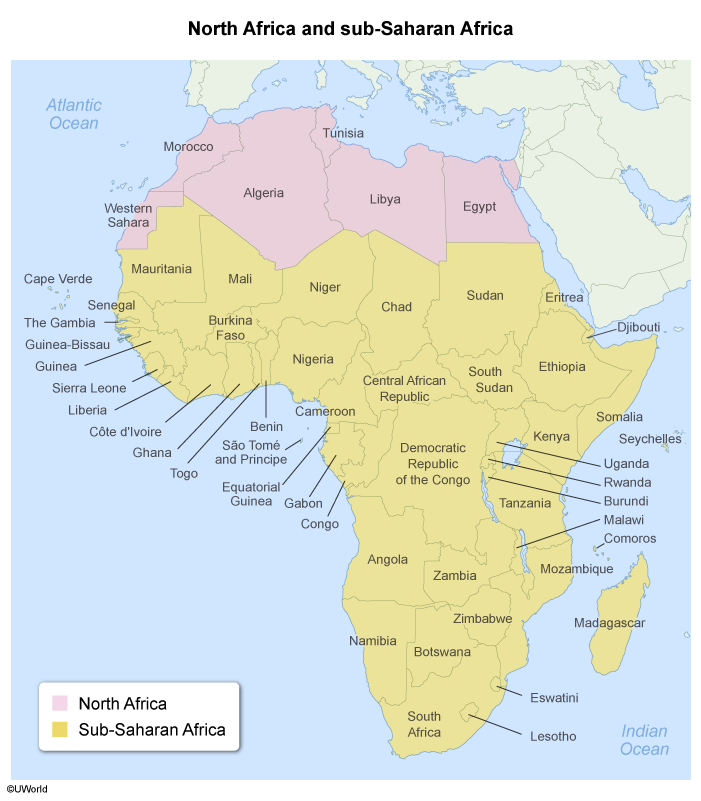
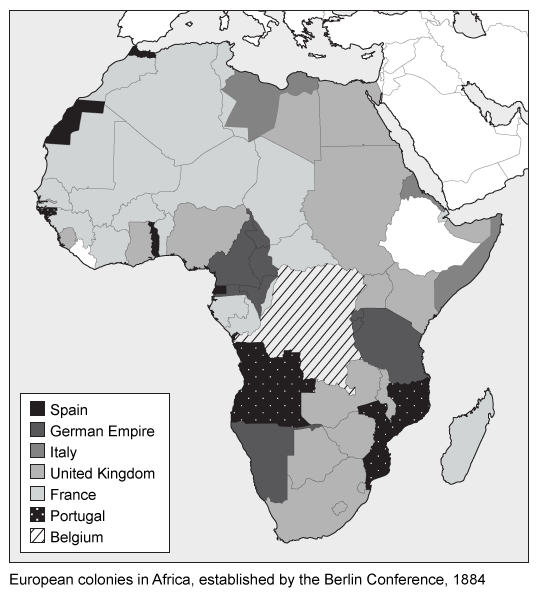
Which of the following was an important social effect of the colonial partition of Africa?
| A. Europeans broadly adopted African art styles and cultural norms | |
| B. European conflicts in Africa rarely targeted African communities | |
| C. Ethnocentrism dramatically decreased in urban areas across Europe | |
| D. Native Africans often lost their cultural and economic connections to traditional lands | |
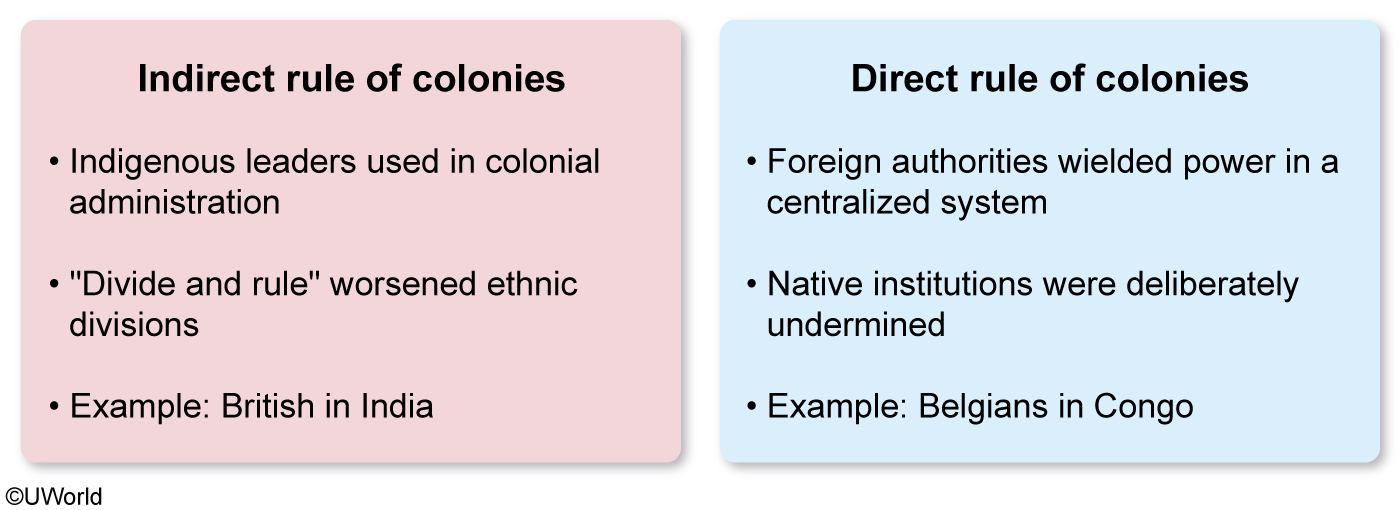
| E. African leaders increased their power through Europeans' direct rule over Africans |
Explanation
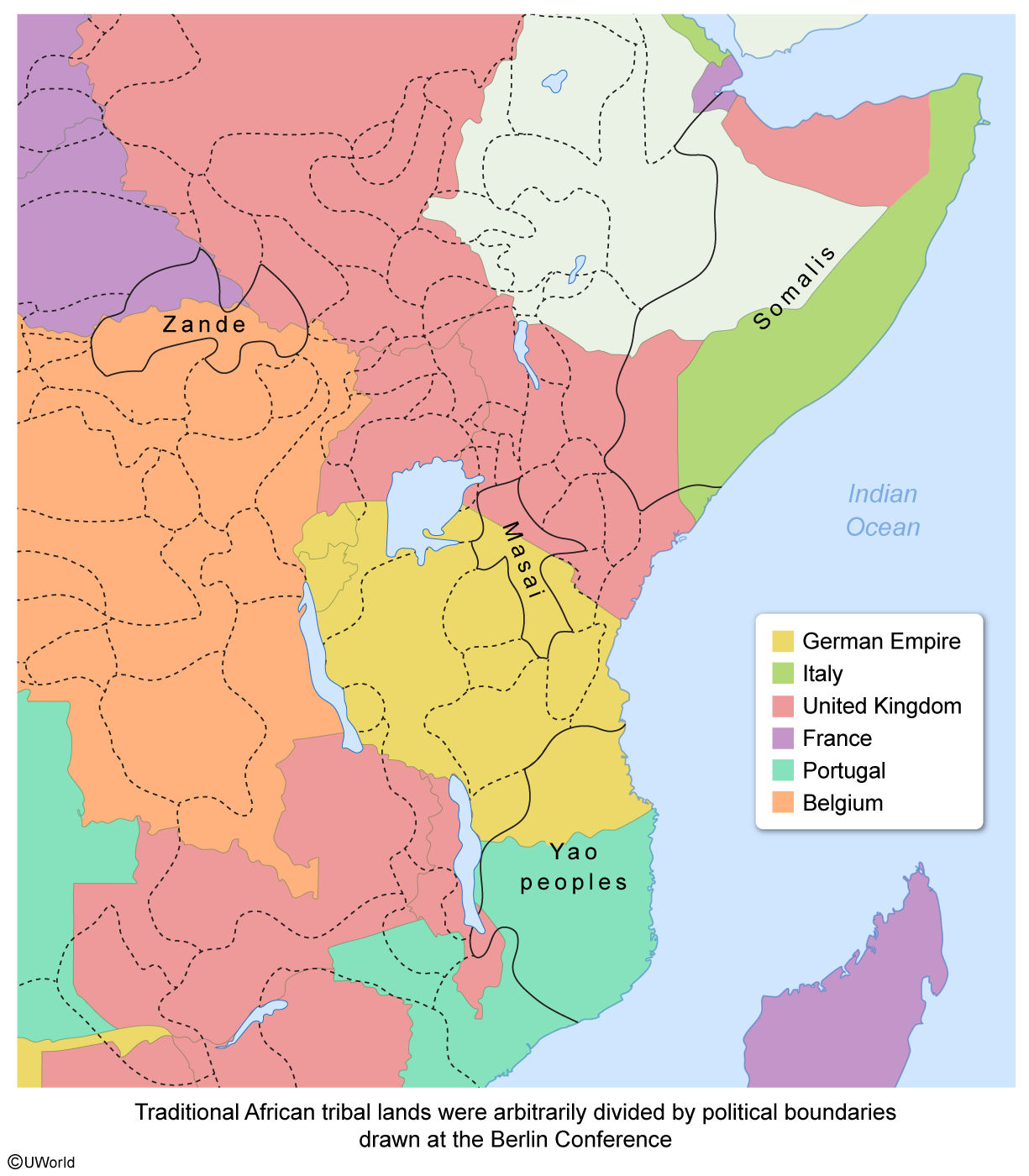
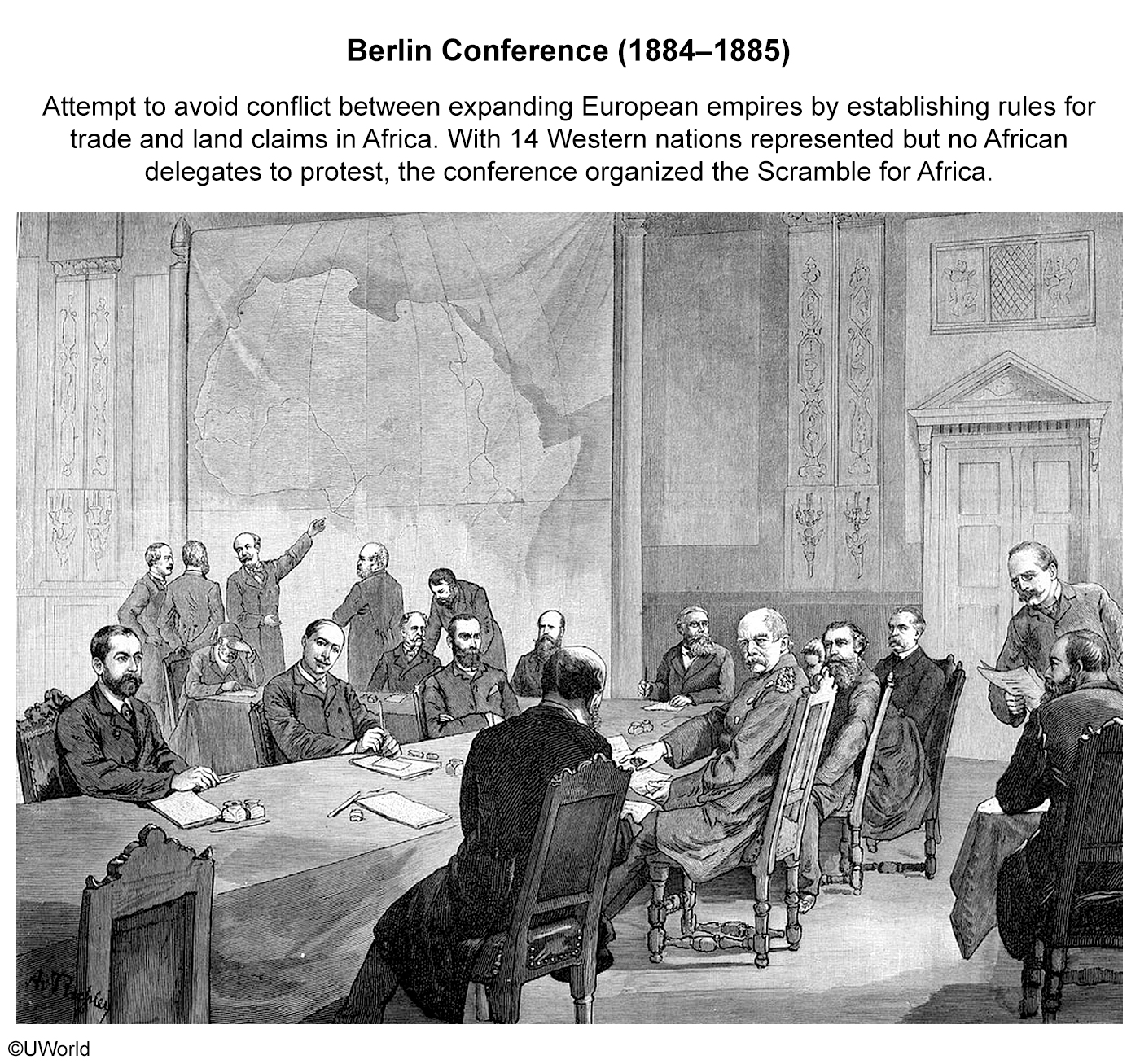
Without consulting African tribal leaders, members of the Berlin Conference arbitrarily established political boundaries across the continent. The new boundaries frequently cut through traditional tribal lands and often divided cultural connections between villages and the economic connections Africans had with their lands.
Culturally, some Zande subjects in the Belgian Congo may have had family members in territories claimed by either France or the United Kingdom. Also, the destruction of Africans' territoriality can be seen in how the Yao peoples were divided between German East Africa and the Portuguese territories.
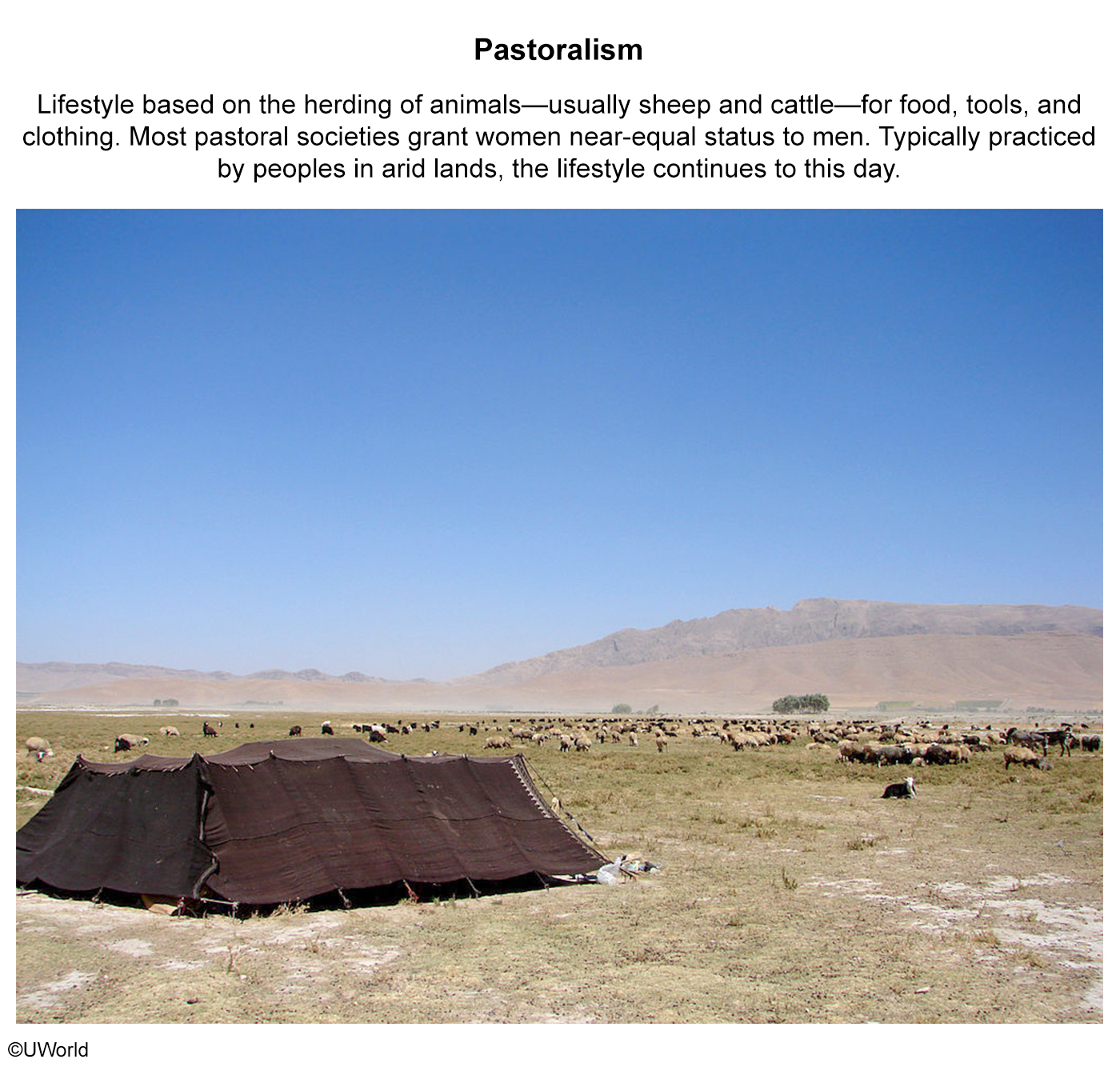
Economically, nomadic pastoralists like the Masai and Somalis were made vulnerable by boundary changes. Seasonal rainfalls determined their movements, making their herds reliant on different grazing pastures throughout the year. Cut off from important pastures, such groups' nomadic cycles were completely disrupted, which threatened their economic survival.
(Choice A) African cultural norms and styles of African art weren’t broadly adopted in Europe.
(Choice B) Europeans frequently targeted African communities to seize control of African territories.
(Choice C) At the time of the Berlin Conference, most of Europe remained ethnocentric.
(Choice E) Europeans’ use of direct rule decreased, not increased, the power of African leaders.
Things to remember:
The Berlin Conference arbitrarily made political boundaries in Africa that often sliced through traditional tribal lands, dividing cultural connections between villages and economic connections that Africans had with their lands.
Question
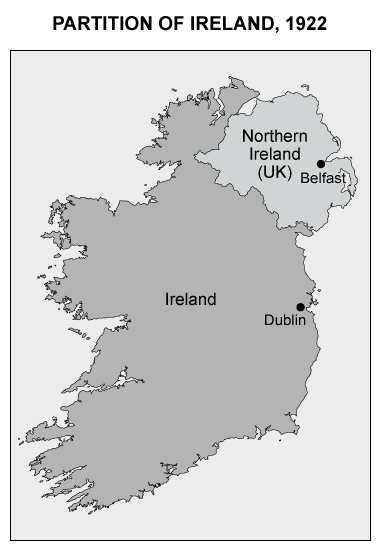
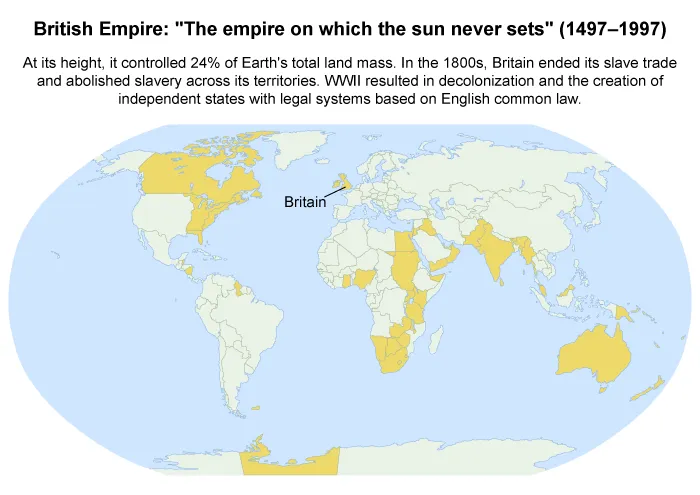
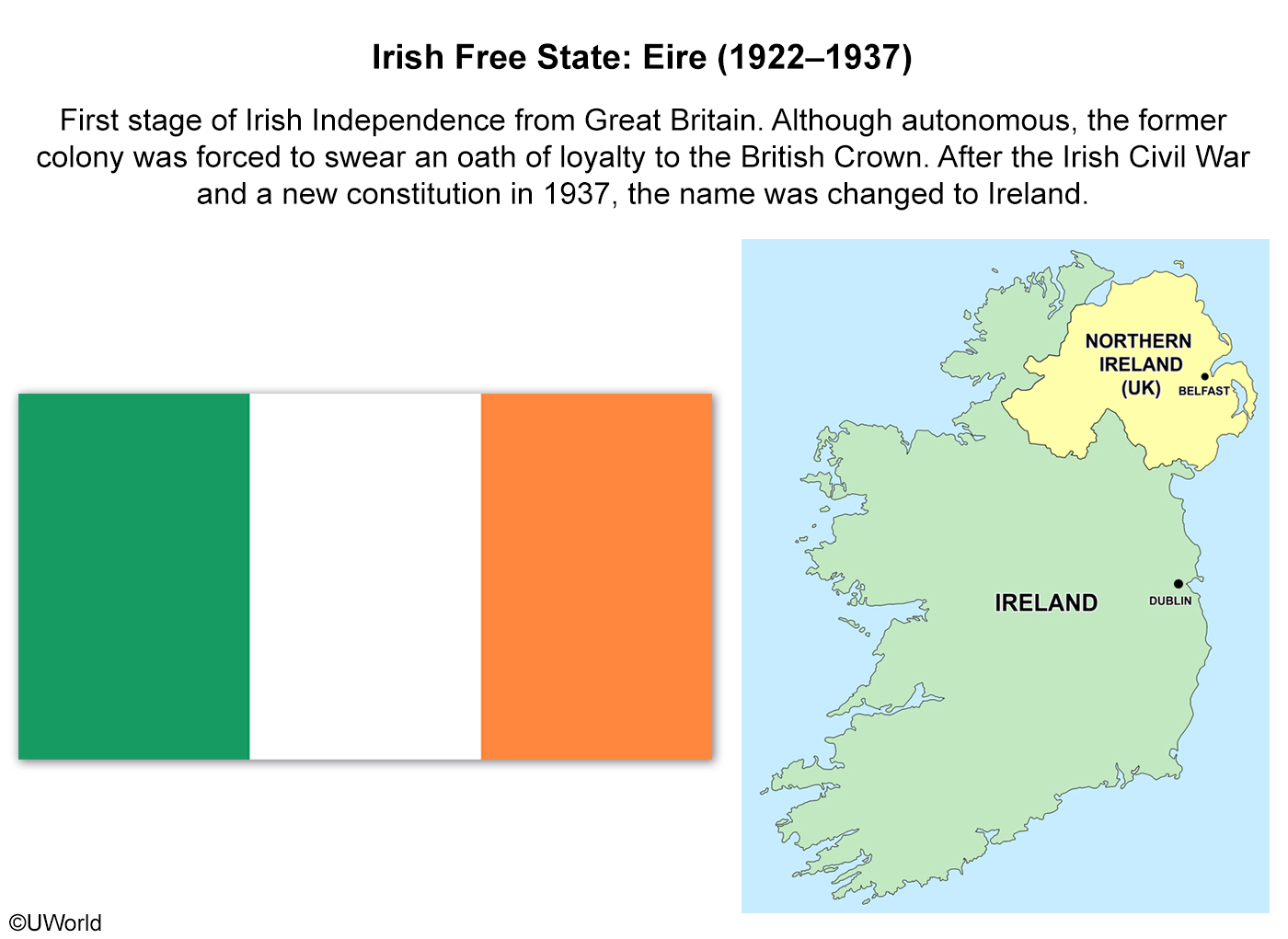
In 1922, after years of conflict, the country of Ireland was partitioned into two territories, Northern Ireland and the Republic of Ireland. A major centrifugal force behind this partition was
| A. economic depression | |
| B. ethnic separatism | |
| C. the Irish Potato Famine | |
| D. neocolonialism | |
| E. religious division |
Explanation
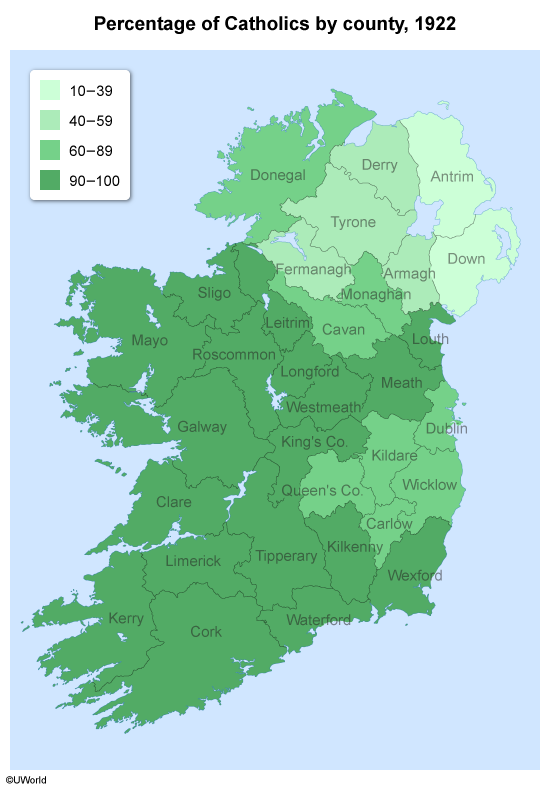
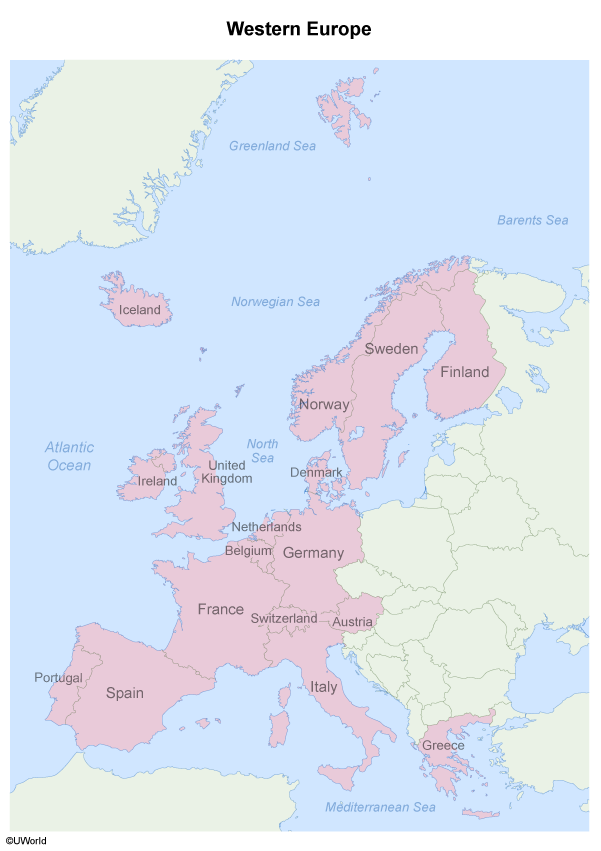
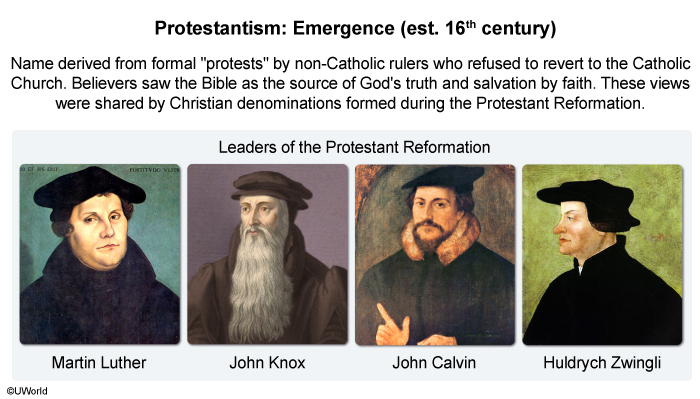
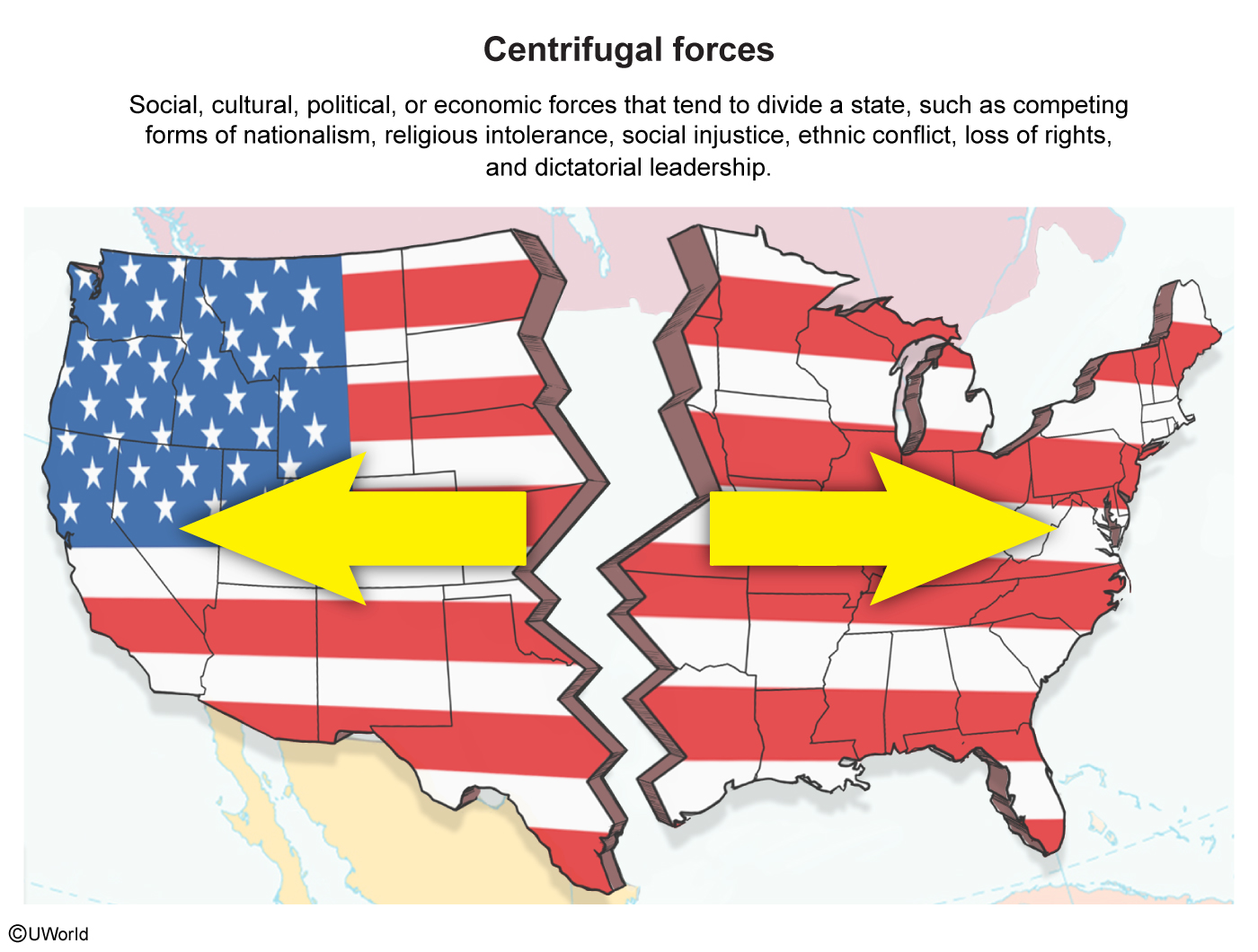
A centrifugal force is a social or cultural force that divides a state. For Ireland, the major centrifugal force behind its partition was religious division. The push in Ireland for independence began as a political movement and became a religious fight in the 16th century, when Britain embraced Protestantism and the Irish remained predominantly Catholic.
The Catholic majority in Ireland, located mostly in the south, demanded a split from the United Kingdom. However, the Protestant minority, located mostly in the north, fought to remain part of the United Kingdom. In 1922, Ireland was divided into two territories:
- Southern Ireland became the Irish Free State and later the Republic of Ireland.
- Northern Ireland remained part of the United Kingdom.
(Choice A) An economic depression is a dramatic economic downturn characterized by a sharp decline in growth, employment, and production. This was not a centrifugal force behind Ireland’s partition.
(Choice B) Ethnic separatism is the process by which an ethnic group that doesn't identify with other groups within a state seeks to form its own independent state. Ireland’s division was based on religious, not ethnic, grounds.
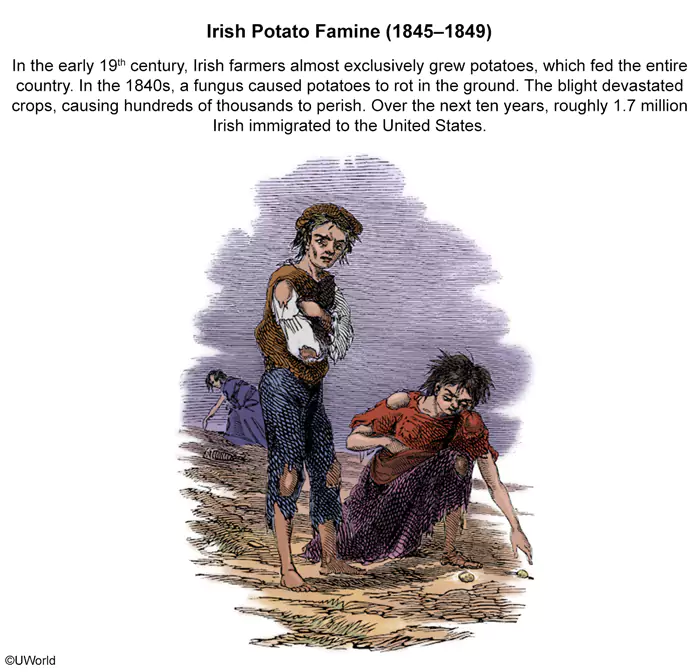
(Choice C) The Irish Potato Famine began in the 1840s and did not contribute to the partition of Ireland in 1922.
(Choice D) Neocolonialism is the establishment of economic and political practices that indirectly influence less powerful nations, especially former colonial territories. It was not practiced in Ireland.
Things to remember:
In 1922, religions division between Catholics and Protestants was the centrifugal force that divided Ireland into two territories.
Question
The altering of a voting district boundary by one political party to produce favorable election results is known as
| A. territoriality | |
| B. voter suppression | |
| C. gerrymandering | |
| D. blockbusting | |
| E. apartheid |
Explanation
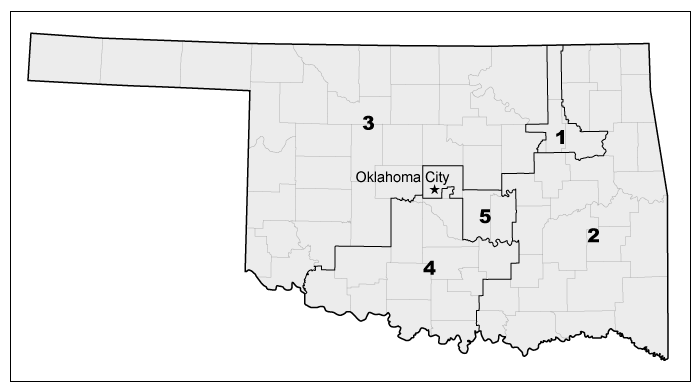
After census data is collected every ten years in the US, congressional and state voting districts are redrawn to reflect changes in population. The state legislatures are tasked with redrawing districts to make sure they have roughly the same number of voters.
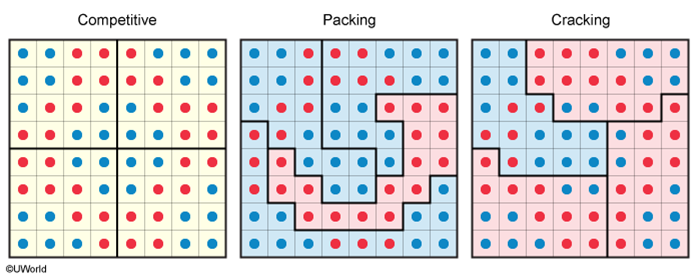
To gain a political advantage, boundaries are often redrawn to favor one party over another; this process is known as gerrymandering. Gerrymandering usually takes two forms:
- Packing groups like-minded voters together to reduce their voting power in another district.
- Cracking spreads like-minded voters apart to dilute their voting power.
Despite the US Supreme Court ruling gerrymandering illegal in 1985, the practice persists, and legal challenges to gerrymandering occur every decade.
(Choice A) Territoriality is a people's attachment to an area of land and its culture. It has no effect on voting district boundaries.
(Choice B) Voter suppression is an effect, rather than a cause, of gerrymandering.
(Choice D) Blockbusting occurs when real estate agents instill in homeowners the fear that their communities are increasingly endangered by an ongoing and increasing influx of people of color. This is unrelated to voting district boundaries.
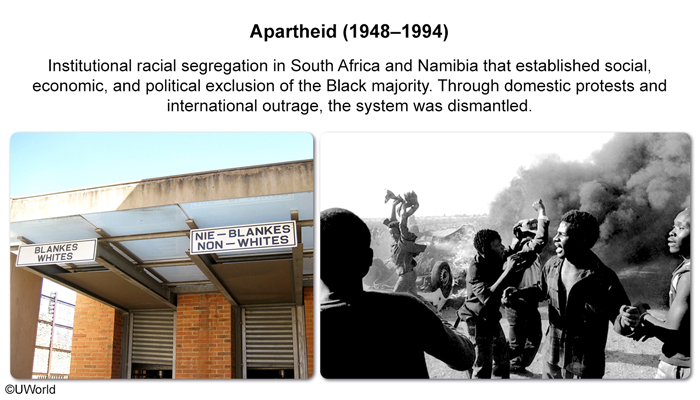
(Choice E) Apartheid was the brutal policy of segregation of Blacks in South Africa; it didn't affect redrawing voting district boundaries in the US.
Things to remember:
Gerrymandering is the process of redrawing boundaries to give one political party advantage over another. Gerrymandering usually takes two forms: packing and cracking.

Don’t Let a Moment Slide to Study AP HUG Unit 4
Strengthen your understanding anywhere. Review videos on state shapes, practice AP Human Geo Unit 4 practice test questions on the bus, or revisit explanations between classes. The UWorld app helps you keep political geography fresh throughout the day while building confidence for the AP Human Geography Unit 4 exam.
Stand Out
with a Top Score in AP Human Geography
Boost your performance and make yourself a standout candidate for competitive colleges, majors, and scholarships by earning a top score.
Get our all-in-one AP HUG review course today!
- Focused AP HUG Videos
- Print & Digital Study Guide
- 300+ Exam-style Practice Questions
- Customizable Quiz Generator
- Adjustable Study Planner
- Realistic Timed Test Simulation
- Colorful Visual Explanations
- Progress Dashboard
- Smart Flashcards & Digital Notebook
Hear From Our AP Students
UWorld’s service is pretty good and helps provide a lot of explanations on subjects I haven’t been confident on before.
The questions here are the most realistic to the AP tests I've seen so far! I appreciate the ability to customize tests as well.
The best part is that all options are well-explained, telling clearly why they are not the right option.

Frequently Asked Questions (FAQs)
What are the main topics covered in AP Human Geography Unit 4: Political Patterns and Processes?
AP Human Geography Unit 4 examines how political power is organized, contested, and expressed across different spaces. To understand this unit effectively, you need to move beyond memorizing definitions and focus on why political boundaries exist, how states function, and how political decisions impact geography. Unit 4 concepts appear repeatedly on the exam, particularly in map interpretation and spatial analysis. Using a structured resource like UWorld helps you connect political processes to real-world examples, so your AP Human Geography Unit 4 review becomes more intuitive.
Key topics in Unit 4 include:
- Types of political entities, such as nations and nation-states
- The ideas and forces that shaped the political boundaries of the modern world
- Forms of government, such as unitary states and federal states
- The factors that lead to states breaking apart
When you understand how these themes connect, navigating political geography becomes easier. You begin to see why political boundaries shift, how power is contested, and how geography shapes state behavior. This clarity helps you answer AP Human Geography Unit 4 MCQ questions, interpret political maps, and handle FRQs that require explanation of political processes. A strong understanding of Unit 4 makes the rest of AP HUG more manageable because political geography influences migration, cultural patterns, and economic systems.
How should I prepare for an AP Human Geography Unit 4 exam?
Preparing for the Unit 4 test requires understanding political geography concepts and knowing how to apply them to real spatial situations. This unit is not about memorizing vocabulary. It is about interpreting political patterns, recognizing state behavior, and explaining why territorial decisions matter. A structured tool like UWorld helps you develop this reasoning by guiding you through political processes with clear explanations that connect ideas effectively.
A strong Unit 4 study plan includes:
- Reviewing boundary types and practicing identifying them on maps
- Studying centripetal and centrifugal forces with real-world examples
- Understanding redistricting, voting districts, and gerrymandering
- Practicing FRQ prompts about political fragmentation and supranationalism
- Solving AP Human Geography Unit 4 MCQ practice questions regularly
- Reviewing devolution cases such as Scotland, Catalonia, or the Balkans
When you study this way, Unit 4 becomes easier to understand and less overwhelming. You learn how political power operates at different scales and why states form alliances or experience conflict. This prepares you well for AP Human Geo Unit 4 review assessments, tests, and progress checks, giving you confidence heading into the exam.
Are any free resources available for AP Human Geography Unit 4?
Yes, several helpful free resources are available for AP Human Geography Unit 4, and the strongest starting point is UWorld’s free 7-day trial. The trial provides you with full access to videos, interactive study guides, and realistic AP Human Geography Unit 4 practice test questions, all designed to explain political geography in a clear and structured manner.
Beyond UWorld, you can explore free online political maps, government organization diagrams, boundary classification visuals, and short video explainers that break down concepts such as redistricting or supranationalism. Teachers may also share worksheets or political geography activities that help you connect theory to real-world situations. The College Board’s AP Classroom provides progress check MCQs and topic questions aligned with the exam, which can help you understand how Unit 4 content is tested.
However, most free resources offer limited explanations, making it harder to fully understand why political boundaries form or how centripetal and centrifugal forces operate. That is why many students pair these materials with UWorld’s step-by-step reasoning, which helps clarify confusing concepts and strengthens your ability to interpret political patterns. Combining free content with structured guidance provides a solid foundation for success in Unit 4.
What types of questions are on the AP Human Geography Unit 4 test?
The AP Human Geography Unit 4 test includes multiple choice questions, map interpretation tasks, and FRQs that evaluate your ability to understand political patterns and processes. Instead of memorizing political terms, you need to know how states form, why boundaries change, and how political power influences space. Many AP Human Geography Unit 4 MCQ questions require analyzing maps or applying concepts to real political scenarios. A structured resource like UWorld helps you build this reasoning by explaining how and why political systems behave the way they do.
You can expect to see:
- MCQs analyzing different types of political boundaries
- Questions about supranational organizations and alliances
- Scenarios illustrating centrifugal and centripetal forces
- Items testing redistricting, voting districts, and gerrymandering
- Spatial analysis of political fragmentation or devolution
- FRQs requiring explanation of political processes using real-world examples
When you understand these question types, Unit 4 becomes easier to navigate. You learn how to interpret political maps, apply theories accurately, and break down complex political changes. This gives you a major advantage on AP Human Geo Unit 4 practice test items and classroom assessments.
How can I improve my score on the Free-Response Questions (FRQs) for Unit 4?
Improving your FRQ performance in Unit 4 requires strong conceptual understanding and the ability to use real-world political examples. FRQs often ask you to explain how political power forms, how states manage conflict, or why boundaries cause tension. Many students lose points by repeating vocabulary without connecting it to a specific place or process. A structured tool like UWorld strengthens your reasoning by showing how to justify each idea clearly, which supports your approach to AP HUG Unit 4 FRQ tasks.
Some of the effective ways to improve your FRQ score are:
- Defining political terms before applying them
- Using concrete examples such as the EU, UN, Scotland, or Quebec
- Explaining how boundary types influence political stability
- Connecting supranationalism and devolution to spatial changes
- Structuring responses in clear, direct points
- Practicing with FRQ prompts to build clarity and speed
With this approach, FRQs become more manageable. You learn to explain political processes rather than memorize disconnected facts. Over time, you develop strong spatial reasoning and clearer writing, which improves performance on both classroom FRQs and the AP exam.
What is the "Political Patterns and Processes" unit's weight on the AP Human Geography exam?
Political geography plays a major role on the AP Human Geography exam, carrying 12-17% of the weight, because it explains how states form, how power operates, and how political decisions influence spatial outcomes. Unit 4 concepts, such as boundaries, nation-states, supranationalism, and devolution, appear in multiple-choice questions, map interpretation tasks, and FRQs. Political geography is closely tied to other units as well, influencing migration, cultural patterns, and economic systems.
This unit teaches students to understand how political forces shape space, laying the foundation for many higher-level questions on the exam. You can expect several AP Human Geography Unit 4 MCQ items that test your ability to identify boundary types, interpret political maps, or recognize political forces at work. FRQs frequently involve explaining devolution, analyzing electoral maps, or evaluating the effects of supranational organizations. When you practice with reasoning-based explanations from a tool like UWorld, you develop a clearer understanding of how political systems interact and why certain spatial patterns emerge. This makes Unit 4 one of the most important units for building confidence across the entire AP Human Geography exam.
What should a good AP Human Geography Unit 4 study guide entail?
A strong AP Human Geography Unit 4 study guide should help you understand political concepts clearly and apply them to real-world spatial patterns. Instead of providing you with lengthy lists of political terms to memorize, a practical guide explains how boundaries form, why devolution occurs, and how political power influences territorial boundaries. You want a resource that breaks down political processes step by step so you can interpret maps confidently. UWorld supports this type of clarity by explaining each idea and reinforcing it through political scenarios, which helps with your AP Human Geography Unit 4 study guide preparation.
A high-quality Unit 4 study guide should include:
- Clear explanations of state formation, sovereignty, and territoriality
- Boundary types with diagrams and real-world examples
- Electoral geography topics such as redistricting and gerrymandering
- Supranational organization impacts and geopolitical theories
- Case studies of devolution, nationalism, and fragmentation
- Concept checks to reinforce understanding
When your study guide emphasizes reasoning, political geography becomes far easier to understand. You begin seeing how political forces interact, how boundaries influence conflict, and why alliances form. This makes AP Human Geography Unit 4 review and test preparation more effective, building your confidence for the AP exam.
Can I find practice tests specifically for AP HUG Unit 4?
Yes, there are practice tests tailored specifically to Unit 4, and they can significantly improve your understanding of political geography. These practice tests help you recognize the patterns behind boundary formation, political fragmentation, and global political cooperation. They also strengthen your ability to interpret political maps, which is essential for AP Human Geography Unit 4 multiple-choice questions. UWorld offers realistic practice tests with detailed explanations that walk you through the political logic behind each scenario.
A good Unit 4 practice test should include:
- MCQs analyzing state shapes, boundaries, and political structures
- Questions about supranational organizations and global alliances
- Items testing electoral geography and redistricting patterns
- Scenarios involving devolution, separatism, and centrifugal forces
- FRQ-style prompts requiring explanation of political processes
- Explanations that strengthen spatial and political reasoning
Once you work through practice tests like these, you start recognizing how political patterns develop across regions. You learn to interpret maps quickly, connect political theories to real-world examples, and explain why certain political outcomes occur. This makes AP Human Geo Unit 4 practice test questions feel more predictable and builds confidence for the exam.
How can I prepare for the AP Human Geography Unit 4 progress check in AP Classroom?
Preparing for the AP Human Geography Unit 4 progress check requires a clear understanding of political boundaries, territoriality, state structures, and supranationalism. The progress check MCQs focus heavily on map interpretation and political processes, so reviewing how boundaries are formed and how political forces influence space is essential. Start by studying boundary types, political divisions, gerrymandering, and examples of devolution. Then practice reading political maps that show state shapes, electoral districts, or supranational membership.
UWorld offers a check for understanding experience that mirrors the style of these progress checks, providing you with practice in realistic political scenarios. The explanations help you identify correct reasoning and eliminate distractors, which strengthens your accuracy on the actual AP Classroom assessment. After working through practice questions, spend time reviewing any concepts that felt unclear, such as centripetal and centrifugal forces or the role of supranational organizations. Building this understanding helps you perform confidently on the Unit 4 progress check MCQ in AP Human Geography and prepares you for the larger AP exam.
How do I stay organized while studying AP Human Geography Unit 4?
Unit 4 brings together many political concepts that overlap, so staying organized is essential. Terms like sovereignty, boundaries, devolution, supranationalism, and territoriality can start blending if your notes and study approach aren’t structured. A clear system helps you connect ideas instead of memorizing isolated definitions. Using reasoning-driven resources, such as UWorld’s explanations, helps you reinforce political patterns as you study, making your AP Human Geo Unit 4 review more effective.
A helpful organization approach includes:
- Grouping vocabulary by theme: boundaries, governance, political forces, supranationalism
- Creating political map collections to compare regions and state shapes
- Using charts to distinguish boundary types and political processes
- Keeping example-based notes with real-world cases like the EU or Scotland
- Practicing a short set of AP Human Geography Unit 4 MCQ questions daily
- Building a summary sheet for centripetal and centrifugal forces
Once you organize the content this way, the unit becomes easier to understand. You begin to recognize how political power operates, how boundaries impact stability, and why conflicts arise. Strong organization also boosts your confidence on tests because you know exactly where each idea fits and how political patterns relate across topics.
What are the most common mistakes students make in AP Human Geography Unit 4?
Many students struggle with Unit 4 AP HUG because political geography introduces terms that sound similar, concepts that overlap, and processes that require clear spatial reasoning. Instead of understanding how political power works, students often focus on memorizing vocabulary without recognizing how these concepts function in real-world settings. This creates confusion on MCQs and leads to vague explanations on FRQs. Using structured explanations from UWorld helps you avoid these issues by showing how political concepts actually operate.
The most common Unit 4 mistakes include:
- Mixing up boundary types, such as geometric vs. superimposed vs. antecedent
- Confusing nation, state, nation-state, and multinational state
- Treating centripetal and centrifugal forces as synonyms instead of opposites
- Forgetting that devolution and supranationalism operate at different scales
- Misinterpreting electoral maps, especially gerrymandering patterns
- Using definitions rather than real examples on FRQs
- Not recognizing how political geography connects to culture and economics
- Reading maps too literally without identifying spatial relationships
When you know what these mistakes look like, it becomes much easier to avoid them. Instead of memorizing isolated terms, focus on understanding how political processes shape territories and how geography influences political decisions. Reviewing real-world cases helps reinforce the difference between similar concepts and makes political patterns more intuitive. Practicing AP Human Geography Unit 4 MCQ questions with detailed explanations also strengthens your ability to eliminate distractors and interpret political scenarios accurately. The more you train yourself to think spatially, the fewer mistakes you’ll make, and the stronger your performance will be on the AP Unit 4 test and the AP exam.
How can I study effectively for AP Human Geography Unit 4 MCQs?
Studying effectively for Unit 4 MCQs requires developing strong spatial reasoning skills related to political systems, boundaries, and state relationships. Most of the questions challenge you to interpret maps, understand territorial patterns, and identify political processes across regions. Memorizing vocabulary is not enough. You need to recognize how political forces play out in real-world settings and why certain patterns recur repeatedly. Using a structured tool like UWorld helps because explanations show how to interpret patterns, eliminate distractors, and think like the exam.
A strong MCQ strategy includes:
- Reviewing boundary types and practicing identifying them using maps
- Studying examples of devolution and political instability
- Analyzing electoral maps for gerrymandering or district shifts
- Connecting political concepts to real events and regions
- Practicing AP Human Geography Unit 4 multiple-choice questions consistently
- Reviewing incorrect answers to understand the reasoning behind each item
When you follow this approach, MCQs become much easier to navigate. You start noticing clues on maps, recognizing political processes instantly, and predicting how political forces shape space. With consistent explanation-driven practice, you build confidence and accuracy for the AP Human Geo Unit 4 exam.
Can I study AP Human Geography Unit 4 offline if I need to?
Yes, you can study AP Human Geography Unit 4 offline, which is especially useful when reviewing political geography on the go. Many Unit 4 concepts, such as boundary types, supranational groups, state shapes, and territorial forces, can be practiced through diagrams, notes, and map interpretation, even without the internet. UWorld supports offline study by allowing you to download question sets. This lets you work through AP Human Geography Unit 4 practice test items, review explanations, and revisit scenarios even when WiFi is unavailable.
Offline access is invaluable for strengthening pattern recognition, as it allows you to repeatedly analyze boundary maps or interpret political divisions during short study sessions. When you reconnect, the UWorld mobile app syncs your progress, keeping your performance data up to date. Pairing offline practice with printed notes, boundary charts, or your own summaries provides a comprehensive review system. This flexibility ensures you stay consistent, reduce gaps in study time, and build strong confidence for the AP HUG Unit 4 exam. Offline study helps you stay focused and prepared, no matter where you are, making it easier to master one of the most important units in the course.
Learn More About Specific Unit
Thinking Geographically
Population and Migration Patterns and Processes
Cultural Patterns and Processes
Agriculture and Rural Land-Use Patterns and Processes
Cities and Urban Land-Use Patterns and Processes
Industrial and Economic Development Patterns and Processes