AP® Human Geography Unit 1 Review and Practice Test
Start your AP® Human Geography Unit 1 review with easy vocab, Thinking Geographically basics, and practice test tips to help you prep smarter and score higher on Unit 1. Resources like UWorld’s AP HUG Unit 1 practice test and study guide give you the step-by-step support you need to build confidence and improve your score.
Your Go-To AP Human Geo Unit 1 Review Guide
Understand Thinking Geographically with quick breakdowns, helpful visuals, and essential AP Human Geo Unit 1 vocab. Every concept is explained in a way that actually clicks. With targeted practice and student-friendly examples, this Unit 1 review helps you study smarter and feel confident on test day.
Engaging Video Lessons
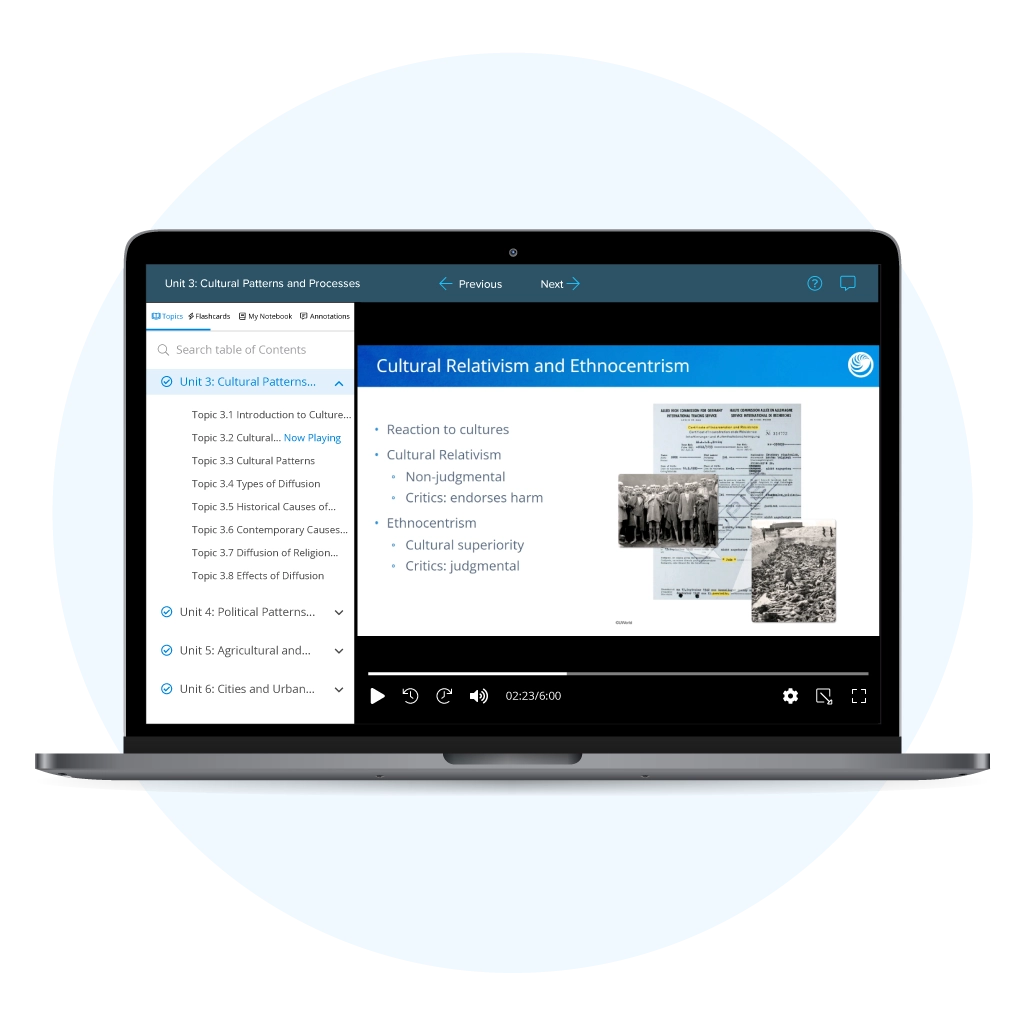
Explore AP Human Geography Unit 1 with short, engaging video lessons that make Thinking Geographically easier to understand. Whether you’re reviewing AP Human Geo Unit 1 vocab or prepping for your Unit 1 practice test, these videos help everything click quickly and clearly.
Interactive Study Guides
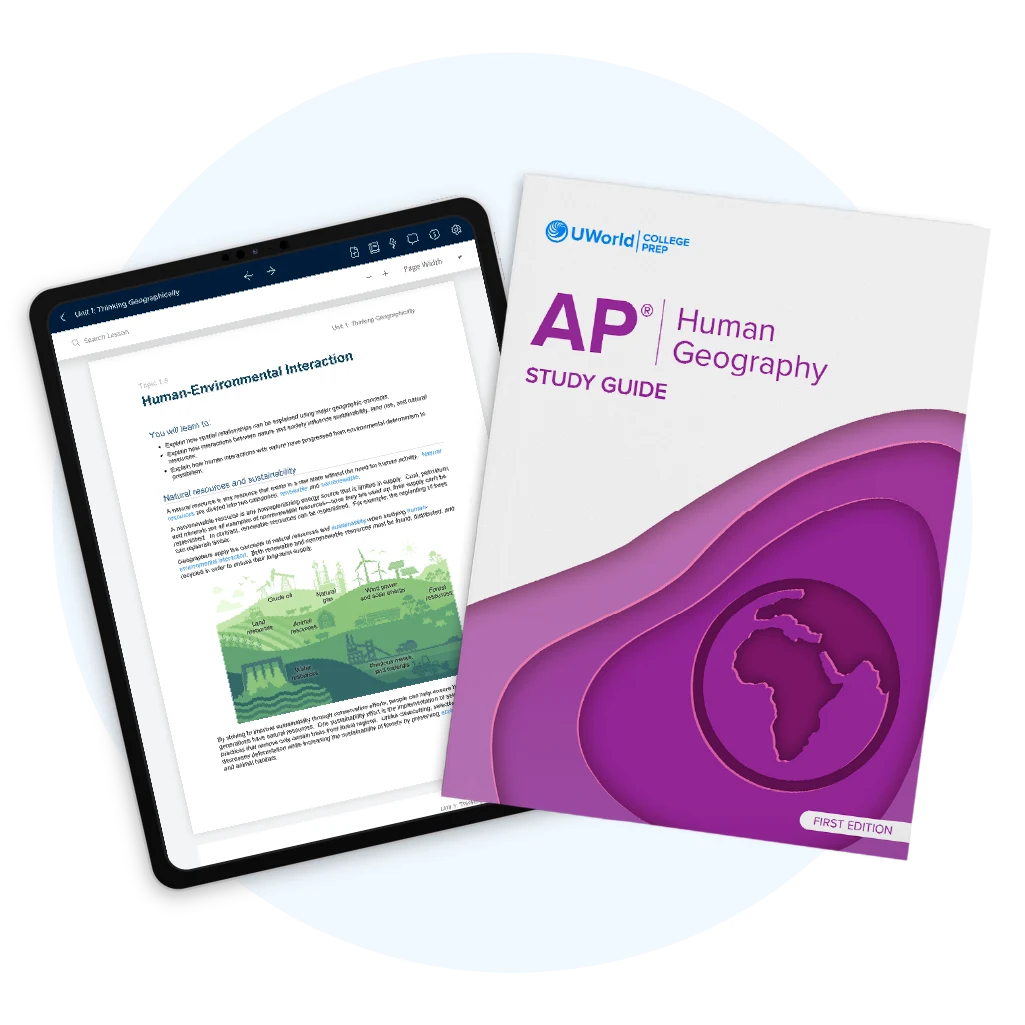
Dig into AP Human Geography Unit 1 with study guides that make Thinking Geographically simple and easy to follow. These guides help you connect ideas fast so you’re ready for any Unit 1 AP Human Geo test or practice question.
Unit 1 AP Human Geography Practice Test Questions
Question
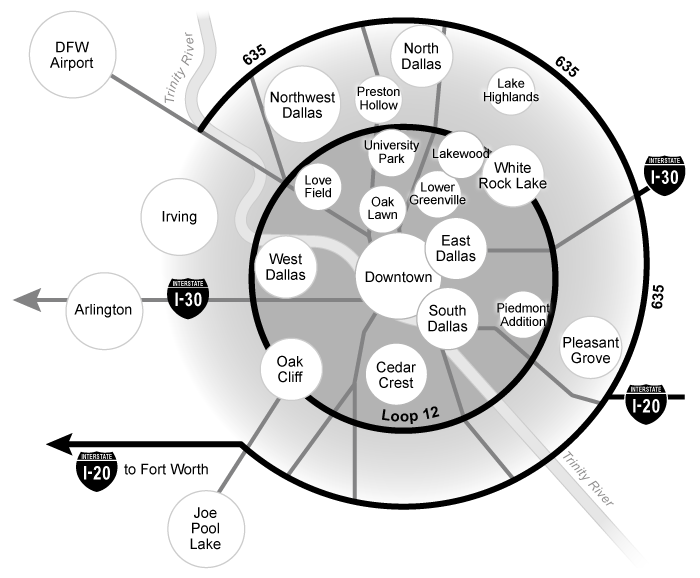
Which of the following best describes the spatial pattern represented on the map?
| A. Relative locations based on personal perceptions | |
| B. Contour lines illustrating elevation | |
| C. Absolute locations determined by GPS | |
| D. Concentrations of urban populations | |
| E. Voting precincts by congressional district |
Explanation
Locations on maps can be either absolute or relative. Absolute location are fixed points on the earth, relative locations are affected by distance, accessibility, and connectivity. Locations on a map may be placed relative to other locations and may not represent a precise point on the landscape.
All mental maps present relative locations because they are based on personal perceptions of spatial relationships. They illustrate how people organize and make sense of the space around them.
On the mental map of Dallas above, the placement of the circles represents relative locations. For example, the map shows that Irving is roughly northwest of downtown and farther from downtown than Oak Lawn. However, the location and distances are relative, and the map does not provide absolute locations and distances.
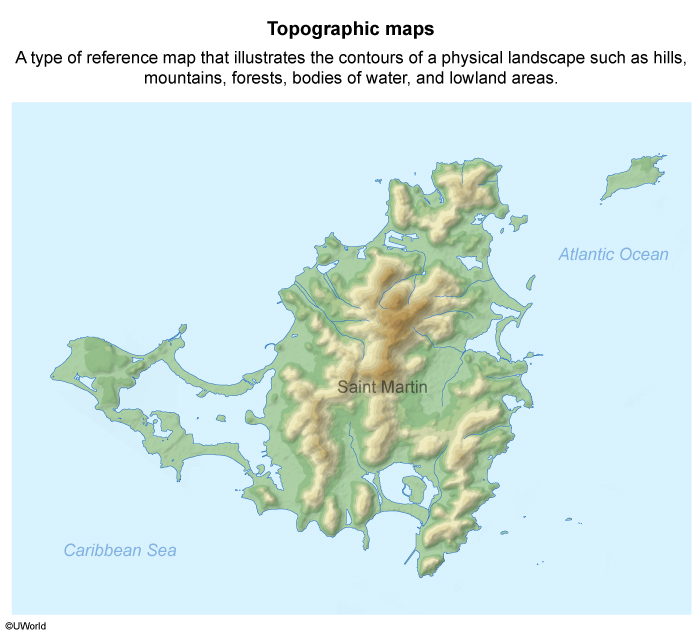
(Choice B) The map above lacks contour lines, which are used in topographic maps to illustrate elevation and relief.
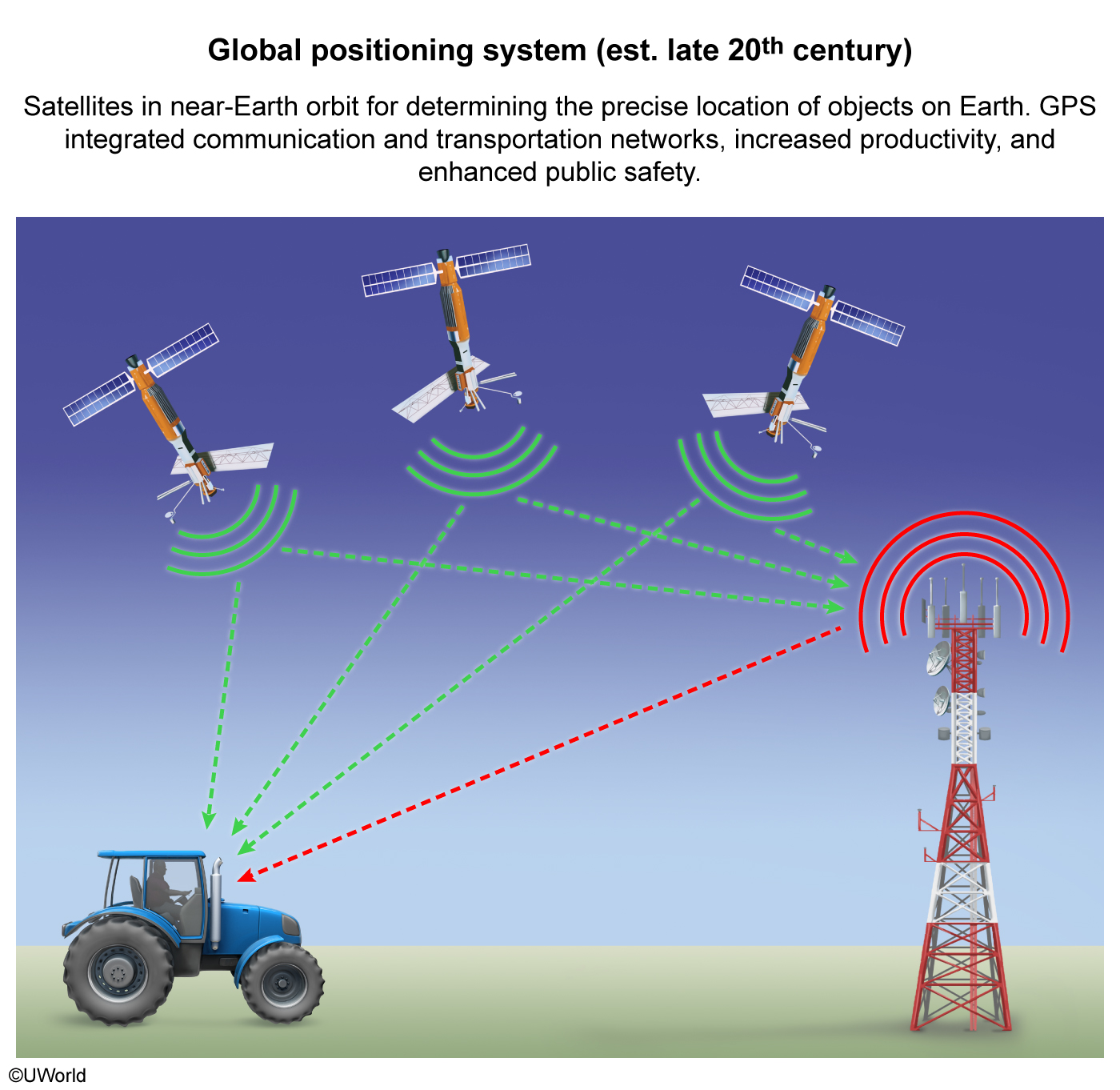
(Choice C) Mental maps are based on relative locations and do not include absolute locations determined by GPS.
(Choice D) The circles in the map reflect the mapmaker’s interpretation of a location, not its population. For example, the circle representing Dallas/Fort Worth International Airport is bigger than the circle representing South Dallas.
(Choice E) The mental map shows the relative locations of places in the greater Dallas area and doesn’t include voting precincts by congressional district.
Things to remember:
Mental maps are based on personal perceptions of spatial relationships and illustrate relative locations.
Passage:
Question
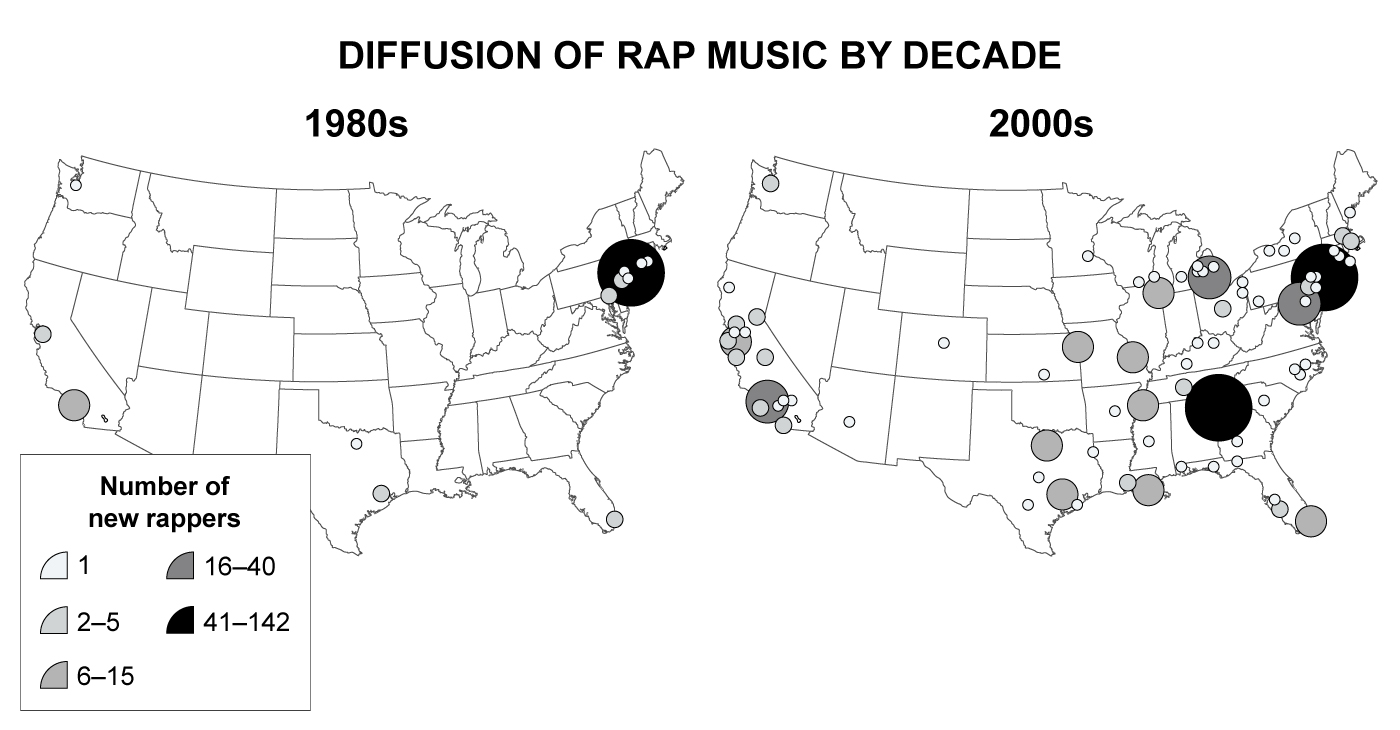
The maps shown above are best described as which of the following?
| A. Isoline | |
| B. Topographic | |
| C. Thematic | |
| D. Regional | |
| E. Reference |
Explanation
Geographers use thematic maps to show distributions of social patterns, trends, or behaviors, such as population distribution or voting turnout. Thematic maps reveal stories, typically showing the degree and movement of an attribute or phenomenon in a geographic location.
The maps above depict the development and spread of rap music across the US between 1980 and 2009. Cultural geographers can use such maps to obtain clues about the innovation and diffusion of the rap genre.
(Choice A) Isoline maps use lines to connect data points of the same values; the maps above do not contain these lines.
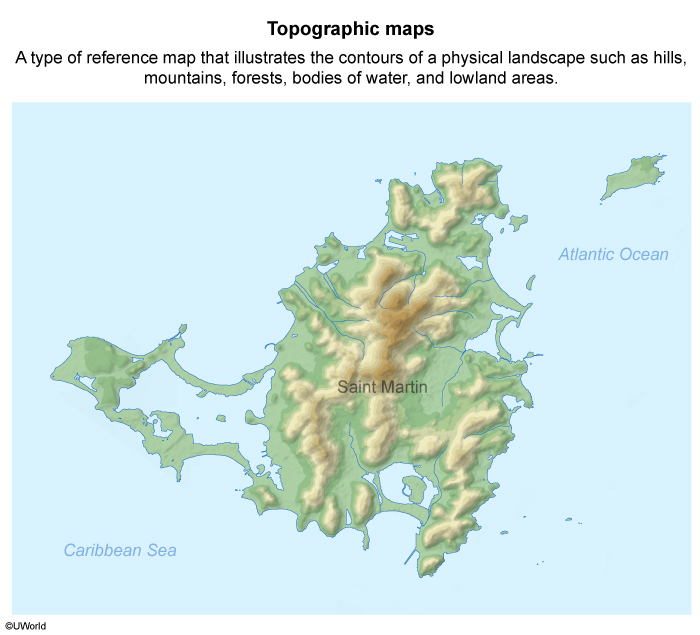
(Choice B) Topographic maps show the contours of a physical landscape, which is not shown on the maps above.
(Choice D) The maps present data at the national level, not by region.
(Choice E) The maps are not reference maps because it is not possible to determine absolute distances between locations on these maps.
Things to remember:
Thematic maps reveal stories, typically showing the movement and degree of an attribute or phenomenon in a geographic location.
Question
Which of the following is true of a thematic map?
| A. It locates objects relative to a known reference point | |
| B. It is a spatial illustration of specific data | |
| C. It is most useful at the local level | |
| D. It is increasingly used in Global Positioning System navigation | |
| E. It has a large amount of distortion due to the curvature of the Earth |
Explanation
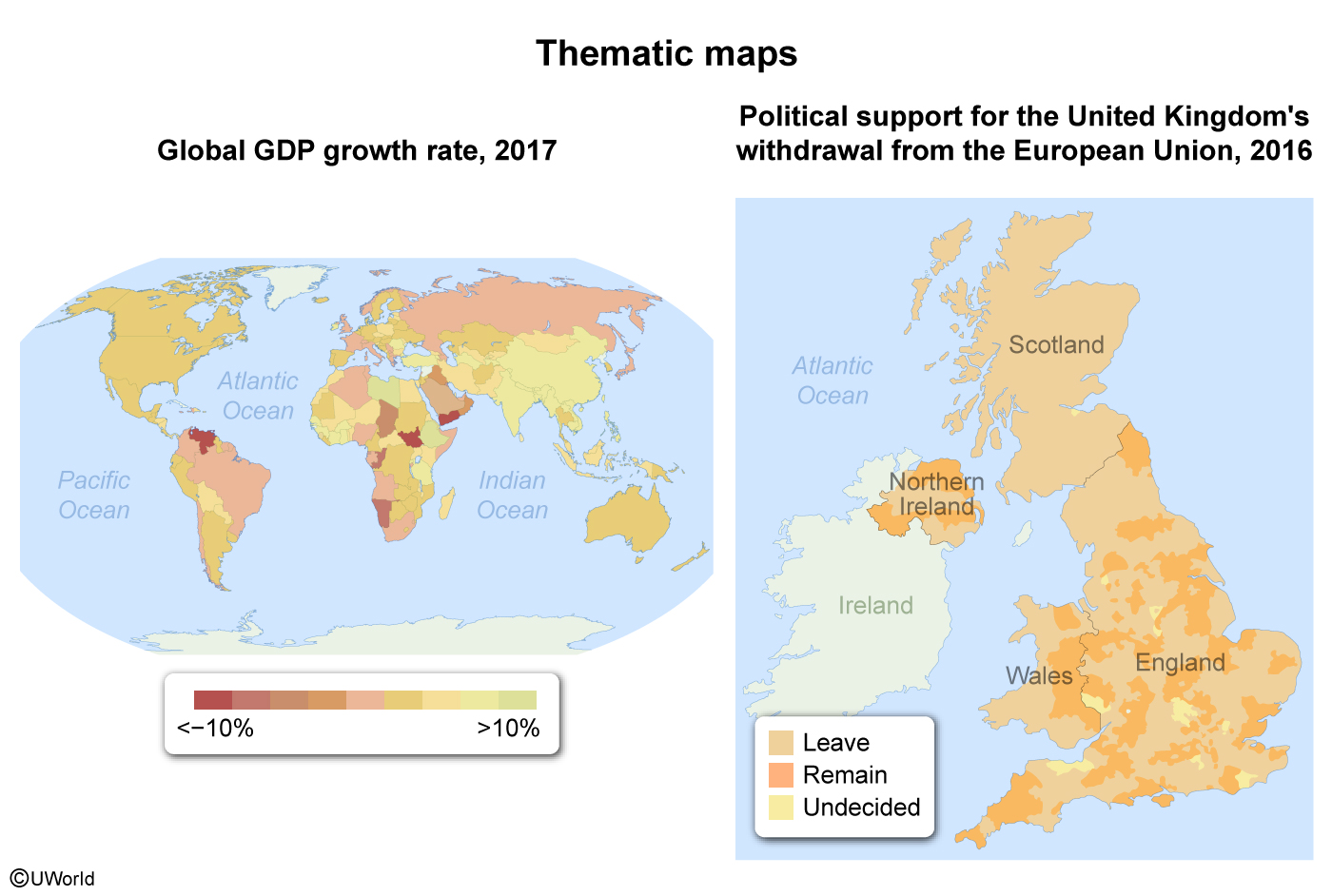
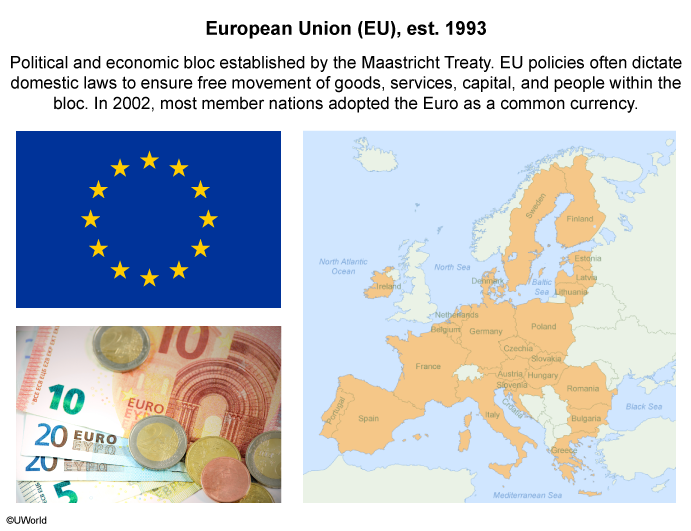
Thematic maps are spatial distributions of specific data, such as economic development or people's political leanings. For example, the map on the left uses data ranges to illustrate increases in gross domestic product worldwide and shows where economic development is occurring the fastest. The map of the United Kingdom on the right illustrates where popular support for leaving the European Union was concentrated in 2016.
(Choice A) Reference maps, not thematic maps, express spatial relationships between objects and known reference points.
(Choice C) Thematic maps are equally useful for local, regional, national, and global scales of analysis.
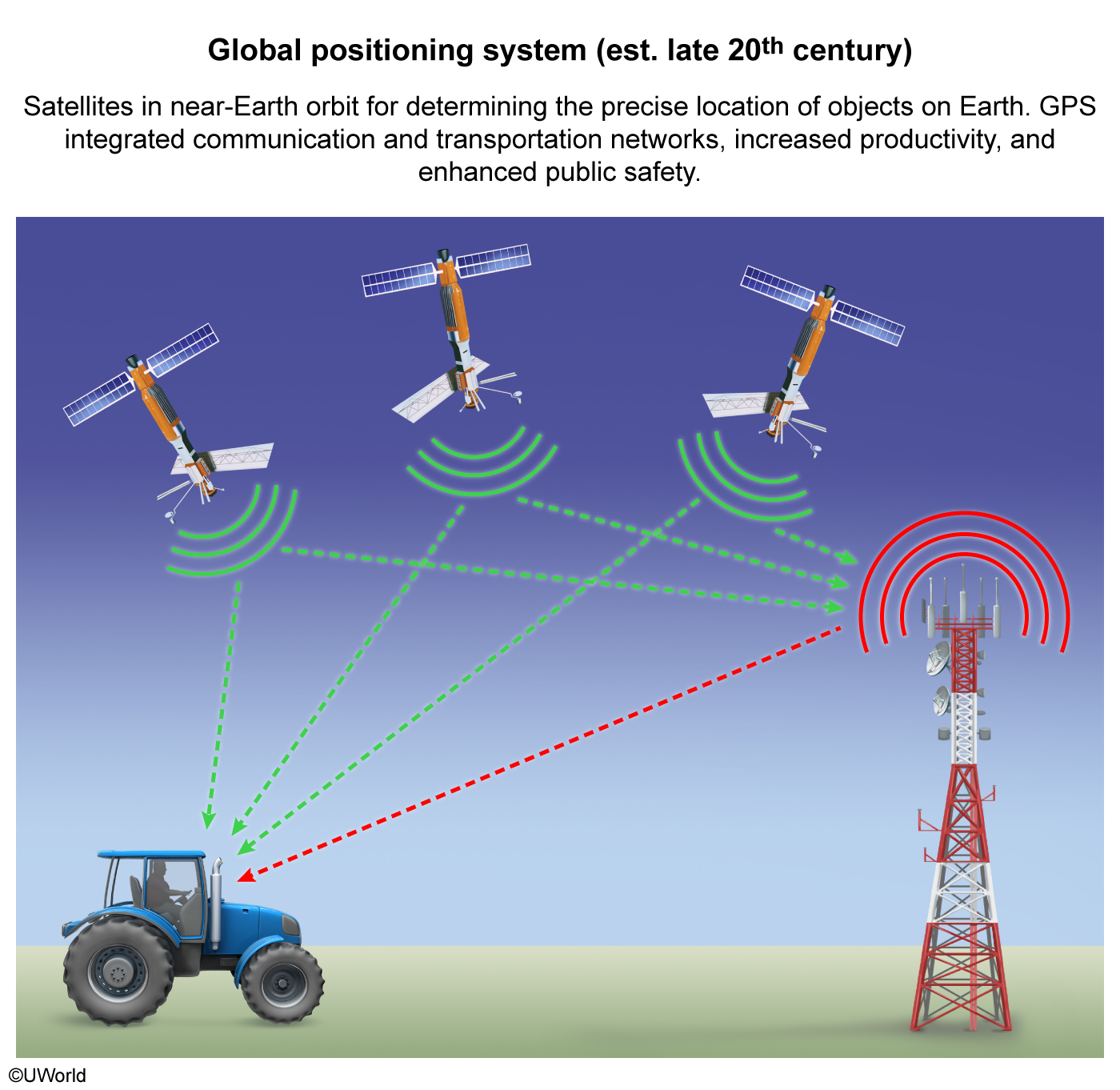
(Choice D) Global Positioning System navigation relies on absolute locations. It does not use thematic maps, which are spatial illustrations of specific data.
(Choice E) World maps have a large amount of distortion due to the curvature of the Earth. This is not a limitation of thematic maps.
Things to remember:
Thematic maps show the distribution of specific phenomena or observable facts across geographic space.

Study Anywhere, Anytime
Review AP Human Geography Unit 1 wherever your day takes you, practice AP Human Geo Unit 1 test questions on the bus, watch Thinking Geographically videos between classes, or look through Unit 1 vocab and notes while hanging out at a cafe. With the UWorld app, every AP Human Geo Unit 1 review tool is right in your pocket, making it easy to study whenever it fits your schedule.
Stand Out
with a Top Score in AP Human Geography
Complete your comprehensive AP Human Geo Unit 1 review to boost your performance and make yourself a standout candidate for competitive colleges, majors, and scholarships by earning a top score.
Get our all-in-one AP HUG review course today!
- Focused AP HUG Videos
- Print & Digital Study Guide
- 300+ Exam-style Practice Questions
- Customizable Quiz Generator
- Adjustable Study Planner
- Realistic Timed Test Simulation
- Colorful Visual Explanations
- Progress Dashboard
- Smart Flashcards & Digital Notebook
Hear From Our AP Students
UWorld’s service is pretty good and helps provide a lot of explanations on subjects I haven’t been confident on before.
The questions here are the most realistic to the AP tests I've seen so far! I appreciate the ability to customize tests as well.
The best part is that all options are well-explained, telling clearly why they are not the right option.

Frequently Asked Questions (FAQs)
What are the main topics covered in AP Human Geography Unit 1: Thinking Geographically?
AP Human Geography Unit 1 introduces the core concepts geographers use to understand places, patterns, and spatial relationships. These ideas help you think like a geographer and make sense of how data, maps, and scale shape the world around us.
- Different types of maps and what they show: Understanding how maps visualize data, patterns, and geographic information.
- How geographers collect and use data: Using fieldwork, surveys, imagery, and tools to study people and places.
- Spatial relationships and patterns: Identifying how phenomena connect and vary across space.
- Data analysis at different scales: Comparing patterns at global, national, and local levels.
- How geographers define regions: Grouping places using physical, cultural, or functional characteristics.
If you want these Unit 1 topics explained clearly with practice that actually helps concepts stick, UWorld’s AP Human Geography Unit 1 review is the perfect place to start.
How should I prepare for an AP Human Geography Unit 1 exam?
Start your AP HUG Unit 1 prep by reviewing the essential vocab and themes in Thinking Geographically. Focus on map types, spatial relationships, data collection, and how geographers define regions. Understanding these concepts early makes everything else feel easier.
Next, use visuals and examples to help you connect big ideas to real places. Watching AP Human Geography Unit 1 video lessons can help you break down tricky ideas like scale, patterns, and mapping tools. Seeing them applied in real-world contexts makes the content click.
Finally, practice with AP Human Geo Unit 1 tests and quizzes to reinforce your understanding. UWorld’s realistic questions and clear explanations help you study smarter and feel confident on test day.
Are any free resources available for AP Human Geography Unit 1?
You can start your AP Human Geography Unit 1 review with UWorld’s free trial, which gives you access to sample questions, explanations, and Thinking Geographically practice. It’s the easiest way to test out the tools you’ll use throughout Unit 1.
You can also explore the free materials on AP Classroom, including Unit 1 progress checks. These resources help you see the types of mapping and spatial data questions that appear on the exam, though the explanations are not always detailed.
If you prefer extra videos and general concept overviews, free platforms like Khan Academy can help with map-reading basics. But for the most accurate AP Human Geo Unit 1 test prep, UWorld is the most reliable choice.
What types of questions are on the AP Human Geo Unit 1 test?
The AP Human Geography Unit 1 test includes a mix of multiple-choice questions and free-response questions. Both formats focus on Thinking Geographically concepts like map interpretation, spatial patterns, scale, and regional analysis.
- Multiple-choice questions (MCQs): These test your ability to interpret maps, identify spatial relationships, and connect geographic data to real-world processes.
- Free-response questions (FRQs): These require you to explain geographic concepts, analyze spatial patterns, or apply regional and scale-based reasoning in writing.
If you want to feel confident with both formats, UWorld’s AP Human Geo Unit 1 practice questions are realistic and packed with explanations that help you learn faster.
How can I improve my score on the Free-Response Questions (FRQs) for Unit 1?
To improve your Unit 1 AP Human Geography FRQ score, focus on writing clearly and explaining the geographic reasoning behind your answers. Since Thinking Geographically is all about understanding spatial relationships, scale, and patterns, FRQs reward students who can connect concepts instead of memorizing definitions.
Practice breaking prompts into smaller parts. Identify the map type, the spatial pattern, and the scale of analysis the question is asking about. Use short, clear sentences to describe what the data shows and why it matters.
For extra help, UWorld’s AP Human Geography Unit 1 FRQs come with step-by-step explanations that show you how high-scoring responses are structured.
What is the "Thinking Geographically" unit's weight on the AP Human Geography exam?
Thinking Geographically makes up about 8–10% of the AP Human Geography exam. While it may seem like a small slice, AP HUG Unit 1 provides the foundation for every other unit in the course. Understanding maps, data, scale, and spatial patterns helps you handle harder topics later on.
Because these skills show up across multiple units, doing well on Unit 1 questions can make other parts of the exam feel easier. Questions about regions, patterns, and data interpretation often trace back to Unit 1 concepts.
If you’re looking to strengthen your base and earn easy points, UWorld’s AP Human Geography Unit 1 review tools make Thinking Geographically much more manageable.
Where can I find a good study guide for AP Human Geography Unit 1?
A strong AP Human Geography Unit 1 study guide should break down Thinking Geographically with clear visuals, simple explanations, and real-world map examples. Look for a guide that walks you through spatial patterns, regional definitions, scales of analysis, and AP Human Geo Unit 1 vocab in a clean, organized way.
The best study guides don’t just list terms; they show how geographers analyze data, interpret maps, and identify patterns across different regions. This helps you understand how Unit 1 ideas connect to the rest of the course.
UWorld’s AP Human Geo Unit 1 study guide gives you all of that plus matching practice questions, making your review much easier and more effective.
Can I find practice tests specifically for AP HUG Unit 1?
There are practice tests specifically designed for AP Human Geography Unit 1, and they’re extremely useful for learning Thinking Geographically. These sets focus on interpreting maps, spotting spatial patterns, and using AP Human Geo Unit 1 vocab in real examples.
Unit 1 practice tests help you understand how geographers collect and analyze data at different scales. You’ll also get better at identifying regions and understanding the patterns that define them. This targeted practice builds confidence faster than general review.
If you want the most realistic experience, UWorld’s AP Human Geography Unit 1 practice questions come with detailed explanations that help you learn from every attempt.
Why is spatial thinking important in AP Human Geography Unit 1?
Spatial thinking is a major skill in AP Human Geography Unit 1 because it helps you understand how people, places, and patterns connect across space. Thinking Geographically means noticing relationships like why certain cities grow where they do or how culture spreads between regions.
This skill also teaches you how to interpret maps and identify patterns you might miss at first glance. When you understand spatial relationships, everything from diffusion to regional identity becomes easier to explain and apply to AP Human Geo Unit 1 test questions.
If you want to build stronger spatial thinking skills, UWorld’s AP Human Geography Unit 1 practice questions give you visuals, explanations, and examples that make patterns much easier to understand.
How does scale affect geographic analysis in AP Human Geography Unit 1?
Scale is a key concept in AP Human Geo Unit 1 because it changes how you interpret data and patterns. A trend that looks obvious at the global scale might disappear at the national scale or even reverse at the local level. That’s why Unit 1 emphasizes Thinking Geographically through multiple perspectives.
You’ll learn how scale shapes the meaning of maps, influences regional definitions, and changes the way geographers analyze spatial patterns. Being able to switch scales helps you better understand human behavior and place-based relationships.
UWorld’s AP Human Geography Unit 1 review offers clear explanations and guided examples for realistic practice using scale, making complex ideas feel much simpler.
Learn More About Specific Unit
Population and Migration Patterns and Processes
Cultural Patterns and Processes
Political Patterns and Processes
Agriculture and Rural Land-Use Patterns and Processes
Cities and Urban Land-Use Patterns and Processes
Industrial and Economic Development Patterns and Processes