FREE Ground Shipping on Courses $149+ | Code: SANTASENDSFREE

AP® Environmental Science Unit 9 Review and Practice Test

Global Change

Master Unit 9 AP® Environmental Science with this complete review on global change, climate impacts, and sustainability. Our APES Unit 9 review covers how natural and human factors influence climate, supported by interactive lessons, videos, and AP Environmental Science Unit 9 practice questions that mirror the real exam.

Explore topics like greenhouse gases, sea level rise, and ecosystem responses to global change. Strengthen your understanding with step-by-step explanations and realistic Unit 9 APES practice tests designed to boost your exam readiness.

Understand Global Change Clearly with Our APES Unit 9 Review

Dive into AP Environmental Science Unit 9 with a clear breakdown of global change, climate shifts, and human impacts on Earth’s systems. Our APES Unit 9 review simplifies complex ideas with visuals, real examples, and guided practice so you can understand the material quickly and feel prepared for your exam.

Watch

Engaging Video Lessons

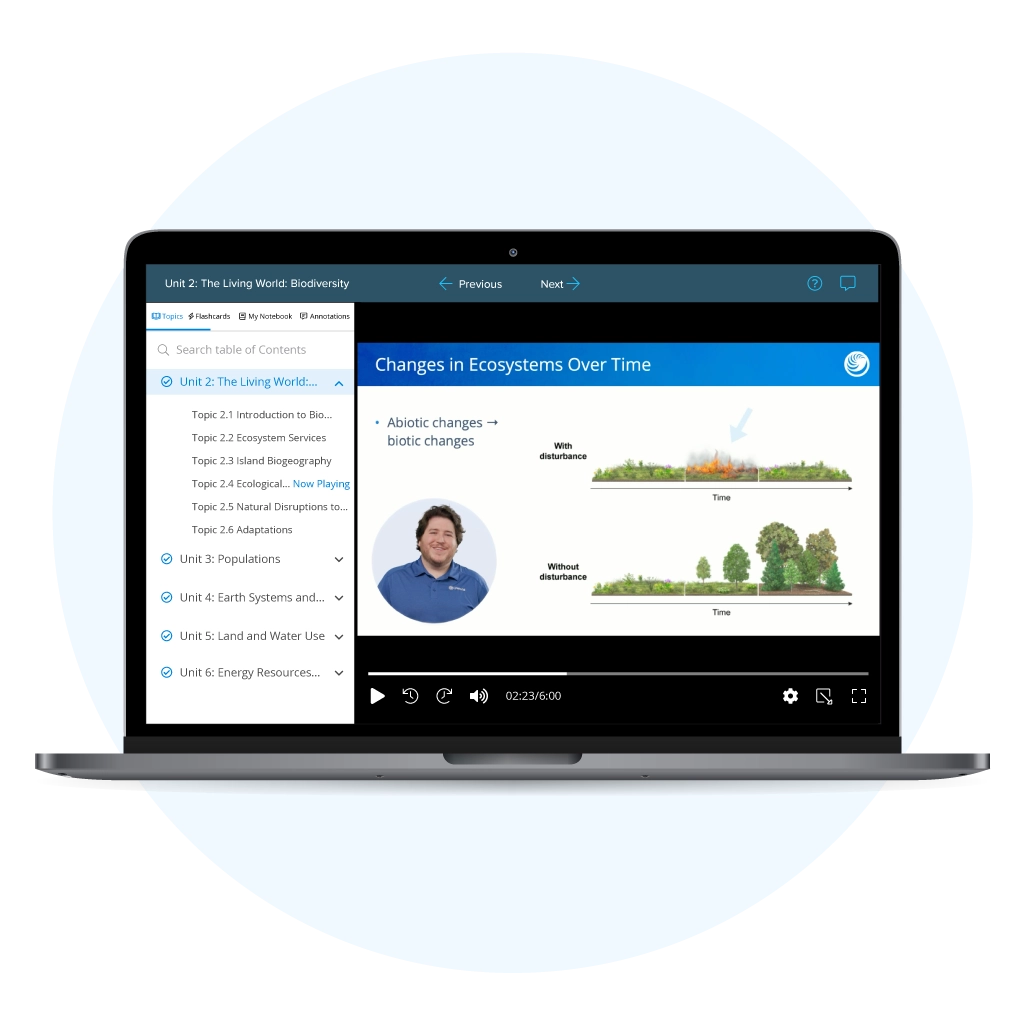
Explore AP Environmental Science Unit 9 topics through clear, engaging video lessons that make global change easier to understand. Each lesson breaks down climate drivers, atmospheric trends, and human impacts with simple visuals and real-world examples. These videos help you connect complex processes and prepare confidently for APES Unit 9 MCQs, progress checks, and FRQs.

Read

Interactive Study Guides

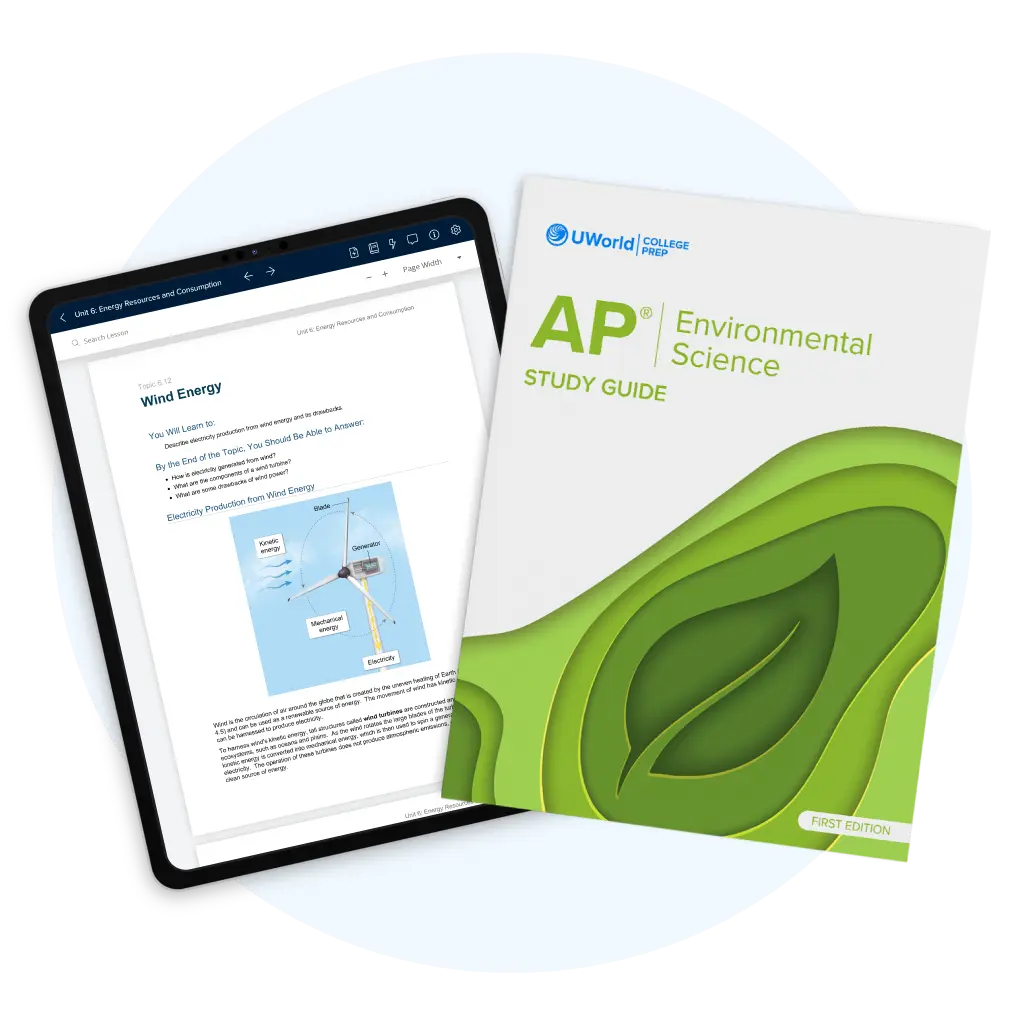
Work through AP Environmental Science Unit 9 with interactive study guides that simplify global change concepts step by step. These guides break down climate patterns, atmospheric changes, greenhouse gases, and ecological responses using visuals and clear explanations. Each section reinforces learning with quick checks and examples so you can stay confident during your APES Unit 9 review and exam prep.

Practice

Sharpen Your APES Skills with Unit 9 Practice Questions

Work through these focused AP Environmental Science Unit 9 questions to strengthen your understanding of global change topics. Each question reflects real AP exam structure, helping you think critically and apply key concepts. Use this set to build accuracy and confidence before test day.
Try these sample practice questions with detailed answer explanations:
Global Change Practice Tests

Question

Which of the following best describes one way the Endangered Species Act helped protect animal populations?

A. Established the first protected area for the National Wildlife Refuge System.
B. Mandated landowners to control the population size of naturally occurring species that prey on endangered species.
C. Created penalties for developing countries that engage in the sale of products made from endangered species.
D. Introduced regulatory measures stating that federal agencies cannot destroy the habitat of endangered species.

Explanation

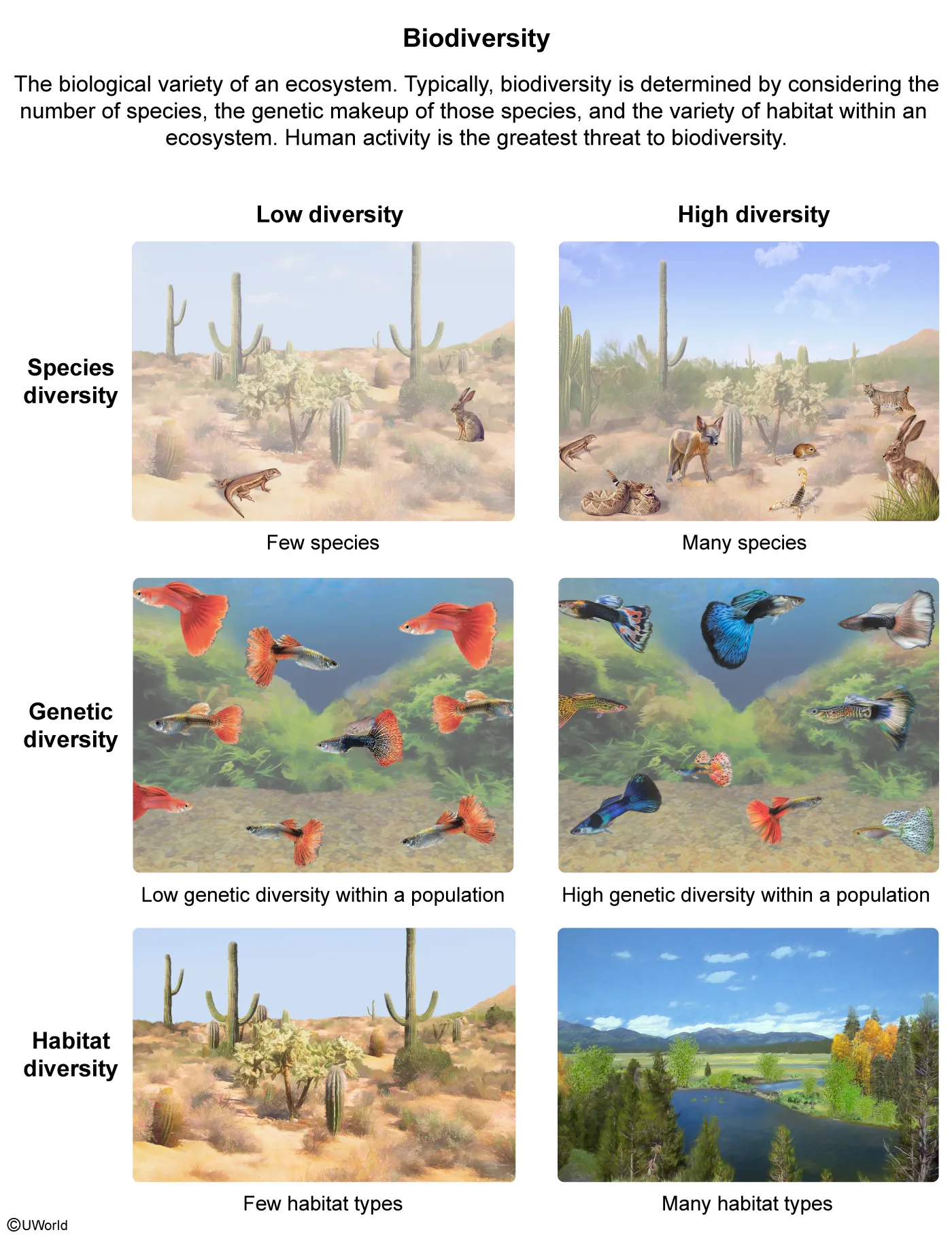
Graph showing rapid human population growth in the 20th century and its impact on global biodiversity

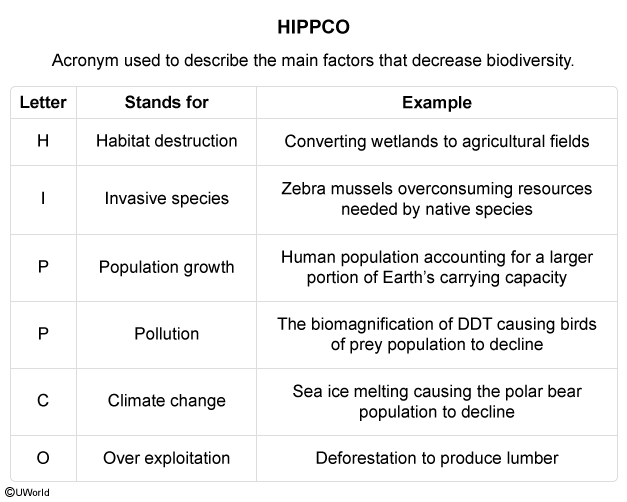
During the 20th century, the human population began a period of rapid growth. This growth led to an increase in housing and commercial development that resulted in fragmented habitats. The loss of habitat, combined with increased threats from hunting and pollution, caused a decrease in biodiversity across the globe.

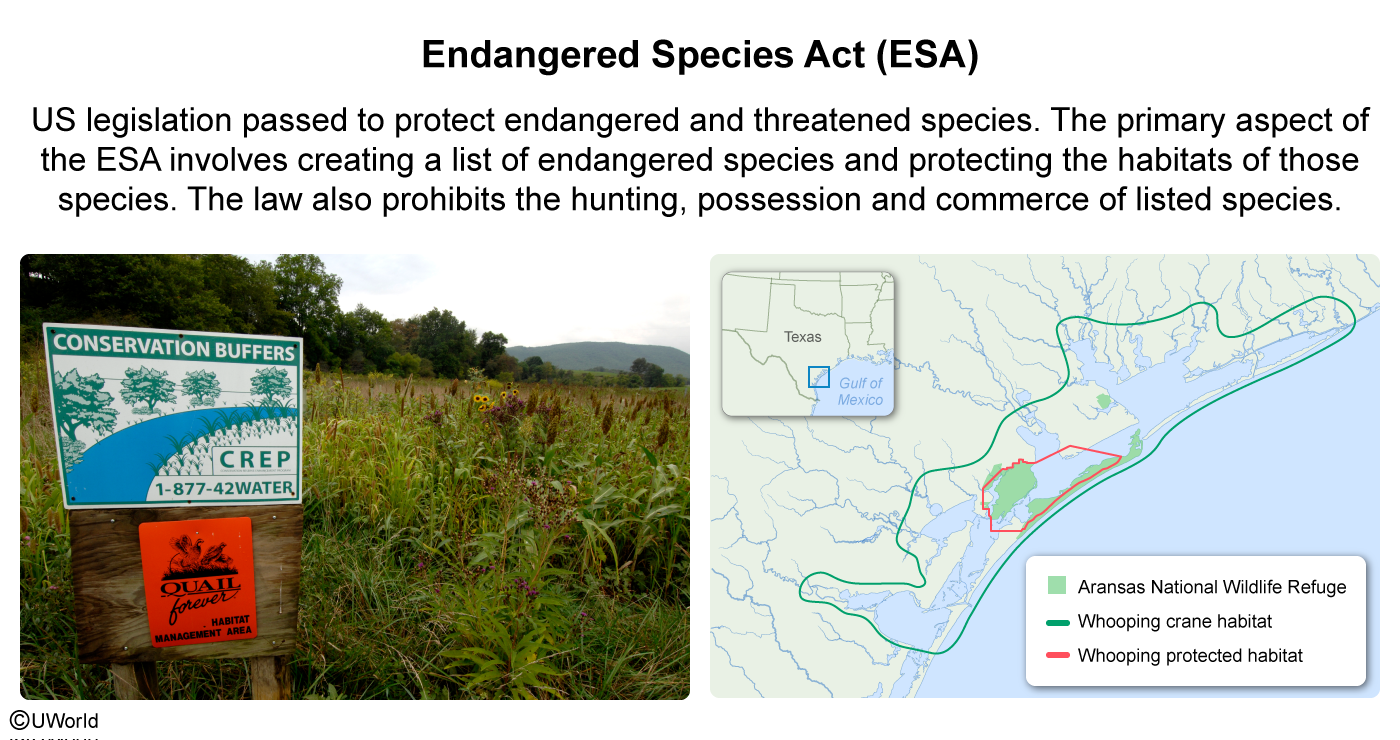
The US government, driven by this loss of biodiversity, enacted the Endangered Species Act (ESA) in 1973. Key provisions of the ESA protected animals by:

  • creating a system to list animals as threatened or endangered.
  • prohibiting the import, export, possession, hunting, sale, and transport of listed species.
  • designating critical habitat (protected land necessary for the survival of a listed species).

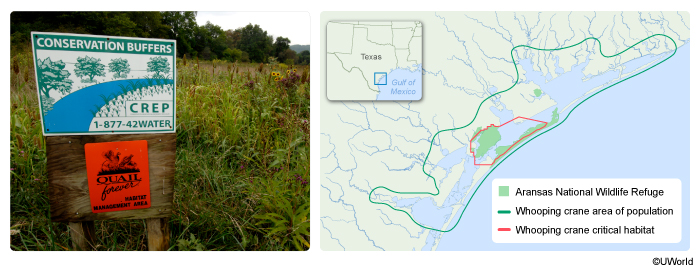
Within the critical habitat provision, the ESA states that the habitat of endangered species cannot be destroyed by individuals or by federal agencies. Through this provision, protected animal habitats enabled the recovery of some threatened species, such as the whooping crane.

(Choice A) The first protected area for the National Wildlife Refuge System was created in 1903; it was not part of the ESA.

(Choice B) Through incentive programs, the ESA encourages rather than mandates landowners to protect endangered species in this way.

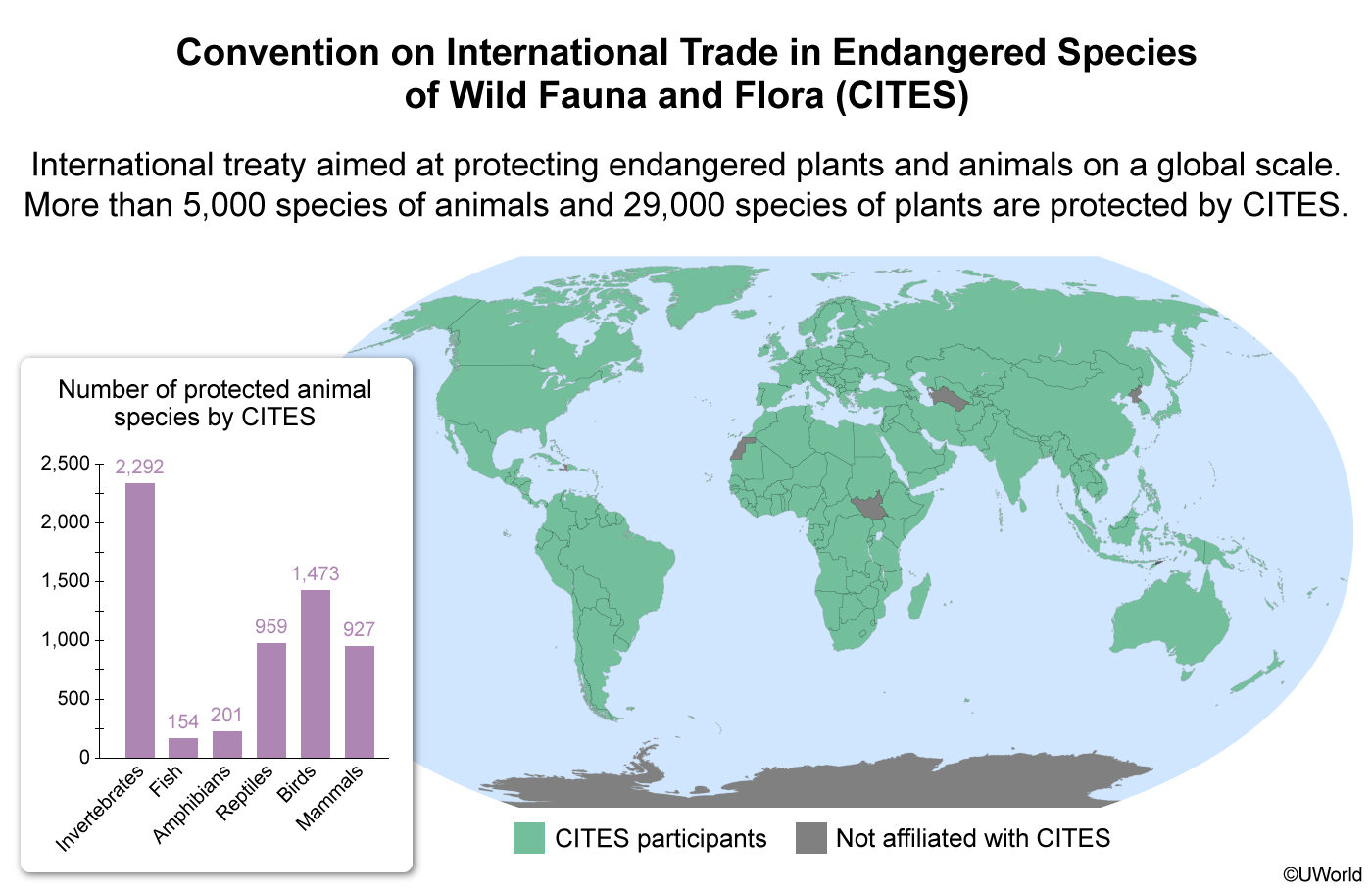
(Choice C) Although the Convention on International Trade in Endangered Species of Wild Fauna and Flora (CITES) provides funds to reduce the sale of products from endangered species, the ESA—a US law—does not penalize other countries.

Things to remember:
The Endangered Species Act, a US law, increases protection of habitats to safeguard threatened animal populations.

Question

Other than rising sea levels, which of the following is a consequence of climate change?

A. Changes in climate slow the rate at which carbon dioxide is stored in the tissues of producers.
B. The ecological range of tolerance for marine species narrows to protect species from temperature fluctuations associated with climate change.
C. Thermal inversions occur more readily with climate change, impacting the formation of ozone in the stratosphere.
D. Climate change poses a threat to the availability of habitat and food for organisms in polar regions.

Explanation

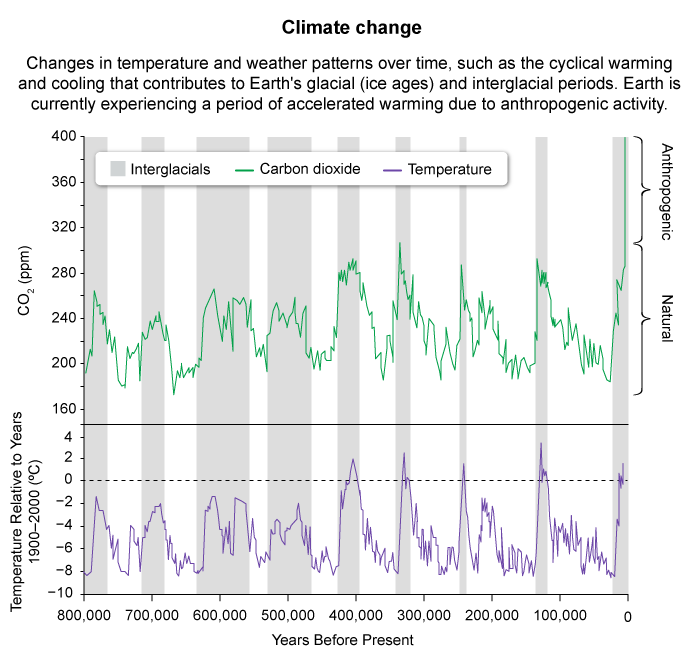
Graph showing cyclical climate patterns throughout Earth’s history, with recent rapid warming due to anthropogenic activity

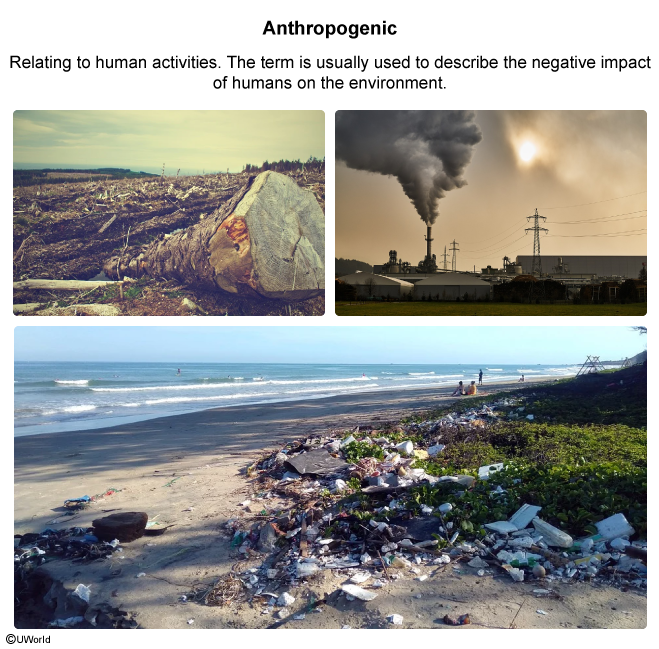
Throughout Earth's history, the prevailing climate (average temperature and rainfall over time) has varied, with cyclical periods of warming and cooling. However, in recent history, anthropogenic activities have contributed to a period of significant warming, which has influenced Earth's biotic and abiotic factors in many ways.

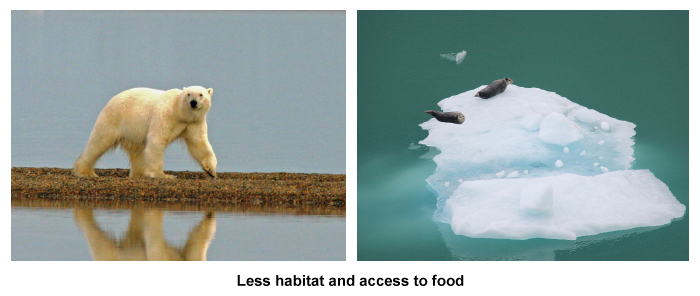
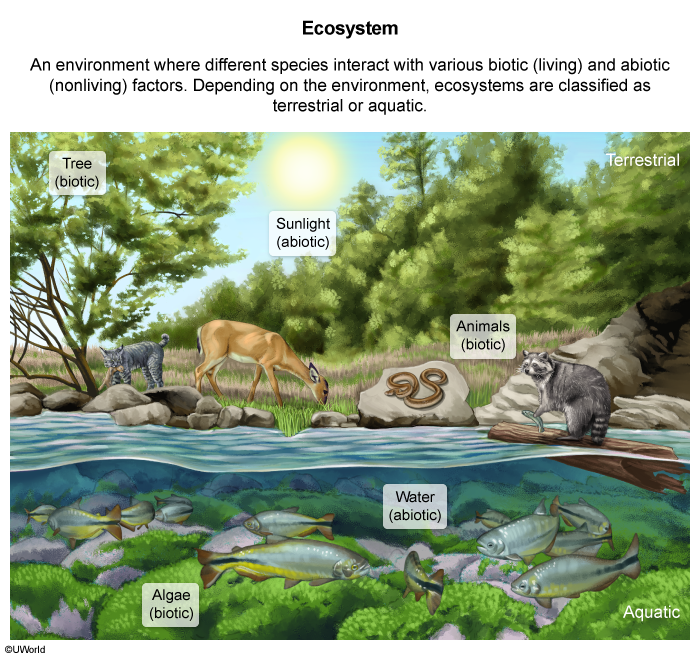
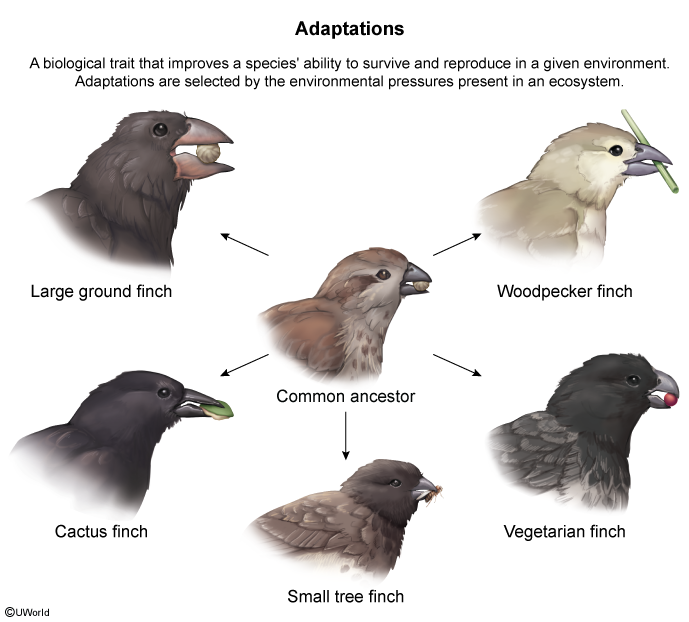
For example, as temperatures rise, the snow and ice in polar regions begin to melt. Because many polar species, such as polar bears and seals, are adapted to snow and ice, changes in the climate of polar regions impact their survival by reducing the availability of habitat and food.

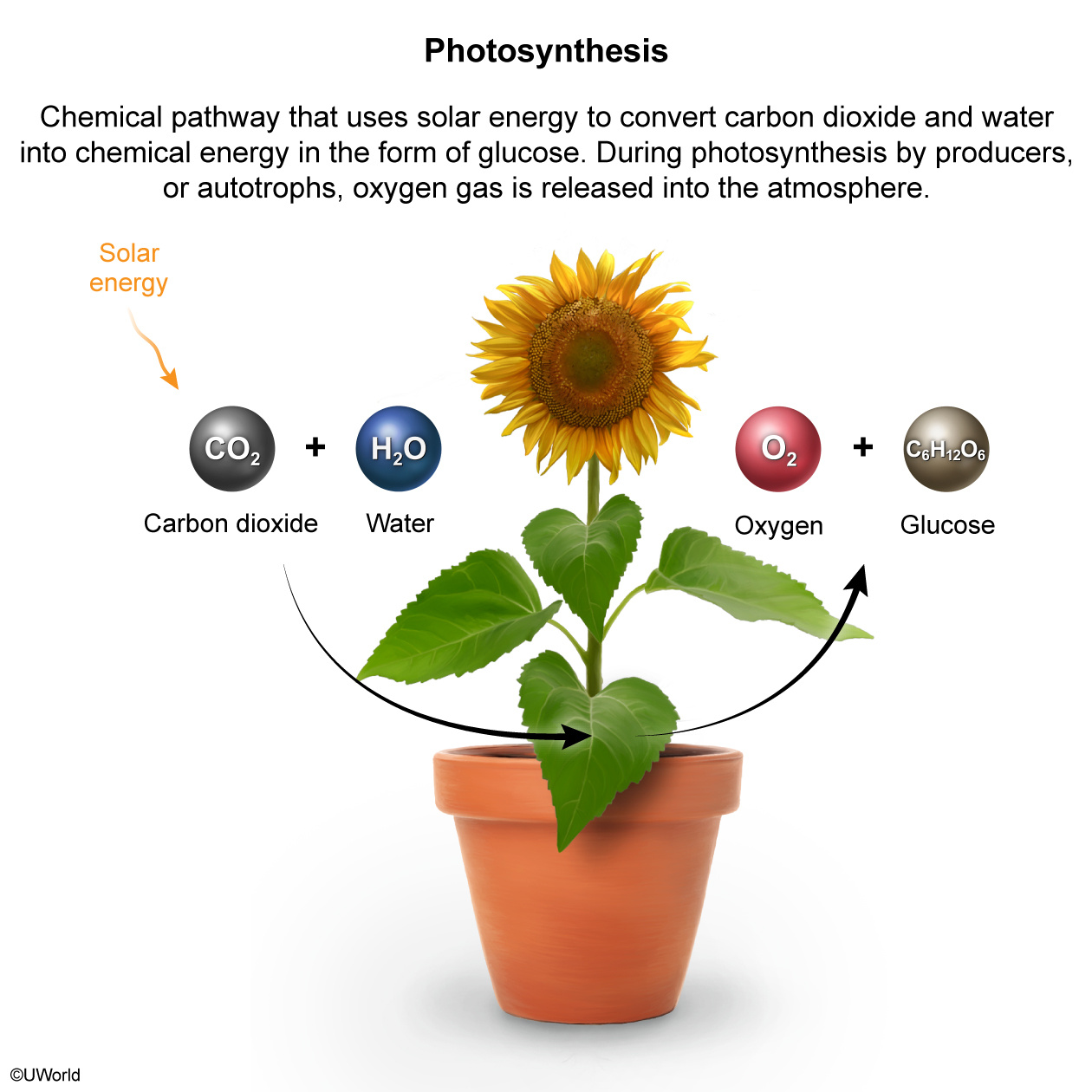
(Choice A) Increased atmospheric carbon dioxide levels from climate change can promote photosynthesis and plant growth that would increase, not slow, the rate of carbon dioxide storage in producers.

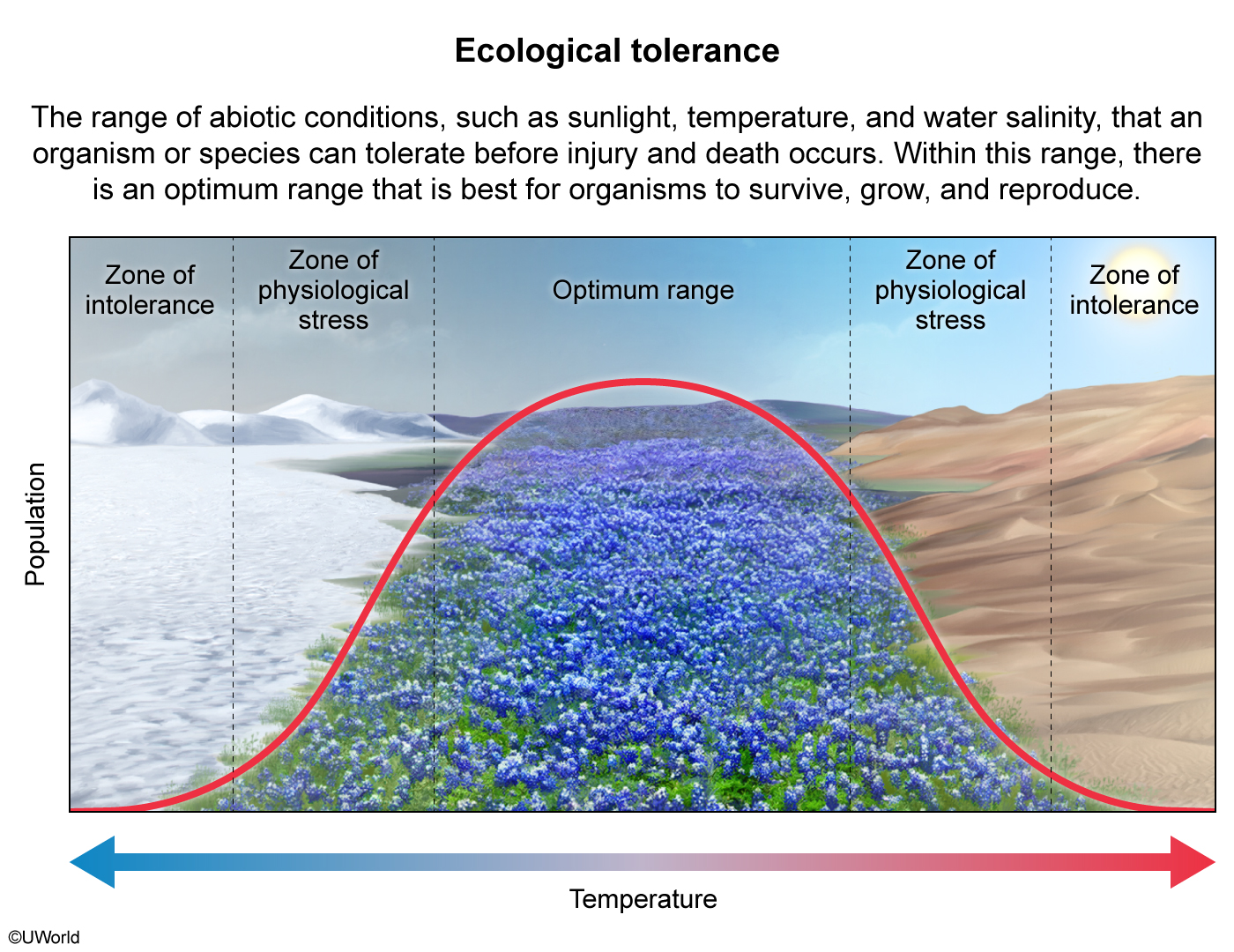
(Choice B) A narrow range of tolerance would limit the temperatures that organisms are adapted to and would not protect species from fluctuations in the temperature.

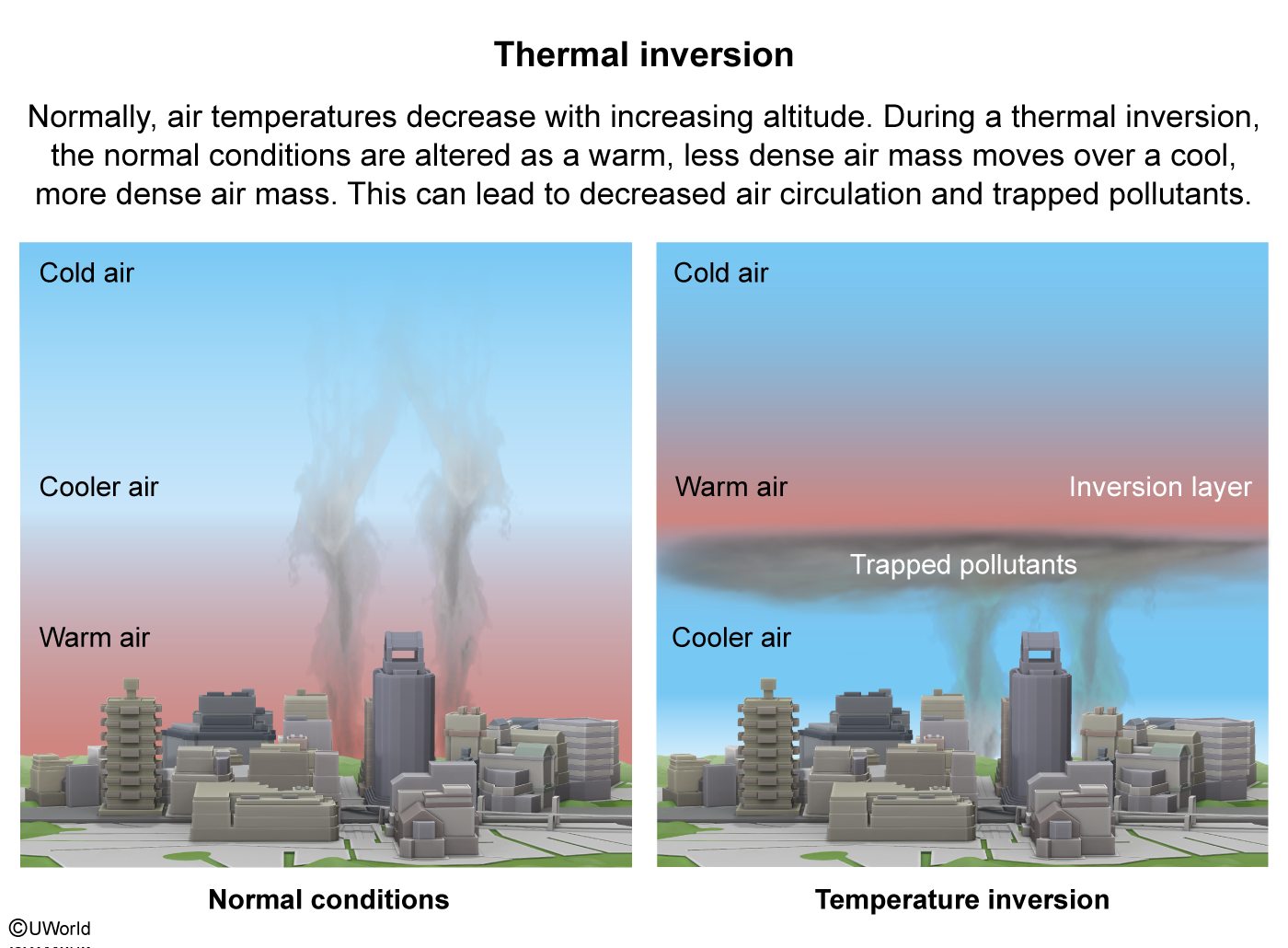
(Choice C) Thermal inversions do not impact the formation of the ozone layer.

Things to remember:
As the climate changes and surface temperatures warm, snow and ice in polar regions melt, resulting in decreased habitat and availability of food for some polar species.

Passage

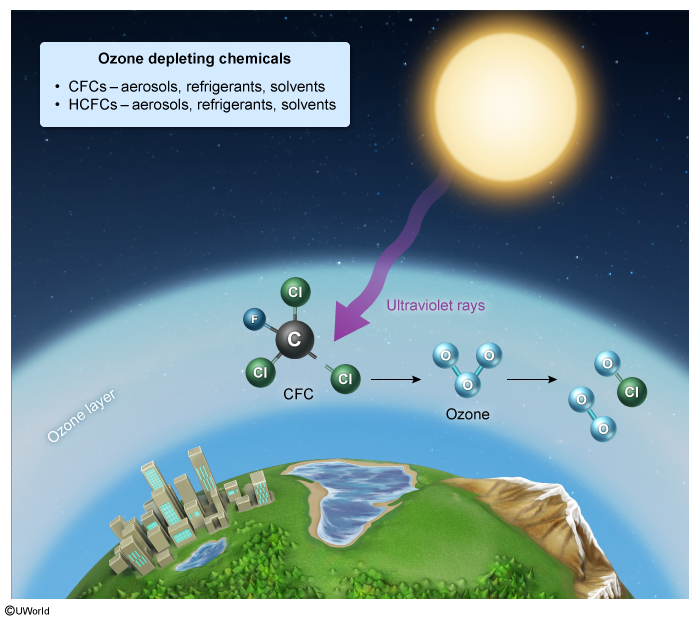
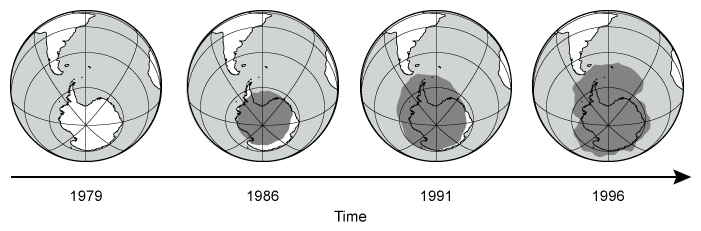
The diagram below shows stratospheric ozone depletion over time.
SAT Reading & Writing Questions 1-3: Information and Ideas

Question

Which of the following best explains an anthropogenic cause of the ozone depletion illustrated in the diagram?

A. Increased atmospheric sulfur dioxide concentrations from the burning of fossil fuels and vehicle emissions.
B. Increased atmospheric sulfur dioxide concentrations from volcanic eruptions and coal-burning power plants.
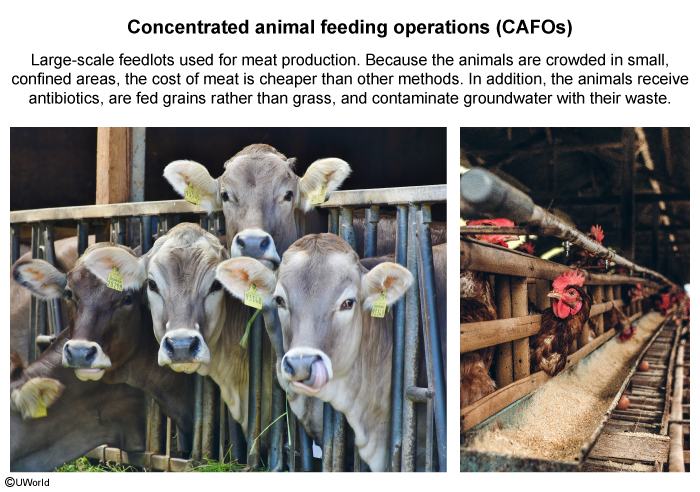
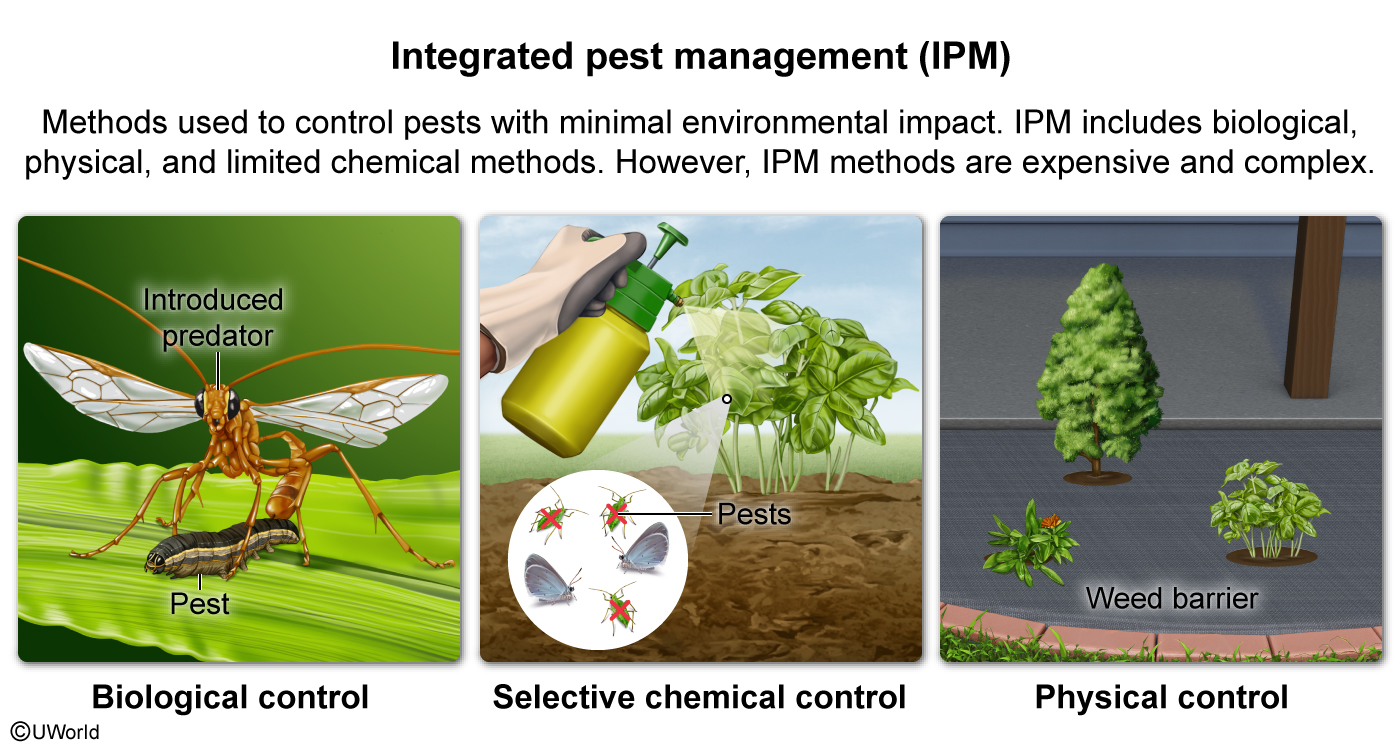
C. Increased atmospheric chlorofluorocarbon concentrations from concentrated animal feeding operations and integrated pest management practices.
D. Increased atmospheric chlorofluorocarbon concentrations from aerosol sprays and refrigerants.

Explanation

Diagram showing the depletion of the ozone layer over Antarctica, with labeled CFC emissions and chlorine-catalyzed ozone destruction cycle

In the early 20th century, chlorofluorocarbons (CFCs) were synthesized as an inexpensive and effective group of gases that could be used in aerosol sprays and in cooling systems. By the 1960s, CFCs were widely used in automobiles, homes, and office buildings.

However, in the early 1970s, scientists discovered that chlorine atoms in CFCs could destroy stratospheric ozone. When the depletion of the ozone layer above Antarctica was observed in the mid-1980s, scientists quickly connected it to CFCs. Therefore, increased atmospheric chlorofluorocarbon concentrations from aerosol sprays and refrigerants is the best explanation for an anthropogenic cause of the ozone depletion illustrated in the diagram.

(Choices A and B) Although sulfur dioxide is produced by the combustion of fossil fuels and volcanic eruptions, it does not contribute to the depletion of the ozone layer.

(Choice C) Concentrated animal feeding operations and integrated pest management practices are not sources of CFCs and do not increase atmospheric CFC concentrations.

Things to remember:
Anthropogenic causes of stratospheric ozone depletion include the emissions of chlorofluorocarbons (CFCs), a group of gases extensively used in the early 20th century.


UWorld Dark Blue logo

On-the-Go Companion for AP Environmental Science

Prepare for AP Environmental Science Unit 9 whenever it fits your day with the UWorld app. Review global change videos between classes, go through climate and atmospheric change study guides while commuting, or solve APES Unit 9 practice questions during short breaks. Every tool you need, MCQs, FRQs, progress-check style practice, and explanations, is always available.

Stand Out
with a Top Score in AP Environmental Science

Finish your AP Environmental Science Unit 9 review and continue mastering all units with UWorld. Boost your performance to make yourself a standout candidate for competitive colleges, majors, and scholarships by earning a top score.

Choose Your Subscription
Dream Score Plan
360-Day
$169
Deep Learning Plan
180-Day
$149
Score Booster Plan
90-Day (No print book, only digital)
$129
Introductory Plan
30-Day (No print book, only digital)
$99

Get our all-in-one course today!

  • Focused APES Videos
  • Print & Digital Study Guide
  • 550+ Exam-style Practice Questions
  • Customizable Quiz Generator
  • Adjustable Study Planner
  • Realistic Timed Test Simulation
  • Colorful Visual Explanations
  • Progress Dashboard
  • Smart Flashcards
  • Digital Notebook
Explore our free trial and frequently asked questions.

Hear From Our AP Students

UWorld’s service is pretty good and helps provide a lot of explanations on subjects I haven’t been confident on before.

— Bence P.

The questions here are the most realistic to the AP tests I've seen so far! I appreciate the ability to customize tests as well.

— Kaila H.

The best part is that all options are well-explained, telling clearly why they are not the right option.

— Syeda Huma Z.

Frequently Asked Questions (FAQs)

AP Environmental Science Unit 9 explores how natural processes and human activities create large-scale changes in Earth’s systems. The unit focuses on long-term environmental shifts, their drivers, and their ecological consequences. 

Key topics in Unit 9 include:

  • Ozone depletion: How CFCs and other chemicals break down the ozone layer and increase UV exposure.
  • Global climate change: Long-term shifts in temperature, weather patterns, and atmospheric composition.
  • Ocean warming and acidification: Rising sea temperatures and decreasing pH levels affecting marine life.
  • Invasive species: How non-native species disrupt ecosystems and threaten native biodiversity.
  • Human impacts on diversity: Habitat loss, pollution, and resource use driving species decline worldwide.

UWorld helps you master all aspects of Unit 9 with clear explanations, visual breakdowns, and realistic APES Unit 9 practice questions, making complex global change topics easier to understand and boosting your exam confidence.

Preparing for AP Environmental Science Unit 9 starts with building a strong understanding of global change and the environmental processes that drive it. Instead of studying everything at once, begin by breaking the unit into smaller themes, climate change, ozone depletion, ocean changes, invasive species, and biodiversity loss. 

Next, strengthen your understanding with resources that turn these topics into clear visual explanations. For Unit 9, it’s especially important to review charts, climate models, atmospheric data, and long-term trend graphs. Short videos and guided notes make it easier to grasp how these global processes interact.

Finally, practice regularly with exam-style questions. Work through APES Unit 9 progress-check style MCQs, data interpretation problems, and FRQs that ask you to analyze climate patterns or evaluate human impacts. UWorld ties all of this together by giving you realistic Unit 9 practice questions, visual explanations, and step-by-step breakdowns, making even the most complex global change concepts feel manageable.

Yes, you can find several helpful free resources for AP Environmental Science Unit 9, starting with the UWorld free trial. It includes a limited set of AP Environmental Science Unit 9 MCQ practice questions, targeted explanations on global change topics, and sample AP Environmental Science Unit 9 FRQ items that show you how exam-style answers are structured. You can also preview APES Unit 9 vocab, quick summaries, and a unit 9 APES reading guide to support your review.

The College Board provides additional support through AP Classroom, including topic questions, progress-check style items, and a Unit 9 APES quiz that reflects the exam’s structure. Their outlines also help you understand exactly what the Global Change unit expects.

Finally, Khan Academy offers general environmental science videos that can help reinforce major ideas. While not AP-specific, they can still support your understanding of atmospheric changes, climate trends, and biodiversity concepts.

The AP Environmental Science Unit 9 test includes both multiple-choice and free-response questions that focus on global change, climate patterns, human impacts, and biodiversity loss. You’ll encounter data sets, graphs, atmospheric trends, and real-world scenarios that require you to connect environmental processes with global outcomes.

  • Multiple-Choice Questions (MCQs): Expect AP Environmental Science Unit 9 MCQ items covering ozone depletion, greenhouse gas trends, ocean acidification, and invasive species. Many questions mirror the format of a unit 9 APES MCQ progress check or an APES Unit 9 MCQ progress check, where you interpret charts, climate models, or short passages to choose the best answer.
  • Free-Response Questions (FRQs): The AP Environmental Science Unit 9 FRQ section often includes data interpretation, short calculations, and explanations of environmental change. You may analyze ecosystem responses, evaluate human impacts, or interpret climate graphs. Reviewing APES Unit 9 FRQ answers and reading an APES Unit 9 summary can help you understand how high-scoring responses are structured.

UWorld recreates all of these question types with exam-style detail, helping you practice exactly what you’ll see on the APES Unit 9 test and build confidence with every session.

Improving your FRQ score for AP Environmental Science Unit 9 starts with consistent practice. Work through past exam FRQs and sample questions to familiarize yourself with the types of prompts you’ll encounter, such as those on population dynamics, species interactions, and ecosystem services.Avoid common mistakes like skipping calculations or misinterpreting data presented in charts and graphs.

Next, refine your writing and time management skills. Break down each question into smaller parts, plan your responses briefly, and practice completing FRQs within the allotted time. 

For the most effective preparation, UWorld’s AP Environmental Science resources provide realistic FRQs with step-by-step explanations, targeted feedback, and customizable quizzes. Practicing with UWorld helps you identify weak areas, reinforces key concepts, and builds confidence so you can approach Unit 9 FRQs with clarity and precision on test day.

The “Global Change” unit, which is AP Environmental Science Unit 9, typically accounts for about 15–20% of the multiple-choice section and a similar portion of the free-response section on the AP exam. This unit covers topics such as climate change, ozone depletion, biodiversity loss, and the impact of human activities on global systems, making it an important area for understanding both current environmental challenges and long-term ecological trends.

UWorld’s APES practice questions allow you to focus on Unit 9 with realistic multiple-choice questions and FRQs. Their explanations highlight the connections between global change concepts and other units, helping you maximize your score efficiently.

A highly effective way to study for AP Environmental Science Unit 9 is to use UWorld’s APES study guide. UWorld provides a structured, topic-by-topic review of Unit 9 concepts, including global change, climate effects, and biodiversity loss. Their study guide combines clear explanations, diagrams, and practice questions that mimic the style and difficulty of the AP exam. You can also track your progress, identify weak areas, and customize quizzes to focus on the topics you need most.

In addition to UWorld, the College Board offers official resources, including course descriptions and sample FRQs, which are essential for understanding how Unit 9 topics appear on the exam.

Khan Academy is another excellent free resource, providing video tutorials and practice exercises that explain complex concepts in an easy-to-understand format.

Yes, UWorld offers practice tests and question banks that are perfect for focusing on AP Environmental Science Unit 9 (Global Change). You can create custom quizzes and practice tests that concentrate only on Unit 9 topics, such as climate change, biodiversity loss, and human impacts on ecosystems. The platform provides multiple-choice and free-response questions designed to mirror the style and difficulty of the actual AP exam.

UWorld also gives detailed explanations for each question, helping you understand why certain answers are correct and where you might need improvement. Their progress-tracking tools let you see which topics you’ve mastered and which need more review, making your practice highly targeted.

Using UWorld for Unit 9 ensures that your preparation is efficient, structured, and closely aligned with the AP exam format, helping you build confidence and improve your score.

Scroll to Top

Smash APES

Your Best Score
Starts Here
No Credit Card Required
Try UWorld FREE for 7 Days

Frequently Asked Questions

New Purchase: All new subscriptions go into effect from the time they are activated and not at the time of setup/purchase. A subscription can be activated immediately or any time thereafter. If your initial purchase consists of multiple courses (Qbank, Self-Assessment exam, CCS, etc.), each can be activated individually and independently via your account on our website. This process of activating a subscription after purchase allows you the flexibility to start a subscription when you are truly ready to use it.

We recommend that all subscriptions be activated within 180 days of setup/purchase. Once a subscription is activated, it cannot be paused or suspended for any reason and will run continuously for the duration of the course material.

Renewal: A renewal is an extension of time to continue access to a current activated subscription. Because a renewal is an extension to an already active subscription, it is effective from the existing expiration date, not from the day of purchase and cannot be deferred to start at a later date/time.

Note: All of our subscriptions are based on the Eastern Time Zone (GMT/UTC -5 hours or New York Time), which may be different than your local time zone.

Any of our product offerings can be purchased from our website with payment due in full at time of purchase via a credit or debit card with American Express/Discover/MasterCard or Visa logo.

You will need to register for an account in order to purchase any of our products. Once you have registered for an account or if you already have an account:

  • Log in to your UWorld account
  • Click on the Cart icon at the top of the page and then select your desired product to see a list of available packages and their prices
  • Select the package you wish to purchase
  • Verify your profile information, address, and educational status, then click the Update button
  • Enter your Billing address and credit/debit card information, then click Review Order
  • Verify that the correct product is in your cart and click Place Order
  • A purchase receipt will automatically be sent to your registered email address

If you complete your purchase but do not receive a receipt, please contact the Customer Care Team at [email protected]

You can subscribe to any of our online courses/services using a credit or debit card with a Visa, MasterCard, Discover or American Express logo. After a successful payment, your subscription will immediately be available for activation via your account on our website or available complementary mobile applications.

You can also subscribe via personal check, money order, or demand drafts taken in U.S. dollars. These types of payments should be mailed to us and should include the name of the subscription and the duration, along with the details asked for in the registration form. We will set up your account as soon as we receive your payment and notify you via email of your access credentials. All direct-mail payments must be in U.S. dollars and made payable to:

UWorld, LLC
9111 Cypress Waters Blvd
Suite 300
Dallas, TX 75019

We do not accept cash via mail, currencies other than U.S. dollars or payments via fax.

Individuals purchasing our CPA Review product may finance their purchase using Affirm during checkout process. Your eligibility depends on your credit score and other criteria, as per Affirm’s policies (outlined here). A soft credit check, a credit check that does not affect your credit score, will be performed by Affirm to determine your loan eligibility. You will need a US based bank account to qualify.

All refunds are evaluated on a case-by-case basis for products purchased directly from UWorld. One case has no bearing on another. Refund amounts determined by UWorld are final.

In-App Purchases: We are unable to process any refunds for purchases made via mobile application (in-app). Please contact Apple for all refund/credit requests for Apple in-app purchases.

USMLE Step 2 CS, Step 3 CCS, Subject Reviews & Self-Assessment Exams: These subscriptions are non-refundable, non-transferable, and cannot be converted into another subscription.

CPA Review: Students may request to cancel their CPA review product only within 10-days of activation of any of the materials. To qualify for a refund, no more than 10% of the course (lectures, Qbank, or a combination there-of) may have been used per exam section. All CPA Review refunds are subject to a cancellation fee of $75 (for single section purchases) or $250 (for package
purchases), plus any applicable shipping charges. No return of merchandise is necessary.

All other Qbanks: Refunds are considered for subscriptions of more than 30 days. Refund amounts are based on the number of days elapsed since the subscription start date or the number of questions used, whichever amounts to a higher deductible.

Example scenarion: An individual purchases a 180-day Qbank subscription and generates a few test blocks equal to 20% of the questions in the Qbank. After 45 days, he/she requests a refund. Because the elapsed duration is greater than the percentage of questions used, the refund amount will be based on a subscription converted to the closest duration (60 days) by deducting the applicable 60-day subscription fee from the refund. In the same scenario, if the individual had used 85% of the questions, the refund would be 15% of the subscription fee paid.

Note 1: A processing fee of 10% (minimum of $10 and maximum of $25) will be applied to all refund amounts.

Note 2: All refunds, pro-rated or otherwise, must be requested within 360 days of original purchase. Refunds for purchases made more than 360 days ago will be issued as non-refundable, non-transferable store credit.

Note 3: Subscribers must notify UWorld of their intent to obtain a refund before activating their subscription (or) during the active duration. If the reset option is used or all of the questions are used, no refund will be allowed (see “I want to reset/delete my Qbank test history (or) start all over again, is this possible?” below for further details). No refunds will be offered for expired subscriptions.

Note 4: For combination package purchases, individual subscription fees will be applied when calculating the refund. If any self-assessment Exam(s) is utilized from a package, the entire purchase is rendered non-refundable.

Note 5: Although access to Qbanks via certain mobile devices is provided as an additional feature, it is not intended to be a replacement for computer access, and no refunds or cancellations will be honored due to user inability to install and/or use the provided software on any mobile device (regardless of whether the device meets the minimum system requirements).

Please use the following steps to purchase a renewal for your subscription:

  • Log in to your account on our website
  • Click on the User Icon in the top right corner of the screen
  • Click on the Renew button corresponding to your subscription
  • Select the Renewal duration you wish to purchase
  • Verify your profile information, address, and educational status, then click the Update button
  • Enter your Billing address and credit/debit card information, then click Review Order
  • Verify that the correct package is in your cart and click Place Order

Upon a successful transaction, you will be sent a confirmation email receipt.

A renewal is an extension of time to continue accessing an active subscription, and it will not start the subscription over, provide a reset, or grant access to additional questions that were not previously accessible. Because a renewal is an extension to an already active subscription, it is effective from the existing expiration date, not from the date of purchase, and cannot be deferred in any way to start at a later date/time.

Please note that to qualify for renewal pricing, you will need to renew the course before it expires. Renewals are not offered to expired subscriptions. If you fail to secure a renewal before the expiration date, you will need to purchase a new subscription at the regular price directly from our website to regain access to the material.

Note: All times and dates displayed for subscription expiration correspond with the Eastern Time Zone (GMT/UTC -5 hours or New York Time), which may be different than your local time zone.

Note: If your initial purchase was a combination package, you will need to renew each active subscription individually. You do not need to renew a course that has not been activated.

You may request to upgrade or downgrade your subscription purchase as long as it has not been activated. If you purchase a combination package, all included subscriptions must be unused. Please be advised that current subscription pricing will apply.

If your subscription has been activated, unfortunately, we cannot upgrade it retroactively. If seeking to downgrade, please refer to our refund policy for available options.

We do not offer custom duration(s) or combination packages other than those outlined on the website. Please refer to our purchase page for currently available subscriptions (including discounted combination packages for some products).

Self-Assessment exam subscriptions are for 14 days each. Subscribers whose active subscription(s) have not expired can purchase renewals from 7 days or more at any time before their active subscription expires. Please refer to the respective course description page for renewal options.

We offer a demo on each of our product pages that contains a sample of the product interface and a few sample questions. We do not offer guest/trial accounts to test our software and view materials.

It is possible to purchase a subscription as a gift for someone else. However, the intended recipient will need to register an account on our website (or have an account registered for them, with their profile information entered accurately). If the user is present at the time of purchase, the purchase can be made from their account on our website using any credit or debit card with a Visa, MasterCard, American Express, or Discover logo.

If the user is not present, or you wish for the gift to be a surprise, please contact Support directly using the contact form to arrange payment for the gift subscription. You will need to provide the user’s registered email address so the account can be located.