FREE Ground Shipping on Courses $149+ | Code: SANTASENDSFREE

AP® Environmental Science Unit 7 Review and Practice Test

Atmospheric Pollution

Get exam-ready with a focused APES Unit 7 review covering all essential atmospheric pollution topics. Learn how pollutants develop, spread, and impact human and ecosystem health through clear, student-friendly lessons. Then test your understanding with UWorld’s realistic AP® Environmental Science Unit 7 FRQ and MCQ practice designed to sharpen your reasoning skills.

Boost Your Confidence and Score High with Our AP Environmental Science Unit 7 Review

Strengthen your understanding of AP® Environmental Science Unit 7 with a review designed to make complex ideas simple. UWorld breaks down smog, ozone depletion, acid rain, and air quality regulations into easy-to-grasp lessons that build true mastery and boost your test-day confidence.

Watch

Engaging Video Lessons

Make learning atmospheric pollution engaging with our AP Environmental Science Unit 7 video lessons. Each concept is broken down through graphics, demonstrations, and clear expert teaching, so even complex ideas become simple to follow.

Read

Interactive Study Guides

Prepare smarter with our AP Environmental Science Unit 7 study guide designed to break down concepts into simple, structured sections. Interactive diagrams and quick summaries help you review efficiently and keep information fresh.

Practice

Try These AP Environmental Science Unit 7 Practice Test Questions

Put your learning to the test with challenging APES Unit 7 practice questions. UWorld’s MCQs mirror real AP difficulty and walk you through key air pollution concepts, helping you identify gaps, understand your mistakes, and build exam-day confidence.
Try these sample practice questions with detailed answer explanations:
Atmospheric Pollution Practice Tests.

Passage

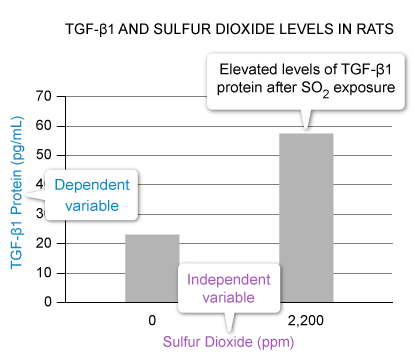
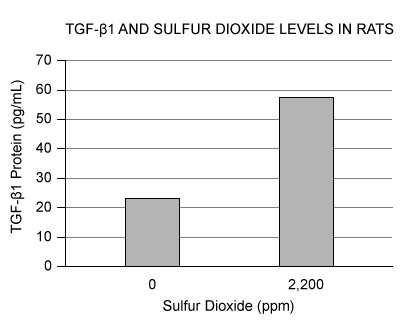
The graph below shows the experimental data from an investigation testing how sulfur dioxide (SO2) in the air can alter the amount of transforming growth factor beta 1 (TGF-β1), a protein used to indicate inflammation, in mammals.

The laboratory experiment was performed with two groups of female rats that were similar in age and size. Each group was housed under identical conditions. Each group was exposed to a different concentration of SO2, and the level of TGF-β1 in their lungs was measured.
Sulfur dioxide: sources and effects

Question

Which of the following conclusions can be drawn from the investigation?

A. The dependent variable causes asphyxiation in the rats.
B. The independent variable acts as an air pollutant.
C. The independent variable impacts the control group the least.
D. The dependent variable is elevated across all groups.

Explanation

Bar graph comparing TGF-β1 protein levels in rat lungs between control group (no SO₂) and experimental groups (exposed to SO₂), showing elevated levels in exposed groups

In the given scenario, scientists were investigating the effects of sulfur dioxide (SO2) exposure on transforming growth factor beta 1 (TGF-β1) levels. In the experiment:

  • SO2 is the independent variable.
  • TGF-β1 protein level is the dependent variable.

When comparing the results of the experimental group to the control (group that did not receive SO2), it can be determined that SO2 exposure increases the amount of TGF-β1 in the lungs of rats. Because TGF-β1 is a marker of inflammation, it can be concluded that SO2 exposure causes negative health impacts.

Any atmospheric chemical or particulate that negatively impacts organisms' health, survival, or activities and decreases air quality is considered an air pollutant. Based on the results of the investigation, SO2, the independent variable, acts as an air pollutant.

(Choice A) Although SO2 exposure can result in asphyxiation (lack of oxygen), SO2 was the independent, not the dependent, variable.

(Choice C) In the scenario, the independent variable was SO2. The control group was not exposed to SO2 and therefore was not impacted by the independent variable.

(Choice D) Although the rats in the experimental groups had elevated TGF-β1 levels in their lungs, the level of TGF-β1 in the control group was not considered elevated because it served as a baseline measurement.

Things to remember:
Sulfur dioxide (SO2) is considered an air pollutant because it can negatively impact organisms' health, survival, or activities and decreases air quality.

Question

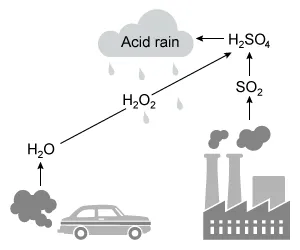
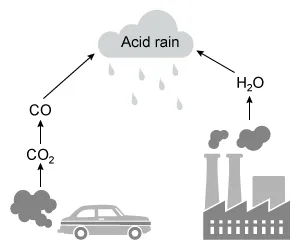
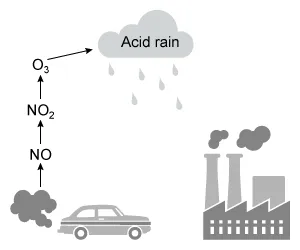
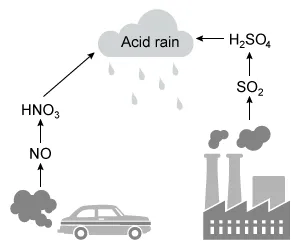
Which of the following diagrams correctly illustrates the formation of acid rain?

A.
B.
C.
D.

Explanation

Acid Rain

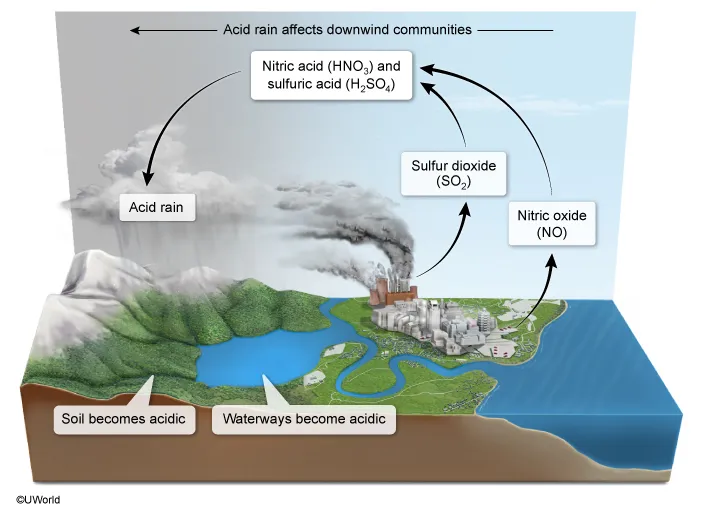
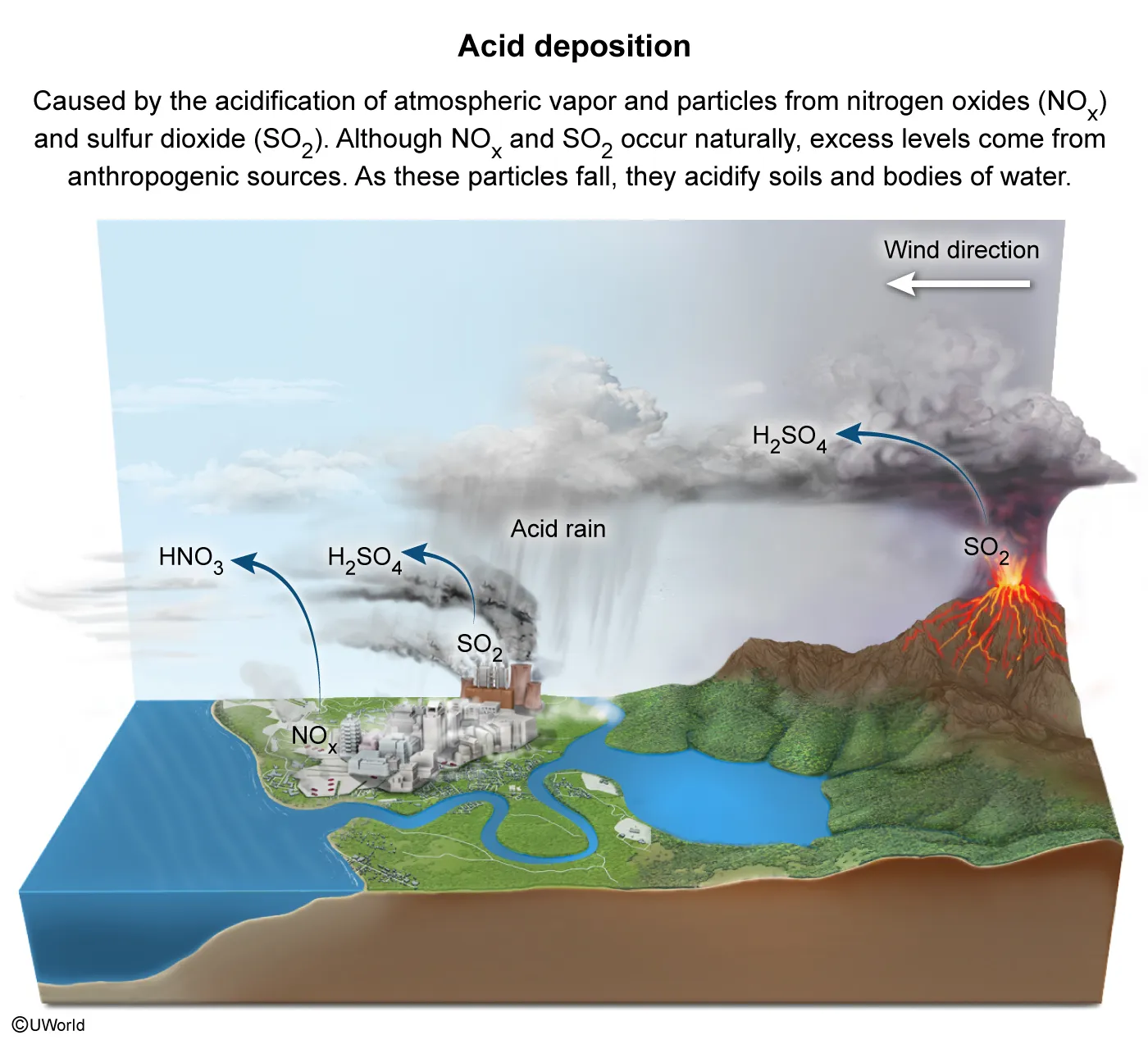
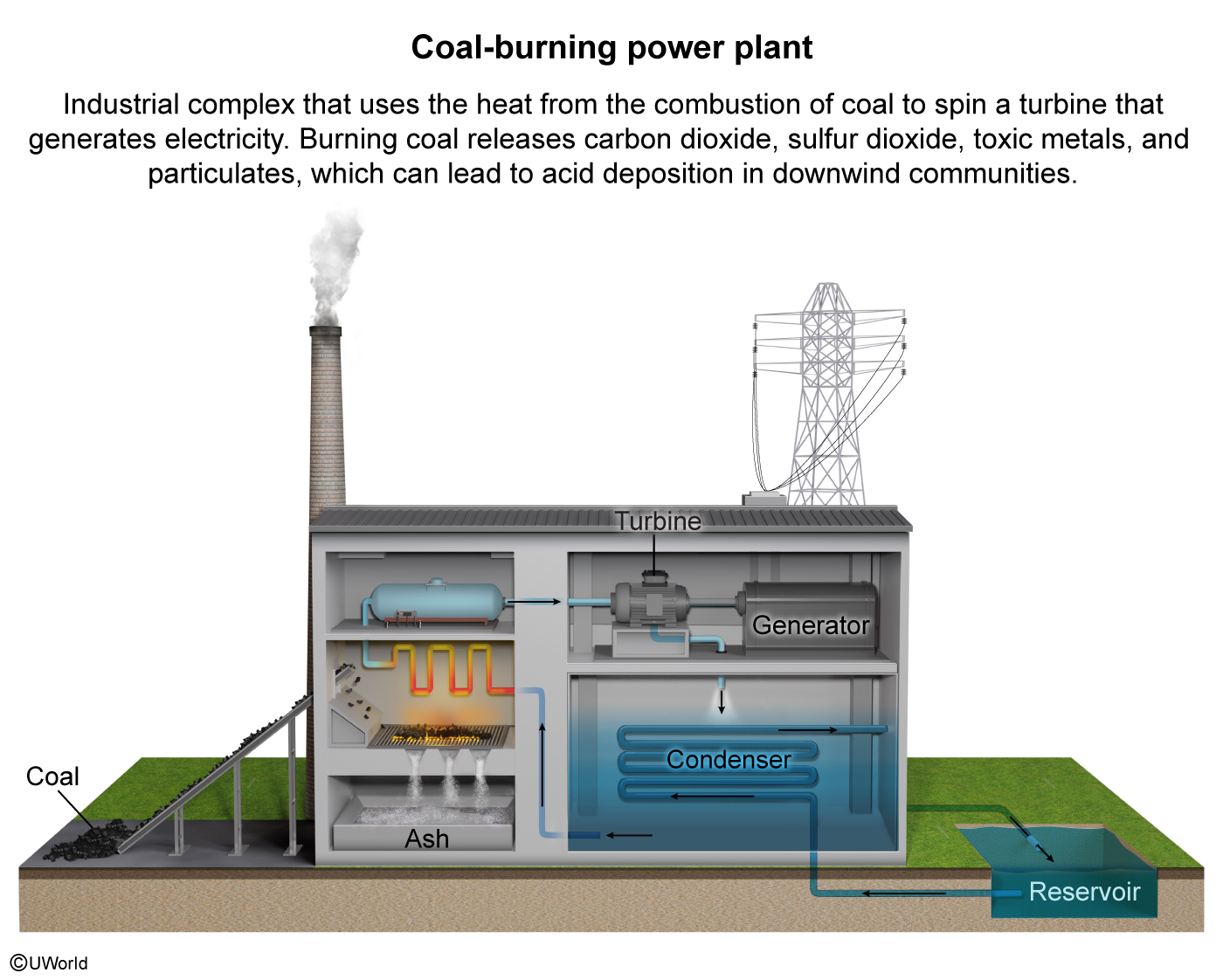
Acid rain, also known as acid deposition, occurs after nitric oxides (NOx), such as nitric oxide (NO), and sulfur oxides (SOx), such as sulfur dioxide (SO2), transform into nitric acid (HNO3) and sulfuric acid (H2SO4) in the atmosphere.

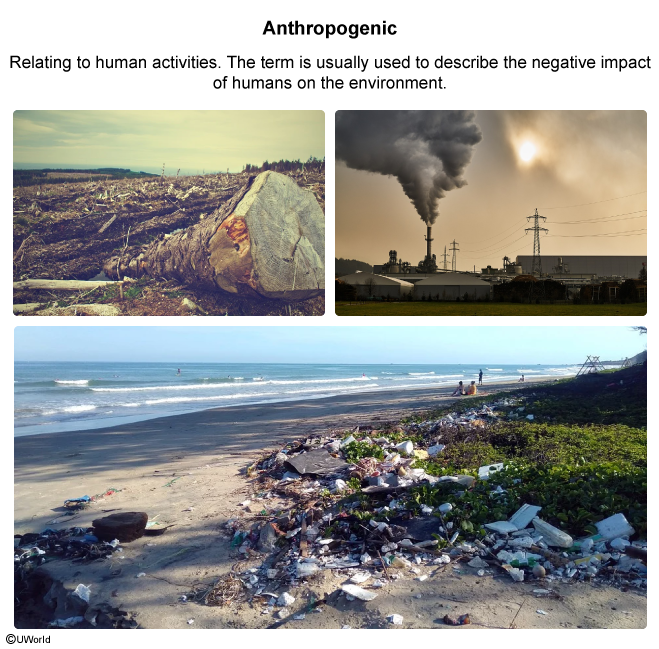
Although NO and SO2 are naturally occurring compounds, excess amounts originate from anthropogenic activities. For example, NO often comes from vehicle emissions, while SO2 is released from industrial facilities, such as coal-burning power plants. As these acids accumulate, they increase the acidity of atmospheric moisture, which condenses into clouds until gravity causes the water to fall back down to Earth as acid rain.

Therefore, the diagram that correctly illustrates the formation of acid rain is Choice A.

Illustration of renewable energy sources including solar panels and wind turbines as alternatives to fossil fuels

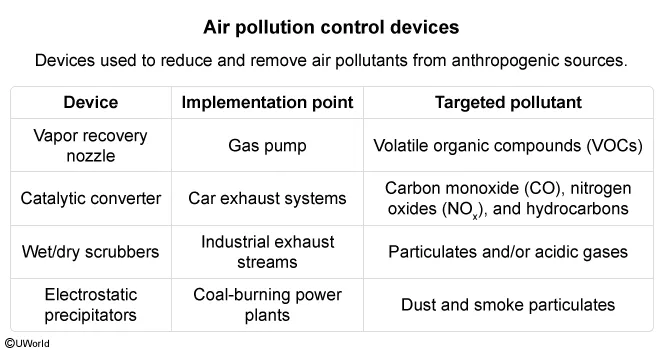
Since 1975, car manufacturers in the US have been required to install catalytic converters in all new cars to help mitigate the impact of air pollution. These devices reduce the emission of hydrocarbons, carbon monoxide, and nitrogen oxides from the tailpipes of vehicles.

(Choice B) Although SO2 is involved in the formation of acid rain, hydrogen peroxide (H2O2) is not.

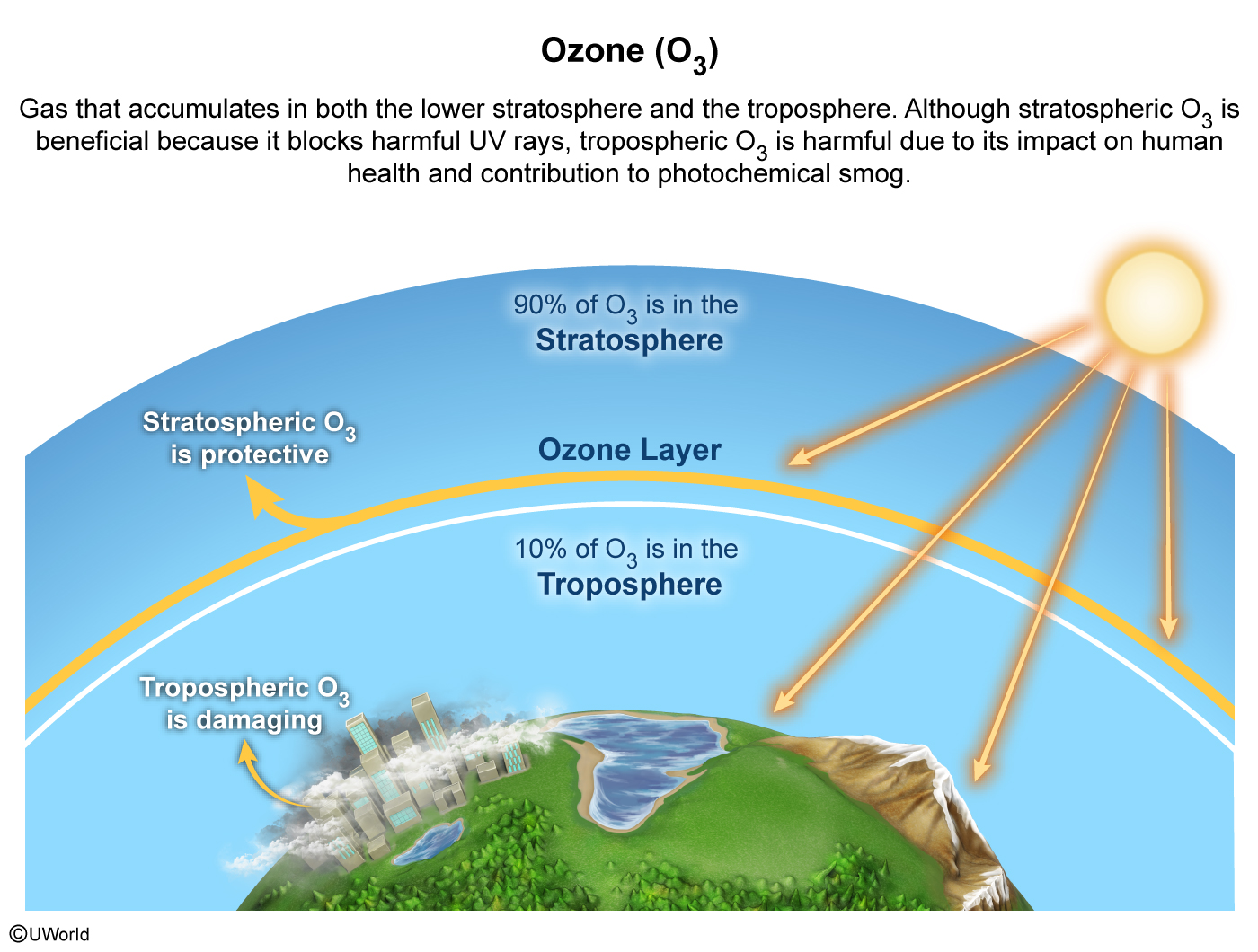
(Choices C and D) Carbon dioxide (CO2) and ozone (O3) are not chemically involved in the formation of acid rain.

Things to remember:
Nitric oxides (NOx) and sulfur oxides (SOx) are compounds that lead to acid deposition. NOx primarily comes from vehicle emissions, while SOx primarily released from coal-burning power plants.

Question

Which of the following environmental consequences is most often linked to noise pollution?

A. Increased rates of auditory cancers in human populations living near airports
B. Alterations in the feeding behavior of aquatic animals
C. Creation of waves that disrupt air flow in the stratosphere
D. Enhanced capabilities for predators who use echolocation

Explanation

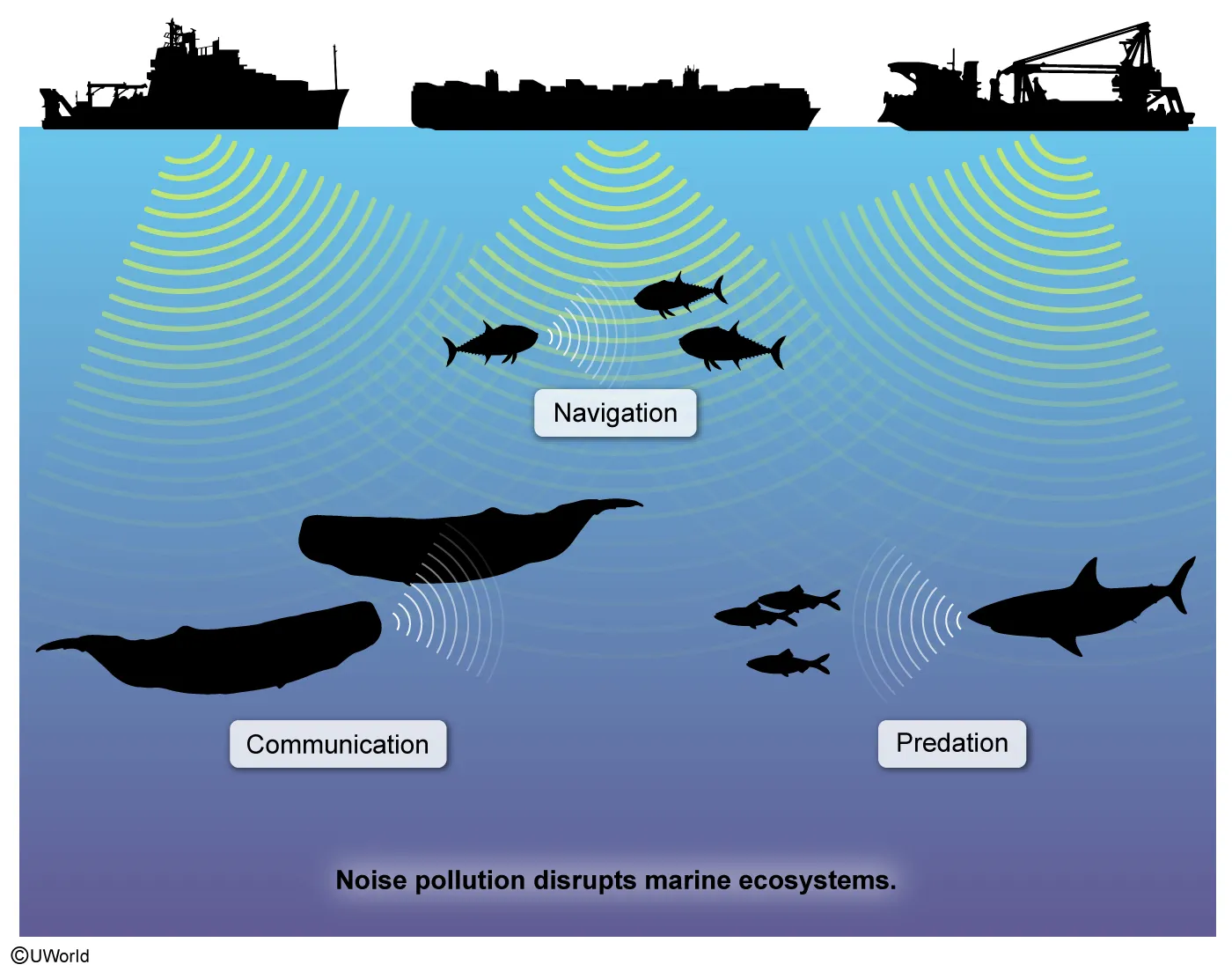
Diagram illustrating sources and impacts of noise pollution in marine and terrestrial ecosystems, showing sound wave propagation from ships, highways, and natural events

Noise pollution is classified as any harmful or disturbing sound. Thunder and high winds are considered natural sources of noise pollution; however, noise pollution predominantly comes from anthropogenic activities, such as highway driving or shipping.

In any ecosystem, these sounds can disturb the animals within that ecological system by:

  • causing stress.
  • masking sounds used to hunt and communicate.
  • damaging hearing abilities.
  • altering migratory routes.

In marine ecosystems, noise pollution spreads over long ranges and is damaging because of marine animals' reliance on sound to communicate, hunt, and navigate. Therefore, one consequence often associated with noise pollution is alterations in the feeding behavior of aquatic animals.

(Choice A) Genetic predisposition, not where people live, is the greatest risk factor for auditory cancers.

(Choice C) Although sound pollution is produced by sound waves traveling through the air, these waves are not strong enough to disrupt air flow in the stratosphere.

(Choice D) Noise pollution inhibits, rather than enhances, the hunting ability of predators who use echolocation (use of sound waves to navigate within an ecosystem).

Things to remember:
Noise pollution causes stress in animals. It masks the sounds used to hunt and communicate, damages hearing, and alters migratory routes.

UWorld Dark Blue logo

Study Anywhere, Anytime

Tackle practice questions on the ride home from a game, review topic videos between classes, or dive into a study guide while waiting for friends at the coffee shop. Everything you need for AP Environmental Science Unit 7 review is always at your fingertips with the UWorld app.

Stand Out
with a Top Score in AP Environmental Science

Finish your AP Environmental Science Unit 7 review and continue mastering all units with UWorld. Boost your performance to make yourself a standout candidate for competitive colleges, majors, and scholarships by earning a top score.

Choose Your Subscription
Dream Score Plan
360-Day
$169
Deep Learning Plan
180-Day
$149
Score Booster Plan
90-Day (No print book, only digital)
$129
Introductory Plan
30-Day (No print book, only digital)
$99

Get our all-in-one course today!

  • Focused APES Videos
  • Print & Digital Study Guide
  • 550+ Exam-style Practice Questions
  • Customizable Quiz Generator
  • Adjustable Study Planner
  • Realistic Timed Test Simulation
  • Colorful Visual Explanations
  • Progress Dashboard
  • Smart Flashcards
  • Digital Notebook
Explore our free trial and frequently asked questions.

Hear From Our AP Students

UWorld’s service is pretty good and helps provide a lot of explanations on subjects I haven’t been confident on before.

— Bence P.

The questions here are the most realistic to the AP tests I've seen so far! I appreciate the ability to customize tests as well.

— Kaila H.

The best part is that all options are well-explained, telling clearly why they are not the right option.

— Syeda Huma Z.

Frequently Asked Questions (FAQs)

AP Environmental Science Unit 7 examines atmospheric pollution, covering the sources, chemical transformations, and environmental consequences of air pollutants. Mastery of this unit is essential because key topics frequently appear in APES Unit 7 progress check MCQs and APES Unit 7 FRQs, making it a key determinant of performance on the AP Environmental Science Unit 7 test. Understanding these concepts allows students to analyze data trends, evaluate human impacts, and predict ecosystem responses.

To study Unit 7 effectively, focus on:

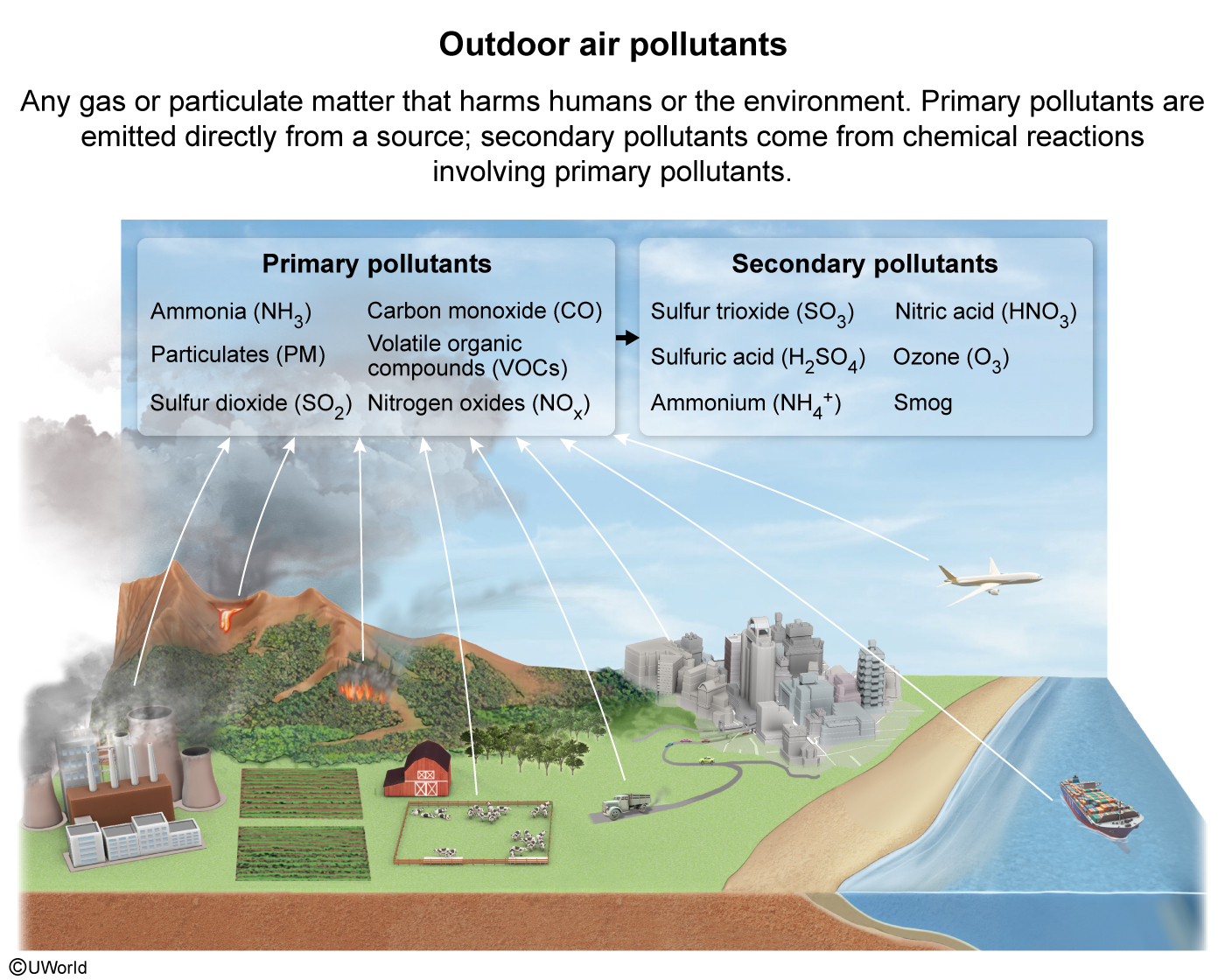
  • Major pollutants: carbon monoxide, sulfur oxides, nitrogen oxides, volatile organic compounds, and particulate matter.
  • Secondary pollutant formation: photochemical smog, acid rain, and ground-level ozone.
  • Human and natural sources: industry, transportation, wildfires, and volcanic activity.
  • Environmental and health impacts: respiratory issues, ecosystem disruption, and climate effects.
  • Regulations and mitigation: air quality standards, emission controls, and international agreements.

By systematically reviewing these topics and using resources such as an AP Environmental Science Unit 7 study guide, students can organize high-yield concepts, interpret pollution data, and link theory to real-world examples. This approach ensures strong preparation for both multiple-choice and free-response questions while building applied understanding of atmospheric pollution.

AP Environmental Science Unit 7 focuses on atmospheric pollution, examining the sources, chemical reactions, and environmental effects of pollutants. These topics are heavily tested in APES Unit 7 MCQs and APES Unit 7 FRQs, making a solid understanding essential for analyzing air quality data, pollutant trends, and real-world scenarios.

Key topics in Unit 7 APES include:

  • Types of pollutants: Primary and secondary pollutants, including particulate matter, sulfur dioxide, nitrogen oxides, and ozone.
  • Chemical processes: Formation of smog, acid rain, ozone depletion, and photochemical reactions.
  • Sources and human impact: Industrial emissions, transportation, energy production, and natural contributors like wildfires or volcanic activity.
  • Atmospheric processes: Dispersion, deposition, temperature inversions, and global transport of pollutants.
  • Environmental and health effects: Impacts on ecosystems, climate change, and human respiratory or cardiovascular health.
  • Regulations and mitigation: Policies, treaties, and technologies aimed at reducing air pollution and improving air quality.

Mastering these topics helps students interpret emission graphs, calculate pollutant concentrations, and apply concepts in AP Environmental Science Unit 7 progress check MCQs and FRQs. Combining structured review materials, like an AP Environmental Science Unit 7 study guide, with UWorld’s interactive lessons and practice sets reinforces key concepts, improves problem-solving skills, and prepares learners for both multiple-choice and free-response sections on the unit 7 APES test.

Studying for Unit 7 APES review requires a combination of conceptual understanding, practice, and application. Atmospheric pollution concepts can be complex, and they appear frequently in APES Unit 7 MCQs and APES Unit 7 FRQs, so a structured approach helps in retaining information and applying it effectively on the AP Environmental Science Unit 7 test.

Effective study strategies include:

  • Concept review: Focus on major pollutants, secondary pollutant formation, and the chemical processes that govern atmospheric reactions.
  • Data interpretation: Practice reading air quality graphs, emission trends, and pollutant concentration charts.
  • Case studies: Examine real-world examples of smog events, acid rain impacts, and ozone depletion scenarios.
  • Applied calculations: Work on related formulas for pollutant concentration, emissions per capita, or atmospheric chemical reactions when applicable.
  • Summarized notes: Create a concise AP Environmental Science Unit 7 study guide with high-yield topics for quick revision before practice tests.

Following this structured method allows students to systematically connect theory with real-world examples, analyze trends, and reinforce high-yield concepts. Regular review and application of these strategies prepare learners to tackle both APES Unit 7 progress check MCQs and free-response questions with clarity and accuracy.

A well-planned study sequence for AP Environmental Science Unit 7 ensures that students build understanding progressively, from foundational concepts to applied scenarios. Following a logical order helps in connecting topics and prepares learners to handle both APES Unit 7 MCQs and APES Unit 7 FRQs efficiently.

Recommended study sequence:

  • Start with pollutant basics: Learn about primary pollutants, secondary pollutants, and their sources.
  • Understand chemical processes: Study reactions that form smog, acid rain, and ozone depletion.
  • Explore health and ecosystem effects: Review the impacts of air pollution on human health, biodiversity, and climate.
  • Examine regulatory frameworks: Learn about national and international air quality standards and mitigation strategies.
  • Practice application: Analyze real-world pollution data, emission trends, and case studies.
  • Integrate knowledge: Solve mixed problems that combine chemical reactions, pollutant sources, and environmental consequences.

Following this sequence allows learners to layer knowledge logically, making it easier to interpret graphs, apply formulas, and respond accurately to unit 7 APES progress check questions. A structured approach ensures that high-yield topics are covered systematically and prepares students to handle both multiple-choice and free-response sections on the exam.

In the final two weeks before the AP Environmental Science Unit 7 test, a focused review plan helps consolidate understanding of atmospheric pollution concepts and improves performance on both MCQs and FRQs. Prioritizing high-yield topics and combining conceptual review with practice ensures students can apply knowledge confidently under timed conditions.

Two-week review plan:

Week 1:

  • Revisit major pollutants, chemical reactions forming secondary pollutants, and sources of pollution.
  • Analyze case studies on smog, acid rain, and ozone depletion.
  • Practice interpreting air quality graphs and emission trend data.

Week 2:

  • Complete APES Unit 7 practice test questions, mixing MCQs and FRQs.
  • Identify areas of difficulty and review related concepts in the AP Environmental Science Unit 7 study guide.
  • Summarize formulas, pollutant effects, and regulatory measures in a concise revision sheet for last-minute review.

This structured approach allows students to consolidate core knowledge, strengthen problem-solving skills, and simulate exam conditions, ensuring readiness for unit 7 APES progress check questions and the full Unit 7 test. UWorld’s interactive lessons and practice sets provide additional guided support to reinforce key concepts and test-taking strategies.

AP Environmental Science Unit 7 FRQs assess a student’s ability to analyze air pollution data, understand chemical processes, and evaluate environmental impacts. These questions frequently appear on APES Unit 7 FRQs, making it essential to know the common formats and expectations for high-scoring responses.

Common FRQ types include:

  • Data analysis questions: Interpret graphs, tables, and charts showing pollutant concentrations, emission trends, or air quality indices.
  • Cause-and-effect scenarios: Explain how specific pollutants affect human health, ecosystems, or climate, and relate them to emission sources.
  • Chemical reaction applications: Describe secondary pollutant formation, such as ozone or acid rain, and predict environmental consequences.
  • Policy evaluation: Discuss air quality regulations, emission reduction strategies, or international agreements and their effectiveness.
  • Integrated problem-solving: Combine multiple concepts to address complex scenarios, like urban smog formation or acid deposition on ecosystems.

Understanding these FRQ types allows students to approach each problem systematically, connect theoretical knowledge to real-world examples, and apply calculations or chemical reasoning when needed. Practicing with APES Unit 7 progress check FRQ questions reinforces these skills and prepares learners to handle both data interpretation and conceptual explanation efficiently.

Improving performance on APES Unit 7 progress check MCQs requires a combination of conceptual mastery, data interpretation skills, and targeted practice. These questions often test knowledge of pollutant types, chemical reactions, human and natural sources, and environmental consequences, so connecting theory to applied scenarios is essential.

Strategies to boost MCQ performance:

  • Review key concepts: Focus on primary and secondary pollutants, chemical transformations, and smog or acid rain formation.
  • Practice data interpretation: Analyze air quality graphs, emission trend charts, and pollutant concentration tables.
  • Apply high-yield formulas: Understand calculations related to pollutant dispersion, concentration, or reaction rates.
  • Timed practice sessions: Simulate exam conditions using APES Unit 7 practice test questions to improve speed and accuracy.
  • Error analysis: Track recurring mistakes to identify weak areas and revisit corresponding topics in the AP Environmental Science Unit 7 study guide.

Following these strategies consistently helps students recognize common question patterns, apply knowledge efficiently, and improve reasoning skills for both MCQs and FRQs. Combining conceptual review with applied practice ensures better performance on Unit 7 APES assessment questions.

In AP Environmental Science Unit 7, understanding how core atmospheric pollution concepts interrelate is crucial for analyzing environmental data and answering both APES Unit 7 MCQs and APES Unit 7 FRQs. The formation, transport, and impact of pollutants are linked through chemical reactions, environmental processes, and human activities.

Key connections include:

  • Primary and secondary pollutants: How emissions like sulfur dioxide and nitrogen oxides react to form acid rain or ozone.
  • Pollution sources and human impact: Industrial, transportation, and energy-related emissions influence pollutant levels and environmental outcomes.
  • Atmospheric processes: Wind patterns, temperature inversions, and photochemical reactions affect pollutant dispersion and concentration.
  • Ecosystem and health effects: Pollutant accumulation affects biodiversity, respiratory health, and climate, demonstrating the interdependence of chemical and ecological processes.

Recognizing these connections allows students to interpret trends in air quality data, predict consequences of pollution events, and apply reasoning in integrated scenarios. Linking theory to real-world examples ensures stronger performance on unit 7 APES progress check questions and prepares learners to tackle multi-part FRQs effectively.

Retaining concepts in AP Environmental Science Unit 7 is critical because topics like pollutant formation, chemical reactions, and environmental impacts appear frequently in both APES Unit 7 FRQs and APES Unit 7 progress check MCQs. Memorization alone is not enough; linking concepts with practical examples and repeated application strengthens understanding.

Strategies for retention:

  • Active summarization: Rewrite key concepts about primary and secondary pollutants, smog formation, and acid rain in your own words to reinforce understanding.
  • Visual learning: Use flowcharts, diagrams, and graphs to track pollutant sources, chemical reactions, and environmental outcomes.
  • Practice exercises: Solve Unit 7 APES practice test questions, including pollutant data analysis and chemical calculations, to apply concepts actively.
  • Self-quizzing: Use UWorld’s digital flashcards or create your own to regularly test definitions, formulas, and cause-effect relationships.
  • Application to scenarios: Relate concepts to real-world events, such as urban smog, acid rain, or ozone depletion, using UWorld’s interactive problem sets to reinforce practical understanding.

By actively engaging with material and practicing both calculations and data interpretation, students can solidify comprehension of high-yield topics. This approach ensures that knowledge is retained long-term and can be applied effectively on the AP Environmental Science Unit 7 test.

Studying atmospheric chemistry for AP Environmental Science Unit 7 requires combining conceptual understanding with practical application. Chemical reactions, pollutant formation, and environmental impacts are commonly tested in FRQs and MCQs, so applying knowledge to real-world scenarios is essential for success.

Effective strategies include:

  • Master chemical processes: Focus on the transformation of primary pollutants into secondary pollutants, such as the formation of ozone and acid rain.
  • Practice calculations: Work on pollutant concentration, emission rates, and chemical reaction stoichiometry when applicable.
  • Interpret visual data: Analyze graphs showing pollutant trends, atmospheric layers, and smog formation patterns.
  • Apply to case studies: Relate chemical processes to events like urban smog episodes, acid rain in forests, and ozone depletion in the stratosphere.
  • Stepwise problem-solving: Break FRQs into smaller steps, identifying formulas, relationships, and ecological implications before writing answers.

This method ensures that learners can connect theory to practical application, interpret data confidently, and respond accurately to both unit 7 APES progress check questions and full-length test problems. Incorporating UWorld’s AP Environmental Science Unit 7 tools, like flashcards and interactive problem sets, further reinforces key concepts and strengthens exam readiness.

The most effective APES Unit 7 practice test mirrors the structure of the actual exam, helping students prepare for both MCQs and FRQs. A balanced test allows learners to apply knowledge of atmospheric pollution, chemical reactions, and environmental impacts while improving speed and reasoning skills under timed conditions.

Recommended practice test structure:

  • Multiple-choice questions: 20–25 questions covering primary and secondary pollutants, chemical transformations, sources, and environmental effects. Include interpretation of graphs, tables, and trend data.
  • Free-response questions: 1–2 multi-part problems requiring calculation of pollutant concentrations, description of chemical reactions, and explanation of ecological or health consequences.
  • Timing: Allocate 50–60 minutes to simulate real exam pacing and improve efficiency.
  • Review and analysis: Identify conceptual errors or calculation mistakes and revisit related topics in your study guide.

Using this format helps students become comfortable with exam-style questions, integrate theory with data interpretation, and strengthen applied reasoning. Structured practice ensures readiness for both multiple-choice and free-response sections on the unit 7 APES test.

Preparation for the AP Environmental Science Unit 7 test should start early to allow sufficient time to master atmospheric pollution concepts and practice both APES Unit 7 MCQs and APES Unit 7 FRQs. Early review ensures students can connect chemical processes, pollutant sources, and environmental impacts while building confidence in data interpretation and problem-solving.

Suggested preparation timeline:

  • 3–4 weeks before the test: Review major pollutants, chemical transformations, and sources. Practice basic calculations and interpretation of air quality graphs.
  • 2 weeks before the test: Apply knowledge to real-world scenarios, analyze case studies, and attempt timed APES Unit 7 progress check MCQs.
  • Final week: Complete full-length practice tests, review errors, and consolidate high-yield topics using a study guide or summary sheet.

Starting preparation early allows students to pace learning, identify weak areas, and systematically reinforce concepts. Integrating UWorld’s AP Environmental Science Unit 7 lessons, interactive exercises, and flashcards with class notes and official College Board® resources provides guided practice, reinforces key concepts, and ensures readiness for both multiple-choice and free-response sections on the Unit 7 APES test.

Students often lose points on FRQs and MCQs due to conceptual misunderstandings, calculation errors, or misinterpretation of data. Recognizing these pitfalls can help learners avoid repeated mistakes and improve overall performance on the AP Environmental Science Unit 7 test.

Frequent errors include:

  • Confusing pollutant types: Mixing up primary and secondary pollutants or misidentifying sources.
  • Incorrect chemical reasoning: Misapplying reactions that form smog, ozone, or acid rain.
  • Graph and data misinterpretation: Misreading air quality charts, emission trends, or pollutant concentration graphs.
  • Overlooking environmental impacts: Failing to connect pollutant levels with ecosystem or human health consequences.
  • Incomplete FRQ explanations: Providing calculations without explaining ecological or health significance.

To minimize mistakes, students can review errors from practice questions, revisit high-yield concepts and practice interpreting data under timed conditions. UWorld’s interactive lessons and detailed feedback on APES Unit 7 MCQs and FRQs help identify specific error patterns, clarify misunderstandings, and provide guided strategies to strengthen reasoning, making it easier to improve accuracy and performance on the test.

High-quality study materials make reviewing AP Environmental Science Unit 7 more efficient and effective. Core topics such as pollutant types, chemical reactions, and environmental impacts appear frequently in APES Unit 7 FRQs and APES Unit 7 MCQs, so having organized resources is essential for targeted review.

Recommended resources:

  • Comprehensive notes: Step-by-step explanations of pollutant sources, chemical processes, and health or ecosystem effects. Include examples and visual aids to clarify complex ideas.
  • Cheat sheets: Quick-reference guides for formulas, pollutant types, and high-yield definitions for rapid revision.
  • Study guides: Structured materials combining concise summaries with practice problems and sample FRQs.
  • Interactive tools: Platforms with annotated visuals, practice sets, and stepwise problem-solving exercises to reinforce understanding.

Using these resources, especially a well-organized study guide, allows students to efficiently review high-yield topics, practice exam-style questions, and track progress. This ensures learners are well-prepared for both unit 7 APES progress check questions and the full Unit 7 test.

Students can access a variety of downloadable AP Environmental Science Unit 7 study guide PDFs and practice materials from the College Board. These resources include official sample APES Unit 7 MCQs and APES Unit 7 FRQs, concise summaries of atmospheric pollution concepts, pollutant types, chemical reactions, and environmental impacts. Additionally, interactive worksheets and annotated graphs help learners practice calculations, interpret data, and apply concepts in real-world scenarios, providing a solid foundation for exam preparation.

In addition to College Board materials, UWorld offers a robust set of AP Environmental Science Unit 7 review tools. Its interactive lessons, guided problem-solving exercises, and practice question sets mirror exam-style MCQs and FRQs, allowing students to track performance and clarify difficult topics. Using UWorld alongside downloadable study guides ensures a comprehensive and structured review, reinforcing key concepts while preparing learners effectively for the Unit 7 APES test.

Scroll to Top

Smash APES

Your Best Score
Starts Here
No Credit Card Required
Try UWorld FREE for 7 Days

Frequently Asked Questions

New Purchase: All new subscriptions go into effect from the time they are activated and not at the time of setup/purchase. A subscription can be activated immediately or any time thereafter. If your initial purchase consists of multiple courses (Qbank, Self-Assessment exam, CCS, etc.), each can be activated individually and independently via your account on our website. This process of activating a subscription after purchase allows you the flexibility to start a subscription when you are truly ready to use it.

We recommend that all subscriptions be activated within 180 days of setup/purchase. Once a subscription is activated, it cannot be paused or suspended for any reason and will run continuously for the duration of the course material.

Renewal: A renewal is an extension of time to continue access to a current activated subscription. Because a renewal is an extension to an already active subscription, it is effective from the existing expiration date, not from the day of purchase and cannot be deferred to start at a later date/time.

Note: All of our subscriptions are based on the Eastern Time Zone (GMT/UTC -5 hours or New York Time), which may be different than your local time zone.

Any of our product offerings can be purchased from our website with payment due in full at time of purchase via a credit or debit card with American Express/Discover/MasterCard or Visa logo.

You will need to register for an account in order to purchase any of our products. Once you have registered for an account or if you already have an account:

  • Log in to your UWorld account
  • Click on the Cart icon at the top of the page and then select your desired product to see a list of available packages and their prices
  • Select the package you wish to purchase
  • Verify your profile information, address, and educational status, then click the Update button
  • Enter your Billing address and credit/debit card information, then click Review Order
  • Verify that the correct product is in your cart and click Place Order
  • A purchase receipt will automatically be sent to your registered email address

If you complete your purchase but do not receive a receipt, please contact the Customer Care Team at [email protected]

You can subscribe to any of our online courses/services using a credit or debit card with a Visa, MasterCard, Discover or American Express logo. After a successful payment, your subscription will immediately be available for activation via your account on our website or available complementary mobile applications.

You can also subscribe via personal check, money order, or demand drafts taken in U.S. dollars. These types of payments should be mailed to us and should include the name of the subscription and the duration, along with the details asked for in the registration form. We will set up your account as soon as we receive your payment and notify you via email of your access credentials. All direct-mail payments must be in U.S. dollars and made payable to:

UWorld, LLC
9111 Cypress Waters Blvd
Suite 300
Dallas, TX 75019

We do not accept cash via mail, currencies other than U.S. dollars or payments via fax.

Individuals purchasing our CPA Review product may finance their purchase using Affirm during checkout process. Your eligibility depends on your credit score and other criteria, as per Affirm’s policies (outlined here). A soft credit check, a credit check that does not affect your credit score, will be performed by Affirm to determine your loan eligibility. You will need a US based bank account to qualify.

All refunds are evaluated on a case-by-case basis for products purchased directly from UWorld. One case has no bearing on another. Refund amounts determined by UWorld are final.

In-App Purchases: We are unable to process any refunds for purchases made via mobile application (in-app). Please contact Apple for all refund/credit requests for Apple in-app purchases.

USMLE Step 2 CS, Step 3 CCS, Subject Reviews & Self-Assessment Exams: These subscriptions are non-refundable, non-transferable, and cannot be converted into another subscription.

CPA Review: Students may request to cancel their CPA review product only within 10-days of activation of any of the materials. To qualify for a refund, no more than 10% of the course (lectures, Qbank, or a combination there-of) may have been used per exam section. All CPA Review refunds are subject to a cancellation fee of $75 (for single section purchases) or $250 (for package
purchases), plus any applicable shipping charges. No return of merchandise is necessary.

All other Qbanks: Refunds are considered for subscriptions of more than 30 days. Refund amounts are based on the number of days elapsed since the subscription start date or the number of questions used, whichever amounts to a higher deductible.

Example scenarion: An individual purchases a 180-day Qbank subscription and generates a few test blocks equal to 20% of the questions in the Qbank. After 45 days, he/she requests a refund. Because the elapsed duration is greater than the percentage of questions used, the refund amount will be based on a subscription converted to the closest duration (60 days) by deducting the applicable 60-day subscription fee from the refund. In the same scenario, if the individual had used 85% of the questions, the refund would be 15% of the subscription fee paid.

Note 1: A processing fee of 10% (minimum of $10 and maximum of $25) will be applied to all refund amounts.

Note 2: All refunds, pro-rated or otherwise, must be requested within 360 days of original purchase. Refunds for purchases made more than 360 days ago will be issued as non-refundable, non-transferable store credit.

Note 3: Subscribers must notify UWorld of their intent to obtain a refund before activating their subscription (or) during the active duration. If the reset option is used or all of the questions are used, no refund will be allowed (see “I want to reset/delete my Qbank test history (or) start all over again, is this possible?” below for further details). No refunds will be offered for expired subscriptions.

Note 4: For combination package purchases, individual subscription fees will be applied when calculating the refund. If any self-assessment Exam(s) is utilized from a package, the entire purchase is rendered non-refundable.

Note 5: Although access to Qbanks via certain mobile devices is provided as an additional feature, it is not intended to be a replacement for computer access, and no refunds or cancellations will be honored due to user inability to install and/or use the provided software on any mobile device (regardless of whether the device meets the minimum system requirements).

Please use the following steps to purchase a renewal for your subscription:

  • Log in to your account on our website
  • Click on the User Icon in the top right corner of the screen
  • Click on the Renew button corresponding to your subscription
  • Select the Renewal duration you wish to purchase
  • Verify your profile information, address, and educational status, then click the Update button
  • Enter your Billing address and credit/debit card information, then click Review Order
  • Verify that the correct package is in your cart and click Place Order

Upon a successful transaction, you will be sent a confirmation email receipt.

A renewal is an extension of time to continue accessing an active subscription, and it will not start the subscription over, provide a reset, or grant access to additional questions that were not previously accessible. Because a renewal is an extension to an already active subscription, it is effective from the existing expiration date, not from the date of purchase, and cannot be deferred in any way to start at a later date/time.

Please note that to qualify for renewal pricing, you will need to renew the course before it expires. Renewals are not offered to expired subscriptions. If you fail to secure a renewal before the expiration date, you will need to purchase a new subscription at the regular price directly from our website to regain access to the material.

Note: All times and dates displayed for subscription expiration correspond with the Eastern Time Zone (GMT/UTC -5 hours or New York Time), which may be different than your local time zone.

Note: If your initial purchase was a combination package, you will need to renew each active subscription individually. You do not need to renew a course that has not been activated.

You may request to upgrade or downgrade your subscription purchase as long as it has not been activated. If you purchase a combination package, all included subscriptions must be unused. Please be advised that current subscription pricing will apply.

If your subscription has been activated, unfortunately, we cannot upgrade it retroactively. If seeking to downgrade, please refer to our refund policy for available options.

We do not offer custom duration(s) or combination packages other than those outlined on the website. Please refer to our purchase page for currently available subscriptions (including discounted combination packages for some products).

Self-Assessment exam subscriptions are for 14 days each. Subscribers whose active subscription(s) have not expired can purchase renewals from 7 days or more at any time before their active subscription expires. Please refer to the respective course description page for renewal options.

We offer a demo on each of our product pages that contains a sample of the product interface and a few sample questions. We do not offer guest/trial accounts to test our software and view materials.

It is possible to purchase a subscription as a gift for someone else. However, the intended recipient will need to register an account on our website (or have an account registered for them, with their profile information entered accurately). If the user is present at the time of purchase, the purchase can be made from their account on our website using any credit or debit card with a Visa, MasterCard, American Express, or Discover logo.

If the user is not present, or you wish for the gift to be a surprise, please contact Support directly using the contact form to arrange payment for the gift subscription. You will need to provide the user’s registered email address so the account can be located.