AP® Environmental Science Unit 5 Review and Practice Test
Understanding AP® Environmental Science Unit 5 is essential for scoring well on the AP Exam because the concepts of land and water use appear in both multiple-choice and FRQ sections. Whether you’re working through a review or strengthening your knowledge before test day, UWorld’s APES Unit 5 review helps build the problem-solving skills needed for high performance.
Achieve a Perfect Score with our AP Environmental Science Unit 5 Review
Unit 5 covers some of the most applied and data-heavy topics in the course, and this section helps you break down the content you must know for real exam questions. From a comprehensive expert-led video library to study guides that make learning stick and questions that solidify your understanding, you approach Unit 5 APES review with clarity by focusing on trends, mechanisms, and AP-level reasoning.
High-Impact Video Lessons
These video lessons simplify the most challenging topics in AP Environmental Science Unit 5. You’ll see real examples that are essential for the test. Each lesson builds the reasoning skills necessary for interpreting data and applying concepts in FRQs and MCQs. By grounding content in visuals and everyday environmental scenarios, you develop a stronger understanding of sustainability, soil health, and human resource consumption.
Interactive Study Guides That Stick
Our study guides break Unit 5 into clear, manageable sections covering agriculture, forestry, grazing, mining, fishing, and water use. Designed to support the Unit 5 land and water use APES exam review, these guides help you understand environmental consequences and mitigation strategies, essential for MCQs and FRQs. Each concept includes diagrams, step-by-step explanations, and breakdowns, allowing you to study efficiently and focus on problem-solving rather than memorization.
Try These AP Environmental Science Unit 5 Practice Test Questions
Question
The graph below shows the number of irrigation wells in four Oklahoma counties overlying the Ogallala Aquifer from 1945 to 2015.
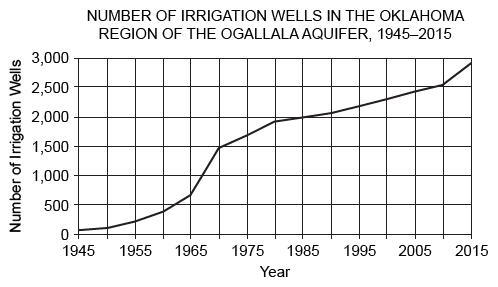
Based on the data in the graph, which of the following is closest to the average irrigation well installation rate from 1965 to 1985?
| A. 1,300 wells per year | |
| B. 700 wells per year | |
| C.65 wells per year | |
| D. 43 wells per year |
Explanation
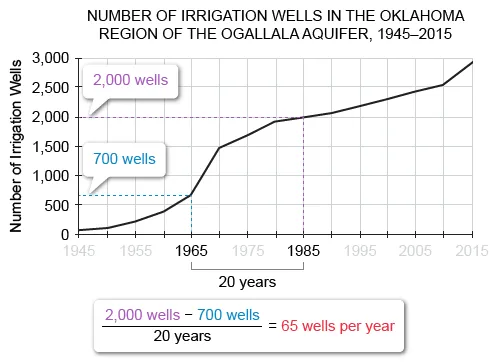
The Ogallala Aquifer is an underground source of water in the central US. This area of the US, which consists of agricultural fields and ranches, has come to rely on the aquifer for irrigation of crops. Because of the reliance on water from this source, many irrigation wells have been drilled into the Ogallala Aquifer and have drawn water from the aquifer quicker than it can be recharged, which has led to the aquifer becoming depleted.
As shown in the graph, the use of irrigation wells in Oklahoma overlying the Ogallala Aquifer has increased significantly since 1945. For example, the number of wells in Oklahoma increased from about 700 in 1965 to about 2,000 in 1985, resulting in an average installation rate of approximately 65 wells per year.
(Choice A) 1,300 is the difference in the number of irrigation wells from 1965 to 1985. However, to find the rate of installation per year, this value should be divided by 20 years.
(Choice B) 700 is the number of wells in 1965, instead of the rate of installation.
(Choice D) 43 wells per year is the approximate rate of installation from 1945 to 2015, instead of 1965 to 1985.
Things to remember:
The Ogallala Aquifer, located in the central US, has become depleted due to excessive use of groundwater to irrigate agricultural lands.
Question
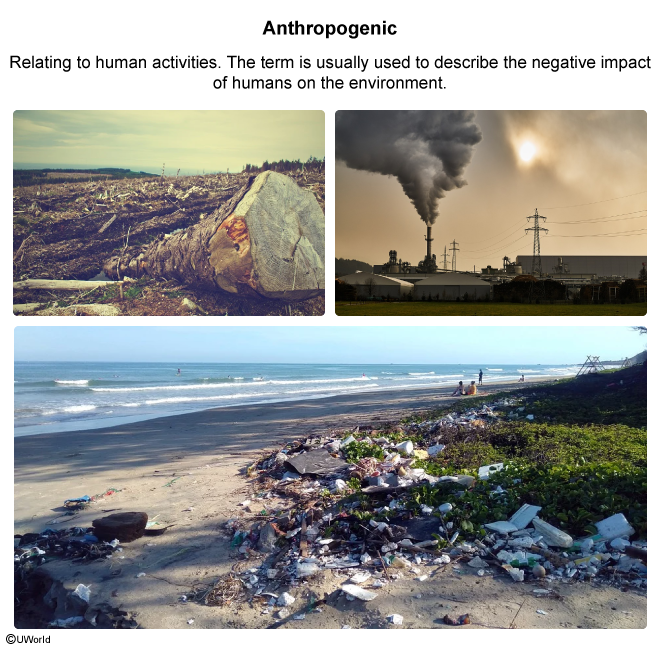
Which of the following anthropogenic activities is correctly paired with its waste product?
| A. Natural gas combustion and methane | |
| B. Agriculture and chlorofluorocarbons | |
| C.Deforestation and acid deposition | |
| D. Mining ore and tailings |
Explanation
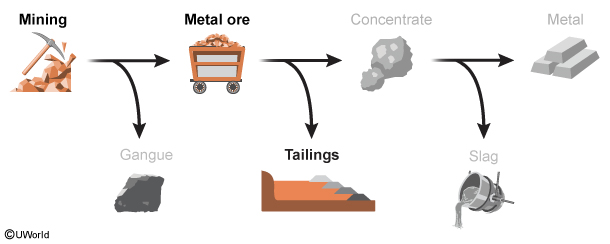
Mining is an anthropogenic process used to extract natural resources, such as coal and metallic ore, from underground deposits. Waste products of the mining process include:
-
overburden (soil and rocks that are removed to gain access to the deposits).
-
slag and tailings that are removed from the ore when it is processed.
Although mining extracts materials used to produce energy and make consumer products, the process can fragment habitats, contaminate groundwater, and release methane.
(Choice A) Although the extraction of natural gas can release methane into the atmosphere, the combustion of natural gas emits carbon dioxide and water, not methane.
(Choice B) Chlorofluorocarbons (CFCs) are typically used for refrigeration and cooling, not agriculture.
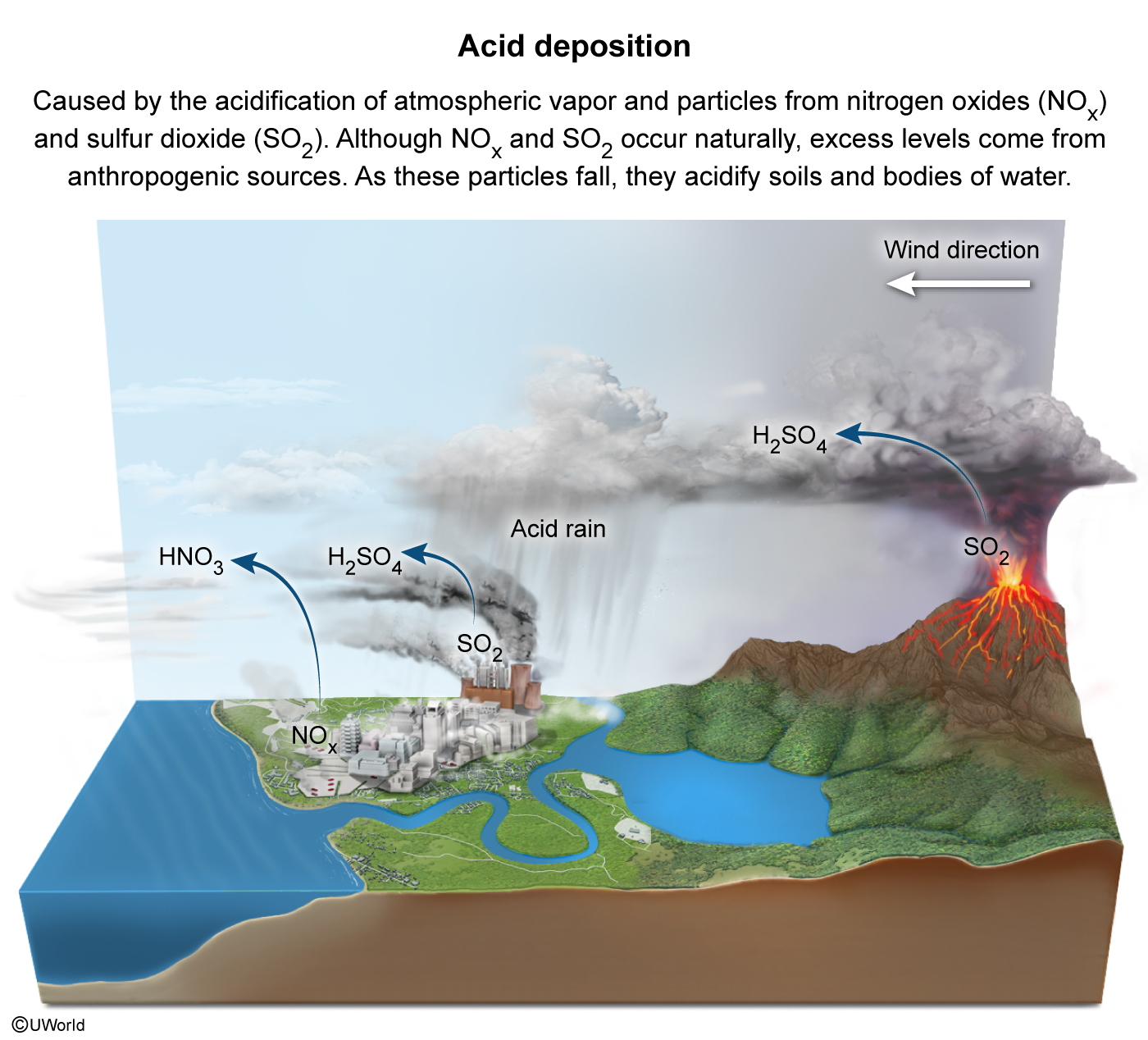
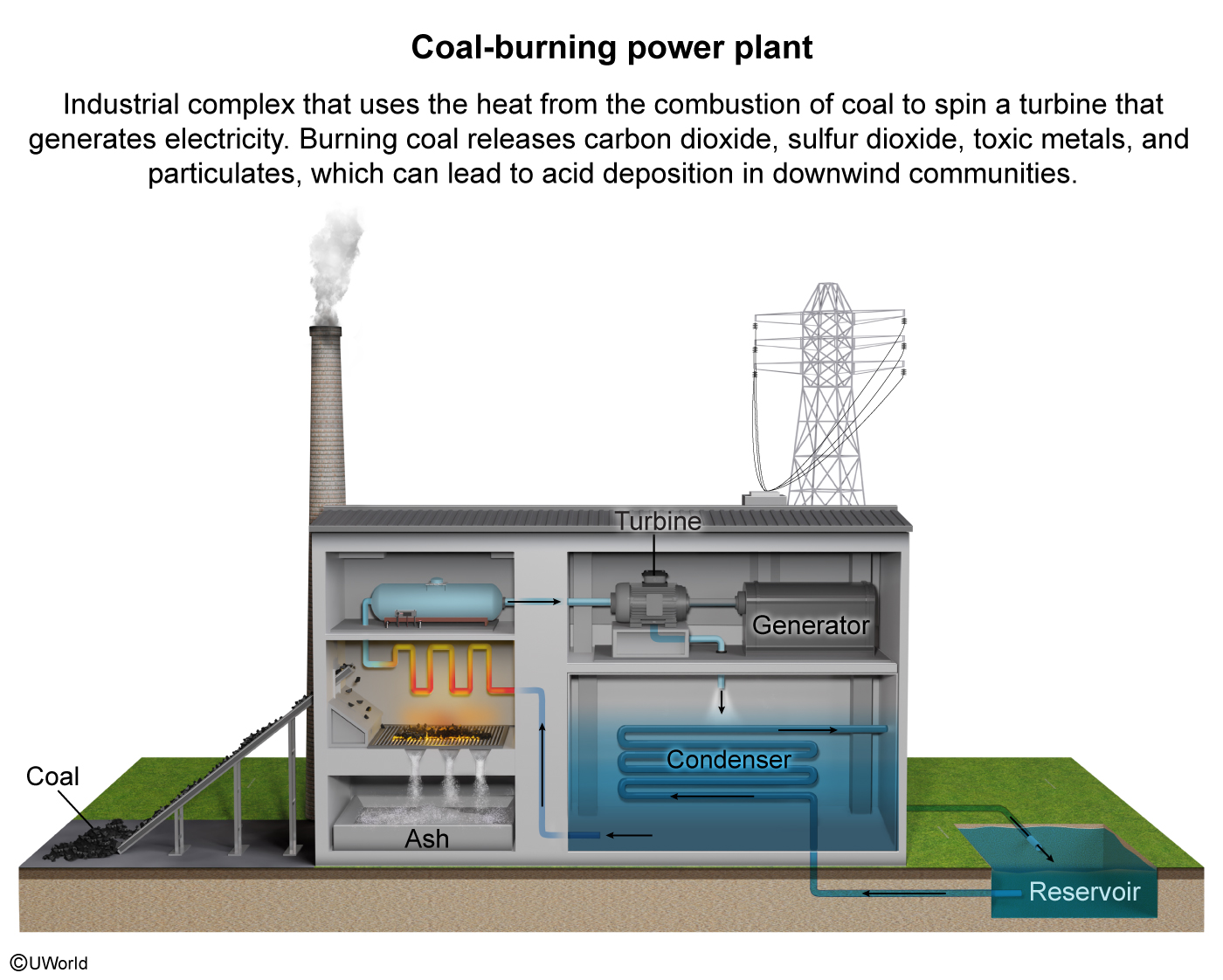
(Choice C) Acid deposition results from burning fossil fuels, such as at coal-burning power plants, not from deforestation.
Things to remember:
Mining is used to extract natural resources from underground
deposits, but the process generates byproducts called slag and tailings. Mining can also fragment
habitats, contaminate groundwater, and release methane.
Question
Which of the following best describes an advantage of using integrated pest management (IPM) over the heavy use of synthetic pesticides?
| A. IPM can minimize threats to human health. | |
| B. IPM requires less time and energy to eliminate pests. | |
| C.IPM is less expensive to implement. | |
| D. IPM provides more nutrients to growing crops. |
Explanation
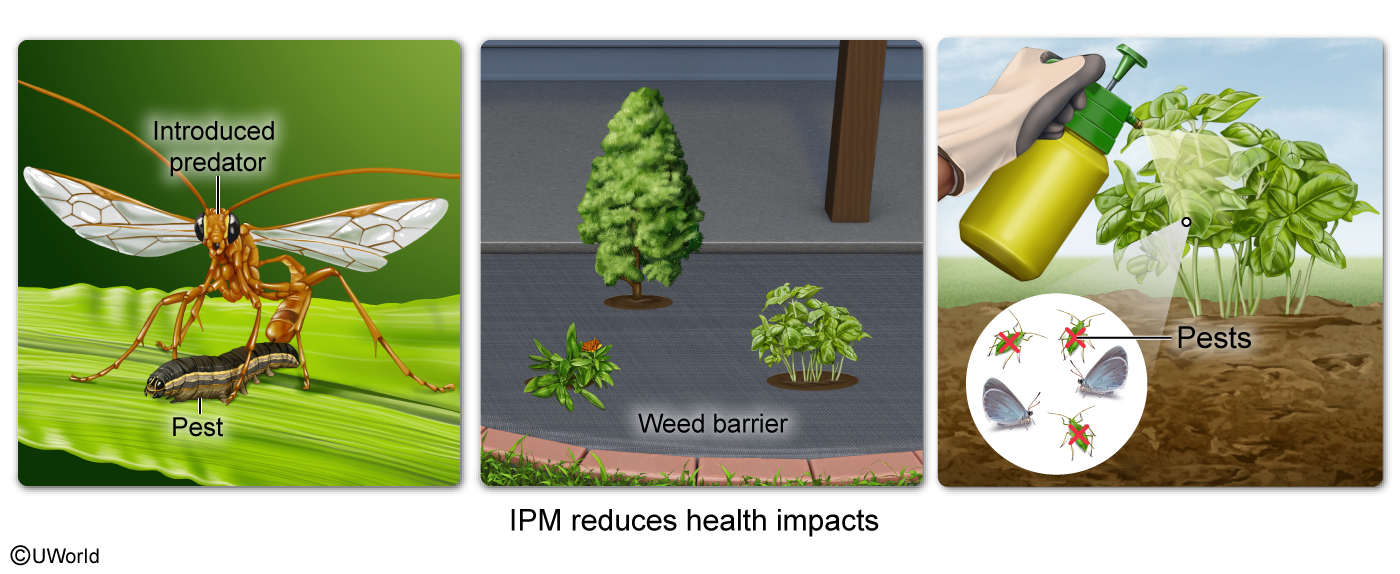
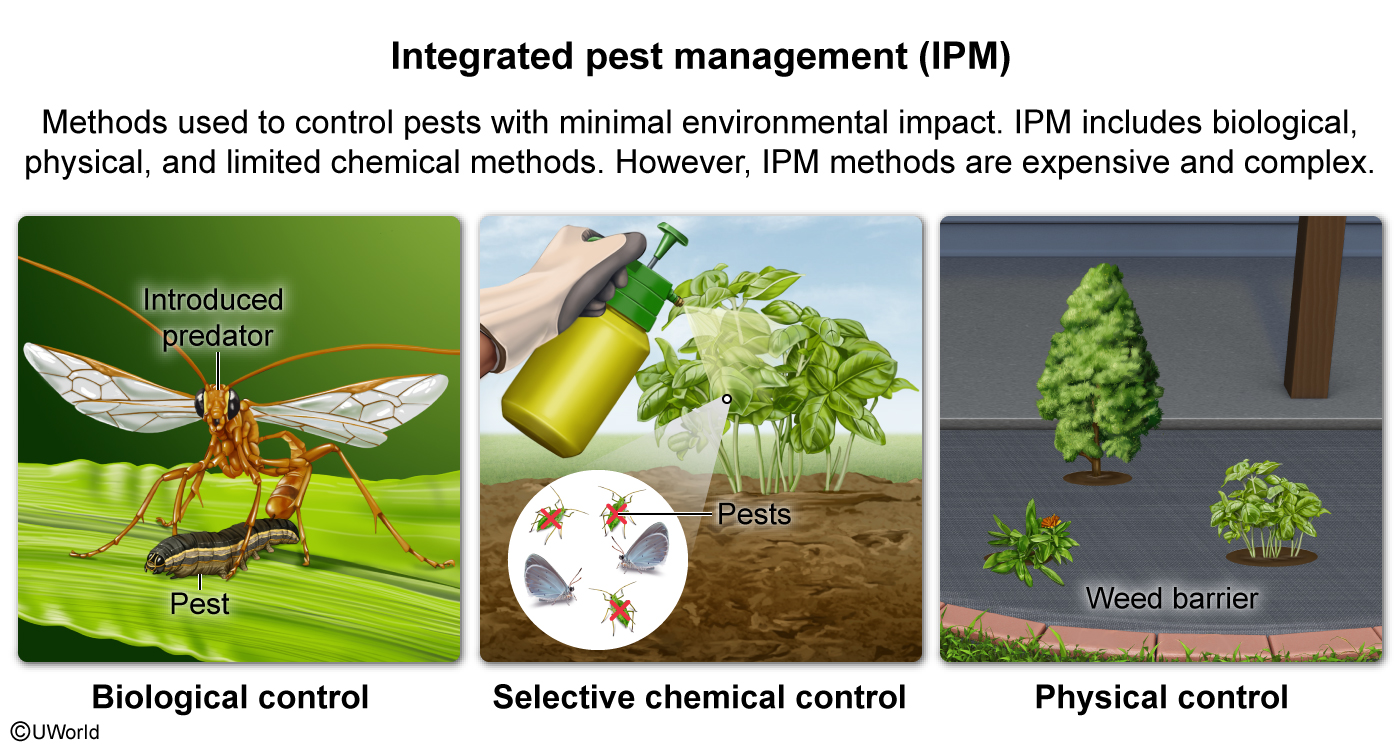
Integrated pest management (IPM) uses biological, mechanical, and limited chemical treatments to reduce the number of pests while minimizing environmental impacts. In the effective use of IPM, crops must be frequently inspected for pests and monitored throughout the treatments, increasing the cost of labor. In addition, the tools and machinery needed to implement the treatments require an up-front cost.
Because of its complexity, IPM is time intensive as well as expensive. However, because it decreases the heavy use of potentially toxic synthetic pesticides, IPM reduces environmental impacts and can minimize threats to human health.
(Choice B) To reduce the number of pests, IPM methods take more, not less, time and energy than applying synthetic pesticides.
(Choice C) Generally, IPM is more, not less, expensive to implement than heavy pesticides because it is more complex and time consuming.
(Choice D) IPM reduces the number of pests through biological, mechanical, and limited chemical methods; it does not provide more nutrients to crops.
Things to remember:
Integrated pest management (IPM) uses biological, mechanical, and
chemical methods to reduce the number of pests. Although IPM can be complex and expensive, it can
minimize environmental impacts and threats to human health.

Keep Studying Anywhere, Anytime
Whether you’re traveling, between classes, or taking a quick study break, our mobile-friendly platform makes it easy to review APES Unit 5 study guide concepts wherever you are. Work through questions, revisit important concepts with flashcards, or complete timed drills on your phone. With everything available in one place, you’re always prepared to study smarter for Unit 5.
Stand Out
with a Top Score in AP Environmental Science
Finish your AP Environmental Science Unit 5 review and continue mastering all units with UWorld. Boost your performance to make yourself a standout candidate for competitive colleges, majors, and scholarships by earning a top score.
Get our all-in-one course today!
- Focused APES Videos
- Print & Digital Study Guide
- 550+ Exam-style Practice Questions
- Customizable Quiz Generator
- Adjustable Study Planner
- Realistic Timed Test Simulation
- Colorful Visual Explanations
- Progress Dashboard
- Smart Flashcards
- Digital Notebook
Hear From Our AP Students
UWorld’s service is pretty good and helps provide a lot of explanations on subjects I haven’t been confident on before.
The questions here are the most realistic to the AP tests I've seen so far! I appreciate the ability to customize tests as well.
The best part is that all options are well-explained, telling clearly why they are not the right option.

Frequently Asked Questions (FAQs)
What are the main topics covered in AP Environmental Science Unit 5: Land and Water Use?
AP Environmental Science Unit 5 covers a broad range of human activities that shape ecosystems, resource availability, and long-term sustainability. Understanding these topics is crucial because AP Environmental Science Unit 5 questions require students to connect land-use choices with environmental consequences. You’ll see these ideas repeated in MCQs, FRQs, data-analysis items, and long explanation prompts. This unit builds the framework for evaluating how humans extract, manage, and modify land and water systems, making it one of the most applied sections of the course.
Major topics include:
- The tragedy of the commons
- The Green Revolution
- Types and effects of irrigation
- Pest-control methods
- Meat production methods and overfishing
- The impacts of mining
- Urbanization and ecological footprints
- Introduction to sustainable practices, including crop rotation and aquaculture
When reviewing APES Unit 5 review materials, prioritize understanding not only what each method is, but also the exact environmental consequences and the quantitative or qualitative indicators used to measure them. This unit rewards students who can evaluate trade-offs, interpret graphs or tables, and explain cause-and-effect relationships clearly. Strong command of Unit 5 concepts ensures better reasoning on both MCQs and FRQs.
How should I prepare for an AP Environmental Science Unit 5 exam?
Preparing for the AP Environmental Science Unit 5 test involves shifting from memorizing terms to understanding how land and water use decisions lead to measurable environmental outcomes. Unit 5 requires you to analyze trade-offs, calculate resource use, and clearly explain cause-and-effect relationships. The most effective approach is combining targeted content review with repeated AP-style practice, particularly in areas such as agriculture, irrigation, mining, forestry, grazing, and sustainability strategies. Since Unit 5 contains some of the most applied topics in the course, your preparation should reflect real environmental mechanisms rather than isolated facts.
Use this structure to organize your study plan:
- Focus on processes, not labels: Understand how irrigation methods affect soil, how clear-cutting alters ecosystems, and why mining generates pollution.
- Create quick diagrams to visualize concepts such as water usage, soil degradation, and forest fragmentation.
- Review FRQ structures: Practice linking ideas with cause-and-effect wording.
- Practice with AP-level questions: Look for items that require interpretation rather than memorization.
- Study in small, repeated sessions: Short bursts of review help reinforce complex mechanisms.
UWorld’s APES Unit 5 review strengthens your preparation by giving you applied scenarios with detailed answer explanations that model the reasoning AP graders expect. Reviewing why each choice is right or wrong helps you avoid superficial thinking and build confidence for both MCQs and FRQs. As you revisit topics over several days, you’ll begin recognizing patterns across agriculture, mining, forestry, and water systems. With consistent, structured review, Unit 5 becomes far more predictable, allowing you to perform strongly on exam day.
Are any free resources available for AP Environmental Science Unit 5?
UWorld provides a free 7-day trial and acts as one of the strongest starting points for studying AP Environmental Science Unit 5 because it gives you full access to exam-style questions, detailed explanations, and visuals that clarify land and water use concepts. During the trial, you can work through questions related to agriculture, mining, forestry, irrigation, aquaculture, and sustainability, written at the AP difficulty level. The explanations break down the environmental mechanisms behind each practice, helping you understand not just what happens, but why. This makes the free trial especially valuable for Unit 5, which demands applied reasoning rather than memorization.
Outside of UWorld, you also have access to reliable free materials from the College Board, including AP Daily videos and released FRQs. These help reinforce structure and scoring expectations. Classroom notes, teacher slides, and open-source ecology diagrams can also support your review, especially for visualizing soil profiles, agricultural systems, and land-use patterns.
Still, the most efficient approach is to use UWorld as your primary study tool for Unit 5 and supplement it with College Board resources to understand the format and scoring. The combination provides strong conceptual clarity, frequent applied practice, and the reasoning tools necessary for success in both multiple-choice and FRQ formats.
What types of questions are on the AP Environmental Science Unit 5 test?
The APES Unit 5 test features a blend of multiple-choice questions and free-response tasks that require students to apply concepts related to land and water use to real-world environmental scenarios. Unit 5 is highly application-based, so you’ll often see data tables, soil charts, resource-use graphs, irrigation diagrams, and mining-impact scenarios. Rather than testing simple definitions, questions ask you to analyze consequences, calculate resource inputs or outputs, and evaluate the sustainability of specific practices. The exam expects you to understand both short-term and long-term ecological effects across agricultural, forestry, grazing, mining, and aquaculture systems.
Common question types include:
- Impact evaluation: Determining environmental consequences of irrigation methods, grazing intensity, or mining practices.
- Data analysis: Interpreting soil composition tables, biodiversity graphs, or groundwater depletion charts.
- Trade-off reasoning: Comparing the sustainability advantages and disadvantages of two land-use methods.
- Mechanism-based questions: Explaining why a practice increases erosion, salinization, or habitat loss.
- FRQs: Writing structured explanations that connect causes, effects, and potential solutions.
Reviewing environmental processes visually and verbally helps you handle the interpretive style of the exam. Many students struggle not with the content but with explaining relationships clearly and accurately. A resource like UWorld strengthens this skill by offering Unit 5 questions that mirror AP scenario-based design. Each explanation reinforces cause-and-effect reasoning, helping you recognize patterns and avoid common errors on test day.
How can I improve my score on the FRQs and MCQs for Unit 5?
The AP Environmental Science Unit 5 test rewards students who can explain why specific agricultural, mining, forestry, irrigation, and grazing methods lead to particular ecological outcomes. FRQs often require multi-step justification, and MCQs demand quick recognition of cause-and-effect relationships. To score higher, you must develop the ability to evaluate resource-use decisions across multiple variables such as soil quality, water availability, pollution, and sustainability.
A targeted improvement strategy includes:
- Strengthening causal reasoning: Practice linking actions to outcomes, such as explaining how flood irrigation increases salinization or why clear-cutting accelerates erosion.
- Interpreting data visually: Become comfortable reading soil profiles, water-use charts, yield graphs, and mining-impact tables.
- Comparing methods: Study differences between conventional vs. sustainable agriculture, industrial vs. selective forestry, and surface vs. subsurface mining.
- Practicing FRQ structure: Use clear transitions like “this leads to” or “as a result,” which AP graders expect.
- Building speed on MCQs: Work through practice questions that require pattern recognition rather than recall.
Using a review tool like UWorld helps reinforce these skills because each AP-style explanation breaks down the reasoning behind both correct and incorrect choices. This teaches you how to avoid common traps and strengthens the logical thinking needed for FRQs. With consistent practice that mixes content review, applied scenarios, and timed question sets, your performance on Unit 5 becomes more predictable and more aligned with AP scoring expectations.
What is the "Land and Water Use" unit's weight on the AP Environmental Science exam?
The “Land and Water Use” content in Unit 5 of AP Environmental Science accounts for 10-15%, a significant portion, of the AP Environmental Science exam because the topics are directly tied to human impact, resource management, and environmental change. Unit 5 concepts frequently appear in both multiple-choice questions and FRQs due to their real-world relevance.
Agriculture, mining, forestry, irrigation, grazing, aquaculture, soil conservation, and water-resource management all influence broader themes such as biodiversity, pollution, climate regulation, and ecosystem services. These topics connect human behavior with ecological consequences; the exam regularly includes scenarios requiring students to interpret graphs, make comparisons, calculate resource use, and justify environmental impacts.
You will likely encounter questions that ask you to explain why certain practices lead to soil degradation, groundwater depletion, erosion, or habitat fragmentation. Other tasks may require evaluating sustainable alternatives, identifying trade-offs, or analyzing land-use efficiency. FRQs often incorporate Unit 5 principles when asking students to propose solutions or analyze data trends. This consistent presence means that students cannot treat Unit 5 as a low-priority topic.
A resource like UWorld supports this by offering exam-style questions that reflect the reasoning skills the AP Exam expects. When you understand how land and water use decisions alter ecosystems, identifying correct answers and writing strong explanations becomes far easier on test day.
Can I find practice tests specifically for APES Unit 5?
Practice tests for APES Unit 5 are especially valuable because this unit’s questions rely heavily on applied environmental reasoning rather than straightforward recall. You need resources that reflect how the AP Exam frames agriculture, irrigation, mining, forestry, aquaculture, and grazing within cause-and-effect scenarios. UWorld offers practice questions that align closely with the structure and difficulty of the AP Environmental Science exam, making it one of the most effective places to prepare for Unit 5. The platform encompasses all major land and water use mechanisms, presenting them through authentic AP-style setups that incorporate data tables, soil diagrams, water-use charts, and environmental impact scenarios.
UWorld’s APES Unit 5 practice tests stand out because they include:
- Realistic environmental scenarios: Questions require interpreting charts, analyzing impacts, and evaluating sustainability strategies.
- Detailed explanations: Every answer choice is broken down so you understand both correct reasoning and the logic behind common misconceptions.
- Visual support: Diagrams and breakdowns help reinforce agricultural systems, soil processes, water-use patterns, and the impacts of resource extraction.
- Exam-aligned difficulty: Questions mirror AP phrasing, structure, and cognitive demands.
Other options include teacher-created MCQs, textbook review questions, and released AP-style FRQs from the College Board. While these offer useful reinforcement, they rarely include the level of explanation needed to correct reasoning errors. That’s why the strongest approach is to use UWorld as the main practice environment, supplemented with classroom or official materials for added familiarity. Practicing with high-quality questions ensures that when you see Unit 5 scenarios on the exam, you can interpret data, evaluate trade-offs, and justify answers with confidence.
Where can I find a good study guide for AP Environmental Science Unit 5?
A strong study guide for AP Environmental Science Unit 5 should do far more than list vocabulary. Unit 5 centers on land and water use; the best study materials help you understand the processes, consequences, and trade-offs behind each human activity. You need a guide that explains agricultural systems, irrigation methods, forestry practices, mining techniques, aquaculture, grazing patterns, and sustainability strategies with clarity and structure. Look for resources that pair explanation with diagrams, flowcharts, soil profiles, and real environmental scenarios. These visual reinforcements make it easier to recall cause-and-effect relationships during the exam.
A study guide should also demonstrate how Unit 5 concepts relate to broader AP topics, such as biodiversity loss, climate impacts, and ecological services. Students benefit most from a guide that breaks complex mechanisms into manageable pieces and explains why each practice leads to specific outcomes. UWorld offers an interactive study guide for Unit 5 that supports this approach by pairing conceptual explanations with exam-style questions that reflect the tone and reasoning used on the AP Exam.
Beyond UWorld, students can also use classroom notes, teacher-created review packets, and digital slide decks that outline agricultural, mining, forestry, and irrigation systems. The key is combining a primary resource that emphasizes reasoning with secondary materials that reinforce key visuals and definitions. A well-structured Unit 5 study guide will feel less like a dictionary and more like a logical map of how human land and water use affects environmental systems.
What are the most common mistakes students make on Unit 5 questions?
Students often struggle with the APES Unit 5 review because Unit 5 demands applied environmental reasoning rather than simple recall. Many mistakes happen when students memorize isolated facts without understanding the mechanisms behind land and water use. On the AP Exam, questions about agriculture, irrigation, mining, forestry, grazing, and aquaculture require evaluating how human activities change soil health, water availability, biodiversity, or ecosystem stability. Misunderstanding these links leads to incorrect answers, especially when interpreting graphs, soil tables, and environmental scenarios.
Common recurring mistakes include:
- Confusing impacts across practices: Students often mix up which irrigation method causes salinization, which mining technique produces the most habitat loss, or why certain forestry techniques lead to erosion.
- Ignoring cause-and-effect reasoning: Many responses describe impacts without explaining why they occur, which results in lost points on FRQs.
- Misreading environmental data: Soil texture diagrams, water-use charts, and population tables are often misinterpreted because students focus on isolated numbers rather than patterns.
- Overgeneralizing sustainability claims: Students may assume that every “green” method is always beneficial or fail to evaluate trade-offs realistically.
- Rushing MCQs: Scenario-based questions require careful reading, but students often skim and miss key details.
- Weak vocabulary precision: Terms like monocropping, aquaculture, clearcutting, and integrated pest management must be applied accurately, not loosely.
The most effective way to avoid these mistakes is to practice with explanations that clarify reasoning, rather than just providing answers. A platform like UWorld reinforces the logic behind soil processes, irrigation efficiency, and environmental trade-offs, allowing you to recognize patterns instead of merely memorizing definitions. As you see more applied examples, Unit 5 becomes predictable, and you gain the ability to explain environmental mechanisms clearly, which is precisely what the AP Exam rewards.
What’s the best way to organize my APES Unit 5 notes for studying?
Organizing notes for AP Environmental Science Unit 5 is essential because this unit encompasses a wide range of processes that yield distinct environmental outcomes. The most effective approach is to structure your notes around environmental mechanisms rather than vocabulary lists. This helps you see how human land and water use connect to soil degradation, groundwater depletion, erosion, biodiversity loss, and pollution. Clear organization also makes it much easier to recognize patterns across Unit 5, which is exactly what the AP Exam expects.
A strong Unit 5 note structure should include:
- Category-based sections: Divide notes into agriculture, mining, forestry, irrigation, aquaculture, grazing, and sustainability.
- Cause-and-effect lists: For each practice, write the environmental impact and the reason behind it.
- Quick diagrams: Add visuals for irrigation systems, soil horizons, or mining methods.
- Examples: Include short real-world cases to strengthen applied reasoning.
- Trade-off comparisons: Note advantages and disadvantages for key practices.
- High-frequency topics: Highlight monocropping, clearcutting, water use, soil erosion, and resource depletion.
Once your notes follow a logical, pattern-based structure, you can review more efficiently and retain far more information. A platform like UWorld reinforces this system through its platform-generated notes, where you’ll find key explanations, summaries, and a glossary. You can also add your notes, and over time, your notebook becomes a map of environmental logic rather than a long list of disconnected terms. This makes recalling information during MCQs and writing clear FRQs much easier, especially when analyzing new scenarios or data tables on the exam.
What should I focus on if I’m short on time while reviewing Unit 5?
If you’re short on time when reviewing Unit 5 AP Environmental Science, focus on the highest-yield concepts that show up repeatedly in AP-style questions. Unit 5 is heavily centered on environmental mechanisms, so your goal should be to understand the major land and water use practices and the specific impacts they produce. Instead of memorizing long definitions, concentrate on processes such as industrial agriculture, major irrigation systems, mining methods, forestry practices, and core sustainability strategies. These areas account for a large portion of Unit 5 MCQs and FRQs, and understanding their consequences gives you the reasoning skills needed to perform well on the exam.
Prioritize the following if time is limited:
- Agriculture: Monocropping, pesticides, fertilizers, soil degradation, and sustainable alternatives.
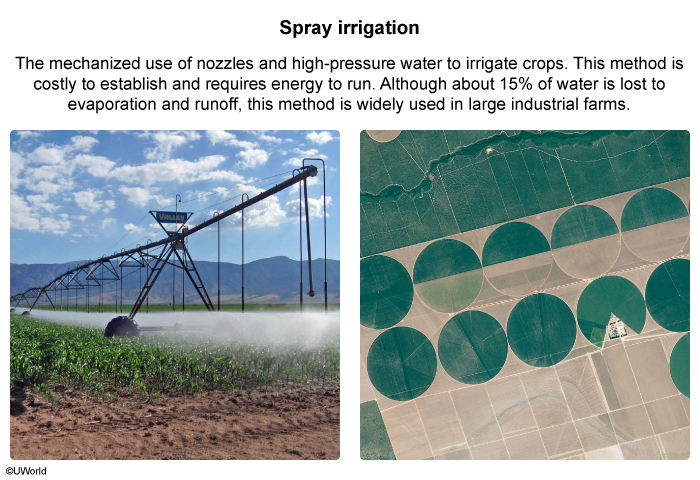
- Irrigation: Flood, furrow, drip, and center-pivot methods, including salinization and water-loss effects.
- Forestry: Clearcutting versus selective cutting and their impacts on erosion and biodiversity.
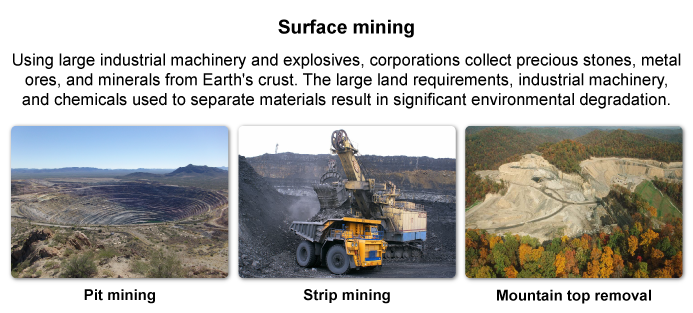
- Mining: Surface and subsurface mining, reclamation, and pollution mechanisms.
- Water Use: Groundwater Depletion, Aquifer Impacts, and Conservation Strategies.
- Soil: Properties, textures, and fertility connections to land use.
- Sustainability: IPM, crop rotation, contour plowing, and agroforestry.
A resource like UWorld helps streamline this process because its exam-style questions allow you to review content and reasoning simultaneously. Instead of reading lengthy summaries, you’re actively working through the exact patterns and cause-and-effect structures the AP Exam rewards. Even with limited time, focusing on these key processes helps you build enough conceptual understanding to handle new scenarios on both MCQs and FRQs with more confidence.
How can UWorld help me prepare for the AP Classroom progress checks for Unit 5?
UWorld is highly effective for preparing students for the APES Unit 5 Progress Check MCQs and FRQs because it builds the exact analytical skills that AP Classroom progress checks are designed to measure. Progress checks place a strong emphasis on Unit 5’s environmental mechanisms, including irrigation efficiency, soil degradation, forestry practices, mining impacts, aquaculture trade-offs, and sustainable agriculture. These assessments test your ability to interpret data, evaluate cause-and-effect relationships, and justify environmental reasoning. UWorld supports this by offering AP-style scenarios that mirror the cognitive demands of progress checks while also training you for the higher difficulty level of the AP Exam.
UWorld strengthens your progress-check readiness by helping you:
- Interpret environmental data accurately, such as soil composition tables, irrigation diagrams, and resource-use charts.
- Build strong causal reasoning, which is essential for FRQs and many Unit 5 progress check MCQ APES items.
- Identify misconceptions, since explanations break down both correct and incorrect logic.
- Practice higher-level scenarios, which makes actual progress checks feel more manageable.
- Develop structured FRQ writing, useful when progress checks include written responses.
While progress checks help teachers track understanding, UWorld focuses on preparing you for the AP Exam itself by exposing you to more challenging questions, richer explanations, and deeper environmental logic. The best strategy is to use UWorld as your primary practice source and treat AP Classroom progress checks as checkpoints. This combination builds mastery of Unit 5 concepts while confirming your progress throughout. Over time, you’ll see significant improvements in both your in-class assessments and your overall AP readiness.
Does UWorld offer offline or downloadable access for AP Environmental Science Unit 5 practice?
Yes. UWorld provides offline access through its mobile app, which allows you to continue studying AP Environmental Science Unit 5 content even without an internet connection. Once questions, explanations, or study material have been loaded on the app, you can revisit them offline at any time. This is especially useful for students who need to fit Unit 5 review into busy schedules, commute times, or areas with unreliable Wi-Fi. Offline access allows you to continue working on topics such as agriculture, land management, irrigation methods, mining practices, forestry impacts, grazing systems, and sustainability at your own pace.
Many students preload several sets of Unit 5 practice questions before heading to school, practice, or work so they can review detailed explanations during downtime. It is also helpful for strengthening FRQ reasoning skills, since you can re-read answer breakdowns whenever you have a few minutes to spare. You can combine this with your own printed notes or flashcards for additional unplugged study options. Overall, the app’s offline support ensures that your AP Environmental Science Unit 5 preparation is never limited by internet access. You can always keep reinforcing concepts that matter for the AP test while staying aligned with your study plan.