AP® Environmental Science Unit 3 Review and Practice Test
Prepare smarter for Unit 3: Populations in AP® Environmental Science with UWorld’s interactive review. From logistic growth to species interactions, our detailed lessons make tough concepts easy to understand. Reinforce your knowledge with APES Unit 3 review questions and full-length practice tests that build the problem-solving skills you’ll need to excel on exam day.
Boost Your Confidence and Score High with Our AP Environmental Science Unit 3 Review
Transform APES Unit 3 challenges into confidence! UWorld’s targeted review blends an easy-to-follow AP® Environmental Science Unit 3 study guide, expert explanations, and realistic practice questions. Master population formulas, trends, and ecological relationships so you can walk into the exam ready to score your best.
Engaging Video Lessons
Learning population ecology can actually be fun! UWorld’s AP Environmental Science Unit 3 video lessons use visuals, real-world examples, and expert explanations to make complex concepts, such as growth models and carrying capacity, easy to understand and retain.
Interactive Study Guides
Get organized with our APES Unit 3 study guide, designed to simplify population ecology. You’ll find concise notes, interactive visuals, and checkpoints that help you review efficiently and turn every study session into measurable progress.
Try These AP Environmental Science Unit 3 Practice Test Questions
Question
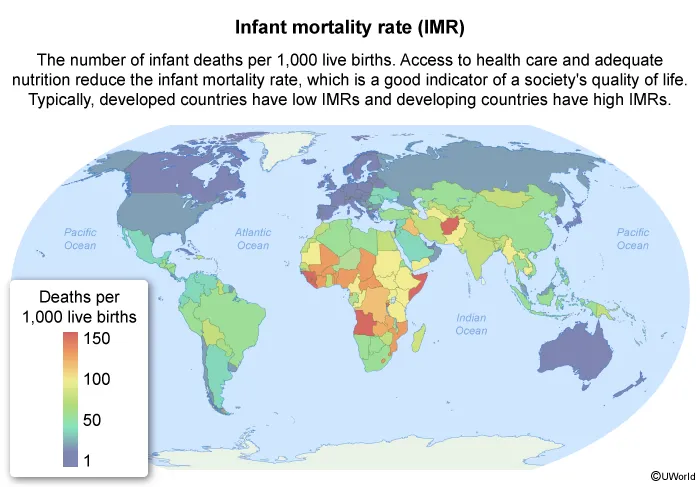
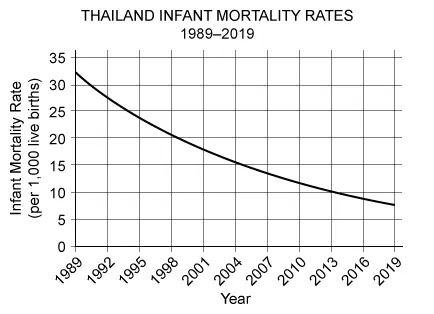
The infant mortality rate in Thailand has dropped from 1990 to 2019. The rate decreased partly because of the population's increased access to health care. Another likely cause for the decline is
| A. a decreased number of opportunities for women in the labor market | |
| B. decreased access to birth control and family planning | |
| C. an increase in the number of people living in poverty | |
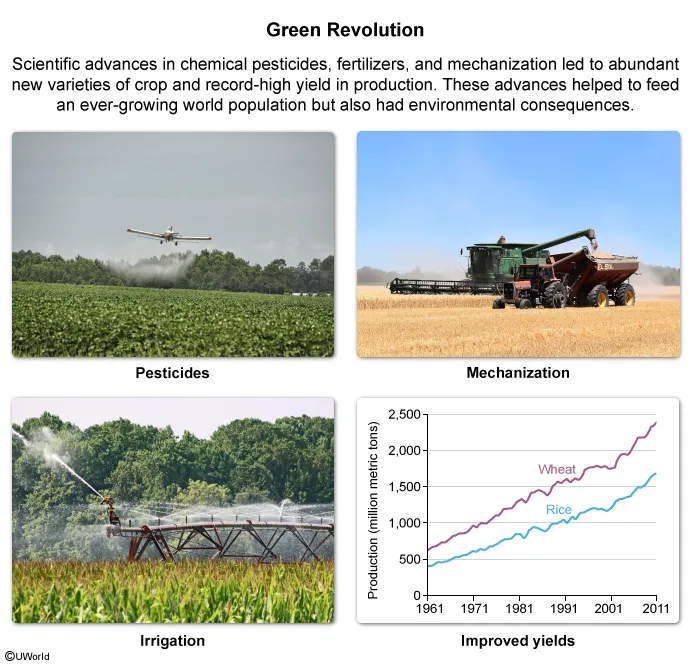
| D. an increase in food production through improved agricultural practices |
Explanation
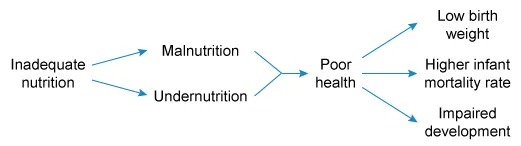
Infant mortality rate is measured as the number of infant (birth to age 1) deaths for every 1,000 live births. The infant mortality rate is a good indicator of a society's quality of life because it highlights a population's access to health services and nutrition.
For both mothers and infants, access to quality health care and nutritious food helps prevent malnutrition (lacking nutrients in food), undernutrition (insufficient food), and other health issues. Improvements in agriculture, such as mechanization of tools and equipment, can reduce the cost of food production. These improvements increase the amount of nutritious food produced and distributed to a population.
Therefore, in addition to increased access to health care, Thailand's decreasing infant mortality rate was most likely caused by an increase in food production through improved agricultural practices.
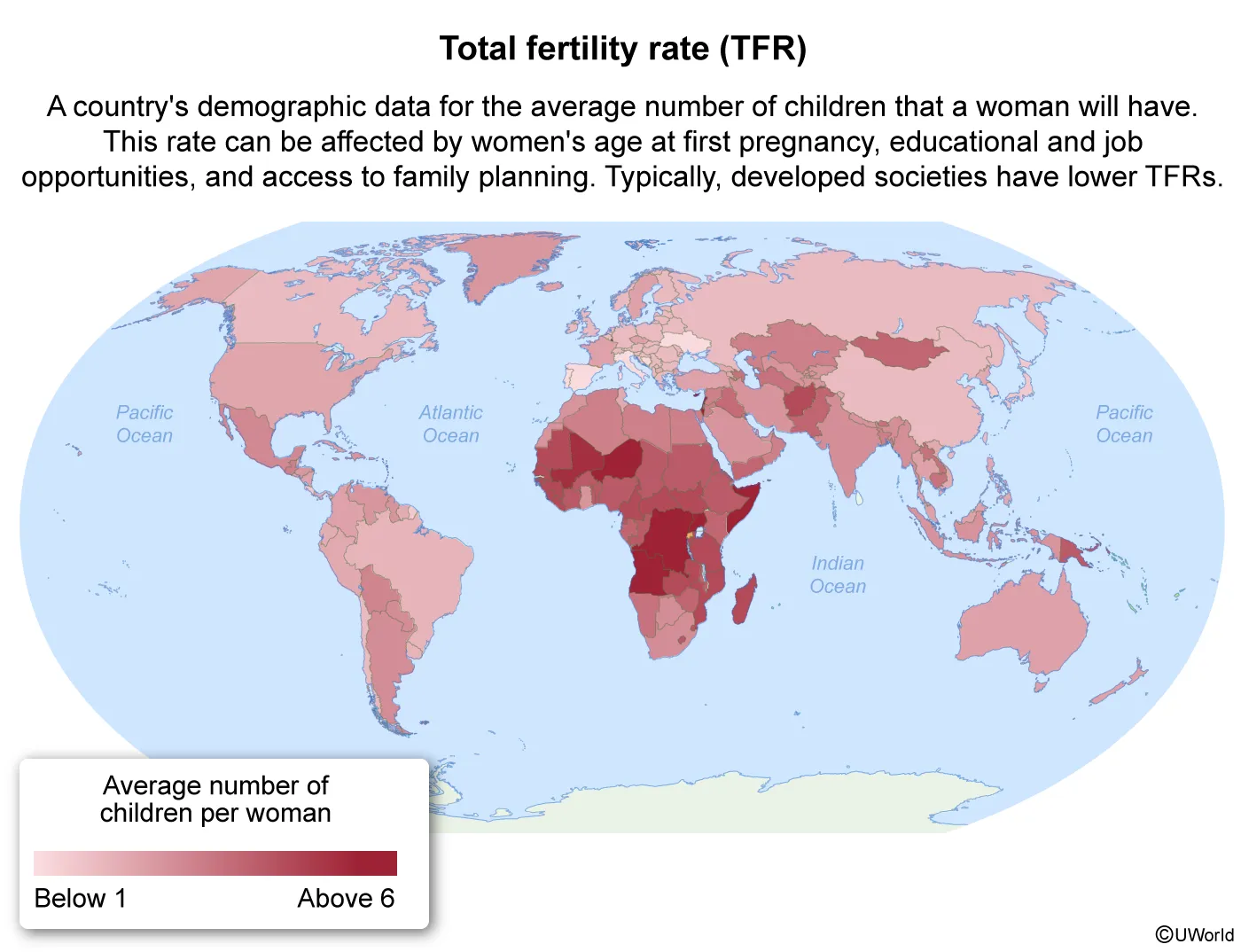
(Choice A) When women have fewer opportunities in the labor market, the total fertility rate increases, which is correlated with increased, not decreased, infant mortality rates.
(Choice B) As access to birth control and family planning decreases, infant mortality rates increase.
(Choice C) High levels of poverty indicate low access to health care and a lack of adequate nutrition, which increase, not decrease, the infant mortality rate.
Things to remember:
Infant mortality rates are measured by the number of infant deaths per 1,000 live births. As access to health care and adequate nutrition improves, the infant mortality rate decreases.
Question
The table below shows the population sizes for various age groups in Angola in 2021.
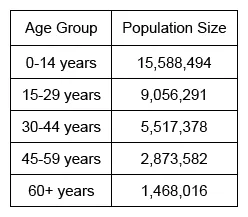
Based on the population size for each age group, which of the following best describes Angola's population growth rate?
| A. Angola's population is rapidly growing. | |
| B. Angola's population is slowly growing. | |
| C. Angola's population is stable. | |
| D. Angola's population is declining. |
Explanation
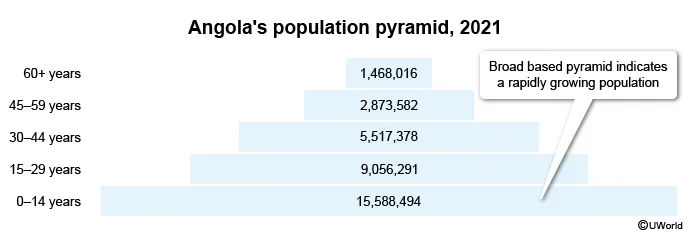
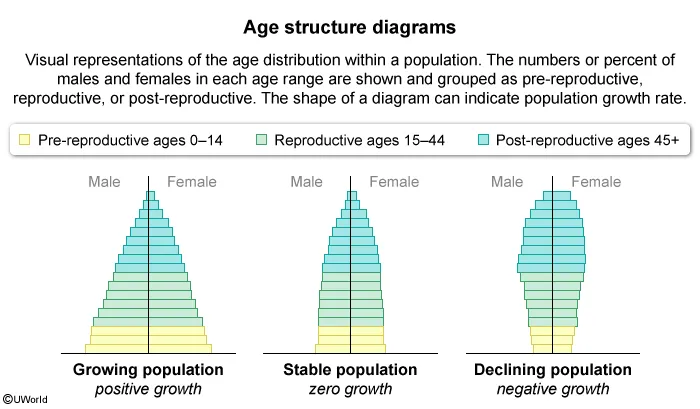
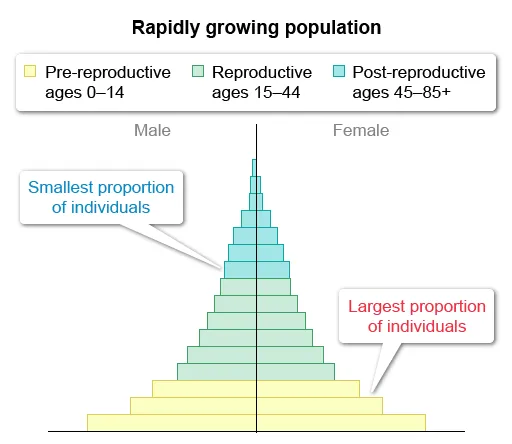
According to the table, Angola has a large number of pre-reproductive individuals (0–14 years old) and a smaller number of post-reproductive individuals (45+ years old). When the population sizes of these age groups are represented as a population pyramid, also known as an age structure diagram, Angola's population forms a broad-based pyramid shape.
Typically, this shape reflects a rapidly growing population because the large number of younger individuals suggests that birth rates are very high. Based on the data, Angola's population is rapidly growing.
(Choice B) Similarly to a rapidly growing population, a slowly growing population will have a larger number of pre-reproductive individuals compared with post-reproductive individuals; however, the population differences between the age groups would be slight, not extreme. The age groups represented in the table show that, beginning with the 0–14 group, the number of individuals in each age group is about half of the previous age group—an extreme difference.
(Choice C) Stable populations have approximately equal proportions of individuals in pre-reproductive and reproductive age groups rather than one age group being significantly larger or smaller than another.
(Choice D) Declining populations typically have a large proportion of post-reproductive, not pre-reproductive, individuals.
Things to remember:
Rapidly growing populations typically have a high proportion of pre-reproductive individuals (0–14 years old), unlike stable or declining populations.
Question
Population overshoot of an animal species is most likely to result in which of the following environmental problems?
| A. Genetic mutations | |
| B. Nitrogen fixation | |
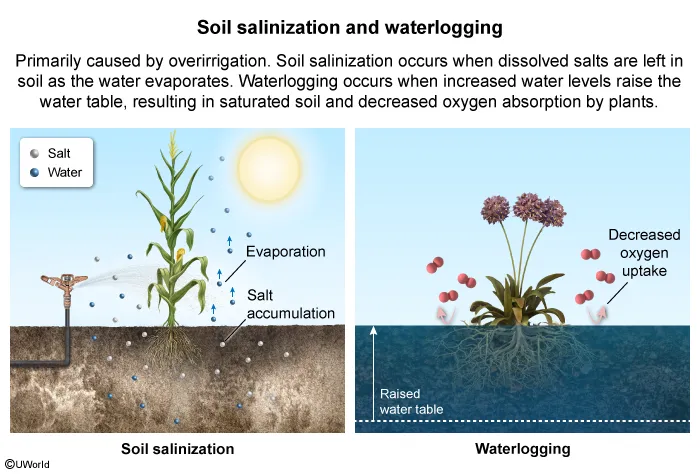
| C. Soil salinization | |
| D. Resource depletion |
Explanation
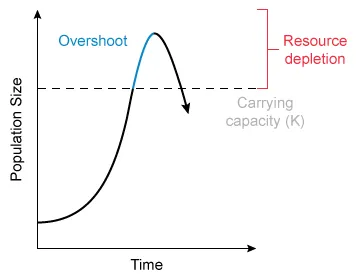
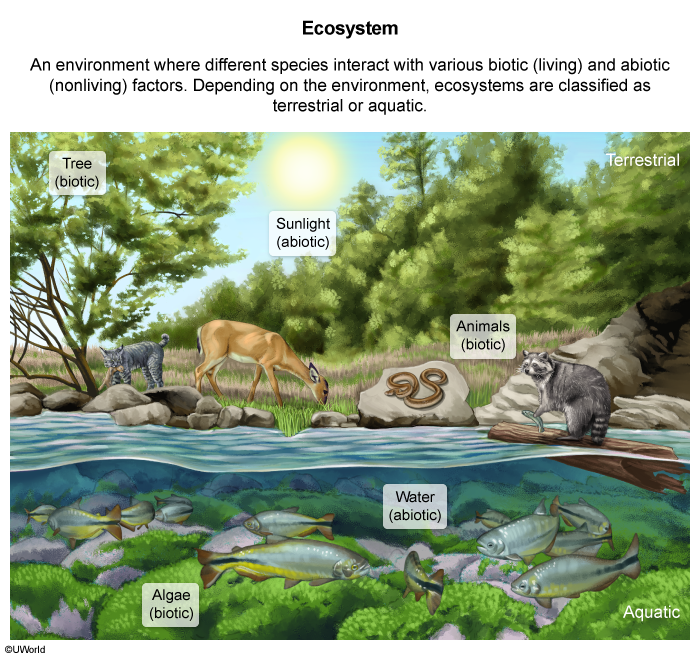
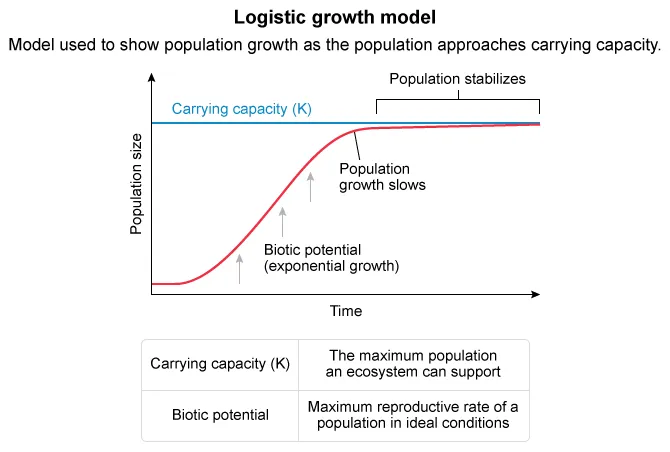
A species can experience a population overshoot when the number of organisms in an ecosystem exceeds the carrying capacity (K)—the largest population an ecosystem can sustain based on biotic and abiotic factors, such as the availability of resources. As the number of organisms in a population increases past K, the available resources are consumed at a rate faster than they can be replenished, resulting in the depletion of resources.
(Choice A) Although genetic mutations can occur during reproductive events, they are not a likely result of a population overshoot.
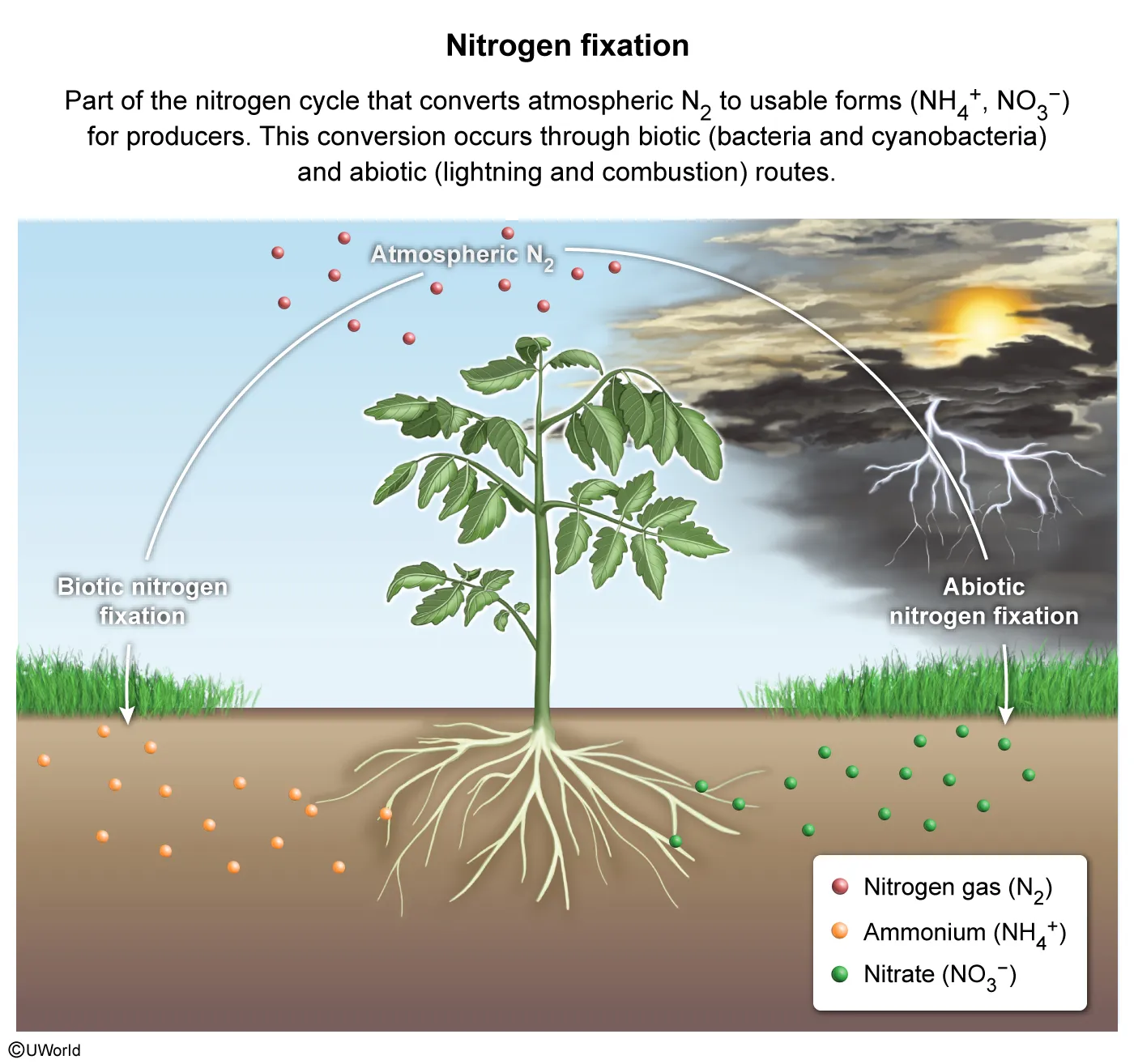
(Choice B) Nitrogen fixation is a natural process that increases nitrogen in the soil and does not result from population overshoot.
(Choice C) Although overpopulation may result in some degradation of the soil, soil salinization is not a likely result of population overshoot.
Things to remember:
Carrying capacity (K) is the largest population that can be sustained by an ecosystem. When populations exceed K, they experience an overshoot, which results in negative environmental impacts.

Stand Out
with a Top Score in AP Environmental Science
Finish your APES Unit 3 review and continue mastering all units with UWorld. Boost your performance to make yourself a standout candidate for competitive colleges, majors, and scholarships by earning a top score.
Get our all-in-one course today!
- Focused APES Videos
- Print & Digital Study Guide
- 550+ Exam-style Practice Questions
- Customizable Quiz Generator
- Adjustable Study Planner
- Realistic Timed Test Simulation
- Colorful Visual Explanations
- Progress Dashboard
- Smart Flashcards
- Digital Notebook
Hear From Our AP Students
UWorld’s service is pretty good and helps provide a lot of explanations on subjects I haven’t been confident on before.
The questions here are the most realistic to the AP tests I've seen so far! I appreciate the ability to customize tests as well.
The best part is that all options are well-explained, telling clearly why they are not the right option.

Frequently Asked Questions (FAQs)
What is AP Environmental Science Unit 3 and why is it important for the exam?
AP Environmental Science Unit 3, Populations, focuses on how species grow, interact, and respond to changes in their environments. This unit builds a foundation for understanding population dynamics, which are central to many APES Unit 3 progress-check MCQs and FRQs. A clear grasp of these concepts helps students explain how ecosystems maintain balance and how human activities can disrupt it.
Key concepts covered in Unit 3 APES include:
- Population ecology: differences between exponential and logistic growth, carrying capacity, and r- and K-selected species.
- Density and distribution: patterns of where organisms live and how they are spread across an area.
- Population regulation: the biotic and abiotic factors that affect survival and growth.
- Human influences: the role of agriculture, urbanization, and technology in shaping population trends.
By mastering these topics, students can better analyze data, apply APES population formulas, and interpret graphs on the AP Environmental Science Unit 3 test. Reviewing real-world examples, case studies, and simulations helps turn theory into application and improves analytical reasoning.
What topics are covered in AP Environmental Science Unit 3: Populations?
AP Environmental Science Unit 3 focuses on population ecology, examining how species interact with each other and their environments. These topics are heavily tested in both APES Unit 3 FRQs and progress check MCQs, making a solid understanding essential for interpreting data, graphs, and real-world scenarios.
Major topics included in Unit 3 APES are:
- Population characteristics: size, density, and age structure.
- Growth models: exponential versus logistic growth and carrying capacity.
- Limiting factors and regulation: how resources, competition, predation, and environmental conditions control populations.
- Reproductive strategies: r- and K-selected species and their adaptive significance.
- Survivorship curves: understanding mortality patterns across species.
- Human population dynamics: fertility, mortality, migration, and demographic transition.
Mastering these concepts helps students analyze population trends, calculate growth rates, and predict ecological outcomes in exam-style questions. UWorld’s APES Unit 3 review reinforces these topics through interactive lessons, practice questions, and clear explanations of APES Unit 3 formulas. By practicing with UWorld alongside official materials, students can strengthen their reasoning, improve accuracy on MCQs, and approach FRQs with confidence.
How should I study for Unit 3 APES review?
Studying for AP Environmental Science Unit 3 requires a balance of conceptual understanding, practice, and application. Unit 3 focuses on populations, growth models, and human-environment interactions, which appear frequently in APES Unit 3 progress check MCQs and FRQs. A structured study approach ensures students can interpret data, graphs, and population calculations confidently.
Effective study strategies include:
- Concept review: Focus on key population concepts such as exponential and logistic growth, carrying capacity, limiting factors, and reproductive strategies.
- Practice problems: Apply APES population formulas to calculate growth rates, doubling time, and population density.
- Graph interpretation: Analyze population trends, survivorship curves, and age structure diagrams.
- Active recall: Use flashcards, summaries, or formula sheets to reinforce core principles.
- Timed exercises: Simulate test conditions with MCQs and FRQs to improve speed and reasoning.
Consistent, step-by-step practice helps connect theory to application and makes interpreting exam questions more intuitive. UWorld’s AP Environmental Science Unit 3 study guide complements these strategies by providing interactive lessons, example problems, and explanations that mirror AP-style questions. Integrating UWorld practice with classroom resources and official College Board® materials allows students to track their progress and strengthen weak areas effectively.
What’s the best study sequence for AP Environmental Science Unit 3?
A well-planned study sequence for AP Environmental Science Unit 3 helps students build understanding progressively, from basic population concepts to more complex applications. Following a logical order ensures that each topic reinforces the next, making it easier to tackle APES Unit 3 FRQs and progress check MCQs efficiently.
Recommended study sequence:
- Start with foundational concepts: Learn population characteristics, density, and distribution.
- Explore growth patterns: Understand exponential and logistic growth, carrying capacity, and limiting factors.
- Examine reproductive strategies: Study r- and K-selected species and their ecological significance.
- Analyze human population trends: Focus on fertility, mortality, age structure, and demographic transition models.
- Interpret data and graphs: Practice reading population curves, survivorship graphs, and resource-related trends.
- Integrate concepts: Solve applied problems that combine multiple topics, such as human impacts on ecosystems and population regulation.
Following this sequence allows students to gradually increase their comprehension and apply concepts in realistic scenarios. It also provides a framework for Unit 3 Populations APES exam review materials and ensures that weaker topics are addressed systematically.
What is the most effective AP Environmental Science Unit 3 review plan in the last two weeks?
In the final two weeks before the exam, an organized review plan for AP Environmental Science Unit 3 helps students consolidate knowledge of population concepts and improve performance on both progress check MCQs and FRQs. Focusing on high-yield topics and applying them in practice questions ensures that understanding translates into exam readiness.
Two-week review plan:
Week 1:
- Revisit core population concepts: growth models, carrying capacity, limiting factors, and reproductive strategies.
- Work through Unit 3 populations APES packet answers and review any areas of difficulty.
- Analyze graphs, survivorship curves, and age structure diagrams to reinforce data interpretation skills.
Week 2:
- Focus on timed practice with AP Environmental Science Unit 3 practice test questions, including mixed MCQs and FRQs.
- Identify weak areas by reviewing mistakes and redoing similar problems.
- Summarize key formulas and concepts in a concise study sheet for last-minute revision.
This focused review ensures that students are comfortable applying APES Unit 3 formulas and interpreting ecological data under exam conditions.
What are the main FRQ question types for AP Environmental Science Unit 3?
AP Environmental Science Unit 3 FRQs primarily test students’ ability to analyze population data, interpret ecological interactions, and apply quantitative reasoning. Understanding the common types of questions helps students focus their study and develop strategies for both computation and explanation.
Common FRQ types in Unit 3 APES include:
- Population calculations: Use APES population formulas to determine growth rates, doubling times, and carrying capacity.
- Graph interpretation: Analyze population curves, age structure diagrams, and survivorship graphs to describe trends or predict future changes.
- Density and limiting factors: Explain how biotic and abiotic factors regulate populations and influence ecosystem stability.
- Reproductive strategies: Compare r- and K-selected species and interpret their ecological significance.
- Applied scenarios: Evaluate human impacts, resource use, or environmental changes on population dynamics using provided data.
Practicing these question types helps students connect theory with real-world examples and improves accuracy on APES Unit 3 progress check FRQs.
How can I improve my score on AP Environmental Science Unit 3 progress check MCQs?
Improving performance on Unit 3 APES progress check MCQs requires a combination of conceptual understanding, practice, and strategic test-taking. These multiple-choice questions often assess population dynamics, growth models, and human-environment interactions, making it essential to connect formulas, graphs, and ecological principles.
Strategies to boost MCQ performance:
- Review core concepts: Focus on exponential vs. logistic growth, carrying capacity, limiting factors, and reproductive strategies.
- Practice calculations: Use APES population formulas to quickly compute growth rates, doubling times, and population density.
- Interpret visual data: Get comfortable analyzing graphs, survivorship curves, and age structure diagrams, as these are commonly tested.
- Timed practice sessions: Simulate exam conditions with mixed APES Unit 3 practice test questions to improve speed and accuracy.
- Analyze errors: Identify patterns in mistakes, whether conceptual misunderstandings or calculation errors, and revisit those areas in the study guide.
Consistent practice with realistic MCQs allows students to recognize common question formats, apply knowledge efficiently, and build analytical skills needed for the multiple-choice section. Using UWorld’s APES Unit 3 MCQ sets alongside these strategies can provide detailed feedback, step-by-step solutions, and additional timed practice that mirrors the actual AP exam, helping to reinforce understanding and reduce mistakes.
How are core population concepts connected in AP Environmental Science Unit 3?
In AP Environmental Science Unit 3, core population concepts are closely interlinked, and understanding these connections helps students analyze ecological systems and answer both progress check MCQs and FRQs effectively. Population size, growth models, and limiting factors all influence one another, and human impacts overlay additional complexity.
Key connections among Unit 3 topics:
- Growth models and carrying capacity: Exponential growth demonstrates potential under ideal conditions, while logistic growth shows how populations stabilize as they approach carrying capacity.
- Limiting factors and population regulation: Density-dependent and density-independent factors determine how population growth aligns with available resources.
- Reproductive strategies and survivorship: r- and K-selected species illustrate how organisms adapt to environmental pressures, affecting population stability and survival patterns.
- Human impacts and ecosystem balance: Fertility rates, habitat modification, and resource exploitation can shift population dynamics and influence biodiversity.
Recognizing these relationships helps students interpret graphs, predict trends, and apply APES Unit 3 formulas in real-world and exam scenarios. Connecting the dots between theory and application allows for more accurate reasoning on Unit 3 APES tests and better performance on multi-part FRQs. Students who see population ecology as an interconnected system rather than isolated topics can analyze questions more efficiently and make informed predictions about ecological outcomes.
How can I retain complex population concepts in AP Environmental Science Unit 3?
Retaining complex concepts in AP Environmental Science Unit 3 requires combining understanding with active practice. Population ecology topics, including growth models, carrying capacity, and reproductive strategies, appear frequently in Unit 3 APES FRQs and progress check MCQs, so memorization alone is not enough. Students need to link theory with practical application.
Strategies for retention:
- Active note-taking: Summarize key points such as exponential vs. logistic growth, limiting factors, and population density in your own words.
- Visual aids: Use graphs, charts, and flow diagrams to connect population formulas with real-world trends.
- Practice problems: Apply APES population formulas to compute growth rates, doubling times, and age structure metrics regularly.
- Flashcards and self-quizzing: Test your understanding of key terms, concepts, and formulas frequently to strengthen recall.
- Teach or explain concepts: Explaining growth models, carrying capacity, or survivorship curves to peers or yourself reinforces long-term memory.
By actively engaging with the material and consistently practicing calculations and data interpretation, students can retain core population concepts and apply them effectively on the AP Environmental Science Unit 3 test. Students can enhance retention by incorporating UWorld’s interactive lessons and digital flashcards for Unit 3, which provide guided problem-solving and reinforce key concepts in a structured way.
How do I study population analysis effectively for the AP Environmental Science Unit 3 test?
Studying population analysis in AP Environmental Science Unit 3 requires combining conceptual understanding with hands-on practice. Many Unit 3 APES FRQs and progress check MCQs involve interpreting population data, calculating growth rates, and analyzing human and environmental impacts, so it is essential to practice applying both formulas and reasoning skills.
Effective strategies for population analysis:
- Master the formulas: Review formulas such as population growth rate, doubling time, and population density.
- Graph interpretation: Practice reading exponential and logistic growth curves, age structure diagrams, and survivorship curves.
- Apply concepts to scenarios: Use real-world examples like fisheries, endangered species, or urban population growth to connect theory with application.
- Stepwise problem-solving: Break multi-part FRQs into smaller steps, identifying what is given, which formulas apply, and how to interpret results.
- Timed practice sessions: Simulate test conditions with Unit 3 populations APES exam review questions to improve speed and accuracy.
Regular practice using a combination of formulas, graphs, and scenario-based problems ensures that students can quickly analyze population data and respond to both MCQs and FRQs on the AP Environmental Science Unit 3 test. Applying these strategies helps reinforce conceptual understanding while building practical problem-solving skills for the exam.
What is the best AP Environmental Science Unit 3 practice test format?
The most effective Unit 3 APES practice test balances multiple-choice questions and free-response questions to mirror the structure of the actual exam. This approach allows students to practice both data analysis and conceptual reasoning, which are essential for tackling APES Unit 3 progress check MCQs and FRQs.
Recommended practice test structure:
- Multiple-choice questions: 20–25 questions covering population growth models, limiting factors, reproductive strategies, and human impacts. Focus on interpreting graphs, charts, and tables.
- Free-response questions: 1–2 multi-part problems requiring calculation of growth rates, carrying capacity, or survivorship curves and explaining ecological implications.
- Timing: Allocate 50–60 minutes to complete the full test to simulate exam conditions and improve pacing.
- Review: After finishing, carefully analyze mistakes to distinguish between conceptual errors and calculation mistakes, revisiting topics as needed.
Using a practice test format that integrates both computational and analytical questions helps students become comfortable with Unit 3 populations APES exam review tasks. Structured practice allows students to develop the reasoning, data interpretation, and problem-solving skills necessary to perform confidently on the AP Environmental Science exam.
When should I begin preparing for the AP Environmental Science Unit 3 test?
Preparation for the AP Environmental Science Unit 3 test should begin as soon as students are introduced to population concepts in class. Early and consistent review ensures a strong grasp of APES Unit 3 FRQs and progress check MCQs, while also allowing time to practice calculations, interpret graphs, and understand ecological interactions.
Suggested preparation timeline:
- 3–4 weeks before the test: Review core concepts such as population growth models, carrying capacity, limiting factors, and reproductive strategies. Begin practicing APES population formulas with simple problems.
- 2 weeks before the test: Focus on applying concepts to real-world scenarios, interpret age structure diagrams and survivorship curves, and attempt timed MCQs.
- Final week: Complete full-length practice tests, review errors, and reinforce weak areas. Focus on FRQs that combine data analysis with conceptual explanations.
Consistent, structured preparation allows students to build a solid conceptual foundation, improve problem-solving speed, and become familiar with AP-style questions. Combining class notes, official College Board materials, and targeted practice ensures that students are ready to approach the Unit 3 AP Environmental Science test with confidence and efficiency.
What are the common mistakes students make in AP Environmental Science Unit 3?
Students often lose points on AP Environmental Science Unit 3 FRQs and progress check MCQs due to misunderstandings of population concepts or calculation errors. Recognizing these common mistakes can help learners avoid them and improve overall performance.
Frequent errors include:
- Confusing growth models: Misidentifying exponential versus logistic growth and misapplying carrying capacity concepts.
- Incorrect calculations: Errors when using APES population formulas to determine growth rates, doubling time, or population density.
- Graph misinterpretation: Misreading age structure diagrams, survivorship curves, or population trend graphs.
- Overlooking limiting factors: Ignoring density-dependent or density-independent factors in applied questions.
- Weak FRQ explanations: Providing calculations without context or failing to connect results to ecological implications.
To minimize these mistakes, students should review errors from practice tests and progress check MCQs, practice interpreting graphs, and ensure they understand the underlying principles behind Unit 3 AP Environmental Science concepts. Students can use UWorld’s APES Unit 3 exercises to review practice questions, receive immediate feedback, and understand the reasoning behind correct answers, which helps prevent repeated errors on the actual exam.
Where can I find AP Environmental Science Unit 3 notes, cheat sheets, or study guides?
High-quality study materials can make reviewing AP Environmental Science Unit 3 more efficient and effective. These resources summarize key concepts in population ecology, growth models, and human impacts, which frequently appear in Unit 3 APES FRQs and progress check MCQs.
Recommended resources:
- Comprehensive notes: Step-by-step explanations of population characteristics, limiting factors, reproductive strategies, and growth models. Include examples and visual aids to clarify complex ideas.
- Cheat sheets: Quick-reference guides covering formulas, graphs, and high-yield definitions for last-minute review.
- Study guides: Structured materials that combine concise summaries with practice problems and sample FRQs.
- Interactive tools: Some platforms provide annotated visuals, practice sets, and step-by-step problem explanations to reinforce understanding.
Using UWorld’s AP Environmental Science Unit 3 study guide and interactive lessons alongside these materials allows students to practice exam-style questions, track progress, and clarify difficult concepts, making review more comprehensive and targeted.
Are there downloadable AP Environmental Science Unit 3 study guide PDFs and practice materials?
Students can access a variety of downloadable resources from the College Board to support their AP Environmental Science Unit 3 review. These include official PDFs with sample MCQs and FRQs, concise study guides covering population formulas and graphs, and interactive worksheets with step-by-step explanations. Using these resources alongside classroom notes helps reinforce key concepts and practice calculations efficiently.
In addition to College Board resources, students can benefit from UWorld’s AP Environmental Science Unit 3 tools. UWorld provides interactive lessons, guided problem-solving exercises, and practice sets that mirror exam-style questions. These resources allow students to track their performance, clarify difficult concepts, and apply population formulas in real-world scenarios. Integrating UWorld’s materials into a study plan ensures comprehensive review, targeted practice, and a deeper understanding of core Unit 3 topics, enhancing readiness for both MCQs and FRQs.