
AP® Calculus AB Unit 1 Review and Practice Test
Build a strong foundation in AP® Calculus AB Unit 1 with lessons on limits, continuity, and problem-solving. Practice with realistic MCQs and FRQs to boost confidence for your AP Calc AB exam.
Excel in AP Calculus AB Unit 1: Limits and Continuity Review
Grasp key concepts from AP Calculus AB Unit 1 with focused lessons on limits and continuity. Utilize our Unit 1 AP Calculus AB review and practice problems to sharpen your skills and prepare for test day.
Engaging Video Lessons
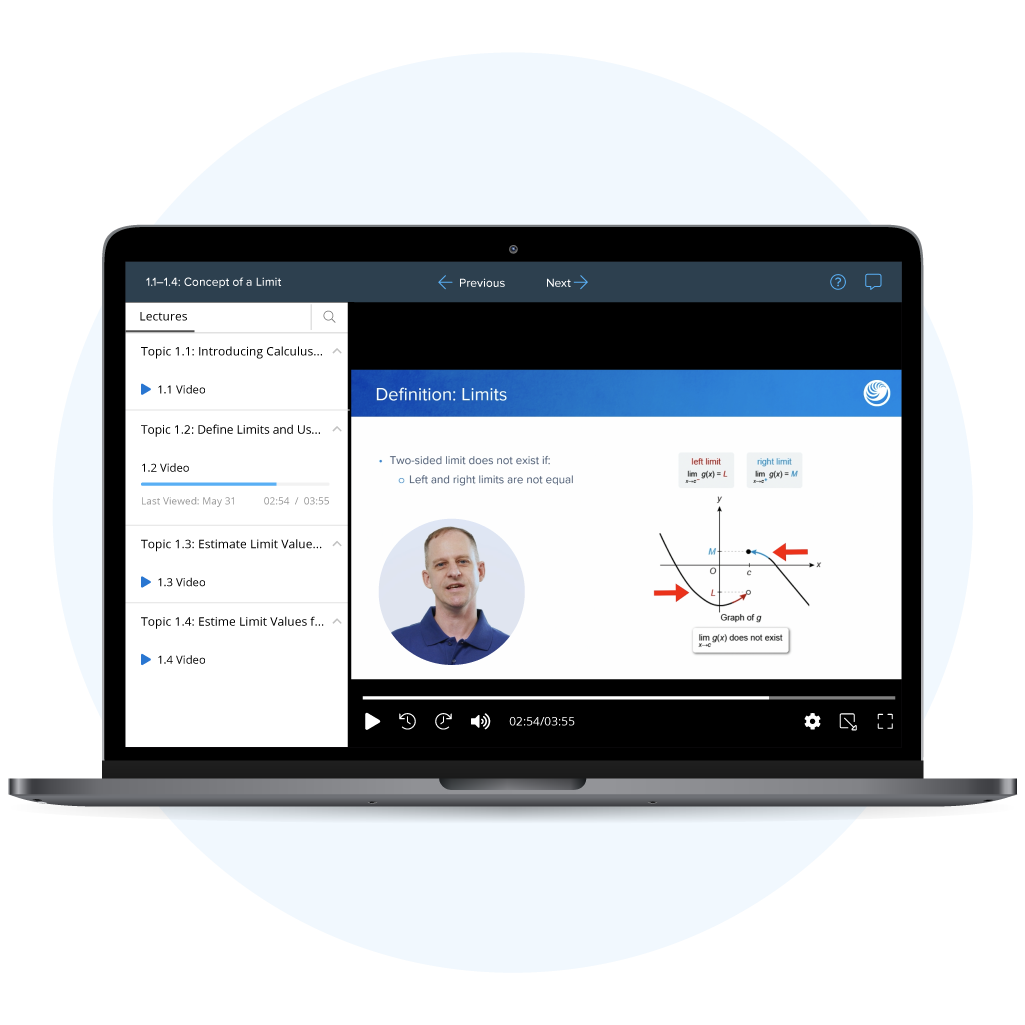
Learn tricky AP Calculus AB Unit 1 concepts like limits, continuity, and one-sided limits through clear, step-by-step videos. Each lesson connects theory to real AP Calc AB Unit 1 test questions, helping you visualize and retain core ideas. Strengthen your understanding with engaging explanations that make complex topics easier to master.
Interactive Study Guides
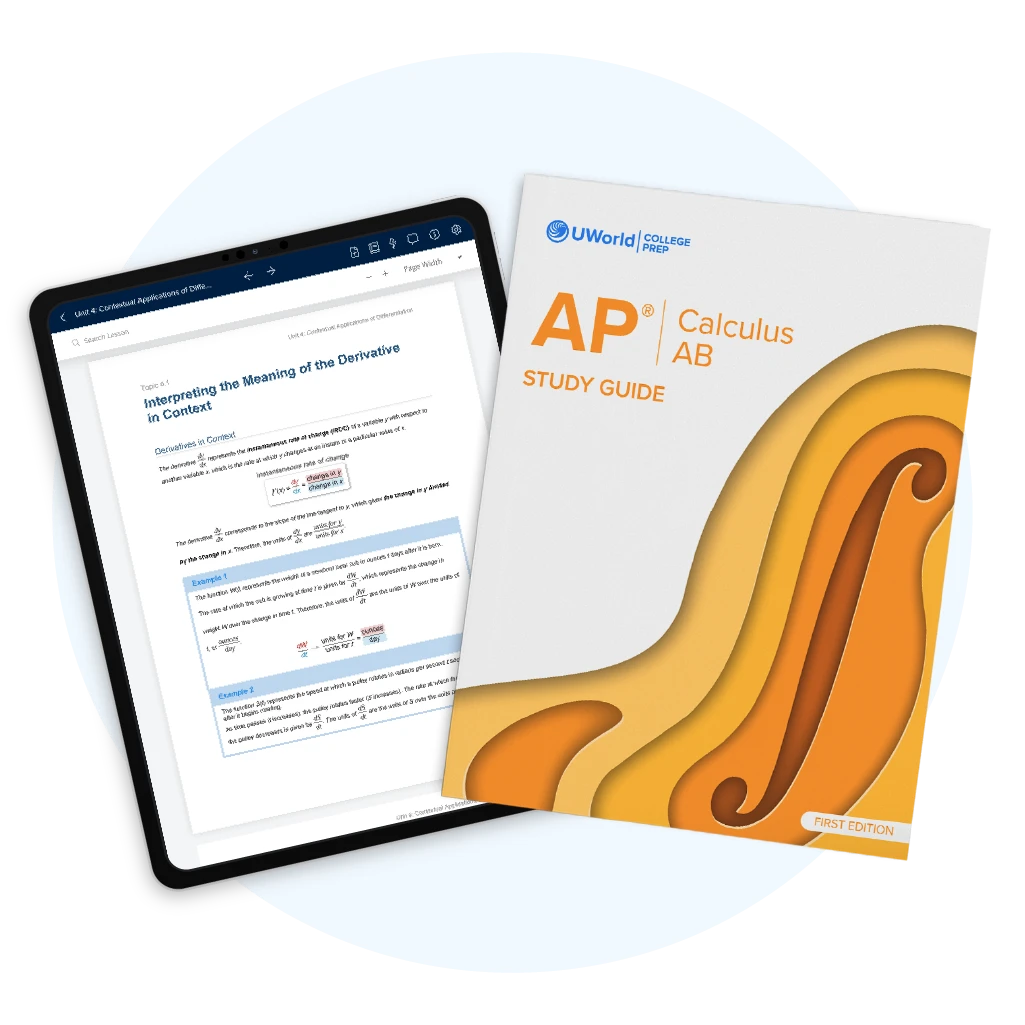
Explore AP Calculus AB Unit 1 study guides that simplify limits and continuity into clear, organized notes. Each section includes examples, visual aids, and AP Calc AB Unit 1 practice problems to reinforce learning. Use these interactive tools to review efficiently and prepare confidently for your next test.
Challenge Yourself with AP® Calculus AB Unit 1 Practice Questions
Question
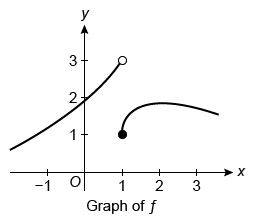
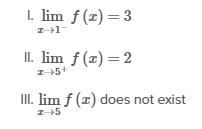
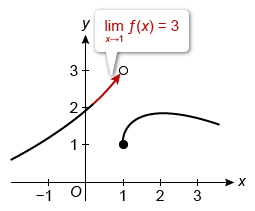
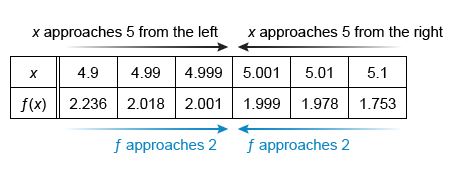
The function f is defined for all real values of x. The graph above shows the portion of the graph of f on [−1, 3], and the table above gives selected values of f near x = 5. Which of the following limit statements is likely to be true?
| A. I and II only | |
| B. I and III only | |
| C. II and III only | |
| D. I, II, and III |
Explanation
As x approaches 1 from the left, the graph of f approaches 3. Therefore, and Statement I is true.
As x approaches 5 from the right, the values of f in the given table get very close to 2. Therefore, and Statement II is true.
As x approaches 5 from the left, the values of f in the given table also get very close to 2. Both limits of f approach the same value as x approaches 5, so exists. Therefore, Statement III is false.
Question
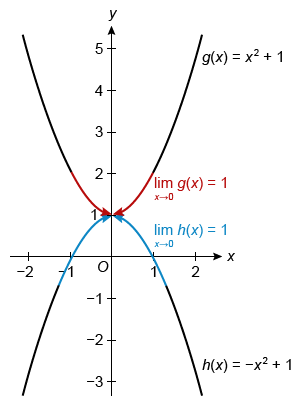
Let f, g, and h be functions such that g(x) ≤ f(x) ≤ h(x) for all values of x. Let g(x) = x2 + 1 and h(x) = −x2 + 1. At what value of x can the squeeze theorem be applied, and what is the limit of f as x approaches this value?
| A. The squeeze theorem can be applied at x = 0 for the given functions, and . | |
| B. The squeeze theorem can be applied at x = 0 for the given functions, and . | |
| C. The squeeze theorem can be applied at x = 1 for the given functions, and . | |
| D. The squeeze theorem cannot be applied to the given functions. |
Stand Out
with a Top Score in AP Calculus AB
Finish your AP Calculus AB Unit 1 review and continue mastering all units with UWorld. Boost your performance and make yourself a standout candidate for competitive colleges, majors, and scholarships by earning a top score.
Get our all-in-one course today!
- Focused AP Calc AB Videos
- Print & Digital Study Guide
- 1400+ Exam-style Practice Questions
- Customizable Quiz Generator
- Adjustable Study Planner
- Realistic Timed Test Simulation
- Colorful Visual Explanations
- Progress Dashboard
- Smart Flashcards & Digital Notebook
Hear From Our AP Students
UWorld’s service is pretty good and helps provide a lot of explanations on subjects I haven’t been confident on before.
The questions here are the most realistic to the AP tests I've seen so far! I appreciate the ability to customize tests as well.
The best part is that all options are well-explained, telling clearly why they are not the right option.

Frequently Asked Questions (FAQs)
What are the main topics covered in AP Calculus AB Unit 1: Limits and Continuity?
AP Calculus AB Unit 1 focuses on understanding how functions behave as inputs approach specific values or infinity. Here’s a quick overview of the key topics:
- How limits help us handle change at an instant: Learn how limits describe instantaneous change, forming the basis for derivatives.
- Definition and properties of limits in various representations: Understand limits through tables, graphs, and equations to see how values approach a point.
- Definitions of continuity of a function at a point and over a domain: Identify when a function is continuous and how to determine points of discontinuity.
- Asymptotes and limits at infinity: Explore how functions behave as inputs grow large, and determine horizontal and vertical asymptotes.
- Reasoning using the Squeeze Theorem and the Intermediate Value Theorem: Apply these theorems to estimate limits and prove the existence of values within intervals.
UWorld makes mastering these concepts easy through clear explanations, visual examples, and exam-style AP Calc AB Unit 1 practice questions that build strong problem-solving skills.
How should I prepare for an AP Calculus AB Unit 1 exam?
Preparing for your AP Calculus AB Unit 1: Limits and Continuity exam starts with building a strong understanding of fundamental concepts. Begin by reviewing your class notes and focusing on core ideas like evaluating limits, identifying points of discontinuity, and interpreting continuity on graphs and equations. Make sure you understand how to apply key theorems such as the Squeeze Theorem and Intermediate Value Theorem, since these often appear on both multiple-choice and free-response questions.
Once you’ve reviewed the content, shift your focus to practice. Solving AP-style questions is one of the best ways to test your comprehension and improve accuracy under timed conditions. UWorld’s AP Calculus AB Unit 1 practice questions are modeled after real exam problems and include detailed, step-by-step explanations for every solution, helping you understand not just what the correct answer is, but why.
You can also track your performance to identify weak areas and revisit related concepts through UWorld’s study guides and video lessons. Consistent practice with this combination of instruction, feedback, and self-assessment will help you retain key ideas, improve problem-solving speed, and feel confident heading into your AP Calc Unit 1 exam.
Are any free resources available for AP Calculus AB Unit 1?
Yes! There are several free resources available to help you review AP® Calculus AB Unit 1: Limits and Continuity. The College Board’s AP Classroom offers topic questions and Unit 1 progress checks (MCQ Part A and Part B) to help you understand what to expect on the exam. Khan Academy also provides free instructional videos and practice problems to strengthen your understanding of limits, continuity, and related theorems.
However, if you want a true exam-level experience, UWorld is your best study companion. UWorld’s AP Calculus AB Unit 1 practice tests are designed by experts to mirror the real exam’s format and difficulty. Each question includes detailed explanations, visual aids, and answer rationales to help you understand concepts thoroughly, not just memorize formulas.
You can even start with UWorld’s free trial to explore interactive practice questions, detailed solutions, and performance tracking before committing to the full version.
While free tools offer a quick review, UWorld’s free trial lets you experience the most realistic and effective AP Calculus AB prep designed to boost your confidence and improve your score
What types of questions are on the AP Calculus AB Unit 1 test?
The AP Calculus AB Unit 1 test includes both multiple-choice questions (MCQs) and free-response questions (FRQs) designed to test your understanding of limits and continuity in various contexts. You’ll encounter problems that ask you to:
- Evaluate limits numerically, graphically, and algebraically
- Determine points of discontinuity and explain whether a function is continuous
- Apply the Squeeze Theorem and Intermediate Value Theorem to justify reasoning
- Analyze functions involving asymptotes and limits at infinity
The MCQs often test conceptual understanding and quick application, while FRQs focus on clear mathematical reasoning and showing all steps.
UWorld’s AP Calculus AB Unit 1 practice tests mirror these exact question types, giving you realistic exam-style practice. Each question includes detailed explanations and visual breakdowns to help you understand the “why” behind each solution. By practicing with UWorld, you’ll strengthen both accuracy and confidence, ensuring you’re fully prepared for any question the AP exam presents.
How can I improve my score on the Free-Response Questions (FRQs) for Unit 1?
To improve your score on the AP Calculus AB Unit 1 Free-Response Questions (FRQs), focus on clarity, accuracy, and reasoning. FRQs assess not just your final answer but how well you communicate your mathematical thinking. Start by reviewing common Unit 1 topics—limits, continuity, asymptotes, and theorems like the Intermediate Value Theorem (IVT) as these frequently appear in open-ended problems.
Here’s how to strengthen your FRQ performance:
- Show every step clearly: Even if your final answer is off, partial credit is often awarded for correct reasoning and setup.
- Use correct mathematical notation: Proper symbols and terminology make your solutions easier to follow and score higher.
- Practice with real AP-style problems: UWorld offers AP Calculus AB Unit 1 FRQs that simulate exam conditions, complete with step-by-step solutions and scoring insights.
- Review feedback and patterns: UWorld’s explanations highlight where mistakes happen and how to avoid them on test day.
By regularly solving UWorld’s FRQs, you’ll develop confidence in structuring answers, improve time management, and maximize points on this challenging section of the exam.
What is the "Limits and Continuity" unit's weight on the AP Calculus AB exam?
The “Limits and Continuity” unit makes up about 10–12% of the AP Calculus AB exam. While this may seem like a small portion, it’s one of the most important sections because it forms the foundation for nearly every topic that follows, especially derivatives and integrals.
Mastering AP Calc AB Unit 1 helps you understand how functions behave, change, and approach specific values, which is essential for success in later units. UWorld’s AP Calculus AB Unit 1 practice questions are designed to strengthen these core concepts through realistic problem sets, visual explanations, and instant feedback.
By consistently reviewing limits, continuity, and theorems like the Intermediate Value Theorem, you’ll not only secure points from this 10–12% but also build the confidence and understanding needed to excel throughout the rest of your AP Calculus AB course.
Where can I find a good study guide for AP Calculus AB Unit 1?
A great study guide for AP Calculus AB Unit 1: Limits and Continuity should include clear explanations, worked examples, and practice problems that match the AP exam format. While you can find summaries online or in textbooks, UWorld offers one of the most comprehensive and interactive study experiences.
UWorld’s AP Calculus AB Unit 1 study guide simplifies tough concepts like limits, continuity, and asymptotes through visual aids and concise explanations. Each topic is paired with AP-style questions and step-by-step solutions to reinforce learning and build problem-solving confidence. The guide also integrates review notes and progress check-style practice to mirror real exam conditions.
Unlike static notes or PDFs, UWorld’s study materials are dynamic and adaptive, helping you focus on weaker areas and retain key concepts longer. Whether you’re reviewing for a quiz or preparing for the AP exam, UWorld provides everything you need to study efficiently and confidently.
Can I find practice tests specifically for AP Calc AB Unit 1?
Yes, you can easily find practice tests that focus specifically on AP Calculus AB Unit 1: Limits and Continuity. Targeted practice helps you master early concepts before moving on to advanced topics.
- UWorld’s AP Calculus AB Question Bank lets you filter and attempt Unit 1-specific quizzes. You’ll get realistic multiple-choice and free-response questions modeled after the actual AP exam.
- Each question includes step-by-step explanations and visual aids, making it easier to understand challenging topics like limits from graphs, continuity, and the Squeeze Theorem.
- You can also adjust difficulty levels, time yourself, and track progress to measure improvement over time.
Practicing with UWorld builds familiarity with real exam patterns and helps you identify weak areas early. It’s a smart, efficient way to strengthen your Unit 1 foundation and move into the rest of the course with confidence.
Learn More About Specific Unit
Differentiation: Definition and Fundamental Properties
Differentiation: Composite, Implicit, and Inverse Functions
Contextual Applications of Differentiation
Analytical Applications of Differentiation
Integration and Accumulation of Change
Differential Equations
Applications of Integration